According to Scripture

A simple comparison of Mark’s and Matthew’s gospels is enough to demonstrate that the gospel writers invented their stories of Jesus. I’m going to take only a few examples over the next few posts, but the same analysis could be made of any of the episodes in the two gospels and yield the same results.

Mark starts his story with Jesus’ baptism and subsequent 40 days in the wilderness. The dominant motifs of both episodes are intended to alert the reader to the fact that Mark sees Jesus as the new Moses, preparing to lead his people out of bondage and into the Kingdom that God is preparing for them. The parting seas of Exodus 14 become the parting clouds through which God proclaims Jesus his Son, the 40 year trek through the wilderness (Exodus 16 etc) is replaced with Jesus’ 40 days in the wilderness. 

Mark gives the wilderness episode a mere two sentences (Mark 1.12-13) which isn’t enough for Matthew. He embellishes it in his gospel, making it a full-blown fantasy, complete with a lengthy conversation between Jesus and Satan. Matthew invented this story. We know he did because:

it cannot possibly have come from an eye-witness (because there wasn’t one);

It is patently fantasy material, with Satan, ministering angels and teleportation;

it cannot have derived from any oral tradition (as it is an embellishment of Mark’s tale, invented only a decade earlier, designed to echo the Moses story);

It is designed specifically to extend the analogy with the Moses. In Matthew, Jesus encounters the same temptations as the ancient Israelites in their wilderness trip, but, unlike his forebears, Jesus triumphantly resists them. He then recruits 12 disciples to go on ahead of him (Mark 3:13-15) just as Moses’ appointed 12 spies for the same purpose (Numbers 13). 

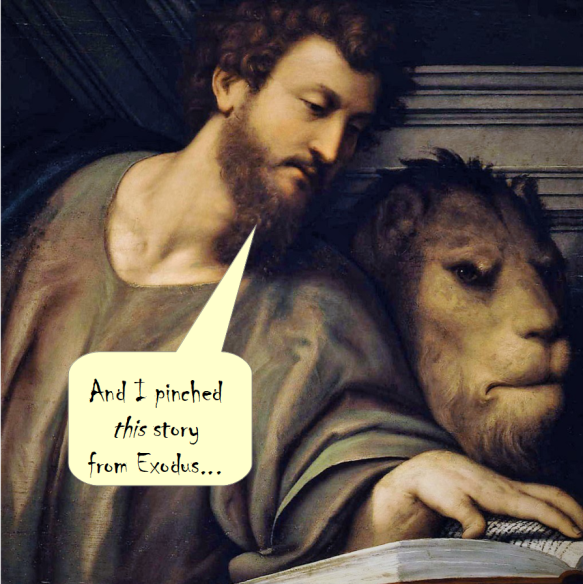
Matthew has even more up his sleeve. He is fully aware of the parallels Mark has made between Jesus and Moses and adds a third to the beginning of his Jesus narrative. In his contrived nativity story, he rewrites the story from Exodus 1 and 2, itself a complete fabrication, in which Pharaoh orders the elimination of all Israelite baby boys. He lifts it directly into the so-called Massacre of the Innocents episode in his gospel.

Again, we know Matthew made this up:

Herod did not order any such massacre. It is not an historical event.

Matthew was determined to find incidents in Jewish scripture he could claim were really about Jesus. Here he is at it.

He is determinedly extending Mark’s metaphor; this is not material from any other source or tradition.

He constructs the narrative using additional ‘prophecies’ he finds in the scriptures. For example, the trip to Bethlehem and the flight to Egypt, neither of which happened (no other gospel writers knows of them.) The Egypt episode is an imaginative (and dishonest) expansion of Hosea 11:1: ‘Out of Egypt I called my son’. In context, the verse refers to the Jewish nation not a future Messiah. And who led the Israelites out of Egypt? Moses.

The nativity story and the Moses/Israelite parallels in the Egypt/baptism/wilderness episodes in Matthew are not drawn from tales of Jesus that were doing the rounds. They are clever, contrived literary creations. They tell us too that Matthew did not regard Mark’s more basic stories as history or biography. He evidently did not view them as immutable. He changes and adds to them to make his own points, ‘correct’ Mark, extend his analogies and emphasise that which he thinks Mark hasn’t emphasised enough. Throughout his gospel he’s prepared to create new incidents, even when they conflict with points Mark makes. He knows that Mark’s work, like his own, constitutes carefully devised stories and he feels free – compelled – to improve them. You can’t treat history this way but you can rewrite fiction.

Stories about Jesus

Our resident Christian implied recently that I disputed that stories about Jesus existed prior to the gospels being written. I don’t – this was another of Don’s straw man arguments – and told him that of course there were earlier stories about Jesus. But then I got to thinking: where exactly are those stories? How do we know they existed? How can we distinguish them from later embellishments?

Let’s take a look at the evidence*, starting with the earliest Christian writing that we have:

Paul

Paul doesn’t refer to a single event from Jesus’ life outside a barebone account of the crucifixion and resurrection. He doesn’t mention, for example, the nativity, the virgin birth, Jesus’ time in the wilderness, his chat with the devil, his baptism, John the Baptist, the miracles, the amazing things Jesus is reputed to have said, the parables, the Sermon on the Mount and Beatitudes, the I Am sayings, the healings, Lazarus, the arrival in Jerusalem, the cleansing of the Temple, the agony in the Garden of Gethsemane, the arrest, Judas, Pontius Pilate, Jesus’ trial, the mockery of the soldiers, Peter’s denial, the words Jesus spoke on the cross, Joseph of Arimathea, the rolled away stone, the empty tomb, Mary Magdalene, Doubting Thomas or the physical Ascension. Neither does he refer to any incidents or episodes from stories that didn’t eventually make it into the gospels. Not one of them. (He does create a narrative of his own that later finds its way there: the ritual of sharing bread and wine which Paul lifts from Pagan ceremonies. We’ll return to it in a later post.)

Apologists like to say that these serious omissions are no more than Paul’s assumption that his readers would already know the stories about Jesus.  He does not need to reiterate them. But no-one is suggesting he should or would have recounted them in full. What is odd and awkward is that Paul doesn’t even allude to them in his teaching. He could clinch many an argument by referring to a particular saying or miracle of Jesus’, but he never does.

When talking about obeying the (Roman) authorities, for example, in 1 Corinthians 15:12 &13, he could have said, ‘Recall that the Lord told us we should render unto Caesar that which is Caesar’s,’ but he doesn’t. He could have alluded to Thomas when explaining the importance of having faith without evidence; talked about the empty tomb when discussing Jesus’ resurrection; mentioned the raising of Lazarus as an example of the dead being resurrected; commented on Jesus turning water into wine when arguing that the Law had been superseded by a new covenant. He might even have quoted something Jesus said from a story in circulation that didn’t later end up in one of the gospels.

He doesn’t. Ever.

Paul claims he received none of his information about Jesus from any human being. He insists he received all he knew through revelation – the Lord speaking to him from heaven. Apparently, the Lord neglected to convey any of the details of his life on Earth. The apostles kept equally schtum. Paul was no more knowledgeable about the life of Jesus once he’d he met them than he had been before. Was he not inquisitive? Did he not ask the right questions? Did they dislike him so much they withheld every detail of Jesus’ activities on Earth? Did they not in fact have that kind of information? Whichever it was, Paul seems not have known any of the stories about Jesus that predated the gospels or even that later appeared in them. It’s possible, I would say likely, he did not know of them because they had yet to be created. Many of the stories about Jesus were ten or more years away.

But we mustn’t jump to conclusions. Next time we’ll take a look at other possible sources of these elusive stories.


*I read Bart Ehrman’s Jesus Before The Gospels a few years back. I hope I’m not merely reiterating what he says there. While there were some points I found less persuasive than others, Ehrman nevertheless does a good job of showing how stories about Jesus changed and evolved over the years.

The Evolution of Jesus II: from Life Giving Spirit to God the Son and beyond.

A couple of decades after the first visions of a risen Jesus, a Jewish zealot called Saul decided he’d seen him too. He came to imagine a vision he’d had in his head was this same Jesus, who then revealed to Saul – all entirely within his head as he admits – what his death and return from the dead really meant. Paul, as he renamed himself, announced that God had decided Jesus was a good man and returned him to life after his execution. In doing so, God made Jesus his Son (you can read all this poppycock in Romans 1:3-4). Jesus was now a life-giving spirit, the Saviour Christ: 1 Corinthians 15:45. (Maybe though Jesus always had been this; it’s kind of confusing, but in Philippians 2:6-8 Paul seems to think Jesus was some sort of quasi-divine being from the get-go. Take your pick. Whatever.)

Memetic selection ensured the survival and perpetuation of Paul’s bizarre idea, one that was, after all, not unfamiliar to the Hellenised people of the first century. The superstitious embraced and transmitted it without knowing a thing about any itinerant Jewish preacher. 

The next stage of Jesus’ evolution came twenty or so years later, when a believer we now know as Mark decided to write a back story for this Christ. He created his story using Jewish scripture, Paul’s ideas and the rules of the sect to which he belonged. Who knows if Mark believed Jesus had ever been a real person who trudged around Palestine preaching the good news about the end of everything, but in Mark’s story he had him do just that. He decided, crucially, that he wouldn’t have Jesus become God’s adopted son at the time of his spiritual resurrection. Instead, Mark had him become God’s son at his baptism (Mark 1.10-11).

This wasn’t quite good enough for the next two cultists who attempted a Jesus narrative. While they plagiarised much of Mark’s story, they changed details and made up more for Jesus to say and do. Importantly, where Mark had avoided suggesting Jesus’ resurrection appearances had occurred in the real world, Matthew and Luke showed no such reticence. Their Jesus(es) showed himself not in visions but in the flesh. It’s likely Matthew at least knew he was creating a symbolic, literary representation of others’ visions.

At the other end of the story, Matthew and Luke invented largely incompatible birth stories for their hero. For Matthew, Jesus was the Messiah from the time he was born, fulfilling all the prophecies Matthew borrowed to create his nativity story (he doesn’t: the Messiah, according to the very ‘prophecies’ Matthew manipulates is not divine but a human warrior).

Luke, on the other hand, is determined to push Jesus’ divinity even back further. For Luke, Jesus became divine when God magically made Mary pregnant; Luke’s Jesus is quite literally God’s son (Luke 1.35). Unfortunately, Mary forgot all about being impregnated by the Holy Semen Spirit later on in Luke’s ridiculous story. Nevertheless, Jesus’ status had evolved again; he’d become God’s son from the very moment of conception.

Even this was not good enough for the next version of the Jesus’ story. The writers of the fourth gospel decide to make him eternal and part of God himself. Plundering Greek philosophy and Paul’s ruminations from Philippians, they declare Jesus the ‘Logos’; the Word or aspect of God responsible for the creation of everything (John 1:1-5). And despite this being as far from an itinerant peasant preacher as it’s possible to be, even more gullible folk came to believe it.

Jesus’ evolution was still not complete, however. The council of Nicaea in 325 decided that Jesus was ‘begotten not made’ (whatever that means) – but couldn’t quite decide whether being the Logos and the Son of God actually made Jesus God Incarnate. It wasn’t until the Council of Constantinople in 381 that a collection of bishops decided Jesus was, after all, officially part of the Godhead. The apocalyptic preacher from the backwoods finally became God the Son, a mere 350 years after he lived (if indeed he did).

Jesus has continued to evolve ever since, becoming all things to all people; a God pliable enough to be whatever his followers want him to be: Roman Catholic, Greek Orthodox, Russian Orthodox, Evangelical, Mormon, fringe cult. He’s evolved into a schizophrenic deity capable of being both meek and mild and bellicose; best buddy and chief executioner; Christian Nationalist, socialist and capitalist, gay and anti-gay, pro-family and anti-family; anti-abortion and pro-gun; environmentalist and iconoclast; the one who promotes a prosperity gospel and the ‘One True God’ known (only) to a select few. Every contradictory manifestation is supported by the Bible, the Church or tradition. Every one is non-existent and ultimately pointless.

That’s some evolution.

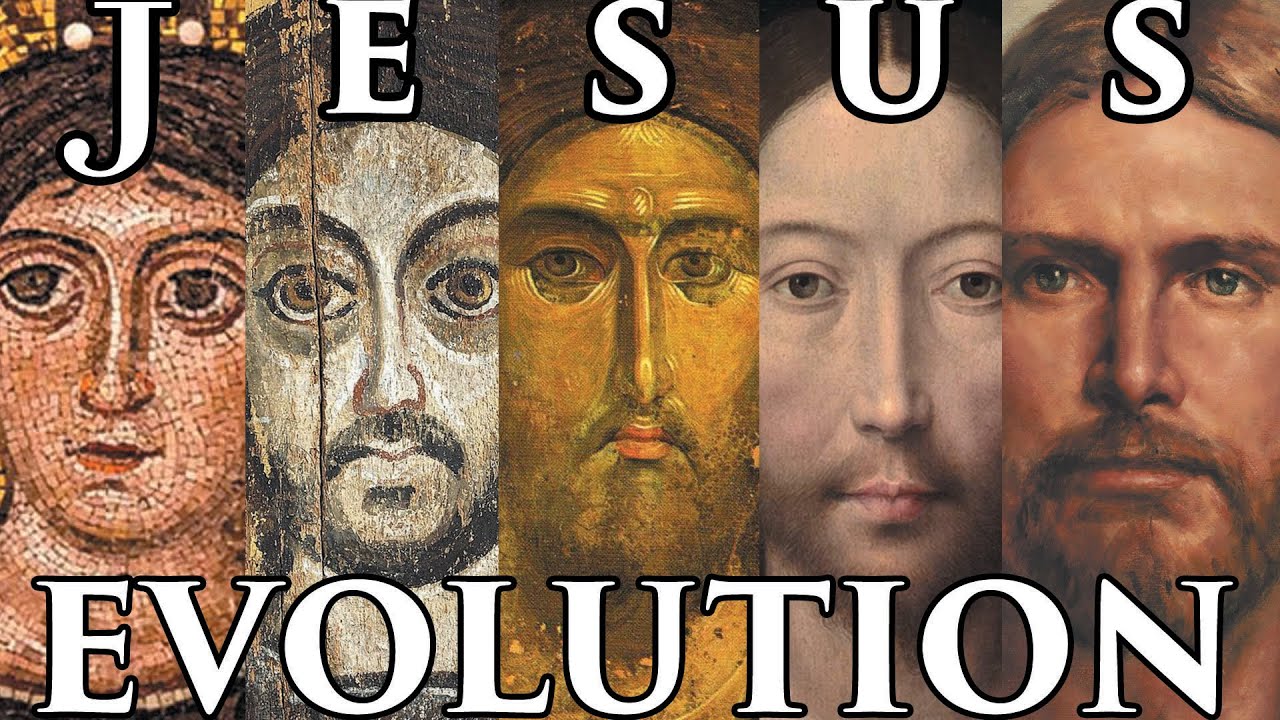
The Evolution of Jesus I: from Itinerant Preacher to Death-Defying Vision

Image by Doppler, from YouTube video The Evolution of Jesus Christ.


Everything evolves. Not just Life, but the Mind, Personality, Morality and Culture. This is the thesis of Matt Ridley’s book, The Evolution of Everything: How Small Changes Transform Our World, in which he demonstrates that everything, from the Economy and Technology to Government and Education, were originally, and to some extent remain, bottom up phenomenon. Each emerged because of the developments that had preceded them; for this reason, they couldn’t arrive before they did, but their arrival, when it came, was inevitable. The time was right. Once each did arrive, it embarked on an inexorable process of change. It evolved.

‘Everything’, of course, includes Religion. As Ridley says (p259):

Further evidence for the man-made nature of gods comes from their evolutionary history. It is a little-known fact, but gods evolve. There is a steady and gradual transformation through human history not only from polytheism to monotheism, but from gods who are touchy, foolish, randy and greedy people, who just happen to be immortal, to disembodied and virtuous spirits living in an entirely different realm and concerned mainly with virtue. Contrast the vengeful and irritable Jehovah of the Old Testament with the loving Christian God of today.’

This is undoubtedly the case (Ridley presents his evidence); religion is an entirely human enterprise that developed from the bottom up. It too evolved. As Ridley shows, there is no other way.

While Ridley doesn’t discuss it, this evolutionary process applies to Jesus too. This seems to me apparent, rather than a little-known fact. He didn’t spring from nowhere; the time was right for him. By the start of what is now the first century, an apocalyptic brand of Judaism had emerged, inspired in part by the book of Daniel and other late Old Testament prophecy. It was whipped to fever pitch during the Roman occupation. People were anticipating that the Messiah would soon rescue them by force; the time was right for him to appear. And appear he did, in multiple forms, all of them eliminated by the Romans. Jesus was one of these.

He began either as an itinerant preacher with delusions of grandeur or he was an imaginary being whom a few people thought miraculously appeared to them. It doesn’t matter which; even if he existed, he very quickly evolved into a supernatural being. As an itinerant preacher he would have wandered around a small part of Palestine with a handful of followers, mouthing platitudes and predicting that God’s Kingdom would soon be arriving, and that he would be its king. Instead, he was executed for insurgency. Shortly afterwards, a couple of his followers swore they’d seen him alive again. With this claim Jesus made an evolutionary leap, from troublesome Jewish preacher to death-defying vision.

His evolution was underway.

To be continued…

If It Walks Like A Duck…

Psychology Today has this to say about cults:

Destructive individuals and cults use deception and undue influence to make people dependent and obedient. A group should not be considered a cult merely because of its unorthodox beliefs. It is typically authoritarian, headed by a person or group of people with near complete control of followers. Cult influence is designed to disrupt a person’s authentic identity and replace it with a new identity.

Let’s break this down a little:

Destructive individuals: But those enemies of mine who did not want me to be king over them – bring them here and kill them in front of me (Luke 19.27).

Do not suppose that I have come to bring peace to the earth. I did not come to bring peace, but a sword (Matthew 10:34).

He said to them, ‘But now, the one who has a purse must take it, and likewise a bag. And the one who has no sword must sell his cloak and buy one. For I tell you, this scripture must be fulfilled in me, “And he was counted among the lawless”; and indeed what is written about me is being fulfilled.’ They said, ‘Lord, look, here are two swords.’ He replied, ‘It is enough’ (Luke 22: 36-38). [This is evidently a fictitious episode created around a supposed prophecy (Isaiah 53:12).]

Use deception: The time has come. The kingdom of God has come near. Repent and believe the good news! (Mark 1:14-15). Therefore I tell you, whatever you ask in prayer, believe that you have received it, and it will be yours (Mark 11.24).

Undue influence: Any one of you who does not renounce all that he has cannot be my disciple (Luke 14.33). No one who puts his hand to the plough and looks back is fit for the kingdom of God. (Luke 9.62).

To make people dependent: If anyone comes to me and does not hate his own father and mother and wife and children and brothers and sisters, yes, and even his own life, he cannot be my disciple (Luke 14.26).

…and obedient: If you love me, keep my commands (John 14:15). Whoever serves me must follow me; and where I am, my servant also will be. My Father will honour the one who serves me (John 12.26).

Typically authoritarian… with near complete control: You are my friends if you do what I command you (John 15.14).

Not everyone who says to me, ‘Lord, Lord,’ will enter the kingdom of heaven, but the one who does the will of my Father who is in heaven. On that day many will say to me, ‘Lord, Lord, did we not prophesy in your name, and cast out demons in your name, and do many mighty works in your name?’ And then will I declare to them, ‘I never knew you; depart from me, you workers of lawlessness’ (Matthew 7.21)

Disrupts a person’s true identity: If anyone wants to come after me, let him deny himself, and take up his cross, and follow me. For whoever wants to save his life will lose it. But whoever loses his life for my sake will find it. (Luke 9.23). 

And replaces it with a new identity: Truly I tell you, unless you change and become like little children, you will never enter the kingdom of heaven (Matthew 18.13).

(John said,)He must become greater; I must become less’ (John 3.30).

It is not the healthy who need a doctor, but the sick. I have not come to call the righteous, but sinners to repentance (Luke 5: 31-32).

Whether Jesus said these things or they were put into his mouth by his early followers, it is still the case that if it looks like a cult, talks like a cult and behaves like a cult… it’s a cult.

As it was in the beginning, now and ever shall be.

Just Like Jesus

Some parts of this post have appeared before.

Early in the first letter of John, we read,

By this we know that we have come to know Him, if we keep His commandments. The one who says, “I have come to know Him,” and does not keep His commandments, is a liar, and the truth is not in him; but whoever keeps His word, in him the love of God has truly been perfected. By this we know that we are in Him: the one who says he abides in Him ought himself to walk in the same manner as He walked. (1 John 2: 3-6)

Isn’t that interesting? John, whoever he was, says that Christians can know they’re saved because they keep Jesus’ commands and ‘walk’ as he walked. Likewise, others should be able to see these traits too because, as Jesus is (later) made to say, cult members can be recognised by their ‘fruits’ (Matthew 7:16).

Just what are Jesus’ commands that converts can’t help but demonstrate? Here’s a few:

  • Cutting themselves off from family – hating their parents, in fact – just to follow him (Luke 14.26);
  • Deny everything about themselves (Matthew 16.24-27);
  • Forsaking home, job, wealth, status, credibility and comfort to help bring about God’s Kingdom on Earth (Mark 10.29-31 etc);
  • Slaving tirelessly in the service of others (Mark 10.43-44; Matthew 23.11 etc);
  • Selling their possessions so that they can give the proceeds to the poor (Matthew 19.21; Luke 14.33);
  • Turning the other cheek, repeatedly going the extra mile and giving away the shirt and coat from off their backs– if they’ve still got them after giving everything away – (Matthew 5.38-40);
  • Welcoming the stranger, feeding the hungry, clothing the naked and visiting those in prison (Matthew 25.35-40);
  • Forgiving again and again and again (Matthew 18.21-22);
  • Avoiding judging others so that they won’t  be judged in turn (Matthew 7.1-3);
  • Loving their enemies (Matthew 5.44);
  • Regarding persecution and injustices as blessings (Matthew 5.11);
  • Doing miracles even more impressive than Jesus’ own (Mark 16.17-18; John 14.12);
  • Healing the sick, raising the dead and casting out demons (Matthew 10.7-8);
  • Asking for anything in prayer, which will be given to them (Mark 11.24; Matthew 21.22);
  • Telling others that the world is about to end (in the first century) and that only Jesus can save them from God’s wrath (Matthew 28.29-34; Matthew 28.16-20).

How many of these things do we see Christians doing? How many of these commandments are Christians compelled to ‘keep’, as letter writer John puts it? Some, it’s true, make attempts with the last (if only they wouldn’t) and a very limited few have a go at a couple of the others. But as far as most Christians are concerned, these commandments may as well not exist. They don’t see Jesus’ instructions as applying to them. I know from experience that they have ready made excuses for not obeying them, let alone feeling an inner compulsion to realise them in their own lives.

Their excuses necessitate them reinterpreting Jesus’ words. They’re metaphorical, they say. ‘He didn’t really mean give everything away because where would that leave us?’ – or they insist his commands have been taken out of context, or have only a spiritual meaning

Which is to say, nothing Jesus said is to be taken literally, even though the most straight forward reading of his pronouncements is that this is how he meant them. It’s how his early followers, the people who preserved or created his words in the gospels, understood them. Why record them otherwise?

But Jesus’ moralising is inconvenient, impractical, exacting, extreme; ridiculous, in fact, and Christians know this. Still his commands must be dealt with somehow. So the Righteous™ work round them or ignore them completely, replacing his priorities with ones of their own: worshipping him; defending his reputation; striving for power; complaining about secular society; whining about the media;  promoting aggression; acquiring wealth (there should be no such thing as a millionaire Christian); claiming persecution; equating faith with guns; trying to control others’ behaviour; interfering in their sex lives; suppressing LGBT people; arguing that religious rights trump those of minorities; opposing abortion.

None of these figured in Jesus’ agenda. Some are even in direct opposition to what he’s made to say in the gospels.

When we see Christians doing the things Jesus tells them they should be doing – what God’s love perfected in them compels them to do – maybe then we’ll listen to what they have to say. When they demonstrate credibility rather than hypocrisy, maybe they’ll have earned the right to be heard. But as there’s not much chance of that happening any time soon, it’s way past time we ignored them, and their superstition, in much the same way they ignore their Lord and Savior™.

A Christian Writes

A Christian commenter writes –

…there is only one issue of primary importantance. That is is Jesus the Son of Man and the Son of God and my/your Savior. If so, every other issue pales.

Neil, you and many other atheists seem to think Christianity is broken up into a multitude of pieces that do not agree and do not get along because of disagreements on doctrine and practice. That is actually untrue. When it gets right down to it, only the one issue is important. And that means there are billions of Christians in fellowship. That is the church.

If you missed that in your time as a Christian, I wonder if you really were or whether you were merely religious. Now, among the religious there are significant differences and divisions. Religious Roman Catholics disagree with religious Baptists, and Pentecostals with Greek Orthodox and so on. But that is religion. Christians in all those denominations agree and can have wonderful fellowship when it is about Jesus.

And I respond –

This is nothing more than the No True Scotsman fallacy: ‘those who don’t practise Christianity in the way I (or my sect/church) approves of are not true Christians; they’re merely ‘religious’.’ Having thus discounted those who ‘disprove’ the rule, the rule now gives every impression of working. Brilliant!

You assert that ‘only one issue is important… is Jesus… my/your Savior?’ No, he’s not. He’s nobody’s. Just because Paul and those who came after him decided he was doesn’t mean he is. He’s long gone. Dead. Even so, he doesn’t claim in the synoptic gospels that he came to be anyone’s personal Savior. For synoptic Jesus the only thing of ‘importantance’ was working towards the Kingdom of God on Earth. ‘Seek ye first the Kingdom of Heaven, and his righteousness, and all these other things shall be added unto you.’ For some in the early church, the ‘only issue of importance’ was obeying Jesus’ commands, including, presumably, seeking first the Kingdom on Earth (1 John 2:3-6).

The evidence shows, however, that Christians have never managed to do this (not even after discounting those they disagree with). Just look at Paul’s first letter to the Corinthians. The church has been an unholy mess since the very beginning. It continues to be to this day: take a look at Christian Research Network, which denounces fellow Jesus-lovers on a daily basis.

You delude yourself if you think the ‘true’ church, then as now, is in complete harmony, enjoying blissful love-ins with Jesus while everything else, differences in doctrine and practice included, conveniently fade away. But then, you’ve already bought into one of the most perfidious delusions ever foisted on human beings so I don’t suppose another one matters all that much.


Ring-a-ding-ding

Don has responded to my challenge that I set him in the last post. His full response is in the comments section but I’m going to address what he says here:

It is not the fine points of doctrine but the essential points of doctrine that John is talking about…

Really, Don? Where does John say this? Certainly not in the following verse which you cite. Be honest, you just made it up.

This issue rose when you proposed that the Book of Mormon could just as easily by received as scripture as the Bible.

Well, not quite. I asked you why you are not a Mormon, given that the Book of Mormon has, superficially at least, as much credibility as the Bible, perhaps more, given its supposed origin and the eye-witnesses who affirmed its creation. (I’m not a believer in its baloney, just as I’m not in the Bible’s.)   

When I read BoM I do not find a Jesus that is like the Jesus of the Bible. That is sufficient to reject it. I don’t have to worry about baptisms or temples or anything else. If Jesus in the BoM is not the Jesus of the Bible, nothing else matters.

The same is true of the Ken Hams, Douglas Wilsons, and Dillon Awes and Neil Robinsons. If they proclaim a Jesus who is not the Jesus of the Bible, what they have to say about creation, women, homosexuality, or the return of the Lord makes no difference. If they agree with the Bible about Jesus, then we might get down to using out God-given ability to read and interpret. And we might differ. And that won’t matter. Wherever we land on these issues, they are far less important than who Jesus is.

And here we hit some real problems.

You fudge around the issue of whether you agree with the preachers and teachers I quoted, eventually implying that you don’t. (Don’t you get tired of being the only one in step, Don?) You insist that interpretations of Bible verses and the claims Christians make must always be measured against Jesus. But which Jesus is this, Don? The one in your imagination: the meek and mild Mr. Nice Guy that you’ve constructed in your head from a lifetime of conditioning and cherry-picking the Bible? Because if we compare the Jesus in the gospels and the version of him that supposedly inspired Paul and the other NT writers, we find the prattling and general ignorance of Awes, Ham and Wilson matches up perfectly.

For example, Jesus – the man who reputedly said ‘love your enemies’ – tells us what he’d like to do to his own enemies:

But as for these enemies of mine, who did not want me to reign over them, bring them here and slaughter them before me. (Luke 19.27)

And according to Revelation 9, he’ll do just this when he returns with his sword in his mouth. He will unleash plagues of locusts to torment and torture non-believers. However,

(those) not killed by these plagues still did not repent of the work of their hands; they did not stop worshiping demons, and idols of gold, silver, bronze, stone and wood—idols that cannot see or hear or walk. Nor did they repent of their murders, their magic arts, their sexual immorality or their thefts.

Later, while the Son of Man watches on, these poor souls get trampled to death:

The angel swung his sickle on the earth, gathered its grapes and threw them into the great winepress of God’s wrath.  They were trampled in the winepress outside the city, and blood flowed out of the press, rising as high as the horses’ bridles for a distance of 1,600 stadia. (Revelation 14.19-20)

Not hard to see how Ames can justify what he’d like to see done to LGBT+ people, is it. Murderous-Jesus endorses him.

(I know Don, these are among ‘the fine points of doctrine’ your anointed lie-detector doesn’t work on, so you ignore them. Alas, crackpots like Awes do not.)

What about Ham’s contention that dinosaurs and humans co-existed? He’s made a career, not to mention an ark, out of believing such crap. Does your cuddly-Jesus endorse him? Why, yes, he does. He believed in a literal Adam and Eve and a six day creation (Mark 10.6). If he’d have known about dinosaurs, which of course he didn’t, he would have had to fit them into this scenario, just like Ham does.

And how about Jesus’ views of women? While he side-lines them in his pronouncements about divorce (also Mark 10) he consistently ‘reveals’ to Paul and other NT writers that women must submit in all things. The word and its derivatives occur in almost all the passages that discuss women – ‘submit’ and ‘submission’. Easy to see how Wilson believes this applies to sex as well as every other context. Unless of course the Jesus in your head has told you differently. 

So there we have it. Any extremist, despicable view can be justified by appeal to Jesus. To say these differences don’t matter because only Jesus matters is laughably disingenuous. Jesus supports any and all claims made in his name. To paraphrase Paul, he is all things to all men. 

As for me, I’m always careful when discussing Jesus to quote the gospels, as I do above, and where relevant other parts of NT. I realise you don’t like this, because I don’t have your imaginary supernatural radar, but I’m happy to show Jesus in his true light and use his own words to condemn him.


Don’s Dynamic Lie-Detector

But you have an anointing from the Holy One, and all of you know the truth. I do not write to you because you do not know the truth, but because you do know it and because no lie comes from the truth.

1 John 2:20-21 as quoted by Don Camp.

Our resident, regularly banned God-botherer, Don Camp, claims that he has a special way of reading and interpreting spiritual writing. No, he hasn’t got a pair of magic rocks, but an inner ‘anointing’ with what Don calls his ‘lie-detector’. (You might have a similar device yourself, known more commonly as a bull-shit detector. Its alarm may well have been a-ring-a-ding-dinging when you read Don’s comment.)

Anointing, if you’re interested, is the ancient Jewish custom of initiating a king or priest by daubing oil on their head. Don has no evidence that he has been inwardly ‘anointed’ by an unseen spirit that helps him understand scripture better than anyone else. There is no evidence, outside of subjective feelings and one tautological bible verse, that any religious believer has had this done to them. (Read 1 John 2.20-21 again, Don, and you’ll see that a tautology is what it is: ‘the truth is the truth is the truth,’ is really all it says.)

On the contrary, we find that different Christians interpret given scriptures in a variety of different ways (I’ll get to examples in a minute). They differ too on which bits of the Bible are relevant to them and their church or sect. They disregard or explain away verses that don’t suit their purposes.

Don does this himself. His anointing Spirit doesn’t lead him to interpret verses like Matthew 16:27-28; 24:27, 30-31 & 34, Romans 13, 11 & 12, 1 Peter 4:7, 1 John 2:18, Revelation 22.20 etc at face value. He cannot countenance the fact that Jesus, Paul, John and all those other early fanatics were wrong about when the end of the age would happen – they are all very clear they thought it was imminent – so he reinterprets what they say to mean something they clearly and unequivocally do not. Don’s interpretation has them meaning, despite what they say, that the end of the age and all that goes with it would be thousands of years in their future. Should you challenge him on this, Don tells you that how you see it is wrong because you don’t have the special anointing he has. As he puts it in his comment, you’re lacking the right ‘dynamic’ (ring-a-ding-ding!) and as a result, you are incapable of interpreting scripture in the right way (i.e. his way).

In fact, Don does not have a way of understanding scripture that he can call his own. Rather, he interprets it with preconceptions he’s acquired elsewhere; that it is God’s Word, that it is Truth, that the spiritual world it describes is real, that it relates an historical resurrection, and so on. He comes to it with these presuppositions that he has learnt from preachers, teachers, commentaries, devotional books and other Christian propaganda he’s been exposed to. He is completely unable to take a step back to look at what he’s reading objectively. He knows what it says before he reads it – ‘truth’ as far as the Bible is concerned, ‘lies’ when it’s the Book of Mormon – and imposes that meaning onto it. This ‘dynamic’ enables him too to smooth over all of the Bible inconsistencies and allows him to see it as one seamless garment when it evidentially is not. He’s not alone in doing this, of course. Most evangelical (‘anointed’) Christians do it. I know I did.

Now for those examples, and a challenge for Don:

1. A few days ago, Holy Spirit anointed, preacher Dillon Awes used his dynamic lie-detector to interpret the Bible’s declarations about homosexuality like this:

What does God say is the answer, is the solution, for the homosexual in 2022, here in the New Testament, here in the Book of Romans (1:26-27)

That they are worthy of death! These people should be put to death!

Every single homosexual in our country should be charged with the crime, the abomination of homosexuality, that they have. They should be convicted in a lawful trial. They should be sentenced with death. They should be lined up against the wall and shot in the back of the head! That’s what God teaches. That’s what the Bible says.

2. Similarly, over the weekend, Ken Ham interpreted Genesis 1 to mean that dinosaurs and humans lived at the same time. After all, he ‘reasoned’, Genesis says God created ‘everything’ in those first six days, so that must include dinosaurs as well as Adam and Eve.

3. Pastor Douglas Wilson who featured recently on Bruce Gerencser’s blog, interpreted the assertion in Ephesians 5:22-24 that wives should be submit to their husbands, even if it entails rape:

…We have forgotten the biblical concepts of true authority and submission, or more accurately, have rebelled against them… However we try, the sexual act cannot be made into an egalitarian pleasuring party. A man penetrates, conquers, colonizes, plants. A woman receives, surrenders, accepts. This is of course offensive to all egalitarians, and so our culture has rebelled against the concept of authority and submission in marriage.

My question to you, Don, is: do you interpret Romans 1:26-27, Genesis 1 and Ephesians 5:22-24 the same way as these other Holy Spirit directed interpreters of scripture? If not, why not, when it’s the same Holy Spirit that equips you with your dynamic lie-detector, that also leads them into all truth?

These is not a rhetorical question; we all want to know. But be warned, Don, our bullshit detectors are primed and ready.


How We Got The New Testament

Recycled pictures, new post.

Once upon a time, there was, possibly, a bloke called Yeshua Bar Yosef. Maybe there was, maybe there wasn’t, but either way, a couple of other blokes, one called Simon (or maybe Cephas or maybe Peter), came to believe that Yeshua had returned from the dead and had appeared to them, alive. This was probably all in their heads and what they saw was at most a blinding light, if they saw anything at all. This was certainly the case for a different bloke, Saul (or maybe Paul) who came along later. He wrote about his experiences and admitted they were all in his mind.

This Simon-Peter-Cephas and maybe one or two others convinced themselves that Yeshua was God’s special emissary and would save them from something, somehow or other. They told other people this and, being gullible, some of these other people believed that Simon-Peter-Cephas and his mates really had seen Yeshua alive again. They started to believe Yeshua would save them too. Saul-Paul, meanwhile, wrote letters to the people he’d persuaded to believe in his version of events – it was a bit different from what Simon-Peter-Cephas and co believed – and, writing in Greek, rendered Yeshua as Iesous (‘Jesus’ came much later when the ‘J’ was invented in the 16th century.) Paul thought Iesous was a celestial being he called ‘the Christ’. He taught that this Christ would soon be coming down to the Earth to set up God’s Kingdom here. Even though they were obviously a bit rubbish, Saul-Paul’s letters were copied multiple times by hand, which is when errors began to creep in. In some places, the letters were deliberately altered.

Other people wanted to get in on the act, so they wrote letters too, pretending they were Saul-Paul. Sometimes these letters said the exact opposite of what the real Saul-Paul wrote. His weren’t the only letters to be forged either. Fifty or more years after the entire scam had got underway, someone pretending to be Simon-Peter-Cephas sent letters as if they were from the man himself. Needless to say there were cultists daft enough to believe it. There were others who wrote letters too, people like James and John. James didn’t see eye-to-eye with Saul-Paul and contradicted many of the things he said.

About 40 years after Simon-Peter-Cephas thought he’d seen the dead-but-alive Yeshua-Iesous-Jesus, somebody in a different country decided to write a back story for the character. He didn’t know much about Yeshua-Iesous-Jesus, what he’d said and done and whatnot, but that didn’t deter him. He borrowed bits from Saul-Paul’s letters and Greek myths and set about it. He scoured the Jewish scriptures for anything that sounded like it might be a prediction of Yeshua-Iesous-Jesus and his supposed escape from death. He made up episodes for him based on these completely unrelated scraps of scripture. He forgot to sign his work, however, and it wasn’t until years later that someone else decided this author’s name should be ‘Mark’.

A couple of other anonymous dudes liked what ‘Mark’ had done when inventing his Yeshua-Iesous-Jesus story but thought they could make a better job of it themselves. The first of these, who would later be called Matthew, lifted most of Mark’s effort (which is how we know ‘Matthew’ wasn’t an eye-witness; an eye-witness wouldn’t plagiarise most of the story from someone who wasn’t) and then went overboard with the prediction/prophecy thing that Mark had started. He found even more spurious bits of scripture and made up a whole lot of new stories about Yeshua-Iesous-Jesus from them. Later still, ‘Luke’ wrote his version of the story, using Mark and Matthew’s accounts and inventing a few new episodes himself. This same person went on to write a fabricated history of the Yeshua-Iesous-Jesus cult, making up stories and speeches for caricatures of Simon-Peter-Cephas and Saul-Paul.

The fourth person to try his hands at writing a script for Yeshua-Iesous-Jesus decided to completely reimagine the character. Strictly speaking, this ‘gospel’ was produced not by a single person but by a collective of cult members. Their Jesus was nothing like the one in the other three gospels. He was more a super-hero, whose special power was boasting about himself. This is the Jesus that, 70 years on, the cult wanted to believe in. Eventually, the name John would be attached to this fantasy, though this isn’t the same John who wrote letters nor the one who created the hallucinatory nightmare that would become the final book of the Bible.

These various letters and stories circulated round the Roman Empire wherever members of the new cult met. Eventually, someone hit upon the idea of collecting them together as one volume. The first we hear of this is when a guy called  Marcion produced his own collection, round about AD140. Stupidly, he didn’t include the right ‘books’ and it wasn’t until AD367 that the collection we now know as the New Testament was first mentioned. This was ratified later that century by a group of men who had elevated themselves to positions of authority in the Church, as the cult was now calling itself. Despite claiming they had been guided by the Holy Spirit, these learned men endorsed the inclusion of several forgeries. Neither did they see fit to arrange the books in the order they’d been written, giving the impression that the accounts of Yeshua-Iesous-Jesus’ life existed before Simon-Peter-Cephas and Saul-Paul’s innervisions that had sparked the whole thing in the first place.

Jump forward a few hundred years and the New Testament, as it was now known, had come to be regarded, by some, as the infallible, inerrant and authoritative Word of God, which clearly it is not. These epithets stuck, however, and are still held to be accurate descriptors of the New Testament by people who have stopped thinking for themselves.

So there we have it: how we got the New Testament –

  • It wasn’t written by eye-witnesses.
  • Its accounts of Jesus’ life are largely fictional.
  • It owes much to fanatics who were prone to visions.
  • It is given to wild speculation, offered without a scrap of evidence.
  • It contradicts itself.
  • It includes many fakes and forgeries.
  • It was banged together by men who didn’t really know what they were doing.

And after that, everyone lived delusionally ever after. The End.