Jettisoned

It’s all very well discussing how the gospels came to be, but are they true and do Christians adhere to what Jesus purportedly tells them there? Let’s take a look at one of his instructions from Matthew 23.8-10:

But you are not to be called ‘Rabbi,’ for you have one Teacher, and you are all brothers. And do not call anyone on earth ‘father,’ for you have one Father, and he is in heaven. Nor are you to be called instructors, for you have one Instructor, the Messiah. 

Context: Matthew’s cult community is moving away from synagogue worship and so supplies Jesus with words condemning Pharisaic practices. Instead, because the new cult at this point is egalitarian, they have him endorse its practice. One teacher: the heavenly Christ. One church: the brotherhood. One Father: God in heaven. One Instructor: the heavenly Christ again.

How quickly the church jettisoned this advice! By the time of Ephesians (written in the late 1st or early 2nd and certainly not by Paul who was long dead) the church is awash with ‘the apostles, the prophets, the evangelists, the pastors and teachers, (given by Christ) to equip his people for works of service, so that the body of Christ may be built up (Ephesians 4.11-12)

A little later still, 1 Timothy – again, not written by Paul – speaks of hierarchical structures of overseers (‘bishops’), leaders, teachers and instructors (the two words have the same meaning), while later in the first century, and in direct contravention of Jesus’ admonition, the Roman church started calling its priests ‘father’. The Pope, – the term means Father or Papa – soon became the Father of all fathers.

Did the early church not really believe that Matthew 23.8-10 recorded the words of Jesus? (They’d be correct if so.) Or did they think that they didn’t matter; were, in fact, optional? (Parenthetically, what is it with gospel-Jesus habitually referring to saviour-figures in the third person? He does it here – ‘one instructor: the Messiah’ – and when he refers to ‘the Son of Man’. Why should we suppose he means himself when he does this? He’s not afraid to talk at length in the first person about himself in John’s gospel, but in the synoptics he’s apparently too timid to do so and feels compelled to use the third person and hide behind alter-egos. Unless of course fictional gospel-Jesus, or his script writers, regards ‘the Messiah’ and ‘the Son of Man’ as beings other than himself.) 

Then there’s the modern church, with its pastors (‘shepherds’), bishops (‘overseers’), teachers, instructors and priests (‘elders’). Does it too consider that gospel truths about brotherhood, no father but God and no teacher except the Christ, to be optional – insignificant even? Apparently so.

Which other words of Jesus do believers feel free to jettison? We’ll take an occasional look in the weeks ahead.


Everything, Everywhere, All At Once

Sadly, we’ve failed to locate Jesus, the celestial super-being who is everything, everywhere, all at once yet nowhere at all. We’ve been presented with some possibilities, specifically that he exists in another dimension, which may or may not exist, from where he whispers directly into the brains of those who, over in this reality, call upon him. He even appears occasionally in visions, when the two dimensions ‘intersect’, which, as everyone knows, they’re capable of doing.

Unfortunately, all of this is undetectable by science but there’s no reason for concern because there is more to reality than that which science can observe. Equally regrettably, there’s no way of verifying this claim either; this is because science is deficient, limited as it is to investigating only ‘dirt and rocks’.

* * * *

It is far more likely that science can’t detect heaven and the eternal Jesus in precisely for the same reason it can’t detect Narnia, Valhalla and all the other fantasy worlds created over the millennia by human minds. Applying Occam’s razor, the imagination accounts for all these other ‘realities’ and the immortals that inhabit them.

No further explanation necessary.


Where’s Jesus?

Not a rhetorical question. Christians keep telling us that he’s alive, so where is he exactly? If he’s alive he has to be some place. The old hymn, ‘I Serve A Risen Saviour’, which I sang many times in my younger days, thinks it knows:

He lives, He lives, Christ Jesus lives today!
He walks with me and talks with me along life’s narrow way.
He lives, He lives, salvation to impart!
You ask me how I know He lives?
He lives within my heart.

This isn’t much use though, is it. All it’s saying is ‘I’ve convinced myself Jesus is alive because I feel him inside me.’ That’s the extent of it, and this being so, it’s really no evidence at all that Jesus is alive in any sense the word is usually understood, let alone that he has an independent on-going existence.

Perhaps the bible will be of more use. Acts 7.55-56 has Stephen see Jesus alive in heaven, standing at the right hand of God. Well, that’s great. Now we’ve got two problems. Not only do we still not know where Jesus abides, we don’t know where God lives either. They’re both together somewhere, ‘heaven’ according to Acts says, but we’re no closer to knowing where this is either.

According to the preceding verse, Acts 7.54, Stephen is ‘looking up’ when he has his vision of heaven. This is significant because for early Christians, God’s abode – heaven – was in the sky. The New Testament speaks of different levels or realms of heaven, all of them up in the sky.

In 2 Corinthians 12, Paul claims to have visited the third (and highest?) level, while the Paul-imposter who wrote Ephesians helpfully explains that the lower level, the one nearest the earth, is occupied by demons and Satan’s minions whom he refers to as ‘the powers of the air’, ‘cosmic powers’ and ‘powers and principalities’. These are the very beings whom Paul claims in 1 Corinthians 2:8 killed Jesus (betcha thought it was the Romans) and 1 Peter 5:8 says seek to devour men’s souls.

Next is the heavenly realm inhabited by angels and the original perfect copies of everything here on Earth (Hebrews 9:22-24).

Then, finally, there’s the highest heaven (alluded to in Luke 2:14)) where dwells the CEO, God himself. If Jesus stands or sits at his right hand, then presumably that’s where he is too. But where is this highest heaven, or indeed any of the levels the early cultists believed existed? There’s no evidence for any of them.

In fact, the Bible’s heavenly hierarchy (which you can read about in detail here) is absolute drivel. Above us, as John Lennon was known to say, is mere sky – the stratosphere, mesosphere, thermosphere and the like – followed by the endless vastness of largely empty space. If Jesus is alive in an imaginary highest heaven somewhere out there, then he, like it, is similarly non-existent.

But let’s not write a living Jesus off just yet. It’s possible that he, his Father and all those lesser supernatural beings – the demons and devils, powers and principalities as well as the angels and snoozing saints – are hidden away in some other invisible and undetectable alternate dimension.

Other dimensions are, according to some scientists, theoretically possible. There may, they say, be as many as 11, but unfortunately for Jesus, none of the Bible authors knew of them. Those who wrote about heaven in the early days of the Jesus cult, were convinced it was overhead and, as ‘intellectual’ Christians are fond of pointing out, we need to read and interpret scripture as the ancients themselves did, not with a modern sensibility. Certainly not with an understanding of ‘dimensions’ derived from Star Trek.

Despite this, theologians have to work mighty hard to transplant such theoretical dimensions into the Bible in order to claim that heaven, and therefore Jesus, exists in one of them. And work hard they do, at what is little more than a god-of-the-gaps argument: ‘we know Jesus is not a few (or even many) miles up above us, therefore we must find a location for him somewhere that science appears to allow.’

(Interestingly, when it comes to the fine-tuning argument, apologists are quick to dismiss the idea of other dimensions, multiverses and parallel worlds; these make the earth less special, less ‘just right’ for life, less designed by God specially for us.)

Locating the living Jesus is like finding Wally/Waldo in one of those cluttered pictures, except this time he hasn’t been included. So tell us, Christians, where is Jesus? And where is the evidence he’s where you say he is?

Jesus: Practically Perfect In Every Way?

Was Jesus a gracious, gentle and humble as Christians like to claim or was he intolerant, self-important and frequently wrong? What do the gospels say?

He’s intolerant and self-important when:

He insists people should love him more than their own families (Matthew 10:37).

He says he’s not a peacemaker but intends creating strife (Luke 12:51).

He claims anyone who doesn’t follow him deserves to be burnt (John 15:6).

He wants the world to be destroyed by fire (Luke 12:49).

He commands people not to call others ‘fools’ (Matthew 5.22) but tells those he doesn’t care for that they’re ‘swine’, ‘dogs’, ‘snakes and vipers’, ‘whitewashed tombs’, and, yes, ‘fools’ (Matthew 7:6; 15:26; 23:33; 23:27; 23:17 & Luke 11:40).

He deliberately speaks in riddles so that people won’t understand him and won’t find forgiveness (Mark 4:12).

He tells his followers to love their enemies but says he’d have his own killed (Luke 19:27 & Matthew 13:41-42).

He endorses slavery and the cruel treatment of slaves (Luke 12:47-48).

He says people would be better off if they cut off their hands, plucked out their eyes and castrated themselves (Mark 9:43-48 & Matthew 19:12).

He endorses the Jewish law that demands the death penalty for those who disrespect their mother and father (Matthew 15:4-7).

He disrespects his mother (Matthew 12:48-49).

He tells people not to get angry but loses his own temper (Matthew 5:22 &Mark 3:5).

He callously kills a herd of pigs and, in a fit of pique, destroys a fig tree (Matthew 8:32 & Matthew 21:19).

He takes a whip to people (John 2:15).

He tells his mates he’ll soon be king of the world and promises them that they’ll rule alongside him (Matthew 19:28).

Are these the marks of a tolerant, compassionate man? Or the characteristics of an unpleasant, delusional megalomaniac?

As for frequently wrong: first, the false promises –

I will do whatever you ask in my name, so that the Father may be glorified in the Son (John 14:13).

Very truly, I tell you, if you ask anything of the Father in my name, he will give it to you (John 16:23).

These signs will accompany those who believe: …they will lay their hands on the sick, and they will recover’ (Mark 16:17).

Therefore do not worry, saying, “What will we eat?” or “What will we drink?” or “What will we wear?” But strive first for the Kingdom of God and his righteousness, and all these things will be given to you as well (Matthew 6:25-7.1).

and then there’s the failed prophecies –

For the Son of Man is going to come in his Father’s glory with his angels… I tell you the truth, some who are standing here will not taste death before they see the Son of Man coming in his Kingdom (Matthew 16:27-28). Just in case we don’t get this the first time, he tells us again in Matthew 24:27, 30-31, 34 and in Luke 21:27-28, 33-34.

Did he return with the angelic host and establish God’s kingdom on Earth before his disciples died? He did not.

Christian zealots unable to accept the evidence of the gospels themselves will no doubt have a hundred and one clichéd, implausible excuses for Jesus’ many failures: ‘he was speaking metaphorically’; ‘you lack the spiritual insight to see what he really meant’; ‘you’re quoting him out of context’, blah blah, blah.

All I ask is that they please, please don’t inflict these excuses on us here when we’ve heard them all so many times before.

Sowing seeds

The early church had multiple problems, many of which Paul and other New Testament writers refer to. Any reasonable person would have taken these problems as a sign that the faith they were pushing really didn’t work; didn’t produce new creations powered by a holy spirit. Some, including a number of the very earliest followers (Matthew 28.17), were leaving the church, disappointed and disillusioned. How were leading figures in the cult to explain this? Having supposedly encountered the supernatural Jesus these people were now having doubts that he was real and were turning their backs on him. This shouldn’t have been happening!

The writer of 1 John accounts for the departure of those who had come to their senses by suggesting they were never really true believers:

They went out from us, but they were not of us; for if they had been of us, they would have continued with us. But they went out, that it might become plain that they all are not of us. (1 John 2:19)

It’s significant that the writer of this letter doesn’t allude to Jesus’ parable about the sower of the seeds from Matthew 13. Not one of the letter writers in the New Testament who address the problem of defections does so. This can only be because none of them knew of it when they were writing decades after it was supposedly told. The reason they don’t mention it is because it had yet to be written.

The parable of the sower is Matthew’s attempt to have Jesus address the problem of those who fell away from the cult. Matthew’s explanation is it’s because the good news – the imminent arrival of God’s kingdom on Earth – only takes root in the spiritually astute. Others, who might initially accept the gospel, are like stony ground on which birds gobble up the seed. They are those who allow the cares of this world – metaphorical weeds – to choke the message before it can flourish.

It’s a very colourful explanation designed to reassure those persisting in the faith that they are the favoured, while those who have defected have fallen prey to the shallow soil, birds and weeds. It’s neat and it gives reassurance and encouragement to remaining cultists.

Jesus could not possibly have known what was to become of his ‘church’ and the (non)arrival of God’s Kingdom – his good news – following his death. The parable was created for him, or more specifically, as Matthew makes abundantly clear in 13:11-12, for devotees of the early cult decades later. What it emphatically is not, is a story originally delivered by Jesus.

Jesus: not worth the paper he’s printed on?

There is broad consensus amongst respected scholars that the Jesus of the gospels didn’t exist. This is hardly surprising. Gospel Jesus, as I hope I’ve demonstrated over the past few weeks, is constructed from fragments of Jewish scripture and Paul’s (and others’) visions and dreams. There is also good evidence, which I’ve not discussed, that some Jesus stories are recreations of legends and tales of other god-men (turning water into wine and the Road to Emmaus story*, for example).

All of which raises the question suggested by David Fitzgerald in Nailed, that if there was a real Jesus who was so incredible that he gave rise to an entire religion, why was almost everything about him invented? Why could his story not have been told as it was? Why didn’t his inspiring, dynamic personality speak for itself? Personally, I don’t care whether Jesus existed or not, but if the supposedly remarkable Jesus of history did once exist, he has been totally obscured by the stories, legends and myth that were constructed around him not long after he died. The celestial Jesus that today’s Christians claim to know personally, who they say inhabits their hearts while simultaneously living in heaven, is emphatically not the man who lived, but a myth. A different myth, even, than that of the New Testament. A non-existent star-man, waiting in the sky.

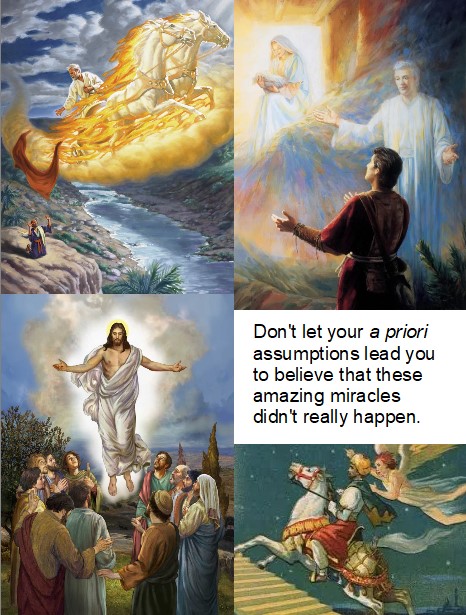
Jesus belongs with all those other heroes who may or may not have existed prior to their being turned into myth and legend: Abraham, Moses, Buddha, Confucius, Saint Nicholas, Robin Hood, Paul Bunyan. There is very little evidence, apart from stories and legends, that any of these figures actually existed. More, it’s entirely conceivable that Jesus belongs to a still different group of super-beings: those who were created as mythic characters, including but not confined to, Osiris (and the entire Egyptian panoply), Apollo (and all the Greek gods), Romulus, Circe, Attis, the angel Gabriel, Mithras, Aladdin, the angel Moroni, Superman, Harry Potter…

There is meagre evidence there was an historical Jesus who, even if he did exist, is now buried beneath layers of make-believe. The Jesus who has come down to us through the gospels and the rest of the New Testament is fictional. From his fairy-tale origin to his fantasy ascension and beyond, he’s completely imaginary.

I’m conscious I’ve written other posts making this same point. I find that, whatever starting point I take, invariably I end up here. Whether it’s ‘prophecy’, prayer, promises, miracles, the second coming, any aspect of the faith, none has any substance. They’re ineffectual, empty and have no bearing on reality. The character who supposedly embodies and promotes them becomes, as a result, similarly void. Either Jesus was transformed into a fantasy figure soon after he lived or he was imagined, by the likes of Paul, as a magical being to begin with. Whichever it was, from the earliest days of Christianity, there was no way for people to hear of or know about a man who actually walked the Earth.

*See Carrier, On the Historicity of Jesus: Why We Might Have Reason to Doubt, pp 480-81

God’s Design for Sexual Relationships: the Gospel According to Don

A digression:

A little while back, a Christian commenter (we’ll call him ‘Don’) made the point that homosexuality and other non-conformist sexualities are ‘not the order of creation God intended‘. Yes, Don knows the intentions of a God whose purposes are unknowable (Romans 11:33-34)! 

And what are those intentions?’ I hear you ask. It is that everyone be, or pretends to be, heterosexual and involves the marriage of one man to one woman for life, for the procreation of children. I know this because it says so in the Book of Common Prayer, originally composed in 1622:

The union of husband and wife in heart, body, and mind is intended by God for their mutual joy; for the help and comfort given one another in prosperity and adversity; and, when it is God’s will, for the procreation of children and their nurture in the knowledge and love of the Lord. Therefore marriage is not to be entered into unadvisedly or lightly, but reverently, deliberately, and in accordance with the purposes for which it was instituted by God.

But how did the writers of this book know this was God’s plan? How do evangelicals today, who subscribe to the same ideas, know that this is what God intended? How does Don?

The Bible. Surely the writers of the prayer book consulted the Bible and created their summary of God’s plan from that. Surely the evangelicals who promote one-man one-woman marriage draw their inspiration from God’s Word. Surely this is how Don knows too.

Let’s see. Here’s what Paul has to say about marriage 1 Corinthians 7:28-29:

…if you marry, you do not sin, and if a virgin marries, she does not sin. Yet those who marry will experience distress in this life, and I would spare you that. I mean, brothers and sisters, the appointed time has grown short; from now on, let even those who have wives be as though they had none.

Hardly a ringing endorsement of marriage!

Paul goes on to say,

I would like you to be free from concern. An unmarried man is concerned about the Lord’s affairs—how he can please the Lord. But a married man is concerned about the affairs of this world—how he can please his wife— and his interests are divided. An unmarried woman or virgin is concerned about the Lord’s affairs: Her aim is to be devoted to the Lord in both body and spirit. But a married woman is concerned about the affairs of this world—how she can please her husband.I am saying this for your own good, not to restrict you, but that you may live in a right way in undivided devotion to the Lord…So then, he who marries the virgin does right, but he who does not marry her does better. A woman is bound to her husband as long as he lives. But if her husband dies, she is free to marry anyone she wishes, but he must belong to the Lord. In my judgment, she is happier if she stays as she is—and I think that I too have the Spirit of God (1 Corinthians 7:32-40).

In other words, avoid marriage if you can, the better to devote yourself entirely to the Lord. How many Christians actually do this? How many preachers and evangelists promote it? None that I know of.

I can already hear Don arguing that Paul’s views are his own and were not handed down from on high. Let’s then turn to what Jesus says about marriage. If anyone knows God’s views on the matter, it must surely be his very own Son. I don’t for a second, believe he was of course, especially as Jesus’ script was written years after Paul and owes a great deal to him. Nonetheless, here’s what Jesus is made to say about God’s plan for marriage:

Jesus said to them, ‘Those who belong to this age marry and are given in marriage; but those who are considered worthy of a place in that age [i.e. that of the Kingdom] and in the resurrection from the dead neither marry nor are given in marriage (Luke 20:34-36).

Surely he can’t be saying that those who want to rise from the dead and make it into the Kingdom of God shouldn’t marry? That they’re not worthy of that Kingdom if they do? Yup, that’s exactly what he’s saying.

Similarly, in Matthew 19:10-12, after discussing divorce with the Pharisees, Jesus responds to the disciples’ remark that ‘it is better not to marry’, with –

…not everyone can accept this teaching, but only those to whom it is given. For there are eunuchs who have been so from birth, and there are eunuchs who have been made eunuchs by others, and there are eunuchs who have made themselves eunuchs for the sake of the Kingdom of heaven. Let anyone accept this who can.

Even interpreted figuratively – though it’s not evident from the text that Jesus is speaking figuratively – this means Jesus thinks it’s preferable to be sexless: chaste, celibate, single. How well that’s worked out for the Catholic church!

Finally, there’s Luke 14:26 where Jesus makes it clear what following him entails:

If anyone comes to me and does not hatewife and children, brothers and sisters—yes, even their own life—such a person cannot be my disciple.

Not much ‘mutual joy’ there.

Unlike Jesus and Paul, I’m not knocking hetero-marriage or the procreation of children. I’ve been involved with both. If these are what floats your boat, that’s great. But they’re not what the Bible promotes. Just the opposite. After the tales of incest, polygamy and adultery in the Old Testament, the New teaches that marriage has had its day. It is to be avoided, the better to follow Jesus, prepare for the coming kingdom and be worthy of eternal life. Only marry, Paul advises, if you can’t control your sexual urges. But, according to Jesus, you are risking your place in the coming kingdom if you do. You can improve your chances by shunning sex altogether.

This is the Bible’s teaching about marriage and God’s intentions for the sexual beings he created. Strictly speaking, it’s the New Testament’s teaching; that of the Old is even more bizarre.

Aah but,’ I hear someone say, ‘it’s all about context.’ Certainly it is; and the context is that Paul and those who created Jesus’ script believed the current age was about to end. Marriage, such as it was (very different from the modern concept, particularly for women who could be bought and sold aged only 12 or 13), would also then be coming to an end. With the arrival of the Kingdom of God on Earth, marriage would be redundant. Better, Paul and the gospel writers argue, to have done with it now to conform ahead of time with the new system, with God’s plan: ‘those who are considered worthy of a place in that age and in the resurrection from the dead neither marry nor are given in marriage.’

But God’s plan – the arrival of his kingdom on Earth in the first century didn’t come to fruition. His plan for marriage to end likewise fell by the wayside. Instead, and without the assistance of any deity, the very human institution of marriage persisted and evolved, eventually being hijacked by the Catholic church in the ninth century. It emerged more or less in its current form – though not for everyone – in the 17th century. Whatever this signifies, it was not what ‘God intended for his creation’ nor his ‘design for sexual relationships’ (Don again, doubling down on his position.)

If the Bible is anything to go by, God has never been very impressed by marriage. His long-term plan for it, if that disreputable book is to be believed, was to scrap it altogether. Yet we still have Christians who use its continued existence to disparage and denigrate those of us who express our sexuality with other adults of the same sex, with whom we share a mutual attraction.

Shame on them.

The Return of the Annual Christmas Quiz!

Back, due to popular demand! The annual Christmas quiz, last seen in 2014. Ten questions on Biblical trivia. Answers at the bottom of the page.

Good luck. You’ll need it.

1. Where did Mary and Joseph live prior to Jesus’ birth?

a) Bethlehem

b) Nazareth

c) Galilee

2. How did Mary conceive?

a) By the power of the Holy Spirit

b) She didn’t. It’s a story.

c) How’d you think?

3. What was the relationship between John the Baptist and Jesus?

a) They were second cousins

b) They didn’t know each other and didn’t meet until they were adults

c) Jesus originally belonged to John’s baptism cult

4, When was Jesus born?

a) When Herod I was alive

b) After Herod had died and Quirinius was governor of Syria

c) Perhaps he wasn’t

5. How did Mary end up giving birth in Bethlehem?

a) There’s no evidence she gave birth in Bethlehem

b) She and Joseph had to go there because of the Roman census

c) She lived there anyway

6. The Lord tells Mary to call her child

a) Jesus

b) Immanuel

c) Yeshua

7. Where did the family go following the birth?

a) They went home to their house in Bethlehem

b) Egypt

c) Nazareth

8. Who preserved the songs of Zechariah, Mary and Simeon (Luke 1 & 2)?

a) They were preserved orally word-for-word for 50 years

b) They were recorded in Q

c) They were created in their entirety by Luke, based loosely on Jewish scriptures

9. Where is the prophecy, quoted by Matthew (2:23), that Jesus would be called a Nazarene?

a) Micah

b) Isaiah

c) Nowhere: there is no such prophecy in Jewish scriptures or anywhere else

10. Which is the most unbelievable part of the nativity stories of Matthew and Luke?

a) a host of singing angels hovering in the sky

b) the wand’rin’ star

c) a virgin giving birth

d) Herod’s re-enactment of a story from Exodus

e) All the angelic visitations, dreams and visions that are needed to make the stories function

Answers:

1. Where did Mary and Joseph live prior to Jesus’ birth? All of the answers here are correct, so the Holy Bible say. According to Matthew, Mary & Joseph lived in Bethlehem. According to Luke they lived in Nazareth. According to Mark, it was known that Jesus hailed from Nazareth though he doesn’t say Jesus was born there. John refers to Jesus being from Galilee and acknowledges he comes from Nazareth (1:46).

Matthew and Luke insist Jesus was from Bethlehem to make him ‘fulfil’ the prophecy that the Messiah would come from there. Mark and John apparently don’t care.

2. How did Mary conceive? Matthew and Luke have the Holy Spirit do the deed. Matthew says merely that Mary ‘conceived by the Holy Spirit’, while Luke really goes to town with a ridiculous story involving an angel and Mary being orgasmic about the coming of the Lord. Mark hasn’t heard of either account, because neither had been invented, and fails to invent his own. John is only interested in Jesus as The Logos prior to his time on Earth. Actually, Jesus could only have been conceived by the only method we know that works: boy and girl hoochie-coochie.

3. What was the relationship between John the Baptist and Jesus? All are correct. Luke says Jesus and John were second cousins (1:36) and their mothers were close (1:56). The Gospel of John (1:31) says that John the Baptist didn’t know Jesus personally. Some scholars think Jesus was originally a member of John’s baptism cult.

4, When was Jesus born? a) and b) are both correct according to the gospels. Matthew places Jesus’ birth in Herod I’s reign, which ended when he died in 4BCE. Luke meanwhile dates it to Quirinius’ governorship of Syria, which was in 6 and 7CE. No wonder there are those who think Jesus may never have existed, so encrusted with myth and make-believe is he.

5. How did Mary end up giving birth in Bethlehem? The census is a contrivance to shift the birth to Bethlehem. There wasn’t a census of the kind described when Quirinius was governor of Syria, nor in 4BCE. Quirinius’ census was of property and would not have entailed the (mass) movement of people. Matthew seems to think M&J lived in Bethlehem all along. No-one else thinks so.

As the Bethlehem connection derives only from prophecy (Micah 5:2), it is likely Matthew and Luke located the birth there to show the ‘fulfilment’ of that prophecy. In other words, they invented it, as they do other ‘fulfilments’. It looks like a) is the only viable answer.

6. The Lord tells Mary to call her child… According to Matthew. Mary is meant to call the baby Immanuel, which, as the text helpfully informs us, means ‘God with us’. This is to make the story comply with Isaiah 7:14 which claims the Messiah will be called Immanuel. But Mary doesn’t call her baby Immanuel. She calls him Yeshua, meaning ‘God Saves’, which is not the same thing. How Matthew thinks this is a fulfilment of the Immanuel prophecy is anyone’s guess. When the gospels came to be written, Yeshua was rendered in Greek as Iesus and eventually in English as Jesus. Neither he nor his mother would have recognised this rendering.

7. Where did the family go following the birth? Again, all are correct according to the gospels. The family went on living in Bethlehem according to Matthew (2:7-11) but fled to Egypt according to Luke. Mark doesn’t appear to know either the Bethlehem or Egypt stories and refers only to Jesus coming from Nazareth.

8. Who preserved the songs of Zechariah, Mary and Simeon (Luke 1 & 2)? c) is correct. No oral tradition could possibly preserve the three carefully structured poems verbatim for 50 years. The hypothetical Q is conjectured to be a collection of Jesus’ sayings so the songs don’t come from there either. Luke or his community made them up.

9. Where is the prophecy, quoted by Matthew (2:23) that Jesus would be called a Nazarene? There is no such ‘prophecy’ anywhere in Jewish scripture nor in any extant writing: c) is correct once again.

10. Which is the most unbelievable part of the nativity stories of Matthew and Luke? That’s right. All of them are completely unbelievable.

How did you do? If you’re confused, don’t be. It’s the gospel writers who were. They made up stories about Jesus so that he complied with parts of Jewish scripture that seemed to them to be speaking of the Messiah. (John’s stories are a little different; they and Jesus’ tedious monologues were created to make him seem more like a Greek demi-god.)

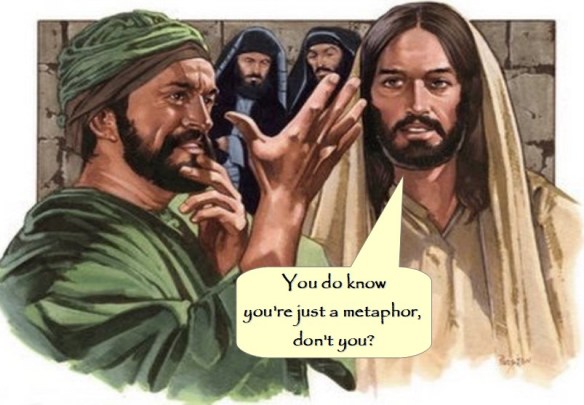
Perhaps though I’m taking it all too literally, ‘like a fundamentalist’ as my self-appointed chief critic likes to say. I should perhaps accept it’s all just a metaphor, as he advises. Of course, when I do, he objects to that too; ‘A metaphor for what?’ he asks, forgetting he’s the one who believes the stories are ‘intended’ to be deeply meaningfully symbolic.

The muddled accounts arose as each gospel writers attempted to make an origin story for their hero based on scraps from Jewish scripture, Paul’s teaching and the emerging beliefs of their particular brand of the cult. They’d have got away with it too if some clever-dicks hadn’t decided, many decades later, to put their efforts side by side so their differences were laid bare for all to see: all the contradictions, inconsistencies, fallacies, anomalies and incompatible flights of fancy. Thank god the church kept their writings hidden away from most folks by preserving them in a language they couldn’t read.

That same critic will no doubt tell me I’m wrong again. ‘Everything happened as Matthew and Luke relate. There are no contradictions between them and the other two, Mark and John, had different priorities anyway.’ (See comments to this post here). He’ll tie himself in knots rather than admit the nativity stories are myth, as is everything that follows.

Have a happy Christmas, ya’ll. See you on the other side.


Jesus the No-Hoper

Jesus – Hope for the World declares the banner outside the church near where I live. I can’t help but wonder about the naivety of the people who came up with the slogan and what it means. What are the possibilities?

‘Peace on Earth, goodwill to all men’ (and maybe women)? If so, the world isn’t showing much of either, certainly none that can be attributed to Jesus and his fractured, fractious and frequently intolerant church.

How about inner peace then, even though that’s a long way from ‘hope for the world.‘ How many Christians exemplify this particular fruit of Spirit? Is this, in the end, all that Jesus offers: the hope of a nice fuzzy feeling inside? Of course, peace of mind can be spirit-generate, though personally I prefer wine. 

Hope of reconciliation with God then. Only if you believe in God in the first place, not to mention ‘sin‘, human sacrifice and magic. If this is the kind of hope Jesus represents, then really, what good is it? 

Possibly the hope of which the banner speaks is the hope the earliest Christians had, of Jesus coming back real soon to slaughter his enemies and set up the Kingdom with, naturally, themselves at the top of the pile? Hasn’t Jesus had two thousand years to deliver this hoped for outcome?  An idea well past its sell-by date, the Kingdom of God on Earth isn’t ever going to materialise, however much ‘hope’ people have.

Maybe, then, it’s a hope of eternal life. The gospel writers have Jesus make such a preposterous offer (e.g. John 10:27-28). If this is what Christians are hoping for they are sadly deluded, and, as Paul puts it, the most pitiable of all people (1 Cor 15:19). No human being outside of myth and comic books has ever lived forever. None ever will.

Hope of heaven? See above. Besides, the Bible really doesn’t offer a place in heaven to anyone. That’s a much later development. It’s a waste of this one and only life to live in the vain hope of something better after death. 

Maybe the hope referred to is hope in hope itself. How futile would that be? Hope is no substitute for food for the hungry, shelter for the destitute, treatment for the sick. 

When I go to the carol service at the church next weekend, I’m confident it will be made clear just what sort of hope Jesus offers the world. If not, I’ll be sure to ask. I’ll let you know.

Miracles made to order

Mark makes his Jesus perform all the deeds the scriptures say will be performed by the Messiah. He doesn’t spell out that this is what he’s doing. He wants those who hear his gospel being read aloud (as it would have been to the cult’s members) to work it out for themselves: ‘he who has ears let him hear’ and all that.

This isn’t good enough for Matthew, however. He wants to make it obvious what’s going on, so he invents a story to draw attention to it. To do so, he has to have John the Baptist, who has previously acknowledged Jesus as the Messiah and heard God say as much from Heaven, doubt all of it. Matthew considers it worth it to make the more important point that Jesus is truly God’s Chosen One:

John (the Baptist) heard in prison about the works of Christ, and he sent his disciples to ask Him, “Are You the One who was to come, or should we look for someone else?”

Jesus replied, “Go back and report to John what you hear and see: The blind receive sight, the lame walk, the lepers are cleansed, the deaf hear, the dead are raised, and the good news is preached to the poor. Blessed is the one who does not fall away on account of Me.” (Matthew 11:2-6)

Matthew makes Jesus refer to several scattered verses from the scriptures that appear to say that once God’s Kingdom arrives on Earth the deaf shall hear, the blind see and the lame walk. Now you can believe, if you like, that Jesus really did make the blind see and the lame walk because the Kingdom had arrived (though -oops – it hadn’t!) or you can recognise that Matthew (and Mark before him) was aware of these references and made up a hero to embody them. Which is more likely, when every one of the miracles Jesus alludes to in Matthew 11 illustrates specific verses from scripture?

The blind see, the deaf hear, the lame walk (Isaiah 35:4-6) is brought to life in Matthew 9:27-31; 15:31-37 and 9.1-8.

Lepers cleansed: Leviticus 14 materialises as Matthew 8:1-4. The ability to heal a ‘defiling skin disease’ had long been thought to be a sign of the Messiah, so naturally Jesus has to be able to do it.

The dead rise: Daniel 12:2 is resurrected as Matthew 9.18-26.

The good news preached: Isaiah 52:7 becomes Jesus’ message.

A man called Jesus didn’t do these looked-for amazing things. These looked-for amazing things gave rise to a character constructed by myth makers: gospel Jesus.