Sorry For Any Inconvenience (a rant, part three)

More meaningless phrases that are used unthinkingly. I hate the lot of them!

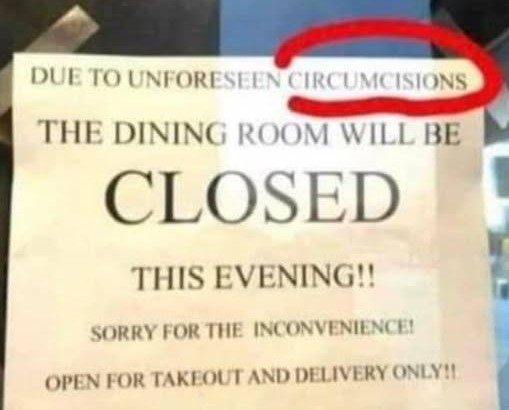
We are closed today/unable to provide the service you’ve paid for, etc. We apologise for the inconvenience.

The hell you do. You couldn’t care less about what your withdrawal of your service means to your customers or you’d have done everything in your power to prevent it. And to suppose I’m only mildly ‘inconvenienced’ by your slipshod ways, not to mention your glib apology, is to underestimate the trouble you’ve put me to.

‘Your reaction is abuse’

Anything remotely assertive is now regarded as abuse. The term has been degraded the extent that those who are genuinely abused – physically, sexually or emotionally – are now on a par with those dealing with a dissatisfied customer in a shop or an obstructive bureaucrat down the phone (assuming you can speak to a real person these days). Of course, it’s best to be calm and civil when trying to resolve a problem, but a little forcefulness is occasionally necessary. These days you’ll have strayed into ‘abuse’ if you make your point with anything other than submissive meekness. As Spectator columnist Mark Mason put it (after I originally drafted this post), a claim of abuse ‘has become a go-to argument of the grievance generation. Express the slightest irritation with them for being irritating and you’re the one in the wrong’. (Is this post abusive? Probably.)

Shit, as in ‘I’ll just collect my shit’ or ‘I need to get my shit together’. The imagery is gross – you do know what shit is, don’t you? – and if you have such low regard for your belongings or your thoughts maybe you should think twice and about telling us about it. There are plenty of other decent and less revolting words for your stuff and your psychological state and to aver them for ‘shit’ is downright lazy

And while I’m having still ranting, let me have a go at the f word. I’m sick to death of it. I do occasionally use it myself, particularly in totally rational disputes with technology, but I get weary of hearing it in snatches of conversation I hear while walking in the street, where every other word is the f-word or one of its derivatives. It is used by parents in the presence of their children and, worse, when addressing them. I deplore its use on TV and in films where it’s added to give more force to dialogue or insight into how a character’s feeling. Any half-decent actor could and should convey emotion or urgency or whatever without the need for superfluous swear words. ‘I want you out of my life, ‘ delivered by a competent actor conveys more personal anguish and naked pain than ‘I want you out of my f***ing life,’ which conveys only anger and reflects the scriptwriter’s societal conditioning that compels him or her to include the f word because that’s what people in the street do. Scriptwriters need to trust their actors far more than they do and cut out the needless profanity. Shakespeare never found the need to include it in any of his 37 plays. ‘Is this a dagger I see before me’ would have been robbed of its power if the bard had seen fit to stick a ‘fucking’ in there somewhere. Likewise, comedians who think a line is made funnier by adding the f word to it; if the line is funny, it’s funny without it. If it’s not funny, adding fuck won’t make it funny. Let’s have less of the f word and more considered writing and genuine funniness.

Rant over.

Newspeak (part two of a rant)

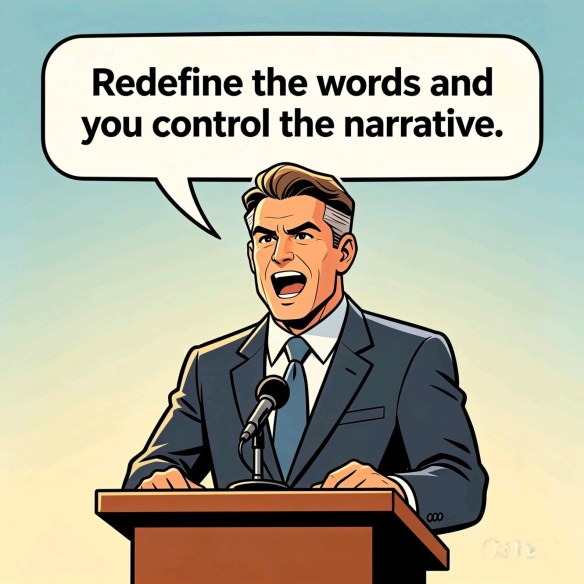
I’ve been considering the changing meaning of words. I acknowledge that this happens over time: language evolves like everything else. My concern here is the deliberate redefining of words to suit a given (political) agenda. This often underhanded stretching of words to give them new meanings, actually diminishes them and renders them dangerous. 

As part of its definition, Merrian-Webster describes racism as ‘behavior or attitudes that reflect and foster ‘the belief in racial superiority): discrimination, prejudice, or violence against people because of their race.’

Violence, it seems to me, is hardly ever justified. I have detested it since I was a child. There can be no doubt that violence is sometimes motivated by racial hatred, but like all the words I’m dealing with here, racism as an accusation is overused to the point of meaninglessness. While other nations – the Scandinavian countries, the US, Scotland and Wales – proudly fly their national flags practically everywhere, here in the UK it has been deemed to be racist by some on the Left. It’s common for the Ukranian, Palestinian, Scottish, Welsh and LGBT flags to be flown here, why are the English and Union flags now considered to be racist? It might, at a stretch be that they are divisive, but then aren’t all flags? Isn’t that what they’re for, to declare a national identity that is distinct from that of other states? The British flag is no more ‘racist’ than any other. Neither is expressing genuine concern for immigration, which is dismissed by those who’ve failed to control it, as racist. How can it be when those coming into Britain are from a variety of ‘races’, many white and European?

It’s racist, and hateful too, say ‘community leaders’ and white liberals, to object to the treatment of women within Islam, or first-cousin marriage or frequently expressed anti-Semitism. ‘Racism’ in these instances is an attempt to shut down discussion and censure those with legitimate concerns. Similarly, for fear of being considered racist, authorities have failed to investigate (hateful) criminal activities by ethnic minorities. And while it’s become clichéd to say it, criticism of Islam and its practices is not racist: Islam is a religion, not a race, its practitioners drawn from a range of ethnicities. The true meaning of racism has been lost. Those who suffer from it abandoned in the transition of the word into meaninglessness.

My 95 year old mother was in hospital recently. She struggled to understand what some of the nurses were saying to her, either about her condition or treatment or something else. She didn’t know which because, between her deteriorating hearing, the mouth coverings some nurses wore and the accents of those from other ethnicities, she couldn’t understand them. What she couldn’t do, she felt, was say this to them. In Britain today it is regarded as racist to tell someone from another culture you can’t understand them. So she didn’t, nor did she mention the problem to any other of the medical team for fear of being thought racist. This is where we are in today’s Britain.

A Phobia of Hate (part one of a rant)

It used to be the case that when writing an essay or presenting an argument, the writer needed to define one’s terms. This way, parameters were set with clarity and, as we say these days, transparency about what was to be discussed. Sadly, this seems not to be the case any more. I don’t blame social media for this; it seems to me politicians have largely led the charge, using terms with usually clear definitions in ways that suit their own purpose, without any regard for that common understanding. Rarely do they make clear that this is what they are doing. The mainstream media are inclined to do the same. What we may think they’re talking about, they may not be. Perhaps both politicians and the media learned the trick from Christian commenters who are happy to change the meaning of words as they see fit (‘Atheists’, ‘myth’, ‘metaphor’ for example.)

I dealt with autism here. The term, and diagnosis, is now stretched so thinly that, according to the social scientist who first proposed the autistic ‘spectrum’, it has become ‘meaningless’. What other terms have been misapplied until they too have been rendered ‘meaningless’?

How about phobia? Strictly speaking a phobia is an irrational fear, one for which there is no real basis: arachnophobia, agoraphobia, claustrophobia, for example. Of course there may be real grounds for being fearful of spiders (some are poisonous) heights (if perched precariously on the top of a mountain) and enclosed spaces (if it is suffocating), but the terms arachnophobia, acrophobia, claustrophobia are reserved, or at least they used to be, for those whose fear is extreme and above and beyond the rational. The term phobia is now applied to anyone who expresses concern about or criticism of any movement or cause: homophobia, transphobia, Islamophobia come to mind. The first of these started life as an irrational fear that one might oneself be homosexual. Now it’s considered to be, by those who attribute their not ‘getting on’ in life or being subjected to personal criticism, to be the result of their being gay. Certainly ill-considered remarks may be unkind, a word that more than adequately describes much of what is described as phobic in modern society. But being unkind does not equate with a phobia, nor is it against the law. Not yet anyway.

Similarly offensive, a word originally that originally signified a physical attack, the meaning it still carries in law. As Paul Simon once expressed it in a rather pleasant little song, ‘One Man’s Ceiling is Another Man’s Floor’: what I might find offensive, in the sense of hurt feelings, is not necessarily what you find offensive, unless you choose to allow it to be. That’s because ‘offence’ in the slack modern sense is ridiculously subjective: it is, it seems, not a problem to call for the death of Jews but it is offensive to show images of an ancient ‘prophet’. Touchy religious sensibilities, sometimes prone to take offence at the slightest provocation, do not signal a criminal or even a criminal offence. And yet that is where we’ve got to, certainly in the UK. Remember your mother teaching you that sticks and stones may break your bones but words will never hurt you? Of course this is not entirely true; words can cause emotional hurt. But this doesn’t mean those who use words critically merit investigation by the officers of the law.

Hate is a verb. Unlike its antonym love, it cannot also be a noun. I know, this is pedantic of me, but we’re talking about words and the damage they can cause when misapplied. To alter and stretch their meaning out of all recognition results in the problems we now have in (British) society. All of the accusations of ‘hate’ that fly around these days are, grammatically, ‘hatred’ though in fact, they rarely qualify as this either. According to Merriam Webster, hatred is ‘an extreme dislike or disgust or ill will or resentment that is usually mutual: prejudiced hostility or animosity.’ Hatred is a powerful, destructive emotion. Reasoned opposition to the political manoeuvring of minority groups is not really it.

Of course it is possible to take such opposition to extreme lengths that it may look a lot like hatred, but by and large it is not. I do not ‘hate’ religious group that try to impose their beliefs and practices on me or my society, but I do oppose them and their efforts. I also oppose those who claim that any opposition to their efforts constitutes ‘hate’. It rarely does so, but how convenient it is for those who don’t get their own way to have the accusation in their armoury. Which is not to say real hatred isn’t expressed, often in violent action, but strangely, as a society, we seem less concerned with such action. We are, apparently, required to understand the frustrations of those carrying them out; their grievance is genuine and heartfelt. Hurty words though are of much more concern.


‘Those who most want to rule others are least suited to do it.’

More stories that we really should be questioning. First today, a perennial favourite:

We, the Left / Right / Green / Centrist / Mad Hatter’s Tea Party, and I as party leader, pledge to solve the country’s problems / Make America Great Again / limit taxes / reduce bills and the cost of living / build new houses / curb immigration / lift families out of poverty etc, etc. We have fully costed these policies and they are achievable, unless we discover they are not, which we might though this is unlikely, but we can’t be sure. This we promise.

Admittedly there’s a hint of scepticism in this particular paraphrase, but even so, once elections roll round again, plenty of us will be taken in by guff like this. However, politicians create more problems than they solve. The difficulties the world faces right now, those that are not the result of religion, have been created by our political leaders. Whatever they promise in order to gain your vote, they will deliver only a small fraction. Don’t believe anything they tell you. Vote for the party that tells you they’ll do f**k all, and as well as being impressed by their honesty, you will find you’re not disappointed. Democracy is broken. As Douglas Adams put it:

It is a well-known fact that those people who most want to rule people are, ipso facto, those least suited to do it.

And:

Anyone who is capable of getting themselves made President should on no account be allowed to do the job.

We really are this much stuffed. And that’s before A.I. takes charge. 

Second, a much repeated mantra in the UK today:

Britain is a fully integrated and wonderfully diverse society. Diversity is truly one of our strengths. We also need people from other cultures to do menial jobs and boost the economy. We must be tolerant and understanding of the cultural practices of some of these newcomers, even if, for example, their attitude towards women and Western values is markedly different from our own. This doesn’t mean their beliefs are any less valid. Anyone who questions this or suggests we are not in fact a fully integrated, diverse society is a hater, racist or fascist. Such individuals are the cause of division. Diversity is our strength.

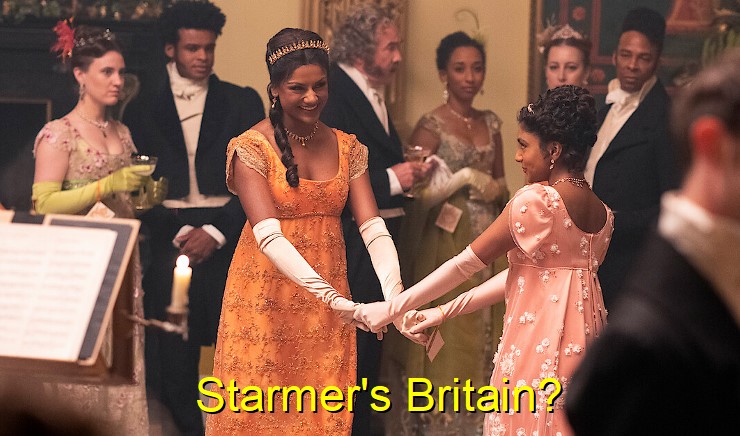
This sort of rhetoric is typical of the UK’s Prime Minister, Sir Keir Starmer. If ever there was anyone who should on no account be allowed to do the job, it is Sir Keir. He has clearly watched too many episodes of Bridgerton in which all races and cultures enjoy a sumptuous life, rubbing along happily together in a comfortable upper class milieu. While many of us do co-exist happily with our neighbours from elsewhere, Britain today is not quite like Bridgerton.

According to Sir Keir, extreme right-wing views among the settled indigenous population prevent it from being fully realised. It is this faction who refuse to compromise or make any concession to accommodate the cultures who now live among us. This is simply not true.

Many cultures have assimilated into the British way of life, but equally many have not and do not wish to. Like Christians who shun ‘the world’ there are newcomers to the British Isles, many Muslims in particular, who reject the way of life here and seek to assert their own cultural values. Many of these are at odds with hard fought Western principles: the equality of women and gay people, religious tolerance, the humane treatment of animals, the long established rule of law, the rights of those who do not subscribe to the tenets of Islam. For many, such people are kaffar, infidels of lesser value than those within the Muslim fold. They see no reason to compromise or integrate with them. And yet, the obligation to do so is theirs; they are the ones who have chosen to make their homes in the UK just as it is. To try to change it to be more like the cultures they have come from – escaped from in many cases – is not how asylum works.

Starmer and his government, meanwhile, blame the indigenous population, many of whom are of immigrant stock themselves, for the lack of assimilation and unity. To teach them the error of their ways, he plans to appoint an ‘anti-Muslim hostility tsar’ to champion efforts across the UK to tackle hostility and hatred when directed, as he or she sees it, at the Muslim community. This, you’ll note, is a process intended only to work in one direction.

You might wonder why, if we’re already living in Sir Keir’s wonderful Bridgerton-esque society (the only division being caused by pesky extreme right-wingers) such an appointment is necessary, but if Sir Keir thinks it is, then surely it must be so.

You may have your own examples of the kinds of stories we’re told today that don’t hold up to closer inspection. You may feel I’ve been conditioned to feel uncomfortable with the particular narratives I’ve looked at, and you would no doubt be right. I’d be interested to hear your views.


More Questions Than Answers

In today’s troubled world, we are fed stories intended to convince us of the rightness of the direction in which we’re travelling. I’ve chosen some that have been circulating in the UK for a while now and comment on them afterwards: remember, question everything! While I’ve paraphrased the stories, I’ve tried to represent them as accurately as I can. You can always click on the links to access their source. I stress that I’m not claiming there’s no evidence for these narratives; there may well be, at least for elements of some of them. I offer them simply as the stories they are, ones that are repeated often, widely circulated and widely believed. The evidence or absence of evidence for them is neither here nor there. It’s the stories as presented by those who want us to believe them that count:

The number of people with autism, children in particular, has expanded exponentially recently. We don’t fully understand why this should be but as we’ve found out more about autism, we’ve come to realise that far more people have the condition than was previously thought. In fact, we now recognise that everyone is on the autistic spectrum somewhere. What this means, for children in particular, is that extra provision needs to be made for them in school and additional money must be found to address their problems.

Except… Dame Uta Frith, the psychologist who first proposed that autistic traits were on a spectrum now says the attempts to diagnose and place every one on this spectrum somewhere is not what she intended. In fact, the overreach that has led to this represents a broadening of the definition of autism to the extent it has become meaningless. In consequence, those who do exhibit genuine artistic traits are overshadowed by those with traits well within the boundaries of normal and are often overlooked. This story, therefore, doesn’t stand up.

Unless we reverse or halt climate change, the planet, and life on it, is doomed. To achieve this the UK must go further and faster, eliminating all fossil fuel vehicles by 2030 and achieve net zero by 2050. It doesn’t matter how much this will cost households, businesses and the UK economy: for the sake of the planet, Britain must be a world leader in this endeavour.

So many questions! (Some already addressed here.) Is climate change as calamitous as some scientists and unqualified commenters suggest? There are other scientists who think not. And what about those dates? Where did they come from? Were they chosen arbitrarily or is there good scientific evidence that if they are missed there will be no reversing climate change? Which leads to, ‘can climate change really be reversed? Can it even be halted?’ We might ask too how much the current, liberal bombing going on in practically every part of the world is accelerating climate change (and why doesn’t the media ask this question?) Does the UK’s importing of gas and oil from other parts of the world really reduce its greenhouse gas emissions? (No) How much gas and oil are involved in the making, functioning and maintenance of wind turbines? How much agricultural land will be lost when the planned 500,000 additional acres of countryside are given over to solar farms? How many animal habitats will be destroyed? Why must the UK, with its 0.8% contribution to carbon emissions, be a (or even the) World Leader in Net Zero? Does any other nation notice or care what the UK is doing? Do China, USA, India or Russia feel compelled to emulate the UK’s virtuous example? (No). Is Net Zero unachievable in any case?

More stories next time…

Racism? What Would Jesus Do?

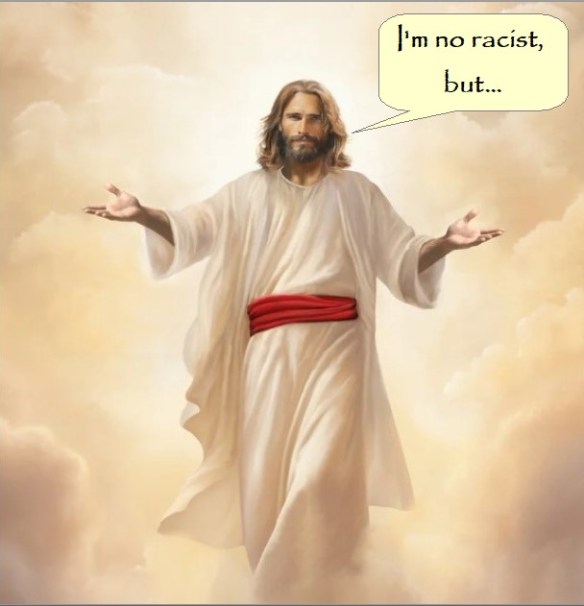
The Church Of England recently issued guidelines to its London clergy advising them to preach anti-racist sermons and suggesting how they might go about it. Asked about it on UK TV, the reverend Sam Norton said he was worried that expressing concerns about the number of migrants entering this small island, many of them illegally, might unreasonably be construed as racist. He argued that it is not; I agree. The reverend was at pains to emphasise that racism was abhorrent (again, I agree) and was not something Jesus would condone.

So, again, Jesus gets a free pass. As he’s portrayed in the four gospels, Jesus is racist. Or, rather, the men who made up his script, the early cult members now known as Mark, Matthew, Luke and John, were. They were racist about those who were not part of the new movement, particularly towards those who were hostile towards it. Granted the gospel creators had Jesus say some pretty good things too: love your neighbour as yourself, love and pray for your enemies, the parable of the good Samaritan; all wildly impractical and widely ignored by Christians everywhere.

Many of Jesus’ admonishments were written by cultists anticipating the end of the age for members of their own group; they were all too happy to lash out at those who weren’t part of it. Hence, the Syrophoenician woman of Mark 7:24–37 whom Jesus calls a ‘dog’, dogs being unclean in Judaism. This woman would have had a paler complexion than Jesus, who would not be the fair Caucasian he’s often portrayed as being. His name-calling is racist; it is only the woman’s pluckiness that persuades him to respond to her pleas.

The story is repeated in Matthew 15:21-28 where the woman is said specifically to be from Canaan, Jesus says explicitly that he ‘was sent only to the lost sheep of Israel’. Earlier, in Matthew 10:5, he instructs his disciples not to take his supposed life-saving message to anyone other than his fellow Jews: ‘Do not go into the way of the Gentiles, and do not enter a city of the Samaritans’. Matthew would, of course, have his version of Jesus exclude those who were not Jewish. Jesus’ racism here reflects Matthew’s community intent on preserving their Jewish heritage. Which makes the anti-Semitism Jesus is made to express in the fourth gospel all the more startling;

You (Jews) belong to your father, the devil, and you want to carry out your father’s desires. He was a murderer from the beginning, not holding to the truth, for there is no truth in him. When he lies, he speaks his native language, for he is a liar and the father of lies… Whoever belongs to God hears what God says. The reason you do not hear is that you do not belong to God [‘the right cult’?]

This is the racism of John 8:44, the rift between the new cult and Judaism having widened by the time the fourth gospel was written.

There are those online who argue that even though Jesus was God incarnate, his ‘human side’ and his upbringing in a prejudiced environment account for his narrow views of ethnicity.  This excuses his racism, they say, and shows how like us he really was. It doesn’t. It reflects the prejudices and racism of those who created the various versions of him. (Alternatively, online Christians argue, as here, that the pericope is invariably read ‘out of context’.) And, please, don’t get me started on the overt racism of Jesus ‘Holy Father’, the genocidal tyrant of the Old Testament.

The Bible as a whole is rife with blatant, divinely-inspired racism. Apart from this, I agree with the reverend Norton: having concerns about the scale of immigration is not racism. Just as criticism of Jesus is not blasphemy and censure of Muslim beliefs and practices is not Islamophobic.

It’s What The Customer Wants

WordPress has changed the way in which blogs are created and posted. They added an alternative way of doing it about two years ago, called Block Editor, which I and many others found difficult to use. There was however the ‘old’ system, which WordPress dubbed ‘Classic Editor’, to fall back on and continue using. This I’ve been doing, occasionally dropping into Block Editor to see if the bugs have been ironed out. No doubt WordPress doesn’t regard these as bugs but missing tabs for adding pictures and hyperlinks, and the absence of a Schedule button for setting the publication date sure seem like it to the user. I can never find them in Block Editor (see the screenshot below for how helpful it looks) and while these same features are inclined to relocate themselves in Classic Editor too, at least they’re there somewhere!
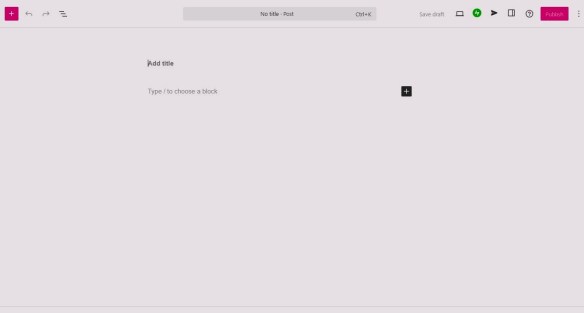
Unfortunately, just before Christmas, WordPress switched off Classic Editor, leaving bloggers with no choice but to use the uncooperative Block Editor. Actually, there is a choice: bloggers can now pay extra to have Classic Editor restored. So to continue with a system that’s been in use for the 12 years I’ve been blogging, I would now have to pay an additional premium.

I attempted to use Block Editor when Classic was switched off a few weeks ago. It was as difficult as ever, and somehow led to the comments from an earlier post being moved on to the end of the new one (you may have noticed). I’ve currently got a workaround that allows me to use Classic Editor a little longer (I’ll not spell it out here; no need to alert WordPress and have them close down the loophole that makes the workaround possible) but I’m unsure how long it will last and how to proceed from here.

Do I –

  • Keep going so long as the workaround works and then call it a day (While I often feel I’ve said everything I can about Christianity there are other subjects I’d like to tackle.)
  • Persevere with Block Editor until I conquer it. It really does feel like a battle each time I try though; I need a system that works with me rather than one that seems determined to throw up obstacles.
  • Keep going as best I can till my annual subscription to WordPress is due in July and see then how things are working out. If they’re no better, I won’t renew. I could look for another provider and migrate everything to that, but honestly I don’t know if it’s worth doing.

Dennis and I have a saying whenever a system is changed for the worse, from supermarket checkouts, to banking apps and ‘improved’ media: ‘It’s What the Customer Wants’. This phrase is often bandied about by companies when they make changes that suit them, to save them money or whatever, but are really of no benefit to the consumer, the schmuck who is paying but is never consulted.

So, what would you recommend I do?

Surviving 2026

It’s that time of year when, according to the media, we need to consider what our strategies might be for surviving the 12 months ahead. I thought I’d share with you some of my thoughts along these lines:

1. Have the lowest expectations of politicians that you can muster. That way you’ll only be mildly disappointed when they fail to live up to them.

2. Have a sense of proportion. The universe has existed for 13.8 billion years, the earth for 4.54 billion, life for 3.8 – 3.5 billion, humans for a mere 300,000 years and you for a miniscule fraction of even this final statistic. None of these events has been directed by a sentient power. They are all the result of natural forces. With this perspective you’ll recognise how nonsensical it is to attribute anything to a tribal deity.

3. Reserve your respect for people who merit respect. You do not have to respect those who espouse nonsense and/or don’t respect you. You certainly don’t have to genuflect in front of ideologies, whether religious, philosophical or political. Ideologies are not people.

4. Party like it’s 1999. That way you can pretend the world isn’t being run by septuagenarian megalomaniacs.

5. Resist the Newspeak that is daily foisted upon us. Call a spade a shovel, an Islamist a Muslim, and send the Thought Police packing when they turn up at your door because someone somewhere is offended by something you’ve said, on someone else’s behalf.

6. Spend lots of time with friends. Studies repeatedly show that socialising contributes significantly to living a longer, happier, healthier life. Even talking to strangers helps. I know that other people can sometimes be  challenging (see below) but being with them is, on balance, pleasurable and rewarding. They do you good (and you them).

7. Stop anyone who starts a sentence with ‘Me and partner’. Point out that this is grammatically incorrect and reflects badly on both their education and personal integrity.

8. Read comic books.

9. Take pride in your country. It belongs to you, not just to politicians and billionaires. Other countries quite rightly take pride in their country’s achievements, culture and values. We need to as well. .

10. Write to your MP/Congressperson to tell them what you think of the job they’re doing. Tell them what they should be doing instead, like keeping their promises. Do this while trying not to use swear words.

11. Do something you might not normally do. Keep it legal. Or at least don’t get found out.

12. Question everything, including everything that’s written here.

I hope 2026 turns out to be a great year for you.

What Is Truth?

I’m sceptical (or skeptical if you’re in the US). It’s a legacy of my years of believing the promises of Christianity. Preachers, pastors, Bible study leaders told me for 25 years that the promises of the bible, of Jesus himself, were all true. And like a fool I believed them. Jesus had made a new creature out of me; he loved me; he was guiding my life; he was returning soon; I’d be resurrected; I’d live in heaven forever… and on and on.

What a preposterous set of propositions! It took my Great Realisation, my own personal revelation that there was no God, to make me see how ridiculous they were.

It is this that left me with a legacy of scepticism. If I’d been misled all this time by people I respected and admired, what else was I accepting as true that very well might not be? I wasn’t going to be fooled again and so began to question practically everything I was told by authorities, experts and the media. If it seemed ‘off’, as we say these days, not quite right or too good (or bad) to be true I asked, ‘Who says so?’, ‘How do they know this?’, ‘What is the evidence?’, ‘Do they jump to conclusions or is their reasoning sound?’, ‘Why should I believe what they say?’ It’s exhausting, I assure you, having to search out the evidence – the primary sources of information – and to sift through it, recognising any bias that has been imposed on it. It’s either this or I must accept without question that everything I’m told is true. I can’t do that any more.

Here are a few examples of claims that I’ve been sceptical of on the recent past:

We are being guided by the science, said politicians during Covid to ensure compliance with whatever lockdown measures were being imposed. Did this really just mean was ‘we are being guided by our interpretation of some rather suspect data’? It became clear after we emerged from the hysteria surrounding the pandemic that this was the case.

Tens of thousands will die of Covid unless you comply: this based on computer predictions which turned out to be very far from accurate: the suspect data that ‘guided’ politicians.

A woman can have a penis. A man can have cervix. Yes, our politicians told us this during our recent fixation with transgenderism. Whatever you think of people changing sex, these two statements, designed to change hearts and minds, if not penises and cervixes, are patently false. Whatever was guiding those who said such things, it certainly wasn’t ‘the science’.

No more irresponsible, undeliverable promises. So said the Prime Minister exactly a year ago. I’m not going to be sceptical or cynical about this. I feel sure it’ll turn out to be true. Is he implying though that promises made earlier than this were indeed ‘irresponsible and undeliverable’. Surely not.

We will not raise taxes on working people (and energy prices will fall by £300 in the long term), Labour politicians, now the government, said only last year in an attempt to gain our votes. I was sceptical about this, as with much they said, and for the first time in many years Labour did not get my vote. Taxes have increased considerably for working people and everyone else in the last year and are set to rise again this week. The price of energy has risen too, by 18%, and will do so again in January. A £300 reduction by 2030, if it happens at all, is not really going to offset this by much. This was all very predictable; since when do politicians tell us the truth in order to get us to vote for them?

Anything Donald Trump says. Insert your selection here.

The NHS is the envy of the world. Pundits and politicians are very fond of this one. They like to add too that the NHS is underfunded. But the NHS is expensive, management heavy and wasteful. Is it really the envy of the world, and if it is, so what, when it’s constantly in crisis at home?

The BBC is the envy of the world. It is impartial and balanced. Is it? A number of independent reviews have determined that it has its own agendas and biases. During lockdowns it fuelled hysteria and now contributes to climate change panic. Rather than reporting facts, it tells us too often what we’re meant to think about issues. It has also been rocked over the past dozen years by sleaze and scandals.

Islam is a religion of peace. So many questions about this one. Many Western politicians have claimed something like it. President George W. Bush did, shortly after 9/11. Perhaps ordinary Muslims are committed to peace but there are many Islamists (the term now used for Muslim extremists) are evidently not: as well as 9/11 there have been acts of Islamist terrorism in London (7th July 2005), at Charlie Hebdo in Paris, in Manchester, the slaughter in the street of an off duty soldier, the massacre of Israeli young people in October 2023, the killing of Christians and others in Nigeria.. Is ‘Allahu Akbar’ really a cry of peace?

We can halt or reverse the climate changes we ourselves have caused. Can we? Who says? (Greta Thunberg, yes, but no actual scientists that I can find.) We can perhaps mitigate and slow down the change, and we should. But the climate will continue to change. Are these changes solely the fault of us humans – we’re contributing to the pace of change, certainly – when the climate has been in constant change from time immemorial?

I was accused of trying to be a maverick in a recent comment on an old post. Honestly, I’m not. It’s more a case of ‘once bitten, twice shy’; I’m not going to be told ever again what to think, especially not by those who don’t present good reasons why I should (I’ve Jesus to thank for this). Everything needs to be questioned, otherwise our minds are not our own. Be sceptical.

Not The Answer

Unlike most Brits, I knew of Charlie Kirk before his assassination last Wednesday. He cropped up on American blogs I read, most frequently on Joe.My.God. I profoundly disagreed with practically everything Charlie Kirk had to say, though a little of it made me re-examine my position on some issues. His views on gun control seemed to me to be extremely foolish and I objected to what he had to say about gay people, our relationships and status in society. I reacted against his Christian views, entangled as they were with his extreme political views. I objected too to his promotion of his faith; it seemed trite and smug (but then I think this of anyone who preaches Jesus.)

Following Kirk’s death, it’s been reported that he was prepared to debate with those who disagreed with him. He said, ‘When people stop talking, that’s when you get violence… When people stop talking, that’s when civil war happens, because you start to think the other side is so evil, they lose their humanity.’ Seemingly then he valued free speech and recognised the importance of dialogue and discussion, though perhaps his intent was to influence the views of others rather than reconsider his own.

He was opposed to transgenderism and this, at the time of writing, looks to have prompted his murder. Many on the Utah University campus last Wednesday would have been incensed by Kirk’s position that trans people were an ‘abomination’, showing a ‘throbbing middle finger to God.’ Some engaged him civilly on the issue, asking pertinent questions. Tyler Robinson, however, decided he would oppose Kirk’s more extreme views and advance the Trans cause by shooting him dead.

There is no justification for what Robinson did. Executing people one disagrees with is a feature of Putin’s Russia or Kim Jong Un in North Korea. It ought not to happen in the democratic west where we debate our opponents or, if they happen to be politicians, vote them out of office. Murder is never the solution, and in this case did not advance the cause the shooter felt so strongly about. Quite the opposite.

Those who argue that his shooting was justifiable – and yes, they’re out there – on the basis that Kirk’s views were extreme and reactionary must also accept that the assassination of any public figure is justifiable on the basis that some people find their views objectionable. Do we really want to go down this road, of rationalising assassinations on the basis the target espouses an ideology we find objectionable?

Those who rejoice at Charlie Kirk’s demise demonstrate a lack of humanity and support the desecration of Western values, free speech in particular.