
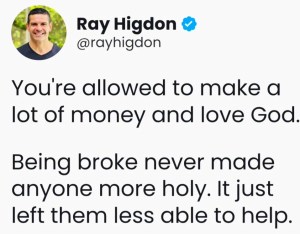
I thought the above a rather interesting meme. It seems to me to contradict at least three of Jesus’ admonitions.
After his good news that God’s Kingdom on the Earth was just around the corner, the subject that exercised Jesus (or at least his script writers) was wealth. Like many today, he wanted to see the wealthy brought down; they would he said be excluded from the Kingdom when it arrived. Not just because they were wealthy – rich, as he called it – but because they failed to give their wealth away to the poor (Luke 16:19-31).
I’m not rich by today’s standards, but compared with those of Jesus’ day, I am wealthy, as you probably are too, dear reader. I do not harbour any grudge against those who are truly rich. I’ve no desire to be like them, and I accept the part I’ve played in making many of them as wealthy as they are. I’ve bought their products, as have we all: think the CEOs of Windows, Microsoft, Apple, Amazon, Facebook and others; ridiculously wealthy pop singers, writers and sportspeople. As long as the very wealthy pay their taxes, that’s okay by me. In fact, the wealthiest 1% in the UK pay 29% of all tax, while in the US the top 10 percent of income earners pay more than 60 percent of all federal taxes and 72 percent of income taxes. I’m not defending the rich here, but if they weren’t rich and didn’t pay the tax they do, who do you think would pick up the tab? That’d be me and you. On top of this, the fact that governments squander much of this money isn’t the fault of the tax payer, rich or otherwise.
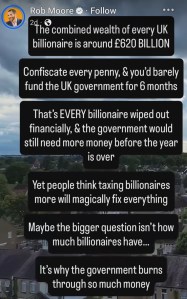
My point is that what Jesus thought of as rich now encompasses millions of today’s Christians. So how do they deal with Jesus’ demand they should sell all they have and give the proceeds to the poor (Matthew 19:21, Luke 19.22)? His belief that their admission into the Kingdom is as unlikely as a camel passing through the eye of a needle (Mark 10:25, Matthew 19:24, and Luke 18:25)? His warning that they shouldn’t accumulate riches (Matthew 6:19-21)? His insistence that they can’t serve God and money (Matthew 6:24, Luke 16:13)?
They ignore it all, or fudge it, just like our man in the meme:
- ‘But if I give it all away, how will I go on helping?’ (I don’t know, I’m not the one who’s telling you to give it away.)
- ‘Giving my money away won’t make me holy.’(Jesus seemed to think it would; giving your wealth would both ease the lot of the poor and grant you eternal life.)
- ‘It’s loving money more than God that is the problem.’ (If so, why didn’t Jesus say this? He tells you just having money means you will put it before God.)
- ‘But God wants me to be rich.’ (Again, he might have mentioned it. He says the priority is to have spiritual riches in heaven, not actual wealth here on Earth: Matthew 6:19-21)
There’s no getting round it. Jesus, as he’s written, was an extremist who believed he, and those he preached to, lived in the very last days. Consequently, wealth, money, possessions didn’t matter any more. They could and should be shed so as not to prevent entry into the imminent Kingdom of God.
Significantly, today’s Christians don’t use the excuse that Jesus was speaking to a world that was about to end 2000 years ago. They can’t, because that would mean they would have to acknowledge he was wrong. The world did not end, the judgement did not happen, the Kingdom of God did not arrive when he said it would. They can’t bring themselves to say that Jesus’ extreme demands, that his followers give up all they have in readiness for the Kingdom, don’t therefore apply to them.

But wait! Many of them are proclaiming, yet again, that these are the last days, that the Rapture and the Kingdom are even now not far off. So shouldn’t Jesus’ injunctions against wealth once more apply? How about it, righteous ones; let’s see you giving away all you’ve got, proving you love God more than mammon and you’ll do anything to ensure you make it through the proverbial needle’s eye into his Kingdom.
If not, why not?

