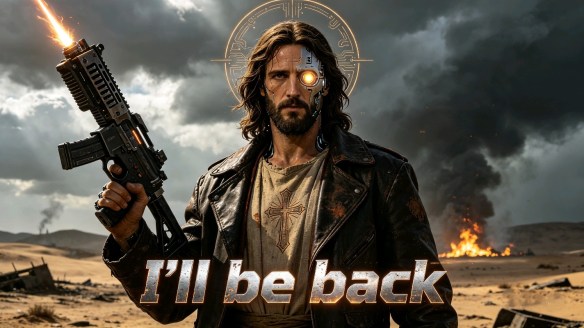
The Return!
Or rather, the absence of any Return and everything that was supposed to go with it.
If Jesus had returned when the breakaway Jewish cult were sure he would, we would be living in a very different world. The Final Judgement and the establishment of the Kingdom of God would have happened 2000 years ago. The Earth as we know it would have been destroyed and reconstructed and the righteous dead resurrected to live in the Kingdom, worshipping Jesus all day long.
I don’t know if you’ve noticed but none of this happened. According to evangelicals there’s still time (but not much). According to apologists Jesus’ return wasn’t meant to happen two millennia ago. That’s not, they tell us, what the early cultists believed.
To take either of these positions is to deny the evidence of the New Testament. Those who wrote its books believed the heavenly Christ would appear or be revealed very soon. That is, in the first century, in their lifetimes, while current conditions prevailed (specifically the Roman occupation.) Christians can deny this as much as they like but to do so they have to ignore so much that’s clearly and repeatedly stated in the New Testament. Let’s take a look at some of this evidence:
1. First is the innumerable references to the Son of Man, the Messiah, the Christ, Jesus appearing soon, first century time, to bring about the restoration of the world, the final judgement and God’s Kingdom on Earth. References like –
1 Thessalonians 4:13-18
But we do not want you to be uninformed, brothers, about those who are asleep, that you may not grieve as others do who have no hope. For since we believe that Jesus died and rose again, even so, through Jesus, God will bring with him those who have fallen asleep. For this we declare to you by a word from the Lord, that we who are alive, who are left until the coming of the Lord, will not precede those who have fallen asleep. For the Lord himself will descend from heaven with a cry of command, with the voice of an archangel, and with the sound of the trumpet of God. And the dead in Christ will rise first. Then we who are alive, who are left, will be caught up together with them in the clouds to meet the Lord in the air, and so we will always be with the Lord. (Why is Paul telling the Thessalonians this if he doesn’t mean they’ll experience these things? Why does the Lord give him this word to pass onto them if none of it would be happening for thousands of years?)
1 THEsSALONIAnS 5:23
Now may the God of peace himself sanctify you completely, and may your whole spirit and soul and body be kept blameless at the coming of our Lord Jesus Christ. (Again, Paul is addressing church members in Thessalonica, not self-obsessed Christians 2000 years later.)
1 CORINTHIANS 1:7
So that you are not lacking in any gift, as you wait for the revealing of our Lord Jesus Christ (Paul doesn’t think to mention they’ll be waiting 2000 years? That’s because he had no concept they would be.)
MARK 9:1
And he said to them, “Truly, I say to you, there are some standing here who will not taste death until they see the kingdom of God after it has come with power.” (Couldn’t be plainer, could it. But there are those who argue the kingdom of God did arrive soon after in the form of the church. That’s a disappointingly poor heavenly Kingdom, don’t you think?)
MARK13:26-31
…people will see the Son of Man coming in clouds with great power and glory. And he will send his angels and gather his elect from the four winds, from the ends of the earth to the ends of the heavens…. when you see these things happening (the destruction of Jerusalem), you know that it is near, right at the door. Truly I tell you, this generation will certainly not pass away until all these things have happened. (Not you ‘will’ know: you know already, present tense. That’s the cult’s inner circle he’s talking to. Jesus says The Son of Man will return in the time-frame of their 1st century generation.)
MARK 14:62
Jesus said, “… you (the Roman authorities) will see the Son of Man seated at the right hand of Power, and coming with the clouds of heaven.”
MATTHEW 24:44
Therefore you also must be ready, for the Son of Man is coming at an hour you do not expect. (The ‘you’ being the audience for this gospel or, if you want to insist Jesus really existed, the people right in front of him whom he was addressing.)
MATTHEW 24:42
Therefore, stay awake, for you do not know on what day your Lord is coming (what day: he’s measuring it in days, not millennia. 2000 years is a long time for his audience to stay awake.)
JAMES 5:7
Be patient, therefore, brothers, until the coming of the Lord. See how the farmer waits for the precious fruit of the earth, being patient about it, until it receives the early and the late rains. (James couldn’t possibly be expecting the audience in front of him to ‘be patient’ for 2000 years!)
JOHN 5:28-29
…an hour is coming when all who are in the tombs will hear his voice and come out, those who have done good to the resurrection of life…
HEBREWS 10: 25-25
And let us consider how to stir up one another to love and good works, not neglecting to meet together, as is the habit of some, but encouraging one another, and all the more as you see the Day drawing near. (It. Was. Expected. Soon.)
HEBREWS10:37
For, “Yet a little while, and the coming one will come and will not delay (ditto.)
1 PETER 4:7
The end of all things is at hand; therefore be self-controlled and sober-minded for the sake of your prayers.
REVELATION 1:7
Behold, he is coming with the clouds, and every eye will see him, even those who pierced him, and all tribes of the earth will wail on account of him. Even so. Amen.
REVELATION 3:11
I am coming soon. Hold fast what you have, so that no one may seize your crown. (Soon is not by any stretch of the imagination, 2000 years in the future. And no, a thousand years is not like a day to God, despite the forger of 1 Timothy’s excuses.)
REVELATION 22:12
Behold, I am coming soon, bringing my recompense with me, to repay each one for what he has done.
REVELATION 22:20
He who testifies to these things says, “Surely I am coming soon.” Amen. Come, Lord Jesus!
(That’s enough. I’m fed up cutting and pasting, and you’re probably fed up reading these quotations. Well done getting this far.)
Moving on, there’s –
2. The evidence the earliest Christians believed the Messiah would soon appear to put their world to rights that’s embedded in the culture-bound parables. These are the little homilies that begin ‘the Kingdom of God is like…’ It’s like first-century virgins with oil lamps, farmers scattering seed by hand and travelling on donkeys as it turns out. These are stories written for a first century audience for whom they were familiar, daily features of their lives. Their creators wanted to convey the fact, as they saw it, that the Son of Man would soon erupt into the world as they knew it, donkeys and oil lamps included. They were not created for a 21st century audience.
There’s also –
3. The extreme morality espoused by Jesus; evidence the early cult believed the end and new beginning were nigh. They have Jesus proclaim a morality that can only be realised in the short term. Wealth and possessions are of no value in a world about to end; self preservation of no matter; prioritising family of no concern. Debasing one’s self in the service of others; selling your possessions – what good will they be anyway in the world to come? – and giving all your money to the poor; forgiving repeatedly; helping the sick, the naked and the imprisoned: these are what matter in a world that is going to end soon. These demands, unsustainable in the long term, are the treasures to lay up in heaven in a world that is soon to end. With this kind of morality, you can be part of heaven’s imminent arrival on Earth.
The evidence is clear: the early Christians, including those whose writing ended up in the New Testament, believed the Christ was coming to the Earth very soon. None of them knew exactly when but they were convinced it was imminent. And they were wrong.
Those who have predicted his coming in the intervening years were all wrong too. Those who tell us today that he’s about to appear are equally wrong. The promise or threat of Jesus appearing in the clouds and all that goes with it, is the greatest failure of the faith. Didn’t happen, won’t happen. It’s a fantasy generated by ancient zealots and sustained by deluded souls in denial of the evidence to this day.
Whatever excuses evangelicals and apologist try to make, the non-return (or first time arrival) of the Son of Man, Messiah or Christ is Christianity’s most monumental failure.