In the Beginning, our End

For God so loved the world that when the first humans couldn’t resist the temptation he deliberately put in front of them, he abandoned them, sending them, and every other creature that occupied the Earth, into terminal decline. He loved the world so much that because of this one transgression he introduced death into his not-so-perfect creation. And he didn’t care. He let them and their descendants all the way down to the present day waste away, miserably and painfully, until they were finally extinguished.

He had to adjust other parts of his creation to assist in this process. He changed the purpose of microbes and viruses so that overnight they became the agents by which he could wipe out the humans he loved so much. God knows what the original point of these creatures was, but he adapted and evolved them with his special magic to suit his new, all-loving purposes. He rapidly evolved still others – flies, larvae, scavengers and still more microbes – so that they became waste disposal systems. Without them, the corpses of all the humans and animals he’d condemned to die would lie around forever, cluttering up the Earth.

This is how the Bible tells it anyway (with a bit of extrapolation from me), the linchpin on which rests not only Judaism but Christianity too. Yes, I know it’s an allegory – though there are still many today who take it literally – but either way, it’s a terrible story. Even without an understanding of evolution, not to mention human psychology, it makes absolutely no sense.

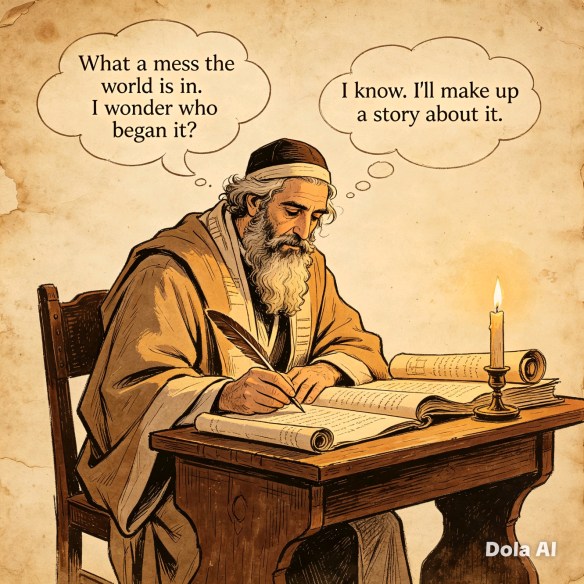
The priest or whoever wrote it (it certainly wasn’t Moses) didn’t have special insight into the mind of God (guess why) nor did he know anything about any archetypal human couple. (He wasn’t there, see.) Instead, he saw the sorry state of the world, including how he and his fellow tribesmen lived short, brutish lives that after only about 40 years (if they were lucky) ended in a miserable death. It seemed irreconcilable with his deity who he felt sure must have created a perfect world. How could he not have? Disease, death and decay could only be the fault of humans. They couldn’t possibly be his perfect God’s doing. So he wrote his myth but still couldn’t exonerate YHWH – his neglect and callousness, not to mention the necessity to evolve microbes and the like to carry out his final solution for his so loved creation. He doesn’t come out of it well; he’s ‘loving’ but having unfairly tempted his creation, he takes offence when they ‘disobey’ and condemns them all, including those not yet born, to a short brutish life ending in a miserable extinction. That’s how much he loved the world.

The original author or someone after him tacked the Adam and Eve story onto an existing one about the creation of the Earth and from then on, up to modern times, his myth was accepted as the truth about our origins (and ‘fallen state’). How do we know this? Because this is how myths are created. They are early attempts to explain life, the universe and death, usually set in the distant past and involving the imaginary gods of the culture that produced them. They were never written, inspired or passed down by deities that have never existed; they’re explanatory stories made up by humans, all of them now redundant.

Meanings, Feelings and Escapism.

This post is a response to an anonymous ‘comment’ by, I think, our camp friend, Don. I have asked him several times to ensure his name is attached to his comments but he persists in submitting anonymously. This is the reason I haven’t published the comment he so generously blessed us with in response to It’s A Small World After All. It has all the hallmarks of a Don sermon: it’s overlong, condescending and redefines words to suit his agenda. Here it is with my comments in blue.

Neal, you’d be right at home with Kafka and Nietzsche. Who is this ‘Neal’ of which you speak?

As you come to the end of the essay – good one by the way – I think you do something that many do; you confuse purpose and meaning. It is easy to do. Even the theologians do it. But you, the great Don Camp, do not because you know better than everyone else. We should all fall on our knees before such a wonderful and wise prophet.

Purpose is what I do or am to do. And I do need that. It is work. I think it is built into us. I feel like I have fulfilled my purpose when (I) serve others.

Meaning is what I receive. So we’re playing semantics again. Despite the fact that meaning and purpose are two sides of the same coin, you want to split them and make them substantively different.

I asked AI to define meaning and it came up with this:

There is no single objective meaning to life; instead, it is a blank canvas. Philosophically, the prevailing view is that you are responsible for defining your own purpose (my emphasis). People generally find meaning through personal connections, pursuing passions, contributing to the world, and embracing the experience of being alive.

Oh dear, even silly old AI ‘confuses’ meaning and purpose. Evidently it needs you, Don, to advise it.

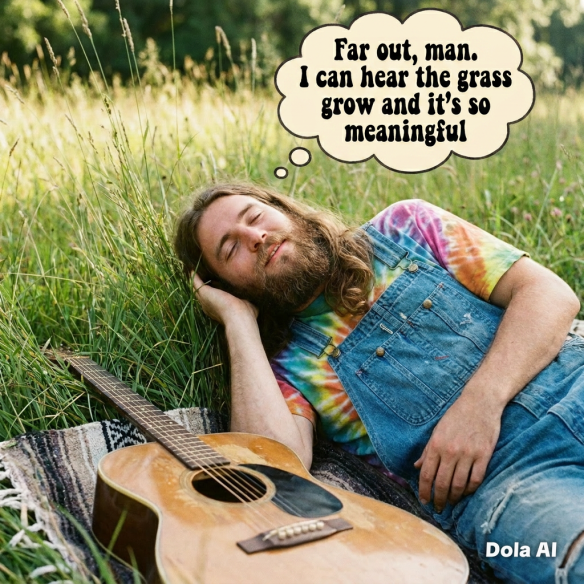
Meaning is what I receive. It is joy. It is what I receive when I sit on a high cliff and watch sea waves crashing upon the rocks below. Or the joy I receive when I stand and survey rolling hills of sage and juniper trees and bunch grass bowing in the warm wind. Or the joy that sweeps over me when I sense God close and am embraced by his goodness. And in all these and many more I feel like this is what I was made for. In all these I feel a oneness and completeness. I could be at peace with these forever. These are subjective feelings, as you inadvertently acknowledge with your use of the word ‘feel’. For some reason you mistakenly interpret your own emotions as externally supplied. You say you ‘receive’ meaning in this way as if it’s transmitted from somewhere outside yourself. It isn’t; what you’re experiencing is ‘emotional reasoning’, mistaking emotions for something that exists beyond yourself.  

Your emotions are not meaning in themselves. Listening to the grass grow or watching the ocean waves for all eternity isn’t going to provide you with anything like meaning. Not that you’ll get the chance, of course, when you’re not going to live forever. How careless of you to confuse feelings with meaning, Don.

But I am brought back too soon to a world that is too much with us. That’s the fleeting nature of emotions, Don. Feeling the world is too much ‘with us’ (incorrect preposition?) is also an emotion, not an eternal truth. What it comes down to is, as Exub1a puts it, preferring your own constructed reality over the beautiful chaos of real life.

I think the two together, purpose and meaning, are what life is about. But they are only satisfying to me when they include forever. Oops! Offer is time limited and excludes forever. Sorry Don. You’re living in a delusion. Without that there is an incompleteness, like the loss when one who was part of that completeness dies. Says who? It’s a non-sequitur to claim that life without delusion is meaningless. Of course, it’s an assertion beloved of religionists who like to tell non-believers their lives are meaningless without their imaginary God. It’s a lie, Don.

Without that I at 81 would be an old man like Ernest Hemingway when the fishing and hunting and women were gone. The only thing left is to end it. Nonsense. You’re very fortunate to be 81. I know 81+ year olds, who enjoy life as I, a mere stripling of 71, do. Even when it is restricted by the infirmities of older age there is still much to live for. If your fantasy is all that makes your life worth living, you are indeed to be pitied (cf. 1 Corinthians 15:19).


That’s it, Don. If you want to comment in future your comment must include your name somewhere. Otherwise, straight in the trash it goes. And what would be the purpose of that?


Advice

Image sourced here

Good news, everybody. The UK Government has released its ‘advice’ to help us all avoid ‘anti-Muslim hostility’. Thank God we have such intellectual giants as Keir Starmer to advise us on such matters. We must not, it turns out, treat Muslims ‘as a collective group’ with ‘fixed negative characteristics’.

This, it also turns out, is what human beings do with every group that exists, and every group that has ever existed, since the beginning of time. We lump people of comparable beliefs and behaviours together no matter how much each category protests they represent a multitude of nuanced perspectives: Jews, Christians, LGB, Trans, environmentalists, Mormons, atheists, feminists, Rastafarians, teachers, sinners, billionaires, politicians, Americans, journalists, the Right, the Left… They’re all subject to criticism as ‘collective groups’. This is often on the basis of the bad behaviour of a few of their ‘community’, or of a caricature of what a member of these groups is perceived to be (as a gay person, I speak from being on the receiving end of this kind of condemnation). It’s neither fair nor reasonable to do this, I agree, but it is what happens. But now we are ‘advised’ we must not do it of Muslims. Don’t criticise Muslims as a whole just because some of them are inclined to blow people up. Don’t criticise them collectively for the pronouncements of extremist preachers. Don’t even criticise them for the practices of the majority.

Okay. But shouldn’t that also extend to all the other ‘communities’ I’ve mentioned? Yes, and it would in an ideal world. Unfortunately, this is not an ideal world. While we continue to judge Christians as a whole, on the basis of the hypocrisy of some, LGB people because of the excesses of a few and Jews because of the actions of their state (Muslims and their trendy left-wing supporters do exactly this in the case of Jews), then why can we not judge Muslims similarly? You’d have to ask Starmer that. But don’t expect him to give you a straight answer.

Oh, and how long before this ‘advice’ becomes law? 

Showing Off

We interrupt this blogcast to bring you breaking news of shenanigans in the wonderful, wacky world of religion.

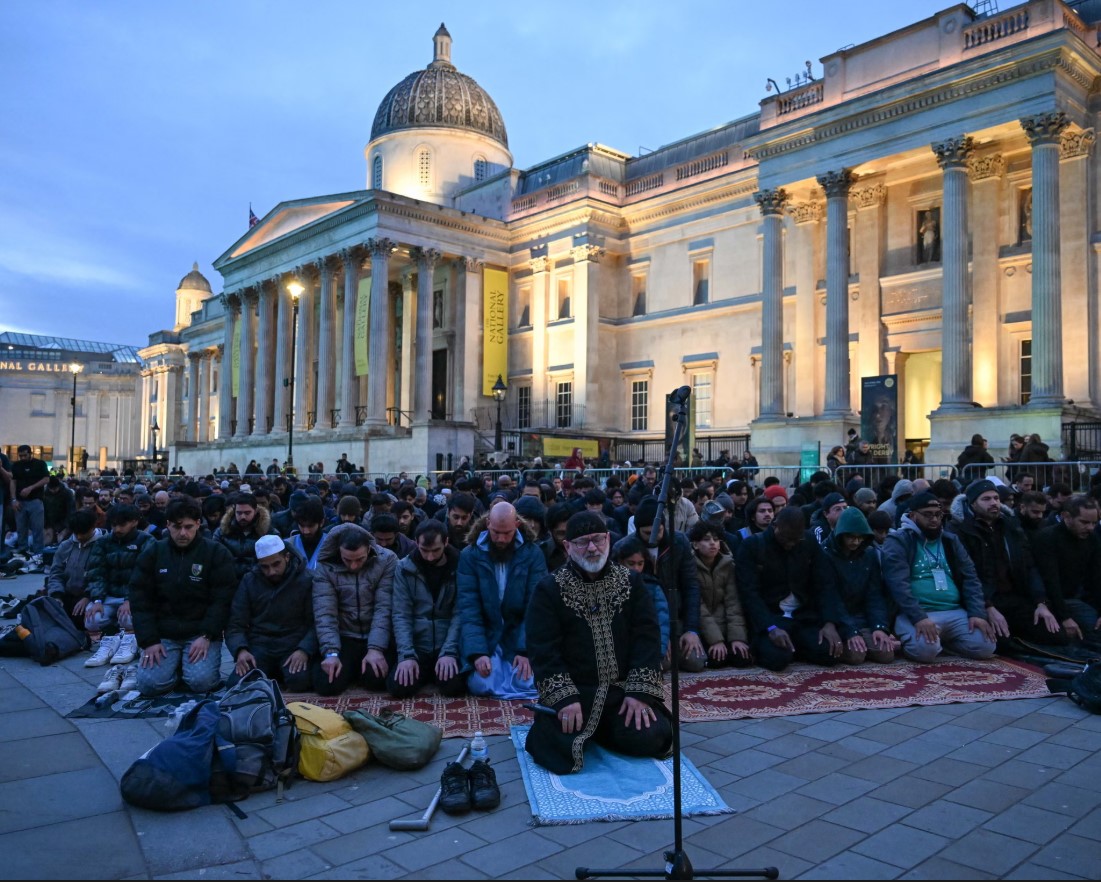
There’s been a kerfuffle here these last few days after Muslims gathered in Trafalgar Square to engage in mass prayers (that’s mass as in ‘3,000 men‘, not Mass as in the cannibalistic ritual beloved of Catholics.) This was not well received by many in the capital with a number of politicians on the right questioning whether it was really the Good Thing the Muslim mayor of London (and number one Donald Trump fan), Sadiq Khan, thought it was. Sadiq is himself is a Muslim and was present at the pray-in, taking selfies with his admirer. One politician who thought this wasn’t kosher (am I confusing things here?) was Nigel Farage – Donald’s real number one fan – who suggested that if he were ever to become Prime Minister (there’s a chance), he would ban ‘performative public prayer’ of the sort witnessed in Trafalgar Square.

This seems to me not an unreasonable proposition given the Quran (Surah Ma’oon, 107:4-7) regards ostentatious public prayer gatherings as not quite the done thing:

So woe to those who pray yet are unmindful of their prayers; those who show off

Naturally, Christians have waded into the controversy, wailing that should Muslims be stopped from enjoying prayer spectaculars, they too might be prevented from doing the same thing. Some fear carol singing and pushing their faith on others who have no interest whatever in hearing it might similarly be prohibited. Of course, banning public prayer would not, unfortunately, include carol singing or proselytising on account of the fact that neither of these two activities are prayer bonanzas in and of themselves.

The authors of the Bible also seemed to think that ‘performative prayer’ is a no-no. As Jesus’ script writers have him say in Matthew 6:5-6:

And when you pray, do not be like the hypocrites, for they love to pray standing in the synagogues and on the street corners to be seen by others. Truly I tell you, they have received their reward in full. But when you pray, go into your room, close the door and pray to your Father, who is unseen. Then your Father, who sees what is done in secret, will reward you.

Let’s not forget that as well as being God incarnate for brainwashed Christians, JC is a prophet in Islam. Both Christians and Muslims are prepared, naturally, to ignore their holy books, their prophets even, when they take to the streets and squares of modern cities ‘to be seen by others’ as they debase themselves in front of imaginary gods. It’s not Nigel Farage who wants to forbid ostentatious public displays of piety. Jesus and Mohammed got there first.

As a post script, can I mention that as an atheist, I find these prayer pantomimes, by whichever brand of the deluded, to be both unnecessary and offensive?

No, I thought not.

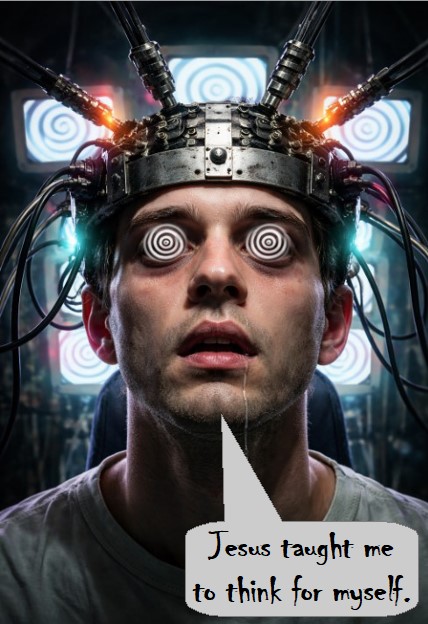
How some see others as brainwashed while they themselves are not

You may have been informed yesterday that a new post was available. For some reason, WordPress may have briefly put next week’s post online while I was working on it. If so, please ignore it as it really needs to be read after this week’s post. As we’ve recently been reminded, context is all! Here’s the correct post for today:

Apparently, I’m anti-intellectual and a fascist. This was revealed to me when I became involved in a discussion on Facebook about a highly suspect report claiming less well educated people were more likely to vote for right-wing parties. This, the Facebook ‘experts’ scoffed, was because less well educated people were brainwashed and indoctrinated. My mistake was in suggesting that better educated people were just as likely to be indoctrinated as their less well educated counterparts. Perhaps higher education institutions, inclined to the left, might influence the views those attending them to the extent that they too are conditioned. Hence, the accusation I’m anti-intellectual and a fascist*.

This happy experience got me to thinking about the extent to which we’re all indoctrinated/ conditioned/brainwashed.

Like many of you reading this, I was brainwashed as a Christian. I swallowed whole the story I was told: that I was a sinner in need of salvation because my sin alienated me from God. Jesus had to give his life so that I might be reconciled to God. I had to accept Jesus into my life. I would then live forever, going to heaven after I died to be with God, Jesus and the angels. You know this story. And a story it is. As Yuval Noah Harari shows in his book Nexus we – all of us not just the less well educated – are more susceptible to investing in a story than in cold hard facts or evidence (not that there is any evidence for this Christian narrative, as with so many of the others we’re subject to.)

Then there were too all those optional additions to the Jesus story that weren’t optional at all: God would meet my needs if I prayed in earnest, read His Word (always with the capitals), met with fellow-believers and listened to the prompting of God’s Holy Spirit inside me. (Deep breath.) Also If I shared my faith with others (‘witnessed’), grew in my walk with him (a mixed metaphor, surely?) and regularly gave money to the work of the church, then I’d be a True Christian™. You and I could not be reasoned out of any of this, because we weren’t reasoned into it in the first place.

The indoctrination was reinforced on an ongoing basis, which is why we were constantly told that we must ‘fellowship’ with those who had been similarly brainwashed. We were told we must also reject and separate ourselves from the thinking and values of non-believers (‘the world’) because they might be a threat to what we were being taught, causing us to backslide and out of the Truth (a feature of every cult.)

There came a point for some of us, however, when a small chink appeared in our armour of God conditioning: an unanswered question about something we’d been told that seemed, well… a little off; an unconvincing attempt to reconcile faith with an aspect of science; the realisation in a crisis that God wasn’t there at all.

It was this latter for me, and as I’ve said before, I began to read books I hoped would throw some light on what I’d believed for so many years. Did these books condition me in ways contrary to those I had escaped from? Yes, probably. But I didn’t subscribe to their stories unquestioningly. I weighed arguments and evidence, taking some on board, putting some aside and creating a synthesis of views as diverse as Carrier’s (Jesus was probably mythical) and Ehrman’s (Jesus existed but was mythologised by early converts.)

I’m quite prepared to accept that this too was a form of conditioning, my selection and rejection of arguments and evidence being determined by my being predisposed to find some persuasive and others not. This predisposition was of course part of earlier conditioning to which I had already been subject, the result of my liberal education that taught me to be impressed by sound argument and evidence. We can’t invest in a position, idea or even propaganda without previous conditioning predisposing us to. Our politics, religious beliefs, rejection of religious beliefs, perspective on life and morality are not genetic. We do not arrive equipped with them, rather we learn them from our environment, our parents, our education, influential people in our early lives, the media, our reading, our culture, the zeitgeist, the groupthink we’re subjected to and the bubble in which we find ourselves. In short, the views we’re exposed to, which is why most of us in the West are not communist or Muslim. Even rebelling against familial or societal values is a form of conditioning, replacing the views and values of our parents or school with others from, for example, a subculture or political cause.

We are never in a position to exercise ‘free will’. We can only make decisions about that which confronts us in the present, with whatever we have internalised in the past. I don’t think there’s ever been a truly original thought in the history of humankind because each thought depends on that which has gone before, both in our own heads and in the heads of others. Your position on any issue, your opinions, views, religious/anti-religious beliefs politics are all the result of conditioning, as selective as that might have been as a result of your conditioned predispositions.

Where does that leave us? Not as ‘free thinkers’ (your free thinking will conform fairly closely with that of other ‘free thinkers’) nor as entirely open-minded (your previous conditioning and the predispositions it led to have taken care of that.) It will, in all likelihood leave you exposed – even though you may regard yourself to be immune – to whatever political and social propaganda is circulating in your particular culture. We’ll take a look at this next time – if you’re predisposed to.

*For the record, I have not so far voted for a right wing party in all of my 70 years. I get my news from a variety of outlets, some left wing, some right. I spent all of my working life in Education, the latter part as an academic; anti-intellectual I am not, though I have little time for those who flaunt their credentials and use them to cudgel others.

The Prophet’s Return

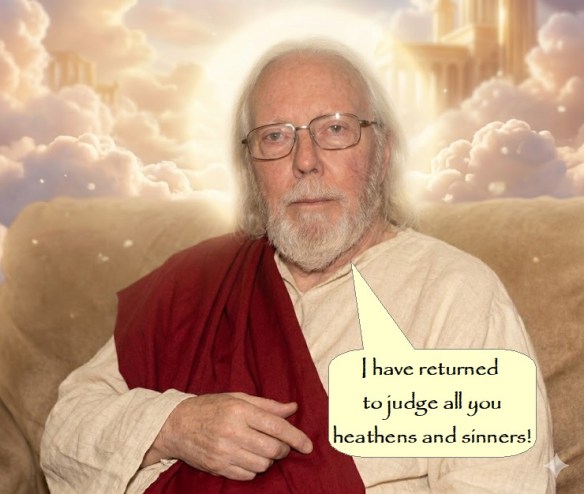
He’s back! After all this time, Jesus has returned! He came through the clouds the other day to judge us and save us from our sin and ignorance!

Oh wait… it’s not Jesus. It’s Don. Yes, Don’s back, eager to rescue us from ourselves. That’s almost as good as JC making a long overdue appearance, don’t you agree?

Let’s see what the sage has to say this time. He commented on three posts: Racism? What Would Jesus Do?, Conversion Porn and Falling By The Wayside. I’m not going to address his comment on Falling By The Wayside as it’s merely a plug for his own blog, something I’ve previously asked him not to do. His other two comments are below. All typos, leaps of logic and condescension are in the originals.

First his response to Racism? What Would Jesus Do?:

A alwaysNeil, you display a particularly poor knowledge of he N.T. and a surprisingly poor ability to read a text given you are a literature guy. You should know, though perhaps it was not part of the curriculum, that any chunk in a text is connected to all the rest and should be read with that in mind. And you should know that there is a cultural and historical context to every piece of writing. You wouldn’t read Tale of Two Cities without considering those, right? Why read Matthew in bits and pieces, then?

Thanks Don, I do know how to read a book, but like you I focus on a particular section when constructing a blog post. Just like preachers do when preaching, just like the set readings do in the liturgy, just like Christian bloggers do. Just like you do, in fact. You do exactly this in the post for which you sent the link. Why do you do that? Don’t you know how to read a book?

All the same, I do set what I say in Racism? What Would Jesus Do? in context: the milieu in which Jesus and his scriptwriters existed. For example, I say, ‘Many of Jesus’ admonishments were written by cultists anticipating the end of the age for members of their own group; they were all too happy to lash out at those who weren’t part of it.’ We know this from the way NT writers address dissidents (‘anti-Christs’), Jews (‘children of the devil’ etc) and those they saw as opponents (‘evil-doers’, ‘dogs’). I also referenced the racism Jesus exhibits in the other gospels. Did you miss this? Do you not know how to read?

Your ‘argument’ is actually nothing but that old chestnut, ‘you took it out of context’. So tell me, Don, what would Jesus’ unpleasantness look like if it were in context as you might define it? Of course you don’t actually tell us how you define it: are you talking about the surrounding verses? The chapter? The whole gospel? The entire New Testament? The Bible from beginning to end? Would Jesus’ behaviour be any more justifiable in these ‘contexts’? Would you be able to excuse it more easily? Do tell us how a wider context would change what Jesus says.

Next, Don passes judgement on Conversion Porn:

Greetings Neil. It jewels to me from your tone, you have reached the bottom of the barrel. So let me give you some more conversion porn.

Richared Bransford, Air Force surgeon who after his toru went to Africa with African Island Mission and spent 30+ years building hospitals and medical clinics and training African medical personnel across east africa. And worked himself in surgery where I visited him in the early 90s. He didn’t write a book or get rich.

Corrie ten Boom. prisoner of the Nazis who lived (her family did not) to tell about how God changed her to love her captors and went on to tell how God made her a new person through her painful imprisonment. Yes, she wrote a book. The Hiding Place.

Harriet Tubman, a slave, who escaped and helped many, many of her fellow negro slaves find freedom. She did not write a book or get rich, though many books have been written about her and a movie was made more recently.

Eric Liddell, olympic runner and missionary to China where he served the poor and where he died in a Japanese internment camp in 1945. Poor I might add. He wrote no books and made no movies, though there have been those made about him.

These are some of the well-known followers of Jesus. Add to them many thousands who worked in rescue missions for nothing, who served as nurses, as my wife did, with no recognition, who fought slavery, who went to India, as my daughter did, to create homes for rescued traffic girls, who build homes for homeless people, as I have done, at their own cost. No one will ever know of them.

What about them, Neil? They believed the “conversion porn” and made a difference in the world.

Don, most of these examples are the same ones trotted out 55 years ago when I was a young Christian. No doubt these individuals did remarkable things, and ‘Richared’ Bransford too. But they’re a select few out of the millions of Christian converts in the hundred years since Eric Lidell. What about all those others? What did they all do? And what about the non-Christians who achieved as much?: Oskar Schindler, Nicholas Winton, Chiune Sugihara, Malala Yousafzai, Chen Shu-chu, Lou Xiaoying (look them up). And, seeing as we’re including people known to us, the young atheist surgeon, the daughter of a friend of mine, who has spent years now in African hospitals working for nothing, despite being diagnosed with cancer herself (now recovered, thanks to medical science, not Jesus).

You see, Don, you’ve selected half a dozen remarkable individuals out of millions without considering the context. Statistically, your examples are insignificant. Maybe most of them didn’t make money from writing books or otherwise cashing in on their service but as I noted in the post, there are certainly those who do. We all know of the many preachers and evangelist who are multi-millionaires. You’ll no doubt say these are not True Christians™, so should be disregarded. Except… they can’t be; they are Christians and they’ve done very well off the back of it. Conversion porn, indeed.

Don, if you’re back to commenting, bear in mind that you won’t get off as lightly this time as you did a couple of years back. I’m not going to put up with your sly ad hominem remarks, your limited, narrow perspective of the Bible, your evasiveness and condescension and your shoddy promotion of Jesus. Comment at your peril.

Falling By The Wayside

Bob Dylan’s conversion to Christianity was short lived. Those who trumpeted his being ‘saved by the blood if the lamb’* in 1979 were strangely silent about his leaving the faith in 1982.

Didn’t Jesus say this sort of thing would happen? Sure he did. In Mark 4:1-20 he warns that not everyone who heard ‘the word’ about the coming of the Kingdom of God would take it to heart. He dressed it up as a story about a sower who scattered seed willy-nilly so that most of it was wasted. Some fell by the wayside, some in shallow soil, some the birds carried away. Only a fraction of the message took hold, and those who in whom it did endured.

It’s as if Jesus knew in advance that many of those who heard his message once he’d gone would lack the resolve to persist in ’the way’. Or did he? Isn’t it more likely that by the time Mark wrote his gospel, 40 years after the cult had got underway, there were may who’d given up on the idea that the Messiah was soon going to come through the clouds to inaugurate God’s Kingdom on Earth. They had abandoned such a ridiculous notion and had left the cult behind.

How then to explain such a destabilising and unexpected course of events? Wouldn’t the Saviour have known this would happen? Of course. And so the parable of the Sower was invented to ensure it looked that way.

The writers of the fourth gospel try a different tack by having Jesus pray for unity (John 17:20-23) which of course they wouldn’t have had to do if there wasn’t already disunity. We know there was division in the early church because Paul and the authors of Hebrews and 1 John (2:!9) write about it. Hence the sticking-plaster solutions to the problem in the gospels – the parable of the Sower and Jesus’ unity prayer. It surely couldn’t be ‘the word’ itself that was the problem. No, it had to be the shallowness and flightiness of those who heard it. Or maybe, as Paul suggests, it was simply that God hadn’t chosen them, back at the dawn of time, to be part of his glee club. They were deluded if they thought so. Nevertheless, they needed a means of letting God and Jesus off the hook.

Bob Dylan and those like him in the centuries that followed didn’t stand a chance with this kind of reverse-engineered thinking.

*Dylan’s own words in his song ‘Saved’ (1980)

Conversion Porn

You’ll recall, I’m sure, all those stories you were told at church, youth group or summer camp about people, almost always the worst of sinners, who had wonderful, supernatural conversions. They turned from debauched lifestyles to Jesus, who set them on the right path and turned their lives around. I’m sure there were people who experienced something like this, but any overpowering emotional experience can produce similar results. Remember those high-profile conversions though? When Jewish Bob Dylan gave his life to Jesus and made gospel albums. My, how we rejoiced! Nicky Cruz of Run Baby Run fame, saved by Jesus from a life of knife crime. Doreen Irvine, one time prostitute, stripper, heroin addict and witch who turned to Jesus to find redemption, not to mention a best-selling book, From Witchcraft to Christ. Joni Eareckson who broke her neck diving into shallow water and, paralysed, called upon the Lord to help and restore her.

Boy, did we love these stories back in the early 1970s. I can’t remember how many times the church youth group was shown The Cross and the Switchblade, with Eric Estrada as Nicky Cruz and Pat Boone as David Wilkerson, the pastor who converted him. I know a dog-eared copy of From Witchcraft to Christ was passed round too and that we took a bus trip to see Doreen Irvine speak somewhere. Likewise Joni Eareckson’s and her best-seller. (I still have some admiration for Joni, who seems the most genuine of them all, despite making a living from her life-changing accident and subsequent conversion.)

Bob Dylan’s gospel albums? Not so much. Who wants to hear him torturing some less than sparkling songs about Jesus? Certainly not me, not now, not even then. Despite claiming he saw Jesus in a vision, Dylan’s love affair with JC was mercifully brief.

What I didn’t do at the time was ask questions of these stories, particularly whether they were really credible. It’s strange how all of their protagonists got best-sellers out of their miraculous conversions. How most hitched a ride on the Christian speaking circuit, not to mention the movies some of them had made of their stories. It seems a good living could be made from meeting Jesus. But credible? Not so much. Certainly Doreen Irvine’s story has been disputed and debunked. I should have asked too why Nicky Cruz and his gang were the only ones saved out of all of the knife gangs in New York in the 1960s. Was Jesus not interested in the others, nor their potential victims? What about their non-conversion stories? And Joni: why did she have to be paralysed for Jesus to get in touch? Was she really restored by him? Certainly not physically; she remains paraplegic to this day, still clinging to stories of how Jesus saved her. Does she not wonder why he didn’t act a few seconds earlier to prevent her terrible accident? (Apparently not: she ‘rationalises’ her accident as God discipline of her in order to bring her to himself. Nice God you got there, Joni).

I wish I had asked these questions back when I was a gullible teenager subject to the church’s propaganda, instead of lapping up the conversion porn they made sure came my way.

Jesus the Great Revolutionary

According to Matthew and Luke’s gospels, Jesus was a revolutionary. He wanted to see the world turned around, the very meaning of the word revolution. He preached that the world as it was would be destroyed and remade, this time with the social order reversed. Those who had been first in the old order – the rich, the powerful, the cruel – would be made to be the last, while those who were formerly last – the poor, the downtrodden, the lowly, the compassionate – would find themselves in first place. They’d be best in show, the new top dogs and, in ways that really mattered, rich. Meanwhile, those who had really committed themselves to him, his closest followers, would become the rulers with him of the renewed revolutionised order that he envisaged: his Kingdom of God.

How would all this happen? Jesus’ Father in Heaven would soon be sending the Son of Man to set the revolution in motion. This powerful being, who perhaps Jesus envisaged as being none other than himself, would ensure all the unimaginable but necessary changes would be achieved. There would be some violence of course, because you can’t have a revolution without at least a little violence:

Do not think that I have come to bring peace to the earth; I have not come to bring peace, but a sword. (The Prince of Peace himself in Matthew 10:34)

Even now the axe is lying at the root of the trees; every tree therefore that does not bear good fruit is cut down and thrown into the fire. (Matthew 3:10)

Once the old is done away with and the new order established, there would be something of a socialist utopia on Earth. Everyone would share what they had; each would have his or her needs met by everyone else. Even those who came late to the party would enjoy all the rewards the new Kingdom had to offer (Matthew 20:1-16). There’d have to be some slaughter too of course: the one who advocated loving one’s enemies looked forward to exacting bloody revenge on his:

But as for these enemies of mine who did not want me to be king over them—bring them here and slaughter them in my presence.” (Luke 19:27. See also Revelation)

Except of course, none of this happened. The Son of Man did not emerge from the clouds when Jesus expected him to. He himself did not become the Son of Man, ready to kick-start the great social revolution. Instead, the rich, the powerful and the cruel put an end to Jesus’ revolutionary ideas; they were gaining too much traction among the poor and downtrodden and needed to be quashed. An uprising couldn’t be ruled out, specially as Jesus recognised the need for force:

From the days of John the Baptist until now the kingdom of heaven has been coming violently and the violent take it by force. (Matthew 11.12)

He predicted too that blood would be spilt, going so far as to recommended his followers arm themselves:

He said to them… ‘the one who has no sword must sell his cloak and buy one. For I tell you, this scripture must be fulfilled in me, “And he was counted among the lawless”; and indeed what is written about me is being fulfilled.’ They said, ‘Lord, look, here are two swords.’ He replied, ‘It is enough.’ (Luke 22:36-38)

According to the gospels, the Jewish religious leaders persuaded the Roman authorities to do away with this dangerous revolutionary and insurrectionist. Once they were made aware of him, the Romans were more than happy to oblige. They mocked Jesus’ aspirations as King of the Jews and crucified him alongside other ‘rebels’ (Matthew 27:38).

His followers however were not yet ready to let go of him or his revolutionary ideas. Perhaps they saw the possibility of their ruling the world slipping from them. They continued to preach that he would appear again, possibly as the Son of Man, to bring about the revolution he had foreseen.

This is, as I say, Matthew and Luke’s version of events. The writers of the fourth gospel would jettison the failed New-World-Order narrative, building their own Superman-Jesus and dispensing entirely with the great social revolution. In their story, the Kingdom of God is ‘not of this world’ (John 18:36) but only in people’s heads.

The four gospels are, of course, make-believe; allegories of the hoped for Messiah. The Kingdom of God, the revolutionary leader, the reversal of the social order are what some of the earliest cultists wished for, looked for, hoped for. It is their aspirations that are reflected and embodied in the earliest gospels. Like the hopes and dreams of every cultist before and since, they came to nothing.

Many of today’s Christians would not, in any case, have cared for the Kingdom of God that Matthew and Luke’s Jesus is made to promote; far too much socialism and the wrong sort of people in charge. Jesus’ new Kings of the World would, in any case, have made a mess of things in much the same way as all those who took control in the revolutions the world did actually experience. Power, as Lord Acton put it, corrupts and absolute power corrupts absolutely. Better for Jesus that he became a personal saviour, confined to the minds of those who think he really existed, a mere revolutionary in the head.

A Big Myth-take

The nativity story is evidently a myth. The evidence?

The virgin conception and birth (similar to other myths);

Angels everywhere;

Warnings in dreams;

The wand’rin’ star;

Events created from out-of-context scraps of Jewish scripture (the virgin birth again; the shoe-horning of Bethlehem; Herod’s massacre; the flight and return from Egypt);

The heavy-handed symbolism (shepherds and their gifts; the magi and theirs);

Historically inaccurate details (disparate dates, the Roman census, Herod’s massacre);

Discrepancies between the two accounts;

The absence of the nativity and its events in the other two canonical gospels,

Disparity with later events in the gospels (Mary treasures the nativity events in Luke 2:19 only to seemingly having no knowledge of them later (Mark 3:12); John and Jesus are second cousins… or not).

And on and on.

Yet the story is analysed endlessly – two thousand years (almost) and counting – as is all that follows in the gospels. There’s a whole lot of jargon to intellectualise this , of what is, in the end, just myth: exegesis, hermeneutics, soteriology, apologia, discourse analysis, close reading. All exist to expose the truth embedded in the text and to defend it. Even those who acknowledge that the nativity story is myth (quite an attractive, cosy myth admittedly) want to confine this admission to the nativity alone. The rest – the symbolic miracles, unfulfilled prophecies, literary sermons, the metaphorical pericopes (more jargon!), the trial, crucifixion and resurrection – they want honoured as historical, factual and mystically embodying Truth. Unfortunately, all of these stories bear the same hallmarks of myth as the nativity tales. Why should these other stories be regarded as anything different?

**********

Christmas is upon us. I’m happy to call it Christmas; the name has a long pedigree and ‘Holidays’ has, in any case, its own religious connotations. Dennis and I will be spending it with my daughter and her family. I hope you too are able to enjoy it in whichever way suits you best.

A happy Christmas to you, both my readers.