Newspeak (part two of a rant)

I’ve been considering the changing meaning of words. I acknowledge that this happens over time: language evolves like everything else. My concern here is the deliberate redefining of words to suit a given (political) agenda. This often underhanded stretching of words to give them new meanings, actually diminishes them and renders them dangerous. 

As part of its definition, Merrian-Webster describes racism as ‘behavior or attitudes that reflect and foster ‘the belief in racial superiority): discrimination, prejudice, or violence against people because of their race.’

Violence, it seems to me, is hardly ever justified. I have detested it since I was a child. There can be no doubt that violence is sometimes motivated by racial hatred, but like all the words I’m dealing with here, racism as an accusation is overused to the point of meaninglessness. While other nations – the Scandinavian countries, the US, Scotland and Wales – proudly fly their national flags practically everywhere, here in the UK it has been deemed to be racist by some on the Left. It’s common for the Ukranian, Palestinian, Scottish, Welsh and LGBT flags to be flown here, why are the English and Union flags now considered to be racist? It might, at a stretch be that they are divisive, but then aren’t all flags? Isn’t that what they’re for, to declare a national identity that is distinct from that of other states? The British flag is no more ‘racist’ than any other. Neither is expressing genuine concern for immigration, which is dismissed by those who’ve failed to control it, as racist. How can it be when those coming into Britain are from a variety of ‘races’, many white and European?

It’s racist, and hateful too, say ‘community leaders’ and white liberals, to object to the treatment of women within Islam, or first-cousin marriage or frequently expressed anti-Semitism. ‘Racism’ in these instances is an attempt to shut down discussion and censure those with legitimate concerns. Similarly, for fear of being considered racist, authorities have failed to investigate (hateful) criminal activities by ethnic minorities. And while it’s become clichéd to say it, criticism of Islam and its practices is not racist: Islam is a religion, not a race, its practitioners drawn from a range of ethnicities. The true meaning of racism has been lost. Those who suffer from it abandoned in the transition of the word into meaninglessness.

My 95 year old mother was in hospital recently. She struggled to understand what some of the nurses were saying to her, either about her condition or treatment or something else. She didn’t know which because, between her deteriorating hearing, the mouth coverings some nurses wore and the accents of those from other ethnicities, she couldn’t understand them. What she couldn’t do, she felt, was say this to them. In Britain today it is regarded as racist to tell someone from another culture you can’t understand them. So she didn’t, nor did she mention the problem to any other of the medical team for fear of being thought racist. This is where we are in today’s Britain.

A Phobia of Hate (part one of a rant)

It used to be the case that when writing an essay or presenting an argument, the writer needed to define one’s terms. This way, parameters were set with clarity and, as we say these days, transparency about what was to be discussed. Sadly, this seems not to be the case any more. I don’t blame social media for this; it seems to me politicians have largely led the charge, using terms with usually clear definitions in ways that suit their own purpose, without any regard for that common understanding. Rarely do they make clear that this is what they are doing. The mainstream media are inclined to do the same. What we may think they’re talking about, they may not be. Perhaps both politicians and the media learned the trick from Christian commenters who are happy to change the meaning of words as they see fit (‘Atheists’, ‘myth’, ‘metaphor’ for example.)

I dealt with autism here. The term, and diagnosis, is now stretched so thinly that, according to the social scientist who first proposed the autistic ‘spectrum’, it has become ‘meaningless’. What other terms have been misapplied until they too have been rendered ‘meaningless’?

How about phobia? Strictly speaking a phobia is an irrational fear, one for which there is no real basis: arachnophobia, agoraphobia, claustrophobia, for example. Of course there may be real grounds for being fearful of spiders (some are poisonous) heights (if perched precariously on the top of a mountain) and enclosed spaces (if it is suffocating), but the terms arachnophobia, acrophobia, claustrophobia are reserved, or at least they used to be, for those whose fear is extreme and above and beyond the rational. The term phobia is now applied to anyone who expresses concern about or criticism of any movement or cause: homophobia, transphobia, Islamophobia come to mind. The first of these started life as an irrational fear that one might oneself be homosexual. Now it’s considered to be, by those who attribute their not ‘getting on’ in life or being subjected to personal criticism, to be the result of their being gay. Certainly ill-considered remarks may be unkind, a word that more than adequately describes much of what is described as phobic in modern society. But being unkind does not equate with a phobia, nor is it against the law. Not yet anyway.

Similarly offensive, a word originally that originally signified a physical attack, the meaning it still carries in law. As Paul Simon once expressed it in a rather pleasant little song, ‘One Man’s Ceiling is Another Man’s Floor’: what I might find offensive, in the sense of hurt feelings, is not necessarily what you find offensive, unless you choose to allow it to be. That’s because ‘offence’ in the slack modern sense is ridiculously subjective: it is, it seems, not a problem to call for the death of Jews but it is offensive to show images of an ancient ‘prophet’. Touchy religious sensibilities, sometimes prone to take offence at the slightest provocation, do not signal a criminal or even a criminal offence. And yet that is where we’ve got to, certainly in the UK. Remember your mother teaching you that sticks and stones may break your bones but words will never hurt you? Of course this is not entirely true; words can cause emotional hurt. But this doesn’t mean those who use words critically merit investigation by the officers of the law.

Hate is a verb. Unlike its antonym love, it cannot also be a noun. I know, this is pedantic of me, but we’re talking about words and the damage they can cause when misapplied. To alter and stretch their meaning out of all recognition results in the problems we now have in (British) society. All of the accusations of ‘hate’ that fly around these days are, grammatically, ‘hatred’ though in fact, they rarely qualify as this either. According to Merriam Webster, hatred is ‘an extreme dislike or disgust or ill will or resentment that is usually mutual: prejudiced hostility or animosity.’ Hatred is a powerful, destructive emotion. Reasoned opposition to the political manoeuvring of minority groups is not really it.

Of course it is possible to take such opposition to extreme lengths that it may look a lot like hatred, but by and large it is not. I do not ‘hate’ religious group that try to impose their beliefs and practices on me or my society, but I do oppose them and their efforts. I also oppose those who claim that any opposition to their efforts constitutes ‘hate’. It rarely does so, but how convenient it is for those who don’t get their own way to have the accusation in their armoury. Which is not to say real hatred isn’t expressed, often in violent action, but strangely, as a society, we seem less concerned with such action. We are, apparently, required to understand the frustrations of those carrying them out; their grievance is genuine and heartfelt. Hurty words though are of much more concern.


Advice

Image sourced here

Good news, everybody. The UK Government has released its ‘advice’ to help us all avoid ‘anti-Muslim hostility’. Thank God we have such intellectual giants as Keir Starmer to advise us on such matters. We must not, it turns out, treat Muslims ‘as a collective group’ with ‘fixed negative characteristics’.

This, it also turns out, is what human beings do with every group that exists, and every group that has ever existed, since the beginning of time. We lump people of comparable beliefs and behaviours together no matter how much each category protests they represent a multitude of nuanced perspectives: Jews, Christians, LGB, Trans, environmentalists, Mormons, atheists, feminists, Rastafarians, teachers, sinners, billionaires, politicians, Americans, journalists, the Right, the Left… They’re all subject to criticism as ‘collective groups’. This is often on the basis of the bad behaviour of a few of their ‘community’, or of a caricature of what a member of these groups is perceived to be (as a gay person, I speak from being on the receiving end of this kind of condemnation). It’s neither fair nor reasonable to do this, I agree, but it is what happens. But now we are ‘advised’ we must not do it of Muslims. Don’t criticise Muslims as a whole just because some of them are inclined to blow people up. Don’t criticise them collectively for the pronouncements of extremist preachers. Don’t even criticise them for the practices of the majority.

Okay. But shouldn’t that also extend to all the other ‘communities’ I’ve mentioned? Yes, and it would in an ideal world. Unfortunately, this is not an ideal world. While we continue to judge Christians as a whole, on the basis of the hypocrisy of some, LGB people because of the excesses of a few and Jews because of the actions of their state (Muslims and their trendy left-wing supporters do exactly this in the case of Jews), then why can we not judge Muslims similarly? You’d have to ask Starmer that. But don’t expect him to give you a straight answer.

Oh, and how long before this ‘advice’ becomes law? 

‘Those who most want to rule others are least suited to do it.’

More stories that we really should be questioning. First today, a perennial favourite:

We, the Left / Right / Green / Centrist / Mad Hatter’s Tea Party, and I as party leader, pledge to solve the country’s problems / Make America Great Again / limit taxes / reduce bills and the cost of living / build new houses / curb immigration / lift families out of poverty etc, etc. We have fully costed these policies and they are achievable, unless we discover they are not, which we might though this is unlikely, but we can’t be sure. This we promise.

Admittedly there’s a hint of scepticism in this particular paraphrase, but even so, once elections roll round again, plenty of us will be taken in by guff like this. However, politicians create more problems than they solve. The difficulties the world faces right now, those that are not the result of religion, have been created by our political leaders. Whatever they promise in order to gain your vote, they will deliver only a small fraction. Don’t believe anything they tell you. Vote for the party that tells you they’ll do f**k all, and as well as being impressed by their honesty, you will find you’re not disappointed. Democracy is broken. As Douglas Adams put it:

It is a well-known fact that those people who most want to rule people are, ipso facto, those least suited to do it.

And:

Anyone who is capable of getting themselves made President should on no account be allowed to do the job.

We really are this much stuffed. And that’s before A.I. takes charge. 

Second, a much repeated mantra in the UK today:

Britain is a fully integrated and wonderfully diverse society. Diversity is truly one of our strengths. We also need people from other cultures to do menial jobs and boost the economy. We must be tolerant and understanding of the cultural practices of some of these newcomers, even if, for example, their attitude towards women and Western values is markedly different from our own. This doesn’t mean their beliefs are any less valid. Anyone who questions this or suggests we are not in fact a fully integrated, diverse society is a hater, racist or fascist. Such individuals are the cause of division. Diversity is our strength.

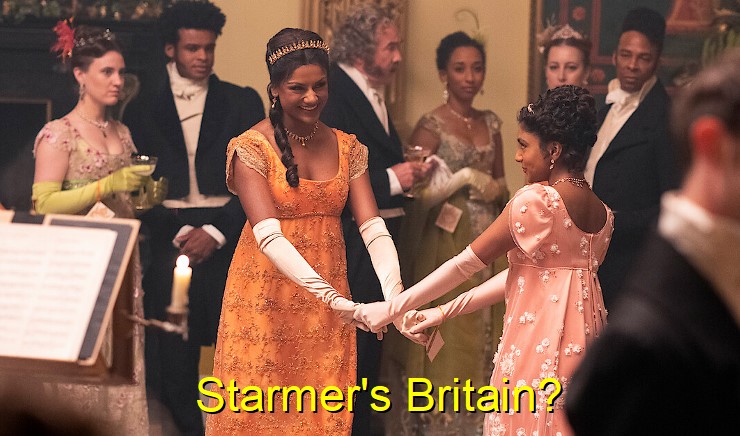
This sort of rhetoric is typical of the UK’s Prime Minister, Sir Keir Starmer. If ever there was anyone who should on no account be allowed to do the job, it is Sir Keir. He has clearly watched too many episodes of Bridgerton in which all races and cultures enjoy a sumptuous life, rubbing along happily together in a comfortable upper class milieu. While many of us do co-exist happily with our neighbours from elsewhere, Britain today is not quite like Bridgerton.

According to Sir Keir, extreme right-wing views among the settled indigenous population prevent it from being fully realised. It is this faction who refuse to compromise or make any concession to accommodate the cultures who now live among us. This is simply not true.

Many cultures have assimilated into the British way of life, but equally many have not and do not wish to. Like Christians who shun ‘the world’ there are newcomers to the British Isles, many Muslims in particular, who reject the way of life here and seek to assert their own cultural values. Many of these are at odds with hard fought Western principles: the equality of women and gay people, religious tolerance, the humane treatment of animals, the long established rule of law, the rights of those who do not subscribe to the tenets of Islam. For many, such people are kaffar, infidels of lesser value than those within the Muslim fold. They see no reason to compromise or integrate with them. And yet, the obligation to do so is theirs; they are the ones who have chosen to make their homes in the UK just as it is. To try to change it to be more like the cultures they have come from – escaped from in many cases – is not how asylum works.

Starmer and his government, meanwhile, blame the indigenous population, many of whom are of immigrant stock themselves, for the lack of assimilation and unity. To teach them the error of their ways, he plans to appoint an ‘anti-Muslim hostility tsar’ to champion efforts across the UK to tackle hostility and hatred when directed, as he or she sees it, at the Muslim community. This, you’ll note, is a process intended only to work in one direction.

You might wonder why, if we’re already living in Sir Keir’s wonderful Bridgerton-esque society (the only division being caused by pesky extreme right-wingers) such an appointment is necessary, but if Sir Keir thinks it is, then surely it must be so.

You may have your own examples of the kinds of stories we’re told today that don’t hold up to closer inspection. You may feel I’ve been conditioned to feel uncomfortable with the particular narratives I’ve looked at, and you would no doubt be right. I’d be interested to hear your views.


Showing Off

We interrupt this blogcast to bring you breaking news of shenanigans in the wonderful, wacky world of religion.

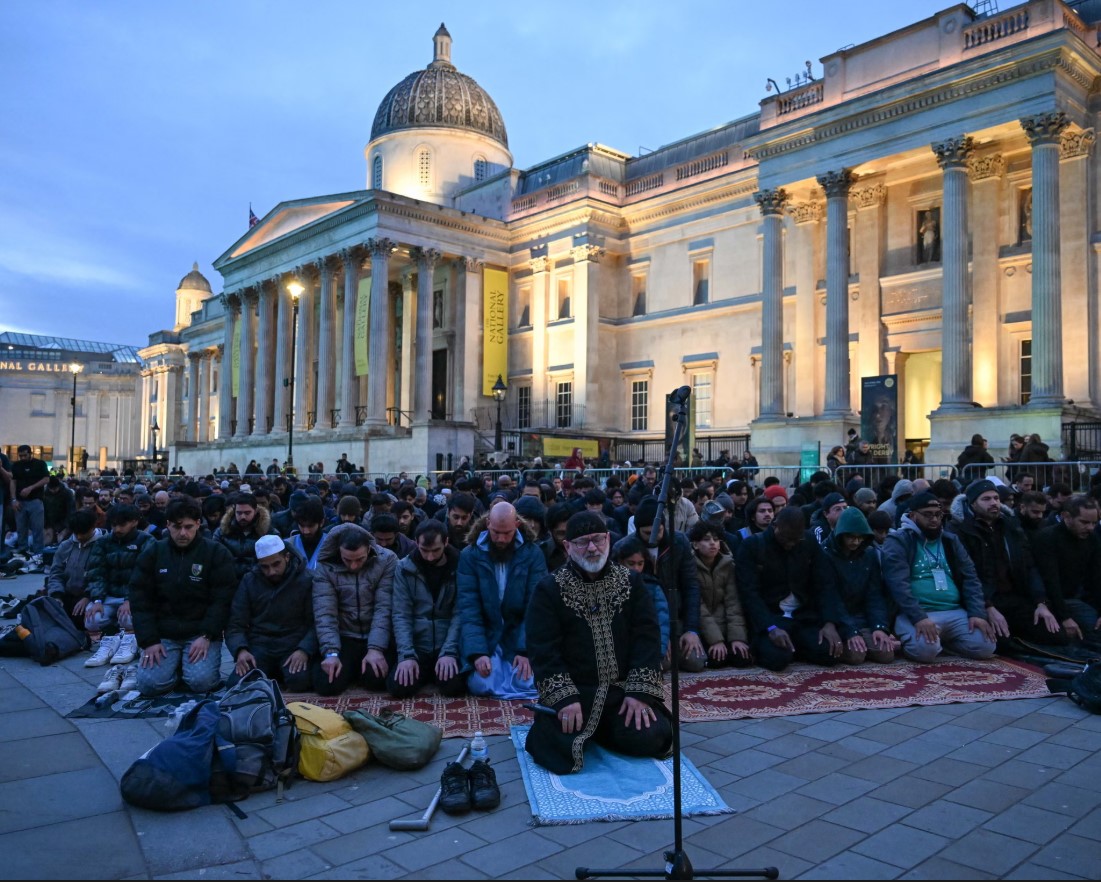
There’s been a kerfuffle here these last few days after Muslims gathered in Trafalgar Square to engage in mass prayers (that’s mass as in ‘3,000 men‘, not Mass as in the cannibalistic ritual beloved of Catholics.) This was not well received by many in the capital with a number of politicians on the right questioning whether it was really the Good Thing the Muslim mayor of London (and number one Donald Trump fan), Sadiq Khan, thought it was. Sadiq is himself is a Muslim and was present at the pray-in, taking selfies with his admirer. One politician who thought this wasn’t kosher (am I confusing things here?) was Nigel Farage – Donald’s real number one fan – who suggested that if he were ever to become Prime Minister (there’s a chance), he would ban ‘performative public prayer’ of the sort witnessed in Trafalgar Square.

This seems to me not an unreasonable proposition given the Quran (Surah Ma’oon, 107:4-7) regards ostentatious public prayer gatherings as not quite the done thing:

So woe to those who pray yet are unmindful of their prayers; those who show off

Naturally, Christians have waded into the controversy, wailing that should Muslims be stopped from enjoying prayer spectaculars, they too might be prevented from doing the same thing. Some fear carol singing and pushing their faith on others who have no interest whatever in hearing it might similarly be prohibited. Of course, banning public prayer would not, unfortunately, include carol singing or proselytising on account of the fact that neither of these two activities are prayer bonanzas in and of themselves.

The authors of the Bible also seemed to think that ‘performative prayer’ is a no-no. As Jesus’ script writers have him say in Matthew 6:5-6:

And when you pray, do not be like the hypocrites, for they love to pray standing in the synagogues and on the street corners to be seen by others. Truly I tell you, they have received their reward in full. But when you pray, go into your room, close the door and pray to your Father, who is unseen. Then your Father, who sees what is done in secret, will reward you.

Let’s not forget that as well as being God incarnate for brainwashed Christians, JC is a prophet in Islam. Both Christians and Muslims are prepared, naturally, to ignore their holy books, their prophets even, when they take to the streets and squares of modern cities ‘to be seen by others’ as they debase themselves in front of imaginary gods. It’s not Nigel Farage who wants to forbid ostentatious public displays of piety. Jesus and Mohammed got there first.

As a post script, can I mention that as an atheist, I find these prayer pantomimes, by whichever brand of the deluded, to be both unnecessary and offensive?

No, I thought not.

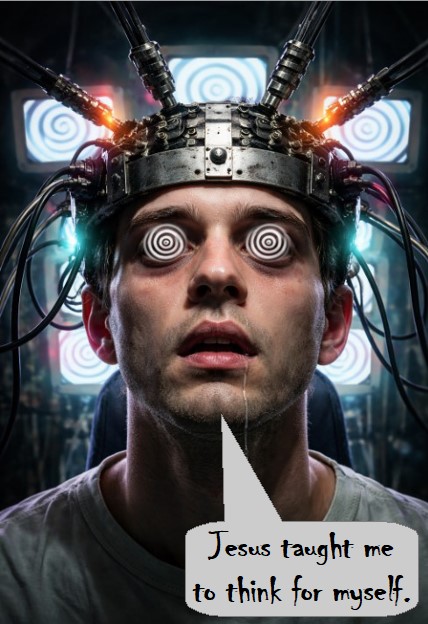
How some see others as brainwashed while they themselves are not

You may have been informed yesterday that a new post was available. For some reason, WordPress may have briefly put next week’s post online while I was working on it. If so, please ignore it as it really needs to be read after this week’s post. As we’ve recently been reminded, context is all! Here’s the correct post for today:

Apparently, I’m anti-intellectual and a fascist. This was revealed to me when I became involved in a discussion on Facebook about a highly suspect report claiming less well educated people were more likely to vote for right-wing parties. This, the Facebook ‘experts’ scoffed, was because less well educated people were brainwashed and indoctrinated. My mistake was in suggesting that better educated people were just as likely to be indoctrinated as their less well educated counterparts. Perhaps higher education institutions, inclined to the left, might influence the views those attending them to the extent that they too are conditioned. Hence, the accusation I’m anti-intellectual and a fascist*.

This happy experience got me to thinking about the extent to which we’re all indoctrinated/ conditioned/brainwashed.

Like many of you reading this, I was brainwashed as a Christian. I swallowed whole the story I was told: that I was a sinner in need of salvation because my sin alienated me from God. Jesus had to give his life so that I might be reconciled to God. I had to accept Jesus into my life. I would then live forever, going to heaven after I died to be with God, Jesus and the angels. You know this story. And a story it is. As Yuval Noah Harari shows in his book Nexus we – all of us not just the less well educated – are more susceptible to investing in a story than in cold hard facts or evidence (not that there is any evidence for this Christian narrative, as with so many of the others we’re subject to.)

Then there were too all those optional additions to the Jesus story that weren’t optional at all: God would meet my needs if I prayed in earnest, read His Word (always with the capitals), met with fellow-believers and listened to the prompting of God’s Holy Spirit inside me. (Deep breath.) Also If I shared my faith with others (‘witnessed’), grew in my walk with him (a mixed metaphor, surely?) and regularly gave money to the work of the church, then I’d be a True Christian™. You and I could not be reasoned out of any of this, because we weren’t reasoned into it in the first place.

The indoctrination was reinforced on an ongoing basis, which is why we were constantly told that we must ‘fellowship’ with those who had been similarly brainwashed. We were told we must also reject and separate ourselves from the thinking and values of non-believers (‘the world’) because they might be a threat to what we were being taught, causing us to backslide and out of the Truth (a feature of every cult.)

There came a point for some of us, however, when a small chink appeared in our armour of God conditioning: an unanswered question about something we’d been told that seemed, well… a little off; an unconvincing attempt to reconcile faith with an aspect of science; the realisation in a crisis that God wasn’t there at all.

It was this latter for me, and as I’ve said before, I began to read books I hoped would throw some light on what I’d believed for so many years. Did these books condition me in ways contrary to those I had escaped from? Yes, probably. But I didn’t subscribe to their stories unquestioningly. I weighed arguments and evidence, taking some on board, putting some aside and creating a synthesis of views as diverse as Carrier’s (Jesus was probably mythical) and Ehrman’s (Jesus existed but was mythologised by early converts.)

I’m quite prepared to accept that this too was a form of conditioning, my selection and rejection of arguments and evidence being determined by my being predisposed to find some persuasive and others not. This predisposition was of course part of earlier conditioning to which I had already been subject, the result of my liberal education that taught me to be impressed by sound argument and evidence. We can’t invest in a position, idea or even propaganda without previous conditioning predisposing us to. Our politics, religious beliefs, rejection of religious beliefs, perspective on life and morality are not genetic. We do not arrive equipped with them, rather we learn them from our environment, our parents, our education, influential people in our early lives, the media, our reading, our culture, the zeitgeist, the groupthink we’re subjected to and the bubble in which we find ourselves. In short, the views we’re exposed to, which is why most of us in the West are not communist or Muslim. Even rebelling against familial or societal values is a form of conditioning, replacing the views and values of our parents or school with others from, for example, a subculture or political cause.

We are never in a position to exercise ‘free will’. We can only make decisions about that which confronts us in the present, with whatever we have internalised in the past. I don’t think there’s ever been a truly original thought in the history of humankind because each thought depends on that which has gone before, both in our own heads and in the heads of others. Your position on any issue, your opinions, views, religious/anti-religious beliefs politics are all the result of conditioning, as selective as that might have been as a result of your conditioned predispositions.

Where does that leave us? Not as ‘free thinkers’ (your free thinking will conform fairly closely with that of other ‘free thinkers’) nor as entirely open-minded (your previous conditioning and the predispositions it led to have taken care of that.) It will, in all likelihood leave you exposed – even though you may regard yourself to be immune – to whatever political and social propaganda is circulating in your particular culture. We’ll take a look at this next time – if you’re predisposed to.

*For the record, I have not so far voted for a right wing party in all of my 70 years. I get my news from a variety of outlets, some left wing, some right. I spent all of my working life in Education, the latter part as an academic; anti-intellectual I am not, though I have little time for those who flaunt their credentials and use them to cudgel others.