
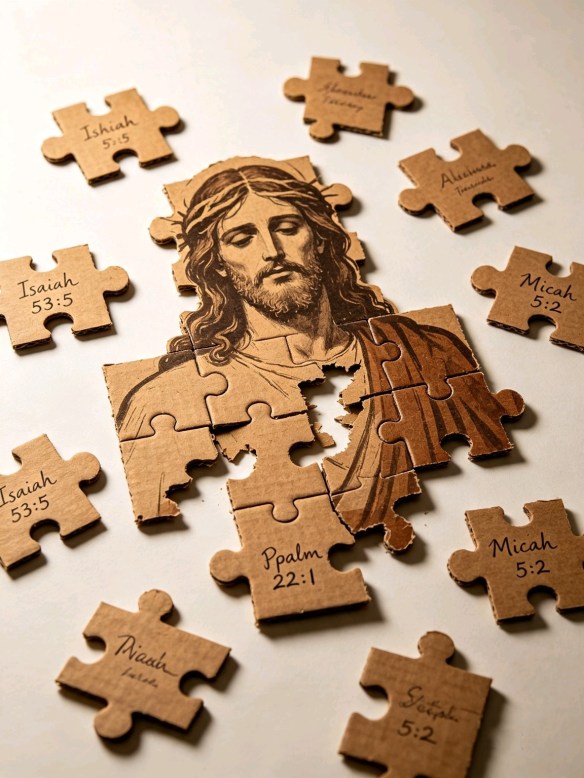
Christianity’s Greatest Failures: 3. The Prophecies


Jesus fulfilled somewhere in the region of 350 prophecies from the Jewish scriptures. Or so many desperate Christians tell us. The mere mention of something – anything – in the Old Testament that might be stretched far beyond its original meaning to apply to Jesus is interpreted as pointing to him. I’ve looked at many of these non-prophecies and supposed foreshadowing episodes before (here and here, for example), so let me make mention of another. John 5:24-29 is, according to newtestamentchristians.com, the fulfilment of Job 19:23-27, which goes as follows:

Oh, that my words were recorded, that they were written on a scroll, that they were inscribed with an iron tool on lead, or engraved in rock forever! I know that my redeemer[ lives, and that in the end he will stand on the earth. And after my skin has been destroyed, yet in my flesh I will see God; I myself will see him with my own eyes—I, and not another. How my heart yearns within me! If you say, ‘How we will hound him, since the root of the trouble lies in him,you should fear the sword yourselves; for wrath will bring punishment by the sword, and then you will know that there is judgment.

And here’s John 5:24-29:

Very truly I tell you, whoever hears my word and believes him who sent me has eternal life and will not be judged but has crossed over from death to life. Very truly I tell you, a time is coming and has now come when the dead will hear the voice of the Son of God and those who hear will live. For as the Father has life in himself, so he has granted the Son also to have life in himself. And he has given him authority to judge because he is the Son of Man.

According to newtestamentchristians.com, the Job passage presages the John in predicting the resurrection. Specifically, the passage from the fourth gospel shows how the Job prophecy has been realised. But the Job is not a prophecy. Just because it is supposedly fulfilled by the fourth gospel doesn’t make it one. To say it does is tautological; A proves B proves A. The author of Job was reflecting his character’s anguish at the trials and tribulations he had been through with the God-approved inflictions that had befallen him. The passage might also be symbolic of the trials the Jews had also suffered according to their mythic history. It had, and has, nothing to do with Jesus. You have to read a lot into it to see any connection between the two (they both mention judgement and the fact a redeemer lives, but that’s it).

Perhaps the authors of John detected an allusion to resurrection in general and then ‘reimagined’ it as applying to Jesus. Perhaps it’s only today’s Christians who do it. Either way, this is how gospel Jesus came to be created: he’s an amalgam of ‘prophecies’, incidents and characters from Jewish scripture. Nothing he does or says is historical or even original; it can all be found in the Old Testament (and in the case of Mark’s gospel, in Paul too). This isn’t because Jesus miraculously and supernaturally fulfilled 350 prophecies as he lived, died and revived. It’s because he was written that way. Everything he did while he supposedly lived, everything surrounding his death and certainly everything about his resurrection is recreated from Old Testament episodes and Paul’s ramblings about his heavenly Messiah. To see it otherwise, is to fall for the trick and succumb to the illusion. As the Religious Studies Center puts it:

What becomes clear from these varied techniques for using scripture is that the earlier Old Testament scriptures were an important resource from which to draw upon in the creation of what would become new or additional scripture, the New Testament. It also becomes evident that these scriptures were read, recited, and known well enough by the listeners and readers to use as support and authority for their teachings (my emphasis).

The New Testament shows us repeatedly that this is the case:

Mark 4: 11-12 (quoting Isaiah 6:9-10): Jesus told them, ‘The secret of the kingdom of God has been given to you. But to those on the outside everything is said in parables so that “they may be ever seeing but never perceiving, and ever hearing but never understanding;
otherwise they might turn and be forgiven!”’’

Matthew 16: 13-17: Jesus asked his disciples, “Who do people say the Son of Man is?” They replied, “Some say John the Baptist; others say Elijah; and still others, Jeremiah or one of the prophets.” “But what about you?” he asked. “Who do you say I am?” Simon Peter answered, “You are the Messiah, the Son of the living God.” Jesus replied, “Blessed are you, Simon son of Jonah, for this was not revealed to you by flesh and blood, but by my Father in heaven. (Wasn’t Jesus ‘flesh and blood’ at this point? And weren’t ‘the people’ not far off the mark in equating JC with the ancient prophets? Fictional Jesus also stresses that Peter is a descendant of Jonah, another hint we’re dealing with revamping of older characters.)

Matthew 17: 2-3, 6-7: Jesus was transfigured before (the disciples). His face shone like the sun, and his clothes became as white as the light. Just then there appeared before them Moses and Elijah, talking with Jesus… They fell facedown to the ground, terrified. But Jesus came and touched them. “Get up,” he said. “Don’t be afraid.” When they looked up, they saw no one except Jesus.

Acts 1:3: After his suffering, he presented himself to them and gave many convincing proofs that he was alive. He appeared to them over a period of forty days and spoke about the kingdom of God.(That’s ’proofs’ from scripture: what else could it be?)

Acts 18:28: …(Paul) vigorously refuted his Jewish opponents in public debate, proving from the Scriptures that Jesus was the Messiah. (Not from Jesus’ amazing life, feats or resurrection?)

Hebrews: Every quote attributed to Jesus is lifted from Jewish scripture. (eg: Hebrews 2:12-13), likewise Revelation.

1 and 2 Peter quote nothing but Jewish scripture when talking about Jesus (this supposedly from a man who supposedly knew Jesus in the flesh.)

So no, Jesus doesn’t fulfil the innumerable ‘prophecies’ Christians claim. He was just written that way.

Strike up another big fail.

Meanings, Feelings and Escapism.

This post is a response to an anonymous ‘comment’ by, I think, our camp friend, Don. I have asked him several times to ensure his name is attached to his comments but he persists in submitting anonymously. This is the reason I haven’t published the comment he so generously blessed us with in response to It’s A Small World After All. It has all the hallmarks of a Don sermon: it’s overlong, condescending and redefines words to suit his agenda. Here it is with my comments in blue.

Neal, you’d be right at home with Kafka and Nietzsche. Who is this ‘Neal’ of which you speak?

As you come to the end of the essay – good one by the way – I think you do something that many do; you confuse purpose and meaning. It is easy to do. Even the theologians do it. But you, the great Don Camp, do not because you know better than everyone else. We should all fall on our knees before such a wonderful and wise prophet.

Purpose is what I do or am to do. And I do need that. It is work. I think it is built into us. I feel like I have fulfilled my purpose when (I) serve others.

Meaning is what I receive. So we’re playing semantics again. Despite the fact that meaning and purpose are two sides of the same coin, you want to split them and make them substantively different.

I asked AI to define meaning and it came up with this:

There is no single objective meaning to life; instead, it is a blank canvas. Philosophically, the prevailing view is that you are responsible for defining your own purpose (my emphasis). People generally find meaning through personal connections, pursuing passions, contributing to the world, and embracing the experience of being alive.

Oh dear, even silly old AI ‘confuses’ meaning and purpose. Evidently it needs you, Don, to advise it.

Meaning is what I receive. It is joy. It is what I receive when I sit on a high cliff and watch sea waves crashing upon the rocks below. Or the joy I receive when I stand and survey rolling hills of sage and juniper trees and bunch grass bowing in the warm wind. Or the joy that sweeps over me when I sense God close and am embraced by his goodness. And in all these and many more I feel like this is what I was made for. In all these I feel a oneness and completeness. I could be at peace with these forever. These are subjective feelings, as you inadvertently acknowledge with your use of the word ‘feel’. For some reason you mistakenly interpret your own emotions as externally supplied. You say you ‘receive’ meaning in this way as if it’s transmitted from somewhere outside yourself. It isn’t; what you’re experiencing is ‘emotional reasoning’, mistaking emotions for something that exists beyond yourself.  

Your emotions are not meaning in themselves. Listening to the grass grow or watching the ocean waves for all eternity isn’t going to provide you with anything like meaning. Not that you’ll get the chance, of course, when you’re not going to live forever. How careless of you to confuse feelings with meaning, Don.

But I am brought back too soon to a world that is too much with us. That’s the fleeting nature of emotions, Don. Feeling the world is too much ‘with us’ (incorrect preposition?) is also an emotion, not an eternal truth. What it comes down to is, as Exub1a puts it, preferring your own constructed reality over the beautiful chaos of real life.

I think the two together, purpose and meaning, are what life is about. But they are only satisfying to me when they include forever. Oops! Offer is time limited and excludes forever. Sorry Don. You’re living in a delusion. Without that there is an incompleteness, like the loss when one who was part of that completeness dies. Says who? It’s a non-sequitur to claim that life without delusion is meaningless. Of course, it’s an assertion beloved of religionists who like to tell non-believers their lives are meaningless without their imaginary God. It’s a lie, Don.

Without that I at 81 would be an old man like Ernest Hemingway when the fishing and hunting and women were gone. The only thing left is to end it. Nonsense. You’re very fortunate to be 81. I know 81+ year olds, who enjoy life as I, a mere stripling of 71, do. Even when it is restricted by the infirmities of older age there is still much to live for. If your fantasy is all that makes your life worth living, you are indeed to be pitied (cf. 1 Corinthians 15:19).


That’s it, Don. If you want to comment in future your comment must include your name somewhere. Otherwise, straight in the trash it goes. And what would be the purpose of that?


Conversion Porn

You’ll recall, I’m sure, all those stories you were told at church, youth group or summer camp about people, almost always the worst of sinners, who had wonderful, supernatural conversions. They turned from debauched lifestyles to Jesus, who set them on the right path and turned their lives around. I’m sure there were people who experienced something like this, but any overpowering emotional experience can produce similar results. Remember those high-profile conversions though? When Jewish Bob Dylan gave his life to Jesus and made gospel albums. My, how we rejoiced! Nicky Cruz of Run Baby Run fame, saved by Jesus from a life of knife crime. Doreen Irvine, one time prostitute, stripper, heroin addict and witch who turned to Jesus to find redemption, not to mention a best-selling book, From Witchcraft to Christ. Joni Eareckson who broke her neck diving into shallow water and, paralysed, called upon the Lord to help and restore her.

Boy, did we love these stories back in the early 1970s. I can’t remember how many times the church youth group was shown The Cross and the Switchblade, with Eric Estrada as Nicky Cruz and Pat Boone as David Wilkerson, the pastor who converted him. I know a dog-eared copy of From Witchcraft to Christ was passed round too and that we took a bus trip to see Doreen Irvine speak somewhere. Likewise Joni Eareckson’s and her best-seller. (I still have some admiration for Joni, who seems the most genuine of them all, despite making a living from her life-changing accident and subsequent conversion.)

Bob Dylan’s gospel albums? Not so much. Who wants to hear him torturing some less than sparkling songs about Jesus? Certainly not me, not now, not even then. Despite claiming he saw Jesus in a vision, Dylan’s love affair with JC was mercifully brief.

What I didn’t do at the time was ask questions of these stories, particularly whether they were really credible. It’s strange how all of their protagonists got best-sellers out of their miraculous conversions. How most hitched a ride on the Christian speaking circuit, not to mention the movies some of them had made of their stories. It seems a good living could be made from meeting Jesus. But credible? Not so much. Certainly Doreen Irvine’s story has been disputed and debunked. I should have asked too why Nicky Cruz and his gang were the only ones saved out of all of the knife gangs in New York in the 1960s. Was Jesus not interested in the others, nor their potential victims? What about their non-conversion stories? And Joni: why did she have to be paralysed for Jesus to get in touch? Was she really restored by him? Certainly not physically; she remains paraplegic to this day, still clinging to stories of how Jesus saved her. Does she not wonder why he didn’t act a few seconds earlier to prevent her terrible accident? (Apparently not: she ‘rationalises’ her accident as God discipline of her in order to bring her to himself. Nice God you got there, Joni).

I wish I had asked these questions back when I was a gullible teenager subject to the church’s propaganda, instead of lapping up the conversion porn they made sure came my way.

A Big Myth-take

The nativity story is evidently a myth. The evidence?

The virgin conception and birth (similar to other myths);

Angels everywhere;

Warnings in dreams;

The wand’rin’ star;

Events created from out-of-context scraps of Jewish scripture (the virgin birth again; the shoe-horning of Bethlehem; Herod’s massacre; the flight and return from Egypt);

The heavy-handed symbolism (shepherds and their gifts; the magi and theirs);

Historically inaccurate details (disparate dates, the Roman census, Herod’s massacre);

Discrepancies between the two accounts;

The absence of the nativity and its events in the other two canonical gospels,

Disparity with later events in the gospels (Mary treasures the nativity events in Luke 2:19 only to seemingly having no knowledge of them later (Mark 3:12); John and Jesus are second cousins… or not).

And on and on.

Yet the story is analysed endlessly – two thousand years (almost) and counting – as is all that follows in the gospels. There’s a whole lot of jargon to intellectualise this , of what is, in the end, just myth: exegesis, hermeneutics, soteriology, apologia, discourse analysis, close reading. All exist to expose the truth embedded in the text and to defend it. Even those who acknowledge that the nativity story is myth (quite an attractive, cosy myth admittedly) want to confine this admission to the nativity alone. The rest – the symbolic miracles, unfulfilled prophecies, literary sermons, the metaphorical pericopes (more jargon!), the trial, crucifixion and resurrection – they want honoured as historical, factual and mystically embodying Truth. Unfortunately, all of these stories bear the same hallmarks of myth as the nativity tales. Why should these other stories be regarded as anything different?

**********

Christmas is upon us. I’m happy to call it Christmas; the name has a long pedigree and ‘Holidays’ has, in any case, its own religious connotations. Dennis and I will be spending it with my daughter and her family. I hope you too are able to enjoy it in whichever way suits you best.

A happy Christmas to you, both my readers.

A Special Christmas Bible Study

An angel of the Lord appeared to (the shepherds), and the glory of the Lord shone around them, and they were terrified.

But the angel said to them, “Do not be afraid. I bring you good news that will cause great joy for all the people. Today in the town of David a Saviour has been born to you; he is the Messiah, the Lord. This will be a sign to you: You will find a baby wrapped in cloths and lying in a manger.”

Suddenly a great company of the heavenly host appeared with the angel, praising God and saying, Glory to God in the highest heaven, and on earth peace to those on whom his favour rests.” (Luke 2:9-16)

Another chunk of scripture that will be proclaimed from pulpits and in nativity plays again this year. Let’s take a closer look at the scenario Luke creates. Does it bear any relation to something that might occur in reality?

First, an angel. Doesn’t this tell us from the outset that we’re in the realms of fantasy fiction? You can’t fault Luke for trying though, he does his best to impress by adding a whole host of them. You can hear him thinking that ‘a great company of angels’ should convince all but the most hardened of hearts. He’s inventing freely, throwing in the tropes of the genre with abandon. Doesn’t he know angels are fierce, two-faced, six-winged creatures (Ezekiel 14:18; Isaiah 6), not handsome youths in glowing white robes? There’s a reason they prefaced their every appearance, including this one, with ‘Do not be afraid’.

Good news that will cause great joy for all the people: All? Even as Luke wrote this paean to wishful thinking he knew that the Jesus myth had not brought joy to ‘all people’. Most had rejected the claims of the new cult and joy was hardly the prevalent emotion in some of the churches Paul wrote to.

This will be a sign to you: You will find a baby wrapped in cloths and lying in a manger. A baby wrapped in cloths, as was the custom, and lying in an animal feeding trough is a ‘sign’? A sign that the Messiah had arrived? Really? Granted a manger is not a conventional place for a new-born but it’s hardly miraculous. And what if by the time the shepherds had abandoned their flocks to the night and its marauding wolves, Mary had, say, picked up the child or found a better place for it? Imagine the confusion! Sorry, Luke but this is a very poorly constructed story. You just didn’t think it through.

As for the angels’ last proclamation, what does it really mean?

Glory to God: this of course is fawning to a God whose ego is more inflated and fragile than Donald Trump’s. He demands continual praise not only from his heavenly messengers but from those here below, or else he’ll go off on one. You really want to spend eternity with such a tyrant, Christians?

…in the highest heavens: a reference to the fact that early Christians believed in different layers of heaven; Paul writes about them too. God resides, as acknowledged here, in the highest, the top floor executive suite. No-one ever gets to go up there. Emails are sent down from on high.

And on earth peace to those on whom his favour rests: what sort of peace? Certainly not the absence of conflict or war. We’ve now had two more millennia of these, some in the past initiated by Christians themselves. Do people who are at peace with themselves start wars? Peace within then. Do Christians know greater peace than anyone else? Hard to say when it’s not something that can be measured but I’m sure Christians will claim it’s so.

On whom his favour rests: who exactly is this? Who enjoys the favour of a capricious deity? How do they know when he visits all manner of trials and tribulations, testing and tempering on those who count themselves as his. I’m sure the early Christians who helped write the angels’ speech thought it was they who enjoyed the Lord’s favour. Today’s Christians probably think the same. YHWH has always played favourites. Everyone else can go to hell.

So, the heralds of Jesus’ birth didn’t exactly bring good news, did they. Not even in Luke’s imaginary, completely invented, never-happened-in-reality and isn’t-even-a-decent-metaphor scenario.

Like a Virgin. Or Not


To arrive at the nativity story most of us grew up with and which your kids and grandkids might well be performing this Christmas (mine are), the one with a stable, shepherds and wise-men, involves some cunning sleight of hand, not to mention a liberal dollop of invention.

The biblical ‘account’ of the story is spread across two gospels, Matthew and Luke. Mark hadn’t heard of it when he wrote his gospel so you won’t find it there. In fact, Mark’s Jesus doesn’t become God’s son until his baptism. Paul, writing earlier still, thinks God adopts Jesus only at his resurrection. Paul has no knowledge either of the nativity myth. John has no time for it: his Jesus is an eternal being who has existed with God from the beginning.

For Matthew, however, Jesus comes into existence when the Holy Spirit impregnates a virgin. Luke likes the idea and so copies it into his gospel. And now we have a problem: the idea that a virgin will bear the Messiah is lifted from the Septuagint, the Greek translation of the Jewish scripture, which renders Isaiah 7:14 as –

Therefore YHWH himself will give you a sign: the virgin (almah) will conceive and give birth to a son, and will call him Immanuel.

In the Septuagint, the Hebrew word almah, meaning ‘young woman’, is translated as virgin. However, the word for virgin in Hebrew is betulah, an entirely different word. Isaiah 7:14 is not a prophecy that a virgin will bear a son: only that a young woman will do so; in other words, a commonplace event. Matthew allowed himself to be misled: in his eagerness to find prophecies of Jesus in Jewish scriptures, he alighted on a mistranslation. He wrote his story accordingly, riffing freely on the error. Luke picked up on it a decade later, adding his own embellishments.

Neither does Isaiah 7:14 suggest the child being talked about will be the Messiah, nor that he will appear hundreds of years in the future. As subsequent verses make transparently clear, a short period of time is all that is suggested; no more than a few years:

He (the child) will be eating curds and honey when he knows enough to reject the wrong and choose the right, for before the boy knows enough to reject the wrong and choose the right, the land of the two kings you dread will be laid waste. YHWH will bring on you and on your people and on the house of your father a time unlike any since Ephraim broke away from Judah – he will bring the king of Assyria (Isaiah 7:15-17).

These are all events contemporaneous with the writing of this part of Isaiah. All that is being said is that a young woman will become pregnant and produce a child in the near future. Even before this child properly knows right from wrong, YHWH will bring Israel’s enemies down upon it. (Because he’s such a caring God.)

None of this has anything to do with a virgin becoming pregnant, nothing to do with a Messiah, nothing to do with Jesus. It is not a prophecy about him, even if Matthew persuaded himself it was. Shamefully, almost all modern ‘translations’ of Isaiah retain ‘virgin’, when they know perfectly well it is not the word used, and that the context neither supports it’s use nor makes it necessary. They do so to maintain the lie that Isaiah 7:14 is about Jesus and to give credibility to Matthew and Luke’s ridiculous fiction that he fulfilled ‘prophecy’ by being born of a virgin. It’s a deception that will be repeated in church services around the world over the next couple of weeks.

Do You See What I See?

Christianity with its visions of God, angels and resurrected god-men, is not distinctive. It emerged from a culture in which such epiphanies were commonplace and highly esteemed. Appearances of deities, other supernatural beings and dead people were valued as genuine encounters with a reality on the other side of this mortal life. Paul was a Hellenised Jew and a Roman citizen (if Acts 17 can be believed); it was perfectly natural for him and his contemporaries to see and hear things that weren’t there.

Not only was the fledging Christ-cult influenced by the superstitious culture around it, but was born too of Judaism, itself awash with visions, apparitions and revelations. How could the new religion fail to be when its originators existed in such a milieu. One or other of these ‘visionaries’ believed they’d seen a resurrected Jesus. Of course they did. This is how gods manifested themselves then; everyone knew it. There were even those who hadn’t really had any inner-visions but wanted to be regarded as mystics themselves so would pretend they too had had direct contact with the deities.

The human mind has always been susceptible to illusions, to the potency of dreams and to misinterpreting what is going on around it. It’s also prone to a spot of fantasising now and then. This propensity didn’t cease once Christianity established itself. Muhammed claimed to have been visited by angels who revealed new truths about the nature of God – not least a change in name.

In the 19th century, a young farmer, Joseph Smith, living during a widespread and particularly intense religious revival, imagined (or pretended) he’d been visited by God and Jesus. Later, he said he’d been visited by a hitherto unknown angel with the unlikely name of Moroni. The result of course was multiple wives for Smith and the foundation of the Church of Jesus Christ of Latter Day Saints. Sufficient numbers of people believed Smith’s cockamamie stories about his alleged visions to commit to Mormonism. Smith wasn’t alone; others had visions of deities, including but not restricted to the Big Two, Jesus and his Father God. Hundreds recently saw the Virgin Mary hovering above New York City. They couldn’t all be wrong could they? Of course not, but they were all be deluded. Just like Joshua Mhlakela whom Jesus appeared to and told him the date of the Rapture was 22nd September, or possibly the 23rd, then with ‘billion percent’ certainty 7th October. Or maybe 8th…

This is how religions are made, changed and adopted: on a bed of illusory sand. If we need any further evidence that such experiences are illusory, created by the mind itself, then consider this: each time God, his angels or his Son appear in the religion-soaked brains of mystics and fraudsters, they reveal a message at odds with that revealed to previous visionaries. Each revelation has to be different of course. There would be no reason for such ‘visits’ otherwise.

Hence Abraham (or his script writer) imagining YHWH promising an eternal covenant and a new land.

Moses (or his script-writer) claiming YHWH had issued new laws while at the time commanding the slaughter of tribal enemies.

Cephas thinking he’d seen a risen Jesus who may or may not have told him of the imminent the End of the Age.

Jesus himself reportedly talking with his ‘Father’ about the necessity of his execution.

Paul flying to heaven so that Jesus could explain in great detail a new covenant, negating the original ‘eternal’ covenant with Abraham.

John of Patmos envisaging Jesus coming to Earth to slaughter the enemies he purportedly instructed his followers to love. (And Christians claim the Bible presents a unified message!)

All of these are manifestations of, and within, the minds of fantasists. Such manifestations are a naturally occurring malfunction of the brain.

And so it continues. Beware anyone who claims to have seen or heard from a deity of any sort. They, like their biblical counterparts, are deluded and almost certainly ill.

Mystic Revelations

What do the three ‘great’ Abrahamic religions have in common?

They all started with visions, hallucinations, dreams and mystic revelations. They’re not only based on these but owe their very existence to encounters with the supernatural that took place entirely within people’s heads. This of course is if they happened at all; many of these encounters with angels and God’s revelations take place in stories that have all the characteristics of myth or legend. Even so, they reveal much about the primitive state of mind (still around today) that believed God frequently revealed himself to, and in the minds of, chosen individuals.

First, the grand-daddy of the Abrahamic religions, Judaism: 

When Abram was 99 years old, YHWH appeared to him. He said to Abram, “I am El Shadday. Live in my presence with integrity. I will give you my promise, and I will give you very many descendants.” Immediately, Abram bowed with his face touching the ground, and again Elohim spoke to him, My promise is still with you. You will become the father of many nations. So your name will no longer be Abram [Exalted Father] but Abraham [Father of Many] because I have made you a father of many nations. I will give you many descendants. Many nations and kings will come from you. I will make my promise to you and your descendants for generations to come as an everlasting promise. I will be your Elohim and the God of your descendants. (Genesis 17)

Then Moses:

The Angel of YHWH appeared to (Moses) in a flame of fire from the midst of a bush. So he looked, and behold, the bush was burning with fire, but the bush was not consumed.

Then Moses said, “I will now turn aside and see this great sight, why the bush does not burn.”

So when YHWH saw that he turned aside to look, Elohim called to him from the midst of the bush and said, “Moses, Moses!” And he said, “Here I am.” (Exodus 3)

Notice how the inner voice goes from being that of ‘the angel of YHWH’ to YHWH himself (or one of his aliases). The entire scenario is preposterous of course, as is the Abraham episode before it. I’ve omitted the other occasions YHWH is said to appear to Abraham, including the infamous Genesis 22, where YHWH instructs Abraham to sacrifice his son. These stories are legends written, created from whole cloth, centuries after Abraham purportedly lived. He, like the later Moses, is almost certainly mythical, a character created to represent the beginnings of the Jewish faith. Even his names are symbolic. In truth, no one knows how Judaism began.

Onto Christianity:

The angel said to (Mary), “Don’t be afraid, Mary; God has shown you his grace. Listen! You will become pregnant and give birth to a son, and you will name him Jesus. He will be great and will be called the Son of the Most High. The Lord God will give him the throne of King David, his ancestor. He will rule over the people of Jacob forever, and his kingdom will never end.” (Luke 1)

Did this happen? If you believe angels exist then possibly, but we know they do not. We also know that this is myth. However, Luke wanted his readers to know that Jesus’ birth was miraculous so invented a story in which Mary encounters a heavenly being. The gospel writer anchors the divinity of Jesus to an implausible event which at best can only be a young woman’s vision (though it most certainly isn’t.)

The same is true of the resurrection appearances. Here’s Matthew 28:1-8:

Now after the Sabbath, as it began to dawn toward the first day of the week, Mary Magdalene and the other Mary came to look at the grave. And behold, a severe earthquake had occurred, for an angel of the Lord descended from heaven and came and rolled away the stone and sat upon it. And his appearance was like lightning, and his clothing as white as snow. The guards shook for fear of him and became like dead men. The angel said to the women, “Do not be afraid; for I know that you are looking for Jesus who has been crucified. He is not here, for He has risen, just as He said.”

More angels (they multiply in later gospels); again at best, though still highly improbable, the angel(s), if seen at all, can only be a vision or an hallucination (or mistaken identity.)

Onto the only first hand account of an encounter with the divine that the bible includes, Paul’s:

God was pleased to reveal His Son in me so that I might preach Him among the Gentiles… I want you to know, brothers and sisters, that the gospel I preached is not of human origin. I did not receive it from any man, nor was I taught it; rather, I received it by revelation from Jesus Christ. (Galatians 1)

I know a man in Christ who fourteen years ago—whether in the body I do not know, or out of the body I do not know, God knows—such a man was caught up to the third heaven. And I know how such a man—whether in the body or apart from the body I do not know, God knows— was caught up into Paradise and heard inexpressible words, which a man is not permitted to speak. (2 Corinthians)

This is all there is. This is the extent Paul talks about his heavenly encounters. In Galatians he admits that God revealing whatever it was he revealed was ‘in’ him, that is, in his own head. The bizarre tale he relates in 2 Corinthians reads like an hallucination (Paul says he doesn’t know whether it was in the body or out of it) which is all it could’ve been; there is no paradise or ‘third heaven’.

And finally, there’s Mohammed:

while I was sleeping last night, the keys of the treasures of the earth were brought to me till they were put in my hand.”… 

The angel came to him and asked him to read. The Prophet replied, “I do not know how to read. The Prophet added, “The angel caught me (forcefully) and pressed me so hard that I could not bear it any more. (Sahih Bukhari 6998)

Encounters with heavenly beings in dreams, ‘revelations’, visions, hallucinations and invented stories: these are central to Judaism, Christianity and Islam. The religions would not exist without them. Written as myth long after they supposedly occurred or referred to obliquely by those who claim to have experienced them, they are the products of fevered pre-scientific minds.

Post-script: I’ve searched in vain for Darwin’s admission that an angel revealed the process of evolution to him. I can only find his collection of evidence, his scientific observations and his careful analysis of his findings. Likewise Mendeleev who calculated the existence of elements that were at the time unknown. Likewise Crick, Watson and Franklin who discovered the structure of DNA. Strangely, none of these people relied on visions, dreams or divine revelations in uncovering truths about reality.

I Wish We’d All Been Ready

Holy cow!

This is a special, urgent post!!! I just learnt to today, courtesy of Joe.My.God that tomorrow is the date set for the Rapture. In case you didn’t know, I need to warn you to give you time to repent and turn to Jesus. We know the rapture’s going to happen this time for sure because a pastor in South Africa was visited by Jesus a couple of nights ago who told him he was definitely returning tomorrow, 23rd September, at the time of the Jewish Feast of Trumpets (me neither). Charlie Kirk’s martyrdom has something to do with it too:

I’m sure these three signs together can’t be wrong, which means the Rapture is going to happen tomorrow as an absolute certainty.

Here’s how the UK’s always reliable Daily Mail reports it:

An ancient Biblical event in which Christians disappear from Earth and those who remain are left to face Doomsday is believed to be just days away.

Claims by social media users, as well as respected pastors and rabbis, have pushed the idea that the Rapture will begin on September 23, marking the Second Coming of Jesus and Judgment Day for non-believers.

This year, September 23 falls during the Jewish Feast of Trumpets, also known as Rosh Hashanah, but some Christians have tied the holiday to the prophecy that Jesus will return to Earth ‘with the voice of the archangel and with the trumpet call of God.’

The prophecy is mentioned in the Bible, 1 Thessalonians 4:16, which states that even the faithful who have died will rise from their graves and be taken to heaven by Jesus; however, a date for this event is not given.

In a YouTubevideo viewed nearly 500,000 times, Pastor Joshua Mhlakela, a South African preacher, claimed Jesus appeared to him in a divine vision and said he would return during the Feast of Trumpets.

‘The rapture is upon us, whether you are ready or not. I saw Jesus sitting on his throne, and I could hear him very loud and clear saying, I am coming soon,’Mhlakela said during the interview with CettwinzTV.

‘He said to me on the 23rd and 24th of September 2025, I will come back to the Earth,’ the pastor declared.

Even more clips predicting the imminent return of Jesus this month have been viewed hundreds of thousands of times in the last week alone.

If you can’t find it in yourselves to welcome Jesus into your hearts as Lord and Saviour then you’ll have to gird your loins for what happens next. Something dire I feel sure. Judgement and a millennium of despair or some such. It might not be too bad though, once the Righteous Ones are out of the picture.

Whichever, I’ll see those of you who are still around come Wednesday when we can discuss what we’re gonna do!!! This blog isn’t going to be of much use any more, that’s for sure. Those of you who’ve decided to head heaven-bound meanwhile, enjoy the trip and don’t forget to write.

More Daft Things Christians Say

Image from a video by Intimacy With God, available here. I don’t recommend it.

In this season: a new favourite of evangelicals.

Though it is biblical (2 Timothy 4:2), what the hell does it mean in the mouths of today’s Christians? Here it is used to excess in the FreshPerspective blog: 

God is shifting his faithful sons and daughters into new seasons. But before I divulge into the signs, understand that everyone is called to different seasons. Some are being released into a season of exposure (platforms, opportunities etc), some into a season of preparation (preparing for a new season), and some into a wilderness season (a time of God pruning you, deliverance from past sins and behaviors before you enter a new season). So don’t be discouraged when it seems like you’re not where everyone else is. Seek God, pray and receive his wisdom and knowledge for what season you’re in.

It’s meant to sound profound, but there’s nothing profound about it. It’s pretentious, meaningless twaddle. Bob Dylan said it far better when he sang, ‘the times they are a-changing’. Things change; they continually evolve. Likewise our personal circumstances. God isn’t blessing, releasing, pruning or preparing you. Nor has he any great plans for you or the church. (Why? Because he’s not real.)  

Thoughts and Prayers/I’ll pray for you

Thoughts and prayers are always proffered when disaster strikes. The ‘thoughts’ I understand; when a long-distance friend lost her daughter to suicide a couple of years ago, I wanted her to know I was thinking of her and was ready to listen if she wanted to talk. She told me later that it was comforting to know that friends were thinking of her and were around if she needed them. I don’t think she said this just to make us, the friends, feel better. Such painful circumstances pare away insincerity.

There’s often not much more we can do beyond thinking about others when they are suffering like this. There are circumstances of course when we can offer more practical help, but adding ‘prayers’ to any expression of concern is lazy and glib. Prayers are of no use to anyone in distress or despair because prayers are, in any context, of no use, period. There’s no God out there, up there or inside us listening to our inner pleading. Even if there were, he is, according to his personality profile in the bible, so capricious and unheeding that he would do nothing to alleviate suffering. Neither would he step in supernaturally to remedy the terrible situations humans find themselves in. If he was even remotely concerned, he wouldn’t allow these to happen in the first place. Little point then in asking him to help with any mess he’s helped created, either intentionally or through disinterest.

But as I say, there’s no God so we need not trouble ourselves trying to work out what he’s playing at. Nor do we ever need the sanctimonious promise of prayers that will probably never be said. It doesn’t matter whether they are or not, so please, True Believers, can we dispense with  the cant?