Meanings, Feelings and Escapism.

This post is a response to an anonymous ‘comment’ by, I think, our camp friend, Don. I have asked him several times to ensure his name is attached to his comments but he persists in submitting anonymously. This is the reason I haven’t published the comment he so generously blessed us with in response to It’s A Small World After All. It has all the hallmarks of a Don sermon: it’s overlong, condescending and redefines words to suit his agenda. Here it is with my comments in blue.

Neal, you’d be right at home with Kafka and Nietzsche. Who is this ‘Neal’ of which you speak?

As you come to the end of the essay – good one by the way – I think you do something that many do; you confuse purpose and meaning. It is easy to do. Even the theologians do it. But you, the great Don Camp, do not because you know better than everyone else. We should all fall on our knees before such a wonderful and wise prophet.

Purpose is what I do or am to do. And I do need that. It is work. I think it is built into us. I feel like I have fulfilled my purpose when (I) serve others.

Meaning is what I receive. So we’re playing semantics again. Despite the fact that meaning and purpose are two sides of the same coin, you want to split them and make them substantively different.

I asked AI to define meaning and it came up with this:

There is no single objective meaning to life; instead, it is a blank canvas. Philosophically, the prevailing view is that you are responsible for defining your own purpose (my emphasis). People generally find meaning through personal connections, pursuing passions, contributing to the world, and embracing the experience of being alive.

Oh dear, even silly old AI ‘confuses’ meaning and purpose. Evidently it needs you, Don, to advise it.

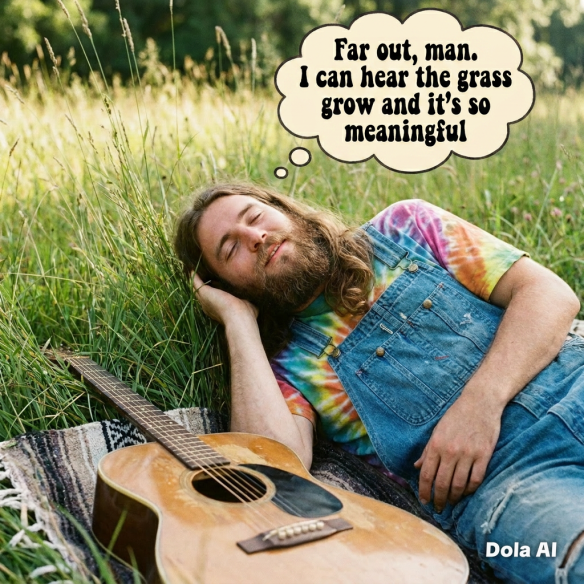
Meaning is what I receive. It is joy. It is what I receive when I sit on a high cliff and watch sea waves crashing upon the rocks below. Or the joy I receive when I stand and survey rolling hills of sage and juniper trees and bunch grass bowing in the warm wind. Or the joy that sweeps over me when I sense God close and am embraced by his goodness. And in all these and many more I feel like this is what I was made for. In all these I feel a oneness and completeness. I could be at peace with these forever. These are subjective feelings, as you inadvertently acknowledge with your use of the word ‘feel’. For some reason you mistakenly interpret your own emotions as externally supplied. You say you ‘receive’ meaning in this way as if it’s transmitted from somewhere outside yourself. It isn’t; what you’re experiencing is ‘emotional reasoning’, mistaking emotions for something that exists beyond yourself.  

Your emotions are not meaning in themselves. Listening to the grass grow or watching the ocean waves for all eternity isn’t going to provide you with anything like meaning. Not that you’ll get the chance, of course, when you’re not going to live forever. How careless of you to confuse feelings with meaning, Don.

But I am brought back too soon to a world that is too much with us. That’s the fleeting nature of emotions, Don. Feeling the world is too much ‘with us’ (incorrect preposition?) is also an emotion, not an eternal truth. What it comes down to is, as Exub1a puts it, preferring your own constructed reality over the beautiful chaos of real life.

I think the two together, purpose and meaning, are what life is about. But they are only satisfying to me when they include forever. Oops! Offer is time limited and excludes forever. Sorry Don. You’re living in a delusion. Without that there is an incompleteness, like the loss when one who was part of that completeness dies. Says who? It’s a non-sequitur to claim that life without delusion is meaningless. Of course, it’s an assertion beloved of religionists who like to tell non-believers their lives are meaningless without their imaginary God. It’s a lie, Don.

Without that I at 81 would be an old man like Ernest Hemingway when the fishing and hunting and women were gone. The only thing left is to end it. Nonsense. You’re very fortunate to be 81. I know 81+ year olds, who enjoy life as I, a mere stripling of 71, do. Even when it is restricted by the infirmities of older age there is still much to live for. If your fantasy is all that makes your life worth living, you are indeed to be pitied (cf. 1 Corinthians 15:19).


That’s it, Don. If you want to comment in future your comment must include your name somewhere. Otherwise, straight in the trash it goes. And what would be the purpose of that?
 

It’s A Small World After All

Life Is Meaningless.

Or is it? I’ve long held the view that life is as meaningful or meaningless as we’re prepared to make it. There is no hidden meaning lurking somewhere out there, certainly not in some holy book, that we can plug into, if we’re so inclined, to make us feel better. This lack doesn’t make our individual lives meaningless. I’ve never understood the assertion that we need a life beyond this one to make it meaningful. Nor does the bizarre notion that this existence is merely a trial run for the real life that comes once this one is over. Why did the incomprehensible god who supposedly created us in this scenario not make us perfect from the get go and ‘fit us to live with him’ in heaven? It’s illogical that he would not.

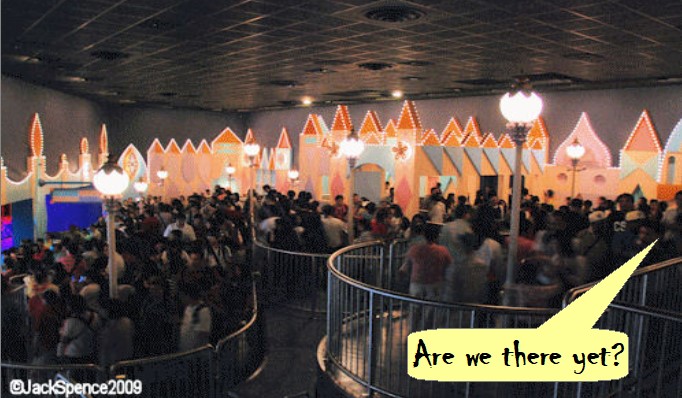
Years ago when I was younger and a newly minted atheist, my then wife and I took our young children to Disneyland Paris. Apart from an argument with Snow White about Dumbo (some other time) I had a moment’s revelation as we waited in line for It’s A Small World After All. I realised how much like life this was: queue interminably before getting on the ride, spend a relatively short time on it before being ejected into the void. This, I realised was life, or a close approximation of it. ‘Wait’ for eons to be born, make the most of the brief ride that follows, and accept that after it stops you will in all probability cease to exist. It’s not a bad deal. Better than not experiencing It’s A Small World (if that’s your thing) or indeed life at all.

My life has meaning, as does yours. If it’s not apparent, it’s certainly workoutable. In fact, part of life’s purpose is to work out what that purpose is for yourself. For me it’s in my relationships, with my partner, my children, my grandchildren (so much love there), my friends; in the things I spend my time doing: travelling, learning, writing, volunteering; in my work, when that was a thing for me. If you can’t find meaning in these kind of things, it doesn’t mean there is a meaning elsewhere; find it where you are. If you need to feel it lies beyond, in a supernatural realm, you are only going to be disappointed; imaginary realms cannot give you purpose. They can mask the fact you have failed to make meaning in your life, but they cannot plug the black hole of meaninglessness if that’s what you’ve created for yourself. Neither can that black hole be plugged by Jesus or any other imagined being. A nothing filled up with nothing is still just nothing.

No, this life is not a rehearsal for a better one that is to follow. Even if it was, there is no meaning in the promise that you will be allowed to spend eternity worshipping a capricious God. There’s no purpose in that. Far better to take what is real to you in the brief time chance has allowed you in the light, and recognise it as your meaning and purpose.

No God and the Domino Effect

This a response to Don Camp’s comment on my post The Evil of Christianity, in which he tries to isolate ‘the crux’ of our disagreement about the Faith.

You start, Don, from the assumption that there is a God. I, on the other hand, have considered the evidence and concluded that in all probability there isn’t one. Certainly not the Christian God. There may be a god out there somewhere that has no interest in human beings and their affairs, though I doubt it. As far as we humans are concerned such a deity is as good as non-existent, being entirely hypothetical. If it is out there, it certainly won’t be offended at my saying so.

Once I realised some years ago that a personal God did not exist a number of other things followed (or rather, collapsed):

No God means no Son of God or God Incarnate, no Saviour or Christ.

No God means no resurrection (which Paul makes clear was a work of God).

No God means no Holy Spirit.

No Holy Spirit means no regeneration of individuals to become new creations in God (you only have to look at Christians today to see this is the case.)

No God means no grand Salvation plan.

No God means no Heaven, no Final Judgement, no Kingdom of Heaven of Earth, no Eternal Life.

No God means the universe can’t have been created by him.

No God means no manipulation of evolution, no intervention in human history and no prophecy of things to come.

No God means that the world would be just as we find it: messy, beautiful, dangerous, turbulent, indifferent.

No God means prophecy is man-made and comes to pass at no greater rate than chance allows (i.e. practically zero.)

No God means conversations with ‘him’, revelations from him and visions of him are all imagined, generated by and within the human brain, which works in mysterious ways.

No God means no God-given morality. Morality is, as you say, culturally determined and so may and does change over time. (You can see this in the Bible itself where morality supposedly handed down by God for all time evolves throughout the Old Testament and into the new.)

No God means there is neither Sin nor Righteousness. These are religious concepts. The whole spectrum of human behaviour, from destructive to altruistic, is demonstrated by believers and non-believers alike.

No God means assertions like ‘the issue turns on what I perceive as good for me versus what God declares is good for me’ are illusory. What is good for you is what you have worked out, even if you think God had a hand in it. A supernatural being who doesn’t exist cannot be responsible for your well-being, though your church and the bible undoubtedly contributed to your conditioning.

No God means individuals must work out their own meaning and purpose. Some do, some don’t, as you observe, Don. This is as true of believers as it is for non-believers. Many atheists have managed it, or not, without having it imposed by religion. And despite what you say, Christianity is a religion. It is the epitome of religion.

No God means none of the Abrahamic religions are true and therefore Christianity and its ‘holy’ book, being based on an invalid premise, must be false. Most of the posts on this here blog are about demonstrating this fact.

No God means all gods are man-made, not all gods except one.

The crux of the matter is you believe in God while I see how unlikely it is that there is one. I’d agree with you if I could, Don, but then we’d both be wrong.