In the Beginning, our End

For God so loved the world that when the first humans couldn’t resist the temptation he deliberately put in front of them, he abandoned them, sending them, and every other creature that occupied the Earth, into terminal decline. He loved the world so much that because of this one transgression he introduced death into his not-so-perfect creation. And he didn’t care. He let them and their descendants all the way down to the present day waste away, miserably and painfully, until they were finally extinguished.

He had to adjust other parts of his creation to assist in this process. He changed the purpose of microbes and viruses so that overnight they became the agents by which he could wipe out the humans he loved so much. God knows what the original point of these creatures was, but he adapted and evolved them with his special magic to suit his new, all-loving purposes. He rapidly evolved still others – flies, larvae, scavengers and still more microbes – so that they became waste disposal systems. Without them, the corpses of all the humans and animals he’d condemned to die would lie around forever, cluttering up the Earth.

This is how the Bible tells it anyway (with a bit of extrapolation from me), the linchpin on which rests not only Judaism but Christianity too. Yes, I know it’s an allegory – though there are still many today who take it literally – but either way, it’s a terrible story. Even without an understanding of evolution, not to mention human psychology, it makes absolutely no sense.

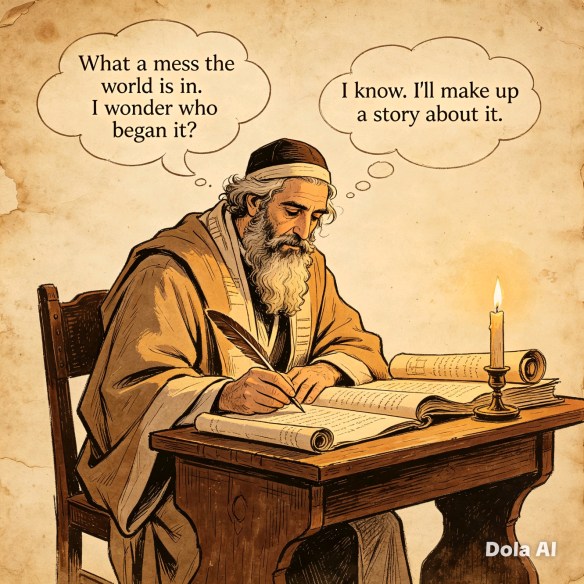
The priest or whoever wrote it (it certainly wasn’t Moses) didn’t have special insight into the mind of God (guess why) nor did he know anything about any archetypal human couple. (He wasn’t there, see.) Instead, he saw the sorry state of the world, including how he and his fellow tribesmen lived short, brutish lives that after only about 40 years (if they were lucky) ended in a miserable death. It seemed irreconcilable with his deity who he felt sure must have created a perfect world. How could he not have? Disease, death and decay could only be the fault of humans. They couldn’t possibly be his perfect God’s doing. So he wrote his myth but still couldn’t exonerate YHWH – his neglect and callousness, not to mention the necessity to evolve microbes and the like to carry out his final solution for his so loved creation. He doesn’t come out of it well; he’s ‘loving’ but having unfairly tempted his creation, he takes offence when they ‘disobey’ and condemns them all, including those not yet born, to a short brutish life ending in a miserable extinction. That’s how much he loved the world.

The original author or someone after him tacked the Adam and Eve story onto an existing one about the creation of the Earth and from then on, up to modern times, his myth was accepted as the truth about our origins (and ‘fallen state’). How do we know this? Because this is how myths are created. They are early attempts to explain life, the universe and death, usually set in the distant past and involving the imaginary gods of the culture that produced them. They were never written, inspired or passed down by deities that have never existed; they’re explanatory stories made up by humans, all of them now redundant.

Written By God

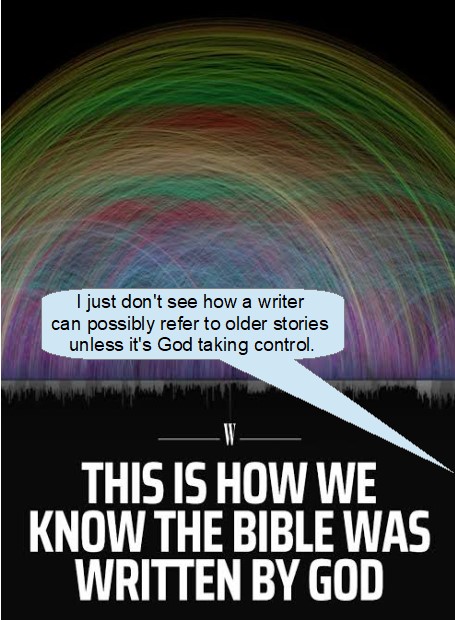
According to researchers, recent analysis of the Bible strongly suggests that it was written by God. I kid you not. The headline above, from Britain’s Daily Mail, proves it.

The researchers in question were ‘a computer scientist at Carnegie Mellon University and a Lutheran pastor in Germany’. Their findings were announced by The Mail in its Science section, conclusive proof that God himself, the mythical creation of an ancient nomadic tribe, personally wrote the Bible! He didn’t inspire it or guide the pens of the men who put it together. Oh no, he actually wrote it.

How can we know this? Because there are way too many coincidences, too much foreshadowing of later events in stories written hundreds of years earlier, and too many fulfilled prophecies for it not to be.

This analysis is of course seriously flawed. Operating within the parameters that the far from objective ‘researchers’ set for it, the project told them exactly what they wanted to hear. Yes, there are some themes and ideas that run throughout the Bible but this is because its various authors were all concerned with the gods, one in particular. This is all they wanted to write about and all that subsequent editors were interested in too.

The Bible is noticeably short on recipes and sports reports because such things were of no interest to the priests and zealots who wrote it. We might have had a more engaging and less divisive book if these men and their later editors had been more interested in sport and cooking, but they weren’t and the Bible reflects this fact. But there’s nothing supernatural about this. The authors were, like many other ancients, concerned with meaning of life stuff and the God myths that seemed to them to explain it. The god the nomadic tribes of the middle east thought explained it best was YHWH. Far from being a consistent presence in the books of what is now the Old Testament, YHWH changes depending on who’s shaping the myths he plays a part in. This is not, incidentally, what theologians are pleased to call progressive revelation.

It’s a reflection of multiple authors writing over long periods of time in various contexts about the same thing. Nonetheless, the way humans relate to YHWH changes from book to book, as do his morals, demands and expectations. If YHWH authored the Bible, the one character he hasn’t got a grip on is himself.

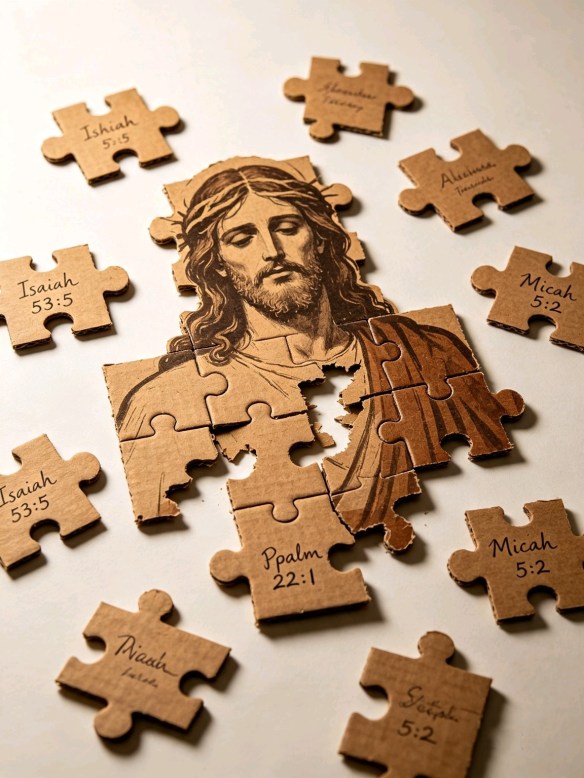
Our computer specialist and German pastor also dredge up the discredited fantasy that Jesus fulfils all the prophecies of the Old Testament. Of course he does; that’s the way he’s written. His story – actually ‘stories’, plural – are rewrites of older myths, particularly those about Moses. Did Moses foreshadow Jesus, foretelling all he’d do hundreds of years before he was even born? Of course not. Did Jesus then knowingly mirror the acts of Moses during his life to prove he was God’s chosen one? Again, of course not; only a fool is taken in by this ruse. There have, alas, been plenty of them, including the present ‘researchers’.

The obvious explanation is the one that makes most sense; the Jesus stories are modelled on earlier myths and snippets from the Jewish scriptures without any of them needing to be remotely historical. The article mentions, for example, the description of the Passover lamb in Exodus 12 and gasps that, yes, centuries later, Jesus is referred to as the ‘Lamb of God’ (John 1:29). It doesn’t seem to enter the researchers’ credulous little heads that the later authors knew Exodus and decided to apply its imagery to Jesus. This is how the trick was done. There was no holy dictation making the connection. They simply applied earlier scriptures to Jesus and write his story around them. We can see this in another example from the report: Matthew used a mistranslation of Isaiah 7:14 as a template for his virgin-conception myth.

Claiming, as the researchers do, that the construction of later stories was God making sure no-one missed the point of the earlier ones is painfully niave.

Jane Austen’s Pride and Prejudice foreshadows Helen Fielding’s Bridget Jones’s Diary. The details of the two works are, after all, remarkably similar. The only plausible explanation for these similarities is that Jane Austen’s hand must have been guided by a spiritual force to record events almost two centuries before they would occur for real in Helen Fielding’s definitive version of the story. This at least is what these present researchers would conclude if they ran an analysis of the two Mr Darcy books in the same way they have the Bible.

True Stories (or perhaps not)

Stories work best. We’re all susceptible to them. As Yuval Noah Harari demonstrates in Nexus, we absorb them far more readily than cold hard facts, evidence, statistics. A narrative means much more to us, which is why humans have told stories since we evolved the ability to speak and, later – much later – write.

The gospel authors knew this and dressed up their beliefs about their heavenly saviour as stories about a man who lived and died in Galilee a few decades earlier. As we know, these stories became popular, were repeated and reshaped down the years by the church, still drawing people in today. They are effective because they’re memorable: the Nativity, the temptation in the wilderness, the miracles, the trial before Pilate, the crucifixion and resurrection are all well constructed narratives that draw on archetypes of human experience.

Within these stories, Jesus is made to tell his own: he, or more likely his writers, knew this was the best way to drive a point home. Even today, many people know at least the outline of the Good Samaritan, the Prodigal Son and the Lost Sheep. Only a few can repeat, far less explain, Paul’s convoluted theology from Romans. The gospels are effective because they, and the stories within them, are well put together, relatable and memorable. This does not, however, mean they’re true in any meaningful sense.

That’s the problem with stories. It’s difficult to know whether they’re true (as in factual), convey (universal) truths, contain some element of truth or are entirely untrue. What we need to do is search for any evidence that supports or refutes them. Very often we don’t. We accept them on the basis of their plausibility or on the authority of those telling them. Their pedigree plays a part too – as with ancient religious claims – as does the way they’re often accepted uncritically by other people. Our own predisposition to believe certain stories (but not others) is a factor too. Then there’s the way that constant repetition of stories endows them with the ‘illusion of truth’ or, as Nazi leaders put it, ‘repeat a lie often enough and it becomes the truth.’ It’s a maxim still applied today.

Not many of us hunt down the evidence for ourselves, and sometimes there isn’t any to hunt down: did George Washington really chop down his father’s cherry tree and follow it with his ‘I cannot tell a lie’ shtick? Probably not, but there’s no way of knowing for sure – and surely millions of people who do believe it can’t all be wrong. Very often we are complicit in our own conditioning.

How about stories that circulate today? Next time I’d like to offer some examples. In the meantime if you have any suspect narratives we’re subject to, please let me know.

The Prophet’s Return

He’s back! After all this time, Jesus has returned! He came through the clouds the other day to judge us and save us from our sin and ignorance!

Oh wait… it’s not Jesus. It’s Don. Yes, Don’s back, eager to rescue us from ourselves. That’s almost as good as JC making a long overdue appearance, don’t you agree?

Let’s see what the sage has to say this time. He commented on three posts: Racism? What Would Jesus Do?, Conversion Porn and Falling By The Wayside. I’m not going to address his comment on Falling By The Wayside as it’s merely a plug for his own blog, something I’ve previously asked him not to do. His other two comments are below. All typos, leaps of logic and condescension are in the originals.

First his response to Racism? What Would Jesus Do?:

A alwaysNeil, you display a particularly poor knowledge of he N.T. and a surprisingly poor ability to read a text given you are a literature guy. You should know, though perhaps it was not part of the curriculum, that any chunk in a text is connected to all the rest and should be read with that in mind. And you should know that there is a cultural and historical context to every piece of writing. You wouldn’t read Tale of Two Cities without considering those, right? Why read Matthew in bits and pieces, then?

Thanks Don, I do know how to read a book, but like you I focus on a particular section when constructing a blog post. Just like preachers do when preaching, just like the set readings do in the liturgy, just like Christian bloggers do. Just like you do, in fact. You do exactly this in the post for which you sent the link. Why do you do that? Don’t you know how to read a book?

All the same, I do set what I say in Racism? What Would Jesus Do? in context: the milieu in which Jesus and his scriptwriters existed. For example, I say, ‘Many of Jesus’ admonishments were written by cultists anticipating the end of the age for members of their own group; they were all too happy to lash out at those who weren’t part of it.’ We know this from the way NT writers address dissidents (‘anti-Christs’), Jews (‘children of the devil’ etc) and those they saw as opponents (‘evil-doers’, ‘dogs’). I also referenced the racism Jesus exhibits in the other gospels. Did you miss this? Do you not know how to read?

Your ‘argument’ is actually nothing but that old chestnut, ‘you took it out of context’. So tell me, Don, what would Jesus’ unpleasantness look like if it were in context as you might define it? Of course you don’t actually tell us how you define it: are you talking about the surrounding verses? The chapter? The whole gospel? The entire New Testament? The Bible from beginning to end? Would Jesus’ behaviour be any more justifiable in these ‘contexts’? Would you be able to excuse it more easily? Do tell us how a wider context would change what Jesus says.

Next, Don passes judgement on Conversion Porn:

Greetings Neil. It jewels to me from your tone, you have reached the bottom of the barrel. So let me give you some more conversion porn.

Richared Bransford, Air Force surgeon who after his toru went to Africa with African Island Mission and spent 30+ years building hospitals and medical clinics and training African medical personnel across east africa. And worked himself in surgery where I visited him in the early 90s. He didn’t write a book or get rich.

Corrie ten Boom. prisoner of the Nazis who lived (her family did not) to tell about how God changed her to love her captors and went on to tell how God made her a new person through her painful imprisonment. Yes, she wrote a book. The Hiding Place.

Harriet Tubman, a slave, who escaped and helped many, many of her fellow negro slaves find freedom. She did not write a book or get rich, though many books have been written about her and a movie was made more recently.

Eric Liddell, olympic runner and missionary to China where he served the poor and where he died in a Japanese internment camp in 1945. Poor I might add. He wrote no books and made no movies, though there have been those made about him.

These are some of the well-known followers of Jesus. Add to them many thousands who worked in rescue missions for nothing, who served as nurses, as my wife did, with no recognition, who fought slavery, who went to India, as my daughter did, to create homes for rescued traffic girls, who build homes for homeless people, as I have done, at their own cost. No one will ever know of them.

What about them, Neil? They believed the “conversion porn” and made a difference in the world.

Don, most of these examples are the same ones trotted out 55 years ago when I was a young Christian. No doubt these individuals did remarkable things, and ‘Richared’ Bransford too. But they’re a select few out of the millions of Christian converts in the hundred years since Eric Lidell. What about all those others? What did they all do? And what about the non-Christians who achieved as much?: Oskar Schindler, Nicholas Winton, Chiune Sugihara, Malala Yousafzai, Chen Shu-chu, Lou Xiaoying (look them up). And, seeing as we’re including people known to us, the young atheist surgeon, the daughter of a friend of mine, who has spent years now in African hospitals working for nothing, despite being diagnosed with cancer herself (now recovered, thanks to medical science, not Jesus).

You see, Don, you’ve selected half a dozen remarkable individuals out of millions without considering the context. Statistically, your examples are insignificant. Maybe most of them didn’t make money from writing books or otherwise cashing in on their service but as I noted in the post, there are certainly those who do. We all know of the many preachers and evangelist who are multi-millionaires. You’ll no doubt say these are not True Christians™, so should be disregarded. Except… they can’t be; they are Christians and they’ve done very well off the back of it. Conversion porn, indeed.

Don, if you’re back to commenting, bear in mind that you won’t get off as lightly this time as you did a couple of years back. I’m not going to put up with your sly ad hominem remarks, your limited, narrow perspective of the Bible, your evasiveness and condescension and your shoddy promotion of Jesus. Comment at your peril.

We Will Judge Angels

The guy in this video has had his mind bent by Paul’s crazy assertion in 1 Corinthians 6:3 that Believers will judge the angels at the Final Judgement.

This is pretty mind bending, I think you’ll agree, not to mention totally insane. The video incidentally turned up in my Facebook feed; I didn’t go looking for it. I’m not that masochistic. My Facebook is back to being inundated with posts and videos from evangelicals. That algorithm certainly needs attention. Just because I write about Jesus doesn’t mean I want to receive wacky posts about him from Christians.

Anyway, Mr Mind-Bent (I can’t track down his name) got me thinking what this judging will be like. For a start, and despite the video’s claim, Paul doesn’t specify that the judgement will be part of the Final Judgement. This is what he actually says:

…do you not know that the Lord’s people will judge the world? And if you are to judge the world, are you not competent to judge trivial cases? Do you not know that we will judge angels? How much more the things of this life! (1 Corinthians 6:2-3)

My God, the Lord’s people will not only judge angels: they’ll judge the world too. We’re really in trouble if God is going to hand the job over to some of the most unstable people in existence. They are also, as the video claims, going to be unleashed on the angels. You might wonder, as I did, what the angels might need to be judged about. The Masked Singer maybe, or which of them farted in the elevator? It could be the Lord’s people will be required to sit in judgement on the Bad Angels: Satan and his minions who rebelled against God back at the beginning of time. Paul doesn’t specify, though elsewhere in the infallible, never-contradictory scriptures, the devil has already been judged (John 16:11) and his fate sealed (Revelation 20:10).

Why in any case would beings who can never sin merit judgement? Sin doesn’t exist in heaven. The presence of God makes it impossible, which doesn’t account for how Satan and his mob managed it. I’m sure there’s a Bible verse somewhere that gets round it some way or other.

Of course none of this judging of the world and angels is ever going to happen. Angels, God, Heaven: none of them exist. Our man in the video has had his mind bent for nothing. While he admits he doesn’t fully understand Paul’s claim, nevertheless he believes it. He has faith in it, he preaches it (‘preach it brother, preach it!’) and wants other people to believe it. He’d be better thinking it through then he’d realise – maybe just maybe – that the Bible is full of crap.

Falling By The Wayside

Bob Dylan’s conversion to Christianity was short lived. Those who trumpeted his being ‘saved by the blood if the lamb’* in 1979 were strangely silent about his leaving the faith in 1982.

Didn’t Jesus say this sort of thing would happen? Sure he did. In Mark 4:1-20 he warns that not everyone who heard ‘the word’ about the coming of the Kingdom of God would take it to heart. He dressed it up as a story about a sower who scattered seed willy-nilly so that most of it was wasted. Some fell by the wayside, some in shallow soil, some the birds carried away. Only a fraction of the message took hold, and those who in whom it did endured.

It’s as if Jesus knew in advance that many of those who heard his message once he’d gone would lack the resolve to persist in ’the way’. Or did he? Isn’t it more likely that by the time Mark wrote his gospel, 40 years after the cult had got underway, there were may who’d given up on the idea that the Messiah was soon going to come through the clouds to inaugurate God’s Kingdom on Earth. They had abandoned such a ridiculous notion and had left the cult behind.

How then to explain such a destabilising and unexpected course of events? Wouldn’t the Saviour have known this would happen? Of course. And so the parable of the Sower was invented to ensure it looked that way.

The writers of the fourth gospel try a different tack by having Jesus pray for unity (John 17:20-23) which of course they wouldn’t have had to do if there wasn’t already disunity. We know there was division in the early church because Paul and the authors of Hebrews and 1 John (2:!9) write about it. Hence the sticking-plaster solutions to the problem in the gospels – the parable of the Sower and Jesus’ unity prayer. It surely couldn’t be ‘the word’ itself that was the problem. No, it had to be the shallowness and flightiness of those who heard it. Or maybe, as Paul suggests, it was simply that God hadn’t chosen them, back at the dawn of time, to be part of his glee club. They were deluded if they thought so. Nevertheless, they needed a means of letting God and Jesus off the hook.

Bob Dylan and those like him in the centuries that followed didn’t stand a chance with this kind of reverse-engineered thinking.

*Dylan’s own words in his song ‘Saved’ (1980)

Jesus the Great Revolutionary

According to Matthew and Luke’s gospels, Jesus was a revolutionary. He wanted to see the world turned around, the very meaning of the word revolution. He preached that the world as it was would be destroyed and remade, this time with the social order reversed. Those who had been first in the old order – the rich, the powerful, the cruel – would be made to be the last, while those who were formerly last – the poor, the downtrodden, the lowly, the compassionate – would find themselves in first place. They’d be best in show, the new top dogs and, in ways that really mattered, rich. Meanwhile, those who had really committed themselves to him, his closest followers, would become the rulers with him of the renewed revolutionised order that he envisaged: his Kingdom of God.

How would all this happen? Jesus’ Father in Heaven would soon be sending the Son of Man to set the revolution in motion. This powerful being, who perhaps Jesus envisaged as being none other than himself, would ensure all the unimaginable but necessary changes would be achieved. There would be some violence of course, because you can’t have a revolution without at least a little violence:

Do not think that I have come to bring peace to the earth; I have not come to bring peace, but a sword. (The Prince of Peace himself in Matthew 10:34)

Even now the axe is lying at the root of the trees; every tree therefore that does not bear good fruit is cut down and thrown into the fire. (Matthew 3:10)

Once the old is done away with and the new order established, there would be something of a socialist utopia on Earth. Everyone would share what they had; each would have his or her needs met by everyone else. Even those who came late to the party would enjoy all the rewards the new Kingdom had to offer (Matthew 20:1-16). There’d have to be some slaughter too of course: the one who advocated loving one’s enemies looked forward to exacting bloody revenge on his:

But as for these enemies of mine who did not want me to be king over them—bring them here and slaughter them in my presence.” (Luke 19:27. See also Revelation)

Except of course, none of this happened. The Son of Man did not emerge from the clouds when Jesus expected him to. He himself did not become the Son of Man, ready to kick-start the great social revolution. Instead, the rich, the powerful and the cruel put an end to Jesus’ revolutionary ideas; they were gaining too much traction among the poor and downtrodden and needed to be quashed. An uprising couldn’t be ruled out, specially as Jesus recognised the need for force:

From the days of John the Baptist until now the kingdom of heaven has been coming violently and the violent take it by force. (Matthew 11.12)

He predicted too that blood would be spilt, going so far as to recommended his followers arm themselves:

He said to them… ‘the one who has no sword must sell his cloak and buy one. For I tell you, this scripture must be fulfilled in me, “And he was counted among the lawless”; and indeed what is written about me is being fulfilled.’ They said, ‘Lord, look, here are two swords.’ He replied, ‘It is enough.’ (Luke 22:36-38)

According to the gospels, the Jewish religious leaders persuaded the Roman authorities to do away with this dangerous revolutionary and insurrectionist. Once they were made aware of him, the Romans were more than happy to oblige. They mocked Jesus’ aspirations as King of the Jews and crucified him alongside other ‘rebels’ (Matthew 27:38).

His followers however were not yet ready to let go of him or his revolutionary ideas. Perhaps they saw the possibility of their ruling the world slipping from them. They continued to preach that he would appear again, possibly as the Son of Man, to bring about the revolution he had foreseen.

This is, as I say, Matthew and Luke’s version of events. The writers of the fourth gospel would jettison the failed New-World-Order narrative, building their own Superman-Jesus and dispensing entirely with the great social revolution. In their story, the Kingdom of God is ‘not of this world’ (John 18:36) but only in people’s heads.

The four gospels are, of course, make-believe; allegories of the hoped for Messiah. The Kingdom of God, the revolutionary leader, the reversal of the social order are what some of the earliest cultists wished for, looked for, hoped for. It is their aspirations that are reflected and embodied in the earliest gospels. Like the hopes and dreams of every cultist before and since, they came to nothing.

Many of today’s Christians would not, in any case, have cared for the Kingdom of God that Matthew and Luke’s Jesus is made to promote; far too much socialism and the wrong sort of people in charge. Jesus’ new Kings of the World would, in any case, have made a mess of things in much the same way as all those who took control in the revolutions the world did actually experience. Power, as Lord Acton put it, corrupts and absolute power corrupts absolutely. Better for Jesus that he became a personal saviour, confined to the minds of those who think he really existed, a mere revolutionary in the head.

A Big Myth-take

The nativity story is evidently a myth. The evidence?

The virgin conception and birth (similar to other myths);

Angels everywhere;

Warnings in dreams;

The wand’rin’ star;

Events created from out-of-context scraps of Jewish scripture (the virgin birth again; the shoe-horning of Bethlehem; Herod’s massacre; the flight and return from Egypt);

The heavy-handed symbolism (shepherds and their gifts; the magi and theirs);

Historically inaccurate details (disparate dates, the Roman census, Herod’s massacre);

Discrepancies between the two accounts;

The absence of the nativity and its events in the other two canonical gospels,

Disparity with later events in the gospels (Mary treasures the nativity events in Luke 2:19 only to seemingly having no knowledge of them later (Mark 3:12); John and Jesus are second cousins… or not).

And on and on.

Yet the story is analysed endlessly – two thousand years (almost) and counting – as is all that follows in the gospels. There’s a whole lot of jargon to intellectualise this , of what is, in the end, just myth: exegesis, hermeneutics, soteriology, apologia, discourse analysis, close reading. All exist to expose the truth embedded in the text and to defend it. Even those who acknowledge that the nativity story is myth (quite an attractive, cosy myth admittedly) want to confine this admission to the nativity alone. The rest – the symbolic miracles, unfulfilled prophecies, literary sermons, the metaphorical pericopes (more jargon!), the trial, crucifixion and resurrection – they want honoured as historical, factual and mystically embodying Truth. Unfortunately, all of these stories bear the same hallmarks of myth as the nativity tales. Why should these other stories be regarded as anything different?

**********

Christmas is upon us. I’m happy to call it Christmas; the name has a long pedigree and ‘Holidays’ has, in any case, its own religious connotations. Dennis and I will be spending it with my daughter and her family. I hope you too are able to enjoy it in whichever way suits you best.

A happy Christmas to you, both my readers.

A Special Christmas Bible Study

An angel of the Lord appeared to (the shepherds), and the glory of the Lord shone around them, and they were terrified.

But the angel said to them, “Do not be afraid. I bring you good news that will cause great joy for all the people. Today in the town of David a Saviour has been born to you; he is the Messiah, the Lord. This will be a sign to you: You will find a baby wrapped in cloths and lying in a manger.”

Suddenly a great company of the heavenly host appeared with the angel, praising God and saying, Glory to God in the highest heaven, and on earth peace to those on whom his favour rests.” (Luke 2:9-16)

Another chunk of scripture that will be proclaimed from pulpits and in nativity plays again this year. Let’s take a closer look at the scenario Luke creates. Does it bear any relation to something that might occur in reality?

First, an angel. Doesn’t this tell us from the outset that we’re in the realms of fantasy fiction? You can’t fault Luke for trying though, he does his best to impress by adding a whole host of them. You can hear him thinking that ‘a great company of angels’ should convince all but the most hardened of hearts. He’s inventing freely, throwing in the tropes of the genre with abandon. Doesn’t he know angels are fierce, two-faced, six-winged creatures (Ezekiel 14:18; Isaiah 6), not handsome youths in glowing white robes? There’s a reason they prefaced their every appearance, including this one, with ‘Do not be afraid’.

Good news that will cause great joy for all the people: All? Even as Luke wrote this paean to wishful thinking he knew that the Jesus myth had not brought joy to ‘all people’. Most had rejected the claims of the new cult and joy was hardly the prevalent emotion in some of the churches Paul wrote to.

This will be a sign to you: You will find a baby wrapped in cloths and lying in a manger. A baby wrapped in cloths, as was the custom, and lying in an animal feeding trough is a ‘sign’? A sign that the Messiah had arrived? Really? Granted a manger is not a conventional place for a new-born but it’s hardly miraculous. And what if by the time the shepherds had abandoned their flocks to the night and its marauding wolves, Mary had, say, picked up the child or found a better place for it? Imagine the confusion! Sorry, Luke but this is a very poorly constructed story. You just didn’t think it through.

As for the angels’ last proclamation, what does it really mean?

Glory to God: this of course is fawning to a God whose ego is more inflated and fragile than Donald Trump’s. He demands continual praise not only from his heavenly messengers but from those here below, or else he’ll go off on one. You really want to spend eternity with such a tyrant, Christians?

…in the highest heavens: a reference to the fact that early Christians believed in different layers of heaven; Paul writes about them too. God resides, as acknowledged here, in the highest, the top floor executive suite. No-one ever gets to go up there. Emails are sent down from on high.

And on earth peace to those on whom his favour rests: what sort of peace? Certainly not the absence of conflict or war. We’ve now had two more millennia of these, some in the past initiated by Christians themselves. Do people who are at peace with themselves start wars? Peace within then. Do Christians know greater peace than anyone else? Hard to say when it’s not something that can be measured but I’m sure Christians will claim it’s so.

On whom his favour rests: who exactly is this? Who enjoys the favour of a capricious deity? How do they know when he visits all manner of trials and tribulations, testing and tempering on those who count themselves as his. I’m sure the early Christians who helped write the angels’ speech thought it was they who enjoyed the Lord’s favour. Today’s Christians probably think the same. YHWH has always played favourites. Everyone else can go to hell.

So, the heralds of Jesus’ birth didn’t exactly bring good news, did they. Not even in Luke’s imaginary, completely invented, never-happened-in-reality and isn’t-even-a-decent-metaphor scenario.

Like a Virgin. Or Not


To arrive at the nativity story most of us grew up with and which your kids and grandkids might well be performing this Christmas (mine are), the one with a stable, shepherds and wise-men, involves some cunning sleight of hand, not to mention a liberal dollop of invention.

The biblical ‘account’ of the story is spread across two gospels, Matthew and Luke. Mark hadn’t heard of it when he wrote his gospel so you won’t find it there. In fact, Mark’s Jesus doesn’t become God’s son until his baptism. Paul, writing earlier still, thinks God adopts Jesus only at his resurrection. Paul has no knowledge either of the nativity myth. John has no time for it: his Jesus is an eternal being who has existed with God from the beginning.

For Matthew, however, Jesus comes into existence when the Holy Spirit impregnates a virgin. Luke likes the idea and so copies it into his gospel. And now we have a problem: the idea that a virgin will bear the Messiah is lifted from the Septuagint, the Greek translation of the Jewish scripture, which renders Isaiah 7:14 as –

Therefore YHWH himself will give you a sign: the virgin (almah) will conceive and give birth to a son, and will call him Immanuel.

In the Septuagint, the Hebrew word almah, meaning ‘young woman’, is translated as virgin. However, the word for virgin in Hebrew is betulah, an entirely different word. Isaiah 7:14 is not a prophecy that a virgin will bear a son: only that a young woman will do so; in other words, a commonplace event. Matthew allowed himself to be misled: in his eagerness to find prophecies of Jesus in Jewish scriptures, he alighted on a mistranslation. He wrote his story accordingly, riffing freely on the error. Luke picked up on it a decade later, adding his own embellishments.

Neither does Isaiah 7:14 suggest the child being talked about will be the Messiah, nor that he will appear hundreds of years in the future. As subsequent verses make transparently clear, a short period of time is all that is suggested; no more than a few years:

He (the child) will be eating curds and honey when he knows enough to reject the wrong and choose the right, for before the boy knows enough to reject the wrong and choose the right, the land of the two kings you dread will be laid waste. YHWH will bring on you and on your people and on the house of your father a time unlike any since Ephraim broke away from Judah – he will bring the king of Assyria (Isaiah 7:15-17).

These are all events contemporaneous with the writing of this part of Isaiah. All that is being said is that a young woman will become pregnant and produce a child in the near future. Even before this child properly knows right from wrong, YHWH will bring Israel’s enemies down upon it. (Because he’s such a caring God.)

None of this has anything to do with a virgin becoming pregnant, nothing to do with a Messiah, nothing to do with Jesus. It is not a prophecy about him, even if Matthew persuaded himself it was. Shamefully, almost all modern ‘translations’ of Isaiah retain ‘virgin’, when they know perfectly well it is not the word used, and that the context neither supports it’s use nor makes it necessary. They do so to maintain the lie that Isaiah 7:14 is about Jesus and to give credibility to Matthew and Luke’s ridiculous fiction that he fulfilled ‘prophecy’ by being born of a virgin. It’s a deception that will be repeated in church services around the world over the next couple of weeks.