
Mammon v. God

I’ve been reading Bart D. Ehrman’s latest book, Love Thy Stranger, in which he makes the case that Jesus’ introduced a far more encompassing morality than existed in the Judeo-Greco-Roman world in which he lived. This new morality extended well beyond the confines of the tribe or community of the previous moral codes of Judaism and Greek civilisation and embraced the stranger, the poor and the needy. Ehrman makes the case that Jesus introduced altruism to the world as the greatest form of morality, with consequences that reach down to the present.

I’ll leave it you to decide whether this is the case. The book is worth reading and raised a few other interesting points. First, Ehrman assumes that Jesus’ admonition to love your neighbour and his insistence that those with wealth should divest themselves of it to provide for the poor are the actual words of Jesus. He seems to think they were somehow captured verbatim by the gospel writers, which seems to contradict his argument in Jesus Before the Gospels that the so-called oral tradition is unreliable.

You may, like me, have your doubts about this assumption. Ehrman makes a strong case however that they are: the morality of the early church, as we know from Paul’s writing, did not extend to caring for the stranger. Paul always talks about helping the poor within and across the early Christian communities themselves, in keeping with the Greco-priorities of the time. He speaks too of helping those in need from the surplus held by each church and its members, with no mention of selling everything to give to the poor in general. Ehrman argues that is unlikely that such communities would then invent speeches for their Saviour that espouse a different kind of morality, that proposed giving everything away. If however these communities did not know of these principles – and Paul himself appears not to – then perhaps that is what the next generation of believers, those that existed when the gospels were written, actually did. Who knows.

Where therefore do such radical idea come from if not Jesus himself? It’s a good question (and one absent as far as I can remember from Ehrman’s ‘proofs’ in Did Jesus Exist? that Jesus was a real person). Why would early church communities invent speech for their hero that promoted values that bore little relation to their own?

The communities that produced the synoptic gospels could of course have been different from those Paul addresses. They could have been the kind that prioritised the poor and needy outside their communities as well as within. It could also be the case that churches established after Paul (writing between 55 and 64) and having nothing to do with him, developed more of a social conscience than those in Rome, Thessalonica or Corinth. It’s possible, but unlikely; unlikely that the records we have of early church morality (the seven Paul addresses) are the very ones that didn’t subscribe to Jesus’ extreme view of giving. Perhaps though they came to see helping the poor as a means of converting them to the Christian cause. But that really wouldn’t be the kind of altruism Jesus appears to espouse.

Equally, what are we to make of the situation in which the churches Paul did address appear not to know that Jesus promoted benevolence to the poor in general? Perhaps he didn’t. Early Christians are known to have referred to themselves as The Poor (‘Ebionites’, a Jewish Christian sect that survived until the early 5th century) and certainly the majority of them would have been, existing on the subsistence line. It’s possible then that when Jesus is made to refer to the poor in the gospels he doesn’t mean the general poor at all, but to The Poor: Impoverished church members themselves. The coded message in the gospels, starting with Mark 10:17-22, could be a form of emotional blackmail, compelling wealthier church members to give what they have to help their poorer brethren.

If this doesn’t seem plausible (though I think it is, and probable too) then the question of why early churches, such as the seven we knew about from Paul, so quickly abandoned Jesus’ altruistic demands once he died? Ehrman has his theories, and relates the reinterpretation of the commands to help the stranger and the poor to that of salvation, different in the gospels from that preached by Paul and his successors. I’ll get to this next time.
God v. Mammon

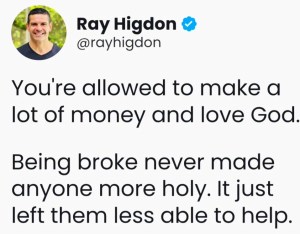
I thought the above a rather interesting meme. It seems to me to contradict at least three of Jesus’ admonitions.

After his good news that God’s Kingdom on the Earth was just around the corner, the subject that exercised Jesus (or at least his script writers) was wealth. Like many today, he wanted to see the wealthy brought down; they would he said be excluded from the Kingdom when it arrived. Not just because they were wealthy – rich, as he called it – but because they failed to give their wealth away to the poor (Luke 16:19-31).

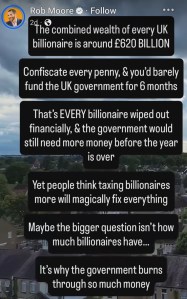
I’m not rich by today’s standards, but compared with those of Jesus’ day, I am wealthy, as you probably are too, dear reader. I do not harbour any grudge against those who are truly rich. I’ve no desire to be like them, and I accept the part I’ve played in making many of them as wealthy as they are. I’ve bought their products, as have we all: think the CEOs of Windows, Microsoft, Apple, Amazon, Facebook and others; ridiculously wealthy pop singers, writers and sportspeople. As long as the very wealthy pay their taxes, that’s okay by me. In fact, the wealthiest 1% in the UK pay 29% of all tax, while in the US the top 10 percent of income earners pay more than 60 percent of all federal taxes and 72 percent of income taxes. I’m not defending the rich here, but if they weren’t rich and didn’t pay the tax they do, who do you think would pick up the tab? That’d be me and you. On top of this, the fact that governments squander much of this money isn’t the fault of the tax payer, rich or otherwise.

My point is that what Jesus thought of as rich now encompasses millions of today’s Christians. So how do they deal with Jesus’ demand they should sell all they have and give the proceeds to the poor (Matthew 19:21, Luke 19.22)? His belief that their admission into the Kingdom is as unlikely as a camel passing through the eye of a needle (Mark 10:25, Matthew 19:24, and Luke 18:25)? His warning that they shouldn’t accumulate riches (Matthew 6:19-21)? His insistence that they can’t serve God and money (Matthew 6:24, Luke 16:13)?

They ignore it all, or fudge it, just like our man in the meme:

  • ‘But if I give it all away, how will I go on helping?’ (I don’t know, I’m not the one who’s telling you to give it away.)
  • ‘Giving my money away won’t make me holy.’(Jesus seemed to think it would; giving your wealth would both ease the lot of the poor and grant you eternal life.)
  • ‘It’s loving money more than God that is the problem.’ (If so, why didn’t Jesus say this? He tells you just having money means you will put it before God.) 
  • ‘But God wants me to be rich.’ (Again, he might have mentioned it. He says the priority is to have spiritual riches in heaven, not actual wealth here on Earth: Matthew 6:19-21)

There’s no getting round it. Jesus, as he’s written, was an extremist who believed he, and those he preached to, lived in the very last days. Consequently, wealth, money, possessions didn’t matter any more. They could and should be shed so as not to prevent entry into the imminent Kingdom of God.

Significantly, today’s Christians don’t use the excuse that Jesus was speaking to a world that was about to end 2000 years ago. They can’t, because that would mean they would have to acknowledge he was wrong. The world did not end, the judgement did not happen, the Kingdom of God did not arrive when he said it would. They can’t bring themselves to say that Jesus’ extreme demands, that his followers give up all they have in readiness for the Kingdom, don’t therefore apply to them.

But wait! Many of them are proclaiming, yet again, that these are the last days, that the Rapture and the Kingdom are even now not far off. So shouldn’t Jesus’ injunctions against wealth once more apply? How about it, righteous ones; let’s see you giving away all you’ve got, proving you love God more than mammon and you’ll do anything to ensure you make it through the proverbial needle’s eye into his Kingdom.

If not, why not?

Did You Know..?

Did you know that Yellowstone – the park, not the Paramount+ series set there – is a giant volcano? Geologists* think that if it were to erupt it would cause a VEI level 8 catastrophe. To put that in perspective, the most severe eruptions that the planet has ever experienced during its existence has been an 8, which caused worldwide environmental destruction and mass extinctions. While Yellowstone is seeing some ‘normal’ activity, there is no indication at present of any major eruption any time soon – it last provided one 64,000 years ago – but with volcanoes you can never say never.

Did you know there have been almost 40,000 earthquakes in the last thirty days? Most have been under 3.5 on the Richter scale, some were not. The Richter scale is a logarithmic scale. An eruption that registers as a 4 on the scale is not just a little greater than a 3. It is 32 times greater. An 8 is 32x32x32x32x32x32 times greater than a 3. Most earthquakes are caused by the movement of the Earth’s tectonic plates. The plates move an average of 2-10cm a year and grind up against, under and over each other. Their movement means there will inevitably be many more quakes greater than the moderate 3.5. These quakes will hit the news, just like the level 5 quake in Venezuela in June this year (6,700 deaths, 226,700 injuries, tens of thousands still missing).

Apart from predicting them, we can do nothing about earthquakes – and the resulting tsunamis when they occur under the sea – except attempt to build quake resistant buildings to minimise their effect. We could also avoid living on the borders of tectonic plates, but invariably we don’t. 

Did you know, we are still within an Ice Age? We are entering an interglacial period towards the end of that Ice Age. This is leading to there being less ice on the planet and a warmer climate. While human activity is almost certainly accelerating this warming, it is happening because of the cyclical nature of glacial and interglacial periods. For the same reason, a future glacial period, with much more ice and much colder temperatures is inevitable, though probably not for a few thousand years.

I mention all of this because of the notion that the Earth is fine-tuned for our existence. In fact our presence is precarious here. We are like ants on an ever-shifting surface that at any time can move violently, destroying a great many of us. The fissures in the Earth’s surface and under its oceans can erupt unexpectedly, creating massive devastation, tsunamis and the destruction not just of human life but of animals and entire environments. The climate changes constantly, warming and cooling for reasons we don’t yet fully understand, driving hardship and extinction for life forms on the planet.

This Earth, like the universe itself, is completely indifferent not only to our well being but our very existence. It does not care whether we, and the animal life on the planet, survive, thrive, live or die. It has not been fine-tuned to nurture us. Homo Sapiens has existed for only 0.007% of the time the Earth has existed. By comparison, the great lizards were here for 3.5% of that time. While it is true that organic life has adapted to being here, it is the surviving life forms, including homo sapiens, that have been fine-tuned to the planet’s changing conditions, not the other way round. This fine-tuning is of course narural selection and pitiless, indifferent evolution. 99% of all the species that have ever lived are now extinct; the vast majority because they could not adapt to the planet’s constant changes (and yes, the arrival of a giant meteorite). 

This is the world, the universe we live in, and we do so at our peril. There’s no fine-tuning creator behind it all who has our best interests at heart. Very far from it.


*The details in the first two paragraphs of this post are taken from a series of talks by the geologist Dr Natasha Stephen, which I was lucky enough to attend recently. I’ve checked those details (and also those of the later paragraphs), not because Dr Stephen could have been be wrong but because I might have misheard or misremembered things she said. Please feel free to check further and correct me if need be.