Lies, Damn Lies and More Lies (Part four of a three part rant)

I turned 71 last month. I know, I know, I don’t look it. I certainly don’t feel it. I feel no older than I did in my 40s, mentally at least. The body’s a little creakier than in was then. Another change I’ve noticed is how less tolerant I’ve become. I’m intolerant these days of other people’s crap including but not limited to Christians attempts to convince others that their superstition is the real deal, and Jesus will return any time soon. Here are a few more examples of the crap* we’re presented with everyday here in the UK:

  • Mass uncontrolled immigration is good for the country;
  • Digital ID cards for everyone will help control immigration;
  • Science is ‘settled’ about whatever agenda our leaders are promoting;
  • Climate change can be reversed;
  • Net zero is achievable and worth the vast expense it entails;
  • Outlawing the use of air conditioning, underfloor heating, bathroom radiators and tumble dryers will help achieve net zero;
  • We need to return to Christian values;
  • Jesus will never you down;
  • Islam is a peace-loving religion;
  • Muslims deserve special protections. Jews, Christians, atheists and any number of others don’t;
  • Racism is exhibited only by white people. Other groups are not really capable of it;
  • Social media is the root of all evil;
  • Free speech causes most of society’s problems and must be controlled;
  • Wealth needs to be redistributed to achieve an equal socialist state;
  • When ordinary people object to being told lies they’re ‘far right’ and ‘divisive’. When the Left respond violently in support of the same lies we need to understand their frustrations.
  • The best way to secure peace is to go to war;
  • The NHS provides the best heath care in the world, and it’s free!
  • All cultures are equally valid;
  • Ordinary people know nothing. Elite leaders know best.

Since I reached teenage, I’ve endured six decades of this kind of propaganda. In the last couple of decades I’ve become so much more wary of it. It is all so much spin, manipulation, untruths. My bullshit detector is alerted whenever I hear a politician speak, a Christian apologist spout or the main stream media promote the same old agenda.

I’m not a conspiracy theorist. I don’t know what’s ‘really’ going on, but I do understand why some people resort to their own explanations. They feel that whatever they’re told almost always feels a little ‘off’, doesn’t quite ring true. Invariably and at best it’s half-truths, the available evidence – if you can be bothered to hunt it down – failing to support the narrative.

I’m not interested any more. I – we – have been lied to too many times to accept anything at face value any more. It isn’t unreasonable to call it all out as crap. The onus is on those making the pronouncements to demonstrate they’re right, telling the truth, and not just blind-siding us with more spin and propaganda. We need only call it out for the crap it is. Let them do the work. They won’t of course and there’s not much we can do about that. But we don’t have to go along with it any more.

*I can supply links to all of these or you can Google them for yourselves. The point is they’re all real. 

Sorry For Any Inconvenience (a rant, part three)

More meaningless phrases that are used unthinkingly. I hate the lot of them!

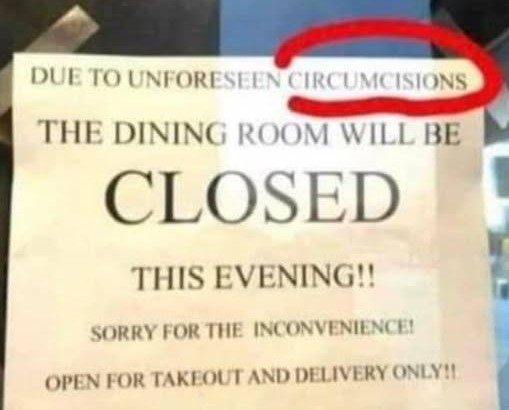
We are closed today/unable to provide the service you’ve paid for, etc. We apologise for the inconvenience.

The hell you do. You couldn’t care less about what your withdrawal of your service means to your customers or you’d have done everything in your power to prevent it. And to suppose I’m only mildly ‘inconvenienced’ by your slipshod ways, not to mention your glib apology, is to underestimate the trouble you’ve put me to.

‘Your reaction is abuse’

Anything remotely assertive is now regarded as abuse. The term has been degraded the extent that those who are genuinely abused – physically, sexually or emotionally – are now on a par with those dealing with a dissatisfied customer in a shop or an obstructive bureaucrat down the phone (assuming you can speak to a real person these days). Of course, it’s best to be calm and civil when trying to resolve a problem, but a little forcefulness is occasionally necessary. These days you’ll have strayed into ‘abuse’ if you make your point with anything other than submissive meekness. As Spectator columnist Mark Mason put it (after I originally drafted this post), a claim of abuse ‘has become a go-to argument of the grievance generation. Express the slightest irritation with them for being irritating and you’re the one in the wrong’. (Is this post abusive? Probably.)

Shit, as in ‘I’ll just collect my shit’ or ‘I need to get my shit together’. The imagery is gross – you do know what shit is, don’t you? – and if you have such low regard for your belongings or your thoughts maybe you should think twice and about telling us about it. There are plenty of other decent and less revolting words for your stuff and your psychological state and to aver them for ‘shit’ is downright lazy

And while I’m having still ranting, let me have a go at the f word. I’m sick to death of it. I do occasionally use it myself, particularly in totally rational disputes with technology, but I get weary of hearing it in snatches of conversation I hear while walking in the street, where every other word is the f-word or one of its derivatives. It is used by parents in the presence of their children and, worse, when addressing them. I deplore its use on TV and in films where it’s added to give more force to dialogue or insight into how a character’s feeling. Any half-decent actor could and should convey emotion or urgency or whatever without the need for superfluous swear words. ‘I want you out of my life, ‘ delivered by a competent actor conveys more personal anguish and naked pain than ‘I want you out of my f***ing life,’ which conveys only anger and reflects the scriptwriter’s societal conditioning that compels him or her to include the f word because that’s what people in the street do. Scriptwriters need to trust their actors far more than they do and cut out the needless profanity. Shakespeare never found the need to include it in any of his 37 plays. ‘Is this a dagger I see before me’ would have been robbed of its power if the bard had seen fit to stick a ‘fucking’ in there somewhere. Likewise, comedians who think a line is made funnier by adding the f word to it; if the line is funny, it’s funny without it. If it’s not funny, adding fuck won’t make it funny. Let’s have less of the f word and more considered writing and genuine funniness.

Rant over.

Newspeak (part two of a rant)

I’ve been considering the changing meaning of words. I acknowledge that this happens over time: language evolves like everything else. My concern here is the deliberate redefining of words to suit a given (political) agenda. This often underhanded stretching of words to give them new meanings, actually diminishes them and renders them dangerous. 

As part of its definition, Merrian-Webster describes racism as ‘behavior or attitudes that reflect and foster ‘the belief in racial superiority): discrimination, prejudice, or violence against people because of their race.’

Violence, it seems to me, is hardly ever justified. I have detested it since I was a child. There can be no doubt that violence is sometimes motivated by racial hatred, but like all the words I’m dealing with here, racism as an accusation is overused to the point of meaninglessness. While other nations – the Scandinavian countries, the US, Scotland and Wales – proudly fly their national flags practically everywhere, here in the UK it has been deemed to be racist by some on the Left. It’s common for the Ukranian, Palestinian, Scottish, Welsh and LGBT flags to be flown here, why are the English and Union flags now considered to be racist? It might, at a stretch be that they are divisive, but then aren’t all flags? Isn’t that what they’re for, to declare a national identity that is distinct from that of other states? The British flag is no more ‘racist’ than any other. Neither is expressing genuine concern for immigration, which is dismissed by those who’ve failed to control it, as racist. How can it be when those coming into Britain are from a variety of ‘races’, many white and European?

It’s racist, and hateful too, say ‘community leaders’ and white liberals, to object to the treatment of women within Islam, or first-cousin marriage or frequently expressed anti-Semitism. ‘Racism’ in these instances is an attempt to shut down discussion and censure those with legitimate concerns. Similarly, for fear of being considered racist, authorities have failed to investigate (hateful) criminal activities by ethnic minorities. And while it’s become clichéd to say it, criticism of Islam and its practices is not racist: Islam is a religion, not a race, its practitioners drawn from a range of ethnicities. The true meaning of racism has been lost. Those who suffer from it abandoned in the transition of the word into meaninglessness.

My 95 year old mother was in hospital recently. She struggled to understand what some of the nurses were saying to her, either about her condition or treatment or something else. She didn’t know which because, between her deteriorating hearing, the mouth coverings some nurses wore and the accents of those from other ethnicities, she couldn’t understand them. What she couldn’t do, she felt, was say this to them. In Britain today it is regarded as racist to tell someone from another culture you can’t understand them. So she didn’t, nor did she mention the problem to any other of the medical team for fear of being thought racist. This is where we are in today’s Britain.

A Phobia of Hate (part one of a rant)

It used to be the case that when writing an essay or presenting an argument, the writer needed to define one’s terms. This way, parameters were set with clarity and, as we say these days, transparency about what was to be discussed. Sadly, this seems not to be the case any more. I don’t blame social media for this; it seems to me politicians have largely led the charge, using terms with usually clear definitions in ways that suit their own purpose, without any regard for that common understanding. Rarely do they make clear that this is what they are doing. The mainstream media are inclined to do the same. What we may think they’re talking about, they may not be. Perhaps both politicians and the media learned the trick from Christian commenters who are happy to change the meaning of words as they see fit (‘Atheists’, ‘myth’, ‘metaphor’ for example.)

I dealt with autism here. The term, and diagnosis, is now stretched so thinly that, according to the social scientist who first proposed the autistic ‘spectrum’, it has become ‘meaningless’. What other terms have been misapplied until they too have been rendered ‘meaningless’?

How about phobia? Strictly speaking a phobia is an irrational fear, one for which there is no real basis: arachnophobia, agoraphobia, claustrophobia, for example. Of course there may be real grounds for being fearful of spiders (some are poisonous) heights (if perched precariously on the top of a mountain) and enclosed spaces (if it is suffocating), but the terms arachnophobia, acrophobia, claustrophobia are reserved, or at least they used to be, for those whose fear is extreme and above and beyond the rational. The term phobia is now applied to anyone who expresses concern about or criticism of any movement or cause: homophobia, transphobia, Islamophobia come to mind. The first of these started life as an irrational fear that one might oneself be homosexual. Now it’s considered to be, by those who attribute their not ‘getting on’ in life or being subjected to personal criticism, to be the result of their being gay. Certainly ill-considered remarks may be unkind, a word that more than adequately describes much of what is described as phobic in modern society. But being unkind does not equate with a phobia, nor is it against the law. Not yet anyway.

Similarly offensive, a word originally that originally signified a physical attack, the meaning it still carries in law. As Paul Simon once expressed it in a rather pleasant little song, ‘One Man’s Ceiling is Another Man’s Floor’: what I might find offensive, in the sense of hurt feelings, is not necessarily what you find offensive, unless you choose to allow it to be. That’s because ‘offence’ in the slack modern sense is ridiculously subjective: it is, it seems, not a problem to call for the death of Jews but it is offensive to show images of an ancient ‘prophet’. Touchy religious sensibilities, sometimes prone to take offence at the slightest provocation, do not signal a criminal or even a criminal offence. And yet that is where we’ve got to, certainly in the UK. Remember your mother teaching you that sticks and stones may break your bones but words will never hurt you? Of course this is not entirely true; words can cause emotional hurt. But this doesn’t mean those who use words critically merit investigation by the officers of the law.

Hate is a verb. Unlike its antonym love, it cannot also be a noun. I know, this is pedantic of me, but we’re talking about words and the damage they can cause when misapplied. To alter and stretch their meaning out of all recognition results in the problems we now have in (British) society. All of the accusations of ‘hate’ that fly around these days are, grammatically, ‘hatred’ though in fact, they rarely qualify as this either. According to Merriam Webster, hatred is ‘an extreme dislike or disgust or ill will or resentment that is usually mutual: prejudiced hostility or animosity.’ Hatred is a powerful, destructive emotion. Reasoned opposition to the political manoeuvring of minority groups is not really it.

Of course it is possible to take such opposition to extreme lengths that it may look a lot like hatred, but by and large it is not. I do not ‘hate’ religious group that try to impose their beliefs and practices on me or my society, but I do oppose them and their efforts. I also oppose those who claim that any opposition to their efforts constitutes ‘hate’. It rarely does so, but how convenient it is for those who don’t get their own way to have the accusation in their armoury. Which is not to say real hatred isn’t expressed, often in violent action, but strangely, as a society, we seem less concerned with such action. We are, apparently, required to understand the frustrations of those carrying them out; their grievance is genuine and heartfelt. Hurty words though are of much more concern.