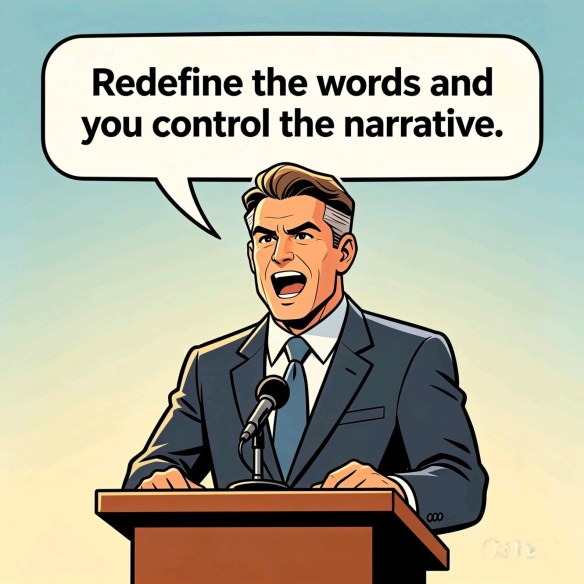
It used to be the case that when writing an essay or presenting an argument, the writer needed to define one’s terms. This way, parameters were set with clarity and, as we say these days, transparency about what was to be discussed. Sadly, this seems not to be the case any more. I don’t blame social media for this; it seems to me politicians have largely led the charge, using terms with usually clear definitions in ways that suit their own purpose, without any regard for that common understanding. Rarely do they make clear that this is what they are doing. The mainstream media are inclined to do the same. What we may think they’re talking about, they may not be. Perhaps both politicians and the media learned the trick from Christian commenters who are happy to change the meaning of words as they see fit (‘Atheists’, ‘myth’, ‘metaphor’ for example.)
I dealt with autism here. The term, and diagnosis, is now stretched so thinly that, according to the social scientist who first proposed the autistic ‘spectrum’, it has become ‘meaningless’. What other terms have been misapplied until they too have been rendered ‘meaningless’?
How about phobia? Strictly speaking a phobia is an irrational fear, one for which there is no real basis: arachnophobia, agoraphobia, claustrophobia, for example. Of course there may be real grounds for being fearful of spiders (some are poisonous) heights (if perched precariously on the top of a mountain) and enclosed spaces (if it is suffocating), but the terms arachnophobia, acrophobia, claustrophobia are reserved, or at least they used to be, for those whose fear is extreme and above and beyond the rational. The term phobia is now applied to anyone who expresses concern about or criticism of any movement or cause: homophobia, transphobia, Islamophobia come to mind. The first of these started life as an irrational fear that one might oneself be homosexual. Now it’s considered to be, by those who attribute their not ‘getting on’ in life or being subjected to personal criticism, to be the result of their being gay. Certainly ill-considered remarks may be unkind, a word that more than adequately describes much of what is described as phobic in modern society. But being unkind does not equate with a phobia, nor is it against the law. Not yet anyway.
Similarly offensive, a word originally that originally signified a physical attack, the meaning it still carries in law. As Paul Simon once expressed it in a rather pleasant little song, ‘One Man’s Ceiling is Another Man’s Floor’: what I might find offensive, in the sense of hurt feelings, is not necessarily what you find offensive, unless you choose to allow it to be. That’s because ‘offence’ in the slack modern sense is ridiculously subjective: it is, it seems, not a problem to call for the death of Jews but it is offensive to show images of an ancient ‘prophet’. Touchy religious sensibilities, sometimes prone to take offence at the slightest provocation, do not signal a criminal or even a criminal offence. And yet that is where we’ve got to, certainly in the UK. Remember your mother teaching you that sticks and stones may break your bones but words will never hurt you? Of course this is not entirely true; words can cause emotional hurt. But this doesn’t mean those who use words critically merit investigation by the officers of the law.
Hate is a verb. Unlike its antonym love, it cannot also be a noun. I know, this is pedantic of me, but we’re talking about words and the damage they can cause when misapplied. To alter and stretch their meaning out of all recognition results in the problems we now have in (British) society. All of the accusations of ‘hate’ that fly around these days are, grammatically, ‘hatred’ though in fact, they rarely qualify as this either. According to Merriam Webster, hatred is ‘an extreme dislike or disgust or ill will or resentment that is usually mutual: prejudiced hostility or animosity.’ Hatred is a powerful, destructive emotion. Reasoned opposition to the political manoeuvring of minority groups is not really it.
Of course it is possible to take such opposition to extreme lengths that it may look a lot like hatred, but by and large it is not. I do not ‘hate’ religious group that try to impose their beliefs and practices on me or my society, but I do oppose them and their efforts. I also oppose those who claim that any opposition to their efforts constitutes ‘hate’. It rarely does so, but how convenient it is for those who don’t get their own way to have the accusation in their armoury. Which is not to say real hatred isn’t expressed, often in violent action, but strangely, as a society, we seem less concerned with such action. We are, apparently, required to understand the frustrations of those carrying them out; their grievance is genuine and heartfelt. Hurty words though are of much more concern.


