Christianity’s Greatest Failures: 3. The Prophecies


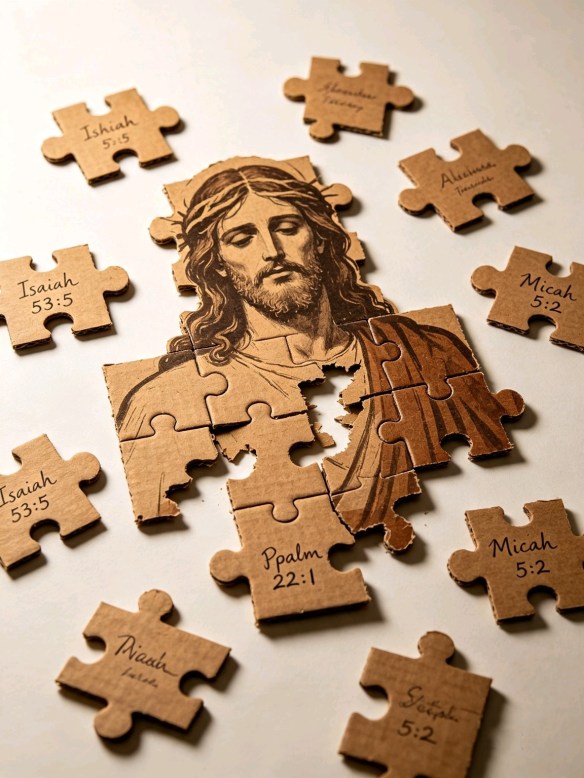
Jesus fulfilled somewhere in the region of 350 prophecies from the Jewish scriptures. Or so many desperate Christians tell us. The mere mention of something – anything – in the Old Testament that might be stretched far beyond its original meaning to apply to Jesus is interpreted as pointing to him. I’ve looked at many of these non-prophecies and supposed foreshadowing episodes before (here and here, for example), so let me make mention of another. John 5:24-29 is, according to newtestamentchristians.com, the fulfilment of Job 19:23-27, which goes as follows:

Oh, that my words were recorded, that they were written on a scroll, that they were inscribed with an iron tool on lead, or engraved in rock forever! I know that my redeemer[ lives, and that in the end he will stand on the earth. And after my skin has been destroyed, yet in my flesh I will see God; I myself will see him with my own eyes—I, and not another. How my heart yearns within me! If you say, ‘How we will hound him, since the root of the trouble lies in him,you should fear the sword yourselves; for wrath will bring punishment by the sword, and then you will know that there is judgment.

And here’s John 5:24-29:

Very truly I tell you, whoever hears my word and believes him who sent me has eternal life and will not be judged but has crossed over from death to life. Very truly I tell you, a time is coming and has now come when the dead will hear the voice of the Son of God and those who hear will live. For as the Father has life in himself, so he has granted the Son also to have life in himself. And he has given him authority to judge because he is the Son of Man.

According to newtestamentchristians.com, the Job passage presages the John in predicting the resurrection. Specifically, the passage from the fourth gospel shows how the Job prophecy has been realised. But the Job is not a prophecy. Just because it is supposedly fulfilled by the fourth gospel doesn’t make it one. To say it does is tautological; A proves B proves A. The author of Job was reflecting his character’s anguish at the trials and tribulations he had been through with the God-approved inflictions that had befallen him. The passage might also be symbolic of the trials the Jews had also suffered according to their mythic history. It had, and has, nothing to do with Jesus. You have to read a lot into it to see any connection between the two (they both mention judgement and the fact a redeemer lives, but that’s it).

Perhaps the authors of John detected an allusion to resurrection in general and then ‘reimagined’ it as applying to Jesus. Perhaps it’s only today’s Christians who do it. Either way, this is how gospel Jesus came to be created: he’s an amalgam of ‘prophecies’, incidents and characters from Jewish scripture. Nothing he does or says is historical or even original; it can all be found in the Old Testament (and in the case of Mark’s gospel, in Paul too). This isn’t because Jesus miraculously and supernaturally fulfilled 350 prophecies as he lived, died and revived. It’s because he was written that way. Everything he did while he supposedly lived, everything surrounding his death and certainly everything about his resurrection is recreated from Old Testament episodes and Paul’s ramblings about his heavenly Messiah. To see it otherwise, is to fall for the trick and succumb to the illusion. As the Religious Studies Center puts it:

What becomes clear from these varied techniques for using scripture is that the earlier Old Testament scriptures were an important resource from which to draw upon in the creation of what would become new or additional scripture, the New Testament. It also becomes evident that these scriptures were read, recited, and known well enough by the listeners and readers to use as support and authority for their teachings (my emphasis).

The New Testament shows us repeatedly that this is the case:

Mark 4: 11-12 (quoting Isaiah 6:9-10): Jesus told them, ‘The secret of the kingdom of God has been given to you. But to those on the outside everything is said in parables so that “they may be ever seeing but never perceiving, and ever hearing but never understanding;
otherwise they might turn and be forgiven!”’’

Matthew 16: 13-17: Jesus asked his disciples, “Who do people say the Son of Man is?” They replied, “Some say John the Baptist; others say Elijah; and still others, Jeremiah or one of the prophets.” “But what about you?” he asked. “Who do you say I am?” Simon Peter answered, “You are the Messiah, the Son of the living God.” Jesus replied, “Blessed are you, Simon son of Jonah, for this was not revealed to you by flesh and blood, but by my Father in heaven. (Wasn’t Jesus ‘flesh and blood’ at this point? And weren’t ‘the people’ not far off the mark in equating JC with the ancient prophets? Fictional Jesus also stresses that Peter is a descendant of Jonah, another hint we’re dealing with revamping of older characters.)

Matthew 17: 2-3, 6-7: Jesus was transfigured before (the disciples). His face shone like the sun, and his clothes became as white as the light. Just then there appeared before them Moses and Elijah, talking with Jesus… They fell facedown to the ground, terrified. But Jesus came and touched them. “Get up,” he said. “Don’t be afraid.” When they looked up, they saw no one except Jesus.

Acts 1:3: After his suffering, he presented himself to them and gave many convincing proofs that he was alive. He appeared to them over a period of forty days and spoke about the kingdom of God.(That’s ’proofs’ from scripture: what else could it be?)

Acts 18:28: …(Paul) vigorously refuted his Jewish opponents in public debate, proving from the Scriptures that Jesus was the Messiah. (Not from Jesus’ amazing life, feats or resurrection?)

Hebrews: Every quote attributed to Jesus is lifted from Jewish scripture. (eg: Hebrews 2:12-13), likewise Revelation.

1 and 2 Peter quote nothing but Jewish scripture when talking about Jesus (this supposedly from a man who supposedly knew Jesus in the flesh.)

So no, Jesus doesn’t fulfil the innumerable ‘prophecies’ Christians claim. He was just written that way.

Strike up another big fail.

There May Be Trouble Ahead…

Prophets, from left to right: Elijah, Julie Stephens,
Cindy Jacobs and er... Ed Miliband

Prophets don’t exist. A bunch of people intoxicated by religious fervour who think God has given them a special message that they must deliver to whoever will listen, are not prophets; they are a collection of extremists intoxicated with religious fervour.

We know this because no God exists. He can’t, as a result, drop messages, special or otherwise, into the heads of fanatics.

That’s it, really. No more to be said.

But so-called prophets exert quite an influence on our modern world. According to Abraham (I know, he’s a mythical figure but bear with me), God selected an ancient Jewish tribe to be his favourite buddies, so long as they did whatever he demanded of them, including hacking off their foreskins and that of their sons. What sort of prophet – what sort of God – comes up with this kind of lunatic fetishism?

Later the creators of a new prophet, whom they called Moses, came up with a story in which their hero encountered God in a bush (the symbolism is lost on us today.) This time he wanted his special buddies to invade their neighbour’s territory, slaughter them and take their land for themselves. This his favourite, de-foreskinned tribe did (modern genetic analysis of the peoples in the region suggests this isn’t what happened.)

After these fictional madmen came some potentially real fanatics who thought God had assigned them to lambast their fellow Jews for their shortcomings. These prophets promised the rubes rewards if they behaved as the prophets thought they should. These guys also came up with the idea that God would send a warrior Messiah to help his special little tribe take over the world. This is what happens when fanatics are allowed to get a hold of things.

A couple of centuries later, another self-proclaimed prophet turned up (or is invented) who seemed to think he’s the most special-est of all the prophets so far. This guy, called Yeshua (meaning ‘salvation’, so obviously not in any way symbolic) prophesied that the Messiah would be arriving real soon to sort the world out. He’d then hand it over to the Jewish people to manage. This guy’s script writers weren’t sure if Yeshua was talking about himself or some other supernatural character called the Son of Man. It doesn’t matter really. Nothing he prophesied happened when he confidently predicted it would: there was no Messiah who flies down from heaven, no final judgment, no great reset for the Earth. He was an absolute failure as a prophet; evidence, if more is needed, that those who claim to speak for God don’t know what they’re talking about. Don’t worry, though, this guy was recast as a resurrected Godman, just like the ones in pagan myths.

A few other prophets appeared around about the same time. In fact, the extremist who changed his name to Paul seemed to think that just about anyone could become one so long as they ‘edified’ the brethren. It was a few years though before the next really big so-called prophet came along.

In the 8th century, a guy called Muhammad said he was told by an angel who represented a different version of God that, amongst other things, Islam would spread worldwide and there would be an increase in senseless murders. These rather nebulous and self-fulfilling predictions are even now coming to pass. Muhammad’s future followers are indeed spreading Islam across the globe while senseless murders continue being committed, a good many of them by Muslims themselves.

While Muslims have made it clear that Muhammad is the final prophet, history has blessed us since with a few more. Joseph Smith in the 1880s was commanded by a different God (or maybe by the same one who’s changed his mind again) to start a new church and to obliterate anyone who stood in his way. He was successful in this enterprise, despite managing to get himself killed in the process.

You’d think, wouldn’t you, that given their abysmal success rate and the number of people who have suffered or perished as a result of their endeavours that we’d have had enough of prophets. While churches cannot agree on whether ‘genuine’ prophecy still exists, the prophets keep coming. Fanatics the world over, every bit as barmy as their predecessors, appoint themselves some deity’s spokesperson, and the ‘prophetic’ pronouncements begin: meaningless theobabble spattered across the Internet.

Either All True Or None True

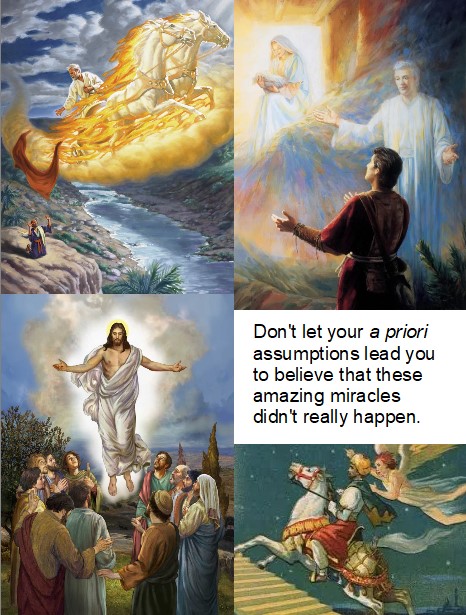
About 2,500 years ago, a man called Elijah went up to heaven while still alive. He was taken through a whirlwind in a chariot of fire, pulled by horses of fire. This amazing event was witnessed by several other people who were profoundly affected by it. The story of this ascension was possibly relayed orally for many years until finally being written down in what is now 2 Kings 2.

Did any of this really happen?

Of course not. It’s a myth.

Some time in the 4th century BCE, the first king of Rome, Romulus, was taken, while still alive, to the dwelling place of the gods. From that time on he was worshipped as a god – some said he was eternal to begin with – with a temple being built in the very place from where he had ascended. Later he appeared to one of his followers, Julius Proculus who said the resurrected Romulus was larger and more beautiful than ever, armed with weapons shining like fire. Julius Proculus attested to this appearance of the resurrected Romulus, swore an oath to its veracity and relayed it faithfully to others.

Did any of this really happen?

Of course not. It’s a myth.

https://mythologymatters.wordpress.com/2019/04/18/easter-mythology-the-resurrection-as-modeled-on-greco-roman-myths/

It is not known when Mithras was born, if indeed he was. He emerged from a rock in the spiritual realm as a child or youth, ritually slaughtering a bull and sharing a banquet with the god Sol. He guided souls to the after-life, propelled as they were by the bull’s blood and flames. He was worshipped primarily by soldiers who saw him as their salvation from the bitterness of earthly life. There were rituals to be followed to become a true initiate and for Mithraic mysteries to be revealed. How Mithras made himself known to his acolytes is unknown, but in the first three centuries CE, his cult rivalled that of the Christians in popularity.

Did all of this really happen?

Of course not. It’s a fabrication, a myth.

In the 8th century CE, the prophet Muhammad flew from Mecca to Jerusalem on a winged equine. Once in Jerusalem he climbed a ladder to heaven. Once there he travelled through the various levels, having conversations with other lesser prophets, before entering Allah’s domain. His journey was later revealed to two early prophets who had known Muhammed when they were boys. They conveyed the details accurately until they were recorded, briefly at first in the Qur’an and later in more detail in its supplement, the hadith.

Did any of this really happen?

Of course not. It’s a fabrication, a myth.

In the early 19th century, Joseph Smith was visited by Jesus and his Father in a vision. They told him that he should not join any existing church because they were all in error. Later, a hitherto unknown angel named Moroni appeared to Smith and indicated to him where some gold plates were buried. He instructed Smith to dig up and translate the plates. Obediently, Smith did so, using a pair of seer stones for the translation. The resulting Book of Mormon was a revelation of Christ’s activities in North America following his resurrection. Smith wisely had a number of his associates witness, in writing, the existence of the gold plates as well as their supernatural provenance.

Did any of this really happen?

Of course not. It’s a fabrication.

In 1916 the Virgin Mary appeared numerous times to three poor Portuguese children, giving them instruction and prophesying to them. She also promised that she would perform a miracle at Fatima. Accordingly, between 30,000 and 100,000 people, including reporters and photographers, gathered at Fatima where many saw multi-coloured lights before the sun itself ‘danced’. It came closer to the Earth before zig-zagging back to its usual place in the sky. While not all of the attendees testified to the phenomenon of the dancing sun (some saw only the lights, others nothing at all) many did and testified to the effect the miracle had had upon them.

Did all of this really happen?

Of course not. It’s a fabrication based on hallucinations.

Around 30CE, a rabbi known as Jesus, who had been born of a virgin, gathered together 12 followers and went around Galilee preaching absolution from sin and the imminence of the Kingdom of God. He announced he was the Messiah who would rule the Earth when the kingdom arrived. The Jewish authorities took exception to his claims and petitioned the Romans to have him executed. This they did, only for Jesus to come back to life three days later, appearing in visions to his followers. He ascended to heaven, promising that those who believed in him would enjoy eternal life. Some of his disciples spread his message faithfully until it was eventually written down, first by a former Pharisee called Paul and then by four authors who accurately recorded what Jesus had said and done.

Did all of this really happen?

What do you think?

The Bible Is Fantasy

The Bible contains:

113 appearances of angels, usually interacting with human beings;

50+ visions, on which all of Christianity hangs: those of Daniel; Cephas and others who ‘saw’ the risen Christ; Paul and John the Elder in Revelation. 

21 supernatural dreams, including those experienced by Jacob, Technicolor Joseph, NT Joseph, the Magi, Pilate’s wife and Paul

Numerous apparitions and ghostly appearances, including that of the resurrected Jesus as well as Moses and Elijah and, in the Old Testament, the spirit of Samuel, conjured up from the grave by the witch of Endor.

Innumerable resurrections: not only that of Jesus but several Old Testament characters, and, in the New, Lazarus, Jairus’ daughter, the young man of Nain and the hordes who rose from their graves at the time of the crucifixion.

Multiple impossible astronomical events, ranging from the sun stopping in its orbit(!); a star wandering and hovering over a small house; a solar eclipse lasting several hours; stars that one day will fall from the sky; a God who lives just above the clouds and a ‘firmament’ between the Earth and the heavens that holds back water;

Several events in which nature is magically controlled: the parting of the Red Sea; Moses’ magician’s staff becoming a snake; the Nile turning to blood; Jonah being swallowed but not digested by a ‘great fish’ and Jesus calming a storm.

An abundance of fantastic beasts and fairy tale creatures: Giants (Genesis 6:1-4, Numbers 13:33); Leviathan the sea monster (Isaiah 27:1 etc); the Behemoth (Job 40:15-24); the Cherubim monsters (Ezekiel 1:4-21); the dragon and other beasts from Revelation

Many characters who are clearly legendary, from Adam & Eve, Noah, Lot and Abraham to Moses, Job, Daniel and gospel Jesus. Some of the Bible’s fictional characters lived to a literally incredible age: Adam 930 years, Seth 912, Methuselah 969, Noah 950, Abraham 175, Moses a pitiful 120. Jesus holds the record being now either 2,000 years old or eternal, depending on how you count it.

5 mythical places: Eden at the beginning of the book; New Jerusalem at the end; Heaven, the abode of God; Sheol the Old Testament place of the dead; Hades (Sheol mark II?) which Jesus visited while supposedly dead in his tomb (Acts 2:27, 31; Matt 16:18).

2 sentient ‘pillars’: one of cloud, one of fire (Exodus 13).

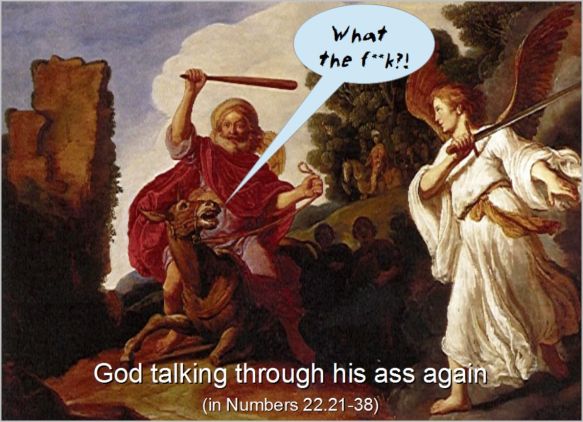
2 talking animals: the serpent in Eden and Balaam’s ass.

1 talking plant (Exodus 3:3).

0 science. No understanding whatsoever of what we now call astronomy, meteorology, germ theory, genetics, evolution, psychology… you name it.

So how do we read all of this? As the ancients themselves would, with an understanding of the world that regarded the supernatural, magic, miracles and monsters as real? We’re told often enough that this is how we should interpret scripture, not from a modern perspective. Perhaps we might credit the creators of the many books of the bible with greater skill, however, and interpret the inclusion of magic and miracle as allegorical or metaphorical; literary pieces, if you will. But then we have to decide which far-fetched stories are myth and which are historical accounts,. There really is no way to do this. A New Testament story awash with impossible events, implausible characters and symbolic tropes is every bit as allegorical or metaphorical as the same kind of story in the Old Testament (or, indeed, in Egyptian, Greek and Roman myth.) The reader who wants to see stories in the Old Testament as carefully crafted allegories has to concede that the Jesus narratives are of the same order.

It looks like we have to read the Bible as 21st century readers, because that is what we are. After all the Bible is supposedly a book for all time. We can, however, recognise the way in which its many creators saw the world – populated with fantasy creatures and subject to impossible events – and accept that they were wrong. Reality is not as they perceived it. What we cannot do is claim that the Jesus story is an oasis of truth in the midst of all this fantasy . 

Making excuses for Jesus


Excuse 1. When he said ‘Kingdom of God’, what Jesus really meant was ‘transfiguration’.

Hokum

However it might seem, Jesus’ mission didn’t fail! Absolutely not. Because after he promised those standing in front of him would see God’s Kingdom come in power and glory, the gospels relate how some of the disciples saw Jesus having a friendly chat with Moses and Elijah (Mark 9.1-8 etc). So, say his apologists, this was what he was really referring to; his being visited by two of Judaism’s great figures, on day release from Heaven or having travelled through time or, more probably, having being planted in a story that is pure fabrication. Whichever, this ‘transfiguration’ is regularly hauled out as ‘evidence’ that those standing with Jesus did indeed see him in his Kingdom. (Here, here and here, for example.)

Pastor Bob Deffinbaugh, for example, puts it like this:

Jesus then promised His disciples that some of them would see the “kingdom of God” before they died: “I tell you the truth, some who are standing here will not taste death before they see the kingdom of God (Luke 9.27). While there are numerous explanations as to what Jesus’ words here mean, the simplest explanation, especially in the context, is that Jesus was foretelling the transfiguration which was to come within a week’s time.

But this cannot be ‘the simplest explanation’ because it doesn’t fit any of what Jesus said the Kingdom would be like. Here’s his description as it appears in Matthew 24.29-31 & 34 (emphasis added):

Immediately after the suffering of those days the sun will be darkened, and the moon will not give its light; the stars will fall from heaven, and the powers of heaven will be shaken. Then the sign of the Son of Man will appear in heaven, and then all the tribes of the earth will mourn, and they will see the Son of Man coming on the clouds of heaven with power and great glory. And he will send out his angels with a loud trumpet call, and they will gather his elect from the four winds, from one end of heaven to the other… Truly, I say to you, this generation will not pass away until all these things take place.

The transfiguration bears no relation to any of this, nor to his other predictions about what the Kingdom would be like – the meek inheriting the Earth, the last becoming first and so on – once it was established. The Kingdom of God as Jesus imagined it (and he did imagine it) was to be a far grander affair than a symbolic encounter ‘witnessed’ by a few disciples. It was to be seen by the entire world and would have far-reaching and long-lasting consequences. The transfiguration, no matter how much Jesus’ raiment is made to shine, simply doesn’t qualify. It can’t possibly be, then, what Jesus had in mind when he predicted the end of the age and God’s rule coming to the Earth. There is a fundamental dishonesty in claiming that it is.

Better luck next, Christians…