Loose Threads

FamilyPick a thread. Any thread. And start pulling. Gently does it, no need for force. A gentle pull on any of the loose ends of faith and the whole fabric will come apart quickly.

Here, pull on this one marked ‘the infallibility of the Bible‘. See how easily it comes loose as soon as you realise that most of it, Old and New Testament alike, was written long after the events it purports to describe, some of it by imposters and forgers.

Or this one – the salvation thread, much of it stitched into place by an excitable chap prone to hallucinations. Pull it and see how its pattern is nothing like the one proposed by the man it claims to be about.

Pull the magic threads, the ones about Gods, supernatural beings, heaven and hell, eternal life. Watch them disintegrate in your fingers once they’re teased out into the real world.

Take hold of the threads about Resurrections, Second Comings, Raptures and Judgements; so fragile, these break away as soon as they’re touched. The only miracle is that they’ve lasted this long.

Then there’s the promises threads, about how believers are going to do fantastic miracles and heal the sick and raise the dead. Imaginative and colourful, these have never really fitted in.

Then there’s the prayer threads, whose embroidery tells us how prayer works, how God will give us whatever we ask for. Downright embarrassing, these – yank ’em out.

And how about the strands that those who say they love the cloth pick out themselves and throw away? You know the ones; the threads which tell them how to live their lives that they just don’t like the look of and think spoil the overall effect. These have definitely got to go.

What about the threads that weren’t originally there – the ones about ‘defending God’s standards‘ and having a ‘relationship‘ with a dead person? These grubby, greasy threads have been added in to replace the ones those who love the cloth have pulled out for themselves.

Choose any number of other threads – the ones that clash with other bits of the pattern, the ugly brutal ones, the fantastic, the ignorant – and give them a tug. Oh, look. They come away too.

And before you know it, the entire fabric has come apart in your hands. All that’s left is a pile of worthless, brittle threads, good for nothing but throwing in the bin.

The Seventeen Commandments

mosesQuick – can you name the sixth of the ten commandments? That was the question in a quiz I went to last night. We got it wrong, but I have to to tell you, so did the quiz-master. If you Google ‘the Ten Commandments’ – which I can assure you we didn’t during the quiz – what you get is the list of injunctions from Exodus 20. You know the ones: thou shalt not kill, steal, commit adultery or covet thy neighbour’s ass. Read them all here if you feel inclined.

When, in a fit of pique, Moses destroyed the stone slabs on which these ‘commandments’ were written, God generously offered to provide him with a replacement set. The Almighty even made a point of saying, in Exodus 34.1, that the two sets would be identical. But they’re not. Here’s the lot from Exodus 34:

1. You shall worship no other god, because the Lord, whose name is Jealous, is a jealous God.
2. Do not make any molten gods (idols).
3. Keep the Feast of Unleavened Bread.
4. The first born of every creature shall belong to me.
5. Work for six days and rest on the seventh.
6. Observe the Feast of Weeks.
7. Present all your male children to the Lord God three times a year.
8. Do not offer the blood of sacrifices to God with leaven and don’t leave the sacrifice of the Feast of the Passover until the morning.
9. Give the first of the first-fruits of the land to the house of the Lord thy God.
10. Do not boil a kid in his mother’s milk.

Far from being identical, only three commandments are the same in the two sets; missing from the Exodus 34 group are those about adultery, theft and killing, replaced with stipulations about ancient Jewish festivals and boiling baby goats (of great eternal significance, that one.) Just to complicate matters, this second lot is the only one referred to in the Bible as ‘The Ten Commandments’ (Exodus 34.28). The more familiar injunctions from Exodus 20 – the ones Google brings up – are not.

What is going on here? It’s as if ‘The Ten Commandments’ are not as immutable as Christians claim. What are they to do? Should they pick and mix between the two sets? Should they reject one and use only the other? Obey both lots – The Seventeen Commandments? It’s far from clear and yet, according to Jesus, their eternal existence depends on getting it right (Matthew 19:17).

All of which makes me think how a single seamless garment has been created out of a ragbag of scraps and patches. The church and believers in general have told us that the shambolic writings stitched together as the Bible tell a consistent story. This deceit is a major accomplishment of the Christian faith because the seamless garment is an illusion, created by pretending there are no discrepancies or inconsistencies and by glossing over all the significant differences within God’s Word™.

This is why we never hear of the second set of commandments – they’re put away like a mad woman in the attic. The church doesn’t want people seeing them or hearing about them. Best to shut them away and make out they don’t exist. Same with the second account of creation in Genesis 2. It’s different from that in Genesis 1, though both are embarrassingly wrong about the means and order of creation. When Christians do acknowledge that there are two accounts (as Ken Ham does) they insist, that, of course, there are no real differences and they can all be explained (away). If there are no differences, why then do they need explaining?

Then there are the disparate accounts of Jesus’ life. Even where they share the same material each gospel presents it differently or gives it a spin that frequently contradicts the other gospels’ versions of the same events. Every one of the stories about the resurrection, for example, is radically different in both detail and significance from all the others.

There are even greater problems for Christians in explaining how Jesus’ supposed sacrifice on the cross brings about salvation. The writers of the New Testament aren’t clear themselves, suggesting at least a dozen largely incompatible ways between them. The four gospels alone have conflicting ideas about how it works (more on this next time), all of which differ from Paul’s salvation formula.

I suppose if Christians want to deceive themselves about their faith and their magic book, it’s up to them. But, please, righteous ones, don’t try and tell the rest of us it has a clear consistent message when it doesn’t. Don’t tell us it’s a seamless garment when it has tangles of loose threads and you’ve had to throw away all the material that doesn’t fit the pattern you pretend you can see.


Oh, and that sixth commandment? ‘Observe the Feast of Weeks’. But of course you knew that.

I Don’t Believe It

Fabric‘When you think about it’, the taller of the two men said, ‘there is no evidence whatsoever that God, nor indeed any supernatural being.

‘I suppose you’re right’, said the other.

‘With that realisation, my faith began to dissipate. I mean if there’s no God, no angels, demons or Christs, no Holy Spirit, devils, fairies or Santa Claus, then it must mean they’re just figments of the imagination. Take that human element out of the equation and what you’re left with is… well, the natural world and nothing else’.

‘I suppose not’, said the other.

‘From there one realises there is no point in praying – I mean, talking to a being who only exists in your own head. Or reading the Bible; one begins to see it as a very human book, which of course it is’.

‘I suppose so’, said the other.

‘It means too that Jesus can only have been a mortal man – of course he was – and that a good deal of his teaching – if we can believe it really was his and not simply invented by his followers – makes no sense whatever. It was only the eyes of misplaced faith that made it appear so’.

‘I suppose it doesn’t’, said the other.

‘I mean, “pray for whatever you need and God will supply it”. Who has ever believed that sort of thing anyway? No-one. Not really. We all know that doesn’t work; Jesus himself, one suspects. And as for the resurrection, well, if you read those accounts at face value all they saw – Mary Magdalene, Paul and the rest of them – all they saw were visions, not a real person. All in their minds, you see’.

‘I suppose I do’, said the other.

‘No, Christianity is nothing but false promises, failed prophecies – Jesus saying he’d return within his disciples’ lifetime – and impossible morality: “be perfect as your father in heaven is perfect”! Well, I’ve never met anyone who is, Christian or otherwise. Good people are good whether or not they’re Christians and the mean-spirited are mean-spirited whichever side of conversion they’re on.

‘I suppose so’, said the other, before seeing his chance to add, ‘well, that’s £1.80 for your Church Times, Archbishop. Will there be anything else?’

Rejecting Jesus – The Book

RJCoverIt’s a miracle! Rejecting Jesus is now in book form! And on Kindle too.

ScrollWell, not quite – sorry JC.

But you can now read Rejecting Jesus posts in the format the Son of God would surely have preferred if books had existed then the way they do now. The pictures are all present and correct too, in glorious B&W, for all first-century messiahs to enjoy.

Available here and here and also all over the world. Go, buy it, make disciples of all nations.


Of Pans & Kettles

WilliamMeet Father Dwight Longenecker. He operates a blog called Standing On My Head, which, if he really does, might account for the topsy-turvy view of the world you’ll find there. Dwight makes grandiose and daft claims for the Roman Catholic church while taking side-swipes at others’ beliefs: Atheism, he says, is dull because – quite unreasonably – it insists on ‘evidence’, which Dwight is sure is quite over-rated. Other belief systems are boring because they don’t involve nearly as much dressing up and parading with statues as Catholicism. Islam is a demonically inspired religion that can only be defeated by Aslan the Catholic church’s special magic… you get the picture.

Here are some other fantastic claims he’s made recently:

On other religions:
There is only one God who is the source and ground of existence. However, there are also demonic beings sometimes called “demi-gods” that many people worship as “gods”.                                                                                                                           

The ‘everybody is wrong but me’ argument, which is ironic when so much of what Catholics believe isn’t even remotely biblical: the Pope, purgatory, Marian worship, saintly intercession, transubstantiation. All this extraneous stuff is regarded by other Christians as being itself ‘demonic’. Dwight doesn’t seem to realise he’s in a glass house (church?) and in no position to cast this particular stone. 

On the after-life:
I would have thought the universal human belief in an afterlife – as well as near death experiences – provide ample evidence, but of course (atheists) dispute that.

The problem here is that there is no ‘universal belief in an afterlife’. As I note in ‘All Is Vanity’ below, the belief in the resurrection of the dead is a very late development even in the Old Testament; ancient Judaism, despite its belief in Yahweh, did not consider the possibility for most of its existence. That said, if there were such a universal belief, it would not mean eternal life actually existed. There has always been widespread belief in fairies and sprites but that doesn’t make such beings real. There is no correspondence between the extent and persistence of a belief and the existence in reality of its object.
As for near death experiences, the clue is in the name; near death. Near death is not death, it’s life. How else would we know of the experiences if not through people who have been resuscitated, brought fully back to consciousness? These experiences are now known to be brain-induced hallucinations while a person remains, if only just, alive.

On the Catholic version of the after-life:
Your understanding of the Catholic approach to the afterlife is immature. We don’t spend our life trying hard to get into heaven. We spend our life in an abundant, joyful and disciplined way being a follower of Jesus Christ and aiming to become “perfect as he is perfect”.

That my understanding of an immature belief is immature seems fitting. I don’t suggest Catholics spend their lives trying to get into heaven; this is a straw man of Longenecker’s creation. I’ve also yet to meet a Catholic who is any more ‘perfect’ than the rest of us. I’ve not encountered many joyful ones either, come to that.

On living this life:
The intrinsic problem with your saying you would rather make the “most of this life” is the question of what that actually means. Your idea of “making the most of life” and your neighbor’s idea of “making the most of life” could vary enormously. Who is to say what “making the most of life” consists of?

Dwight and the church he represents would rather we all conform to Catholic ideas of what makes life worth living. As for who is to say what making the most of life consists of, I’d have thought it was those living it. Dwight has chosen strange religious practices as his way of living his life, but so insecure is he in his choice he feels the need to denigrate others’ choices as a means of bolstering his own.

On the world’s problems:
It seems to me that most of the problems in the world are caused by people “making the most of life”- which usually means unfettered and total selfishness – which of course leads to destruction.      

I’d be the last person to mention the Catholic church’s paedophilia scandals, its covering up of those scandals, its suppression of women and LGBT people, its accumulation of vast wealth in the service of one who constantly preached against it. Nor would I want to say anything about the church’s historic failings (so no mention of the Inquisition, the imprisonment and execution of those who disagreed with it, its support of Hitler and so on.

Dwight presents no evidence for his subjective claim (‘it seems to me’) that the only alternative to Catholicism is hedonism and selfishness. The false dichotomy is wholly disingenuous. It is not hedonism or atheism that says we merit God’s special attention; not atheism that panders to our selfish desire to live forever; not atheism that says God will get us out of the hole into which we’ve dug ourselves; not atheism that promulgates such a supremely arrogant and self-centred view of life. No, it’s the Christian perspective that does that, the Catholic one. Indeed, it could and has been argued, by Hitchens, Harris et al, that most of the problems in the world are caused not by atheism or even ‘unfettered selfishness’, but by religion.

Atheism and the humanism to which it gives rise accept that we got ourselves into this mess and it’s ourselves who will have to get us out of it. Maybe that’s boring and maybe it will prove impossible, but it’s better, more realistic, than appealing to fairy tales, dressing up and talking to statues.


Picture updated 23/08/15

When it’s Gone, it’s Gone

JudgementAs you’ll see in comments to previous posts, Christians like to encourage gambling. Recycling Pascal’s wager, they say things like ‘if I am wrong then I have based my life on a false premise and have ceased to exist. I won’t even have the opportunity to express regrets. However, if you are wrong, having rejected Christ, you, sadly, will have quite a while to weep, wail and gnash your teeth.’

The old faith-as-insurance-policy argument. Rather like the Chance card in Monopoly that lets you avoid jail, it offers you the chance to escape hell, where all this gnashing is supposed to occur, by the simple expedient of holding a particular set of beliefs in your head.

Surely this hedging of bets doesn’t impress God, the supposed creator of the universe, Father of mankind and judge of all the Earth. He won’t really be taken in, will he, on that great and dreadful Judgement Day when we admit, ‘actually, I only believed in you so you wouldn’t send me to hell’? Maybe he will, being a God without discernment or insight. It’s certainly all that evangelical Christianity has to offer – just ask my preacher friends – a Get Out Of Hell Free card. Which is a long way from what Jesus taught about the coming Kingdom and how to be part of it; not, in his case, by believing the right things but by doing them (Matthew 25.31-36).

What if I am wrong, though, as Christians think? Then I could be in trouble. But so might they; they could find they’ve gambled on entirely the wrong God (curse you Pascal for not thinking of that!) and find themselves up before Allah or Vishnu once they’ve miraculously survived death. ‘Wrong God, mate,’ Allah will have to tell them: الله خطأ، تتزاوج . What then?

And given that they think eternal life awaits them, why are so many Christians fearful of leaving this life? Could it be because they’re not convinced that the gamble is going to pay off? They know intuitively that this life is the only life they’ll be getting – and that when it’s gone it’s gone, as it says in Poundland. That will be why they mourn their brothers and sisters in Christ who ‘pass away’; “sorry to hear about your loss,” they say, when according to their magic betting slip it’s no loss at all but an immortal gain.

So I’m confident I’m not wrong. The odds are in my favour; the evidence is on my side. Consider, if you will, Christians:

  • Every single human who has ever lived has died, or will die, and has ceased to be in their entirety;
  • No human has ever lived again after death (not even Jesus who wasn’t, according to you, properly human anyway and so doesn’t qualify.)
  • No human has ever lived forever;
  • There’s nothing on the other side – no judgement, no Heaven, no Hell, no eternal life – because there is no ‘other side’.

If any of you would like to demonstrate that these assertions are wrong, please do. All I ask is that you bear in mind that insisting they’ll happen at some point in the future because the Bible says so, is not evidence; it’s wishful thinking. Which is pretty much where we came in.

All is vanity.

All is Vanity

DaleThe idea that human beings can live forever is a very old one, being part of a number of ancient religions. The Egyptians, for example, believed there was an afterlife and that where you spent it was determined by a post-mortem judgement. Christianity would later embrace similar notions of judgement and everlasting life.

The idea is, however, largely absent from Judaism. Ecclesiastes in the Christian Old Testament (‘Kohelet’ in Judaism) has this to say about death and its aftermath:

I said in my heart with regard to human beings that God is testing them to show that they are but animals. For the fate of humans and the fate of animals is the same; as one dies, so dies the other. They all have the same breath, and humans have no advantage over the animals; for all is vanity. All go to one place; all are from the dust, and all turn to dust again (Ecclesiastes 3.18-20).

This seems to me to be an entirely realistic, if somewhat pessimistic, view of life and death. (And humans as animals! Today’s believers still have trouble accepting this, even when their holy book spells it out for them.) Later writing – the book of Daniel, for example – begins to toy with the idea of eternal life, but it isn’t until we get to Jesus’ time that the idea really takes off.

As the writer of Ecclesiastes knew, and as I suggest here, there is no evidence we survive death. Death would hardly be death if we did. The dessicated bodies of those Egyptians, mummified so their ‘owners’ could reclaim and re-use them on the other side, are still with us. There’s no evidence either that a special part of us – a soul or spirit – makes the transition. In any case, this is a predominantly pagan idea and is not what the New Testament offers. Both Jesus and Paul are firm believers in bodily resurrection here on the Earth.

The desire to live beyond the brief few years that our physical bodies last is understandable. It’s hard to imagine that one day every single one of us will no longer exist, that our consciousness, personalities, thoughts, memories, emotions – everything that makes us who we are – will simply no longer be. That’s why, I suppose, people in the past rebelled against that inevitability and fantasised about a continued existence once this one came to an end. Eventually religions came to offer such compensatory life-after-death, provided of course suckers people believed the right things.

Such is Christianity.

When you think about it, what a truly absurd notion it is; that believing in a magic formula will defeat death and enable you to be resurrected on the Earth to live in God’s new Kingdom here, or (when that didn’t quite pan out) taken up to Heaven to live there. All you have to do is believe the right things and God will do this for you. Death will be defeated by the simple expedient of your belief. We’re so used to the idea after 2,000 years of Christianity that the absurdity ceases to register – but absurd it surely is.

to be continued


Christians’ Favourite Delusions 32: Jesus Is God

Res2Test your Bible knowledge and see if you can work out when it was Jesus became God:

Was it:

a) After he died?
Paul thought this was when God decided to adopt Jesus. The Almighty noticed what a good man Jesus was and decided to resurrect him. In so doing, he made him his Son:

his Son… was descended from David according to the flesh and was declared to be Son of God with power according to the spirit of holiness by resurrection from the dead. (Romans 1. 3-4, my emphasis)

Paul doesn’t say Jesus was God. In fact, he strongly suggests he wasn’t, both in the phrase ‘descended from David’ and in his assertion that he became God’s Son – not God – only at the resurrection. So, Jesus wasn’t God when Paul wrote Romans, round about 57CE. If, as Bart Ehrman suggests in How Jesus Became God (p224), Paul is quoting an earlier creed, it’s not what the first Christians believed either.* Paul does edge closer to a divine Jesus in other letters – Philippians 2, for example – but that’s not what ‘God revealed’ to him originally.

b) When he was baptised?
In the earliest gospel, Mark says it was when he was baptised that Jesus became God’s son:

(Jesus) saw the heavens torn apart and the Spirit descending like a dove on him. And a voice came from heaven, ‘You are my Son, the Beloved; with you I am well pleased.’ (Mark 1.10-11)

So in Mark, God adopts Jesus earlier in his career than in Paul’s Romans scenario. All the same, while he gets to be God’s beloved son, this doesn’t make him divine; God has many sons in the Bible and a Son of God, with or without capitals, is not the same as ‘God the Son’. Jesus himself makes this clear in Mark 10.18, where he actually denies he’s God.

c) When he was born?
Well, this is more like it. According to Matthew, Jesus is the Messiah from the time he was born. We’ve got even further back now – from Paul’s post-mortem elevation of Jesus, to his baptism, to his birth. Of course all of these can’t right. If Jesus was divine from birth – or even before – there’d be no need for him to be promoted after his death. But Matthew doesn’t actually say he’s divine; he suggests that Jesus fulfils all the prophecies of the Messiah (of course he doesn’t, but that’s what Matthew wants us to believe.) However, the Messiah, according to the very ‘prophecies’ Matthew quotes, is not divine; he’s a human warrior king. Oops.

d) When he was conceived?
Luke is determined to push it back further still. For Luke, it’s when God magically makes Mary pregnant that Jesus becomes truly and literally God’s son (Luke 1.35). Except, of course, Mary appears to have no recollection of this event later in the gospel narratives when she can’t work out why her son behaves in bizarre ways. Could Luke have made up the entire conception story? You bet.

e) Back at the beginning of time?
John’s gospel appears to say so:

In the beginning was the Word, and the Word was with God, and the Word was God. He was in the beginning with God. All things came into being through him, and without him not one thing came into being. What has come into being in him was life, and the life was the light of all people. The light shines in the darkness, and the darkness did not overcome it. (John 1.1-5)

Or does it? John says the Word (Logos) has always existed and is part of God – but does this mean Jesus? This question vexed the church for the best part of it first four hundred years. Was the Logos the same as God and was Jesus the Logos? The council of Nicaea in 325 attempted to clear the matter up but not all bishops agreed with its conclusion – that the Son was ‘begotten not made’ (whatever that means) – and the controversy raged for another few decades.

f) When the church decided he was?
Yup, this is it. A different group of bishops decided, finally, that Jesus was God at the Council of Constantinople in 381. They re-jigged the statement made at Nicaea fifty-six years earlier, which then became the ‘Nicene creed’ that’s still said in some churches today.

So, Jesus didn’t become wholly and officially divine until 381, a mere 350 years after he lived and 300 after Paul and the gospel writers. How scriptural is that?

Jesus wasn’t divine, wasn’t God incarnate, wasn’t the Son of God with capital letters, wasn’t the Messiah, wasn’t and isn’t the saviour of the world. He was a first-century preacher and prophet whose prophecies were a disaster, whose mission to bring the Kingdom of God to Earth failed and who died and was buried. He was resurrected only in the ideas of other men, who tried and eventually succeeded in making him into something he wasn’t.


* I’ve not referred extensively to Ehrman’s writing in this post but undoubtedly his many books, especially How Jesus Became God, have influenced me, as has Barrie Wilson’s How Jesus Became Christian. Jonathan Hill’s Christianity: The First 400 Years, published by Christian company, Lion, was also useful.
 

Christians’ Favourite Delusions 31: The first Christians wouldn’t have been prepared to die for a lie.

VisionOkay, so if Jesus didn’t rise from the dead, what caused Christianity to spread the way it did? Or, as Christians like to put it, why would early Christians be prepared to die for something that didn’t happen? For the same reason they were ready to die for things that did happen; they were religious fanatics and people have died for a lot less. In any case, we have little evidence the earliest Christians did die prematurely for their faith, but they had plenty of reasons, other than a resurrection that didn’t happen, to give their lives to the cause:

1. Many of them seemed to think that, after his death, they’d had a vision of their leader. This was persuasive enough for the Pharisee Paul to become a follower ‘unto death’ – so why not for others? Still today, believers claim they’ve seen Jesus – it’s often how new cults get started – and those who lived in the first century were even more fanatical and superstitious. According to the gospels they –

  • believed in reincarnation (Jesus and John the Baptist are taken to be reincarnated versions of long dead prophets in Mark 6.14-15 and Matthew 16.14);
  • thought that the dead could return to life (Mark 6.16; Matthew 27.52) and
  • accepted that angels walked the Earth performing miracles (John 5.4).

It’s not much of step for them to have believed that the visions they were having or hearing about were of a resurrected Jesus. It doesn’t matter they weren’t; it was enough that early converts believed they were.

2. Jesus promised his original disciples and hangers-on that the Kingdom of God on earth was not far off. It would happen, he promised, in their lifetime; the ‘Son of Man’ would come down from heaven through the clouds with a battalion of angels and would take charge of the Earth on God’s behalf (Matthew 16:27-28; Matthew 24:27, 30-31, 34; Luke 21:27-28, 33-34). It’s not clear whether Jesus regarded himself as this mythical figure from the book of Daniel but nonetheless Jesus’ first followers were convinced the end was nigh – God was soon to intervene in history to transform the Earth, remodelling it in their favour (Matthew 5.5-12). They were privileged to have this information direct from Jesus himself – this was his Good News, his gospel – and they set about making it known. Even Paul, who changed the Jesus he’d never met into a cosmic super-hero, believed this (1 Corinthians 15:23-26). A brave new world was a cause worth living for and, if necessary, dying for.

3. The very first Jesus-followers, the disciples, believed that when all of this happened – when God’s Kingdom was on the Earth as it was in Heaven – they would rule it with him. Hadn’t Jesus himself told them that they would? He surely had – it’s recorded in Luke 22:28-30. So not only was God going to renew the Earth and its political systems, he was going to put them in charge! Who wouldn’t want to hang on to a promise like that? It was, surely, one worth living and dying for. We know, because Paul tells us in Galatians 2 and elsewhere that the disciples holed themselves up in Jerusalem to await God’s intervention; for them this meant the return of their Master who would carve up the transformed world and put them in charge of it.

So there we are, three good reasons why Christianity caught on:

  • Visions of Jesus, which meant that, even if his body had died, he had miraculously gone beyond death and would be returning soon;
  • The promise of God’s Kingdom on Earth, when the underdogs would become top dogs;
  • The susceptibility and gullibility of those at whom the message was aimed.

This is why the new movement spread rapidly, particularly among the susceptible, gullible under-class. No resurrection was necessary. Over time those visions, like Jesus’ message, would morph into something quite different, giving us the myth of a physical resurrection, a church he never intended founding and, eventually, the ‘promise’ of heaven. These were never part of the original ‘Good News’.

Happy Easter, y’all.

Christians’ Favourite Delusions 30: The Resurrection means we’re going to Heaven.

Resurrection2According to the Bible, why did the resurrection happen?

To show us that we’re all going to go to Heaven when we die? No, nowhere does the Bible say that.

To demonstrate that Jesus was really God? No, it doesn’t say that either.

To let people know that God was about to resurrect everyone so that the righteous could live on a renewed Earth, while the rest would be sent off to eternal punishment?

Yup, that’s the one. That’s the way Mark, Matthew and Luke tell it and it’s also what Paul believed. He refers to Jesus as the ‘first fruits’, with lots more ‘saints’ being resurrected after him to populate God’s kingdom on Earth:

…in fact Christ has been raised from the dead, the first fruits of those who have died. For since death came through a human being, the resurrection of the dead has also come through a human being; for as all die in Adam, so all will be made alive in Christ. But each in his own order: Christ the first fruits, then at his coming those who belong to Christ. Then comes the end, when he hands over the kingdom to God the Father, after he has destroyed every ruler and every authority and power. For he must reign until he has put all his enemies under his feet (1 Corinthians 15. 20-25).

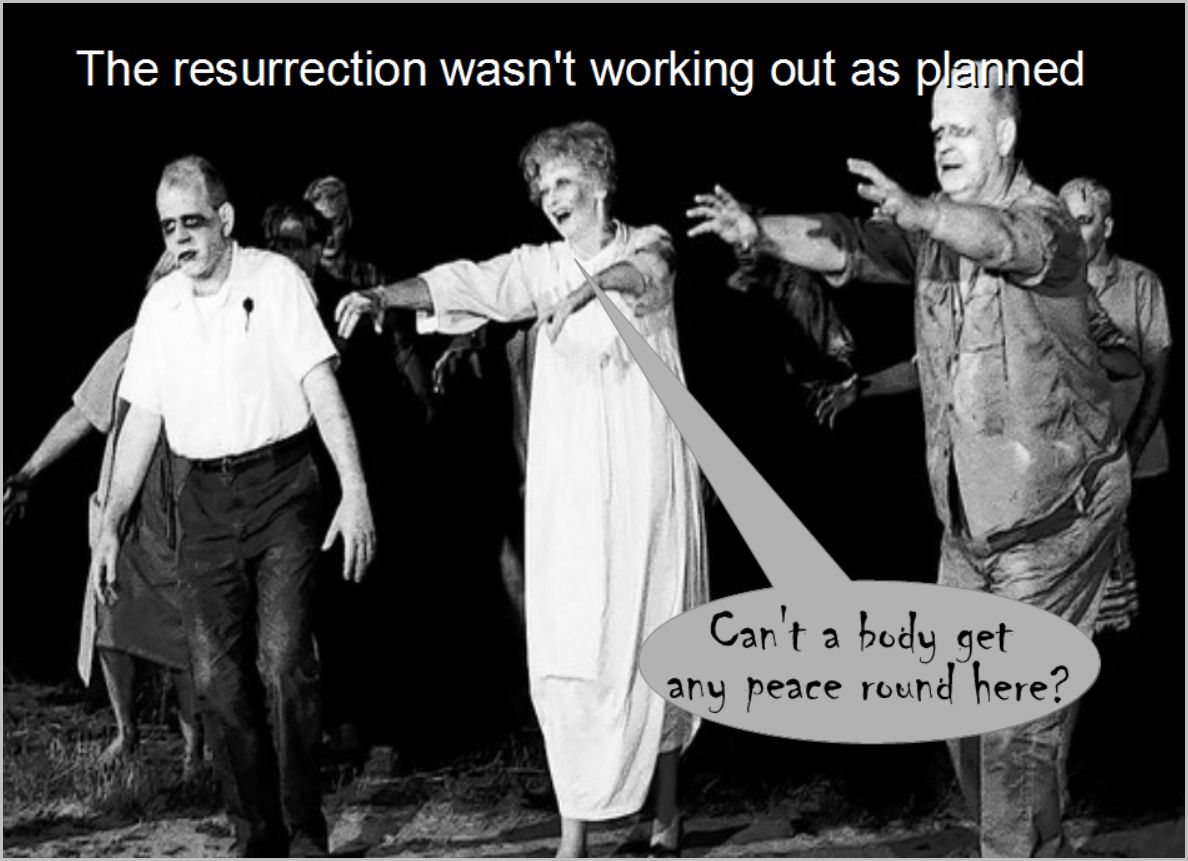
This is why Matthew has hordes of the dead rising from their tombs (Matthew 27.53) – he sees resurrection as the indisputable proof that the Kingdom has arrived. Matthew is so desperate to show that it’s already started, he has bodies emerging from their graves even before he has Jesus himself come back from the dead.

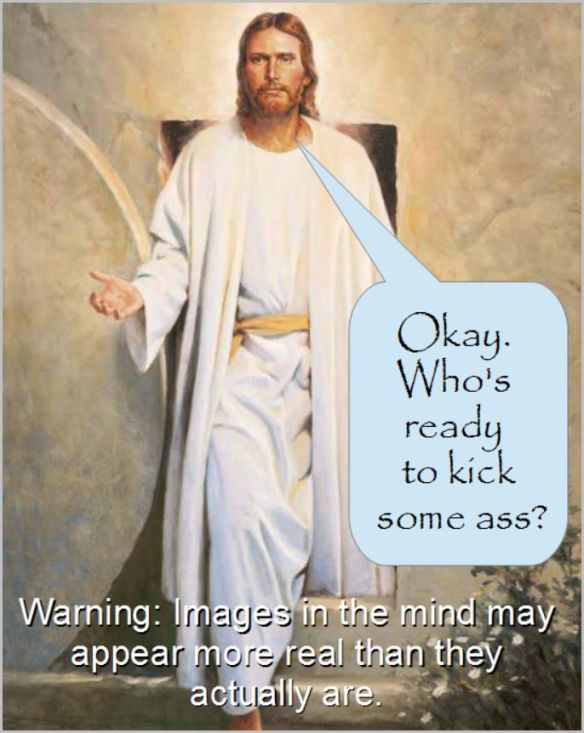
Of course, all of it’s a fairy story, Matthew’s zombies and Jesus’ resurrection included. As we saw last time, there’s no evidence at all that Jesus rose physically from the grave. Paul’s experience of the resurrected Christ was of a beam of light that appeared in his own head, and from this he concocted his entire theology (Galatians 1.12). When the gospel writers created their resurrection stories much later on, they turned such visions into ‘real’ encounters with a reinvigorated Jesus. They offer stories of his eventual return – after a quick visit to Heaven – as a conquering hero who will kick-start God’s Kingdom on Earth (Matthew 25.31).

So there you are. Jesus’ return from the dead, which didn’t happen anyway, was intended to be the first of many such resurrections, right here on Earth. According to Paul and the later synoptic gospels, it signified that God’s Kingdom was about to be established in this world, not the next. In the first century.

As we know, it all happened just as they said it would.