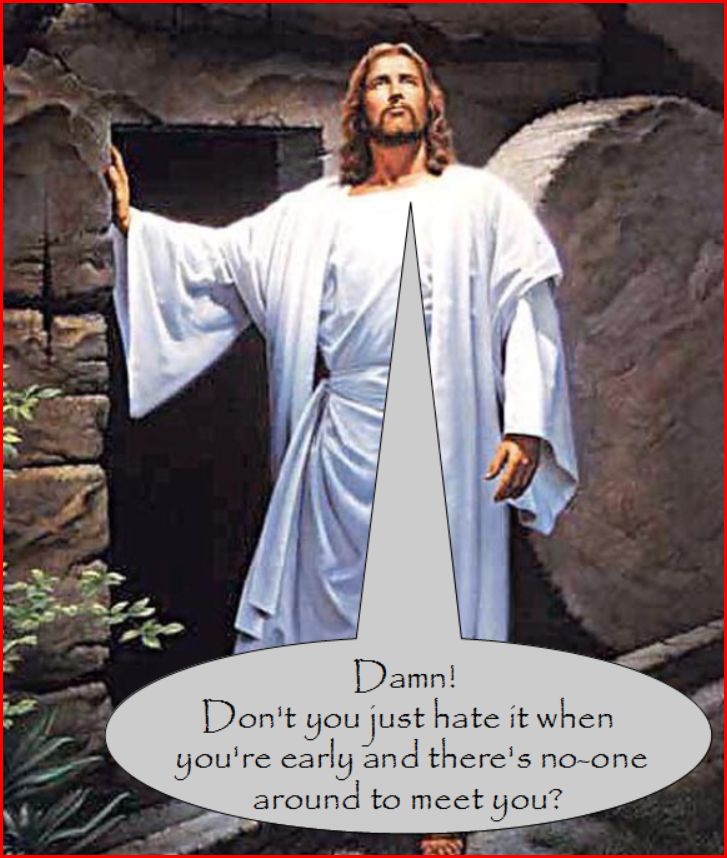
Christians’ Favourite Delusions 29: The Resurrection Can’t Be Disproved

Or can it?Burial

The resurrection can’t be disproved, or so says a Christian on Bob Seidensticker’s Cross Examined blog. If it could be, the commenter tells us, he would abandon his Christian faith. Of course it isn’t up to sceptics to disprove the resurrection, or any other of religion’s fantastic claims. It’s up to those making them to demonstrate their veracity, just as it would be for me to prove I keep an invisible pink unicorn in my garage. There would be no obligation on anyone else to disprove it.

That being said, the resurrection is rather easy to refute. First, let’s qualify what we mean by the term, or rather what Christians usually mean by it: that Jesus rose from the dead in or as the same body that had, a couple of days earlier, died on the cross. There are, it’s true, some liberal Christians who find this such a preposterous idea that they concede the resurrection happened only in some sort of metaphorical fashion. They’re probably right, so our truck is not with these particular believers, even if their evangelical brethren take them to task for their apostasy. No, we are refuting the idea that Jesus rose physically from the grave, fully alive again, after spending slightly under two days completely and entirely dead.

Here’s how we can know this didn’t happen:
1. There’s only one eye-witness account of the resurrected Jesus, and that’s Paul’s (in Galatians 1.11-12 and 1 Corinthians 9.1 & 15.45; I’ve covered this more fully here.) And what does he ‘see’? Not a resurrected body, just a beam of light and a voice, both in his own head as the text makes clear (the Greek states baldly his experience was ‘within’ him). His resurrected Jesus is therefore a vision or an hallucination or an epileptic event. It is most emphatically not an encounter with an actual man returned from the dead.

So much for our only eye-witness. What about the others?

There are no others:

2. All the other resurrection accounts were written, third, fourth, fifth hand, some 40-70 years after the supposed event, so they’re not exactly reliable. They are, in fact, positively unreliable. In these accounts, Jesus is unrecognisable to those who knew him; he walks through walls; disappears at will and beams up into the sky.

I’m sure it won’t escape your attention that these are not something a flesh-and-blood body can do. They are not, as a result, descriptions of real experiences and belong, like Paul’s inner experience, to the realm of fantasy/visions/hallucination. Paul himself was of the view that others’ experiences of the ‘risen Christ’ were exactly the same as his own (1 Corinthians 15.6-8).

Not only this, the gospel accounts of these visions were embellished between the time they occurred (if they did) and their being recorded many years later by different groups of interested parties. They were also significantly tampered with. For example, Mark’s gospel originally had no resurrection appearances; these were added later – possibly 40 years later – 80 after the events they supposedly describe.

And so we come to the most conclusive of the arguments against the resurrection:

3. The dead stay dead. Always, with no exceptions. Once the brain is dead it cannot be revived – certainly not 40 hours after it is extinguished. “Ah, but wait!” say Christians, “Jesus was (the Son of) God so the normal laws of nature don’t apply. He is the one true exception.” But this is special pleading based on circular reasoning: Jesus rose from the dead because he was (the Son of) God. How do we know he was (the Son of) God? Because he rose from the dead. As such, it’s no proof at all – even if, in Romans 1.14, Paul seems to think it is. The man Jesus died and then… he stayed dead.

There are other reasons that lend support to the fact that the resurrection did not happen (for example, all the noise about an empty tomb, which is nothing more than a distracting sleight of hand. So what? What does an empty tomb prove? Certainly not a resurrection.) These three, however, are sufficient evidence that Jesus didn’t physically rise from the dead – and without the resurrection, as Paul says in 1 Corinthians 15:13-19, Christianity falls apart:

If there is no resurrection of the dead, then not even Christ has been raised. And if Christ has not been raised, our preaching is useless and so is your faith. More than that, we are then found to be false witnesses about God, for we have testified about God that he raised Christ from the dead. But he did not raise him if in fact the dead are not raised. For if the dead are not raised, then Christ has not been raised either. And if Christ has not been raised, your faith is futile…

How right he was.

Now if you’ll excuse me, I have to take my invisible pink unicorn for a walk.

There Is No God. And Here’s Why

adamSometimes I wonder why I continue writing this blog. There seems to be little that can shake believers from their delusions; what I write here doesn’t appear to be it. When they do respond it’s to tell me that I’m in for a shock when, after my death, I stand in front of the the throne of God and have to give an account of myself. I’ll not be smiling then, they tell me. They’re right, I won’t be. Not because of any ‘judgement’, but because dead people don’t smile. Not of their own volition anyway.

Christians can’t seem to see the ludicrousness of their post-mortem proposals. Religion, all religion, is wrong about most things at most levels; it denies death, which does exist, and replaces it with fantasies about supernatural beings, eternal life and judgements, none of which does. Christianity offers false promises, failed prophecies and an impossible morality, which Christians themselves can’t even manage. By and large they don’t even try to (see previous posts on all of this) yet they stick uncritically, unthinkingly, blindly to the fantasy elements of their ‘faith’ because they’re frightened of their own extinction and want to live forever. Christianity deceitfully promises them that they will – the ultimate false promise.

So let’s cut to the chase. There is no God. This is an indisputable fact, though believers will dispute it anyway. Even now, any Christians who are reading this will be muttering something about the fool saying in his heart there is no God; another tired, cliched response, which I’ve already considered here. But there is no God, not because of any foolishness on my part but because of the evidence. Or rather the absence of it. There is no evidence there is anything other than the physical universe or that life came about as the result of anything other than physical processes (it is not the case that scientists do not know how life emerged from non-life; they do and it did) or that humans evolved by any means other than blind, mindless natural selection. God is not required to explain any of this; not necessary to explain anything at all to do with life, the universe and ‘why there is something rather than nothing’. That being the case, we can know for certainty that he wasn’t in any way involved.

Let’s take a more down-to-Earth parallel to illustrate the point: we do not need to resort to stories of the tooth fairy to explain dentistry. I’m guessing that even Christians would agree with this; the tooth fairy has no part in matters of dental hygiene, orthodontist training or even the payment sometimes made by indulgent parents when their child’s tooth falls out. Trying to force the tooth fairy into any of these scenarios is not only entirely unnecessary, it’s erroneous and unhelpful. Dentistry is far better explained without reference to a mythical sprite. The tooth fairy not being needed, we can safely conclude that she doesn’t actually exist; she is a figment invented for children intended to take the away the pain of tooth loss, nothing more.

So it is with God in explanations into which he too is shoe-horned. He’s not needed, he’s superfluous to requirements. That being so, we can similarly conclude that he isn’t real either. A being that isn’t needed to explain anything is one that doesn’t exist.

This is not, note, a rejection of a figure who, even now, is sitting up in the sky somewhere feeling sad or angry because we’re ‘shaking our fist’ at him. If that’s what you’re seeing, you’re still believing in God, even if it is one you might be in the process of rejecting. It’s worse than that, Jim (or better): there is no super-being in the sky, or anywhere else. The universe is devoid of gods and of God; it always has been and always will be. There are none to be found because there are none there; not your pet god, nor those of other faiths, ancient or modern. None. There is only the physical universe itself and for the brief time we are here in it, we are lucky to be here in it. Which is more than any god has ever managed.

What Christians Believe: Part One

A very special guest post by Thea Lojan.

PilateThe Creed

I’m very pleased to have this opportunity to share my testimony with you and give you an idea of what I and millions of other Christians believe. We call this the Apostles’ Creed and it goes like this:

I believe in one God. Actually no… three. Three Gods. One really, but he’s like three, a buy-one-get-two-free kind of God. Yes, okay, he says he’s the one and only God back in the Old Testament, but that’s before he knew he was really three. This doesn’t make him/them anything like those collections of ancient Greek Gods, though, because he’s still only one God really. That’s what’s called the Trinity and I hope I’ve made it clear for you .

Anyway, I believe in one God and in two others besides, creator, or creators, of Heaven and Earth. Yes, he/they definitely did this even though scientists think the universe was created billions of years before the Bible says it was and that God probably wasn’t even involved. But these scientists are all anti-Christian, that’s why they say that. If you have faith you know that of course God was involved. Other people who are also anti-Christian just out of spite say that if God made the Earth and all that is in it therein, then he must’ve made parasites and poisonous bugs and harmful bacteria and disease. But I’ve an answer to all that. Just don’t think about it.

And I believe in Jesus Christ, his only son, our Lord. Yes definitely this, even though Jesus says he’s not really anything like God’s son in three of the eye-witness accounts of his life in God’s Word. I expect he was just a bit muddled when he said this, being away from home and down here instead of up in Heaven with his Heavenly Father. He probably meant to say he was God’s son because it’d be too weird if he really was God’s Son and didn’t know it. We should be grateful to those people who came after him who realised exactly who he was.

And then there’s that bit somewhere about him being ‘begotten not made, of one substance with the father’, or something, which I think means he was more than God’s son. That he was, like, God himself. You’d think he’d remember that, wouldn’t you, when he was down here on Earth. What confuses me though is, if he was God, then who was he praying to all those times? I can’t get my head round that. But anyway, it’s a good job there were even more people who came after him who knew better than him and could tell he really was God.

He was conceived by the Holy Spirit, born of the Virgin Mary. Well, you’ve got to believe this haven’t you, even though some people say ‘virgin’ should really just say ‘young woman’. A young woman might or might not be a virgin, especially if she wasn’t a Christian to begin with. It does make me wonder that if she was pregnant then it’s more than likely Mary wasn’t a virgin, ’cause we all know how babies get made. Still, if God’s Word says it was the ‘Holy Spirit’ that was the father then that’s what we should believe. If you want to know more about the Holy Spirit that can make people pregnant, well, we’ll get to it soon.

He suffered under Pontius Pilate, was dead and was buried. He descended into hell and on the third day he rose again. I think a bit got missed out here – all the stuff Jesus said and did in between being born and suffering under Pontius Pilate. Isn’t that important? You bet it is. Pontius Pilate, by the way, was a Roman perculator who worked for Julius Caesar. I can’t find anything about Jesus ‘descending into hell’ in my Bible but I suppose it must be right. I definitely believe though that after three days and nights in the tomb he rose again from the dead. I mean, that’s a really important bit. I know he wasn’t in the tomb for a full three days and nights, even though he said he would be, but a day and a half is close enough. I guess that’s why we say ‘on the third day’ instead; it sounds like three days when it was only a day and half. But, you know, Friday night till Sunday morning – it’s legit to say ‘on the third day’.

And we know he rose from the dead because Saint Paul said so – he saw him himself, in person. Well, not exactly in person but in his head. He was like an amazing flash of light in Paul’s head, a bit like an epileptic event, except, you know, like really real. And then other people started seeing him but not in their heads, as a real person, but one who could walk through walls and disappear if he felt like it. Totally real. Amazing.

I’ll be back next time to tell you what else Christians believe. In the meantime, keep praising the Lord!


Thea was talking about the Apostles’ Creed, though she also mentions the Nicene Creed. The Apostles’ Creed was created prior to 390CE and the Nicene Creed in 325, both quite a bit after Jesus’ lifetime. Three hundred years after, in fact.

Oh, and Pontius Pilate was a Roman procurator or prefect during the reign of the Emperor Tiberius.

The Great Resurrection Miscalculation

How long was Jesus in the tomb before he ‘rose again’? Three days you say? Wrong! Read on and discover the secret of the Great Resurrection Miscalculation.

Resurrection

Jesus is wrong about no less an issue than his claim that he would rise from the dead after three days. In Mark 10.33-34 he prophesies:

the Son of Man will be handed over to the chief priests and the scribes, and they will condemn him to death; then they will hand him over to the Gentiles; they will mock him, and spit upon him, and flog him, and kill him; and after three days he will rise again.

On the surface, this seems pretty accurate for a prediction of events made some time before they actually happen (it wouldn’t be a prediction otherwise). Except, of course, this prophecy, like others of Jesus’, was written forty years or more after the event. Even then, Mark or whoever wrote the earliest gospel, can’t get it right. He tells us clearly in Mark 15.34 that Jesus dies at 3pm on Friday; Matthew and Luke agree. Jesus then reappears, fully recharged, ‘very early’ on the Sunday morning (Mark 16.2). But 3pm Friday to the ‘very early’ hours of Sunday is less than 48 hours – not three days, not even two.

What is the cause of this failed prophecy? For some reason, Mark assumes that ‘on the third day’, when he believed Jesus rose from the dead, means the same as ‘after three days’, the words he has Jesus prophesy. The third day after the crucifixion would indeed be the Sunday, but it wouldn’t be, and isn’t, three full days after it, as Mark’s Jesus seems to think.

The problem is not Mark’s alone, however. Matthew’s Jesus is even more emphatic that he will be buried for the three complete days:

For just as Jonah was for three days and three nights in the belly of the sea monster, so for three days and three nights the Son of Man will be in the heart of the earth. (Matthew 12.40)

Thanks to Jesus’ insistence in Mark and Matthew that he would spend three days in the tomb, the belief that he must have done so – contrary to the ‘evidence’ in those same accounts that it was less than two – appears to have become securely established by the time of the fourth gospel. Its writers, however, find their own unique way round the problem. Their thinking seems to have been along the lines that ‘if Jesus said he was going to be buried for three days and three nights, then he must have been. He was the Son of God after all, and he wouldn’t get a thing like this wrong. Therefore, if, as we know, he rose on the Sunday, he cannot have been crucified on the Friday. He must have died on the Thursday’. And so the writers of John’s gospel shift the crucifixion back a day, to around noon on Thursday (John 19.14). It’s an ingenious solution. Thursday to Sunday – near enough three whole days. There’s even some neat symbolism as a bonus: the earlier execution equates with the slaughter of the sacrificial lambs on the Thursday, ready for that evening’s Passover. Problem more than solved!

Except it creates a whole raft of new ones, not least the glaring inconsistency between the synoptic gospels’ accounts of the crucifixion on the Friday – after Jesus’ and the disciples’ celebration of Passover the previous evening – and John’s gospel’s account of the crucifixion during Thursday afternoon, well before the Passover meal would have been eaten. Significantly, no-one in the history of Christendom has ever been persuaded by John’s Thursday crucifixion, otherwise we’d remember it on ‘Good Thursday’ instead of ‘Good Friday’, and have a different day off work.

Does any of this matter? Probably not, but it does demonstrate that:

i) if Jesus’ words in the synoptic gospels are to be taken literally, then either he can’t count or he badly misjudges the timing of his resurrection. If scheduled for three days after the crucifixion it should have occurred on the Monday;

ii) the resurrection probably didn’t happen at all, and more than forty years later Mark and Matthew trip themselves up trying desperately to convince people that it did, and that Jesus knew it would;

iii) the gospel writers are prepared to rearrange already highly improbable events to make equally unlikely prophecies appear true;

iv) because the Bible cannot get its own faked, after-the-supposed-event prophecies right it can’t possibly be trusted about other claims it makes. 

Happy Easter, y’all.

Adapted from my book Why Christians Don’t Do What Jesus Tells Them To …And What They Believe Instead. Buy it on Amazon UK or Amazon US.

Why_Christians_Don't_Cover_for_Kindle


Which Christians won’t be resurrected after they die?

Robertson

All of these well-known Christians are unworthy of the Kingdom of God and won’t live again after they’ve died. See if you can work out why:

Billy Graham, Justin Welby (Archbishop of Canterbury), Desmond Tutu, Pat Boone, Mel Gibson, John Sentamu (Archbishop of York), Stephen Green (Christian Voice), Bono, Her Majesty the Queen, Sarah Palin (politician), Pat Robertson (700 Club), Joyce Meyer (evangelist), Bryan Fischer (outspoken radio broadcaster), Rick Warren (pastor of US mega-church), Rob Bell (ditto), George W. Bush, Tony Blair, Cherie Blair (barrister), Graham Kendrick (songwriter), Tony Perkins (anti-gay preacher), Scott Lively (ditto), Matt Barber (ditto), Peter LaBarbera (ditto), Tom Wright (theologian), Fred Phelps (late of Westboro church), Joni Eareckson Tada (writer), Mike Ratcliff (minister and blogger), Kirk Cameron (actor)… and, in all probability, your local pastor  – and maybe even you yourself, Christian reader.

They’re not worthy of God’s Kingdom nor are they likely to be resurrected because they’re married. And who says this makes them unworthy? Not me… Jesus:

those who belong to this age marry and are given in marriage; but those who are considered worthy of a place in that age (of God’s Kingdom on Earth) and in the resurrection from the dead neither marry nor are given in marriage (Luke 20.34-35).

So next time one of these famous Christians or some other married believer tells you you’re not saved, tell them that they’re not either. Jesus says so.

They won’t care, of course, because they pick and choose the bits of the Bible they believe. They’re more than happy to pretend this tricky bit doesn’t exist or doesn’t apply to them. Obviously, or they wouldn’t be married. Naturally this doesn’t stop them going on about about God’s plan for marriage even though it’s one they’ve made up themselves that flies in the face of what Jesus says.

Which means these same believers also have to ignore Jesus when he says, ‘Why do you call me “Lord, Lord”, and do not do what I tell you?’, which is a very good question.

Christians’ Favourite Delusions 5: The resurrection is well attested

PsychHere’s a question for you. How many first-hand, eye-witness reports do we have of the resurrection of Jesus?

Thousands? Christians would like you to think so.

Hundreds? St Paul tells us he’s heard this is the case (1 Corinthians 15.6).

Dozens? All those folk mentioned in the gospels, surely…

The answer is one. We have one first-hand, eye-witness report of the resurrected Christ. It’s St Paul’s own which he mentions, in passing, only three times. A total of six verses cover the allegedly most important event in history. Here they are:

Have I not seen Jesus our Lord? (1 Corinthians 9:1)

Last of all, as to one untimely born, he appeared also to me. (1 Corinthians 15:8)

The Gospel preached by me is not of human origin. For I did not receive it from a human being, nor was I taught it, but it came through a revelation of Jesus Christ… When he who had set me apart before I was born, and had called me through his grace, was pleased to reveal his Son in me, in order that I might preach him among the Gentiles. (Galatians 1: 11-12 & 15-16)

And that’s it. That’s Paul’s own account of his seeing the risen Lord. It hardly compares with the high drama of the Acts account, where on the road to Damascus, Paul is blinded by light and has a conversation with Jesus. But that story was written forty years after the supposed event, twenty after Paul’s death, by someone else. What’s more, it is recounted differently each time it’s told (in Acts chapters 9, 22 and 26). It’s not first-hand, it’s not eye-witness and it’s certainly not reliable.

What about the gospel accounts then? Don’t Mary Magdalene, Peter and others see the risen Jesus? Well, no, not in the earliest gospel, Mark, where, in the oldest versions, there are no resurrection appearances at all. The other three gospels have them, but these were written 50 to 90 years after Jesus lived and they contradict each other significantly. You can decide whether his makes them reliable or not, but they certainly weren’t written by the people involved, nor by eye-witnesses.

So, Paul’s account is the only first-hand report we have.

Let’s take a closer look at it.

Even in the heavily reworked versions in Acts, what Paul encounters is not a physical Jesus, a man in a resurrected body, but light from the sky and a disembodied voice, which, depending on which of the Acts account you rely on, no-one else present sees or hears. Paul himself doesn’t even know what he is experiencing – certainly not a recognisable human figure – until the light tells him ‘who’ it is.

There is no difference between Paul’s experience of a light purportedly from heaven and an event that occurred in its entirety – as far as it occurred at all – in Paul’s head. The original Greek of Galatians 1.15-16 makes absolutely clear that this is where it took place: while English translations say that the risen Christ revealed himself to Paul, the original Greek has Paul’s initial experience of the Christ take place in him. Paul, then, admits only to an inner vision of ‘a life-giving spirit’ (1 Corinthians 15.45) and nowhere does he claim that he encountered an extrinsic, embodied Jesus. Nor does the writer of Acts, however much he embroiders Paul’s experience, make the claim for him. The risen Lord, if he’s become anything, is not a resurrected body but a spiritual being made of light.

So, the only witness to the resurrected Jesus who has left us an account – six extremely sketchy verses in his letters – didn’t see the risen Jesus in physical form at all. He experienced an hallucination, or, as he puts it, a ‘revelation’. The resurrected Christ, in our earliest and only eye-witness report, is no more than a vision within a person’s head.

And from this, all else followed.