We owe it all to Jesus

MarySo the UK is a Christian country. Prime minister Dave Cameron has decreed it. In his hallowed Christmas message he proclaims that Britain derives all of its values from Christianity:

As a Christian country, we must remember what (Jesus’) birth represents: peace, mercy, goodwill and, above all, hope. I believe that we should also reflect on the fact that it is because of these important religious roots and Christian values that Britain has been such a successful home to people of all faiths and none.

‘Peace, mercy, goodwill, hope and tolerance’. Doesn’t it warm your heart? This country of ours has these wonderful sentiments at its core and all of them derive from the baby Jesus. I’m not sure about where our other values – capitalism, colonialism, democracy, free-thought and expression – originate but no doubt Dave will tell us they too spring from our ‘religious roots’.

What about the values he mentions though? Do they originate with Jesus as Dave claims?

Peace we covered last time: Christianity have not brought peace into the world, ever. Dave seems to have forgotten that Britain is currently at war; the so-called ‘war on terror’ Is he now suggesting that as a ‘Christian country’ we should turn the other cheek and propose peace, because that’s what Jesus would want? I doubt it, somehow.

Mercy? Here’s the kind of mercy Jesus proposed: ‘But those enemies of mine who did not want me to be king over them – bring them here and kill them in front of me’ (Luke 19:27). Nice.

Goodwill? Jesus always extended goodwill to others. Like here: ‘It is not right to take the children’s bread and toss it to the dogs (non-Jews)’. And here: ‘Do not give dogs what is holy, and do not throw your pearls before pigs (non-Jews again), lest they trample them underfoot and turn to attack you’ (Matthew 15.26 & Matthew 7.6).

Hope? The Bible does speak about hope – hope that this will all soon be over and God will consign non-believers to hell, set up his kingdom on earth and put Jesus in charge (Matthew 19:28 & 24.51). Is this what Cameron means by hope?

Tolerance? Paul on tolerance: ‘do you not know that wrongdoers will not inherit the kingdom of God? Do not be deceived: Neither the sexually immoral nor idolaters nor adulterers nor men who have sex with men’ (1 Corinthians 6:9). It’s difficult to see how modern notions of equality and acceptance can derive from bigotry like this.

No, Britain does not get its values from Christianity or the Bible or baby Jesus. It has worked them out for itself, principally through social progress and the reforms of modern times.

The UK is not a Christian country in any other sense either. Christians are required to turn the other cheek (Matt. 5.38–42), give all they have to the poor (Luke 14.33) and buy into a convoluted salvation scam plan (2 Timothy 1.9 etc). Can a country do these things? It would be unthinkable for it to give away its wealth, accede to other countries’ demands and respond non-aggressively to attack. Individual Christians don’t or won’t do these things and it would be nothing short of suicidal for a country to attempt to; yet this is what Jesus insists is involved in following him. It’s impossible for individuals to live this way, let alone entire nations.

Cameron can’t even claim that the majority of the population subscribes to the great salvation plan either. A recent government poll showed that only 49% of the population admits to being Christian and in any case, the plan is designed for individuals, not countries. So let’s hope (hah!) the Prime Minister will stop fawning over Christians, fatuously pretending that the UK is a Christian country when it isn’t. Let’s hope too he understands that our values, whatever they are, do not derive from an ancient, expired superstition. The UK is not a Christian country in any sense. Let us rejoice in that fact.

What is the point?

Stairway

There isn’t any point. At least, not ‘out there’ somewhere, waiting to be discovered. The point, purpose and meaning of life is what we make of it. We make our own purpose.

The Christians among us claim to have real purpose. Not like we sad non-believers whose purpose is to do with raising and supporting our family, being creative, doing things for others or whatever. No, Christians get their real purpose from God, or so they say. Perhaps some of them would be good enough to share it with us; is it rushing from one church meeting to another? Singing badly written hymns badly? Cosying up to one another? Telling others about the great salvation plan?

Apparently not, though they do seem to spend a lot of time doing these things. According to CARM the purpose of life ‘is to praise God, worship Him… proclaim His greatness, and… accomplish His will.’ Got Questions, on the other hand, says it’s to ‘1) glorify God and enjoy fellowship with Him, 2) have good relationships with others, 3) work, and 4) have dominion over the earth,’ while Open Bible claims it’s ‘to love and serve God in order to help bring about God’s glorious plan for creation.’

That’s it? The purpose faith supplies is this woolliness? It’s about doing stuff we already do (‘work’, ‘have good relationships with others’) and fawning over a needy, insecure deity? God help us if this is all it amounts to. Those who claim to know the secrets of eternal life and the mind of God himself should surely be able to come up with something better than the rest of us.

As I’ve written before, this isn’t what Jesus told his followers life was for. No, he said it was to work to bring about God’s kingdom on Earth (Matthew 6.33; 13.44, Luke 9.62 etc). Try as you might you’ll struggle to find a Christian site that says this is the point. That’s because Christians long ago – almost two thousand years ago – stopped believing that God’s kingdom was due to arrive here and switched their expectation to one of an after-life in heaven. But that’s not what the Bible promises, and it’s certainly not what Jesus said.

So maybe, Christians, you’re missing the point of your faith and your purpose in life; it’s to bring about the Kingdom of God on Earth (Matthew 6.10) – in the first century (Mark 9.1). No wonder you’re now so rudderless, so lacking in direction and real purpose. You missed the boat, which sank without you two millennia ago.

Now you have to construct your own meaning, just like the rest of us. Except ours is better, lacking as it does the faux Biblical language and all those fairy tale elements.


Our Operators are Waiting to Hear from You!

ApostlesHi! You’ve reached the Salvation Hotline. Calls may be recorded for training purposes. All offers are validated by our six day guarantee.* Please listen carefully to your options:

Press 1 for Matthew. With one of our less popular offers (but don’t let that put you off!) Matthew is waiting to explain our buy-one-get-one-free offer! Keep the Jewish law and be saved, plus, forgive others and be forgiven yourself!

Press 2 for John who will tell you how you can get your very own get-out-of-Hell just by believing! Eternal life awaits!

Press 3 for Luke. Luke wants to let you know you how you can be saved simply by asking for forgiveness. Note: this offer cannot be used in conjunction with any other.

Press 4 for Luke’s bargain Family Ticket! Only one family member need sign up and the rest go free!

Press 5 for Paul and to hear about a unique special offer! ‘God’s grace’ can save you without you making any real effort on your part! Not to be missed.

Press 6 for Paul’s great alternative offer: get saved for free! No need to do anything! (Offer good for Jews only. Terms and conditions apply.)

Press 7 for a special operator who passes himself off as Paul but isn’t. And he has a great offer for our female callers! He’ll tell you about how, just by having babies, you can be saved! It really doesn’t get any better than this, ladies! Get saved just by doing what comes naturally!

Press 8 for a very special guy of ours who wants to stay anonymous! But he will show you how you can escape death by buying into Jesus’ cosmic defeat of evil!

Press 9 for James who will tell you how you need to do good if you want to be saved. So, okay, Paul doesn’t think so, but we want to make sure you hear all our offers!

Please note: these offers are mutually incompatible so you might just want to hang up now and forget all about them.

*Our guarantee isn’t worth the paper it’s written on but for legal reasons, here it is anyway:
Press 1: Matthew 5.17-19 & 6.14.
Press 2: John 5.24.
Press 3: Acts 2.36-38.
Press 4: Acts 16.30-31.
Press 5: Romans 10.5; Ephesians 2.8.
Press 6: Romans 11.26-27.
Press 7: 1 Timothy 2.15.
Press 8: Hebrews 2.14-15.
Press 9: James 2.14-17, 24

The Jesus Cult

Cult2A programme on the UK’s Channel 5 this week, Trapped In A Cult?, featured stories of people who had had encounters with or had escaped from cults. It didn’t spend too much time defining what a cult might be, but suggested that it’s a movement revolving around a charismatic individual who insists that only he or she has a direct line to God or some sort of Higher Truth. Such individuals insist that others must follow their teaching exclusively and that followers sever all ties with family and non-believing friends. They frequently demand too that followers give up their material possessions in order to demonstrate their commitment to the movement.

The programme also noted that once the original founder of a cult dies, or has been discredited in some way, belief in him or her can persist, with followers persuading themselves that their leader has miraculously transferred to a higher plane of existence. (Further information about cults and their leaders can be found on The Cult Education Institute web-site.)

Many modern religious movements conform to this pattern: The Church of Latter Day Saints (Mormons), Jehovah’s Witnesses, Christian Science, the Unification Church (Moonies), Scientology and Branch Davidians to name but a few. Orthodox Christians are always eager to point out the apostate, cultish nature of these heterodox ‘churches’, blind to the fact that their own belief system began in exactly the same way. The original Jesus movement had all the hallmarks of a cult and its leader the characteristics of a cult leader:

Jesus insisted that only he had a direct line to God and Higher Truth:
For example in Matthew 10.32–33: Whoever acknowledges me before others, I will also acknowledge before my Father in heaven.  But whoever disowns me before others, I will disown before my Father in heaven

and John 14.23: Anyone who loves me will obey my teaching. My Father will love them, and we will come to them and make our home with them.

He demanded his teaching be followed exclusively:
For example in Luke 10.16: He who listens to you, is listening to me; and he who rejects you is rejecting me; and he who rejects me is rejecting him who sent me

and Matthew 12.30: Whoever is not with me is against me, and whoever does not gather with me scatters.

He expected his followers to sever ties with family and non-believing friends:
For example in Luke 14.26: If anyone comes to me and does not hate his own father and mother and wife and children and brothers and sisters, yes, and even his own life, he cannot be my disciple.

He told those interested in joining his movement to give up material possessions:                                                                                                             Matthew 19.21: If you want to be perfect, go, sell your possessions and give to the poor, and you will have treasure in heaven. Then come, follow me.

and when he died, his followers persuaded themselves he’d gone on to a higher plane:                                                                                                                  Luke 24.51: While he blessed them, he parted from them and was carried up into heaven.

What do we learn from this? That if it looks like a cult, sounds like a cult and behaves like a cult then the chances are, it’s a cult. Christianity is just a first century cult that hit the big time. We are now so used to having it around – how legit it became! – we overlook its origins and essential characteristics. These are exactly the same as any other cult, both before and since.

Idiotic Stuff Jesus Said 12: My words will never pass away

AndersonThe premise of my first ‘Jesus’ book* is that while Christians profess to believe in Jesus, they choose to ignore most of what he taught while he was alive. While they claim a vapid super-hero Christ as personal saviour, they replace what the human Jesus had to say with words of their own choosing. In reality, they have about as much time for Jesus’ ‘eternal words’ as the average non-believer or atheist. You don’t have to look very far to see how much his words have already ‘passed away’:

Jesus said, ‘Don’t judge so that you won’t be judged’ (Matthew 7.1). Our representative Christian says, ‘LGBT people are filthy and wrong.’

Jesus said ‘Love your enemies, pray for those who persecute you’ (Matthew 5.44). Our representative Christian says, ‘I’m gonna pray a transgender person dies and goes to Hell.’

Jesus said, ‘Love your neighbour as yourself’ (Mark 12.31). The Christian says, ‘The way to show love is to tell other people they’re going to Hell.’

Jesus said, ‘sell all you have and give to the poor’ (Mark 10.21). The Christian is concerned about where to buy jewellery: ‘…somewhere other than Tiffany’s, because Tiffany’s is gay friendly.’

Jesus said, ‘Forgive those who sin against you so you can be forgiven yourself’ (Matthew 6.14). Our believer rants, ‘LGBT people should be executed.’

Jesus said, ‘Don’t commit adultery and don’t get divorced’ (Matthew 5.27-28 and 19.9). Significant numbers of Christians , including our own Stephen Green, say, ‘that doesn’t apply to me.’

See what I mean? Christians regard the words of their saviour, not as having everlasting value, but as if they’re nothing more than worthless bits of fluff. Even if God were real, every word of the Bible true, every aspect of the Great Salvation Plan genuine, it wouldn’t change the fact that believers treat as optional almost everything Jesus commanded and live as if he never had.


* Why Christians Don’t Do What Jesus Tells Them To …And What They Believe Instead is available from Amazon worldwide (UK here, US here) but not, alas, from Tiffany’s.

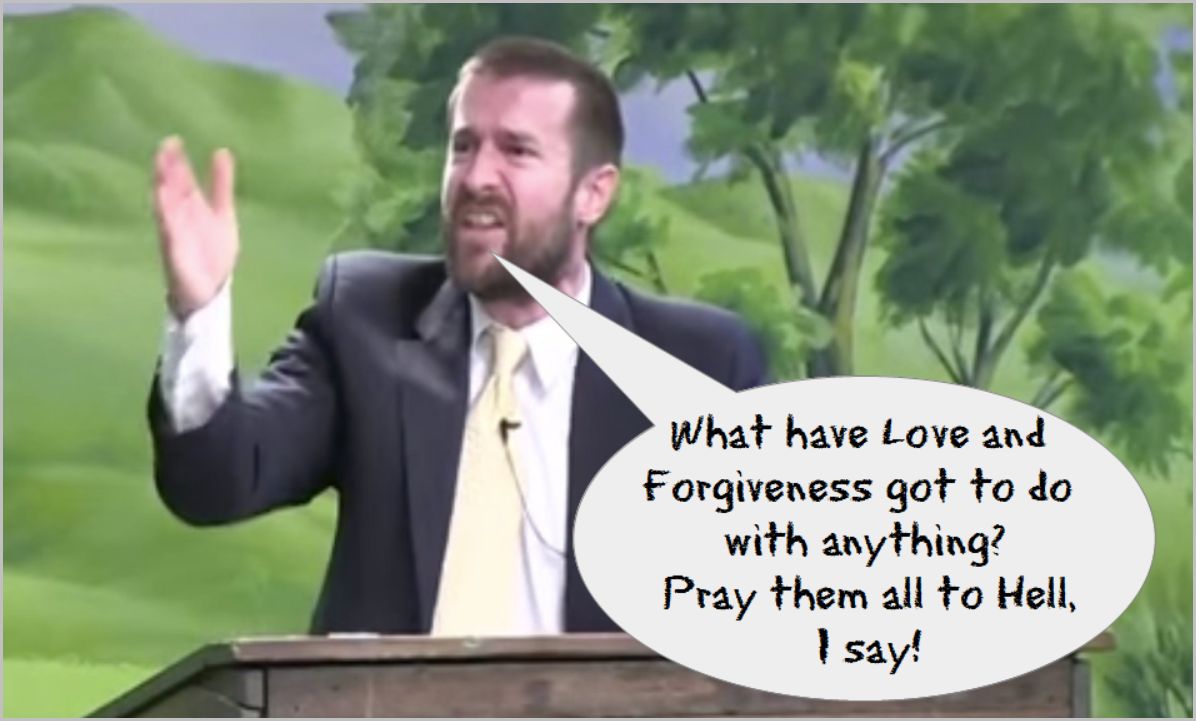
The picture shows the deplorable Pastor Steven Anderson (linked above). He knows better than Jesus ever did.


Jesus: The Dark Side

SacrificeDo not think that I have come to bring peace to the earth; I have not come to bring peace, but a sword (Matthew 10.34).

Well, isn’t that a comfort. Jesus, who said ‘blessed are the peacemakers’ and for whom Christians like to claim the title ‘Prince of Peace’, declares himself to be anything but.

Of course, it’s possible these words were put into Jesus’ mouth once belief in him had indeed started splitting families and communities; between those who subscribed to his cult and those who saw it for what it was. Maybe though he really did advocate armed rebellion – against the Roman and Jewish authorities – rather more than later believers care to admit. Even as they’ve come down to us, the gospels retain references to taking up arms in the cause of God’s Kingdom. For example:

  • Jesus didn’t see the transition from the existing system to the Kingdom as a peaceful one:

Matthew 11.12: From the days of John the Baptist until now the kingdom of heaven has been coming violently and the violent take it by force.

Matthew 3.10: Even now the axe is lying at the root of the trees; every tree therefore that does not bear good fruit is cut down and thrown into the fire.

  • He instructed the disciples to arm themselves:

Luke 22. 36-38: He said to them… ‘the one who has no sword must sell his cloak and buy one. For I tell you, this scripture must be fulfilled in me, “And he was counted among the lawless”; and indeed what is written about me is being fulfilled.’ They said, ‘Lord, look, here are two swords.’ He replied, ‘It is enough.’

  • And evidently they did:

Luke 22.48-49: Jesus said to him, ‘Judas, is it with a kiss that you are betraying the Son of Man?’ When those who were around him saw what was coming, they asked, ‘Lord, should we strike with the sword?’ Then one of them struck the slave of the high priest and cut off his right ear. (Jesus promptly heals the slave and then says, sanctimoniously, that ‘those who live by the sword will die by it’, as if swords weren’t his idea in the first place!)

  • More than this, when, as he clearly believed he would be, Jesus is appointed King in God’s new Kingdom, he hints he will be happy to see all of his opponents put to death:

Luke 19.27: “But as for these enemies of mine who did not want me to be king over them—bring them here and slaughter them in my presence.”

  • Jesus was executed by the Romans as a revolutionary. Crucifixion made an example of those who actively opposed Roman rule. The charge against Jesus was that he was an intended usurper of power; two fellow ‘rebels’ are executed with him:*

Mark 15.26-27: The inscription of the charge against him read, ‘The King of the Jews.’ And with him they crucified two rebels, one on his right and one on his left.

So much for ‘love your enemies’ and ‘turn the other cheek’. So much for the Jesus who does nothing but preach love and forgiveness. So much too for Paul’s mystical Christ. There is a very dark side to Jesus that expresses itself in vengefulness and megalomania. That anyone so disturbed could be considered an emissary from God, let alone God the Son, beggars belief.


* Since writing this post I’ve read Marcus J. Borg’s Jesus: Uncovering the Life, Teachings, and Relevance of a Religious Revolutionary. Borg makes precisely the same point about the charges against Jesus (though he sees him as a non-violent revolutionary). He explains that the Greek word used to describe the two killed with him – rendered as ‘rebels’ above – ‘is the term more commonly used for those engaged in armed resistance against Rome – “terrorists” or “freedom fighters”, depending on one’s point of view (p265).

The gift that keeps on giving…

PunchSo that’s it then. The Pope has spoken. We can no longer ridicule religion.

Frankie warned yesterday that faith, his own especially, cannot be mocked.

Shame. I was enjoying this.

This Year’s All-New Christmas Quiz!

SantaBack by popular demand (well, mine anyway), try this year’s all-new Christmas quiz!

Answers in the Bible or not, as the case may be. Real answers next time.

1. Where does the word ‘Christmas’ come from?
a) the Bible
b) the Catholic Mass held on the supposed date of Jesus’ birth
c) the Greek, meaning to pull the wool over people’s eyes

2. When was Christ born?
a) he wasn’t
b) 25th December
c) in the year 0

3. Which gospel writers didn’t think the nativity story worth including in their accounts?
a) Luke
b) Mark
c) John

4. Following the miraculous events of Jesus’ birth, what did Mary do?
a) she remembered them all in her heart
b) she wrote them down for later use in the gospels
c) she forgot all about them

5. How many times does Jesus refer to his miraculous birth?
a) never
b) twice
c) he doesn’t shut up about it (well, would you?)

6. How many times does the rest of the New Testament refer to Jesus’ miraculous birth?
a) repeatedly, showing how important it was
b) only when making an important theological point
c) never

7. How well attested are the events surrounding Jesus’ birth in historical documents of the time?
a) not at all
b) quite substantially
c) as you’d expect when mass murder and strange astronomical events are involved, they’re mentioned everywhere

8. When did Christians first start celebrating Christmas?
a) hundreds of years after the event
b) not long after Jesus died
c) immediately

9. Which of these Christmas traditions originate in the Bible?
a) Christmas trees
b) kissing under the mistletoe
c) giving presents

10. Which of these groups has benefited most from Jesus’ birth?
a) women
b) black people
c) LGBT people

11. What does Pastor Steven Anderson want for Christmas?
a) his two front teeth
b) peace and joy
c) the execution of all homosexuals

12. How will Christians celebrate Christmas this year?
a) by fighting the War On Christmas
b) by telling everyone that Jesus is the Reason for the Season
c) by putting the Christ back into Christmas


Picture from memegenerator.net


Who Ya Gonna Call?

DemonAnd when they came to the crowd, a man came up to him and, kneeling before him, said, “Lord, have mercy on my son, for he is an epileptic and he suffers terribly. For often he falls into the fire, and often into the water. And I brought him to your disciples, and they could not heal him.” And Jesus answered, “O faithless and twisted generation, how long am I to be with you? How long am I to bear with you? Bring him here to me.” And Jesus rebuked the demon, and it came out of him, and the boy was healed instantly. (Matthew 17.14-20)

Do you believe in spirits and demons? When you’re ill, do you visit the nearest exorcist or do you take yourself off to the doctor or hospital? Of course, most Christians (but by no means all) have more faith in the medical profession than they do in the wingnuts who’d tell them their ailment was the result of demonic activity and command the demon to leave in the name of Jesus.

Why? Because, even Christians know, in spite of what they might tell you, what causes disease and illness. They know what cures them too; and it has nothing to do with Jesus. ‘The Son of God’ is among the wingnuts when it comes to believing unclean spirits are at the root of human ailments and behaviour (Mark 5.1-8; Matthew 8.28-34; Matthew 12.43-45; Luke 4.33-36; Luke 8.29 etc.)

In spite of the fact there’s absolutely no evidence that demons exist, Jesus thought that invisible supernatural creatures were responsible for conditions like epilepsy. Like everyone at the time he thought that if these unclean spirits could be driven out, then the condition would be ‘cured’. Some follow in his misguided footsteps today; the Catholic church has an entire coven of exorcists, and charlatans like the Reverend Bob Larson make a living driving out the demons of pride, lust, homosexuality and greed from stooges and the gullible (except of course they don’t.)

If you’re a Christian, you should believe in demons and unholy spirits; you believe everything Jesus uttered was true, don’t you?

Of course, Jesus was a product of the pre-scientific era in which he lived; his ignorance might be excusable if it wasn’t offered up as God’s Truth. All that Jesus’ belief in devils and unclean spirits demonstrates is that he was very much a man of his time – evidence, if more were needed, that he wasn’t remotely divine. Unless, of course, the God he also believed in was as ignorant of the causes of illness and human behaviour as he was.

But next time you’re unwell, Christian, or you’re feeling a mite greedy or lustful, don’t go to the doctor’s. Don’t even ask the Lord for forgiveness. Have a little faith and, in the name of Jesus, command that hell-spawned demon within you to leave. See how that works out for you.


Update: New this week in ‘It Can All Be Blamed On Demons’:

Right-wing American broadcaster, Bryan Fischer, claims unarmed black teenager killed by cop was in fact possessed by a ‘homicidal demon’.

Tele-evangelist Pat Robertson asserts playing Dungeons and Dragons leads to demon possession.

Thank you, Lord, for your endorsement of fantasist rubbish like this.


Let’s Suppose…

This article originally appeared as a guest post on Bruce Gerenscer’s U.S. blog, ‘The Way Forward’ a couple of months back. Bruce has since had to close his blog and as a result the article became inaccessible. I’ve rescued it, my little lost sheep among a hundred, and present it here for your delight and delectation. Or something.

While on ‘The Way Forward, the post generated quite a few comments from Bruce’s readers. Feel free to respond to it here in like manner – and indeed to any other posts. All comments, spam excluded, are published whether agreeing or disagreeing with what I have to say.

BlessedLet’s, for the sake of argument, suppose that Christians could prove that the universe was created by a supernatural agent.

Let’s further suppose that they could demonstrate conclusively that this supernatural agent is none other than their very own God, as opposed to, say, Allah or Atum or Marduk.

And then let’s say they are able to show us, with sundry proofs, that an itinerant Jewish preacher, generally known by the Greek name, Jesus – though he was never called that by those who knew him – was somehow a manifestation of this God on Earth.

Then let’s say we grant them, although it doesn’t seem it from reading Jesus’ story in the synoptic gospels (Mark, Matthew and Luke, all written between forty and sixty years after this man lived) that his death somehow or other bridged the gap between humanity and this very touchy deity.

And then let us suppose that, although he never met Jesus but only had some sort of hallucination about him, the man Paul was right to say that through magically invoking Jesus’ name, people could be reunited with God and completely remade.

Let’s further grant them that, although their book about Jesus and Paul doesn’t actually say so in so many words, they really are going to go and live in Heaven when they die.

Assuming all of this is true – even though Christians are unable to demonstrate even the first of these propositions (the one about the universe being made by a supernatural being) – why is it they disregard and otherwise ignore most of what their god-man, Jesus, tells them about how they should live their lives?

Why are they, for example, so cavalier about forgiving others when he says in order to be forgiven they must first forgive those who have offended them? (Matthew 6.14-15)

Why are they so harsh in their judgements of others when he tells them that how they judge others will be how they themselves will be judged? (Matthew 7.1-2 & Matthew 25.34-46)

Why are they so lacking in compassion, when he says the amount of compassion they’ll receive is directly related to the amount they show others? (Matthew 5.7 & Luke 6.38)

Why are they so vociferous in their condemnation of others when they should be dealing with their own ‘sins’ first? (Luke 6:42)

Why do so many of them fail to serve others sacrificially, without expectation of reward and with no ulterior motive? (Mark 9.35 & 10.43-44)

Why are they not known for selling their possessions, giving to all who ask and going the extra mile? (Luke 12.32, Matthew 19.21, Luke 6.38 & Matthew 5.41)

Why do they not turn the other cheek, bless and pray for those who abuse them, and treat others like they want to be treated themselves? (Luke 6.28-29 & Matthew 7.12)

Why do they not love their neighbour as themselves, and their enemies too? (Matthew 22.39 & Matthew 5.44)

Shouldn’t they be doing these things, and more, as if their eternal lives depended on it? Especially when Jesus says their eternal lives do depend on it (Matthew 25.37-40). Shouldn’t they be just so much more radical than they actually are, changing the world by serving others? (Matthew 25.34-40)

Yes, they should, but they’re not, and they never have. Deep down, they know that Jesus is too extreme, too demanding. They make excuses for themselves; he doesn’t really mean the things he says; he speaks in metaphor and uses hyperbole (specially when he’s saying something they don’t like the sound of) and they invoke the bumper-sticker theology of ‘we’re not perfect, just forgiven’, even when ‘perfect’ is the very thing Jesus tells them they must be (Matthew 5.48).

The only reasonable conclusion we can draw from all of this is that Christians don’t really believe the man they call God and Saviour. Their actions, or lack of them, speak far louder than their words. It’s so much easier to claim Paul’s magical incantation, looking heavenward and damning the rest of us, than it is to do what Jesus demands. Who cares what Jesus said anyway. What did he know?