 So that’s it then. The Pope has spoken. We can no longer ridicule religion.
Frankie warned yesterday that faith, his own especially, cannot be mocked.
Shame. I was enjoying this.

So that’s it then. The Pope has spoken. We can no longer ridicule religion.
Frankie warned yesterday that faith, his own especially, cannot be mocked.
Shame. I was enjoying this.
 Back by popular demand (well, mine anyway), try this year’s all-new Christmas quiz!
Answers in the Bible or not, as the case may be. Real answers next time.
1. Where does the word ‘Christmas’ come from?
a) the Bible
b) the Catholic Mass held on the supposed date of Jesus’ birth
c) the Greek, meaning to pull the wool over people’s eyes
2. When was Christ born?
a) he wasn’t
b) 25th December
c) in the year 0
3. Which gospel writers didn’t think the nativity story worth including in their accounts?
a) Luke
b) Mark
c) John
4. Following the miraculous events of Jesus’ birth, what did Mary do?
a) she remembered them all in her heart
b) she wrote them down for later use in the gospels
c) she forgot all about them
5. How many times does Jesus refer to his miraculous birth?
a) never
b) twice
c) he doesn’t shut up about it (well, would you?)
6. How many times does the rest of the New Testament refer to Jesus’ miraculous birth?
a) repeatedly, showing how important it was
b) only when making an important theological point
c) never
7. How well attested are the events surrounding Jesus’ birth in historical documents of the time?
a) not at all
b) quite substantially
c) as you’d expect when mass murder and strange astronomical events are involved, they’re mentioned everywhere
8. When did Christians first start celebrating Christmas?
a) hundreds of years after the event
b) not long after Jesus died
c) immediately
9. Which of these Christmas traditions originate in the Bible?
a) Christmas trees
b) kissing under the mistletoe
c) giving presents
10. Which of these groups has benefited most from Jesus’ birth?
a) women
b) black people
c) LGBT people
11. What does Pastor Steven Anderson want for Christmas?
a) his two front teeth
b) peace and joy
c) the execution of all homosexuals
12. How will Christians celebrate Christmas this year?
a) by fighting the War On Christmas
b) by telling everyone that Jesus is the Reason for the Season
c) by putting the Christ back into Christmas
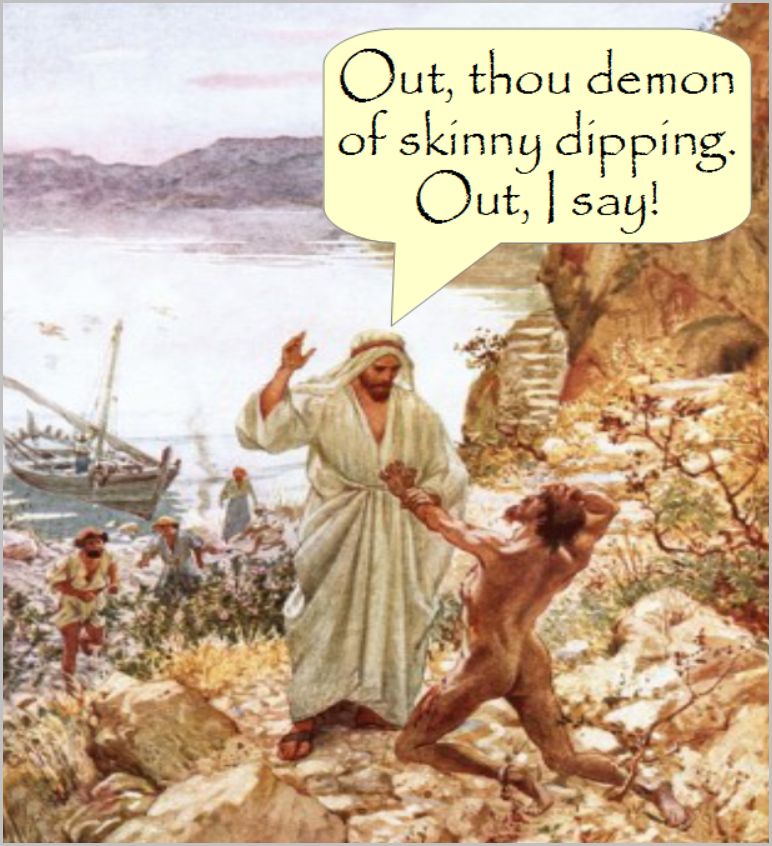
Picture from memegenerator.net
And when they came to the crowd, a man came up to him and, kneeling before him, said, “Lord, have mercy on my son, for he is an epileptic and he suffers terribly. For often he falls into the fire, and often into the water. And I brought him to your disciples, and they could not heal him.” And Jesus answered, “O faithless and twisted generation, how long am I to be with you? How long am I to bear with you? Bring him here to me.” And Jesus rebuked the demon, and it came out of him, and the boy was healed instantly. (Matthew 17.14-20)
Do you believe in spirits and demons? When you’re ill, do you visit the nearest exorcist or do you take yourself off to the doctor or hospital? Of course, most Christians (but by no means all) have more faith in the medical profession than they do in the wingnuts who’d tell them their ailment was the result of demonic activity and command the demon to leave in the name of Jesus.
Why? Because, even Christians know, in spite of what they might tell you, what causes disease and illness. They know what cures them too; and it has nothing to do with Jesus. ‘The Son of God’ is among the wingnuts when it comes to believing unclean spirits are at the root of human ailments and behaviour (Mark 5.1-8; Matthew 8.28-34; Matthew 12.43-45; Luke 4.33-36; Luke 8.29 etc.)
In spite of the fact there’s absolutely no evidence that demons exist, Jesus thought that invisible supernatural creatures were responsible for conditions like epilepsy. Like everyone at the time he thought that if these unclean spirits could be driven out, then the condition would be ‘cured’. Some follow in his misguided footsteps today; the Catholic church has an entire coven of exorcists, and charlatans like the Reverend Bob Larson make a living driving out the demons of pride, lust, homosexuality and greed from stooges and the gullible (except of course they don’t.)
If you’re a Christian, you should believe in demons and unholy spirits; you believe everything Jesus uttered was true, don’t you?
Of course, Jesus was a product of the pre-scientific era in which he lived; his ignorance might be excusable if it wasn’t offered up as God’s Truth. All that Jesus’ belief in devils and unclean spirits demonstrates is that he was very much a man of his time – evidence, if more were needed, that he wasn’t remotely divine. Unless, of course, the God he also believed in was as ignorant of the causes of illness and human behaviour as he was.
But next time you’re unwell, Christian, or you’re feeling a mite greedy or lustful, don’t go to the doctor’s. Don’t even ask the Lord for forgiveness. Have a little faith and, in the name of Jesus, command that hell-spawned demon within you to leave. See how that works out for you.
Update: New this week in ‘It Can All Be Blamed On Demons’:
Right-wing American broadcaster, Bryan Fischer, claims unarmed black teenager killed by cop was in fact possessed by a ‘homicidal demon’.
Tele-evangelist Pat Robertson asserts playing Dungeons and Dragons leads to demon possession.
Thank you, Lord, for your endorsement of fantasist rubbish like this.
This article originally appeared as a guest post on Bruce Gerenscer’s U.S. blog, ‘The Way Forward’ a couple of months back. Bruce has since had to close his blog and as a result the article became inaccessible. I’ve rescued it, my little lost sheep among a hundred, and present it here for your delight and delectation. Or something.
While on ‘The Way Forward, the post generated quite a few comments from Bruce’s readers. Feel free to respond to it here in like manner – and indeed to any other posts. All comments, spam excluded, are published whether agreeing or disagreeing with what I have to say.
 Let’s, for the sake of argument, suppose that Christians could prove that the universe was created by a supernatural agent.
Let’s further suppose that they could demonstrate conclusively that this supernatural agent is none other than their very own God, as opposed to, say, Allah or Atum or Marduk.
And then let’s say they are able to show us, with sundry proofs, that an itinerant Jewish preacher, generally known by the Greek name, Jesus – though he was never called that by those who knew him – was somehow a manifestation of this God on Earth.
Then let’s say we grant them, although it doesn’t seem it from reading Jesus’ story in the synoptic gospels (Mark, Matthew and Luke, all written between forty and sixty years after this man lived) that his death somehow or other bridged the gap between humanity and this very touchy deity.
And then let us suppose that, although he never met Jesus but only had some sort of hallucination about him, the man Paul was right to say that through magically invoking Jesus’ name, people could be reunited with God and completely remade.
Let’s further grant them that, although their book about Jesus and Paul doesn’t actually say so in so many words, they really are going to go and live in Heaven when they die.
Assuming all of this is true – even though Christians are unable to demonstrate even the first of these propositions (the one about the universe being made by a supernatural being) – why is it they disregard and otherwise ignore most of what their god-man, Jesus, tells them about how they should live their lives?
Why are they, for example, so cavalier about forgiving others when he says in order to be forgiven they must first forgive those who have offended them? (Matthew 6.14-15)
Why are they so harsh in their judgements of others when he tells them that how they judge others will be how they themselves will be judged? (Matthew 7.1-2 & Matthew 25.34-46)
Why are they so lacking in compassion, when he says the amount of compassion they’ll receive is directly related to the amount they show others? (Matthew 5.7 & Luke 6.38)
Why are they so vociferous in their condemnation of others when they should be dealing with their own ‘sins’ first? (Luke 6:42)
Why do so many of them fail to serve others sacrificially, without expectation of reward and with no ulterior motive? (Mark 9.35 & 10.43-44)
Why are they not known for selling their possessions, giving to all who ask and going the extra mile? (Luke 12.32, Matthew 19.21, Luke 6.38 & Matthew 5.41)
Why do they not turn the other cheek, bless and pray for those who abuse them, and treat others like they want to be treated themselves? (Luke 6.28-29 & Matthew 7.12)
Why do they not love their neighbour as themselves, and their enemies too? (Matthew 22.39 & Matthew 5.44)
Shouldn’t they be doing these things, and more, as if their eternal lives depended on it? Especially when Jesus says their eternal lives do depend on it (Matthew 25.37-40). Shouldn’t they be just so much more radical than they actually are, changing the world by serving others? (Matthew 25.34-40)
Yes, they should, but they’re not, and they never have. Deep down, they know that Jesus is too extreme, too demanding. They make excuses for themselves; he doesn’t really mean the things he says; he speaks in metaphor and uses hyperbole (specially when he’s saying something they don’t like the sound of) and they invoke the bumper-sticker theology of ‘we’re not perfect, just forgiven’, even when ‘perfect’ is the very thing Jesus tells them they must be (Matthew 5.48).
The only reasonable conclusion we can draw from all of this is that Christians don’t really believe the man they call God and Saviour. Their actions, or lack of them, speak far louder than their words. It’s so much easier to claim Paul’s magical incantation, looking heavenward and damning the rest of us, than it is to do what Jesus demands. Who cares what Jesus said anyway. What did he know?


Jesus keeps his promises? Let’s see…
‘I’ll be back while my disciples are still alive’.
For the Son of Man is going to come in his Father’s glory with his angels… I tell you the truth, some who are standing here will not taste death before they see the Son of Man coming in his Kingdom. (Matthew 16:27-28)
Oops. He got that wrong. Two thousand years later and his followers are still waiting. Despite what today’s believers claim, he didn’t say he’d reappear over two thousand years into his future. Safe to assume he’s not going to make it at this late date
‘Anything you ask for will be yours… whatever you ask.’
Very truly, I tell you, if you ask anything of the Father in my name, he will give it to you. (John 16.23)
Truly I tell you, if you say to this mountain, “Be taken up and thrown into the sea”, and if you do not doubt in your heart, but believe that what you say will come to pass, it will be done for you. So I tell you, whatever you ask for in prayer, believe that you have received it, and it will be yours. (Mark 11.24; also Matthew 21.21-22)
Christians hedge round this one by saying God answers prayers in his own time and in his own way. His answer might be ‘no, you can’t have that’. But that’s not what Jesus says. He says ‘Whatever you ask… anything… will be yours.’ What is this if not a false promise?
‘My followers will do even greater miracles than I have.’
Very truly, I tell you, the one who believes in me will also do the works that I do and, in fact, will do greater works than these, because I am going to the Father. I will do whatever you ask in my name, so that the Father may be glorified in the Son. If in my name you ask me for anything, I will do it. (John 14.12-14)
Believers regularly walk on water, turn water into wine, and – slightly less frivolously – raise the dead. Except… no they don’t. It doesn’t happen. They should be doing even more startling things than this too – Jesus promises ‘greater works’ than his – but again, two thousand years on and they haven’t even mastered basic mountain throwing. What a let down. What hokum.
‘You’ll be able to do the impossible.’
These signs will accompany those who believe:…. they will pick up snakes in their hands, and if they drink any deadly thing, it will not hurt them; they will lay their hands on the sick, and they will recover. (Mark 16.17)
Which is why, I guess, we have no need of hospitals, because Christians can heal everyone; why members of those fanatical snake-handling churches in America, who take Jesus at his word… erm… regularly die from snake bites. And not even these true believers are crazy enough to drink poison. There’s a limit to how much faith even gullible Christians have in Jesus’ empty words.
‘Don’t bother working or earning a living. God will provide.’
Therefore do not worry, saying, “What will we eat?” or “What will we drink?” or “What will we wear?” For it is the Gentiles who strive for all these things; and indeed your heavenly Father knows that you need all these things. But strive first for the Kingdom of God and his righteousness, and all these things will be given to you as well. (Matthew 6.25-7.1)
Yeah, right. His followers recognise how useless this one is too; they do strive to make a living and provide for their families. None of them wait for God to provide because they’d be dead before he got round to it.
‘God will look after your hair (because you’re worth it).’
But even the hairs of your head are all counted… You will be hated by all because of my name. But not a hair of your head will perish. (Luke 12.7 & 21.12-19)
Oh, come on. Now he’s just being silly.
And that’s only a few of them… Jesus’ promises. All as worthless as the proverbial chocolate fire-guard. Christians, of course, know this well. They neither trust in his promises nor demonstrate them in their lives. As it is, how they live is indistinguishable from everyone else; completely devoid of miracles and lacking in any supernatural provision. They tell themselves (and us) that Jesus is special but then disregard most of what he said – and who can blame them from that? Anyone else who made the sort of ludicrous promises Jesus did would be dismissed as a fool and a charlatan. It’s way past time we recognised Jesus as just that.

1. In what year was Jesus born? a) 4 BCE (when Herod the Great was king) b) the year 0 c) 6CE (when Quirinius was governor of Syria)
Matthew’s gospel claims Jesus was born when Herod the Great was king (Matthew 2.1) while Luke says it was when Quirinius was governor of Syria (Luke 2.2). But Herod died in 4BCE and Quirinius didn’t become governor of Syria until ten years later, in 6CE. So JC couldn’t have been born when both men were in their respective positions. Neither was he born in the year 0, because there wasn’t one (the Gregorian calendar goes from 1BCE to 1CE). Most scholars think Jesus was born around 4BCE, just before Herod’s death (as Matthew’s gospel suggests). Award yourself a splash of myrrh if you got this right.
2. When was Jesus born? a) December 25th? b) April 1st c) in the summer
Not December 25th (see my post Jesus Is The Reason For The Season below) which was the date usurped from the pagan festival of Saturnalia; April 1st, maybe, as there’s something about this that takes us all for fools, but if the story is to be believed, it’s most likely he was born in the summer when shepherds would be out on the hillside with their sheep – if the story is to be believed. In short, we don’t actually know. If you said this, reward yourself with three hail Marys.
3. Who was Jesus’ father? a) God himself b) Joseph, so that Jesus was descended from King David c) one of Mary’s one night-stands
a) and b) rule each other out: see my post Jesus was born of a virgin… er, no was descended from David, er… below. There were much later rumours that Mary was raped by a Roman soldier called Pantera, and certainly Jesus’ legitimacy is called into question by early critics of Christianity. This may be reflected in the gospels themselves where Jesus is referred to as his mother’s son, not his father’s as would have been customary (Mark 6.3). Treat yourself to Susan Boyle’s rendering of ‘Silent Night’ if you knew this.
4. How often did the Romans make people return to their ancestral home to be counted? a) never b) it was one-off c) only when the gospel writer needed to get them to Bethlehem
Answer is c). While the Romans did carry out a census in 6CE, i) Jesus was born ten years earlier and ii) there is no record of the Romans forcing people to return to the home of their ancestors.
5. How did Mary get to Bethlehem? a) on foot b) on a donkey c) by being a character in a contrived story
The answer is c). Luke’s nativity story, the only one to have them travel to Bethlehem, doesn’t say how she got there. Leave a carrot out for Santa’s reindeer if you answered correctly.
6. Where was Jesus born? a) in a stable b) in a cave c) at home in Nazareth
Again, Luke’s Bethlehem account doesn’t say. Matthew implies Mary and Joseph lived in Bethlehem all along (Matthew 2.11 & 16) making the whole ‘no-room-at-the-inn’ scenario superfluous. Sprinkle yourself with frankincense for saying so.
7. According to Matthew’s gospel, how many wise-men visited the new-born babe? a) none b) three c) they weren’t wise-men, they were astrologers
The answer is c) and the number isn’t specified.
8. What did the angels say to the wise-men when they told them of Jesus’ birth? a) you will find him in a manger b) nothing c) follow that star
b) is correct. According to the story the angels spoke to the shepherds, not the wise-men. Deck the halls with boughs of holly if you fell for this one.
9. Where did the magic star shine? a) over the stable where Jesus lay b) over his house c) since when do stars shine over specific objects here on Earth?
Looks like c) again, though Matthew, who is the only gospel writer to mention it, claims in Matthew 2.9-11 that it was b), over his house.
10. When did the wise-men visit the infant Jesus? a) when he was a toddler b) while he was still in the manger c) after the Christmas rush
Matthew says Jesus was a child when the so-called wise-men visited him at home (Matthew 2.9-11 again). Given their encounter with Herod (Matthew 2.16), who thinks Jesus could be anything up to two years old, it’s likely JC was a toddler at this point in the fabricated story. Don ye now your gay apparel if you knew this.
11. When did Herod massacre all the little boys, hoping to kill the baby Jesus? a) later that same week b) a few years after the birth c) there is no record of him having done any such thing
Yup, c) again.
12. How many shepherds visited the baby Jesus? a) all of them b) two old men and a young boy c) none
The number isn’t specified, though Luke suggests all of them went (Luke 2.15-16). In fact it was ‘none’ because none of this actually happened.
13. What gifts did the shepherds bring? a) a lamb b) a lamb kebab c) a pair of hand-knitted socks
It doesn’t say. You can have a new pair of hand-knitted socks yourself if you said so. Or a kebab.
14. Which animals were present at the birth? a) a horse (c’mon, it was supposed to be in a stable) b) an ox and ass c) an ox, an ass, the wise-men’s camels and the shepherds’ sheep
No animals are mentioned.
15. After the birth, where did Mary, Joseph and the baby Jesus go? a) to Egypt b) home to Nazareth c) nowhere
According to Matthew (2.13-18) the family went to Egypt following the visit of the wise-men and, after hiding there until Herod died, made their home in Nazareth (Matthew 2.19-23). According to Luke, however, they lived in Nazareth before the birth (Luke 1.26) and simply went back there once they’d had the baby circumcised (Luke 2.38); no mention of the holiday in Egypt nor of Herod, who’d been dead for ten years according to Luke’s chronology. It’s kinda neat the way the Bible tells such a consistent story, don’t you think?
16. Where will you find the Christmas story in the Bible? a) in Genesis (because the answers are always in Genesis) b) in all four gospels c) in only two of the gospels, which have conflicting accounts
The answer is c); only in Matthew and Luke, each having a completely different take on things.
Feel entitled to sacrifice two turtle doves for making it this far.
 If Jesus was the Son of God, or maybe God himself, as Christians like to claim, then it wouldn’t be unreasonable to see his promises come true. After all, if God says he’ll do something, we should expect to see it happen… shouldn’t we?
The fact is, though, that so many of Jesus’ promises have turned out to be false. They haven’t materialised in the time-frame Jesus set for them. Here are just five that turned out to be a complete let down:
1) I’ll be back…
For the Son of Man is going to come in his Father’s glory with his angels… I tell you the truth, some who are standing here will not taste death before they see the Son of Man coming in his Kingdom. (Matthew 16:27-28)
Just in case we don’t get this the first time, he tells us again in Matthew 24:27, 30-31, 34 and Luke 21:27-28, 33-34, while ‘Saint’ Paul peddles the same nonsense in 1 Thessalonians 4.15-17 and 1 Corinthians 15.51-52. Did JC return with the angelic host for company to establish God’s kingdom on Earth before his disciples died? Nope,’fraid not.
2) Anything I can do…
Very truly, I tell you, the one who believes in me will also do the works that I do and, in fact, will do greater works than these, because I am going to the Father. (John 14.12)
Do we see Christians walking on water? Changing water into wine? Raising the dead? Doing feats even more remarkable than these? We should, if Jesus is telling the truth here. I guess the fact we don’t means this is another fib.
3) Ask and it’s yours…
I will do whatever you ask in my name, so that the Father may be glorified in the Son. (John 14.13)
Very truly, I tell you, if you ask anything of the Father in my name, he will give it to you. (John 16.23)
Does he? When Christians ask of him, does he always provide what they ask, as he says he will here and again in Matthew 18.19? Absolutely not, which is why Christians like to tell us God’s answer to prayer is often ‘no’ or ‘maybe’ or ‘in a while’. But that’s not what Jesus says here; looks like he got it wrong again.
4) Signs and wonders…
These signs will accompany those who believe: …they will lay their hands on the sick, and they will recover’ (Mark 16.17).
Clearly, this why we’ve had no need for medicine or hospitals these last two thousand years. The Christians have been taking care of it all. Or perhaps not.
5) God will provide…
Therefore do not worry, saying, “What will we eat?” or “What will we drink?” or “What will we wear?” But strive first for the Kingdom of God and his righteousness, and all these things will be given to you as well. (Matthew 6.25-7.1)
Which is why true believers don’t need to go out to work to earn money to provide for themselves or their family. Everything they need, the good Lord provides – so long as they ‘strive’ for the kingdom, whatever that entails. Except no amount of chasing the Kingdom of God is going to manifest food and clothing. Jesus must know this because he acknowledges in Matthew 25 that there are people who are hungry, thirsty and without clothes. So why doesn’t God provide for them? It must be that they don’t strive strenuously enough for the Kingdom.
The gospels are full of these empty promises of Jesus’. He fails to deliver on every one, even for those who worship him as God. How would we react if a supposed friend lied to us as often as Jesus does? If we’d any sense, we’d recognise them as a fraud and a failure and send them packing.
Time to do the same to this old con-artist.
Some prefer the comfort of Faith. I prefer the cold, hard Truth.
In a time of universal deceit, telling the truth is a revolutionary act. - George Orwell
Welcome to Carlisle Writers' Group blog, showcasing some of our recent writing and outlining a few of our other activities. Please note, all these works are original pieces from our individual members and may contain sensitive, disturbing or delicate material.
Musings on my former Christian Faith
by E.B. de Mas, reachable at: pink.agendist@yahoo.com
Responses to common theist arguments
 rejectingjesus,