Let’s Play Pointless

statue

If anything underlines the pointlessness of religion it’s the Pope’s declaration this weekend that two of his predecessors are now ‘saints’.

It’s pointless because, according to the Bible, Pope John XXIII and John Paul II (not their real names) were already saints. Yes, truly. According to the Bible all believers are ‘saints’ (Romans 1.7, etc).

Pointless because the two of them are dead and bestowing sainthood on them does not affect their fatal condition in any way.

Pointless because the dead are of even less use than the living.

Pointless because the Catholic church’s many adherents already hold these ex-popes in ridiculously exalted esteem – witness the hundreds who turned out yesterday for Pope Frankie’s saint-making ceremony. It hardly matters that he bestows a further, dubious accolade on them.

Pointless because, when alive, both men presided over an obscenely wealthy organisation whose God directed his followers to sell all they had to give to the poor; an organisation that, during these men’s reigns, repeatedly covered up child sex-abuse by its priests, prohibited the use of condoms in Africa (thus aiding the spread of HIV), denied women control of their own bodies and regarded LGBT people as evil. How ‘saintly’ is that?

Pointless because it’s all dressing-up make-believe anyway.

In other news, a giant crucifix in Italy, erected in honour of Pope John Paul II, collapses and kills a twenty-one year old man. Surely this is a sign of… well, something. Sure to be. Maybe someone can tell us… God? Catholic commentators? Saint John Paul?


Christians’ Favourite Delusions 21: Jesus Keeps His Promises

Promises

Jesus keeps his promises? Let’s see…

‘I’ll be back while my disciples are still alive’.

For the Son of Man is going to come in his Father’s glory with his angels… I tell you the truth, some who are standing here will not taste death before they see the Son of Man coming in his Kingdom. (Matthew 16:27-28)

Oops. He got that wrong. Two thousand years later and his followers are still waiting. Despite what today’s believers claim, he didn’t say he’d reappear over two thousand years into his future. Safe to assume he’s not going to make it at this late date

‘Anything you ask for will be yours… whatever you ask.’

Very truly, I tell you, if you ask anything of the Father in my name, he will give it to you. (John 16.23)

Truly I tell you, if you say to this mountain, “Be taken up and thrown into the sea”, and if you do not doubt in your heart, but believe that what you say will come to pass, it will be done for you. So I tell you, whatever you ask for in prayer, believe that you have received it, and it will be yours. (Mark 11.24; also Matthew 21.21-22)

Christians hedge round this one by saying God answers prayers in his own time and in his own way. His answer might be ‘no, you can’t have that’. But that’s not what Jesus says. He says ‘Whatever you ask… anything… will be yours.’ What is this if not a false promise?

‘My followers will do even greater miracles than I have.’

Very truly, I tell you, the one who believes in me will also do the works that I do and, in fact, will do greater works than these, because I am going to the Father. I will do whatever you ask in my name, so that the Father may be glorified in the Son. If in my name you ask me for anything, I will do it. (John 14.12-14)

Believers regularly walk on water, turn water into wine, and – slightly less frivolously – raise the dead. Except… no they don’t. It doesn’t happen. They should be doing even more startling things than this too – Jesus promises ‘greater works’ than his – but again, two thousand years on and they haven’t even mastered basic mountain throwing. What a let down. What hokum.

‘You’ll be able to do the impossible.’ 

These signs will accompany those who believe:…. they will pick up snakes in their hands, and if they drink any deadly thing, it will not hurt them; they will lay their hands on the sick, and they will recover. (Mark 16.17)

Which is why, I guess, we have no need of hospitals, because Christians can heal everyone; why members of those fanatical snake-handling churches in America, who take Jesus at his word… erm… regularly die from snake bites. And not even these true believers are crazy enough to drink poison. There’s a limit to how much faith even gullible Christians have in Jesus’ empty words.

‘Don’t bother working or earning a living. God will provide.’

Therefore do not worry, saying, “What will we eat?” or “What will we drink?” or “What will we wear?” For it is the Gentiles who strive for all these things; and indeed your heavenly Father knows that you need all these things. But strive first for the Kingdom of God and his righteousness, and all these things will be given to you as well. (Matthew 6.25-7.1)

Yeah, right. His followers recognise how useless this one is too; they do strive to make a living and provide for their families. None of them wait for God to provide because they’d be dead before he got round to it.

‘God will look after your hair (because you’re worth it).’

But even the hairs of your head are all counted… You will be hated by all because of my name. But not a hair of your head will perish. (Luke 12.7 &  21.12-19)

Oh, come on. Now he’s just being silly.

And that’s only a few of them… Jesus’ promises. All as worthless as the proverbial chocolate fire-guard. Christians, of course, know this well. They neither trust in his promises nor demonstrate them in their lives. As it is, how they live is indistinguishable from everyone else; completely devoid of miracles and lacking in any supernatural provision. They tell themselves (and us) that Jesus is special but then disregard most of what he said – and who can blame them from that? Anyone else who made the sort of ludicrous promises Jesus did would be dismissed as a fool and a charlatan. It’s way past time we recognised Jesus as just that.

The Great Resurrection Miscalculation

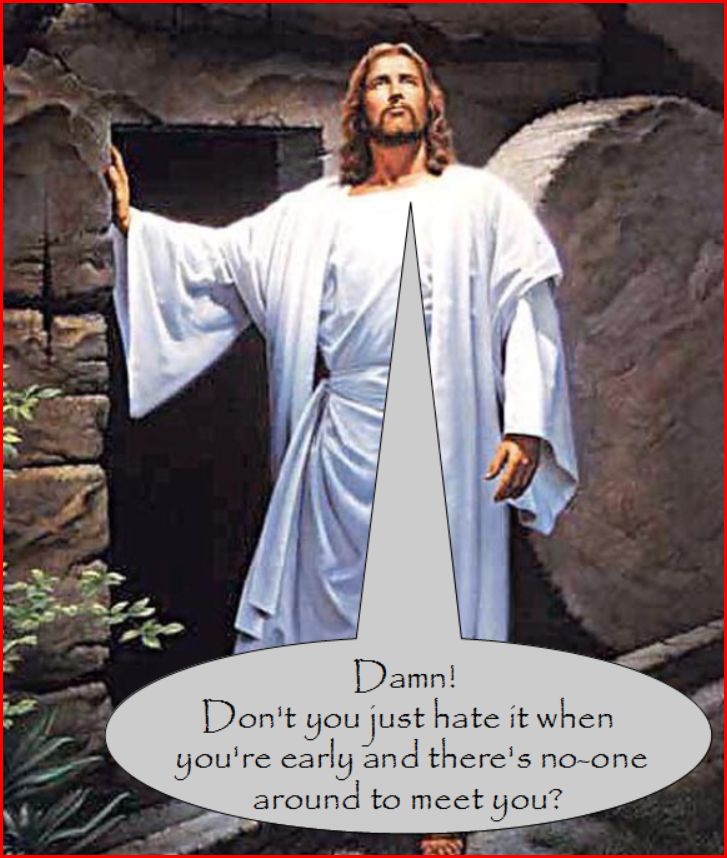
How long was Jesus in the tomb before he ‘rose again’? Three days you say? Wrong! Read on and discover the secret of the Great Resurrection Miscalculation.

Resurrection

Jesus is wrong about no less an issue than his claim that he would rise from the dead after three days. In Mark 10.33-34 he prophesies:

the Son of Man will be handed over to the chief priests and the scribes, and they will condemn him to death; then they will hand him over to the Gentiles; they will mock him, and spit upon him, and flog him, and kill him; and after three days he will rise again.

On the surface, this seems pretty accurate for a prediction of events made some time before they actually happen (it wouldn’t be a prediction otherwise). Except, of course, this prophecy, like others of Jesus’, was written forty years or more after the event. Even then, Mark or whoever wrote the earliest gospel, can’t get it right. He tells us clearly in Mark 15.34 that Jesus dies at 3pm on Friday; Matthew and Luke agree. Jesus then reappears, fully recharged, ‘very early’ on the Sunday morning (Mark 16.2). But 3pm Friday to the ‘very early’ hours of Sunday is less than 48 hours – not three days, not even two.

What is the cause of this failed prophecy? For some reason, Mark assumes that ‘on the third day’, when he believed Jesus rose from the dead, means the same as ‘after three days’, the words he has Jesus prophesy. The third day after the crucifixion would indeed be the Sunday, but it wouldn’t be, and isn’t, three full days after it, as Mark’s Jesus seems to think.

The problem is not Mark’s alone, however. Matthew’s Jesus is even more emphatic that he will be buried for the three complete days:

For just as Jonah was for three days and three nights in the belly of the sea monster, so for three days and three nights the Son of Man will be in the heart of the earth. (Matthew 12.40)

Thanks to Jesus’ insistence in Mark and Matthew that he would spend three days in the tomb, the belief that he must have done so – contrary to the ‘evidence’ in those same accounts that it was less than two – appears to have become securely established by the time of the fourth gospel. Its writers, however, find their own unique way round the problem. Their thinking seems to have been along the lines that ‘if Jesus said he was going to be buried for three days and three nights, then he must have been. He was the Son of God after all, and he wouldn’t get a thing like this wrong. Therefore, if, as we know, he rose on the Sunday, he cannot have been crucified on the Friday. He must have died on the Thursday’. And so the writers of John’s gospel shift the crucifixion back a day, to around noon on Thursday (John 19.14). It’s an ingenious solution. Thursday to Sunday – near enough three whole days. There’s even some neat symbolism as a bonus: the earlier execution equates with the slaughter of the sacrificial lambs on the Thursday, ready for that evening’s Passover. Problem more than solved!

Except it creates a whole raft of new ones, not least the glaring inconsistency between the synoptic gospels’ accounts of the crucifixion on the Friday – after Jesus’ and the disciples’ celebration of Passover the previous evening – and John’s gospel’s account of the crucifixion during Thursday afternoon, well before the Passover meal would have been eaten. Significantly, no-one in the history of Christendom has ever been persuaded by John’s Thursday crucifixion, otherwise we’d remember it on ‘Good Thursday’ instead of ‘Good Friday’, and have a different day off work.

Does any of this matter? Probably not, but it does demonstrate that:

i) if Jesus’ words in the synoptic gospels are to be taken literally, then either he can’t count or he badly misjudges the timing of his resurrection. If scheduled for three days after the crucifixion it should have occurred on the Monday;

ii) the resurrection probably didn’t happen at all, and more than forty years later Mark and Matthew trip themselves up trying desperately to convince people that it did, and that Jesus knew it would;

iii) the gospel writers are prepared to rearrange already highly improbable events to make equally unlikely prophecies appear true;

iv) because the Bible cannot get its own faked, after-the-supposed-event prophecies right it can’t possibly be trusted about other claims it makes. 

Happy Easter, y’all.

Adapted from my book Why Christians Don’t Do What Jesus Tells Them To …And What They Believe Instead. Buy it on Amazon UK or Amazon US.

Why_Christians_Don't_Cover_for_Kindle


Unbelievable: Why, despite everything, Christianity makes absolutely no sense whatsoever.

Spufford2

There’s no real reason to believe in God.

 
Who says so? Francis Spufford in his book Unapologetic: Why, Despite Everything, Christianity Can Still Make Surprising Emotional Sense. Francis does believe though, because sometimes when he’s alone – specially after a tiff with his wife or while sitting quietly in church – he gets a funny feeling. And this feeling is so funny, as in weird, that it can only be God. Or so Frank says, slipping in as many four letter words as he can, just to show he’s not a namby-pamby sort of believer. (He’s especially proud of his new term for ‘sin’: ‘the Human Propensity to Fuck things Up’, or HPtFtU for short.)

 
What’s more, even though there are a hundred and one reasons to think there isn’t a God, at least not one who cares about us (think pain, suffering, death, evolution and his complete lack of interest in his creation, all of which Frank’s acknowledges) he nevertheless wants to say that he does believe because, you know… feelings.

 
That’s not all. This God Frank’s decided to believe in as result of feeling funny, is the Christian God. He could’ve turned out to be Allah or Zeus or Ra, but he isn’t, because Frank feels he’s the Christian God, for no other reason than he wants him to be. Then, in a final leap of faith, he decides that Yeshua, as he insists on calling Jesus, is the walking embodiment of this God, and he rewrites the gospel story so that it fits with the funny feeling that kick-started his delusion in the first place.

 
And so we have it from the horse’s mouth; a Christian who’s proud to admit there’s nothing remotely rational or empirical about believing in God. Faith, he confirms, is no more than some very human, very peculiar feelings that lead you merrily down whichever garden path you choose to take.

Stephen Green is Gay

Green2

Stephen always got his inspiration from the Lord…

Stephen Green of Christian Voice is unhappy. Gay Marriage, he insists, is a Very Bad Thing.

Green has had a lot to say about gay relationships and gay sex over the last few years. In fact, he’s obsessed with the subject. His latest ejaculation, called ‘Gay Marriage is a Farce’, helpfully informs us:

‘Gay’ relationships (are) built on perversion.

Homosexual desires are described as vile affections in the Bible.

‘Gay marriage’ is a massive step towards the social economy of Sodom.

We don’t say homosexuals are perverts because of what they are, but because of what they do.

Homosexual activity… is either dirty or abusive or both.

Homosexuals, frustrated by their inability to engage in true sexual intercourse, have to resort to activities which are abusive or dirty.

Homosexual acts fall a long way short of the God-ordained conjugal act.

Personally, I now use the word gay mostly in its modern sense of substandard (as in, ‘that coat’s gay’).

Never self-identify as ‘gay’. Never let someone else identify you as ‘gay’.

Green is himself ‘gay’. In the ‘modern sense’, of course. He preaches that marriage is between one man and one woman for life, yet is divorced and now with his second wife-for-life. He trashes charities that help young LGBT people and makes unwarranted personal attacks on gay celebrities, recently suggesting that Stephen Fry has a ‘porcine ancestor… not that we do evolution here’ and adding derisory inverted commas around the ‘Sir’ in Ian McKellen’s name. How big and clever is that?

Even though Jesus has more to say about poverty and homelessness than homosexuality (about which he says precisely nothing), Green never mentions them. He consistently avoids talking about his saviour’s commands to turn the other cheek, go the extra mile and avoid judging others. These, it would seem, don’t matter.

While he occasionally rants about evolution and complains Christians are persecuted, it is to homosexuality he constantly returns. Always with inverted commas around ‘gay’, to ward off the voodoo.

But Green is insecure in his beliefs and faith; he rarely publishes comments that dissent from his ‘biblical’ position and when he does, responds to those who make them with an uncharitable smugness that borders on abuse. There is no sense of any Christian charity in either his comments or on his site as a whole.

Worst of all, he washes his hands, Pontius Pilate like, of the harm his negative, destructive comments cause LGBT people. The real bullies, he says, are not Christians with poisonous views like his but rather:

homosexual activists who persuade young boys and girls that adolescent same-sex attraction indicates a permanent ‘orientation’ and who go around talking homosexuality up and giving bullies a weapon to use against shy boys and tomboyish girls. People like ‘Sir’ Ian McKellen, Elly Barnes, Jake Dyos and the rest of the low-life at ‘School’s Out’.

So now you know. Stephen Green, who calls ‘gay’ people perverts with ‘vile affections’, whose relationships and love-making are, he says, founded on dirt, disease and abuse, is in no way a bully whose views contribute to any ill-feeling towards gay people.

No, the vilification to be found on Christian Voice is actually Christian love™. The gospel according to Stephen Green: it’s so substandard.

Which Christians won’t be resurrected after they die?

Robertson

All of these well-known Christians are unworthy of the Kingdom of God and won’t live again after they’ve died. See if you can work out why:

Billy Graham, Justin Welby (Archbishop of Canterbury), Desmond Tutu, Pat Boone, Mel Gibson, John Sentamu (Archbishop of York), Stephen Green (Christian Voice), Bono, Her Majesty the Queen, Sarah Palin (politician), Pat Robertson (700 Club), Joyce Meyer (evangelist), Bryan Fischer (outspoken radio broadcaster), Rick Warren (pastor of US mega-church), Rob Bell (ditto), George W. Bush, Tony Blair, Cherie Blair (barrister), Graham Kendrick (songwriter), Tony Perkins (anti-gay preacher), Scott Lively (ditto), Matt Barber (ditto), Peter LaBarbera (ditto), Tom Wright (theologian), Fred Phelps (late of Westboro church), Joni Eareckson Tada (writer), Mike Ratcliff (minister and blogger), Kirk Cameron (actor)… and, in all probability, your local pastor  – and maybe even you yourself, Christian reader.

They’re not worthy of God’s Kingdom nor are they likely to be resurrected because they’re married. And who says this makes them unworthy? Not me… Jesus:

those who belong to this age marry and are given in marriage; but those who are considered worthy of a place in that age (of God’s Kingdom on Earth) and in the resurrection from the dead neither marry nor are given in marriage (Luke 20.34-35).

So next time one of these famous Christians or some other married believer tells you you’re not saved, tell them that they’re not either. Jesus says so.

They won’t care, of course, because they pick and choose the bits of the Bible they believe. They’re more than happy to pretend this tricky bit doesn’t exist or doesn’t apply to them. Obviously, or they wouldn’t be married. Naturally this doesn’t stop them going on about about God’s plan for marriage even though it’s one they’ve made up themselves that flies in the face of what Jesus says.

Which means these same believers also have to ignore Jesus when he says, ‘Why do you call me “Lord, Lord”, and do not do what I tell you?’, which is a very good question.

Proof that God is real?

Thor

Christians – can you prove God exists? J. Lee Grady of Charisma magazine thinks he can and offers ‘7 Things That Prove God Is Real’. Leaving aside the fact that it shouldn’t be necessary to prove God is real – the God of the universe, Creator of Heaven and Earth, Father of Mankind should be more… apparent, shouldn’t he? – what are Mr Grady’s incredible proofs? Glad you asked. You can read the full article here, but to cut a long story short, they are:

Babies, thunderstorms, flowers, the Bible, the global spread of Christianity, Jesus and a personal friendship with God.

I hope you’re convinced. I know I am.

Problem is, all of these things are also evidence that God doesn’t exist.

Babies: Babies are miracles, according to Lee. We’ve evolved to find human babies cute and appealing even when they’re yelling, pooping and spewing – it helps us nurture them. But they’re not miracles; nearly 37,000 are born every day. What’s more, over a million of them die every year on the day they’re born. Which might just suggest God is not real at all.

Thunderstorms: Mr Grady says that because storms are powerful they put him in mind of God. This, however, is not proof of anything. Unless of course it’s Thor, god of thunder in Norse mythology and star of Marvel Comics. Is this who you mean, Lee?

Flowers: Lee says flowers are proof of God because they’re pretty. He seems to be unaware that their appearance is the result of natural selection; it has developed in order to attract insects and birds who then unwittingly assist in the plant’s reproduction. Yes, flowers are pleasing to the human eye as well, but their job is emphatically not ‘to simply make the world beautiful’, as Lee claims. They are evidence of evolution, not of a flower-arranging god.

The Bible: Lee trots out the false assertion that the Bible, in spite of having numerous authors over thousands of years, presents a consistent message. It doesn’t. There are, for example, at least nine different ways of being saved expressed by writers in the New Testament (some of whom, including the one Lee quotes, are forgers) – and they lived within a few decades of each other! A book cobbled together more than 300 years after the supposed main event, by men – not God – with a vested interest in its success, is not proof of the divine.

The global spread of Christianity: Human beings have worked hard throughout the ages to spread their own particular version of Christianity – often converting others on pain of death. There are today over 34,000 Christian groups, sects and cults, which is ‘proof’ that there is no one Mastermind behind it all. Other religions spread too, so perhaps that’s evidence their God is real as well (or instead), and so do diseases. The spread of an idea only illustrates human preoccupation with that idea.

Jesus: Really? His broken promises, failed prophecies, impossible morality and shabby treatment of those who didn’t buy into his mission somehow ‘prove God’? Maybe Lee means that Christ proves God. But ‘the Christ’ is an invention of Paul’s and has little to do with the man Jesus. In any case, one mythical figure does not prove another. Unless it’s Thor, of course, whose existence definitely proves there’s an Odin.

A personal friendship with God: What goes on in Lee’s head doesn’t prove anything, never mind the existence of God. A person’s feelings are subjective, solipsistic and entirely unverifiable. Thinking he’s got a relationship with God doesn’t mean that he has. Unlike my friendship with Thor. That’s really real.

So, seven proofs of God that are no proof at all. Anyone else care to take a turn?

Christians’ Favourite Delusions 20: The Lord God Made Them All

creation

The poster outside a church in my neighbourhood informs all who pass by that ‘the Earth is the Lord’s and everything that is in it’ (Psalm 24.1). Christians seem to think it’s important that their deity is the one who made the universe and life in this particular small part of it. Some even go so far as to say their God (though being Jewish he wasn’t their God back then, of course) made the world and all of its occupants including ourselves, literally within 6 days, about 6,000 years ago. I suppose that’s where you end up if your premise is that mythical beings, like ol’ Jehovah, actually exist. A third of Americans believe in Creation, innumerable web-sites insist an Intelligent Designer is responsible for life on Earth and street preachers are happy to tell you that evolution is a lie. ‘Were you there?’ asks Ken Ham of Answers in Genesis, as if this clinches the deal.

But let’s be generous. Let’s concede that we don’t know how life started on this planet – because we don’t – and let’s jump to the conclusion that therefore it must’ve been the Christian God. It’s not a very convincing line of reasoning, I know, but I’m being generous as I say. So let’s acknowledge that the Lord did indeed make hummingbirds and butterflies, roses and angel fish, lambs and tygers and all other bright and beautiful things, more or less in their present form.

But that means we’ll also have to concede that he made mosquitoes, flies, lice, ring-worms, parasites of all descriptions, E-Coli, pneumacoccus, all manner of harmful bacteria, viruses, AIDs, cancer – and on and on. The naturalist David Attenborough points out that Creationists are quick to give credit to their God for hummingbirds but that he himself sees ‘a little child in east Africa with a worm burrowing through his eyeball. The worm cannot live in any other way, except by burrowing through eyeballs. I find that hard to reconcile with the notion of a divine and benevolent creator.’

How do Christian creationists square their loving God with such harmful creatures?

There are only four possible ‘explanations’ available to them:

1. Harmful bacteria, viruses and parasites were ‘good’ when God first made them (Genesis 1.31). Then, like everything else, they become perverted when Adam and Eve ate some forbidden fruit.

But this creates more questions than it answers. What were these creatures like in their original forms? How did they live, when their ‘life-cycle’ depends on them infecting other forms? How did they change from being ‘good’ into the creatures they are today? It can’t have been by the process we know as evolution because, of course, evolution is a lie.

2. The Devil made them to plague mankind. He even made sure they survived Noah’s flood – no doubt in the bodies of Noah’s family and the animals supposedly on the Ark.

But if Satan did create them, doesn’t that make him as clever as God in his own way? (I know, I know, the devil doesn’t exist either but I’m trying to think like a Christian here). In any case, why would God let him? Ultimately, he’s responsible for his creation.

3. God made them because, even from the beginning, infections, infestations and disease were all part of what he considered ‘good’.

If this is the case, what an evil bastard he is, indistinguishable from Satan himself.

4. God, the Intelligent Designer just set things in motion at the beginning before leaving evolution to do his work for him.

But, as Darwin pointed out, evolution is a mindless, haphazard, wasteful process that relies heavily on sex and death. What is a supposedly loving, intelligent designer doing using it to bring about his creation? Did he forget that evolution is lie?

Which leaves us with the fact that if God designed and created all life intelligently, as many Christians want to believe, then much of his creation shows little sign of either his love or his intelligence. It does, however, show every sign of having come about as the result of a mindless, haphazard, wasteful process, in which all life-forms occupy their own particular niche to which they have adapted and have evolved, through an infinite amount of sex and death, into the life-forms we see today – hummingbirds and eye-burrowing worms included.

A Story From The Bible…

Luke 10.29-37 accurately translated from the original Greek

 Jerry&Sam

…And so Jesus told them a story to explain what he meant:

“There was,” he said, “a young man called Jerry Cohen who was making his way across the city late at night when he was set upon by some yobs. They kicked him to the ground, stole his wallet and phone and left him for dead. He lay in the doorway of a shop, blood seeping from the deep cut to the back of his head and pooling into the shadowed corner. With his teeth broken and ribs cracked, Jerry slipped into unconsciousness.

By chance, a group of people from a local church were out that night witnessing to the young people partying in the bars and pubs of the district and for whom, let’s be honest, this was an unwelcome intrusion. Some of these well-meaning church-folk noticed Jerry lying in the doorway as his life ebbed away, but as they couldn’t see all the blood they simply assumed he had passed out from an excess of alcohol. They decided to leave him where he was to sober up. ‘Let’s give him the Good News to read when he does,’ said one, tucking a tract called Salvation through the Redemptive Power of the Cross into his top pocket. 

Minutes later, an evangelist happened to pass Jerry, still curled foetally on the floor, and noticed that the premises next to where he was seemed to be one of dubious repute. Its lights blazed even at this late hour and there were over-sized, suggestive pictures of athletic-looking young men in the windows. He didn’t want to look too closely because he didn’t want the taint of sin to cling to him but it seemed obvious that if the shop was what he thought it was, then the boy next to it could only be a homosexualist, hell bent on foisting his perverted lifestyle on everyone and destroying traditional marriage in the process. And so he walked swiftly on, quietly quoting Romans 1.27 to himself: Men commit shameful acts with other men, and receive in themselves the due penalty for their error. ‘If ever there was a sign that the end times have arrived,’ he thought to himself, ‘it’s the likes of that degenerate individual over there.’ As he crossed the road, he failed to see another young man approaching in the opposite direction.

Sam Harrington wasn’t a homosexualist either – because really there’s no such thing – but he was a homosexual. He’d had been working late and was eager to get home so he too was taking a short cut through the centre of the town. He spotted Jerry in the doorway and before he could even think what he was doing, he had pulled his phone out of his pocket and had dialled the emergency number. While he waited for the ambulance to arrive, he cradled Jerry’s head in his lap, holding closed the gash to stop further blood loss and helping it start to heal. When the ambulance arrived, Sam went with Jerry to the hospital where he sat anxiously in Accident and Emergency for  two hours, waiting to hear how he was. When, finally, a nurse came to tell him that now the young man’s jaw had been wired together and his head stitched there was every chance he would pull through, Sam wept unashamedly.

With the last bus long gone, he began his long walk home. He didn’t have enough money for a cab and he didn’t like ringing his partner in the early hours of the morning to ask for a lift.”

“So tell me,” Jesus said finally, “which of the three, do you think, was a neighbour to the man who fell into the hands of the yobs? Who showed him real love?”

His followers looked around blankly at each other, for surely this was a question that was impossible to answer.    

Christians’ Favourite Delusions 19: We’re living in the End Times

Chicken licken

The belief that things are worse now than they’ve ever been before, is, ironically, a conviction that has been around for a very long time. Every generation, it seems, has held the view that it was all so much better back in some ill-defined time in the past and the likes of today’s wickedness and degeneration has never before been seen. With things as bad as they are, it can only mean one thing: God is going to intervene pretty soon to put things right.

This is how religions start. It’s what Jesus thought (Mark 8.38 and 13) and Paul (Roman 13) and most of the other New Testament writers (e.g. Ephesians 5; 2 Timothy 3). Many of today’s Christians believe it too:

There is no doubt whatsoever, that the signs of the end of the world in the Bible are pointing to our generation. Anyone can see the great moral degeneration that has happened over the past 50+ years. The moral depravation of this world has reached such a point that we are now like Sodom and Gomorrha just before God destroyed that city with fire … 2 Peter 2:6 …’And turning the cities of Sodom and Gomorrha into ashes, condemned them with an overthrow, making them an example unto those that after should live ungodly.’

But really, things today are no worse than they were back in the primitive past and in many ways they’re a great deal better. In general terms, we live longer, healthier lives and more of us are literate and educated. Many of us enjoy a very comfortable existence. There are fewer wars and violence is decreasing. Equality and opportunity exist in many parts of the world for all kinds of people; we are more welcoming of difference and by and large we treat each other better. Of course there are problems, but there always have been. Life in the first century, when Jesus lived and died, was short, brutish and insanitary. The culture he found himself in was paternalistic, maintained by slavery and ruled over by invaders who were cruel and violent. Who can blame him for thinking it couldn’t get any worse? It did, of course, mainly thanks to his legacy, but it also got better. Either way, God did not intervene.

What’s more, he won’t be doing any time soon, no matter the strength of conviction of those who feel he will or should.

He’s prevented from doing so chiefly by the fact he doesn’t exist (quite an impediment, I’d have thought) but also because for those in the affluent west – who are usually those who shout most about how dreadful things are – everything is pretty damn good.

As Jesus discovered (or was it Chicken Licken? I get confused) portents of doom do not bring about the end of the world. We might, one day, actually manage to destroy ourselves and this beautiful planet we live on, but if we do, it won’t be because our morals have changed for the better nor because we’re teaching evolution in schools (another sign of the end, apparently). And it certainly won’t have anything to do with a vengeful God.

If you stop thinking the world is going to hell in a hand-cart, you’ll very soon see that it isn’t.