Christians’ Favourite Delusions 26.1: The Bible is the Word of God

IsaiahThe Bible: not so much holy as full of holes.

So much hinges on the fallacy that the Bible is the literal, inerrant Word of God. As the ‘director’ of Christian Voice, Stephen Green, puts it:

We believe the Holy Bible to be the inspired, infallible, written Word of God to whose precepts, given for the good of nations and individuals, all man’s laws must submit.

Try as you might, you will not find the Bible claiming it is the Word of God, capitalised or otherwise. The phrase does appear, without the capital W, but on none of these occasions is the Bible referring to itself.

Christians usually base their conviction that the Bible is the Word of God on a verse in 2 Timothy (3.16):

All scripture is inspired by God and profitable for teaching, for reproof, for correction, and for training in righteousness.

There are some serious problems with this claim.

Firstly, the ‘scripture’ to which 2 Timothy 3.16 refers cannot be the Bible as we know it today. This was not compiled until about 260 years after these words were written*. At best, the author of 2 Timothy is referring to the first five books of the Bible – the Pentateuch – and maybe, possibly, though we cannot know for certain (you see how tentative it is?) some of the writing he had encountered that was eventually included in the New Testament.

By the same reckoning though, he could equally be referring to books that at one time were considered to be inspired but did not make it into the final 27 books of the New Testament**. This is also why the use of the term ‘the word of God’ in other places in the New Testament cannot be referring to the Bible as a whole. No-one knew when using the phrase in its original context that there was going to be a Bible, let alone one divorced from its Jewish roots.

Secondly, most scholars today are convinced that Paul did not write 2 Timothy, even though it claims that he is its author. There are very good reasons for saying the letter was written between 100-150CE, thirty-six years, at the very least, after Paul’s death in 64CE. In other words, 2 Timothy is a fake, claiming to be written by one person – Paul – when it is in fact the creation of another, taking advantage of the reputation of the more well-known writer.

How far can such a false witness be trusted? Most people in any other context would say not at all. And yet Christians take this forger’s letter to be ‘inspired by God’, just because it says it is. In essence they are saying that God is happy to inspire forgery, and not just in this instance either: none of the ‘pastoral’ letters (1 and 2 Timothy, together with Titus) is written by Paul, even though all of them claim to be. The second letter to the Thessalonians and those to the Ephesians and Colossians are not by him either; 1 and 2 Peter are not by the (illiterate) apostle Peter and the letters of James and Jude, while wanting us to think that they are, are not by Jesus’ brothers***.

In short, and as Bible scholar Bart Ehrman puts it:

Many of the books of the New Testament were written by people who lied about their identity, claiming to be a famous apostle — Peter, Paul or James — knowing full well they were someone else. In modern parlance, that is a lie, and a book written by someone who lies about his identity is a forgery.

Christians do not accept that the Qur’an is the word of God (Allah), nor the book of Mormon, even though both say they are, so why do they take it on trust, from a forged document that was lucky enough to find its way into the New Testament, that it and all other ‘scripture’ is inspired? ‘Faith’, they would tell you; but in this as in many other contexts, it is extremely misguided faith.


Notes:

* For the Bible’s late compilation see Charles Freeman (2008) Heretics, Pagans and the Christian State, p42

** For non-canonical texts once considered contenders see Bart Ehrman (2009) Jesus Interrupted: Revealing the Hidden Contradictions of the Bible, chapter 4

*** Forgeries in the New Testament are discussed more fully in Ehrman (2011) Forged: Writing in the Name of God – Why the Bible’s Authors Are Not Who We Think They Are: The pastoral letters – pp96-103; 2 Thessalonians – pp105-108; Ephesians – pp108-112; Colossians – pp112-114; Jude – pp186-188; James – pp192-198. Peter’s illiteracy is noted in the Bible itself (Acts 4.13) and is discussed on pp75-76 of Forged.

UK editions referenced.
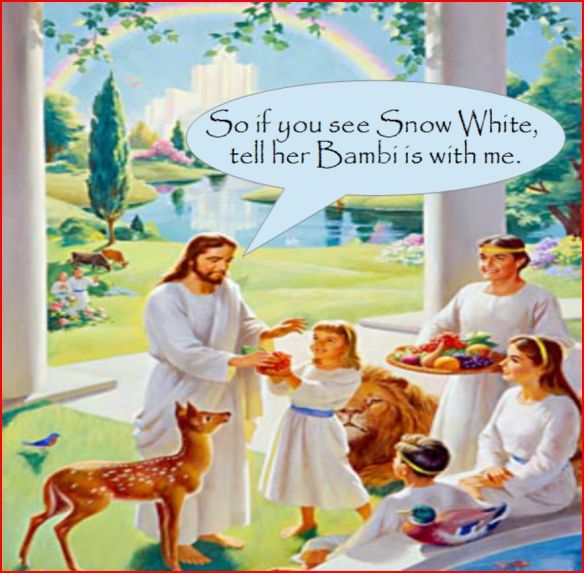
 

What would the world look like if Jesus had been right?

NewEarth

If everything Jesus promised had come true, then:-

Jesus and his twelve mates – or maybe it’s eleven, what with one of them pissing on the parade – would have been running the world for 2,000 years by now (Matthew 24.34 & Matthew 19.28).

All the undesirables – that’s me and, in all probability, you – would’ve been consigned to Hell and the Righteous would’ve been living on the New Earth, working miracles all day long, not getting married, enjoying eternal life and definitely not having sex (Matthew 13.43, Luke 20.34-35, Matthew 25.46, Matthew 13.41-42).

But seeing how none of that has happened yet, what does the world-according-to-Jesus look like while we wait for the Kingdom to arrive?

Well, duh, look around you; this is how it is:

True Believers go around curing the sick, the blind and the lame, just by touching them or using magic saliva. There’s no need for hospitals, medicine, doctors or heath care. Jesus did this sort of thing and he said his followers would too, to an even greater extent. That’s why Christians can even help amputees grow back missing limbs (Mark 16.18 & John 14.12).

By the same principle, True Believers regularly raise the dead. Okay, so there’s not going to be any death in God’s Kingdom on Earth, but it’s a handy power to have all the same (Matthew 10.8).

Hunger is a thing of the past. When anyone feels a bit peckish – an entire continent, say – Christians feed them using whatever scraps they’ve got lying around, like left-over sardines and burnt toast with Jesus’ face on it (Matthew 14.13-21).

True Believers supply everyone with as much wine as they want, too. They simply pour out some water and change it into alcohol with their water-into-wine superpower. If their beneficiaries turn out to be tee-total, the Righteous change it into something else for them, like coffee or Kool-Aid or cyanide. Of course, cyanide is the beverage of choice for God’s Chosen. He makes sure no harm comes to those who imbibe it (John 2.1-11, Mark 16.18).

Christians are regularly to be seen playing with poisonous snakes, because, like Superman they’re practically invulnerable (Mark 16.18).

Transport is transformed in Jesus’ new world too. No need for ships or ferries; Believers travel overseas by walking over seas. Conditions a bit choppy? The Almighty calms things down for them; all they have to do is ask. (Matthew 14.22-33 & Mark 4.35-41).

Mountains getting in the way? They can just be lifted out of the way using the Power of Faith, and thrown into the sea. Or, if that’s likely to cause problems for those out for a stroll on the oceans, the mountains can be rearranged to make a passage through. Very neat and tidy (Mark 11.23-24).

Best of all, True Believers can ask God for anything at all and whatever they ask for he provides. No questions asked. He does it (Matthew 7.7 & 21.22, Mark 11.24 etc).

Thanks to Jesus’ followers, this is how it is in the world, while they wait for God’s Kingdom to arrive. And when it does, it’ll be even better. Hard to imagine it could be any better than it is, I know, but Jesus guarantees it. What a blessing it is to live, here and now, in such a transformed reality.

Except of course we don’t. None of these things happen. Not the miracles, the healings, the living forever. This is not the world we live in, even though Jesus said it would be. His Kingdom didn’t come; his followers don’t do miracles like his (and certainly don’t do better ones); no-one lives forever. They never have and never will.

Instead his Followers spend their time squabbling between themselves, judging others and living – and dying – pretty much the same way we all do.

Funny that.


Why would someone choose to be like this?

KissJesus and friend enjoy a quiet moment of intimacy.

Over at Barbwire, a particularly prickly Christian web-site about guns and how the world is going to hell in a handcart and how Christians are persecuted – persecuted, I tell you! – just because, out of love, they trash homosexuals, they’ve been discussing gay Christians. In a totally fair and balanced way, they’ve concluded you can’t be both because of something or other the Bible says.

What I don’t understand about gay Christians is how anyone would choose – and it is a choice when there’s no evidence they’re born that way – to be something as destructive, unhealthy, degenerate, unproductive and downright icky, as a Christian.


What would this world look like if there was no God?

TrinityIf God did not exist –

Human beings would frequently behave like territorial primates;

Nature would be the result of a mindless and heartless process;

Sex and death would be the drivers of its development;

Life would be a cruel struggle for most living creatures, including many humans;

Disease and illness would be pervasive, except where humans themselves had eliminated them;

The world would be largely indifferent to human aspiration;

The brain would find pattern and impose order where none existed;

Progress would be due entirely to human endeavour;

People would adopt the beliefs of their culture and be entirely convinced they alone were right.

Hang on a minute! Isn’t this the world we already have? It’s just like Julia Sweeney says: ‘The world behaves exactly as you expect it would if there were no Supreme Being, no Supreme Consciousness, and no supernatural’. A world without God is exactly the world we’ve got. And the world we’ve got is evidentially a world without a God.

Surely that’s no bad thing.

Christians’ Favourite Delusions 25: Unbelievers are going to Hell!

Spoiler alert: No, they’re not.


HellIt’s always nice when the local fellowship keeps in touch.
There’s good news and bad news. First, the good news: Hell doesn’t exist. You can’t go to a place that doesn’t exist.


Next, the bad news; you’re not going to survive your death. Sorry to break it to you like this, but there it is: no-one survives death. Once the physical, chemical and electrical processes in your brain cease then so do you, because that’s what you’re made of. That self you have a sense of – your soul if you want to call it that – is entirely dependent on those electro-chemical processes. It doesn’t exist independently from them. You cease to be once the brain dies and begins to deteriorate*. Everyone who has ever lived and died, including true believers down the ages – from Jesus, Peter, Paul, Matthew, Mark, Luke and John to Augustine, Bede, Wilberforce and C. S. Lewis – have all ceased to be, dissipated and obliterated forever, along with their physical brains and bodies.


And why, dear Christian, would you want to survive death? What makes you think that the bundle of petty concerns, loves and hates, neuroses, reactions and habits that you call ‘you’, merit long-term survival? Because that odd little collection of impulses is what you’re talking about when you say you are going to live forever. You may regard yourself as changed into some sort of reflection of Christ, but it’s your essential self that you desperately, and arrogantly, hope will enjoy eternal life. It won’t – and why should it?


So, there’s no you to survive and no Hell, or Heaven, for you to go to. The Bible doesn’t offer Heaven – see my previous posts here and here – but it does talk about Hell. It’s the place the Unrighteous go when the Righteous™ take over the earth (albeit it in the first century). According to Jesus in Mark 7.20-23, the Unrighteous are people like murderers, thieves and the proud, while Paul includes other ‘undesirables’ like homosexuals (1 Corinthians 6.9). This isn’t nearly enough for today’s Christians though**. They want everyone except themselves to be sent to Hell. So if you’re not ‘saved’ according to their magic formula, then you’re certain to go there. Never mind if you’re not a murderer or proud or gay. That’s where the God of Love is going to send you, to be tormented forever.


And where is Hell? Jesus seems to think it’s in the heart of the Earth (Matthew 12.40) and invariably those threatened with Hell go ‘down’ to it. The wingnut who wrote Revelation also implies it’s in the Earth (9.2). You’d think, that being the case, we would have found it by now. But we haven’t because, of course, it doesn’t exist. And you’re not going. And there won’t be a ‘you’ to go in any case.


So don’t waste any time worrying about it or letting Christians persuade you Hell is a real place. Live your one and only life in the here and now as best you can. Enjoy it. It’s not a rehearsal for a better place, and certainly not for a far worse one.


Notes:

* In The Lazarus Effect, Dr Sam Parnia relates instances of people being revived up to an hour after death, but only in specific circumstances, when the brain remains undamaged. Any longer than an hour and it’s not possible. Such revivals are extreme forms of the rebooting your brain does every morning after sleep; the brain itself and all its neuro-connections must still be capable of functioning for you to be you again after sleep or even apparent death.


** Yes, I acknowledge some Christians don’t accept Hell. American pastor, Rob Bell, suggests in Love Wins that Hell doesn’t make ‘a very good story’, and that God will save everybody. All Hell was let loose in the resulting backlash from true, Bible-believing Christians; a response that was extreme, brutal and frequently sanctimonious. How dare Bell contradict God’s Word, Holy Scripture? Surely he deserves to go to Hell for that.


Christians in denial

Trial

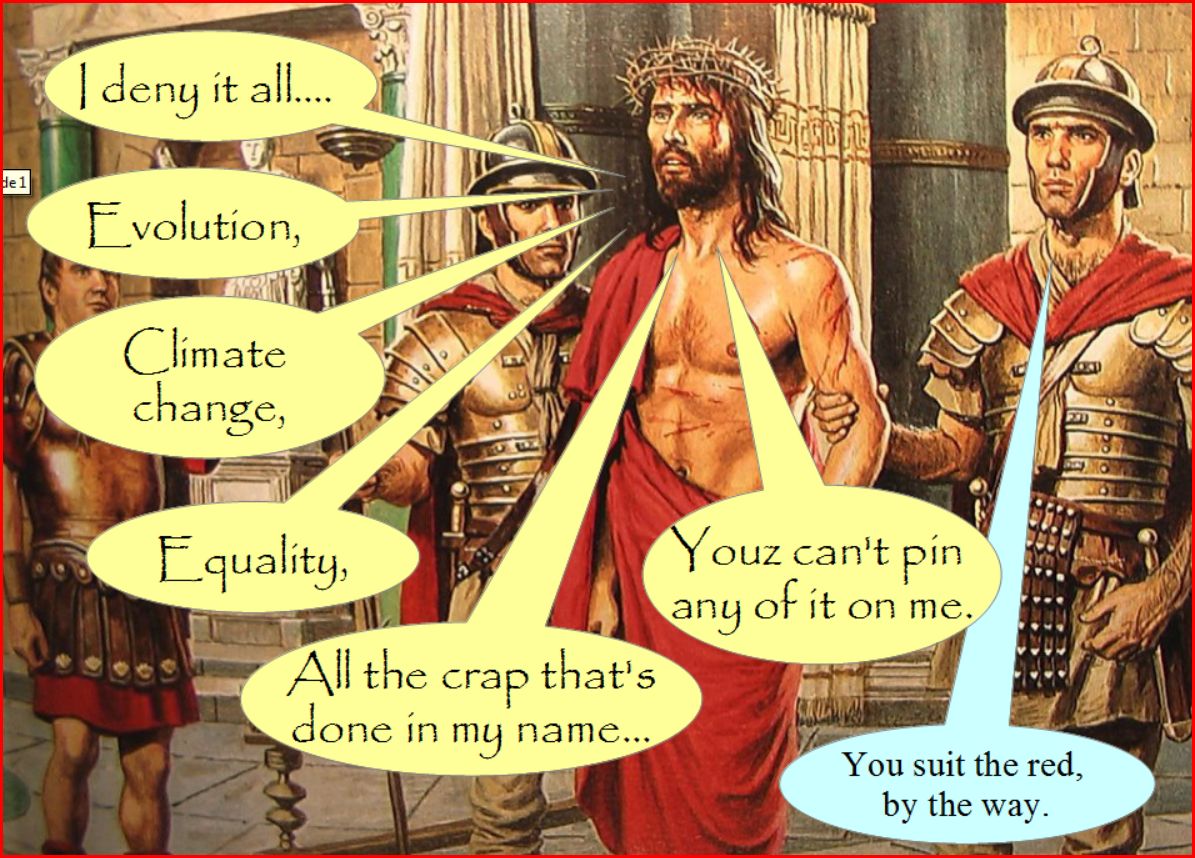
Deny yourself, deny your parents, deny your family. That’s what Jesus tells his followers they’ve to do. Today’s Christians can do better than that though! They’re in complete denial about everything, especially stuff for which there’s tons of evidence. Believing loads of made-up stuff is more their thing.

So, they deny climate change because God wouldn’t allow it (or something).

They deny that human beings contribute in any way to climate change because it’s not part of God’s plan.

They deny evolution because God created everything (in six days).

They deny how unpleasant, wasteful and cruel evolution is in order to believe that God used it to develop life here on Earth.

They deny that death existed before humans evolved because the Bible says it didn’t.

They want to deny gay people equality because the Bible says marriage is for one man and one woman (it doesn’t).

They seek to deny others their rights, often slanderously and viciously, but expect their ‘right’ to do so to be protected.

They deny that morality has anything to do with the way we treat other people and is really only about sex.

They deny that anyone can be moral or rational without believing in their God.

They deny that for most of us things are better than they’ve ever been and insist instead that things have only got steadily worse.

They deny the humanity of fellow human beings but believe in fantasy creatures like angels, spirits and demons.

They deny their own humanity, with its corresponding needs and limitations, and insist instead we’re designed to be spiritual creatures.

They deny most of what Jesus taught but tell everyone else they’re sinners.

They deny that Jesus said he’d be back in his disciples’ lifetime, and believe instead he’s still on his way.

They deny death and imagine they’re going to live forever in Heaven instead.


Christianity is a religion of negativity. Truth, reality and other people are the casualties of its life-denying efforts at self-preservation.


Christians’ Favourite Delusions 24: We stand for biblical truth!

Judge

Christian commentator Tony Perkins demands that Christians defend ‘biblical truth without compromise.’ What he really means – because he only ever uses it in this specific context – is that Christians should use the bible to condemn gay people.

He’s not so hot on standing up for the ‘biblical truths’ that say you should turn the other cheek. Or go the extra mile. Or that you should sell all you have and give the proceeds to the poor. No sir. Those are biblical truths that demand something of Christians themselves so of course they feel perfectly at liberty to disregard them.

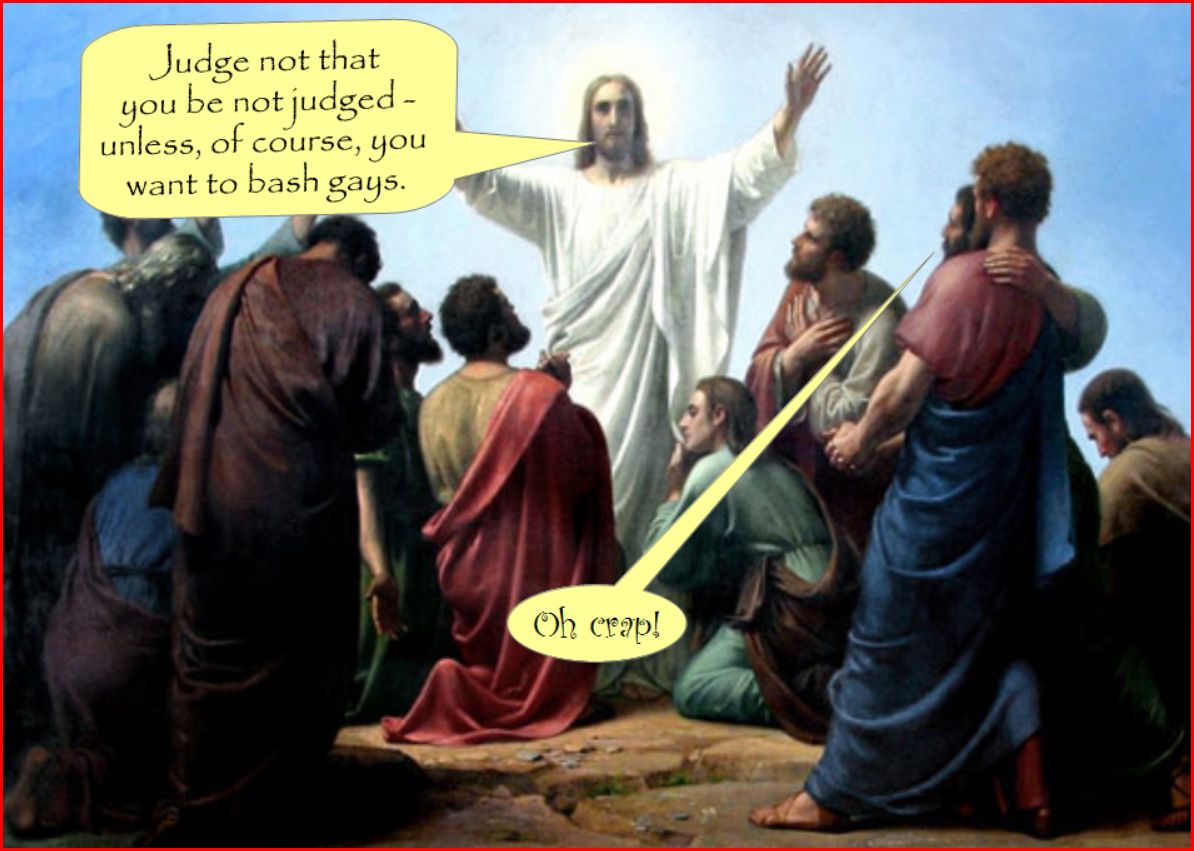
And what about ‘judge not that you be not judged’? Christians will tell you that this doesn’t mean they shouldn’t judge others, just that they should do it according to those same ‘biblical truths’.

This is not what Jesus is saying here though. He clearly means ‘do not judge others unless you’re prepared to be judged yourself’, which, we can only conclude, Christians are happy to have happen to them. They judge others and in so doing open themselves up to judgement; Jesus is very fond of this kind of yin and yang, measure-for-measure arrangement:

Judge not that you be not judged. For with the judgement you pronounce you will be judged, and the measure you give will be the measure you will get (Matthew 7.1-2).

It could also be the case that Jesus is referring here to God’s ultimate judgement as well, in which case those condemnatory Christians who believe that being ‘saved’ allows them to escape the final judgement are in for quite a shock. Still, they can always use the ‘I was only defending biblical truths’ excuse.

Christians’ Favourite Delusions 23: Jesus shows us how to live

Doctor

Was JC a great moral teacher?

No, the best things he said – do unto others, love your neighbour – had already been said eons before he came along. Some of the other stuff he came out with was ridiculously impractical – give away all you have; live only for today; turn the other cheek – that his followers have been unable to do from day one.

Did what he said about God turn out to be right?

No. He said God would establish his Kingdom on Earth while the disciples were still alive.

Did he commit himself to long-term responsibility for others and their needs?

Another no.

Did he experience the infirmities and difficulties of old age?

Nope.

Did he suffer from any of the serious illnesses we mere mortals are prone to?

Apparently not.

Did he give over his entire life to raising children or taking care of elderly relatives?

Not that we know of.

Did he have to work each day to earn a living?

No. He sponged off gullible female fans (Luke 8.1-3).

Did he have any understanding of science and of how the world works?

Erm, no. He thought people became ill because of sin and demon possession and that Heaven was in the sky.

Was he interested in anything but his own futile ‘mission’?

Yet another no.

Apart from his last few days did he know suffering, the everyday frustrations of life or the daily struggle to make ends meet?

Not so’s you’d notice.

Did he, in short, know anything of the life as it was lived and is lived by ordinary people?

Emphatically not.

There was nothing marvellous about Jesus. He was out of touch with ordinary people and at loggerheads with those cleverer than he was. He was a failed prophet who was turned into a supernatural being by those who came along afterwards – mainly Paul, who’d never met him – and is worshipped today by those who ignore most of what he said.


Christians’ Favourite Delusions 22: Jesus is gentle and humble

Humble

Without any humility, Jesus boasts in Matthew 11.29 about how gentle and humble he is. Let’s see how he qualifies:

He insists people should love him more than their own families (Matthew 10.37).

He says he’s not a peacemaker but intends creating strife (Luke 12.51).

He claims anyone who doesn’t follow him deserves to be burnt (John 15.6).

He wants the world to be destroyed by fire (Luke 12.49).

He commands people not to call others ‘fools’ (Matthew 5.22) but tells those he doesn’t care for that they’re ‘swine’, ‘dogs’, ‘snakes and vipers’, ‘whitewashed tombs’, and, yes, ‘fools’ (Matthew 7.6; 15.26; 23.33; 23.27; 23.17 & Luke 11.40).

He deliberately speaks in riddles so that people won’t understand him and won’t find forgiveness (Mark 4.12).

He tells his followers to love their enemies but says he’d have his own killed (Luke 19.27 & Matthew 13.41-42).

He endorses slavery and the cruel treatment of slaves (Luke 12.47-48).

He says people would be better off if they cut off their hands, plucked out their eyes and castrated themselves (Mark 9.43-48 & Matthew 19.12).

He endorses the Jewish law that demands the death penalty for those who disrespect their mother and father (Matthew 15:4-7).

He disrespects his mother (Matthew 12.48-49).

He tells people not to get angry but loses his own temper (Matthew 5.22 & Mark 3.5).

He callously kills a herd of pigs and, in a fit of pique, destroys a fig tree (Matthew 8.32 & Matthew 21.19).

He takes a whip to people (John 2.15).

He tells his mates he’ll soon be king of the world and promises them that they’ll rule alongside him (Matthew 19.28).

So, the marks of a gentle, humble man? Or the characteristics of an unpleasant, delusional megalomaniac?

The evidence is in front of you. You decide.


Let’s Play Pointless

statue

If anything underlines the pointlessness of religion it’s the Pope’s declaration this weekend that two of his predecessors are now ‘saints’.

It’s pointless because, according to the Bible, Pope John XXIII and John Paul II (not their real names) were already saints. Yes, truly. According to the Bible all believers are ‘saints’ (Romans 1.7, etc).

Pointless because the two of them are dead and bestowing sainthood on them does not affect their fatal condition in any way.

Pointless because the dead are of even less use than the living.

Pointless because the Catholic church’s many adherents already hold these ex-popes in ridiculously exalted esteem – witness the hundreds who turned out yesterday for Pope Frankie’s saint-making ceremony. It hardly matters that he bestows a further, dubious accolade on them.

Pointless because, when alive, both men presided over an obscenely wealthy organisation whose God directed his followers to sell all they had to give to the poor; an organisation that, during these men’s reigns, repeatedly covered up child sex-abuse by its priests, prohibited the use of condoms in Africa (thus aiding the spread of HIV), denied women control of their own bodies and regarded LGBT people as evil. How ‘saintly’ is that?

Pointless because it’s all dressing-up make-believe anyway.

In other news, a giant crucifix in Italy, erected in honour of Pope John Paul II, collapses and kills a twenty-one year old man. Surely this is a sign of… well, something. Sure to be. Maybe someone can tell us… God? Catholic commentators? Saint John Paul?