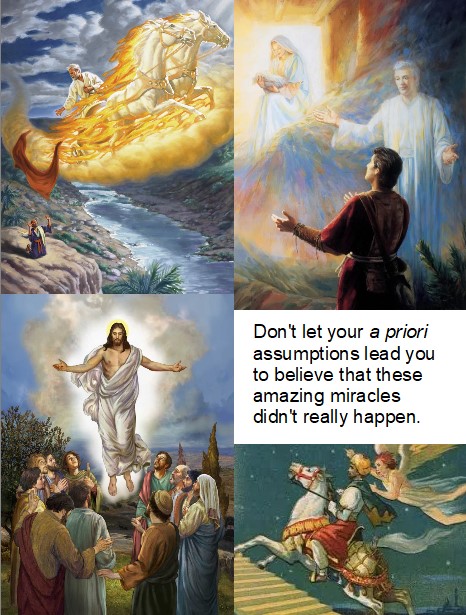
Either All True Or None True

About 2,500 years ago, a man called Elijah went up to heaven while still alive. He was taken through a whirlwind in a chariot of fire, pulled by horses of fire. This amazing event was witnessed by several other people who were profoundly affected by it. The story of this ascension was possibly relayed orally for many years until finally being written down in what is now 2 Kings 2.

Did any of this really happen?

Of course not. It’s a myth.

Some time in the 4th century BCE, the first king of Rome, Romulus, was taken, while still alive, to the dwelling place of the gods. From that time on he was worshipped as a god – some said he was eternal to begin with – with a temple being built in the very place from where he had ascended. Later he appeared to one of his followers, Julius Proculus who said the resurrected Romulus was larger and more beautiful than ever, armed with weapons shining like fire. Julius Proculus attested to this appearance of the resurrected Romulus, swore an oath to its veracity and relayed it faithfully to others.

Did any of this really happen?

Of course not. It’s a myth.

https://mythologymatters.wordpress.com/2019/04/18/easter-mythology-the-resurrection-as-modeled-on-greco-roman-myths/

It is not known when Mithras was born, if indeed he was. He emerged from a rock in the spiritual realm as a child or youth, ritually slaughtering a bull and sharing a banquet with the god Sol. He guided souls to the after-life, propelled as they were by the bull’s blood and flames. He was worshipped primarily by soldiers who saw him as their salvation from the bitterness of earthly life. There were rituals to be followed to become a true initiate and for Mithraic mysteries to be revealed. How Mithras made himself known to his acolytes is unknown, but in the first three centuries CE, his cult rivalled that of the Christians in popularity.

Did all of this really happen?

Of course not. It’s a fabrication, a myth.

In the 8th century CE, the prophet Muhammad flew from Mecca to Jerusalem on a winged equine. Once in Jerusalem he climbed a ladder to heaven. Once there he travelled through the various levels, having conversations with other lesser prophets, before entering Allah’s domain. His journey was later revealed to two early prophets who had known Muhammed when they were boys. They conveyed the details accurately until they were recorded, briefly at first in the Qur’an and later in more detail in its supplement, the hadith.

Did any of this really happen?

Of course not. It’s a fabrication, a myth.

In the early 19th century, Joseph Smith was visited by Jesus and his Father in a vision. They told him that he should not join any existing church because they were all in error. Later, a hitherto unknown angel named Moroni appeared to Smith and indicated to him where some gold plates were buried. He instructed Smith to dig up and translate the plates. Obediently, Smith did so, using a pair of seer stones for the translation. The resulting Book of Mormon was a revelation of Christ’s activities in North America following his resurrection. Smith wisely had a number of his associates witness, in writing, the existence of the gold plates as well as their supernatural provenance.

Did any of this really happen?

Of course not. It’s a fabrication.

In 1916 the Virgin Mary appeared numerous times to three poor Portuguese children, giving them instruction and prophesying to them. She also promised that she would perform a miracle at Fatima. Accordingly, between 30,000 and 100,000 people, including reporters and photographers, gathered at Fatima where many saw multi-coloured lights before the sun itself ‘danced’. It came closer to the Earth before zig-zagging back to its usual place in the sky. While not all of the attendees testified to the phenomenon of the dancing sun (some saw only the lights, others nothing at all) many did and testified to the effect the miracle had had upon them.

Did all of this really happen?

Of course not. It’s a fabrication based on hallucinations.

Around 30CE, a rabbi known as Jesus, who had been born of a virgin, gathered together 12 followers and went around Galilee preaching absolution from sin and the imminence of the Kingdom of God. He announced he was the Messiah who would rule the Earth when the kingdom arrived. The Jewish authorities took exception to his claims and petitioned the Romans to have him executed. This they did, only for Jesus to come back to life three days later, appearing in visions to his followers. He ascended to heaven, promising that those who believed in him would enjoy eternal life. Some of his disciples spread his message faithfully until it was eventually written down, first by a former Pharisee called Paul and then by four authors who accurately recorded what Jesus had said and done.

Did all of this really happen?

What do you think?

After the Gospels

None of the New Testament documents written prior to AD70 – those by Paul – contain any of the sayings, miracles or activities attributed to the Earthly Jesus in the later gospels. They don’t reflect anything of the oral tradition, first proposed in the 18th century. Those same gospels don’t reflect much of it either; the only ‘good news’ passed on by word of mouth was of a transcendent celestial Godman seen in visions. There is no evidence of any other. The later gospels incorporate the visions experienced by Cephas and others in their resurrection stories.

What then of the letters and books written after the appearance of the gospels? Do they reference, quote or base their teaching on the pre-crucifixion aspects of the Earthly Jesus of the gospels? Or do they, like Paul, concentrate solely on demonstrating the heavenly Jesus is the Messiah on the basis of what can be found in Jewish scriptures? You’d think that, with the gospels in circulation by then, that It’d be the former. But you’d be wrong.

Let’s make a quick survey of New Testament books post AD70. I’m taking their composition to be those listed here.

Hebrews (composed anywhere between 60 and 115 by unknown author[s])

Hebrews describes the Messiah as a heavenly high priest. Everything the writers ascribe to him is taken not from the gospels, nor an oral tradition on which the gospels are supposedly based, but from ancient Jewish writing; what we know as the Old Testament. Every single reference is from this source. Read the book for yourself and take note of the footnotes. Like gospel Jesus, Jesus the High Priest is constructed from snippets lifted from the Old Testament.

Revelation (composed anywhere between 70-110)

In Revelation, warrior Jesus has a lot to say, most of it quotations from the Old Testament. None of it is derived from the gospels nor the oral tradition on which the gospels are supposedly based. John’s ‘revelation’ is a fantasy constructed around ancient ‘prophecy’. Again, read the book for yourself and take note of the footnotes. Like gospel-Jesus, Jesus the Great Warrior is constructed from snippets lifted from the Old Testament.

1 Peter (70-100) and 2 Peter (125-150)

You’d think the letters purportedly written by the disciple Peter (or Cephas), the man who, according to the gospels spent three years with Jesus, would be full of his teaching, the mysteries he explained only to his closest followers, reports of his miracles or any of his other activities. But no. The best he can do across the two letters (written by two different people, decades apart, neither of them Peter the disciple) is this:

For we did not follow cleverly devised stories when we told you about the coming of our Lord Jesus Christ in power, but we were eyewitnesses of his majesty. He received honour and glory from God the Father when the voice came to him from the Majestic Glory, saying, “This is my Son, whom I love; with him I am well pleased.” We ourselves heard this voice that came from heaven when we were with him on the sacred mountain (2 Peter 1: 16).

Remarkably, this fake Peter recalls an event which never happened: when Jesus glowed like a lightbulb as two long-dead prophets beamed down from Heaven. It is, however, finally a reference to a gospel story. But then, doesn’t the author disparage ‘cleverly devised stories’ in this same passage? What else could he be referring to if not the gospels? We find a similar warning in 1 Timothy (and again in Titus 3: 9):

…command certain people not to teach false doctrines any longer or to devote themselves to myths and endless genealogies. Such things promote controversial speculations rather than advancing God’s work – which is by faith (1 Timothy 1: 4, written by a fraud pretending to be Paul).

These New Testament writers, even when they seem aware of gospel myths and their endless genealogies don’t approve of them. Perhaps that is why they prefer to ignore them, deriving proof of the Messiah from ancient Jewish scriptures instead. Every other reference to Jesus in the Peter epistles is from the Old Testament. How strange for someone pretending to know the man in the flesh.

We could go on to look at other books of the New Testament – for example, that written by ‘James’, supposedly Jesus’ brother – but this post is already too long. Rest assured if we did, we would see the same thing: none of the information about Jesus is derived from the gospels or the oral tradition on which the gospels are said by apologists to be based. There was no oral tradition, apart from stories of visions. The gospels are literary recreations – allegories – of those visions. They were not well received by the other writers of the New Testament who either ignore or disparage them. All that mattered to these early cultists were ‘revelations’ directly from the Lord and the Old Testament ‘prophecies’ that validated them.

An Anonymous Author Writes…

A little while ago I came across a group of enthusiasts who met locally to celebrate the chap who’d founded their group a few decades back. I paid them a few visits to see what they were about and when they learnt I was capable of stringing a few sentences together, asked if I would write a short biography of their Founder. Being an obliging sort, I said I would, not realising the challenges that lay ahead.

For a start, none of them had actually known the guy. He’d died soon after the group had started and none of the current membership had ever met him. Worse, they weren’t even sure what his real name was. Some said ‘Josh’, some ‘Jess’ and others ‘Manny’. They thought a guy who had known him was still alive, but couldn’t remember his name either. ‘Rocky’, they said, or maybe ‘Tiny’.

All the same, I’d said I’d have a go at the biography and didn’t want to disappoint them so I set about searching the Web. I soon discovered that both ‘Rocky’ and ‘Tiny’ had passed away, about the same time six or so years earlier. There was nothing online about any Rocky but there was quite a bit about Tiny. Or rather by him. He’d left a whole series of posts, mostly about he’d been contacted by the founder from beyond the grave. He said over and over that he could prove it really was the Founder he was channelling because, apparently, it said so in some old stories. He quoted these all over the place.

All weird stuff, but all I had to go on.

So I set to. I tried to make as much sense as I could of Tiny’s writing. I made stories out of his rambling, imagining what the Founder must’ve been like from the things Tiny claimed he’d told him. Like Tiny, I used old stories to fill out the narrative and included loads of metaphor. People love finding hidden meanings in things. I stopped short though at having the Founder come back from the dead at the end, not even metaphorically. Tiny insisted he had done but no-one in their right minds would believe it.

In the end, I thought I’d made a good job of it. The guys in the group thought so too. They were so pleased they suggested I publish it on Amazon, which I did. To my surprise, it started selling really well and got some very good reviews (and only a couple of poor ones.) To my annoyance, though, it wasn’t not long before a bunch of opportunists took to writing novellas about the Founder themselves, and (the nerve of it) lifting whole chunks of my story and ‘correcting the errors’! Errors? How could there be errors in something I’d made up? They even used my technique, lifted from Tiny, of borrowing bits from older books and making them fit their version. Their ‘Founder’ turned out to be different from mine, though not, I’m convinced, anywhere near as good.

I’ve decided I was going to retire from this writing lark. It’s too competitive and there are too many plagiarists around. Let them get on with their inferior sequels. Everybody will remember I was the first, and the best. Won’t they?

Mark and the Oral Tradition

Paul never refers to ‘the disciples’, the term used for Jesus’ inner circle in the later gospels. Instead, he refers to the founders of the cult as ‘apostles’ (literally ‘messengers’). Cephas is described as an apostle, as is Barnabas (Acts 14:14) and Paul himself. Paul defines the term more specifically as someone who has been commissioned directly by Jesus (1 Corinthians 9:1; Galatians 1:1-2). Evidently he himself was not: he encountered the risen Christ only in his head. He felt this was more than good enough. For Paul it was the only qualification anyone needed to be an apostle. He cites others who had encountered Jesus in the same way:

For what I received I passed on to you as of first importance: that Christ died for our sins according to the Scriptures, that he was buried, that he was raised on the third day according to the Scriptures, and that he appeared to Peter, and then to the Twelve. After that, he appeared to more than five hundred of the brothers at the same time, most of whom are still living, though some have fallen asleep. Then he appeared to James, then to all the apostles, and last of all he appeared to me also, as to one abnormally born. For I am the least of the apostles and do not even deserve to be called an apostle, because I persecuted the church of God. (1 Corinthians 15: 3-8)

What he goes on to say is crucial in understanding the nature of ‘the gospel’ that was in circulation in the years before Mark’s gospel:

But by the grace of God I am what I am, and his grace to me was not without effect. No, I worked harder than all of them – yet not I, but the grace of God that was with me. Whether, then, it was I or they, this is what we preach, and this is what you believed (1 Corinthians 15: 8-11; my emphasis.)

What they preached was their visions of a celestial Saviour. The witness of these visionaries of the risen Christ was the only gospel they knew and, Paul suggests here and elsewhere, the only one that was being transmitted orally when he was active. As we saw last time, he knew no other details of Jesus’ life, had none passed on to him and passed none on to others, except for these visions and the teaching he worked out from them – his ‘revelations’. Let me say that again: the visions of the risen Jesus were all he, Cephas and others knew. Paul says so categorically. There was no other ‘oral tradition’.

Paul builds his subsequent teaching on Jewish scripture, showing how his ‘revelations’ must be from the Christ because they comply with this scripture (even though he has to manipulate it to make it do so: in Romans 9, for example). Nowhere does he say he is referring to any history he has learnt, nor to anything passed on to him orally about Jesus’ teaching, ministry, life or miracles. Just the opposite in fact:

I want you to know… that the gospel I preached is not of human origin. I did not receive it from any man nor was I taught it; rather I received it (directly) by revelation from Jesus Christ’ (Galatians 1: 11-12).

About seven years after Paul’s death, a literate member of the one of the cult communities – known to us as Mark – decided to set down Paul’s teaching about the Christ in allegorical form. He tells us this is what he is doing several times in his gospel, including Mark 4:11-12:

To you has been given the secret of the kingdom of God, but for those outside everything is in parables, so that “‘they may indeed see but not perceive, and may indeed hear but not understand, lest they should turn and be forgiven’” (referencing and misquoting Isaiah 6:9)

Mark did not depend on any oral tradition for his information about Jesus’ life because apart from the ‘announcement’ built on Cephas’, Paul’s and others’ visions there was no oral tradition. Mark took Paul’s teaching and like him, used Jewish scripture as the basis for the story he developed from it. Thus, Paul’s ‘revelation’ of a bread and wine ritual (1 Corinthians 11:23-27) becomes the Last Supper (Mark 4:22-24); Paul’s teaching about forgiveness becomes Jesus’ teaching about forgiveness; Paul’s dispute with Cephas leads to a gospel Peter who is bungling and disloyal; Paul’s mention of The Twelve in 1 Corinthians becomes, with a miscalculation, the disciples; Paul’s instruction to obey the authorities (Roman’s 13:1) becomes Jesus’ (Mark 12:17); Paul’s, and Jewish scriptures’, promise of the spiritually blind (2 Corinthians 4:3-6) being helped to see becomes Jesus’ miracles of healing; Paul’s predictions about the end of the age (1 Thessalonians 4:15-17) become Jesus’ (Mark 13); Paul’s talk of the coming of the Christ in person (1 Thessalonians 4:13-5:11) becomes Jesus’ prophecies about the Son of Man appearing (Mark 14:61); Paul’s vision of the risen Christ becomes the resurrection. And on and on. There is nothing in Mark’s gospel that doesn’t derive from Paul’s teaching, and Jewish scripture in turn. it is, in short, made up.

All of this accounts for the absence of any resurrection appearances in Mark. His gospel ends with the discovery of the allegorical empty tomb and leaves off there because it is where his audience came in, as it were. They had been converted by hearing of the ‘appearances’ of the celestial Christ to Cephas and those Paul lists in 1 Corinthians. They already knew how the story ended or, more accurately, how it had begun: with those visions.

Later, Matthew, Luke and John would take Mark’s allegory and use it as the basis for their gospels, adding new, invented material of their own. The myth, in both the technical and popular sense, was born.

Christmas Quiz!

See how you do in this year’s Christmas Quiz. Most of the questions are related to subjects we’ve discussed during the year.

  1. Which of the events listed are literary realisations of so-called prophecies from Jewish scripture?

a) The virgin conception and birth

b) Bethlehem as Jesus’ birth place

c) Herod’s massacre of the Innocents

d) The ‘Holy Family’s’ flight into Egypt 

  1. Which of the events listed are metaphorical?

a) God’s insemination of Mary with Holy Semen

b) Pregnant Mary visiting Elizabeth, herself pregnant with the child she’d christen ‘John The Baptist’ (sarcasm, for those who can’t tell)

c) The visit of the shepherds with their symbolic gifts

d) The visit of the magi with their symbolic gifts

  1. Which of the events listed are sentimental and/or dramatic invention on the part of the gospel writers?

a) The archangel Gabriel visiting Mary

b) Joseph’s dream convincing him Mary hadn’t been sleeping around behind his back

c) The no room at the inn scenario

d) Jesus being laid in a manger

  1. Which of the events listed are historical fact?

a) The Roman census that entailed pregnant women trailing off to their husband’s ancestral home

b) The angelic host appearing unto shepherds

c) The Star of Bethlehem hovering over Jesus’ place of birth / home

d) Jesus’ birth occur during the reign of Herod the Great (died 4 BCE) and while Quirinius was governor of Syria (appointed 6 CE)

         5. What do the answers to questions 1-4 tell us about the rest of the      gospel stories?

a) They’re equally fanciful

b) They’re all metaphorical

c) They’re invented, largely based on ancient Jewish scripture

d) There’s nothing historical about them either

        6. What do the answers to questions 1-5 tell us about those who believe these stories to be factual and true?

a) They’re gullible

b) They’ve switched off their critical faculties

c) They believe whatever they’re told

d) They feel compelled to argue that all of the fanciful stories about Jesus are true


Answers:

  1. Which of the events listed are literary realisations of so-called prophecies from Jewish scripture?

All of them are based on what Matthew found in Jewish scripture and shoe-horned into his Jesus fantasy.

  1. Which of the events listed are metaphorical?

All of them. You don’t think such blatantly symbolic events really happened, do you?

  1. Which of the events listed are sentimental and/or dramatic invention on the part of the gospel writers?

Oh come on, what else could they be?

  1. Which of the events listed are historical fact?

None of them.

  1. What do the answers to questions 1-4 tell us about the rest of the gospel stories?

They tell us the gospel writers – Matthew and Luke as far as the Christmas stories are concerned – were more than happy to invent stuff for metaphorical purposes and to make it look like prophecy was being fulfilled when it wasn’t. If they were prepared to do this for the Nativity them why not for all of their other stories, the resurrection included?

  1. What do the answers to questions 1-5 tell us about those who believe these stories to be factual and true?

Yup, they’re all of those things. And they won’t be happy till they’ve inflicted their damn fool views on you too.

So how’d you do? Well done to everyone who got full marks. Try to do better next time the rest of you. It really wasn’t hard.

A very merry Christmas to both my readers. See you on the other side.

Parables

Jesus’ parables are analogies: similes or metaphors. ‘The Kingdom of heaven is like’; ‘there once was a man…’ Every one of the parables tells a story that didn’t actually happen. There was no literal Good Samaritan, no Prodigal Son or Sower. Jesus, or more probably the gospel authors, made up these stories to illustrate ‘mysteries’ (μυστήριον; gnosticism anyone?) What do they say about the parables? The majority appear in Matthew’s gospel, though Mark and Luke also include them. There are none in John. Did he, a supposed eye and ear- witness, not know of them?

Mark has Jesus say to his disciples:

To you has been given the secret of the kingdom of God, but for those outside everything is in parables, so that “‘they may indeed see but not perceive, and may indeed hear but not understand, lest they should turn and be forgiven’” Mark 4:11-12

Mark lets his readers in on the ‘secret’ (μυστήριον again) because there are mysteries within the cult, secrets available only to the initiated. Remember, the parables were written – they are almost certainly literary creations – 40 years after the cult was established. Only cultists would understand the secrets/mysteries embodied in the parables. Parables, Mark tells us, are intended to disbar those who are not spiritually attuned from salvation/the kingdom of God/eternity.

The word translated as parable also means ‘riddle’, designed to puzzle or obfuscate. But Mark doesn’t just say the parables are intended to do this. He says ‘everything is in parables’. What did he mean by ‘everything’? All of the teaching he attributes to Jesus? All of the episodes he relates? Could it be that the entire Jesus story, crucifixion and resurrection included, is one long, extended parable? A metaphor, if you like.

You bet it is.

Related:

Stories about Jesus

The Jesus Story v. Reality

Cruci-fiction

Inventing Jesus

The Bible as Metaphor (again)

A few days ago, Dennis and I visited Penrith, a small market town a short distance from the city where we live. What a delight it was to discover that the street preacher who plagues our city – the humourless Dale McAlpine – also inflicts himself on this smaller place. We so enjoyed hearing him bellow out, as we manoeuvered past his confederates handing out poorly written tracts, that we were all sinners – ye, everyone of us – bound for hell.

As we stopped at an ATM we heard Dale announce how Jesus healed lepers and cured leprosy, which patently he did not. He said Jesus’ healing of lepers was a metaphor for what he could do for us all, by removing our sin and making us whole again. His metaphor schtick – an sophisticated one for a simple street preacher – put me in mind of our very own Camp commenter. As Sunday school teacher Don frequently reminds us, the Bible is a) literature and b) largely metaphorical.

In case he’s forgotten and is arguing this week that we should view the bible’s stories as historical accounts (his other favourite tack), here’s what he actually said:

Much of scripture is the kind of literature in which metaphor and other kinds of figurative language is common… you are out of touch with the literary character of ancient literature.

I hope you all feel thoroughly chastised by this. I know I do. Don was taking exception to my post in which I itemised the Bible’s mythical creatures, talking animals and impossible events. So, I’m going to take him, and Dale at their word and take a fresh look at the Bible’s use of ‘metaphor and other kinds of figurative language’

First though, let’s understand that metaphor and figurative language are distinctly literary techniques. In literature and sometimes in speech, metaphors make subtle comparisons and bring to mind a host of associations that the author does not then have to explain. Outside of fiction, they don’t have much of a function. We don’t, for example, attribute metaphorical meaning to human events and interactions in the real world. The present war in the middle east is not a metaphor for something else, like, for example, the warfare that Christians believe rages in the Spirit world. Sleepy Joe Biden’s activity, or lack of it, is not a metaphor for the present condition of the USA (let’s hope not anyway). Our personal relationships are not metaphors for something grander. There is no metaphor embedded in actual events or real world interactions.

No. Metaphor exists almost entirely in literature. While the occasional non-fiction author might add a metaphor for flourish, strictly speaking, metaphor exists in and for fiction and poetry. More than this, when, in fiction, ideas are expressed metaphorically, it signals that the surface meaning is of lesser significance. It is the underlying or hidden meaning that matters. The fiction is the vehicle by which the metaphorical truth is conveyed. Don admits as much in his comment.

Let’s try some illustrations. The underlying metaphor of The Great Gatsby, its truth, is the dark underside of the American dream. Its surface story isn’t real; it is fiction. The metaphor conveyed through Moby Dick – the fictional whale as well as the novel as a whole – is the destructive nature of obsession. Again, as powerful as this is, none of the story that conveys it actually happened. Frankenstein’s central metaphor is the danger that uncontrolled science represents to humankind. The story that carries this message is, however, pure invention. In All The Light We Cannot See, Light is the metaphor, as it frequently is. The characters’ insights into truth are what the author seeks to convey. The fiction is the vehicle of that truth. Choose your own example: fiction embodies metaphor, the ‘truth’ of the story. But the story itself is rarely an actual event. Even when it’s based on one, as the movies say, the narrative is extensively fictionalised.

So, let’s go back to Dale’s leprosy metaphor. In several gospel stories, the authors have Jesus cure lepers precisely to illustrate how he can heal people of their inner leprosy: their sinful nature. Jesus almost certainly did not heal any lepers; this is the fiction. The creators of the gospels designed the story to carry metaphorical meaning, which, in this case, is that Jesus can heal us from sin.

Likewise the stories in which he heals the blind; the blindness is metaphorical. The saviour opens people’s eyes to spiritual truth. He didn’t really cure blind people; that is the fictional vehicle for the metaphor.

He didn’t turn water into wine; the writers of the fourth gospel wanted to convey the spiritual ‘truth’ that the new cult’s beliefs were superseding old Jewish ones; a metaphor was a memorable way to do it.

Lazarus was not raised from the dead; the story is a metaphor to illustrate how God will raise believers at the last day.

The Romans did not execute Jesus; it was the spiritual rulers of the age who, according to Paul in 1 Corinthians 2:8, put the saviour to death. The Romans are the metaphor for the wickedness of these supernatural beings.

Jesus did not rise from the dead. This too is a metaphorical fiction.

How did I do, Don? I’ve interpreted isolated periscopes from the gospels metaphorically. I’ve borne in mind that metaphor and other figurative devices are purely literary, techniques in fiction. I’ve channelled the literary character of ancient literature as defined by you (except of course you never actually do define it.)

You are invited to respond. I offer to post your comment, if it is as lengthy as I expect it to be. You must, however, keep to the point and resist making personal jibes. Choose any of the miracles, healings or pericopes from the gospels and demonstrate that they are real historical events.

It matters to you and to other Christians that the events of Jesus’ life did happen. That they’re not just the invention of clever writers who, taking inspiration from Jewish scriptures, created metaphorical events to convey higher ‘truths’. So persuade us that at least one miracle, healing or episode is more than a literary device, a metaphor for some fanciful theological ‘truth’. Provide the evidence that it really happened. Claiming the disciples witnessed the miracles or healing won’t cut it, when the disciples are themselves characters in the stories, and metaphorical at that.

How To Read The Bible

A step by step guide to reading God’s Word, courtesy of Don Camp.

Always read passages in context. This is the only way you can understand what they mean.

Synthesise different passages from a range of contexts so that collectively they say something else.

Read the Bible with all the discernment of a fifth grader.

Always take what is being expressed at face value.

Work out what the original author intended. (Note: ignore the Intentional Fallacy for this purpose.)

Scrutinise what the author intended until he says what you think he should say.

Because the Bible is made up of stories, poems and other literary forms, make sure you recognise the genre you’re dealing with and process it accordingly. (Note: different genres may be synthesised if it suits your purposes.)

Always assume that the improbable, implausible or ludicrous parts of the bible are metaphor, allegory or hyperbole.

Interpret metaphor and allegory in a way that eliminates their obvious ludicrousness.

Do not apply the metaphor/allegory principle to the gospels. The gospels are 100% historical documents, untainted by metaphor and allegory.

Ignore any of Jesus’ commands that are expressed as metaphors.

Dismiss any of Jesus’ more extreme commands – give away all you have, love your enemies, turn the other cheek etc – with the assurance that they’re hyperbole and/or metaphor.

Read the Bible like a first-century believer, even though the Bible didn’t exist in the first century.

On no account concede that Carrier, Ehrman or any other scholar with a book to sell has reached a far more valid conclusion than you have yourself.

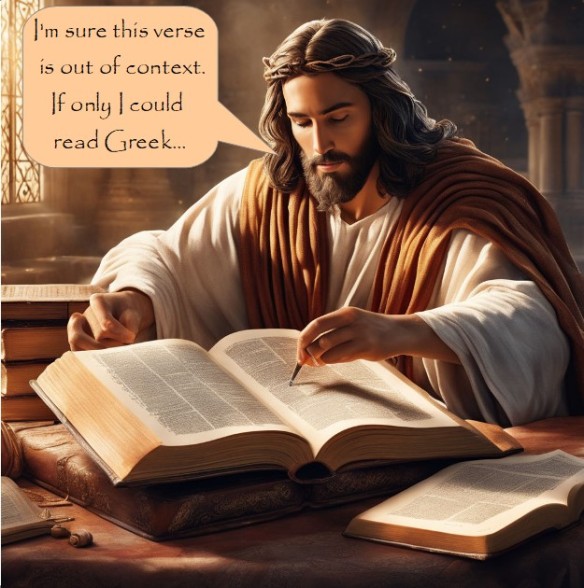
To appreciate fully the nuances of New Testament theology, learn Ancient Greek.

Above all, remember that cognitive dissonance is one of the most powerful tools at your disposal.

(Continues in similar vein for 86 pages.)

Thank you, Don. I appreciate how you’ve collected together the many and varied points you’ve made in your recent voluminous comments, synthesised them and presented them here to equip us to read the Bible the Don Camp way. I can’t help but think that, as a result, we’re all that much closer to a personal encounter with Jesus.

The Bible Is Fantasy

The Bible contains:

113 appearances of angels, usually interacting with human beings;

50+ visions, on which all of Christianity hangs: those of Daniel; Cephas and others who ‘saw’ the risen Christ; Paul and John the Elder in Revelation. 

21 supernatural dreams, including those experienced by Jacob, Technicolor Joseph, NT Joseph, the Magi, Pilate’s wife and Paul

Numerous apparitions and ghostly appearances, including that of the resurrected Jesus as well as Moses and Elijah and, in the Old Testament, the spirit of Samuel, conjured up from the grave by the witch of Endor.

Innumerable resurrections: not only that of Jesus but several Old Testament characters, and, in the New, Lazarus, Jairus’ daughter, the young man of Nain and the hordes who rose from their graves at the time of the crucifixion.

Multiple impossible astronomical events, ranging from the sun stopping in its orbit(!); a star wandering and hovering over a small house; a solar eclipse lasting several hours; stars that one day will fall from the sky; a God who lives just above the clouds and a ‘firmament’ between the Earth and the heavens that holds back water;

Several events in which nature is magically controlled: the parting of the Red Sea; Moses’ magician’s staff becoming a snake; the Nile turning to blood; Jonah being swallowed but not digested by a ‘great fish’ and Jesus calming a storm.

An abundance of fantastic beasts and fairy tale creatures: Giants (Genesis 6:1-4, Numbers 13:33); Leviathan the sea monster (Isaiah 27:1 etc); the Behemoth (Job 40:15-24); the Cherubim monsters (Ezekiel 1:4-21); the dragon and other beasts from Revelation

Many characters who are clearly legendary, from Adam & Eve, Noah, Lot and Abraham to Moses, Job, Daniel and gospel Jesus. Some of the Bible’s fictional characters lived to a literally incredible age: Adam 930 years, Seth 912, Methuselah 969, Noah 950, Abraham 175, Moses a pitiful 120. Jesus holds the record being now either 2,000 years old or eternal, depending on how you count it.

5 mythical places: Eden at the beginning of the book; New Jerusalem at the end; Heaven, the abode of God; Sheol the Old Testament place of the dead; Hades (Sheol mark II?) which Jesus visited while supposedly dead in his tomb (Acts 2:27, 31; Matt 16:18).

2 sentient ‘pillars’: one of cloud, one of fire (Exodus 13).

2 talking animals: the serpent in Eden and Balaam’s ass.

1 talking plant (Exodus 3:3).

0 science. No understanding whatsoever of what we now call astronomy, meteorology, germ theory, genetics, evolution, psychology… you name it.

So how do we read all of this? As the ancients themselves would, with an understanding of the world that regarded the supernatural, magic, miracles and monsters as real? We’re told often enough that this is how we should interpret scripture, not from a modern perspective. Perhaps we might credit the creators of the many books of the bible with greater skill, however, and interpret the inclusion of magic and miracle as allegorical or metaphorical; literary pieces, if you will. But then we have to decide which far-fetched stories are myth and which are historical accounts,. There really is no way to do this. A New Testament story awash with impossible events, implausible characters and symbolic tropes is every bit as allegorical or metaphorical as the same kind of story in the Old Testament (or, indeed, in Egyptian, Greek and Roman myth.) The reader who wants to see stories in the Old Testament as carefully crafted allegories has to concede that the Jesus narratives are of the same order.

It looks like we have to read the Bible as 21st century readers, because that is what we are. After all the Bible is supposedly a book for all time. We can, however, recognise the way in which its many creators saw the world – populated with fantasy creatures and subject to impossible events – and accept that they were wrong. Reality is not as they perceived it. What we cannot do is claim that the Jesus story is an oasis of truth in the midst of all this fantasy . 

Mr J: The Defence

Unfortunately, Mr J is unable to speak for himself so I have taken it upon myself to defend him. I’m going to prove to you he exists and that he loves us all.

The first thing I want to mention is how he created the Earth and everything in it in six days, about six thousand years ago. Or possibly not. It’s might’ve been billion years ago and it might have taken a very long time. Mr J would like to keep his options open.

In any case, he eventually created human beings, either on the sixth day or billions of years later. He quite probably controlled evolution to get to them, killing off billions of other creatures along the way just so humans could emerge. Some might say this was pretty heartless but it’s the only way natural selection could produce Mr J’s favoured creation. All a bit hit and miss, but Mr J knew what he was doing. I read it in a Richard Dawkins book some time.

Anyway, once humans appeared they managed to upset Mr J in some silly, insignificant way, so that he had to come up with a whole series of complicated plans to bring them into line.

The first plan was, admittedly, not all that great. It was necessary though. He drowned the lot of them, every man, woman and child, except for one old drunkard and his family. Needless to say the humans that came along after them weren’t any better than the ones who’d come before. No surprise there! Mr J rightly blamed the humans themselves for the shortcomings he’d built into them. That and the demons with their boss, Satan, whom he’d thoughtfully made right back at the start of the six days. Or maybe it was during the billions of years when he was creating everything by process.

Er… moving swiftly on, his second plan was that he’d just concentrate on one special group. He picked, for reasons best known to himself, a small, nomadic desert tribe. He demanded of those who had them that they should slice the tops off their penises. Weird, I know, but other tribes were doing it and Mr J thought if it was good enough for them and their fertility deities then it was good enough for his besties too. They also had to obey all 613 of the rules he would make up as he went along. This was to set a moral example to his Chosen People so naturally included instructions on how to beat their slaves, how to stone people to death and how to massacre their neighbours. Needless to say, despite how reasonable Mr J’s terms were, the useless humans couldn’t manage to comply with them. He was more than pissed. He let other tribes brutalise them, had them turn on each other and sent them into exile. But still they didn’t learn. You might think he’d have done better offering some encouragement, a little bit of positive enforcement, but you’d be wrong. Mr J always knows best.

The time rolled round for another half-arsed plan. This time Mr J sent a Figment Of His Imagination down to the Earth so the friends for whom he’d set such a good example while punishing them endlessly, could engineer his death. Or maybe it was the Romans who did it. Whatever, the story got around that after his execution this Figment had come back to life, which meant all sort of marvellous things would happen, including a complete reboot of the Earth. The old deal with its dick-docking and interminable lists of rules was over. There was a new deal now: believe it and you’d live forever: don’t and you’d boil forever in a fiery pit while demons tortured you for eternity.

Soon after this (because a thousand years is like a day to him), Mr J became something of a recluse. He removed himself from time and space – no more walking in gardens and masquerading as a burning bush – he would become… transcendent! He also announced, in a revelation to some churchy types, that he wanted, henceforth, to identify as a threesome. He insisted he be called ‘Daddy’, ‘Sonny’ and ‘Friendly Ghost’ all at the same time. It was a mystery why he…

Hang on. I just can’t go on with this. I mean, I know I’m supposed to be defending Mr J but when you see it written down like this, none of it makes sense. None at all. It’s rubbish and if this is what Mr J is all about, he can’t be defended. Not by anyone with half a brain anyway, and I like to think I have at least that. Mr J will just have to defend himself or, failing that, get someone without any critical faculties at all to do it for him.