A Reply to a Slave

I’ve discovered this new gizmo that lets me look stuff up on the Interweb. Goober or somesuch. I used it to find the meaning of ‘doulos’ that the absence of dictionary prevented you from doing. All of the results Goober brought up described doulos thusly:

Doulos (Ancient Greek: δοῦλος, Greek: δούλος, Linear B: do-e-ro) is a Greek masculine noun meaning “slave”. Wikipedia

Doulos (a masculine noun of uncertain derivation) – properly, someone who belongs to another; a bond-slave, without any ownership rights of their own. Biblehub (Christian site)

…anyone could become a slave, in a sense. However, once someone was sold into slavery, they remained a slave for life, and all of their offspring automatically became slaves as well. The only standard way of obtaining freedom was to earn enough money to pay your owner back as much as he had paid for you in the first place. This was a nearly impossible task to accomplish because slave owners did not often facilitate their slaves ability to earn money on the side. As such, most slaves, and their offspring remained slaves for the totality of their lives. Slavesandsons (Christian site)

Doulos is a Greek word in the Bible that has only one true historical option for accurate translation into English, which is slave. It literally means to be owned by someone for a lifetime. This word is found at least 127 times in 119 verses in the New Testament scriptures. It is used in the context of human slavery, which, sadly, was very common throughout the ancient Roman Empire for hundreds of years. Recorder.com (Christian site)

You’ll see none of them say what you say, Don. None think slavery was a nice amicable arrangement. Christian sites especially emphasise how slavery was a downright awful thing so’s they can sermonise about how Jesus saves us from slavery to sin.

If you’re going to reduce real world, God-approved slavery to something akin to a nice comfortable arrangement, you diminish the metaphor of Christ’s redemptive work to… not much at all. (Which of course it isn’t.) I noticed you didn’t comment on this point when I mentioned it in an earlier post and here you are digging yourself in deeper with your ‘slavery wasn’t really all that bad’. Good work, Don!

You’re certainly enslaved to all this Christian mumbo-jumbo. To Christ though, not really. There’s no such being and you certainly don’t give the impression of being a slave in any real world sense. Perhaps that’s because you have no understanding of what slavery was and is.

Myths and Endless Genealogies

I’ve been reading Richard Carrier’s recent post about Docetism. Docetism, as you’ll know, is the idea that the Christ’s human body was illusory. Carrier questions whether this idea existed as a belief system in ancient times; the term, he says, was invented by modern theologians to describe a few vague notions that appeared only towards the end of the 2nd century.

He finds no evidence for Docetism as a movement at any time and certainly not when the books of the New Testament were being composed. Along the way, however, he discusses 1 Timothy 1:3-4, written either in the late first or early second century (and therefore not by Paul who died in AD 64):

…Command certain people not to teach false doctrines any longer or to devote themselves to myths and endless genealogies. Such things promote controversial speculations rather than advancing God’s work – which is by faith. (My emphasis)

‘Myths and endless genealogies’: interesting. What could these myths and genealogies be? Where were they to be found? In what way did they promote controversial speculations? How did they deplete faith?

The ‘myths’ are mentioned again in 2 Timothy, also not written by Paul but by someone using his name, again in the late first or early second century:

For the time will come when people will not put up with sound doctrine. Instead, to suit their own desires, they will gather around them a great number of teachers to say what their itching ears want to hear. They will turn their ears away from the truth and turn aside to myths. (2 Timothy 4:3-4)

Not, you’ll note, ‘(they will) turn aside to false doctrines or heretical teaching’, which is how this verse is usually interpreted and applied by nit-picking evangelicals today, but ‘they will turn aside to myths‘. Some in the early second century church were being distracted by such myths – spurious stories about Jesus – and the writer(s?) of 1 and 2 Timothy feel compelled to warn against them.

The author of 2 Peter, who certainly wasn’t Peter/Cephas, issues a similar warning in his letter of 80-90:

For we did not follow cleverly devised stories when we told you about the coming of our Lord Jesus Christ in power, but we were eyewitnesses of his majesty. (2 Peter 1:16)

What can these myths have been? What ‘cleverly devised stories’ about Jesus were circulating in the late 1st century and early 2nd? There were no ‘Docetic’ texts at this time, no ‘Gnostic’ ones, none of the more far-fetched, downright weird gospels, which all appeared later.

The use of ‘genealogies’ in 1 Timothy is a clue. Which documents with ridiculously contrived genealogies were circulating in the churches of the late first and early 2nd centuries? We know of none – apart from Matthew and Luke’s gospels. Could the forgers of 1 & 2 Timothy and 2 Peter be referring to these? Did they object to the fictional backstory Matthew, Luke and Mark had created for their heavenly saviour? Were these the myths to which believers were turning to instead of gazing heavenward at the ‘majesty’ of the celestial saviour who was soon to come in power to the Earth, as 2 Peter 1:16 suggests?

It certainly could.

The Gospels and Other Fiction, part 2

The gospels were written as history. Their writers did not make things up.’

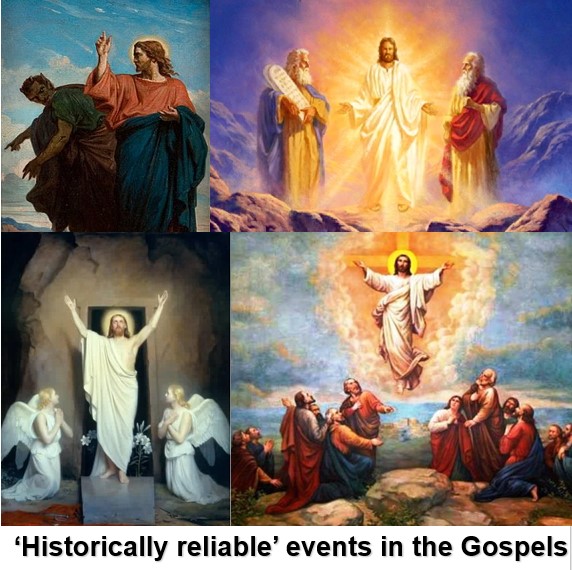
History, as koseighty has reminded us, is not littered with angels, devils, demons, spirits, apparitions, miracles, voices from the sky and resurrected corpses. Real history was being written at the same time as the gospels, by Josephus and Suetonius for example, who do not include the supernatural but do reference their sources, something the gospels never manage.

And of course the gospel writers did make things up. They invented numerous stories for Jesus to make it appear he is fulfilling prophecy (even when that ‘prophecy’ wasn’t prophecy to begin with.) This included making up ‘history’; Herod’s Massacre of the Innocents (a rewrite of a fiction about the infant Moses), the crucifixion eclipse, the rending of the temple curtain and more. These are all symbolic events. They didn’t really happen. Jesus’ own resurrection can safely be added to the list. It’s ironic that those who defend the gospel authors against the charge they made stuff up are the same who invent stories themselves: Mark and Luke knew each other? Mark proof-read Luke’s first draft? There were people who would fact check the gospels and point out any errors? But the original Christians wouldn’t do such a thing. Except they did.

There are no Inconsistencies, contradictions and inaccuracies in and between the gospels, but if there are, these are irrelevant. It’s the bigger picture that counts.’

Jesus is different in all four gospels. Despite Matthew and Luke’s plagiarising of Mark, they alter him to reflect the Jesus they believe in. John’s Jesus is so far removed from Mark’s that he’s a different character altogether. The inconsistencies do matter: did Jesus perform signs and wonders or not? Was he crucified on Thursday or Friday? Was it Peter, John or Mary who was first to see him resurrected? Did he hang around for one day or for 40? These conflicting details tell us that the creators of the Jesus story were more than happy to alter it when it suited their purposes. This is not how history is written. It is how propaganda is created. The ‘bigger picture’ is, in any case, made up of these smaller details. They work collectively and cumulatively to create the bigger picture. If we can’t rely on their being accurate how can we be sure the bigger picture is? When the gospel writers are unreliable in the smaller details, how can we be certain they’ve got the bigger picture right, given they’re all copying it from the same source, Mark, and giving it their own spin?

There is corroborating evidence of the gospels’ accounts’.

There is? Where? Just because there is some evidence that Nazareth existed doesn’t mean Jesus performed miracles, any more than Dunsinane castle’s existence proves Macbeth murdered King Duncan (he didn’t). Just because Pilate was a real historical figure doesn’t mean he crucified Jesus, any more than the existence of King’s Cross Station means Harry Potter catches his train there. And these, surely, are merely the small details. There is no corroboration at all for the bigger picture. Mention of the followers of Chrestus in Suetonius confirms at best that there were Christians in Rome at the time of Claudius, but no-one is disputing that. At worst, for the apologist, this curious reference has nothing whatever to do with Jesus. Later references to incidents from his story, by the much vaunted Church Fathers, are derived from the gospels and are therefore dependent on them. As such, they don’t constitute independent corroboration.

Everything Jesus prophesies or predicts in the gospels will come to pass, then sceptics will see that everything in the Jesus story is true.’

This one is from a commenter on Don’s blog. (I only went there by accident, honest.) The problem with this one is that everything Jesus is made to promise should already have come true, two thousand years ago. The Son of Man should have appeared in the sky with the heavenly host to usher in God’s Kingdom on Earth, while sending most of mankind to the fiery pit or outer darkness or some other damn place. Both he and Paul claimed that this would happen within their and their followers’ lifetimes. The trouble with Christianity is it is always winter and never Christmas. Its fulfilment God’s – God’s Kingdom on Earth, life after death, the final judgement – is always going to be at some indeterminate time in the future, a time and fulfilment that never quite arrives. It never will; part of ‘the big picture’ we can be confident we will never see.

More to come (unlike Jesus). 

The Gospels and Other Fiction, part 1

Christian apologists vigorously deny the idea that the Jesus story is fiction even though all of the evidence, both internal and external, points to the fact that it is. I’m not going to rehearse that evidence in this post (I address it in several earlier posts, including here and here, and there are always primary sources that, God forbid, defenders of the faith could read for themselves.) I’m interested here in looking at Christians’ defence of scripture as truth. What arguments do they have and better still, what evidence, that the gospels are historically accurate depiction of events in 1st century Palestine? Most of these arguments have been offered by our resident apologist, Don Camp, and although I’m fairly sure Don makes things up as he goes along, I’ll not reference other sources except where I’m introducing an argument he hasn’t offered.

Church Fathers believed the gospels were accurate, therefore, because they lived closer to the time of the gospels’ composition, they’re more likely to be right.’

Church Fathers, such as the unreliable Eusebius,, Papias, Clement, Ignatius and Polycarp were predisposed to believe the gospels were accurate; they had already converted to the faith and had a vested interest in seeing it promulgated and preserved. They were also steeped in the thinking of the age, typified by Paul and other NT writers, that the Earth was at the centre of a cosmic war between God and the forces of Satan. Above all, the Jesus story was theirs, a new revelation from God that didn’t, as far as they were concerned, belong to Jewish tradition or any other. It was new and it belonged to them: they wanted and needed it to be true. Later scholars, from the 19th, 20th and 21st centuries, did not come with these particular encumbrances and while of course not entirely free of prejudices of their own, considered the texts more dispassionately as history and found them to be wanting.

‘‘Mark’ is an accurate record of the disciple Peter’s time with Jesus.’

There is no evidence at all for this claim. Analysis of Mark (and also Matthew and Luke) demonstrates how the story is constructed around supposed prophecies from Jewish scriptures. Mark also incorporates much of Paul’s gospel to the Gentiles, a feature Matthew is at pains to ‘correct’. His Jesus is distinctly Jewish.

There was an oral tradition that accurately preserved the stories about Jesus until such time as they could be written down.’

There is no evidence that this tradition, if it existed, was accurate. It is, as Bart Ehrman shows in Jesus Before The Gospels, highly unlikely that it was. We know that stories conveyed orally are altered, embellished and modified with successive retellings.

There was an earlier document that preserved sayings of Jesus’ until such times they could be incorporated into the gospels.’

Then it simply vanished so that no fragment of it survived. The Church Fathers don’t appear to know anything about it. Wouldn’t such a priceless document have been preserved somehow, somewhere by someone? Q, as it’s called, is entirely hypothetical. It’s unlikely it existed. Even if it did, it is considered to have been a sayings gospel. It did not preserve details of Jesus’ life, death or resurrection. We’ll get to the so called ‘logia’ in part 3.

The gospels were written by eye-witnesses or associates of eye-witnesses.’

We know with certainty that this is not the case. All of them were written in Koine Greek and are carefully constructed literary creations. None was written in Palestine but much further afield and all reflect the concerns of the later cult. Over a hundred years after they were written, Irenaeus ascribed the names by which they are now known without any evidence that the authors were called Matthew, Mark, Luke or John. Later compilers of the New Testament didn’t even know of ‘Mark’s’ primacy, which is why ‘Matthew’s’ gospel appears first in the New Testament. ‘Matthew’ and ‘Luke’ are heavily dependent on ‘Mark’ (as is ‘John’ for its overall structure), an incongruous and inexplicable approach for Matthew to take, and John too, if they were eye-witnesses themselves. Eye-witnesses do not need to rely on the testimony of people who weren’t.

More next time…

Real Christianity v Catholicism

I visited a Catholic cathedral in Santa Cruz, Tenerife, while on my latest adventure. Not, I hasten to add, as a worshipper but as a tourist. One of the Canary Islands, Tenerife is a Spanish territory with a long association with Catholicism. Its name means Holy Cross, reflecting its history and the pervasiveness of the church. The cathedral’s altar can be seen in the picture above, highly ornate and completely over the top, with a statue of Mary, the Holy Mother, as its centrepiece. .Her son, you’ll note, plays only a bit part in the picture above her.

Real Christians™ of course don’t regard Catholics as true Christians. They point to their reliance on the Pope, when Jesus himself says his followers should call no-one Father apart from God; the army of dead saints that intercedes in heaven when all people really need is Jesus; the need to confess sins to a priest and the worship of Mary as the immaculately conceived ‘Mother of God’, who works miracles on their behalf.

People – Catholics – who believe these things can never be part of the club. ‘Their ideas are as ridiculous as they are unbiblical. No-one in their right mind,’ Real Christians™ say, ‘should believe such fanciful stuff. Stick resolutely to what we know to be true: the resurrection of a dead man; the Virgin birth and the promise of eternal life. These things are biblical and as such we can know and trust them. Not rubbish about saints in… erm, heaven living forever, having to ask for our sins to be forgiven and thinking Mary was conceived free from the scourge of sin.’

It seems to me that it’s only a short hop from believing one lot of far-fetched rubbish to believing still more. Maybe the Catholic stuff isn’t strictly biblical (though at a stretch it could be said to have been drawn from the make-believe found there) but then there’s nothing particularly special, plausible or reasonable about that which has found its way into God’s Word. Just because something is in there doesn’t make it true. Those who invented Jesus’ Virgin birth, his resurrection and the promise of everlasting life were making it all up, just as those who, further down the line, created the phantasmagoria that is Catholicism.

Santa Cruz is nice though.


Jesus: not worth the paper he’s printed on?

There is broad consensus amongst respected scholars that the Jesus of the gospels didn’t exist. This is hardly surprising. Gospel Jesus, as I hope I’ve demonstrated over the past few weeks, is constructed from fragments of Jewish scripture and Paul’s (and others’) visions and dreams. There is also good evidence, which I’ve not discussed, that some Jesus stories are recreations of legends and tales of other god-men (turning water into wine and the Road to Emmaus story*, for example).

All of which raises the question suggested by David Fitzgerald in Nailed, that if there was a real Jesus who was so incredible that he gave rise to an entire religion, why was almost everything about him invented? Why could his story not have been told as it was? Why didn’t his inspiring, dynamic personality speak for itself? Personally, I don’t care whether Jesus existed or not, but if the supposedly remarkable Jesus of history did once exist, he has been totally obscured by the stories, legends and myth that were constructed around him not long after he died. The celestial Jesus that today’s Christians claim to know personally, who they say inhabits their hearts while simultaneously living in heaven, is emphatically not the man who lived, but a myth. A different myth, even, than that of the New Testament. A non-existent star-man, waiting in the sky.

Jesus belongs with all those other heroes who may or may not have existed prior to their being turned into myth and legend: Abraham, Moses, Buddha, Confucius, Saint Nicholas, Robin Hood, Paul Bunyan. There is very little evidence, apart from stories and legends, that any of these figures actually existed. More, it’s entirely conceivable that Jesus belongs to a still different group of super-beings: those who were created as mythic characters, including but not confined to, Osiris (and the entire Egyptian panoply), Apollo (and all the Greek gods), Romulus, Circe, Attis, the angel Gabriel, Mithras, Aladdin, the angel Moroni, Superman, Harry Potter…

There is meagre evidence there was an historical Jesus who, even if he did exist, is now buried beneath layers of make-believe. The Jesus who has come down to us through the gospels and the rest of the New Testament is fictional. From his fairy-tale origin to his fantasy ascension and beyond, he’s completely imaginary.

I’m conscious I’ve written other posts making this same point. I find that, whatever starting point I take, invariably I end up here. Whether it’s ‘prophecy’, prayer, promises, miracles, the second coming, any aspect of the faith, none has any substance. They’re ineffectual, empty and have no bearing on reality. The character who supposedly embodies and promotes them becomes, as a result, similarly void. Either Jesus was transformed into a fantasy figure soon after he lived or he was imagined, by the likes of Paul, as a magical being to begin with. Whichever it was, from the earliest days of Christianity, there was no way for people to hear of or know about a man who actually walked the Earth.

*See Carrier, On the Historicity of Jesus: Why We Might Have Reason to Doubt, pp 480-81

The Walking Dead

Let’s take a look at another of the stories from the gospels. This time the miraculous rising from the dead of ‘saints’ at the time of Jesus’ death (or maybe at the time of his resurrection…): 

And Jesus cried out again with a loud voice, and yielded up His spirit. And behold, the veil of the temple was torn in two from top to bottom; and the earth shook and the rocks were split. The tombs were opened, and many bodies of the saints who had fallen asleep were raised; and coming out of the tombs after His resurrection they entered the holy city and appeared to many (Matthew 27:51-53).

Yes, it’s another case of Matthew making up a story from bits of Jewish scripture. We know it’s made up not only because of its fantastical nature, but because no-one else thought to record it; no eye-witness, no Roman official, no Jewish priest, no writer of Q. Not Paul, who says Jesus was the first to be resurrected; not even Mark, who doesn’t include it and therefore probably didn’t know of it; nor Luke, who omits it when he copies chunks of Matthew; nor John, who invents his own raising-the-dead story, the one about Lazarus.

So where does Matthew find his inspiration? There are many verses in Jewish scripture that declare YHWH will resurrect his people; Ezekiel 37: 12-14 for example:

Therefore prophesy and say to them: ‘This is what the Sovereign Lord (YHWH) says: My people, I am going to open your graves and bring you up from them; I will bring you back to the land of Israel. Then you, my people, will know that I am the Lord, when I open your graves and bring you up from them. I will put my Spirit in you and you will live, and I will settle you in your own land. Then you will know that I the Lord have spoken, and I have done it, declares the Lord.’”

And Isaiah 26:19:

But your dead will live, Lord; their bodies will rise – let those who dwell in the dust wake up and shout for joy!

Matthew ignores the fact that ‘prophecies’ like this are about the revival of the Jewish nation. He rips them out of context and creates his bizarre, Jesus-related story from them. Bizarre not only because of resurrected dead bodies, but because he has the tombs crack open as Jesus dies, only for the revived occupants to wait more than 36 hours to emerge from them. The poor buggers lie around in their tombs, alive again for a day and a half before they make it out into the outside world (Some scholars think the delay is an interpolation introduced by a later scribe who didn’t want the dead guys getting ahead of Jesus.)

Of course, the story is symbolic. It didn’t happen (though there are those who insist that it did); Matthew invented it, like most of his gospel. It’s another literary recreation of ‘prophecies’ from scripture, intended this time to show that Jesus was the Promised One who was about to bring about the great resurrection of the dead. The verses in their original context say nothing of the sort, of course. There’s no verse in the Jewish scriptures that does (though no doubt there are those who believe there is.)

So, yet another story, yet another symbolic fantasy. We could play this game endlessly: name the gospel story – the resurrection included – and it can be shown to have been created around lines lifted out of context from the Jewish scriptures.


,


This time it’s personal

Desperately searching for another reason to dismiss recent critiques of Christianity, Don has suggested that my views and those of commenters here are somehow invalid because they’re ‘personal’. (I declined to publish Don’s latest comment in which he elaborated on this theme; not only was he already on enforced rest but he also decided to have a rant about ‘sexual depravity’. This would appear to have been directed  at my own happy same-sex relationship, as well as all other forms of consensual sex that God Don disapproves of.)

So what’s wrong with ‘personal’? My faith, when I had it was personal. I’d prayed the sinner’s prayer in which I confessed I was a sinner and I received Jesus into my heart (or so I thought) and began to live my life in accordance with what he required of me. This personal relationship with Jesus, as it was usually described in evangelical circles, was reinforced by the preaching I heard in church, by prayer meetings and Bible studies, by the devotional books I read, C. S. Lewis’s writing and the notes I used alongside my personal Bible reading.

I’ve written before how I abandoned all of this when, in a time of crisis, God wasn’t there, and I eventually came to realise, in what I can only describe as a moment of personal revelation, that this was because he didn’t exist.

I then set about discovering what it was I had believed for the previous 30 years; what were these beliefs that had shaped my life, determining what I did, who I married, my morality, my sense of guilt and failure… essentially all that I was. That quest, which began with my broadening my reading well beyond the bounds of devotional Christian books (how treacherous I felt when I first picked them up!) was personal. It was fuelled by the reaction of some Christian friends who attacked me personally when, still later, I came out not only as an atheist but as gay too. My dealings with one particular zealous and homophobic friend led to my first book and ultimately, over 12 years ago, to this blog.

RejectingJesus is a personal working out of my love-hate relationship with Christianity. It is, I hope, informed by my reading but it is first and foremost personal. The posts are my analysis of Christianity as it is practised and my own dissection of the Bible. I’m not a historian nor a theologian (thank god); my Masters is in English Literary Research and it is these skills, together with my knowledge of the Bible from my Christian days, that I apply in my sometimes irreverent analyses. Nothing is sacred, though I’m aware of the importance of providing evidence for my claims and, where relevant, in citing appropriate sources, which is why I provide links and reference relevant verses from the Bible. Perversely, Don also accuses me of being in thrall to the scholars I cite; the opposite of his complaint that posts are ‘personal’.

Do I then, as Don implies, try to discredit the Bible because I’m gay? Am I, as Don suggests, motivated by the ‘constraints’ the Bible places on my sexuality? I don’t believe so. Once I recognised that God didn’t exist, it followed that he could not have any opinion about homosexuality or indeed anything else. Like any other fictional character, his views were created by those who presumed to speak for him: ‘I am so mysterious and my ways unknowable. Oh, but by the way, I really don’t like those depraved gays. Feel at liberty to stone them.’ God’s self-appointed homophobes have to be challenged because of the damage they do.

Am I as an atheist predisposed to being critical of both faith and the Bible, as Christian readers sometimes say? Undoubtedly, but I’m no more predisposed than as a Christian I was predisposed to see God everywhere. As Nan put it in a recent comment:

Any individual who allows him/herself to put aside the centuries-long teachings of Christianity … and read the scriptures without bias and/or preconception … cannot fail to see the multitude of inconsistencies.

Nor can they fail to see the Bible’s flights of fancy, its reliance on dreams and visions, its make-believe and pretend fulfilment of prophecy, its forgeries and false promises, its disconnect from reality and magical thinking, its supernaturalism and sheer cultishness. Critically evaluating scriptures at face value, without making excuses for them or trying to guessing what the original writers might have ‘intended’ or deciding that unpalatable parts are ‘really’ symbolic/metaphorical is, however ‘personal’, by far the more honest approach.

To insinuate with a personal slur that having ‘personal’ reasons for criticising Christianity is a weak ad hominem. It does not address the arguments in question nor the issues at hand. Anyone who wants to demonstrate that what I say about the Bible, Christian belief and practice is wrong needs to provide evidence of their own. Insult, screeds of Bible quotation and ‘a legion of “work arounds”’ (Nan again) is not how to go about it.


The Return of the Annual Christmas Quiz!

Back, due to popular demand! The annual Christmas quiz, last seen in 2014. Ten questions on Biblical trivia. Answers at the bottom of the page.

Good luck. You’ll need it.

1. Where did Mary and Joseph live prior to Jesus’ birth?

a) Bethlehem

b) Nazareth

c) Galilee

2. How did Mary conceive?

a) By the power of the Holy Spirit

b) She didn’t. It’s a story.

c) How’d you think?

3. What was the relationship between John the Baptist and Jesus?

a) They were second cousins

b) They didn’t know each other and didn’t meet until they were adults

c) Jesus originally belonged to John’s baptism cult

4, When was Jesus born?

a) When Herod I was alive

b) After Herod had died and Quirinius was governor of Syria

c) Perhaps he wasn’t

5. How did Mary end up giving birth in Bethlehem?

a) There’s no evidence she gave birth in Bethlehem

b) She and Joseph had to go there because of the Roman census

c) She lived there anyway

6. The Lord tells Mary to call her child

a) Jesus

b) Immanuel

c) Yeshua

7. Where did the family go following the birth?

a) They went home to their house in Bethlehem

b) Egypt

c) Nazareth

8. Who preserved the songs of Zechariah, Mary and Simeon (Luke 1 & 2)?

a) They were preserved orally word-for-word for 50 years

b) They were recorded in Q

c) They were created in their entirety by Luke, based loosely on Jewish scriptures

9. Where is the prophecy, quoted by Matthew (2:23), that Jesus would be called a Nazarene?

a) Micah

b) Isaiah

c) Nowhere: there is no such prophecy in Jewish scriptures or anywhere else

10. Which is the most unbelievable part of the nativity stories of Matthew and Luke?

a) a host of singing angels hovering in the sky

b) the wand’rin’ star

c) a virgin giving birth

d) Herod’s re-enactment of a story from Exodus

e) All the angelic visitations, dreams and visions that are needed to make the stories function

Answers:

1. Where did Mary and Joseph live prior to Jesus’ birth? All of the answers here are correct, so the Holy Bible say. According to Matthew, Mary & Joseph lived in Bethlehem. According to Luke they lived in Nazareth. According to Mark, it was known that Jesus hailed from Nazareth though he doesn’t say Jesus was born there. John refers to Jesus being from Galilee and acknowledges he comes from Nazareth (1:46).

Matthew and Luke insist Jesus was from Bethlehem to make him ‘fulfil’ the prophecy that the Messiah would come from there. Mark and John apparently don’t care.

2. How did Mary conceive? Matthew and Luke have the Holy Spirit do the deed. Matthew says merely that Mary ‘conceived by the Holy Spirit’, while Luke really goes to town with a ridiculous story involving an angel and Mary being orgasmic about the coming of the Lord. Mark hasn’t heard of either account, because neither had been invented, and fails to invent his own. John is only interested in Jesus as The Logos prior to his time on Earth. Actually, Jesus could only have been conceived by the only method we know that works: boy and girl hoochie-coochie.

3. What was the relationship between John the Baptist and Jesus? All are correct. Luke says Jesus and John were second cousins (1:36) and their mothers were close (1:56). The Gospel of John (1:31) says that John the Baptist didn’t know Jesus personally. Some scholars think Jesus was originally a member of John’s baptism cult.

4, When was Jesus born? a) and b) are both correct according to the gospels. Matthew places Jesus’ birth in Herod I’s reign, which ended when he died in 4BCE. Luke meanwhile dates it to Quirinius’ governorship of Syria, which was in 6 and 7CE. No wonder there are those who think Jesus may never have existed, so encrusted with myth and make-believe is he.

5. How did Mary end up giving birth in Bethlehem? The census is a contrivance to shift the birth to Bethlehem. There wasn’t a census of the kind described when Quirinius was governor of Syria, nor in 4BCE. Quirinius’ census was of property and would not have entailed the (mass) movement of people. Matthew seems to think M&J lived in Bethlehem all along. No-one else thinks so.

As the Bethlehem connection derives only from prophecy (Micah 5:2), it is likely Matthew and Luke located the birth there to show the ‘fulfilment’ of that prophecy. In other words, they invented it, as they do other ‘fulfilments’. It looks like a) is the only viable answer.

6. The Lord tells Mary to call her child… According to Matthew. Mary is meant to call the baby Immanuel, which, as the text helpfully informs us, means ‘God with us’. This is to make the story comply with Isaiah 7:14 which claims the Messiah will be called Immanuel. But Mary doesn’t call her baby Immanuel. She calls him Yeshua, meaning ‘God Saves’, which is not the same thing. How Matthew thinks this is a fulfilment of the Immanuel prophecy is anyone’s guess. When the gospels came to be written, Yeshua was rendered in Greek as Iesus and eventually in English as Jesus. Neither he nor his mother would have recognised this rendering.

7. Where did the family go following the birth? Again, all are correct according to the gospels. The family went on living in Bethlehem according to Matthew (2:7-11) but fled to Egypt according to Luke. Mark doesn’t appear to know either the Bethlehem or Egypt stories and refers only to Jesus coming from Nazareth.

8. Who preserved the songs of Zechariah, Mary and Simeon (Luke 1 & 2)? c) is correct. No oral tradition could possibly preserve the three carefully structured poems verbatim for 50 years. The hypothetical Q is conjectured to be a collection of Jesus’ sayings so the songs don’t come from there either. Luke or his community made them up.

9. Where is the prophecy, quoted by Matthew (2:23) that Jesus would be called a Nazarene? There is no such ‘prophecy’ anywhere in Jewish scripture nor in any extant writing: c) is correct once again.

10. Which is the most unbelievable part of the nativity stories of Matthew and Luke? That’s right. All of them are completely unbelievable.

How did you do? If you’re confused, don’t be. It’s the gospel writers who were. They made up stories about Jesus so that he complied with parts of Jewish scripture that seemed to them to be speaking of the Messiah. (John’s stories are a little different; they and Jesus’ tedious monologues were created to make him seem more like a Greek demi-god.)

Perhaps though I’m taking it all too literally, ‘like a fundamentalist’ as my self-appointed chief critic likes to say. I should perhaps accept it’s all just a metaphor, as he advises. Of course, when I do, he objects to that too; ‘A metaphor for what?’ he asks, forgetting he’s the one who believes the stories are ‘intended’ to be deeply meaningfully symbolic.

The muddled accounts arose as each gospel writers attempted to make an origin story for their hero based on scraps from Jewish scripture, Paul’s teaching and the emerging beliefs of their particular brand of the cult. They’d have got away with it too if some clever-dicks hadn’t decided, many decades later, to put their efforts side by side so their differences were laid bare for all to see: all the contradictions, inconsistencies, fallacies, anomalies and incompatible flights of fancy. Thank god the church kept their writings hidden away from most folks by preserving them in a language they couldn’t read.

That same critic will no doubt tell me I’m wrong again. ‘Everything happened as Matthew and Luke relate. There are no contradictions between them and the other two, Mark and John, had different priorities anyway.’ (See comments to this post here). He’ll tie himself in knots rather than admit the nativity stories are myth, as is everything that follows.

Have a happy Christmas, ya’ll. See you on the other side.


Miracles made to order

Mark makes his Jesus perform all the deeds the scriptures say will be performed by the Messiah. He doesn’t spell out that this is what he’s doing. He wants those who hear his gospel being read aloud (as it would have been to the cult’s members) to work it out for themselves: ‘he who has ears let him hear’ and all that.

This isn’t good enough for Matthew, however. He wants to make it obvious what’s going on, so he invents a story to draw attention to it. To do so, he has to have John the Baptist, who has previously acknowledged Jesus as the Messiah and heard God say as much from Heaven, doubt all of it. Matthew considers it worth it to make the more important point that Jesus is truly God’s Chosen One:

John (the Baptist) heard in prison about the works of Christ, and he sent his disciples to ask Him, “Are You the One who was to come, or should we look for someone else?”

Jesus replied, “Go back and report to John what you hear and see: The blind receive sight, the lame walk, the lepers are cleansed, the deaf hear, the dead are raised, and the good news is preached to the poor. Blessed is the one who does not fall away on account of Me.” (Matthew 11:2-6)

Matthew makes Jesus refer to several scattered verses from the scriptures that appear to say that once God’s Kingdom arrives on Earth the deaf shall hear, the blind see and the lame walk. Now you can believe, if you like, that Jesus really did make the blind see and the lame walk because the Kingdom had arrived (though -oops – it hadn’t!) or you can recognise that Matthew (and Mark before him) was aware of these references and made up a hero to embody them. Which is more likely, when every one of the miracles Jesus alludes to in Matthew 11 illustrates specific verses from scripture?

The blind see, the deaf hear, the lame walk (Isaiah 35:4-6) is brought to life in Matthew 9:27-31; 15:31-37 and 9.1-8.

Lepers cleansed: Leviticus 14 materialises as Matthew 8:1-4. The ability to heal a ‘defiling skin disease’ had long been thought to be a sign of the Messiah, so naturally Jesus has to be able to do it.

The dead rise: Daniel 12:2 is resurrected as Matthew 9.18-26.

The good news preached: Isaiah 52:7 becomes Jesus’ message.

A man called Jesus didn’t do these looked-for amazing things. These looked-for amazing things gave rise to a character constructed by myth makers: gospel Jesus.