Christian charity?

Blog367

Over at the distastefully named Cripplegate, Jordan Standridge has been considering what Christians should do when a homeless person asks for money. Jordan wants some means of weeding out the fakes (fair enough, though he doesn’t really have any clear strategy for doing this) and also attaches conditions to his giving – the recipient of his largesse has to listen to him ‘sharing the gospel’. Jordan reports that none of those he treats to a free meal object to him doing this – probably because they fear going hungry if they don’t listen to him droning on about Jesus.

Most of the comments following Jordan’s post betray the Christian eagerness not to have to follow the command of Jesus’ to give unstintingly. I felt moved to add one of my own:

It’s good that you’re considering ways you can help the poor and homeless, but Jesus says to ‘give to everyone who asks’ (Luke 6.30). ‘Everyone’ is a pretty inclusive! There’s no mention of ‘weeding out the fakes’; just give to all. Seems to me you’re hedging around this command.

This met with variety of responses, shown below in italics, followed by my replies:

Mike: By that logic, if a homeless person asks you for your home, are you then to sign it over to them? If they simply ask for your car, are you then going to hand them your keys? Of course not. That’s not what Luke 6 has in mind. Otherwise YOU would be left on the street naked and homeless simply because someone ASKED you for everything you owned…

You’re right, Mike – it’s completely absurd and unreasonable. But it’s Jesus’ absurdity and unreasonableness, not mine. If you want to say he’s wrong – as you do when you say ‘that’s not what Luke 6 has in mind’ (you know what it ‘has in mind’, I take it?) – then your dispute is with him, not me.

Jane: I believe your atheism qualifies you as the one having the dispute with Him.

Well, Jane, you’re the one who claims to obey him as Lord and Savior and yet here you are trying to figure out ways not to. It brings to mind another of his sayings from Luke 6: ‘Why do you call me “Lord, lord,” and not do what I tell you?’ Why indeed.

Craig: The passage in Luke 6 is not instructions for the body of Christ. In the gospels Jesus has come to Israel as their Messiah to bring in the kingdom that was promised to them. Jesus is telling them how it will be if they accept Him as Messiah.

It’s not, Craig? How’d you know?

What you’re really saying is ‘we Christians don’t much care for this commandment, so we’ve decided it doesn’t apply to us.’

However, if we were to go along with your argument, that Jesus is not addressing the ‘body of Christ’ here, then it follows neither can he be addressing it anywhere else in the gospels. You can’t simply delete the bits you don’t like.

4CommenceFiring4: “Give to everyone who asks” doesn’t specify what to give, or how much. The other commands–like going the second mile or giving them your cloak when they ask for your shirt–has to do with attitude, not mathematical formulas.

The Jews asked Jesus for a “sign” that He was the Christ. Did violate His own standards by not providing a sign? If you think He did, then it would be fruitless to get into the subject any further.

Really? It’s to do with attitude not action? Who says so? I thought the Bible was the literal word of God, meaning Jesus’ commands here should be taken at face value. Thanks for enlightening me; I’m relieved to learn there’s enough wriggle room not to have to do what Jesus says.

Oh, and according to John’s gospel, Jesus provided numerous ‘signs’ for ‘the Jews’ (which he was himself, of course.)

4CommenceFiring4: “The Bible is the literal Word of God” is the claim of someone–believer or otherwise–who hasn’t thought much about what that even means. There are theological debates by serious people about that, so don’t think for one minute that because “literal” means different things to different people means it doesn’t mean anything and we can go merrily on our way thinking we have nothing to which we owe our attention.

A devotion to strict literalism would lead to ridiculous conclusions, as you well know, so if you intend to use that as a defense for why the Bible isn’t to be taken seriously, try again. Smarter people than either of us have devoted their lives to debunking it, and it’s still standing long after they faded away. So don’t waste your time with that empty pursuit.

The bottom line is, are you ready for what comes next? And are you sure? It’s a bet you can’t afford to get wrong. Examine that, and everything else is secondary.

Great stuff. The ingenuity and effort that goes into avoiding doing what Jesus clearly commands is truly impressive.

Am I ready for what comes next? Sure. Oblivion never hurt anyone.

*****

Meanwhile, the homeless go on being homeless and Christians continue to demonstrate that the people who get the most out of their ‘discipleship’ is primarily they themselves.

Proof of God

Blog364

Amateur apologist and C. S. Lewis wannabee, Don Camp, makes the argument that as human beings have always believed in gods (have they?), it must mean that gods exist. They – or at least one of them – must have planted an instinct for worship within us from the outset. Don, of course, feels it is ‘self-evident’ that the god he believes in (the Christianised version of the Jewish tribal god, YHWH) is the One True God and consequently the deity who imbued us with the god instinct. Eventually, after millennia, during which humans misdirected their god-instinct to create thousands of false gods and imaginary supernatural beings, this One True God revealed himself and made known his expectation that he be acknowledged as the only God.

Where to begin?

It is not ‘self-evident’ that the tribal god of ancient Jews is the One True God. It is not ‘self-evident’ that this god exists while all the other gods humans have created (current estimate: 28,000,000) do not. The people who created these other deities were equally convinced they existed. Some had texts setting out the expectations the gods had of their human acolytes; most had rituals and forms of worship that had to be adhered to; they had experts – priesthoods – who knew exactly what the gods required; many encouraged adherents to serve the gods in their daily lives.

These other deities were every bit as ‘real’ as YHWH. There is nothing that singles ‘him’ out from them; nothing that makes him any more real than they were. He is indistinguishable from them in every way. It cannot be argued that they don’t exist, while, ‘self-evidently’, the Christian god – a very late arrival on the scene – is real.

What of the god instinct then? Where does it come from if not from the gods themselves? As others have argued (Dawkins and Harris, for example) it appears to be a misfiring of our need to know. The ancient peoples who devised gods to explain their world were doing their best with what little knowledge they had. Attributing agency to the activities of nature is an understandable mistake to make. Early people had first-hand experience of human agency and it was not an unreasonable assumption that agency must therefore lie behind other phenomena. We know that very early religions did precisely this in respect of animals, weather and the stars (animism; while astrology, in which celestial bodies control human behaviour, survives to this day.)

We now know, however, that such attribution was wrong. Inanimate phenomena do not possess agency. They do not possess it because they are not cognitive beings; any cognition we think we detect is our own, reflected back at us. The entities earlier humans created to explain what they took to be the purposeful activities of nature had no independent existence.

Our imaginary creations have no counterparts in reality; none of the 28,000,000 gods that humans have conjured up have actually existed. Is it reasonable to assume, then, that one of these otherwise imaginary beings really does? That YHWH is the exception; the one god, who, just because we’re more familiar with him than any of the other 27,9999,999 deities, is one hundred percent real?

What do you think?

Try praying

TryPraying

I was in Edinburgh recently and spotted posters, like the one above, on the backs of buses, advising people to ‘try praying’. There is, naturally, an entire web-site devoted to the campaign, created by Christians with more money than sense.

Here’s a thought: try praying that the bus on which one of these ads appears waits for you as you run for it and it pulls away from the stop. You think that would work? (No more than chance would allow.) Or try praying that if you do catch it, the driver will let you on, even though you’ve left your purse at home and can’t buy a ticket. Try praying that the pain you’ve experienced all day be taken from you as you set off walking home. Try praying for or about anything and see what God’s response is. Prayer, ‘tried’ or not, is no more effectual than wishful thinking or chatting with the fairies at the bottom of your garden.

Blog362a

(fixed it)

While in Edinburgh, I visited St Giles’ cathedral in the centre of the city. A friend I was with wanted to see a commemorative plaque there and I saw a chance to rest my aching legs. At the entrance was a sign that said the cathedral welcomed a donation of £5 ($6.55) per visitor to help with daily running costs. Evidently the ecclesiastical administrators haven’t realised they could ‘try praying’ and ask God to fund a building, the sole purpose of which is to honour him. Or perhaps they had ‘tried’ prayer and had discovered God wasn’t willing to provide the hundreds of pounds needed every day to keep it going.

Whichever, the only way churches like St Giles can survive is to have those humans who think they serve some meaningful purpose, fund them themselves. God couldn’t care less whether they flourish or not. If he did he’d keep them going from his abundant supply. That he doesn’t demonstrates not only his non-existence but also tells us that the church is an entirely human enterprise. Without human effort, and liberal amounts of filthy mammon, they invariably fail.

Jesus, Simon and me

Blog357a

It took me long time to accept who I was. Most of my life, in fact. When I was in my late teens, I had a relationship with a young man the same age as myself. This was illegal at the time as the age of homosexual consent in the UK was 21, remaining so until the late 1990s when it became 18. (In 2004 it was finally made the same as heterosexual consent: 16.) We didn’t care. We had a lovely time and I for one was very happy. I think Sam was too. We lost touch eventually as life took us down different paths.

Not long after, I fell in among Christians. A friend – let’s call him Simon – thought it would be a good idea if we started going to the YMCA. This was long before the organisation became synonymous with the Village People and hangin’ out with all the boys. The YMCA I encountered was markedly evangelical. Once we’d visited a few times we were ‘invited’ to one of their young people’s meetings. I can’t remember what snappy title these meetings went by, but essentially they were a mixture of worship, bible reading and ‘teaching’. Sometimes there’d be a guest speaker who would tell us all about their relationship with Jesus, which, in case we had any doubts, was just marvellous. Before long I was giving my life to Jesus too, though in the long run it turned out to be only a temporary loan.

Occasionally, one of these guest speakers would talk about relationships, those with other human beings, and sex. From them I learnt that sex was almost always wrong: sex before marriage, sex outside marriage, sex with yourself – all of them were sinful. Even imagining sex and fancying someone (which qualified as lust) were wrong too. Who knew? But the most sinful, wicked and sordid sex of all was sex with someone of the same sex.

It didn’t seem it to me. The encounters I’d had with Sam were far from sordid and not at all evil. On the contrary, they were a lot of fun! But these people, these Christians, seemed to know what they were talking about. And hadn’t I given my life to Jesus? He detested homosexuality, or God did anyway, so Jesus must’ve felt the same way (actually this was all in the present tense, Jesus being alive and monitoring us from Heaven and all; Jesus detests homosexuality, they’d tell us.) Sometimes they’d read verses from the bible that proved it.

And so I started to suppress my feelings. They’d kinda got me in trouble anyway, when my body betrayed me in the showers after gym at school. Other boys would torment me about it. I wasn’t actually ‘out’, as we’d say today, and terms like ‘queer’ and ‘poof’ (the British equivalent of ‘fag’) were bandied around as general insults – they didn’t necessarily mean anyone actually thought you were gay. Nonetheless, they came a little too close to comfort. All things considered, a retreat to the back of the closet (not that I knew this terminology then either) seemed the best option. It was what Jesus wanted, or so I thought. I started to deny myself for him, as he insists his followers do, and began a life of self-deception.

Which would’ve been fine, except it’s impossible to live a lie in isolation. Others invariably become involved.

Enter Jane…

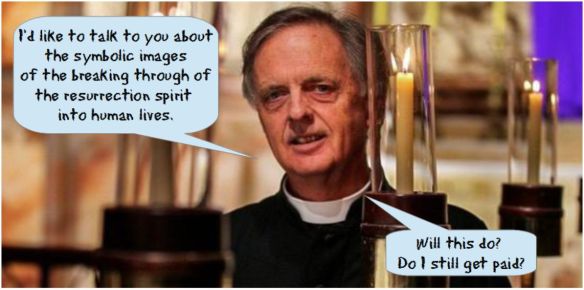
Anglican minister almost gets it right Shock

blog352

There was controversy last week over the appointment of Dr John Shepherd as the Archbishop of Canterbury’s new ambassador to the Vatican. The controversy wasn’t about the fact one branch of Made-up Beliefs was mingling its Sacred Truths™ with the Sacred Truths™ of another (which was upsetting enough for some of the faithful) but that Dr Shepherd has previously declared Jesus did not rise physically from the grave. In his 2008 Easter sermon, he said:

The resurrection of Jesus ought not to be seen in physical terms, but as a new spiritual reality. It is important for Christians to be set free from the idea that the resurrection was an extraordinary physical event which restored to life Jesus’ original earthly body.

Well, heaven forbid Christians should be compelled to accept reality! Needless to say, many of them didn’t like being made to do so. Undaunted, however, Shepherd went on to explain how the belief in Jesus’ resurrection came about:

…Jesus’ early followers felt His presence after His death as strongly as if it were a physical presence and incorporated this sense of a resurrection experience into their gospel accounts.

Yes, absolutely! This is precisely what happened. I’ve written about it here. This guy’s good. Until we get to his conclusion, anyway:

But (the gospels) are not historical records as we would expect history to be written today; they are symbolic images of the breaking through of the resurrection spirit into human lives.

He’s right about he nature of the gospels, of course. They’re not historical, nor are they eye-witness accounts or even second-hand reports of eye-witness accounts; they’re propaganda, written ‘so that you may believe’ as the fourth gospel  puts it.

But what’s this ‘symbolic images of the breaking through of the resurrection spirit into human lives’, Shepherd talks about? Having a good grasp of how the stories of Jesus’ ‘resurrection’ came about, he wants, for some reason, to continue promote the underlying fantasy – it’s his livelihood, after all – so he has to dress it up as something relevant to people today. He goes for ‘images of the breaking through of the resurrection spirit into human lives’, whatever that means. Breaking through from where? And what’s a ‘resurrection spirit’ when it’s at home?

Why bother though with the Jesus stuff at all? Plenty of people have life-changing experiences without having to hitch them to an ancient cult. My advice to Dr Shepherd would be to dump the ‘breaking through of the resurrection spirit’ hokum and he’ll be pretty much there. Then he can work on getting a real job.

Thou shalt worship False Idols

Blog335Trump

Franklin Graham was in England over the weekend, to preach at Blackpool’s presumptuous ‘Festival of Hope’. There was considerable opposition to his presence from, amongst others, the town council and local churches. One objection in particular stood out: Nina Parker, a minister at Blackpool’s Liberty church said –

(Graham) seems committed to condemnation, discrimination, walls and prejudice in a way that Jesus never was.

‘In a way that Jesus never was?’ Has Nina read the gospels? I feel sure she must have done – and yet, she, along with many others, still sees a Jesus as a beautiful soul, full of love, kindness and forgiveness. Many Christians, like Nina, don’t let the evidence (such as it is) interfere with their own inaccurate construct(s) of him. Their reading is coloured by their preconceptions to such an extent they can’t see that, while he may occasionally pay lip-service to being nice, Jesus is, as we saw last time, actually a bit of a shit.

Should you doubt it, there’s his

advocacy of cruelty and self-harm –

If anyone causes one of these little ones – those who believe in me – to stumble, it would be better for them to have a large millstone hung around their neck and to be drowned in the depths of the sea. (Mattthew 18.6)

enthusiasm for destruction –

I have come to bring fire on the earth, and how I wish it were already kindled! (Luke 12.49)

disrespect for life and propensity for violence –

If a man abide not in me, he is cast forth as a branch, and is withered; and men gather them, and cast them into the fire, and they are burned. (John 15.6)

disdain for non-Jews –

(Jesus said) “I was only sent to the lost sheep of Israel.” The woman came and knelt before him. “Lord, help me!” she said. He replied, “It is not right to take the children’s bread and toss it to the dogs.” (Matt 15.24-26)

exclusion of those who would follow him –

And He told them, “The mystery of the kingdom of God has been given to you, but to those on the outside, everything is expressed in parables so that, “‘they may be ever seeing but never perceiving, and ever hearing but never understanding; otherwise they might turn and be forgiven!'” (Mark 4.11-12)

contempt for those who don’t subscribe to his ‘good news’ –

it will be more bearable for Sodom and Gomorrah on the day of judgment than for that town (that isn’t interested in his message.) (Matthew 10.15)

contempt for those who do –

So you also, when you have done everything you were told to do, should say, ‘We are unworthy servants (slaves); we have only done our duty.'” (Luke 17.10)

delusions of grandeur –

Jesus said to them, “Truly I tell you, at the renewal of all things, when the Son of Man is seated on the throne of his glory, you who have followed me will also sit on twelve thrones, judging the twelve tribes of Israel. (Matthew 19.28)

Is this the Jesus Nina Parker speaks of, the one with no time for ‘condemnation, discrimination, walls and prejudice’?

Hardly.

Nor do Christians reserve such cherry-picking for their saviour. Many of them make the same allowances for Donald Trump, proclaiming him to be God’s choice for president because he’s anti-abortion, anti-LGBT and makes the right noises about Christians’ religious liberty (and no-one else’s). Trump’s corruption, dishonesty, pettiness, serial adulteries, misogyny and self-obsession, together with the absence of any behaviour that might reasonably be considered ‘Christian’, are ignored, excused and dismissed; he couldn’t be a Man of God with characteristics like these – and a Man of God of God he most definitely is: Franklin Graham says so.

Turning a blind eye to the many obvious faults of their heroes is something Christians have always been good at, making false idols of Trump and Jesus alike.

Hearing Voices

Blog331Moses

I’ve been having a little exchange with the super-spiritual Don Camp over on Debunking Christianity. Don is convinced that the Holy Spirit speaks to him directly. He argues that all true Christians™ can hear the Spirit inside their heads, and seems to think this direct contact is as important as, possibly more important than, what it says in God’s Holy Word®.

There are, of course, many Christians who disagree with him, who think hearing voices in your head is flirting with demonic deception and apostasy (Yes, we’re in pot and kettle territory, but isn’t this what internecine squabbling is all about?) Don says he knows it’s the Spirit who talks to him, however, because what it has to say is in keeping with ‘the tenor’ of the New Testament. Here’s how the discussion went, with my contribution in italics:

Don’s opening salvo: Actually, if you ask people who do have God speak or if you look through the Bible and read the experiences of those to whom God spoke, it is rarely that the Spirit speaks what we want to hear. Do you think Paul want to hear that Jesus was lord? Do you think Abraham wanted to hear God tell him to sacrifice his son? Do you think Moses wanted to hear God tell him to return to Egypt? Do you think Jeremiah wanted to hear God’s message of destruction for Jerusalem? Or Jonah that he was to go to Nineveh? Or Isaiah that he musty preach, but no one would listen?

That in fact is one of the tests. If the “voice” tells you what you want to hear, be careful.

Me: Just reading over on Friendly Atheist of the guy who said the Lord told him to behead his partner because she didn’t repent. It doesn’t say whether he ‘wanted’ to hear this or not, but he went ahead anyway. Luckily for him (though not his partner) there were some bible verses that confirmed what the Lord had told him direct.

This the kind of thing you’re talking about, Don?

Don (below): Nope (a good solid argument! John Loftus threatened at this point to ban Don from Debunking Christianity as he’s had enough of his proselytising and lack of argument. Consequently, after another question from me, Don answered more fully.)

Me: Why not? Why is the voice in your head the real deal while this other nutjob’s isn’t? How can you possibly distinguish? He had bible verses to support what he thought the Lord was telling him, just like you do.

You see, Don, there is no way to distinguish between the two because, like yours, the Lord whispering in this guy’s cerebral cortex is exactly the same as the one whispering in yours. They’re both the product of brains suffering from a surfeit of religiosity.

Don:How can you possibly distinguish?’

Pretty much everyone can identify self-talk. No Christian mistakes the Spirit speaking with self-talk.

‘He had bible verses to support what he thought the Lord was telling him, just like you do.’

It is not simply a matter of finding a verse somewhere and yanking it out of context so that it can mean whatever you wish. That is superstitious and dishonest to the Bible. The question is whether what you feel the Spirit saying to you is is in conformity to the general tenor and tone of Scripture and in particular with the general tenor and tone of the New Testament. I say that because the general tone and tenor is incomplete until we come to the New Testament.

In the case you refer to, I cannot find anything in the New Testament that would allow beheading anyone for any reason. Rather I find a lot that tells us to love our enemy and to love the sinner, repentance or not.

Find me one place where Jesus said anything that would allow one of his followers to take another person’s life. What he said was love others, love the sinner, treat with kindness those who disrespect and even purposefully misuse you.

Find me one place where Paul said anything that would allow a Christian apart from acting under the authority of the state to take another’s life.

Both he and Jesus allow that an unrepentant person who claims to be a follower of Jesus might be excluded from the fellowship of Christians. But nowhere is there any warrant for beheading anyone anywhere.

The person who finds such warrant is misreading and misusing the Scripture

Me: ‘Pretty much everyone can identify self-talk. No Christian mistakes the Spirit speaking with self-talk.’ Though not, apparently, the guy who decapitated his partner. How about the preacher (Steven Anderson) who says the Spirit tells him LGBT people should be executed? Or those who say this self-same Spirit tells them to welcome gay people? Why does the same ‘Spirit of Truth’ provide such contradictory messages?

I feel the Spirit telling me right now, Don, that the voices in your head are nothing more than self-generated delusions.

As for New Testament verses (why you suddenly excluding the blood-soaked Old Testament?) that advocate violence, how about Matthew 10.34-36 where Jesus says he came to bring not peace but a sword? Or Matt 3.10-12 where he says that those who bear bad fruit will be ‘cut down’ and burned ‘with unquenchable fire.’? Or Matt 5.25-30 where he advocates cutting off hands and gouging out eyes when they ‘offend’? There are many more such verses attributed to Jesus; violence is easily justified with the words of your ‘peace-loving’ fraud, Don.

As for Paul, how about Romans 1.31-32 or 1 Thessalonians 1.10? Do you ever read this damnable book for yourself, Don, or do you just rely on hearing voices in your head telling you what you want to hear?

Don:How about the preacher (Steven Anderson) who says the Spirit tells him LGBT people should be executed?’

He is wrong. And everyone I know

‘how about Matthew 10.34-36 where Jesus says he came to bring not peace but a sword?’

The sword would be that which would be directed against them – as it was of Jesus.

‘Or Matt 3.10-12 where he says that those who bear bad fruit will be ‘cut down’ and burned ‘with unquenchable fire.’?’

It is not Christians who will do this. This is God’s final judgment. The King who has that authority will judge.

‘Or Matt 5.25-30 where he advocates cutting off hands and gouging out eyes when they ‘offend’?’

This is a metaphor. It is neither your hands or eye that offends. Evil comes from the heart (the inner person).

As for Paul, how about Romans 1.31-32′

It is not Christians who will judge the sins listed here. This is God’s judgment.

‘or 1 Thessalonians 1.10?’

This also is God’s judgment.

I said, if you recall, that Christians are never called to behead anyone anywhere, that they are to love their enemies and to do good to them rather than harm. There will be no “voice in the head” from God that tells a Christian to do harm – except as the agent of a government, which does have the God-given right to enforce justice.

Christians are called to follow Jesus. And he picked up no stone or sword to do violence to anyone.

But I did not say that God would not judge evil. That is his right and prerogative. He will certainly do so.

Me: All neatly side-stepped with the usual ‘he didn’t really mean what he clearly says.’ (Your response to the sword quote is particularly ludicrous: Jesus has just told the disciples to bring their swords to the garden in anticipation of his arrest; Peter actually uses his!)

I guess this kind of self-deception – you’re fooling no-one else – is why you can suggest Steven Anderson ‘and everyone I know’ is wrong. Only you are right, Don; the voice in your head says so.

Don:You can suggest Steven Anderson ‘and everyone I know’ is wrong. Only you are right, Don’;

Sorry. The failure to complete the sentence was a fault of not proof reading. It should read “everyone I know” agrees. (I knew this really.)

So let me say this carefully. I personally know of no Christian who condones Anderson’s act of beheading his partner. We all find it totally out of step with the words and character of Jesus. In a word, Anderson is a nut job on the order of a terrorist or atheist who walked into a Texas church and shot 20 plus people. They are all carried along by some passion that the rest of us would find far over the edge.

Me: Well, as you say it carefully that you and your buddies know personally that these other guys are wrong, I guess I’m convinced.

Unfortunately, the other fruitloops I’ve mentioned are as convinced as you are that the Lord (of Murder and Genocide) is really speaking to them. You see how subjective it all is, Don?

Btw, Steven Anderson isn’t the Christian who decapitated his partner; Anderson is your brother in the Lord – a preacher no less – who says the Holy Spirit has told him that gay people deserve death (because the bible says so.)

Don: ‘the other fruitloops I’ve mentioned are as convinced as you are that the Lord (of Murder and Genocide) is really speaking to them. You see how subjective it all is, Don?’

Self-talk, whether positive or negative, is subjective. No one else hears your internal talking to yourself. BTW there is nothing wrong with self-talk. We all do it.

Schizophrenia delusions (see https://www.aristada.com/wh… are also subjective. In this case almost everyone who is not schizophrenic can identify the unreality of the messages and hallucinations of a schizophrenic.

My own experience with schizophrenics is that they rarely if ever act in positive ways. They are fearful and troubled and riven people. Far more often their delusions cause them to act in anti-social and even violent ways. I would say that the person who beheaded his partner seems schizophrenic. I wonder if many of the mass shooters are not schizophrenic. We certainly know that some have been.

Schizophrenics can mix religious talk into their delusions. But we should not imagine that these are meaningful any more than the delusions they see.

Neither self-talk nor schizophrenic delusions describe the kind of God-speaking believers experience. They are different in kind not merely in degree.

‘Anderson . . . says the Holy Spirit has told him that gay people deserve death (because the bible says so.)’

The Bible says that we all deserve death. I deserve death. You deserve death. Romans 6:23 “The wages of sin is death, but the gift of God is eternal life through Christ Jesus our Lord.”

But that fact is not a mandate for any follower of Jesus to kill another person.

I do not know what Anderson did with his word from the Lord. If he organized a lynch mob, he is violating the word and tenor of the New Testament. If he argued that gay people should be denied their civil rights or in any way treated as enemies of Christians (yes, this what Anderson advocates, as well as the state execution of gay people), he is violating the word and tenor of the New Testament. If I remember right, Jesus was a friend of sinners not their executioner. And I do not know of any instance in which Jesus made a distinction between me as a heterosexual sinner and any homosexual sinner. We are all the same.

Jesus message to every sinner – and that was everyone he met – was repent and and seek the kingdom of God.

Me: This is the last time I’m going to respond to this nonsense. I have a godless life to be getting on with.

So, let me see if I’ve got this right: anyone who hears a different voice from yours, or receives a message from the Lord that’s at odds with your highly selective, rose-colored perspective of the bible, is schizophrenic.

You sure you’re not in two minds about this, Don?

Which all just goes to show how pointless it is arguing with someone in whom the Delusion is very strong.

I want to return to Jesus’ advocacy of violence and self-harm soon. These parts of his  inspirational teaching are so overlooked, don’t you think?


Atheists and Agnostics

Child

This is how a god-botherer managed to make a fool of himself recently in the i, a national UK newspaper.

Agnostics and Atheists

It is misleading for Gwilyn Hughes to put atheism and agnosticism together as if they are the same two varieties of the same genre: they are worlds apart.

‘The fool has said in his heart, there is no God’ – the old psalm is right, for the atheist is a fool.

He ignores the thousands of centuries of human thought and experience to put all his trust in the tiny fragment of the present, embracing the myth of inevitable human progress.

The agnostic, on the other contrary, is wise: he considers everything including the present and concludes that, with the believer, its existence is unproven as its non-existence.

John Toy,

Scarborough

I sent the following reply:

As an atheist, I was interested to read that, according to Mr Toy, I ignore ‘all the thousands of centuries of human thought’ and embrace ‘the myth of inevitable human progress.’ Clearly, I’m failing as an atheist as I do neither and nor do most other atheists. Nonetheless, I’m grateful to be set on the right track by Mr Toy, who, I’m guessing from his quoting one of the bible’s most ignorant verses (oh, what choice there is!) is a Christian.

In fact, I regard myself as both an atheist, which means I see no evidence of a personal loving god and therefore ‘believe’ accordingly, and an agnostic. I do not know if there is some sort of deity ‘out there’ that gets on with his/her/its life with neither interest in, nor involvement with, the inhabitants of this planet. I doubt it, but as the possibility exists, I can only be agnostic on the subject.

I have to say I’m surprised that a national newspaper in a largely secular country allows those promoting belief in a god, however tenuously, to do so in its pages. I do hope it won’t happen again.

Pride & Prejudice

Dale2

Ken Ham took a swipe at Gay Prides recently on his crackpot Answers in Genesis. He didn’t, for once, harp on at length on about how sinful same-sex everything is (if it’s same sex, it’s sinful) but takes the perspective that because Prides involve the word ‘pride’ they are prideful – and that, my friends, is a sin too! This remarkable insight allows the Hamster to gay bash from a completely different angle, though predictably the result is the same. LGBTQ people are lost in sin, and it’s a double whammy; they don’t just wallow in their sexual sin but in pride too, and, my, how God hates both of those!

In the context of Gay Pride, ‘pride’ doesn’t quite mean what ol’ Kenny thinks it does. He takes his definition from some esoteric evangelical dictionary that defines pride as “both a disposition/attitude and a type of conduct,” which according to Ham boils down to that old chestnut, Rebellion Against God, which, he says epitomises gay people.

As usual, he’s wrong. What Gay Pride represents, in both its public and personal forms, is gay people’s rejection of any shame imposed by others about who they are and their refusal to remain hidden; not so much pride but joy, liberation and self-assertion. I’ve been to one or two Prides myself and these have been their predominant characteristics. They reflect the exhilaration gay people feel about being themselves and escaping from the constrictions of the closet. For many, this can be a long and difficult journey, as it was for me. Gay people have every reason to be pleased with who they are and what they’ve achieved and Gay Prides are a way of declaring this self-acceptance, self-esteem and, yes, love – to their communities, city and the world.

‘Pride’ of this sort is no sin (neither is any other, because there’s no such thing as ‘sin’) but other kinds of pride – say, Donald Trump’s arrogance and bluster – are particularly distasteful. Thank goodness Christians don’t suffer from that sort of pride!

They don’t for example, think they’re superior to the unsaved and especially to LGBTQ people. if they did, they’d spend their time judging everyone else and finding them lacking. They’d lambast gay folks and suggest they should cured or silenced or even executed. They’d disparage atheists, sceptics and unbelievers at every turn. Thank God Christians don’t demonstrate this sort of pride!

Praise the Lord they don’t think they somehow merit living forever! What a relief they don’t think a magic trick of God’s is going to make that possible because, really, they don’t deserve to die; there’s something about them that is worth preserving forever. Thank goodness they can see that this life is all there is and the little bundle of hopes, fears, neuroses and prejudices that make up most of us, don’t really merit unlimited continuation. To think that really would be prideful!

Hallelujah that Christians don’t think the particular brand of mumbo-jumbo they subscribe to is the only one true religion. If they did, they’d spend their time disputing with one another about who’s right and who’s apostate, misguided and deceived by the devil. Praise Lucifer we don’t see pride like this emanating from Christians everywhere!

So, one last message for Kenny and those who put down others, or call them out on their ‘pride’:

Judge not, that you be not judged. For with the judgment you pronounce you will be judged, and with the measure you use it will be measured to you. Why do you see the speck that is in your brother’s eye, but do not notice the log that is in your own eye? Or how can you say to your brother, ‘Let me take the speck out of your eye,’ when there is the log in your own eye? You hypocrite, first take the log out of your own eye, and then you will see clearly to take the speck out of your brother’s eye (Matthew 7.1-5).

And if you think you have removed that log from your own eye – isn’t that just another manifestation of, well… pride?

In which the witnesses try to get their story straight

Tomb2

Mary: Well, the other Mary and me (Matthew 28.1) were first to go down to the cave where somebody said they’d put the body overnight.

Salome: I was there too, don’t forget (Mark 16.1).

Mary: Were you? I don’t remember that.

Salome: Bloody was, I’m telling you. So were a bunch of others (Luke 24.10).

Mary: Anyway, we get there and the entrance stone has been rolled away (Mark 16.4).

Peter: Wait a minute… I thought you said that happened after you got there. I thought you said there was an earthquake nobody else could feel and an angel came and rolled away the stone in front of your very eyes (Matt 28.2).

Mary: Did I? Oh yes, that’s right. That’s what happened. And the guards fainted out of sheer fright (Matt 28.4)

Thomas: They did? You didn’t mention any guards the first time you told this story (Mark 16.4).

Mary: Didn’t I? I must’ve forgotten. Oh well. And there was this strange young man sitting inside the tomb (Mark 16.5).

Salome: There were two young men and they were standing outside (Luke 24.4).

Mary: Really? I saw only one and he was definitely inside.

Peter: It wasn’t a young man, it was an angel (Mark 28.5).

Mary: Angel? Oh yes, I suppose you’re right. It must have been an angel. And he said the Master wasn’t there, that he’d risen or something (Matt 28.7).

John: That’s funny, I don’t remember anyone being there at this point. I certainly don’t remember anybody speaking to us (John 20.4-5).

Mary: That’s strange, because the young man in the tomb definitely spoke to me.

Salome: And the two men outside the tomb spoke to me.

Peter: And the angel… don’t forget the angel.

Thomas: So what happened then?

Mary: We were so frightened, we just ran away.

Thomas: You ran away? And then what?

Mary: Nothing. We said nothing to anybody (Mark 16.8).

Thomas: You said nothing to anybody. Then how did Peter find out? ‘Cos the next thing he was running hell for leather to the garden to see this empty cave for himself.

Peter: Oh, she must’ve told me. Yes, that was it, she said something to me and some of the others (Luke 24.10).

Mary: Erm, yes, that’s right. I told Peter and he went to see the empty tomb.

Peter. Ran all the way on my own, I did (Luke 24.12).

John: No, you didn’t. I went with you. In fact I overtook you and got there first (John 20.3-6).

Peter: Did you? I don’t remember that. Are you sure you haven’t just added yourself in here?

John: So anyway, we ran to the tomb…

Peter: And we see that the body has gone. I’m telling you, we couldn’t work out what had happened (John 20.9).

John: Though the most logical explanation seemed to be that he’d risen from the dead. I mean nothing else made sense (John 20.8).

Mary: It’s a shame you didn’t see the young man/men/angel. They’d have spelt it out for you like they did for us.

John: Don’t worry, we’ll bring them into the story later and we’ll have two angels for good measure. (John 20.12).

Mary: So while I was waiting there alone…

Thomas: Wait, you were there alone? I thought you said you ran away with the other women (Mark 16.8)?

Mary: Erm, yes, that’s right, I did. I must’ve gone back later just to hang about (John 20.11) and suddenly I see this, like, apparition. At first, I thought it was the gardener…

Thomas: You mean you didn’t know who it was?

Mary: No, I didn’t, which I agree was a bit odd, but then I realised it must be him, the Master, I mean. Who else could it have been?

Thomas: Well, if it was anyone at all, I’d have thought it more likely it was the gardener than a body back from the dead.

Mary: I suppose, but it just felt like the Master to me. I so wanted to see him again.

Thomas: Did he have holes in his hands and a wound in his side (John 20.27)? Surely that would’ve told you it was him.

Mary: Erm, I can’t recall now. But anyway, it was him.

Thomas: How’d you know?

Mary: ‘Cos he spoke to me. He said, ‘Keep your hands off me, woman, because I’ve not yet, erm… ascended’ (John 20.17, 20).

Thomas: What did that mean? If he was back like you said then how come you couldn’t touch him?

Mary: Well, I don’t know, you’d have to ask him.

Thomas: And how we gonna do that, him being dead and all?

Mary: He’s not dead, I tell you, and you’re all just jealous ‘cos I did better than all of you. I saw him in person and he talked to me!

Peter: All of you, just stop a minute and listen. Can you hear it?

Thomas: No.

Peter: Can you feel it?

Mary: Yes, I can. I can sense his presence (Luke 24.36-37).

John: He’s here with us. He’s back. Hallelujah!

Mary: It’s as if he’s standing right in front of us, talking to us.

John: Yes, that’s exactly what it’s like. He’s here with us. I can feel him. He’s back from the dead, I’m sure of it (John 20.19).

Peter: Let’s tell people we’ve seen him. They’re bound to believe us. I mean, we don’t live in a superstitious first-century backwater for nothing.

Thomas: Jesus Christ! Next you’ll be trying to convince everyone that this cockamamy story is true.