
The Myth of God’s Forgiving Love

homosexualdemons

God loves you, he really does. His love for you is so wide you can’t get round it. So high you can’t get over it, blah, blah, blah. We know this because Christian preachers are forever telling us. I saw Joel Osteen saying so the other evening on TBN, God’s very own TV station.

Don’t you think it’s strange that God needs TV stations and evangelists and preachers to tell you about his love, and everything else about him? An alien looking at religion without any foreknowledge would think it and its gods were entirely a human creation. He or she would ask why God doesn’t show himself, reveal his nature and demonstrate first-hand how much love he has for us. To which our Christian friends, if they’re not squabbling between themselves or blaming the world’s (i.e. America’s) problems on gay people, abortion or the absence of prayer in school (where, in fact, anyone is free to pray), would tell our alien that God did just that, once upon a time, when he sent Jesus. And they might then tell him how Jesus died so we might all be forgiven our sins and live with God, once we’re dead, happily ever after in Heaven. Grace they’ll call it, the free gift of God.

If you’ve read this blog for any length of time – I admire your stamina! – you’ll know that very little of this is what the Bible offers and that Jesus’ idea of getting right with God is very different from this perversion of Paul’s magical salvation plan.

In Matthew 18.21-35, Jesus tells a particularly unpleasant parable about God’s love and patience. It turns out it’s at odds with Joel Osteen’s view of the same things (still, I expect Osteen’s right; he’s got a congregation far in excess of the rabble who followed Jesus.)

The story concerns a king who cancels (forgives) the substantial debt one of his servants owes him. This king, who represents God (or maybe even Jesus himself in one of his more egotistical moments) is indeed forgiving at this stage of the story. However, the servant – let’s call him Franklin – then comes across a fellow-servant (Jason) who asks Franklin to overlook the much smaller debt he owes him. Franklin responds by telling Jason that he must pay his debt immediately or else he’ll have him thrown in jail. Unfortunately for Franklin, the king hears of his lack of compassion and in light of the fact he himself has forgiven Franklin much, is enraged at his attitude towards Jason. He rescinds the forgiveness he extended towards him and has Franklin thrown in jail instead. Having told the story, Jesus hammers the moral home, as he does here in Matthew 6.14-15:

If you forgive others for their transgressions, your heavenly Father will also forgive you. But if you do not forgive others, then your Father will not forgive your transgressions.

We learn three things from the parable about how Jesus (or his scriptwriters) viewed forgiveness:

1) Far from being an unmerited free gift, God’s forgiveness is entirely conditional. It is conditional on how much we ourselves are forgiving. Matthew 5.23-26 and the Lord’s prayer both take the idea further: we can’t even expect God to forgive us unless we’ve forgiven others: ‘Father, forgive our sins,’ says the prayer, ‘to the extent we forgive those who sin against us.’

2) God’s forgiveness is not once-and-for-all; it can be withdrawn if and when we fail to forgive others.

3) There is no mention in this story, nor in the prayer, nor in Jesus’ other teaching about forgiveness, of unmerited grace or a salvation formula, even though the gospels were recorded long after Paul devised his magical incantation. God’s forgiveness, therefore is not the result of Jesus’ dying for us, nor is it unmerited, as ‘grace’ would suggest; it has to be earned. And how is it earned? By forgiving others.

4) God is no God of Love. He’s a bastard who can’t be trusted; one slip and you’re out on your ear.

So what does any of this matter when there’s no God and Jesus was something of a deluded charlatan, anyway? Well, you won’t hear this version of forgiveness preached in church or promoted by evangelists, or even practised by Christians. This perspective on forgiveness is so far removed from Paul’s ‘gospel of grace’ and modern day Christianity that it has to be ignored, disregarded, forgotten about. After all, Christian leaders don’t want their flocks to know that forgiveness needs to be earned. And they certainly don’t want the rest of us to know that they’re really not up to the task. Besides, squabbling about doctrine and blaming gays for everything is much more satisfying.


Judgement Day

Franklin2

And the Lord said to them, ‘Let’s have a look how you got on. You fed the hungry, right?’

And they answered, ‘Well, we gave some money to charity a couple of times and we’re pretty sure the charity fed the hungry for us.’

‘Okay,’ he said, ‘I suppose I can give you some credit for that, though I have to say I was looking for something a little more… hands on. How about when people were naked – you know, needing their material needs met. How’d you get on then?’

‘The charities did that too, we think. Maybe.’

‘And the sick and imprisoned? You bother with them?’

‘Not so much,’ they answered. ‘Look, Lord, if people can’t take care of their own health needs or choose to live lawless lives, then that’s up to them. It’s really not up to us to help them out, now is it.’

‘I see. So how about the stranger, the homeless, the immigrant? You take any of them in? You cared for them?’

‘Well, no. I mean, if you’d said that’s what you wanted doing we would’ve done it, wouldn’t we. But you didn’t make it clear.’

‘I thought I had,’ he said. ‘Maybe it got lost somewhere in translation. Selling all you have to give to the poor, then? Surely some of you did that.’

‘One or two extremists maybe, but look where it got them. Obviously that daft instruction was meant only for the guy you were talking to – you know, the rich young ruler or whatever he was.’

‘Well, not exactly. I said it so many times in so many ways you’d have thought you’d have got the message.’

‘We’re not socialists, you know, even if you are,’ they said.

‘So how about turning the other cheek, then? Or going the extra mile? Giving to all who ask? Surely you managed those?’

‘Well, no. We felt you were speaking metaphorically when you said all that. You didn’t seriously expect us to do such ridiculous things, did you? I mean, we’re not doormats.’

‘So what is it you did in my name?’

‘Well, we accepted you as Lord and Savior. That’s all that’s required, isn’t it?’

‘Not really,’ he said. ‘Not if you didn’t do as I asked.’

‘Lord, Lord,’ they said, becoming exasperated. ‘We’re washed in the blood of the lamb. Sanctified and redeemed.’

‘You’re what?’ he said.

‘Sanctified and redeemed. Made spotless. You know, like Saint Paul explained.’

‘Saint who?’ the Lord said.

‘We worshipped you and praised your holy name,’ they went on. ‘Filled with your Holy Spirit we witnessed unto you and defended your Holy Word.’

‘But you didn’t actually do as I commanded?’ he said. ‘And you think that’s good enough?’

‘We stood up for you and for family life. We spoke out against unbelievers and sodomites and all those who were unholy, lest they bring down the Father’s wrath on all of us.’

‘You didn’t consider that to be judging, then?’ he asked. ‘Something else I told you not to do?’

‘Oh no, Lord, not really. We decided what you really meant was it was okay to judge so long as it was done righteously. We always judged righteously, so that was fine.’

‘Well,’ he said, ‘what can I say? You came up with a much better agenda than the one I left you with. Come in and dwell in the house of the Lord forever. You’re my kind of people.’

And, lo, the self-righteous stepped forward, ready to surge into heaven.

But he stopped them in their tracks. ‘Now you just hold on,’ he said, ‘I was being metaphorical there,’ and he stood up to his full height and cleared his throat. ‘Here’s the deal,’ he said, ‘Not everyone who keeps saying to me, ‘Lord, Lord,’ will get into the kingdom from heaven, but only the person who keeps doing the will of my Father in heaven… So, get away from me, you who practise evil. I never knew you.’

‘What?’ they said. ‘We didn’t think you really meant that. We’re washed in the blood of the lamb, you know.’


“When (a worldview) doesn’t include God, there is no basis for morality.” Roy Moore, 2008

Ravi3

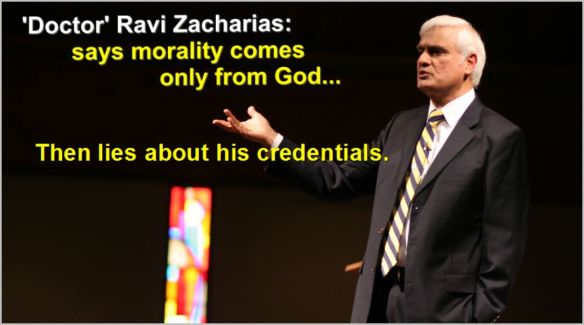
I planned to dissect Ravi Zacharias’ morality argument even before recent revelations that he lied about his credentials. I’m sure that, despite his fraudulent claims, he’s still a good Christian™, perfectly entitled to tell the rest of us what terrible sinners we are. If you’ve ever seen his grandiose sermonising, you’ll know he likes to pretend that Faith is something deeply intellectual, despite Paul’s contention in 1 Corinthians 1. 26-27 that it isn’t. Zacharias’ pseudo-intellectual Christianity is, like many of his qualifications, fake.

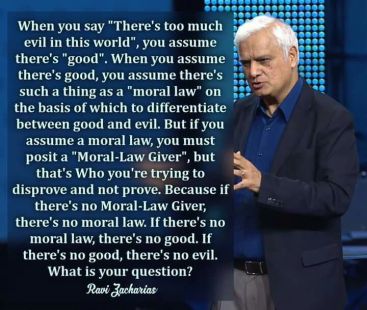
In common with other Christians desperate to prove their God, he relies too on circular reasoning. He tells us that our morality derives from God (you listening TC Howitt?) and then uses this to argue that, because of we have morality, God must exist. His unproven conclusion is his premise, with nothing in between to justify either.

Here’s his ‘argument’ in full:

Ravi3

Let’s take a closer look:

‘When you say “There’s too much evil in the world”, you assume there’s “good”. Who says this? How much evil is ‘too much’? Do people other than Christians see the world in terms of good and evil? Does acknowledging evil mean one also assumes there is good? How is this ‘good’ defined? So many unanswered questions in this first muddled statement.

‘When you assume there’s good, you assume there’s such a thing as a “moral law” on the basis of which to differentiate between good and evil.’ The only one making assumptions here is Ravi himself. The considerate treatment of others, which is how we might reasonably define morality, is easily recognisable when it occurs. This presumably, given he fails to define any of his terms, is what Ravi means by ‘good’ (and conversely, inconsiderate or malicious treatment of others is his ‘evil’). There’s no reason to suppose, however, that the demonstration of good is a component of an objective ‘moral law’ that exists somehow independent of human interaction. Morality and any resulting goodness (or ‘evil’), is human interaction.

‘But if you assume a moral law you must posit a “Moral-Law Giver.” Well, of course we’re not assuming a moral law, not in the magical way Ravi is assuming we’re assuming. And how about that imperative: ‘You must posit a “Moral-Law Giver”‘! Must we? Morality is socially determined by human beings themselves; we see this is in the different moralities that have emerged in cultures with shared heritage; we see it in the changing attitudes over the last fifty years to the treatment of women and gay people. Morality is fluid; it evolves. The ‘Moral-Law Giver’ then, if we must have such a term, is we ourselves.

‘But that’s Who you’re trying to disprove and not prove.’ Erm no. Ravi’s being disingenuous here. ‘We’ were not trying to disprove a Moral-Law Giver at all; he was trying to prove it (him? – note the capital sneakily added to ‘Who’). Let’s though, for the sake of argument say Ravi is right; let’s say there is a Moral-Law Giver out there somewhere. Why has he, over the expanse of human existence, issued such varying and often conflicting moral codes? Compare, for example, today’s moral standards with the harsh, brutal morality of the ancient Israelites, which demanded the death penalty for almost any infringement of the law. Compare that with the morality Christians today claim they derive from New Testament. Then compare Jesus’ impossible demands with how Christians actually behave. By and large, they’re happy to ignore him and, with the exception of one or two areas they get hot under the collar about (abortion, same-sex relationships), they go along with the consensus of the culture in which they live.

‘Because if there’s no Moral-Law Giver, there is no moral law.’ There is a ‘moral-law giver’: it is us. That is why moral laws vary according to culture and through time. Zacharias wants us to conclude that this capitalised ‘Moral-Law Giver’ is his God, yet he has neither demonstrated that a deity (any deity) decrees moral codes from on high, nor has he ‘proved’ (his word) that this cosmic law giver is his god, the barbaric and inconsistent YHWH. Rather, he ‘assumes’ this to be the case and hopes that his audience, failing to notice his assumptions, presuppositions and sleight of hand, will too. Given that most of them are Christian sheep  (Jesus’ term, not mine) they will no doubt do just that.

‘If there’s no moral law, then there’s no good. If there’s no good, there’s no evil.’ This is where the argument, such as it is, turns back on itself. Zacharias thinks he’s being very clever (he always thinks he’s being clever) but all he’s doing is declaring his premise over again.

Of course there are moral standards; humans have devised them throughout their existence. The ‘Golden Rule’ promoted by Jesus, for example, is first recorded thousands of years before him. We determine for ourselves what is good and therefore what is ‘evil’; these defintions are not delivered to us ready made from a “Moral-Law Giver” in the sky.

(While Zacharias doesn’t use the argument, there are those who like to say, on the basis of Romans 2.15, that God has written his (ever-changing) rules in our hearts, a fallacy I’ll address in the next post.)

‘What is your question?’ clever Ravi finally asks. We didn’t have a question. Here’s one for him anyway: how has he got away with such fraudulent drivel for so long?


To clanging cymbals everywhere

Massacre

If you’ve ever engaged one of God’s gentle people™ in discussion about one of their pet topics – the infallibility of scripture, evidence for the resurrection, the ‘abomination’ that is homosexuality or some other damn thing – you’ll know that, sooner or later, they turn nasty. They resort to name-calling and personal attacks; they tell you the reason you’re arguing against them is because you just want to wallow in your own sin – and, boy, are you going to suffer when it comes to judgement day.

Fellow-blogger, Bruce Gerencser has recently experienced this kind of thing from some twerp self-appointed ‘preacher of God’s word’ called T.C. Howitt, over on the Reasonable Doubt blog. I’ve been subjected to it innumerable times too. Eventually, you retreat; not because you’ve lost the argument or don’t have anything reasonable left to say but because there is only so much battering you can take. Then, as Bruce says, the bible thumper declares victory; the foe is vanquished – God’s word prevails! Even supposing this to be true, it is a Pyrrhic victory; the defence of doctrine is at the expense of others’ well-being and is achieved only by hurting them, usually intentionally so.

We shouldn’t be surprised by this of course; it has been the church’s way since the very beginning, from Paul’s tantrum about other evangelists he wished would accidentally castrate themselves (Galatians 5.12) to the massacre of native Americans by those passing on Jesus’ good news in the 16th century, right through to present day ‘hate’ preachers like Steven Anderson and Franklin Graham. Christianity is, and always has been, a nasty, bullying religion that cares only about its own preservation, never other people.

Those who proselytise on its behalf might care to read one of Paul’s better bits of self-promotion (1 Corinthians 13.1-2) which, if it is part of God’s infallible Word™, applies to those Christians today who have nothing better to do than hang around social media:

If I speak in the tongues of men or of angels, but do not have love, I am only a resounding gong or a clanging cymbal. If I have the gift of prophecy and can fathom all mysteries and all knowledge, and if I have a faith that can move mountains, but do not have love, I am nothing.

We might add that if the only way you can win your argument is by demolishing your opponent psychologically, you demonstrate that you are without love, making you in the eyes of ‘men’ and your own God, worth precisely nothing.

How to argue like a Christian

Argue

If you’ve ever tried discussing matters of faith with a True Believer™, you’ll know how difficult it can be; like wrestling with a jellyfish – and just about as poisonous.

So here’s a guide for the unwary; 10 of their favourite lines (5 this time, 5 next), all of which I’ve experienced more times than I care to remember.

“You don’t know your Bible!”

Point out that Jesus’ ‘good news’ was nothing like Paul’s or that they were both wrong about the Kingdom arriving in the first century and this old canard gets trotted out. Even if you quote chapter and verse, a clear indication you do know the Bible, they still produce it. What they mean is ‘how dare you quote the bits of the Bible we true believers don’t like and prefer not to acknowledge.’

“You’re quoting out of context.”

I’ve posted about this one before. Seemingly as a sceptic you have no discernment when it comes to selecting Bible verses. How ever many you reference – one or a hundred – they will tell you it’s not enough; that you’ve not, somehow, caught the true meaning of what the Bible is saying, which is, naturally, what they say it means. Unsurprisingly. quoting isolated verses is something the Righteous themselves like to do all the time…

“The bible says…”

It doesn’t matter what point you make, this will appear somewhere in the Christian’s response, followed, of course, by some random verse from the book in question. Christians seem to regard it as the ultimate clincher, the way to silence any opponent, as if quoting the bible to those who recognise neither its credibility nor its authority persuades anyone of anything.

“You’ve no right to criticise Christianity when you can’t ‘prove’ how something came from nothing/how life arose/evolution.”

It’s unlikely anyone can explain these biggies in 140 characters or a Facebook comment, but we can direct those issuing the challenge to scientific works that offer viable theories soundly based on the evidence available. Needless to say our Christian smart-Alec is unlikely to read them, claiming instead that one’s inability to comprehensively explain the Big Bang or evolution ‘proves’ it must have been – watch the sleight of hand here – YHWH.

“‘People like you’ only want to wallow in your own sin (which is why you won’t let me have my own way).”

Now I like to wallow as much as the next man, but outside the Christian bubble, ‘sin’ is a fairly meaningless concept, designed only to induce guilt in others. Which means the point of this unpleasant finger pointing is to side-step any discussion and to dismiss whatever point you might want to make. What this retort really means is ‘you have an ulterior motive for saying what you’re saying and, in any case, your inherently evil nature doesn’t entitle you to have an opinion.’

More next time…

The original ‘good news’ had nothing to with any mystical salvation plan (part two)

Disciples2

Last time, I provided evidence that Jesus’ original ‘good news’ had nothing to do with any mystical salvation plan constructed around his supposed resurrection. My six references demonstrated that, even after his death, the disciples adhered to Jesus’ original message: God’s Kingdom was coming soon and they were going to rule over it. Here are six more reasons we can be sure this was the case:

7. Our earliest sources, Q and the gospel of Mark, do not give much credence to the resurrection as an actual event: Q records no sayings of the risen Jesus and Mark has no resurrection appearances; it ends with the women who discover the empty tomb deciding not to tell the disciples about it. In Mark’s gospel, then, the disciples are not even aware the tomb is empty, let alone that Jesus has returned from the dead. We can conclude from this that the community that produced Mark’s gospel, the supposed resurrection was not significant in and of itself.

8. Paul tells us that the disciples’ gospel was not the same as his, despite the fact he too believed the Kingdom wasn’t far off (1 Thessalonians 4:17). The disciples, he says in 2 Corinthians 11.4-5 and Galatians 1.6; 2.11-21, were preaching ‘a different gospel’. Different from his, certainly, but the same as the ‘good news’ Jesus proclaimed: Jewish people should prepare for the imminent arrival of God’s Kingdom on Earth (Mathew 9.35; 15.24), when, as Jesus himself had promised them, the disciples would judge the restored tribes of Israel and rule over them. It is, as we have seen, out of the question that they would jettison this aspect of the ‘good news’, given to them by Jesus himself.

9. Because the disciples – and Jesus’ brother James – saw the new Kingdom as intended for Jews only, as Jesus had before them (Matthew 10.23), they insisted that any Gentile converts must be circumcised; must become Jewish (Galatians 2.7). Paul, of course, objected to this requirement and throws tantrums about it in his letters (Galatians 5.1-12; Philippians 3.3). But like Jesus, the disciples saw no place for Gentiles, the unrighteous, in the new age; those who didn’t convert would, of necessity, be dispatched to eternal punishment (Matthew 25.31-46).

10. As far as the disciples were concerned, therefore, it was entirely for their own good that converted Gentiles be circumcised (Galatians 6.12-13) as this was their only guarantee of a place in the new Kingdom. What this tells us is that a salvation formula, such as that dreamt up by Paul, had no part in the disciples’ ‘good news’.

11. Wherever they appear – in Paul’s writing, the gospels, Acts – the disciples are portrayed as being at odds with an incantational, faith-based Christianity. The Bible attests, even with Paul’s new religion superimposed, that they held to a different gospel, a different sense of what Jesus’ life meant and a different notion of their place in the coming Kingdom. And wouldn’t they be the ones to know? They knew Jesus, spent time with him, listened to his teaching, bought into his misguided mission and had sufficient understanding of it to spread his ‘good news’ to fellow Jews, both while he was still alive and afterwards (Matthew 10.23; Luke 9.1-2).

12. The New Testament is testimony to the failure of everything Jesus and the disciples stood for; their ‘news’ that God was soon to turn the Earth over to the meek and that they would then rule the only people who mattered, the twelve tribes of Israel, with everyone else thrown into outer darkness (Luke 13:28). Jesus himself, of course, would return at some point to be top dog, God’s representative on Earth – his anointed one. None of this happened.

If only it had been allowed to rest there, we might not know today of Jesus and his mad ideas. Instead, Paul stepped in, reinterpreted the whole ridiculous enterprise and bequeathed the world a set of different but equally absurd beliefs. And the rest is history: religious wars, pogroms, inquisitions, suppression, superstition, clerical child abuse, Pat Roberston. Is this the Kingdom that Jesus and his closest associates foresaw? Decidedly not. But it is their legacy.

The original ‘good news’ had nothing to do with any mystical Salvation Plan™


Pentecost

As I discussed last time, there are indications throughout the New Testament that Jesus’ original ‘good news’ had nothing to do with a mystical salvation plan. There are clues too that the disciples clung to this original message – they’d heard it from Jesus himself, after all – even as other interpretations began to supersede it.

Let’s take a look at the evidence:

  1. Jesus tells his chosen twelve, which includes Judas, that they will rule with him in the age to come (Matt 19.28). As Bart Ehrman points out1, the fact that Jesus evidently had no foreknowledge of Judas’ later betrayal means this promise undoubtedly goes back to Jesus – it is unlikely later believers would have made it up. Though their names vary between gospels, Jesus hand-picked twelve men to rule with him.

  2. He appoints twelve disciples quite specifically and later tells them privately that this is so they can judge and each rule one of the twelve tribes of Israel once God’s Kingdom arrives (Luke 22.30).

  3. When Judas kills himself, the remaining eleven disciples think it vital to appoint a replacement twelfth (Matthias, in Acts 1.21-26). The number remains significant to them. How would they be able to rule the twelve tribes of Israel if there were only eleven of them? There had to be twelve for this very purpose. Even after Jesus’ death and supposed resurrection, the disciples are still preparing for the end of the age he prophesied and for their positions of power in God’s Kingdom.

  4. By the time the synoptic gospels were written, Jesus secret teaching that the Twelve would rule alongside him in the new kingdom had become common knowledge (hence its inclusion in the gospels). Given that he told them in private they’d be judges and rulers, it can only have been the disciples who later broadcast this information. And why would they do this? Because it was an integral part of their good news. Furthermore, all three synoptic gospels include a range of episodes in which the twelve are castigated for their presumption (eg: Mark 10.37-41; Matthew 20.22-24; Luke 22.24-30). These have all the hallmarks of stories created later, when a different ‘good news’ was emerging, specifically to mock the disciples’ belief.

  5. In much the same way, the disciples are consistently depicted as having no real understanding of Jesus’ mission (Mark 9.30-32; 10.35-45). And they don’t, in that they have no understanding of the later reinterpretation of Jesus’ significance. How could they? By the time the gospels came to be written, the mystical-Christ version of Christianity had started to take hold. Paul’s salvation plan and the supposed resurrection were beginning to assume greater importance than Jesus’ original message. How could the disciples, 40 years earlier, have known that this was going to happen? How could Jesus? They have to be portrayed as being largely ignorant of later developments – developments which, in any case, they opposed when they did encounter them (Acts 9.26; Galatians 1.6; 2.11-14; 3.1-3).

  6. In fact, Jesus teaching – all of it – was predicated on his belief that the Kingdom of God was ‘at hand’, imminent, about to happen real soon (Mark 1.15; 9.1; 13.30; Matthew 10.23; 16.28; 24.34), and that when it did, he and his chums would be there ruling it. It is unthinkable his inner circle would abandon this teaching, even after he died, in favour of something else. Any visions they had of him returned from the dead would only have reinforced their commitment to his ‘good news’; resurrection, after all, was a sure sign of the Kingdom’s arrival (Daniel 12.2-3).

To be continued…

1 Ehrman, Bart D., The Lost Gospel of Judas, p146

Good news? What good news?

Disciples

Here’s what we know so far:

  1. There is no evidence the disciples were martyred.

  2. There is no evidence the disciples were martyred simply for believing that someone they knew had returned from the dead. In the age in which they lived such a claim wouldn’t have been out of the ordinary. The gospel accounts themselves record instances of resurrections other than Jesus’ and of miraculous manifestations of the dead. This was how people thought.

  3. There is no evidence that believing a dead man was alive again was a capital offence. Really, who could possibly care? Even Paul did not suggest that, as Saul, he liked to persecute early believers because of this belief.

  4. The gospel preached by Jesus and his disciples was completely different from that promoted by Paul. Their good news was about the imminent arrival of the Kingdom of God, when the Romans would be overthrown and every injustice made right (Luke 13.30). And while they may not have made it public, Jesus and his friends believed they would be the judges and rulers of this new system.

  5. This ‘good news’ existed long before Jesus died and long before Paul came along to change its nature entirely (Matt 10.23).

  6. Matthew and Luke, while including resurrection stories inspired by ‘visions’ like Paul’s, preserve, as does Mark, Jesus’ apocalyptic teaching. His promise of the coming Kingdom and his private teaching that he and his disciples would rule the new age together remain a significant part of the synoptic gospels.

  7. Jesus was executed for his seditious views (Mark 15.2, 9 & 32; John 19.19-20)

  8. It is likely, if they were martyred at all, that the disciples were killed for the same reason.

There are further indications in the New Testament that the original ‘good news’ had nothing to do with a mystical salvation plan and that the disciples clung to this original message – they’d heard it from Jesus himself, after all – even as other interpretations began to supersede it. We’ll look at these indications next time.

How not to love your neighbour

preachersImagine: a group of health-fascists set themselves up on a soap box in the city centre from where they lambaste everyone going past, with language that is abusive and demeaning, about the poor state of their health, their out-of-condition bodies and that many of them are  significantly over-weight. But, the speakers insist, a bottle of a magic potion they just happen to be selling will solve all their health problems overnight! All anyone has to do is commit to swallowing some every day for the rest of their lives.

Unsurprisingly, people are upset about this; they’ve come to town for all sorts of reasons, but not to be lectured about their health and size, which, for most of them are both perfectly fine. Some of these folk challenge the snake-oil salesmen, shouting back at them (not having the benefit of a tannoy system) and demanding to know what gives them the right to harass passers-by. In response, one of the salesmen pulls out a copy of last Tuesday’s Daily Mail; ‘it’s all in here,’ he declares, ‘all in black and white, and we believe it. The Daily Mail wouldn’t lie to us. Its Word is Truth. So get your magic potion now before it’s too late, ya depraved, ignorant slobs!’

Acceptable or not?

While you think about – if you even need to – the picture above was intended to accompany the previous post. It shows street preachers Michael Overd, Michael Stockwell and Adrian Clark before their trial for ‘public order offences’, which started last week and concluded on Tuesday this week. I felt it couldn’t be used while the trial was ongoing (contempt of court and all that) and so had it replaced with one of rabid American nutcase Franklin Graham.

Two of the three preachers, Overd and Stockwell, were found guilty and fined. Naturally, there’s an outcry from Christians and assorted fruitcakes everywhere about how the two have been denied their freedom of speech (though there is no protection of free speech under UK law) and how – oh calamity! – it’s no longer possible to ‘preach the gospel’ in the Britain. Absolute nonsense, of course, and while some more liberal commentators feel the case should never have reached the courts (let the nutjobs condemn themselves by spouting in the streets, suggests one) an example has been made of people who think the way to show love for your neighbour is setting out, in the judge’s words, to ‘insult, humiliate, demean (and) belittle’ them in public using a loud speaker in a shopping centre.

As Andrew Calibre pointed out in the previous post, haranguing and provoking people like this has nothing to do with love, nor is it ‘the gospel’. Shouting, as Overd did, about how your neighbour is ‘depraved and ignorant’ and how those who have sex outside marriage and gay people (of course) are ‘filthy, depraved and perverted’ is not, by any stretch of the imagination, ‘the good news’.

Perhaps the confusion is understandable when the Bible and God’s people™ are so muddled themselves about what ‘the good news’ actually is; God’s Kingdom arriving on Earth, as Jesus seems to have thought? Paul’s magical salvation formula? Or maybe it’s that there’s a free pass to heaven? One thing’s for sure, verbally abusing your neighbours and other strangers it isn’t. Even if street preachers justify their arrogance and rudeness by claiming they’re only conveying what (they think) the Bible says – so what? Their tawdry little book has no more authority than any other collection of ancient (or modern) fantasy, prejudice and supposition.

So, no, it’s not acceptable that hypothetical, self-appointed health experts verbally abuse strangers in the street. And as the court ruled this week, nor is it when religious zealots do the same. Passers-by and by-standers have every right to feel irritated, annoyed and offended, just as Christians would be if a group of Muslims propounded their beliefs with the same aggression, informing all and sundry how wicked they are and how they are destined to spend eternity in whatever hell Islam envisages. Nor would ‘we’re only preaching what the Qu’ran teaches’ be any justification.

But the issue isn’t only the irritation that people feel when religious extremists abuse them. It’s the one in a hundred, or whatever the percentage is, who takes them seriously, accepts the confederate’s tract, shows interest and is ultimately sucked into one of the many versions of the mind-numbing Jesus cult. Far worse than selling people magic potions, or insurance they don’t need, there is something obscene about cranks taking to the streets to recruit the gullible and unsuspecting to their (lost) cause. We wouldn’t tolerate it if it were anything other than religion, why should we accept it when it is? The prosecution of presumptuous con-artists does us all a service.


What’s Love Got To Do With It?

franklinA guest post by Andrew Calibre.

So there’s this smart-arse who thinks he’ll catch Jesus out by asking him a tricky question like, is it true microbes cause illnesses? Or, is Ken Ham right that the universe is only six thousand year old? But he bottles it, maybe ’cause he knows JC won’t have a clue what he’s talking about, and asks him an easy one instead – simple stuff about Jewish rules or something. “What is the greatest commandment?” is the best he can come up with (Matthew 26.32-40).

Jesus takes his chance and says, “Love the Lord your God with all your heart and with all your soul and with all your mind.” Predictable or what, even if he does make a big mistake: whoever heard of ‘the mind’ having anything to do with religion! Still, JC can’t resist elaborating on it. “This is the first and greatest commandment,” he says, as if everybody round him doesn’t know that already when it’s in their old magic book (Deuteronomy 6.5). He’s on a roll now and on he goes: “And the second is like it: ‘Love your neighbour as yourself.’ Clearly a cock-up, but there’s no stopping him: “The whole bloody religion” – he’s talking about the Jewish stuff, not the Christian fantasy that he knows nothing about on account of it not being invented yet – “is about these two things, nothing more,” he says.

Christ! How could he have got it so wrong? Love your neighbour as yourself! Whoever heard such crap? I know, a nice idea, but I ask you. Everybody knows that being religious, being a Christian, is about believing the right stuff (having the right doctrine, I think it’s called), trashing other Christians who believe the wrong stuff, and dumping on everybody else, specially if they’re sinners (and they’re all sinners), foreigners, LGBTI or transgender. Now that’s real Christianity. I know it is, because that’s how Christians do it, and they’re the ones who should know.

Apart from Jesus, nobody thinks loving others like you love yourself is a good idea. Even he wasn’t very good at it (Matthew 15.22-28 etc). What ‘your neighbour’ is for, is pointing out how sinful/lost/degenerate they are, how they’ve f**ked up their lives, how God’s going to punish them for all eternity for not being the same as you and how they’re just about single-handedly bringing about the end of the world on account of being so perverted/evil/foreign.

That’s how you love your neighbour! You can’t even claim to be loving them properly unless you’re telling them about Jesus, over and over again, and, in the process, denigrating, dismissing and damning them to hell over and over again. This is what truly loving your neighbour is about! I know because Christians say so endlessly: ‘you’re only really loving others if you’re telling them what shite they are and how they need Jeeesus to wipe it all away.’ So, okay, this isn’t exactly how you love yourself, but what’s that got to do with it?

If only Jesus had listened to his mouthpieces today. They know far more than he did about what’s important.

And love it isn’t.