Why I Can’t Believe in the ‘Lord Jesus Christ’: 2. Demons, demons everywhere

Demon2

They tell you all you need to do is accept Jesus as your Lord and Saviour. But it’s not true. You also have to accept on faith all sorts of peripheral nonsense. Nonsense like demons. And the ever-present malevolent Force that will pressurise you into misbehaving and compromising your commitment to the Lord. This Force is ‘The Enemy’, a.k.a. Satan or the Devil, and leading Christians astray is its/his principal occupation. The Enemy and his minions, the demons, are everywhere! All over the internet for a start, mainly on Christian sites. While the Church of Lucifer has an online presence, it’s Christians who love the bad guys the most.

According to some, Satan and his demons are in charge of this reality (though it could be God who’s got the whole world in his hands.) When they’re not attacking true believers, demons are doing their damnedest to bring America to its knees, mainly through ‘The Homosexual Agenda‘™ and abortion rights.

Perhaps it’s possible to ignore this aspect of the faith and still be a Christian, but to do so is to disregard the significant presence the devil and his demons have in the New Testament. Jesus himself has a cosy chat with Satan during his time in the wilderness, or so Matthew 4.1-11 would have us believe. Throughout the synoptic gospels, Jesus speaks very much as if he believes Satan to be an actual being, not merely a metaphorical personification of evil (eg: Luke 11:14-26). He also exorcises a significant number of individuals possessed by demons.

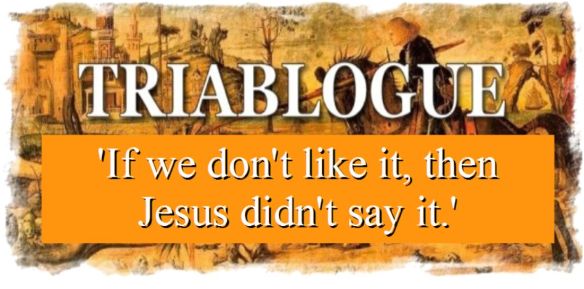
Steve Hayes on Triablogue blithely suggests that ‘when friends and relatives brought people to Jesus to be exorcized, that reflects their diagnosis, not his. They think the individual is possessed – which doesn’t imply that Jesus always shared their suspicions.’ But of course it does; to imply he was God and therefore would have known better is to impose a perspective that had yet to develop when the synoptic gospels were written – that, and a modern sensibility onto a first-century conditioned mind. If Jesus didn’t regard those brought to him to be possessed by demons, he would have said so. He is quick enough to correct his disciples elsewhere when they ascribe the wrong reasons to the causes of illness (John 9.1-3). Inventing ways to excuse Jesus’ ignorance is to avoid what the text clearly indicates; Jesus believed in demons. When he diagnoses a disturbed mind himself he doesn’t hesitate to conclude they are involved; he even engages in conversation with them (Luke 8.30-35).

We know now, and have known for some time, that illness and mental conditions are not caused by demons. We know too that same-sex relationships are not Satanic. There are no supernatural forces trying to debase America. There are no supernatural forces, full stop. It follows that Jesus’ mission couldn’t have been to magically defeat the devil by dying on the cross (Hebrew 2.14); his supposed sacrifice couldn’t have been the beginning of the end of the devil’s reign (Romans 16.20). Neither can there be any of the spiritual warfare against ‘powers and principalities’ of the air that dimwitted Christians imagine themselves to be engaged in (Ephesians 6.12).

Christianity is nothing without its imagined adversaries. With them it is nothing more than a superstition, which its founders ignorantly subscribed to and worked hard to perpetuate. Christians are about the same business today.

As for me, I cannot believe in a ‘Lord Jesus Christ’ who was so primitive, so uneducated and so ignorant he regarded Satan and his demonic forces to be real.


The Christian blog that knows better than Jesus

Triablogue-Header-240x1080 (1)

The superior intellects at Triablogue responded to my comment (see previous post below) by telling me they’d already dealt with the claim that Jesus believed the arrival of the Son of Man/the End of the Age/the Final Judgement and God’s Kingdom on Earth were imminent.

They directed me to one of their articles, Misdating the Second Coming, which argues that neither Jesus nor Paul really believed the end was nigh and that the texts which suggest they were need to be interpreted carefully (i.e. to get round what they clearly say to make them say something else.)

I can’t find any other instance of Triablogue contributors proposing that Jesus didn’t really say what the gospels have him say. They don’t dispute, for example, the so-called great commission in Matthew 28.19 (‘Therefore go and make disciples of all nations, baptizing them in the name of the Father and of the Son and of the Holy Spirit‘) even though, with its Trinitarian formulation, Jesus almost certainly didn’t say it. Instead, the know-alls at Triablogue  reserve their hedging for the prophecies that patently failed to materialise, on the basis that Jesus couldn’t possibly have been wrong so he must have meant something else.

I’ve written several posts under the banner Making Excuses for Jesus, on the varied and feeble attempts Christians make to get round the fact the synoptic gospels consistently have Jesus say the Kingdom of God, and all that accompanies it, are just around the corner. His early followers all believed this and his eschatological pronouncements are recorded in all of the earliest texts. Mark’s gospel includes his prophecies about the Son of Man while Matthew and Luke include material not found in Mark from their ‘M’ and ‘L’ (oral?) sources that warn it is the ‘eleventh hour’. The entire thrust of the synoptic gospels is that the Kingdom is about to arrive and therefore people need to be prepared for it: ‘The time is fulfilled, the kingdom of God is at hand; repent and believe the good news’ (Mark 1.15).

The sayings gospel ‘Q’, which predates Mark and was probably in circulation only a few years after Jesus died, preserves several Son of Man sayings; he would be appearing soon to kick-start the Kingdom. Paul, writing decades before the gospels, tells his readers to expect the Second Coming – the Son of Man having become Jesus himself – while he and they are still alive (Thessalonians 4.14-15). Likewise, the anonymous writer of Hebrews believed he lived in the ‘last days’ (1.1-2) while the nutjob who concocted Revelation claimed he was quoting the Risen Jesus promising he would ‘surely come quickly’ (22.20). The imminence of God’s Kingdom on Earth is the consistent message of the New Testament.

And what do the cerebral Christians at Triablogue do when confronted with a summary of these facts? They don’t approve my comment, that’s what. I guess that’s all you can do when you really don’t have an answer for why your Savior™ got everything so drastically wrong; dishonestly pretend he didn’t and silence those who show that he did

Pride & Prejudice

Dale2

Ken Ham took a swipe at Gay Prides recently on his crackpot Answers in Genesis. He didn’t, for once, harp on at length on about how sinful same-sex everything is (if it’s same sex, it’s sinful) but takes the perspective that because Prides involve the word ‘pride’ they are prideful – and that, my friends, is a sin too! This remarkable insight allows the Hamster to gay bash from a completely different angle, though predictably the result is the same. LGBTQ people are lost in sin, and it’s a double whammy; they don’t just wallow in their sexual sin but in pride too, and, my, how God hates both of those!

In the context of Gay Pride, ‘pride’ doesn’t quite mean what ol’ Kenny thinks it does. He takes his definition from some esoteric evangelical dictionary that defines pride as “both a disposition/attitude and a type of conduct,” which according to Ham boils down to that old chestnut, Rebellion Against God, which, he says epitomises gay people.

As usual, he’s wrong. What Gay Pride represents, in both its public and personal forms, is gay people’s rejection of any shame imposed by others about who they are and their refusal to remain hidden; not so much pride but joy, liberation and self-assertion. I’ve been to one or two Prides myself and these have been their predominant characteristics. They reflect the exhilaration gay people feel about being themselves and escaping from the constrictions of the closet. For many, this can be a long and difficult journey, as it was for me. Gay people have every reason to be pleased with who they are and what they’ve achieved and Gay Prides are a way of declaring this self-acceptance, self-esteem and, yes, love – to their communities, city and the world.

‘Pride’ of this sort is no sin (neither is any other, because there’s no such thing as ‘sin’) but other kinds of pride – say, Donald Trump’s arrogance and bluster – are particularly distasteful. Thank goodness Christians don’t suffer from that sort of pride!

They don’t for example, think they’re superior to the unsaved and especially to LGBTQ people. if they did, they’d spend their time judging everyone else and finding them lacking. They’d lambast gay folks and suggest they should cured or silenced or even executed. They’d disparage atheists, sceptics and unbelievers at every turn. Thank God Christians don’t demonstrate this sort of pride!

Praise the Lord they don’t think they somehow merit living forever! What a relief they don’t think a magic trick of God’s is going to make that possible because, really, they don’t deserve to die; there’s something about them that is worth preserving forever. Thank goodness they can see that this life is all there is and the little bundle of hopes, fears, neuroses and prejudices that make up most of us, don’t really merit unlimited continuation. To think that really would be prideful!

Hallelujah that Christians don’t think the particular brand of mumbo-jumbo they subscribe to is the only one true religion. If they did, they’d spend their time disputing with one another about who’s right and who’s apostate, misguided and deceived by the devil. Praise Lucifer we don’t see pride like this emanating from Christians everywhere!

So, one last message for Kenny and those who put down others, or call them out on their ‘pride’:

Judge not, that you be not judged. For with the judgment you pronounce you will be judged, and with the measure you use it will be measured to you. Why do you see the speck that is in your brother’s eye, but do not notice the log that is in your own eye? Or how can you say to your brother, ‘Let me take the speck out of your eye,’ when there is the log in your own eye? You hypocrite, first take the log out of your own eye, and then you will see clearly to take the speck out of your brother’s eye (Matthew 7.1-5).

And if you think you have removed that log from your own eye – isn’t that just another manifestation of, well… pride?

Man imagines he sees Jesus

Congregation

Just last Friday, a pastor saw the Risen Lord.

I wonder: how different is Pastor Stovell Weems’ sighting from those of the disciples and Paul? Would you say it was just as real? Less real? Completely inauthentic? How do we decide?

For me, his encounter is every bit as real as those experienced by the disciples. I defy anyone to demonstrate otherwise.

Of course, accounts of visions, hallucinations and dreams, however old or however new, are not evidence that the resurrection really happened. Paul happily admits that his experiences were in his head (Galatians 1.16). It is entirely reasonable to conclude that Pastor Weems’ encounter with an apparition-like Risen Lord is exactly the same as Paul’s, and identical to that experienced by Mary, Peter and John in the gospels. Like theirs it’s vague – “I could sense his personality”, “I didn’t see his face” – and dream-like.

There is a difference though: the nutty pastor recounts his hallucination first-hand. The disciples’ encounters were reported third, fourth, fifth… hand, decades down the line.


How To Be Saved (Possibly)

NewCreature

Personal righteousness, that’s how. Who says so? Not Paul, that’s for sure; he thinks you get right with God by accepting the salvation made possible by Jesus death (Romans 1.16-17). Jesus on the other hand thinks it’s by being righteous. More than this, he says God will treat you in exactly the same way you treat others. He makes this point repeatedly; what the believer will receive from God will be in direct proportion to what the believer does.

So, according to Jesus, if you want God’s forgiveness, you must first forgive those who have wronged you:

For if you forgive men their trespasses your heavenly Father also will forgive you; but if you do not forgive neither will your Father forgive your trespasses. (Matthew 6.14)

He applies this principle to other areas too. You want to experience God’s riches and blessings? Then first be generous yourself:

Give and it will be given to you; good measure, pressed down, shaken together, running over, put into your lap. For the measure you give will be the measure you get back. (Luke 6.38)

You want to avoid God’s judgement? Then don’t judge others:

Judge not that you be not judged. For with the judgement you pronounce you will be judged, and the measure you give will be the measure you get. (Matthew 7.1-2)

You want God to show you mercy? Then you must first show mercy yourself:

Blessed are the merciful, for they shall obtain mercy. (Matthew 5.7)

You want God to show you compassion? Then be compassionate yourself:

The King will say to those at his right hand… I was hungry and you gave me food, I was thirsty and you gave me drink, I was a stranger and you welcomed me… Then the righteous will answer him, ‘Lord when did we see the hungry and feed thee or thirsty and give thee drink? And when did we see thee a stranger and welcome thee?… And the King will answer them, Truly I say to you, as you did it to one of the least of these my brethren, you did it to me’. (Matthew 25.34-46)

Do Christians believe that the degree to which they demonstrate mercy and forgiveness to others is the degree to which God will demonstrate it towards them, both in this life and the next?

It’s not that Christians don’t help the needy. Clearly many do, as do some atheists, Jews, Muslims and all manner of others. No, the point is that Christians have lost sight of the fact that for Jesus such behaviour directly equates with righteousness, which in turn determines one’s ultimate fate. There really is no getting away from the correlation that Jesus is at pains to underscore, particularly in Matthew and Luke’s gospels. The only recourse seems to be to disregard it, which most Christians are content to do. They are much happier with the self-centred faith that Paul offers in Romans 5.17, ‘the free gift of righteousness’. This makes far fewer demands, carrying only the minimal expectation that one’s treatment of others has any bearing on one’s own well-being.

Except this isn’t how it works, not according to Jesus; God’s forgiveness, blessing, compassion and removal of judgement are entirely conditional. To Jesus, a ‘measure for measure’ arrangement is how one attains righteousness, which is not God-given, but is worked at in the practicalities of daily life, in relation to others.

I dared to suggest this recently on a Christian blog and was berated for making a ‘Satanic’ suggestion. Not me, but the one Christians say is the Son of God, God himself even. Evidently this doesn’t extend to knowing what he actually says, taking notice of it and doing something about it.

The Myth of God’s Forgiving Love

homosexualdemons

God loves you, he really does. His love for you is so wide you can’t get round it. So high you can’t get over it, blah, blah, blah. We know this because Christian preachers are forever telling us. I saw Joel Osteen saying so the other evening on TBN, God’s very own TV station.

Don’t you think it’s strange that God needs TV stations and evangelists and preachers to tell you about his love, and everything else about him? An alien looking at religion without any foreknowledge would think it and its gods were entirely a human creation. He or she would ask why God doesn’t show himself, reveal his nature and demonstrate first-hand how much love he has for us. To which our Christian friends, if they’re not squabbling between themselves or blaming the world’s (i.e. America’s) problems on gay people, abortion or the absence of prayer in school (where, in fact, anyone is free to pray), would tell our alien that God did just that, once upon a time, when he sent Jesus. And they might then tell him how Jesus died so we might all be forgiven our sins and live with God, once we’re dead, happily ever after in Heaven. Grace they’ll call it, the free gift of God.

If you’ve read this blog for any length of time – I admire your stamina! – you’ll know that very little of this is what the Bible offers and that Jesus’ idea of getting right with God is very different from this perversion of Paul’s magical salvation plan.

In Matthew 18.21-35, Jesus tells a particularly unpleasant parable about God’s love and patience. It turns out it’s at odds with Joel Osteen’s view of the same things (still, I expect Osteen’s right; he’s got a congregation far in excess of the rabble who followed Jesus.)

The story concerns a king who cancels (forgives) the substantial debt one of his servants owes him. This king, who represents God (or maybe even Jesus himself in one of his more egotistical moments) is indeed forgiving at this stage of the story. However, the servant – let’s call him Franklin – then comes across a fellow-servant (Jason) who asks Franklin to overlook the much smaller debt he owes him. Franklin responds by telling Jason that he must pay his debt immediately or else he’ll have him thrown in jail. Unfortunately for Franklin, the king hears of his lack of compassion and in light of the fact he himself has forgiven Franklin much, is enraged at his attitude towards Jason. He rescinds the forgiveness he extended towards him and has Franklin thrown in jail instead. Having told the story, Jesus hammers the moral home, as he does here in Matthew 6.14-15:

If you forgive others for their transgressions, your heavenly Father will also forgive you. But if you do not forgive others, then your Father will not forgive your transgressions.

We learn three things from the parable about how Jesus (or his scriptwriters) viewed forgiveness:

1) Far from being an unmerited free gift, God’s forgiveness is entirely conditional. It is conditional on how much we ourselves are forgiving. Matthew 5.23-26 and the Lord’s prayer both take the idea further: we can’t even expect God to forgive us unless we’ve forgiven others: ‘Father, forgive our sins,’ says the prayer, ‘to the extent we forgive those who sin against us.’

2) God’s forgiveness is not once-and-for-all; it can be withdrawn if and when we fail to forgive others.

3) There is no mention in this story, nor in the prayer, nor in Jesus’ other teaching about forgiveness, of unmerited grace or a salvation formula, even though the gospels were recorded long after Paul devised his magical incantation. God’s forgiveness, therefore is not the result of Jesus’ dying for us, nor is it unmerited, as ‘grace’ would suggest; it has to be earned. And how is it earned? By forgiving others.

4) God is no God of Love. He’s a bastard who can’t be trusted; one slip and you’re out on your ear.

So what does any of this matter when there’s no God and Jesus was something of a deluded charlatan, anyway? Well, you won’t hear this version of forgiveness preached in church or promoted by evangelists, or even practised by Christians. This perspective on forgiveness is so far removed from Paul’s ‘gospel of grace’ and modern day Christianity that it has to be ignored, disregarded, forgotten about. After all, Christian leaders don’t want their flocks to know that forgiveness needs to be earned. And they certainly don’t want the rest of us to know that they’re really not up to the task. Besides, squabbling about doctrine and blaming gays for everything is much more satisfying.


“Christian” Scare Quotes: A Response

JesusLaughs

Christian bloggers like their quotation marks – ‘scare quotes’ as they’re often known. The Righteous wear away the computer keys with them on when ranting writing about same-sex “marriage” in particular. This kind of marriage always receives them, even though marriage is marriage whether same-sex or not. Those who like to use and over-use them, however, intend to show that same-sex marriage isn’t marriage at all but a devilish, unbiblical substitute for the real thing.

The Christian Research Network (a misnomer if ever there was one: the site only ever features two contributors, involves no research and is distinctly unChristian) regularly adds speech marks to other terms and titles. The Pope, for example, becomes “Pope Francis”, and the fact Francis is not his real name is constantly highlighted. This is intended to show, presumably, that he lacks authenticity. The irony is that the figure whom Christians themselves worship and adore isn’t known by his real name either, a fact lost on “God’s chosen”. Yeshua Bar Yosef wouldn’t recognise “Jesus” and certainly not “Jesus Christ”.  Then there’s “Paul”, real name Saul. Christianity’s use of false names is nothing new.

My proposal, therefore, is that from now on, whenever we write “Christians”, we add quotation marks to the term to reflect the hypocrisy of so many of them, as well as the vacuity of the belief system itself. This can be done even when speaking of “Christians”, by wiggling the fingers as the word is said. It can, and should, be extended to all of the other fallacious ideas within Christianity: “God”, “Jesus”, “God’s Word”, “The Kingdom of God”, “Holy Spirit”, “Heaven” and “faith”.

We needn’t worry about running out of quotation marks with which to do this; we can always use those that “Christians” have previously attached to same-sex marriage.

Forgiven

Boy

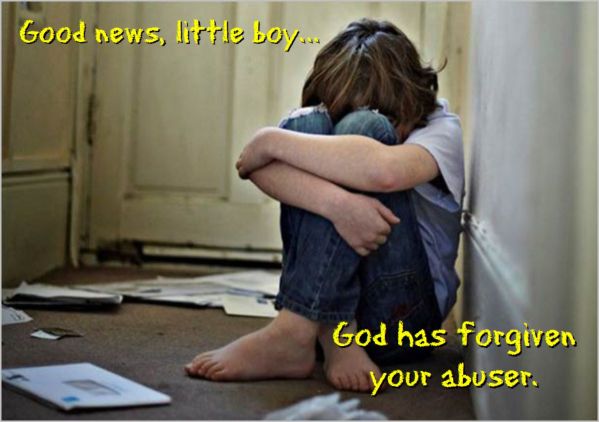
In the UK, as in the States, there has been a spate of sexual predators who, although admitting to their crimes, have claimed that God has already forgiven them their misdemeanours (the links provide only a couple of examples; there are many more out there). Naturally the abusers expect this to carry weight in any trial they face or in their rehabilitation into society, but it seems to me that such claims are, every one of them, bogus and fraudulent.

Overlooking the fact that God’s forgiveness is an impossibility – on account of there being no God – the idea is incompatible with the brand of Christianity, drawn from Paul’s theology, practised today. According to Paul’s reasoning – I use the term loosely – God doesn’t offer forgiveness. He provides the means to have one’s sins overlooked, covered by the blood of Christ. They are not forgiven, rather Jesus’ death serves as an atonement for sin. In those letters that are genuinely his (1 Thessalonians, Galatians, 1 and 2 Corinthians, Romans, Philippians and Philemon), Paul doesn’t mention divine forgiveness once.

On the other hand, Jesus, whose teaching is largely ignored by those who claim to follow him, does have plenty to say about forgiveness. This isn’t, however, the easy ‘get out of jail free’ card proffered by today’s offenders and populist preachers. Like all of Jesus’ morality, this forgiveness is hard to come by. If you want God’s forgiveness, Jesus says, it has to be earned; it is dependent on whether we ourselves forgive. Here’s how he puts it:

If you forgive others the wrongs they have done to you, your Father in heaven will also forgive you. But if you do not forgive others, then your Father will not forgive the wrongs you have done. (Matthew 6:14-15)

The same idea is preserved in the so-called Lord’s prayer: ‘forgive us our sins in direct proportion to the sins we have forgiven’ (Matthew 6:12). This measure-for-measure approach is central to Jesus’ teaching.

So are those who’ve hurt or abused others claiming they’ve forgiven everyone else for offences that they’ve been subject to and have so earned God’s forgiveness? Even so, is this good enough? ‘I have God’s forgiveness because I’ve forgiven those who’ve hurt me,’ doesn’t begin to cover the hurt I may have caused others. What about them? As usual Jesus’ morality here is inadequate in the real world.

He has another go at it in Matthew 18:21-22 where he commands his disciples to forgive others innumerable times. But again this covers only those who have offended me; it doesn’t do anything for those whom I might have offended. It’s not good enough. His parable of the unforgiving servant (Matthew 18:23-35) has the same problem.

If I’ve caused the hurt, have I the right to expect my victims to forgive me so that they in turn can earn God’s forgiveness for their sins? This seems to be the implication. And the answer is ‘no’, I can’t expect those I’ve hurt to forgive me just so they can be forgiven; it’s unrealistic. It doesn’t work.

Rather, when we have hurt or offended others the onus is on us to ask for forgiveness and to make reparation. This is how seeking forgiveness really works. You want forgiveness from others, you earn it. I need forgiveness from others, I earn it.

Jesus makes brief mention of this in Matthew 5:23-24:

So if you are about to offer your gift to God at the altar and there you remember that your brother has something against you, leave your gift there in front of the altar, go at once and make peace with your brother, and then come back and offer your gift to God.

‘Make peace with your brother’: it’s not enough, is it? Jesus doesn’t say how to ‘make peace’ and what sort of reparation he has in mind; his teaching is strictly ‘in-house’: believers are not being called upon to forgive those outside the fold at all, nor do women appear to be covered by his edict. This is a paltry, poorly thought-through version of how to seek and earn forgiveness.

The easy claims of abusers, rapists and other offenders, that God has forgiven them simply because they’ve asked him to, is cynical, insulting and cheap beside the sorrow and effort that is really needed to merit others’ forgiveness; not just cheap – worthless.


Judgement Day

Franklin2

And the Lord said to them, ‘Let’s have a look how you got on. You fed the hungry, right?’

And they answered, ‘Well, we gave some money to charity a couple of times and we’re pretty sure the charity fed the hungry for us.’

‘Okay,’ he said, ‘I suppose I can give you some credit for that, though I have to say I was looking for something a little more… hands on. How about when people were naked – you know, needing their material needs met. How’d you get on then?’

‘The charities did that too, we think. Maybe.’

‘And the sick and imprisoned? You bother with them?’

‘Not so much,’ they answered. ‘Look, Lord, if people can’t take care of their own health needs or choose to live lawless lives, then that’s up to them. It’s really not up to us to help them out, now is it.’

‘I see. So how about the stranger, the homeless, the immigrant? You take any of them in? You cared for them?’

‘Well, no. I mean, if you’d said that’s what you wanted doing we would’ve done it, wouldn’t we. But you didn’t make it clear.’

‘I thought I had,’ he said. ‘Maybe it got lost somewhere in translation. Selling all you have to give to the poor, then? Surely some of you did that.’

‘One or two extremists maybe, but look where it got them. Obviously that daft instruction was meant only for the guy you were talking to – you know, the rich young ruler or whatever he was.’

‘Well, not exactly. I said it so many times in so many ways you’d have thought you’d have got the message.’

‘We’re not socialists, you know, even if you are,’ they said.

‘So how about turning the other cheek, then? Or going the extra mile? Giving to all who ask? Surely you managed those?’

‘Well, no. We felt you were speaking metaphorically when you said all that. You didn’t seriously expect us to do such ridiculous things, did you? I mean, we’re not doormats.’

‘So what is it you did in my name?’

‘Well, we accepted you as Lord and Savior. That’s all that’s required, isn’t it?’

‘Not really,’ he said. ‘Not if you didn’t do as I asked.’

‘Lord, Lord,’ they said, becoming exasperated. ‘We’re washed in the blood of the lamb. Sanctified and redeemed.’

‘You’re what?’ he said.

‘Sanctified and redeemed. Made spotless. You know, like Saint Paul explained.’

‘Saint who?’ the Lord said.

‘We worshipped you and praised your holy name,’ they went on. ‘Filled with your Holy Spirit we witnessed unto you and defended your Holy Word.’

‘But you didn’t actually do as I commanded?’ he said. ‘And you think that’s good enough?’

‘We stood up for you and for family life. We spoke out against unbelievers and sodomites and all those who were unholy, lest they bring down the Father’s wrath on all of us.’

‘You didn’t consider that to be judging, then?’ he asked. ‘Something else I told you not to do?’

‘Oh no, Lord, not really. We decided what you really meant was it was okay to judge so long as it was done righteously. We always judged righteously, so that was fine.’

‘Well,’ he said, ‘what can I say? You came up with a much better agenda than the one I left you with. Come in and dwell in the house of the Lord forever. You’re my kind of people.’

And, lo, the self-righteous stepped forward, ready to surge into heaven.

But he stopped them in their tracks. ‘Now you just hold on,’ he said, ‘I was being metaphorical there,’ and he stood up to his full height and cleared his throat. ‘Here’s the deal,’ he said, ‘Not everyone who keeps saying to me, ‘Lord, Lord,’ will get into the kingdom from heaven, but only the person who keeps doing the will of my Father in heaven… So, get away from me, you who practise evil. I never knew you.’

‘What?’ they said. ‘We didn’t think you really meant that. We’re washed in the blood of the lamb, you know.’


Some Pig: Why God’s laws are not written on our hearts

Morals

According to Christians, everyone of us knows the right way to behave because God has written his laws in our ‘hearts’. We don’t always bother to consult what he’s written there, however, because we prefer to do our own thing, which is when our consciences start to bother us about our wicked ways. Here’s how Paul put in Romans 2.15:

Gentiles show that the work of the law is written on their hearts, while their conscience also bears witness, and their conflicting thoughts accuse or even excuse them.

There’s no evidence that this is how it works, of course; Paul never cared much for evidence nor even for making sense. We know that, provided we are not born with psychopathic tendencies, we learn values, morals and how to relate to others from care-givers in our early lives. They teach us to share (or not) and how we should treat other people, and while it’s true we do seem to be born with a sense of empathy – watch a young child respond to the distress of another – this needs to be cultivated and nurtured. A knowledge of the 613, frequently absurd stipulations of the Old Covenant (which is what Paul is referring to) is demonstrably not genetic; we do not have an innate or instinctive understanding of God’s requirements. Psychologists point to the fact that it is only when she is three that a child learns that stealing is wrong; she is not born knowing it.

All of which is a far cry from ‘God’s law being written in (our) hearts’. Even if Paul meant we have a sort of general, non-specific understanding of how we ought to behave – though this is not what he actually says – there is no evidence this has been planted in us by a supernatural being. Certainly not one that thinks slavery is okay and whose prohibition against killing doesn’t extend to tribes beyond one’s own.

The Christian approach to morality puts me in mind of Charlotte’s Web. In that great children’s book, Charlotte the spider adds messages to the webs she spins to help save her friend, Wilbur the pig, from slaughter. When the gullible humans in the story see ‘Some Pig’, ‘Radiant’, ‘Amazing’ and ‘Humble’ written in the webs, they inexplicably give the credit, not to Charlotte, but to Wilbur. No-one, either in the book itself nor in reviews, comments on the fact that it is not Wilbur who has these qualities, despite what the messages say, but the creature who made them (an anomaly I’m sure E. B. White was aware of when he wrote the book.)

If I might interpret Charlotte’s Web allegorically, we humans are Charlotte, while Wilbur, on whom everyone seems focused, is God. It is we who have developed moral codes throughout our existence, the latest versions of which our children learn from us, and attempt to follow (or not). Meanwhile, the likes of Paul and contemporary Christians refuse to give us one iota of credit. Instead, they insist, the credit goes to their god; a being nowhere near as pleasant as Wilbur, though he’s every bit as fictional – another of our creations, just like those moral codes we invented.