Jesus just isn’t up to it

A brief diversion from considering why God couldn’t possibly have created the universe…

Falls

Billy Graham’s grandson, Boz Tchividjian, has been addressing the issue of child abuse in the protestant church. He concludes his considered comments with the claim that,“there was no greater defender of children than Jesus.” Presumably he bases this on the few things Jesus is made to say about children in the gospels – all two of them: ‘suffer the little children’ (Luke 18.15-17) and that stuff about ‘whoever leads a little one astray’ (Mark 9.42), which is really more about the precariousness of faith than children. And, according to Boz, this qualifies Jesus as the greatest defender of children ever. No-one has ever done anything ‘greater’ for them. Not Dr Barnardo, not Save the Children, not the NSPCC, not foster carers or ordinary mothers and fathers. Nope, Jesus is the best ever child protector. The same Jesus in whose name both Catholic and Protestant churches have systematically abused young people down the years.

I never cease to be amazed at the willingness of Christians to superimpose every conceivable virtue, and quite a few prejudices, on a long dead itinerant preacher. But this is no modern phenomenon. It began within a few years of Jesus’ death, when religious zealot Saul decided that a peculiar turn he’d had was really Jesus returned from the dead. On the back of this, Saul – newly rebranded as ‘Paul’ – invented all manner of nonsense about a man he’d never met, his entire, tortured theology bearing little relation to any individual who had ever actually lived. We know this is what happened because of the disciples’ objections to Paul’s ideas and the very different ways in which Jesus was later to be portrayed in the synoptic gospels.

Then the crank who wrote Revelation added even more to the Jesus legend; he was now an avenging warrior-king, ready to fight dragons and smite his enemies right, left and centre.

And still it goes on: Christians insist Jesus was perfect, that he did not ‘sin’ or do anything immoral, when the figure in the synoptic gospels is alternately misogynistic, xenophobic, insulting, prone to anger, supportive of slavery and megalomaniacal. Far from perfect, in fact.

Not so, say other Christians who make it up as they go along; Jesus is a great protector and defender, looking after his flock from Heaven. But in reality, his protection is non-existent, as those who implored him to divert hurricane Harvey recently discovered. (We can be sure his uselessness as an insurance policy won’t change the way any of them regard him.)

Even if Jesus isn’t perfect or a great defender, he is, according to extremist nincompoop, Kevin Swanson, a divine punisher, inflicting natural disasters as a result of people’s ’embrace of sexual perversion’. Yet at the same time, he has a special affection for the good ol’ US of A, steering Donald Trump into the presidency and pulling his strings to Make America Great Again.

Or maybe Jesus is really a financial wizard; proponents of the ‘prosperity gospel’ say so, despite Jesus’ repeated repudiation of wealth in the gospels. On the other hand, he’s a sensitive little snowflake, easily offended by anything and everything we do down here on Earth, to the extent he gets upset by what’s on the TV.

Jesus can barely bear the weight of the incredible claims made for him in the gospels (miracle worker, prophet, healer), even though this is a great deal less than the characteristics he’s had projected on him since. Jesus was not eternal, nor the ultimate sacrifice as Paul claimed; he was not God himself as later Christians determined; he was not perfect, nor the greatest defender of children ever; he was not a super-hero warrior-king, nor was he patient, meek or mild. He did not have a preference for a nation that did not exist in his time nor was he explicitly anti-gay. Despite how he’s invariably shown in devotional material produced by western Christians, he certainly wasn’t white. He wasn’t even a Christian.

All of these attributes have been added to him, long after his death, by those who need and want him to be these very things, who need a saviour in their own image. The many Christs that exist, from those invented in the first century to those worshipped today, are, every one, figments of the human imagination.


Gilead – just a stone’s throw away

Stone3

Ken Ham’s Answers In Genesis thinks it’s okay to stone people. Specifically, your wayward kids. The bible says so and AiG’s Elizabeth Mitchell is eager to defend whatever the bible says, on account of it being ‘God’s Word’. She does warn us that we need to read Deuteronomy 21:18–21, where you’ll find this particular bit of parenting advice, in context, because although the bible is the fallible, eternal, literal word of the Creator of the Universe it needs interpreting, and has to be understood in terms of the time it was written.

The context is of course that Deuteronomy and all of the Old Testament was written by primitive, superstitious bronze-age tribesmen who had the same mentality the Taliban and Isis have today. But this isn’t good enough for ‘Doctor’ Mitchell. No, her context is altogether different; she tells us in an article recently posted on the Answers In Genesis Facebook page that Deuteronomy 21 isn’t talking about children. No, it’s referring to uppity teenagers, which makes it okay. And not just teenagers, but really, really troublesome ones, which makes it doubly okay. These really, really troublesome teenagers are the scourge of society and can be stoned with impunity. The bible says so.

And yet, they’re not. Christians don’t stone awkward family members, thankfully. Perhaps, despite articles like Mitchell’s and others’, Christians don’t really believe the brutality promoted in and by the bible. Mitchell offers no explanation for this inconsistency of belief. Instead, her article peters out with some incoherent rambling about Jesus; the same Jesus who declared his undying support for these brutal, Old Testament laws (Matthew 5.17-19).

I suggested in the comments on Facebook that it doesn’t matter how much one takes context into account, the command of Deuteronomy, that rebellious youths be stoned to death, is utterly indefensible. It is cruel, barbaric and belongs in the past when, presumably, unfortunate young people were actually killed in this way by their families and tribal elders. I suggested morals and standards have evolved for the better since the days when people considered that murder was the best way to deal with youthful bad behaviour.

And for that I was metaphorically stoned myself. How dare you challenge God and his Word! How ridiculous to suggest we have better moral standards today when clearly we are in an immoral abyss worse than any before! Last Days! God’s standards are inviolate and if he says the best way to deal with miscreants is to stone them to death then it is!

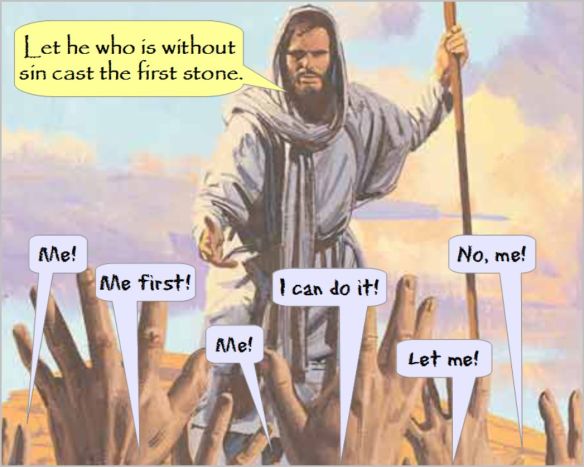
The Gilead regime envisaged by Margaret Atwood in The Handmaid’s Tale, where Old Testament sanctions are stringently applied in contemporary society, is closer than we think. People like those who hang around on Answers In Genesis’ Facebook pages, like flies around a corpse, would be more than happy to see the death penalty for those who infringe God’s barbaric laws. They’d be only too willing to throw the first stone, not only at difficult teenagers, but at all the others ‘God’s Word’ says merit the death penalty: couples who have sex when the woman is on her period (Leviticus 18.19); women who are not virgins on their wedding nights (Deuteronomy 22.13-14; 20-21); gay people (Leviticus 20.13); those who work on the Sabbath (Exodus 35.2; Numbers 15.32-36); blasphemers (Leviticus 24.16) and worshippers of other gods (Deuteronomy 13.6-9).

I am not an advocate of censorship but some form of censure is necessary for those who, either in speech or writing, advocate that others be put to death. Calling for the execution of those with whom you disagree or who have different moral codes cannot – must not – be tolerated in a civilised society. Pronouncements like those of Elizabeth Mitchell, her supporters and other religious crackpots who defend the indefensible, should be flagged up as hate speech, carrying a warning that the views expressed are themselves immoral, insupportable and, ultimately, illegal in civilised society. Ideally, their poisonous rhetoric should not be provided with an online platform. This wouldn’t, before anyone suggests otherwise, violate their right to free speech; they would still be free to express their unpalatable views in their churches, Creation Museums and own homes. Excluding them from Twitter, Facebook and YouTube, however, would deprive them of their wider audience – they’re only showing off, after all – and confine their hateful rhetoric to where it can do least harm.

These people are not merely ‘causing offence’ – offence is not the issue. They are inciting violence against others, influencing fellow believers to adopt their repellent views as their own. The standards of bronze-age tribes are not ours today; those who think they are abuse free speech and forfeit their right to be heard publicly.


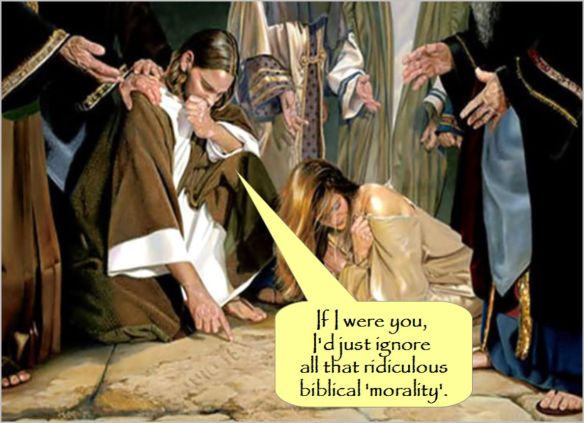
Making Excuses for Jesus

Hokum2

Excuse 3. When Jesus said ‘Kingdom of God’ what he really meant was ‘heaven’.

According to many Christians, the Kingdom of God is a supernatural realm where those whom Jesus has redeemed are going to go when they die. This kingdom is not, despite what Jesus said, coming to the Earth; believers are going to it, and it’s called heaven.

This is probably the most prominent view among Christians today and it couldn’t be more wrong. As we’ve established, Jesus says repeatedly and consistently that the Kingdom is coming here, to the earth. As well as all of his assurances (cited in earlier posts), he taught his followers to pray to God that ‘thy kingdom come, thy will be done on earth as in heaven’ (Matt 6.10), a petition Christians affirm whenever they repeat ‘the Lord’s prayer’.

Nowhere does Jesus promise his followers that they will spend eternity in heaven with God. Neither does Paul, nor any of the New Testament writers. Heaven, according to the bible, is God’s abode beyond the clouds; it is not a theme park open for visitors or long term guests. True, Paul believed that deceased souls would enter the presence of Christ to be kept safe until the Kingdom’s arrival, at which point they would be housed in new, spiritual bodies (1 Corinthians 15:35-58; 1 Thessalonians 4.13-18). These new bodies would not be for life in heaven, however, but for a resurrected existence here on earth, once the Kingdom had been established.

Amazingly, Paul expected people to believe this appalling drivel. Later Christians evidently couldn’t, and so invented the idea that they would be going to Heaven permanently post-mortem. John 14.3, which makes Jesus say he’s going to prepare a place for his disciples ‘in his father’s house’, might be an early sign of this wishful thinking. On the other hand it might mean something else altogether – as usual Jesus is made to speak in obtuse riddles.

Whichever it is, Christians are not promised an existence in heaven when they die. The only offer is of a place in God’s Kingdom on Earth, which both Jesus and Paul thought was coming very soon.


Excuse 4. When Jesus said ‘Kingdom of God’ what he really meant was ‘an internal kingdom of the heart’.

The Kingdom of God, then, must be, as a commenter on Answers in Genesis recently assured me, ‘an internal kingdom of the heart’. But you’d be hard pushed to find this bit of fluff in the bible. The closest it comes to saying any such thing is in Luke 17.20-21 where Jesus announces that the Kingdom of God is ‘entos hymon,’ a phrase sometimes rendered as ‘within you’ but which is more accurately translated ‘among you’. It is not an assurance that the Kingdom of God is some sort of silopsistic comfort blanket for believers in the far-flung future. It is yet more evidence that Jesus (or his script-writers) regarded the Kingdom as imminent in his and their own immediate context: first century Palestine. 

That’s four excuses – four explanations that what Jesus really meant was what today’s Christians want him to have meant. It’s tough facing up to the reality that God’s Son – God himself according to some Christians – was so mistaken, so disastrously wrong. But he was.

So naturally, more excuses are needed…


Whatever happened to the Kingdom of God?

Cross4

Jesus clearly and unequivocally announced that the Kingdom of God would soon be coming to the earth (Matthew 16.27-28; Matthew 24.27, 30-31,34; Luke 21.27-28, 33-34 etc).

This was his Good News. According to the synoptic gospels his entire ministry was about announcing the arrival of this Kingdom and demonstrating it was just around the corner (Mark 1.15; Luke 11.20 etc). All of his teaching was predicated on his belief that God was soon to intervene in human affairs to right all wrongs, repair injustices and punish the wicked (Matt 5.3-12; 25.31-46). He had no message other than this.

Yet many – most? – Christians refuse to acknowledge any of this. For Christians, Jesus was about something else entirely. Many of them argue that even though he might have appeared to say that God’s Kingdom was imminent, this wasn’t what he really meant.

When he promised it would happen ‘within this generation’ (Matt 24.34), they say, what he really meant was the generation alive after certain calamities had taken place (Matt 24.15-31), evidently more than 2000 years into the future. As I’ve suggested before, this makes him one heartless bastard, standing, as he did, in front of the meek, the hungry and the downtrodden and promising them all would soon be well, when he was ‘really’ referring to people who wouldn’t be born for another two millennia.

But then he’s more specific about who he intends the promises for, when says in Matthew 16:28, “Truly I tell you, some who are standing here will not taste death before they see the Son of Man coming in his kingdom.” ‘Some who are standing here’ – the people who were physically present, there in front of him, being addressed by him. It’s difficult to maintain that he meant people in the far future when he specifies those who are ‘standing here.’ Yet Christians maintain just this.

“Aah, yes,” they say, “but he was clear no-one knew the hour of the Kingdom’s return – not even himself.” Yes, he did say this – in Mark 13.32 – but there’s no conflict between this claim and his insistence the Kingdom would arrive soon. We all do this sort of thing when we say, ‘my parcel is due to be delivered some time today but I don’t know when exactly.’ This is what Jesus is claiming: ‘the Kingdom will be here very soon, though I don’t know precisely when.’ Too right he didn’t.

Nonetheless he thought he had a pretty good idea. In Matthew 10.23 he sends the disciples off to announce its arrival to the cities of Israel and tells them the Kingdom will have arrived before they return. When they get back (in the next verse!) the Kingdom is still conspicuously absent, so he and the gospel writers conveniently forget all about his rash promise. Where’s a good editor when you need one?

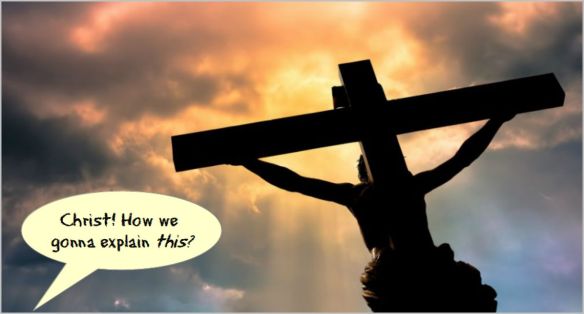
And then it all goes wrong for him. Jesus is arrested for his seditious idea that the existing system is about to be overturned and replaced (Matt 19.28), and he’s sentenced to death. Did he continue to hold out hope that God would act before the execution could be carried out? Did he expect his Heavenly Father to carry out a last minute rescue by bringing in the Kingdom with a great show of power? It seems likely, but as he hangs on the cross he realises, finally, that God is not going to act. God has let him down, as he always must, and a deserted and despondent Jesus cries out in dereliction: “My God, my God, why have you forsaken me?” (Mark 15.34). How could he have got it so wrong?

‘No, no, It can’t end like this,’ cry the Christians in return (and indeed it didn’t). But how to explain (away) the great failure of Jesus’ mission heralding the arrival of God’s Kingdom on earth?

Don’t worry, our Christian friends are up to the task.

Next time…


How to argue like a Christian (part two)

Street-preachers

Five more ‘arguments’ offered by Christians in defence of their insupportable beliefs:

You’re not entitled to speak because you have no objective basis for your morality; morality comes only from God/the Bible.

Except it doesn’t, of course; moral codes existed long before the Bible or even the invention YHWH, who is, in any case, morally bankrupt. This ‘most unpleasant character in all fiction’ ‘wallows’, if I might borrow the term, in genocide (1 Samuel 15.2-3 etc) and slavery (Leviticus 25.44-46; Exodus 21.20-21 ); he relishes the death penalty for the most minor infringements of his petty rules (Leviticus 24.16; Deuteronomy 21.18-21, etc ad nauseam); fails to keep his promises (Genesis 17.7; Mark 11.24); does nothing to relieve human or animal suffering and lets millions of children die needlessly, year in, year out. It just doesn’t suit his mysterious ways, apparently, to behave like any halfway-decent human being would.

And even if he were the morally-upright paragon of virtue Christians delude themselves into thinking he is, they would ignore his moral guidance at every turn, just as they do now. Ministers, priests, evangelists as well as run-of-the-mill believers are convicted every day of the most despicable of crimes (Bruce Gerenscer keeps a tally on his blog-site) and that’s before we get to the more exacting moral demands Jesus makes. Going the extra mile (Matt 5.41), loving neighbour (Mark 12.31) and enemy alike (Luke 6.27), giving to all who ask (Luke 6.30) – these most Christians simply ignore. ‘We’re forgiven, not perfect,’ they whimper, even though ‘perfect’ is precisely what their unreasonable saviour tells them to be (Matt 5.48). But then I’m probably quoting out of context again… or something.

You’ve been hurt in the past.

This weak, ad hominem response is the converse of the charge that you’re immoral; good cop as opposed to bad cop. The Christian who says this is all-seeing and all-knowing and is able to evaluate your entire psychology and personal history from a single comment you’ve made. They can tell that you’re only disputing an aspect of Christianity because obviously at some point in your past a Christian – who wasn’t really a true Christian – hurt you. Or maybe it was a church you once belonged to that let you down. Well, you’ve every right to feel hurt! But that doesn’t mean there’s anything wrong with the True Faith™ or those who subscribe to it! And so your point is neatly invalidated; you’re only responding emotionally and you’ll get over it.

If there’s no God then life is meaningless.

Used extensively by some Christian blog-sites, this non-sequitur translates as, ‘I’m not going to address anything you say. My neediness demands there’s some point to life and I’ve decided that it comes from the fantasy I’ve bought into.’ Questions of whether that fantasy is actually true (which by definition it can’t be) and whether life is meaningless without it, are never considered. Believers’ need for the delusion to be true, their fear of working out meaning for themselves and their subsequent investment in Christianity’s empty promises, compel them to hide behind what is an essentially… er, meaningless solipsism.

Unbelievers have no right to criticise those who belong to Jesus.

Haven’t we? We put up with all the nonsense Christians spout, their attempts to influence everything from elections to what we can see on TV, from their opposition to gay rights, same-sex marriage, women’s rights, abortion and adoption issues to the restrooms people can or can’t use and their judging of the rest of us as hell-bound sinners. In return, we unbelievers are perfectly entitled to hold Christians accountable. At the risk of repeating myself, do they do what Jesus tells them to? Do they turn the other cheek (Matt 5.39)? Sell their possessions to give to the poor (Mark 10.21)? Give more than is demanded of them (Matt 5.40)? Avoid judging others so they’re not judged in return (Matt 7.1-3)?

What do you think?

You’re of the devil/an enemy of the cross/wilfully blind/apostate/a troll.

If all else fails (and it will) the faithful resort to an insult carefully selected from the extensive bank of Christian cliches. That way, there’s no need to engage the brain at all. God love ’em!


Good news? What good news?

Disciples

Here’s what we know so far:

  1. There is no evidence the disciples were martyred.

  2. There is no evidence the disciples were martyred simply for believing that someone they knew had returned from the dead. In the age in which they lived such a claim wouldn’t have been out of the ordinary. The gospel accounts themselves record instances of resurrections other than Jesus’ and of miraculous manifestations of the dead. This was how people thought.

  3. There is no evidence that believing a dead man was alive again was a capital offence. Really, who could possibly care? Even Paul did not suggest that, as Saul, he liked to persecute early believers because of this belief.

  4. The gospel preached by Jesus and his disciples was completely different from that promoted by Paul. Their good news was about the imminent arrival of the Kingdom of God, when the Romans would be overthrown and every injustice made right (Luke 13.30). And while they may not have made it public, Jesus and his friends believed they would be the judges and rulers of this new system.

  5. This ‘good news’ existed long before Jesus died and long before Paul came along to change its nature entirely (Matt 10.23).

  6. Matthew and Luke, while including resurrection stories inspired by ‘visions’ like Paul’s, preserve, as does Mark, Jesus’ apocalyptic teaching. His promise of the coming Kingdom and his private teaching that he and his disciples would rule the new age together remain a significant part of the synoptic gospels.

  7. Jesus was executed for his seditious views (Mark 15.2, 9 & 32; John 19.19-20)

  8. It is likely, if they were martyred at all, that the disciples were killed for the same reason.

There are further indications in the New Testament that the original ‘good news’ had nothing to do with a mystical salvation plan and that the disciples clung to this original message – they’d heard it from Jesus himself, after all – even as other interpretations began to supersede it. We’ll look at these indications next time.

Famous Christian makes fatuous comments

Sentamu3

The Archbishop of York, John Sentamu, has spoken out on one of the most important issues of the day.

       Chemical warfare in Syria?

                                              Poverty?

                                                     The repercussions of Britain’s departure from the EU?

No, none of these. Chocolate Eggs. Or more precisely Chocolate Egg Hunts – those arranged by the National Trust in conjunction with chocolate manufacturers, Cadbury. This year, you see, these are not being promoted as Easter Egg Hunts but as Cadbury Egg Hunts.

And I’m sure you can appreciate just how significant this is. Because you see, without the name of a Germanic goddess of fertility (from which we also derive the word ‘oestrogen’) in the title of such a deeply spiritual activity, then, according to Sentamu, ‘faith is being airbrushed out of Easter.’ After all, chocolate eggs were such a crucial part of the original Christian Easter story, when the first thing the resurrected Jesus instructed his disciples to do was find all the Easter Eggs he’d hidden round the garden. And so it came to pass.

That’s why omitting the word ‘Easter’ from the Egg Hunt is, again according to silly old Sentamu, ‘tantamount to spitting on the grave’ of John Cadbury, who was there for that very first Easter but didn’t start making chocolate eggs until 1875.

But wait! Wasn’t John Cadbury a Quaker? And isn’t it the case that Quakers don’t celebrate ‘Easter’ because of its pagan associations? So Mr Cadbury is hardly likely to be upset, even if dead people could be, at his company’s alleged metaphorical grave spitting. Furthermore, might it just have been the case that those original Easter Eggs were – and remain – a cynical capitalist cash-in on a festival that the man himself didn’t actually believe in? Oh my, yes.

So, here’s all that spitting right back atcha, Senty – one in the eye for all your vacuous, self-promoting twaddle.


Next time: Why the side-lining of cute and cuddly Easter bunnies is an affront to the faith of many devout Christians, by Theresa May.


Still more of the Bible written sdrawkcab

The first mention of the Last Supper and the ritual established at it is in Paul’s first letter to the Corinthians (11.23-26):

For I received from the Lord that which I also delivered to you, that the Lord Jesus in the night in which he was betrayed took bread; and when he had given thanks, he broke it and said, “This is my body, which is for you; do this in remembrance of me.” In the same way he took the cup also after supper, saying, “This cup is the new covenant in my blood; do this, as often as you drink it, in remembrance of me.” For as often as you eat this bread and drink the cup, you proclaim the Lord’s death until he comes.

As David Madison points out, Paul happily admits he invented this – or, rather, he worked it up from one of his hallucinations. He certainly didn’t hear it from the people who’d known Jesus when he was alive; it’s unlikely they would have subscribed to such barbarity. As Madison shows, the idea of consuming blood, even symbolically, would have been anathema to most Jews (Deuteronomy 12.23 etc); it’s a ritual that originates in pagan worship. It’s there, for example, in Mithraism, which flourished in, among other places, Tarsus, where Paul came from. Evidently, celebrating Christ’s sacrifice by eating his body and drinking his blood took hold in the churches Paul established and by the time the gospels came to be written, its origin story was sent back in time to be part of them. This kind of thing happens in comic books all the time.

It’s quite possible that the stories of the resurrection developed the same way. We know that later followers of Jesus had visions that they interpreted as being of ‘Christ’. We know this because Paul refers to his experience a few times and also implies that other people had visions similar to his own. Were these hallucinations the only ‘sightings’ of the Risen Christ? We have no first-hand, eye-witness accounts of any other sort. Given that bodies don’t ever rise from the grave, especially not after a couple of days, it is more than likely they were all imaginary. It looks suspiciously like later encounters of Christ – all entirely within people’s heads – were written back into the gospel accounts to become the resurrection. Some of these were ‘firmed up’ to seem like encounters with a real person, which led to the invention of the empty-tomb, while others weren’t; a number make little attempt to convey an encounter with a real flesh-and-blood individual.

Bur wait, you say. There were believers in the resurrection before Paul. Surely the original followers of Jesus – the disciples, Mary Magdalene – saw the Risen Jesus. That’s why they believed in him, why they gave their lives to his cause, why they were prepared to die for their faith.

Well, no. We don’t know that this is what the original followers of Jesus thought or experienced. Why don’t we? Because:

  • The original followers left no records (or did they?)
  • Their community was wiped out by the Romans in 70CE.
  • Their brand of the faith, whatever it was, was obliterated by Paul’s Christ cult.
  • They had plenty of other reasons for believing in Jesus.

Seemingly Jesus told them he’d be back soon, bringing God’s Kingdom with him (Matthew 16.27-28 etc). And then, as he promised, the meek would inherit the Earth and his original followers would the rule the planet with him (Matt 19.28). Good enough – though completely daft reasons – why, after his death, these same followers holed-up in Jerusalem to await his re-appearance (through the clouds no less). The unlikely resurrection scenario, if they were even aware of it outside of their difficult meetings with Paul, must have seemed a poor second to the possibility of ruling the world in the here and now alongside their returned Lord and Master.

So, it’s entirely plausible that the resurrection, like Jesus’ prophecy of the temple’s destruction and the body-and-blood ritual of the Last Supper were invented decades after he lived by those in the Christ cult. It has long been known that the experiences of those in the early church, particularly those promoted by Paul, were written back into the gospels when they came to be created years after Jesus’ and the disciples’ deaths. Much of what you read there is fiction, propaganda served up, and believed to this day, as history.


How not to love your neighbour

preachersImagine: a group of health-fascists set themselves up on a soap box in the city centre from where they lambaste everyone going past, with language that is abusive and demeaning, about the poor state of their health, their out-of-condition bodies and that many of them are  significantly over-weight. But, the speakers insist, a bottle of a magic potion they just happen to be selling will solve all their health problems overnight! All anyone has to do is commit to swallowing some every day for the rest of their lives.

Unsurprisingly, people are upset about this; they’ve come to town for all sorts of reasons, but not to be lectured about their health and size, which, for most of them are both perfectly fine. Some of these folk challenge the snake-oil salesmen, shouting back at them (not having the benefit of a tannoy system) and demanding to know what gives them the right to harass passers-by. In response, one of the salesmen pulls out a copy of last Tuesday’s Daily Mail; ‘it’s all in here,’ he declares, ‘all in black and white, and we believe it. The Daily Mail wouldn’t lie to us. Its Word is Truth. So get your magic potion now before it’s too late, ya depraved, ignorant slobs!’

Acceptable or not?

While you think about – if you even need to – the picture above was intended to accompany the previous post. It shows street preachers Michael Overd, Michael Stockwell and Adrian Clark before their trial for ‘public order offences’, which started last week and concluded on Tuesday this week. I felt it couldn’t be used while the trial was ongoing (contempt of court and all that) and so had it replaced with one of rabid American nutcase Franklin Graham.

Two of the three preachers, Overd and Stockwell, were found guilty and fined. Naturally, there’s an outcry from Christians and assorted fruitcakes everywhere about how the two have been denied their freedom of speech (though there is no protection of free speech under UK law) and how – oh calamity! – it’s no longer possible to ‘preach the gospel’ in the Britain. Absolute nonsense, of course, and while some more liberal commentators feel the case should never have reached the courts (let the nutjobs condemn themselves by spouting in the streets, suggests one) an example has been made of people who think the way to show love for your neighbour is setting out, in the judge’s words, to ‘insult, humiliate, demean (and) belittle’ them in public using a loud speaker in a shopping centre.

As Andrew Calibre pointed out in the previous post, haranguing and provoking people like this has nothing to do with love, nor is it ‘the gospel’. Shouting, as Overd did, about how your neighbour is ‘depraved and ignorant’ and how those who have sex outside marriage and gay people (of course) are ‘filthy, depraved and perverted’ is not, by any stretch of the imagination, ‘the good news’.

Perhaps the confusion is understandable when the Bible and God’s people™ are so muddled themselves about what ‘the good news’ actually is; God’s Kingdom arriving on Earth, as Jesus seems to have thought? Paul’s magical salvation formula? Or maybe it’s that there’s a free pass to heaven? One thing’s for sure, verbally abusing your neighbours and other strangers it isn’t. Even if street preachers justify their arrogance and rudeness by claiming they’re only conveying what (they think) the Bible says – so what? Their tawdry little book has no more authority than any other collection of ancient (or modern) fantasy, prejudice and supposition.

So, no, it’s not acceptable that hypothetical, self-appointed health experts verbally abuse strangers in the street. And as the court ruled this week, nor is it when religious zealots do the same. Passers-by and by-standers have every right to feel irritated, annoyed and offended, just as Christians would be if a group of Muslims propounded their beliefs with the same aggression, informing all and sundry how wicked they are and how they are destined to spend eternity in whatever hell Islam envisages. Nor would ‘we’re only preaching what the Qu’ran teaches’ be any justification.

But the issue isn’t only the irritation that people feel when religious extremists abuse them. It’s the one in a hundred, or whatever the percentage is, who takes them seriously, accepts the confederate’s tract, shows interest and is ultimately sucked into one of the many versions of the mind-numbing Jesus cult. Far worse than selling people magic potions, or insurance they don’t need, there is something obscene about cranks taking to the streets to recruit the gullible and unsuspecting to their (lost) cause. We wouldn’t tolerate it if it were anything other than religion, why should we accept it when it is? The prosecution of presumptuous con-artists does us all a service.


What’s Love Got To Do With It?

franklinA guest post by Andrew Calibre.

So there’s this smart-arse who thinks he’ll catch Jesus out by asking him a tricky question like, is it true microbes cause illnesses? Or, is Ken Ham right that the universe is only six thousand year old? But he bottles it, maybe ’cause he knows JC won’t have a clue what he’s talking about, and asks him an easy one instead – simple stuff about Jewish rules or something. “What is the greatest commandment?” is the best he can come up with (Matthew 26.32-40).

Jesus takes his chance and says, “Love the Lord your God with all your heart and with all your soul and with all your mind.” Predictable or what, even if he does make a big mistake: whoever heard of ‘the mind’ having anything to do with religion! Still, JC can’t resist elaborating on it. “This is the first and greatest commandment,” he says, as if everybody round him doesn’t know that already when it’s in their old magic book (Deuteronomy 6.5). He’s on a roll now and on he goes: “And the second is like it: ‘Love your neighbour as yourself.’ Clearly a cock-up, but there’s no stopping him: “The whole bloody religion” – he’s talking about the Jewish stuff, not the Christian fantasy that he knows nothing about on account of it not being invented yet – “is about these two things, nothing more,” he says.

Christ! How could he have got it so wrong? Love your neighbour as yourself! Whoever heard such crap? I know, a nice idea, but I ask you. Everybody knows that being religious, being a Christian, is about believing the right stuff (having the right doctrine, I think it’s called), trashing other Christians who believe the wrong stuff, and dumping on everybody else, specially if they’re sinners (and they’re all sinners), foreigners, LGBTI or transgender. Now that’s real Christianity. I know it is, because that’s how Christians do it, and they’re the ones who should know.

Apart from Jesus, nobody thinks loving others like you love yourself is a good idea. Even he wasn’t very good at it (Matthew 15.22-28 etc). What ‘your neighbour’ is for, is pointing out how sinful/lost/degenerate they are, how they’ve f**ked up their lives, how God’s going to punish them for all eternity for not being the same as you and how they’re just about single-handedly bringing about the end of the world on account of being so perverted/evil/foreign.

That’s how you love your neighbour! You can’t even claim to be loving them properly unless you’re telling them about Jesus, over and over again, and, in the process, denigrating, dismissing and damning them to hell over and over again. This is what truly loving your neighbour is about! I know because Christians say so endlessly: ‘you’re only really loving others if you’re telling them what shite they are and how they need Jeeesus to wipe it all away.’ So, okay, this isn’t exactly how you love yourself, but what’s that got to do with it?

If only Jesus had listened to his mouthpieces today. They know far more than he did about what’s important.

And love it isn’t.