Don’s Dynamic Lie-Detector

But you have an anointing from the Holy One, and all of you know the truth. I do not write to you because you do not know the truth, but because you do know it and because no lie comes from the truth.

1 John 2:20-21 as quoted by Don Camp.

Our resident, regularly banned God-botherer, Don Camp, claims that he has a special way of reading and interpreting spiritual writing. No, he hasn’t got a pair of magic rocks, but an inner ‘anointing’ with what Don calls his ‘lie-detector’. (You might have a similar device yourself, known more commonly as a bull-shit detector. Its alarm may well have been a-ring-a-ding-dinging when you read Don’s comment.)

Anointing, if you’re interested, is the ancient Jewish custom of initiating a king or priest by daubing oil on their head. Don has no evidence that he has been inwardly ‘anointed’ by an unseen spirit that helps him understand scripture better than anyone else. There is no evidence, outside of subjective feelings and one tautological bible verse, that any religious believer has had this done to them. (Read 1 John 2.20-21 again, Don, and you’ll see that a tautology is what it is: ‘the truth is the truth is the truth,’ is really all it says.)

On the contrary, we find that different Christians interpret given scriptures in a variety of different ways (I’ll get to examples in a minute). They differ too on which bits of the Bible are relevant to them and their church or sect. They disregard or explain away verses that don’t suit their purposes.

Don does this himself. His anointing Spirit doesn’t lead him to interpret verses like Matthew 16:27-28; 24:27, 30-31 & 34, Romans 13, 11 & 12, 1 Peter 4:7, 1 John 2:18, Revelation 22.20 etc at face value. He cannot countenance the fact that Jesus, Paul, John and all those other early fanatics were wrong about when the end of the age would happen – they are all very clear they thought it was imminent – so he reinterprets what they say to mean something they clearly and unequivocally do not. Don’s interpretation has them meaning, despite what they say, that the end of the age and all that goes with it would be thousands of years in their future. Should you challenge him on this, Don tells you that how you see it is wrong because you don’t have the special anointing he has. As he puts it in his comment, you’re lacking the right ‘dynamic’ (ring-a-ding-ding!) and as a result, you are incapable of interpreting scripture in the right way (i.e. his way).

In fact, Don does not have a way of understanding scripture that he can call his own. Rather, he interprets it with preconceptions he’s acquired elsewhere; that it is God’s Word, that it is Truth, that the spiritual world it describes is real, that it relates an historical resurrection, and so on. He comes to it with these presuppositions that he has learnt from preachers, teachers, commentaries, devotional books and other Christian propaganda he’s been exposed to. He is completely unable to take a step back to look at what he’s reading objectively. He knows what it says before he reads it – ‘truth’ as far as the Bible is concerned, ‘lies’ when it’s the Book of Mormon – and imposes that meaning onto it. This ‘dynamic’ enables him too to smooth over all of the Bible inconsistencies and allows him to see it as one seamless garment when it evidentially is not. He’s not alone in doing this, of course. Most evangelical (‘anointed’) Christians do it. I know I did.

Now for those examples, and a challenge for Don:

1. A few days ago, Holy Spirit anointed, preacher Dillon Awes used his dynamic lie-detector to interpret the Bible’s declarations about homosexuality like this:

What does God say is the answer, is the solution, for the homosexual in 2022, here in the New Testament, here in the Book of Romans (1:26-27)

That they are worthy of death! These people should be put to death!

Every single homosexual in our country should be charged with the crime, the abomination of homosexuality, that they have. They should be convicted in a lawful trial. They should be sentenced with death. They should be lined up against the wall and shot in the back of the head! That’s what God teaches. That’s what the Bible says.

2. Similarly, over the weekend, Ken Ham interpreted Genesis 1 to mean that dinosaurs and humans lived at the same time. After all, he ‘reasoned’, Genesis says God created ‘everything’ in those first six days, so that must include dinosaurs as well as Adam and Eve.

3. Pastor Douglas Wilson who featured recently on Bruce Gerencser’s blog, interpreted the assertion in Ephesians 5:22-24 that wives should be submit to their husbands, even if it entails rape:

…We have forgotten the biblical concepts of true authority and submission, or more accurately, have rebelled against them… However we try, the sexual act cannot be made into an egalitarian pleasuring party. A man penetrates, conquers, colonizes, plants. A woman receives, surrenders, accepts. This is of course offensive to all egalitarians, and so our culture has rebelled against the concept of authority and submission in marriage.

My question to you, Don, is: do you interpret Romans 1:26-27, Genesis 1 and Ephesians 5:22-24 the same way as these other Holy Spirit directed interpreters of scripture? If not, why not, when it’s the same Holy Spirit that equips you with your dynamic lie-detector, that also leads them into all truth?

These is not a rhetorical question; we all want to know. But be warned, Don, our bullshit detectors are primed and ready.


How We Got The New Testament

Recycled pictures, new post.

Once upon a time, there was, possibly, a bloke called Yeshua Bar Yosef. Maybe there was, maybe there wasn’t, but either way, a couple of other blokes, one called Simon (or maybe Cephas or maybe Peter), came to believe that Yeshua had returned from the dead and had appeared to them, alive. This was probably all in their heads and what they saw was at most a blinding light, if they saw anything at all. This was certainly the case for a different bloke, Saul (or maybe Paul) who came along later. He wrote about his experiences and admitted they were all in his mind.

This Simon-Peter-Cephas and maybe one or two others convinced themselves that Yeshua was God’s special emissary and would save them from something, somehow or other. They told other people this and, being gullible, some of these other people believed that Simon-Peter-Cephas and his mates really had seen Yeshua alive again. They started to believe Yeshua would save them too. Saul-Paul, meanwhile, wrote letters to the people he’d persuaded to believe in his version of events – it was a bit different from what Simon-Peter-Cephas and co believed – and, writing in Greek, rendered Yeshua as Iesous (‘Jesus’ came much later when the ‘J’ was invented in the 16th century.) Paul thought Iesous was a celestial being he called ‘the Christ’. He taught that this Christ would soon be coming down to the Earth to set up God’s Kingdom here. Even though they were obviously a bit rubbish, Saul-Paul’s letters were copied multiple times by hand, which is when errors began to creep in. In some places, the letters were deliberately altered.

Other people wanted to get in on the act, so they wrote letters too, pretending they were Saul-Paul. Sometimes these letters said the exact opposite of what the real Saul-Paul wrote. His weren’t the only letters to be forged either. Fifty or more years after the entire scam had got underway, someone pretending to be Simon-Peter-Cephas sent letters as if they were from the man himself. Needless to say there were cultists daft enough to believe it. There were others who wrote letters too, people like James and John. James didn’t see eye-to-eye with Saul-Paul and contradicted many of the things he said.

About 40 years after Simon-Peter-Cephas thought he’d seen the dead-but-alive Yeshua-Iesous-Jesus, somebody in a different country decided to write a back story for the character. He didn’t know much about Yeshua-Iesous-Jesus, what he’d said and done and whatnot, but that didn’t deter him. He borrowed bits from Saul-Paul’s letters and Greek myths and set about it. He scoured the Jewish scriptures for anything that sounded like it might be a prediction of Yeshua-Iesous-Jesus and his supposed escape from death. He made up episodes for him based on these completely unrelated scraps of scripture. He forgot to sign his work, however, and it wasn’t until years later that someone else decided this author’s name should be ‘Mark’.

A couple of other anonymous dudes liked what ‘Mark’ had done when inventing his Yeshua-Iesous-Jesus story but thought they could make a better job of it themselves. The first of these, who would later be called Matthew, lifted most of Mark’s effort (which is how we know ‘Matthew’ wasn’t an eye-witness; an eye-witness wouldn’t plagiarise most of the story from someone who wasn’t) and then went overboard with the prediction/prophecy thing that Mark had started. He found even more spurious bits of scripture and made up a whole lot of new stories about Yeshua-Iesous-Jesus from them. Later still, ‘Luke’ wrote his version of the story, using Mark and Matthew’s accounts and inventing a few new episodes himself. This same person went on to write a fabricated history of the Yeshua-Iesous-Jesus cult, making up stories and speeches for caricatures of Simon-Peter-Cephas and Saul-Paul.

The fourth person to try his hands at writing a script for Yeshua-Iesous-Jesus decided to completely reimagine the character. Strictly speaking, this ‘gospel’ was produced not by a single person but by a collective of cult members. Their Jesus was nothing like the one in the other three gospels. He was more a super-hero, whose special power was boasting about himself. This is the Jesus that, 70 years on, the cult wanted to believe in. Eventually, the name John would be attached to this fantasy, though this isn’t the same John who wrote letters nor the one who created the hallucinatory nightmare that would become the final book of the Bible.

These various letters and stories circulated round the Roman Empire wherever members of the new cult met. Eventually, someone hit upon the idea of collecting them together as one volume. The first we hear of this is when a guy called  Marcion produced his own collection, round about AD140. Stupidly, he didn’t include the right ‘books’ and it wasn’t until AD367 that the collection we now know as the New Testament was first mentioned. This was ratified later that century by a group of men who had elevated themselves to positions of authority in the Church, as the cult was now calling itself. Despite claiming they had been guided by the Holy Spirit, these learned men endorsed the inclusion of several forgeries. Neither did they see fit to arrange the books in the order they’d been written, giving the impression that the accounts of Yeshua-Iesous-Jesus’ life existed before Simon-Peter-Cephas and Saul-Paul’s innervisions that had sparked the whole thing in the first place.

Jump forward a few hundred years and the New Testament, as it was now known, had come to be regarded, by some, as the infallible, inerrant and authoritative Word of God, which clearly it is not. These epithets stuck, however, and are still held to be accurate descriptors of the New Testament by people who have stopped thinking for themselves.

So there we have it: how we got the New Testament –

  • It wasn’t written by eye-witnesses.
  • Its accounts of Jesus’ life are largely fictional.
  • It owes much to fanatics who were prone to visions.
  • It is given to wild speculation, offered without a scrap of evidence.
  • It contradicts itself.
  • It includes many fakes and forgeries.
  • It was banged together by men who didn’t really know what they were doing.

And after that, everyone lived delusionally ever after. The End.

Assertions

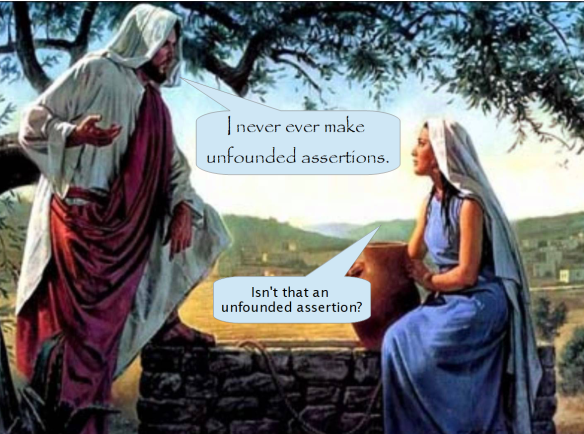
Don likes to take me to task for what he says are assertions in my arguments. I do make assertions, as do we all, because not all points in an argument need to be demonstrated every time they’re used. Indeed, not all assertions can be.

There are assertions that we all accept are likely to be true: the sun will ‘rise’ tomorrow; the Earth is a sphere; evidence is better than no evidence and so on. There are those who dispute these assertions but the onus is then on them to provide the evidence or argument that their counter-assertion is true. Yes, there may come a day when the sun doesn’t rise but it is statistically improbable; the Earth is demonstrably not flat; faith is not an reliable substitute for evidence. There is abundant evidence and sound argument why these things are not the case. But – and this is my point – this evidence does not have to be trotted out every time an argument relies on such probabilities; they can be asserted.

I write, and indeed live my life, on the basis of the fact (‘assertion’) that the supernatural does not exist. Over the last ten years, I’ve posted several arguments why this is the case. I frequently provide a link to these arguments when asserting that, outside of the human imagination, gods, spirits, angels, devils, demons, powers, principalities, ghosts, avatars, heaven and hell do not exist. These arguments form the backbone of any subsequent assertion that the supernatural is not real.

Nonetheless, the onus to ‘prove’ that this is the case does not rest with me. First, because it is impossible to prove a negative. Consider, for example, the Christians challenge to prove their God doesn’t exist. While there is plenty of circumstantial evidence that this is the case, there is no absolute ‘proof’ of God’s non-existence (as I’ve argued before, it all comes down to probability, or, in God’s case, improbability.) Absence of evidence is invariably evidence of absence.

The onus instead lies with the one making the incredible claim. Those who take it as fact that the supernatural and God are real need to demonstrate to the rest of us that this is the case. They have, in my long experience, failed to do this. The best they can do are the various arguments (the ontological, Kalam cosmological, teleological, fine-tuning and the argument from design) that suggest the possibility of the supernatural but fall far short of convincing evidence that the supernatural is real, and further still that the Christian God exists. They depend in the end on the feelings they have in their heads and the Bible (or some other holy book.) This is wholly inadequate

Consequently, I’ll continue to operate from and make my assertion that the supernatural does not exist until such time as Don or any other of his co-religionists demonstrate the probability that it does.

From my assertion, backed up, remember, by earlier arguments, a number of other facts follow:

With no supernatural, there are no gods; YHWH in all his incarnations is a God, therefore YHWH does not exist.

Much follows from this:

If YHWH does not exist, Jesus cannot have been either his avatar, Son or incarnation;

Jesus cannot have been raised from the dead by a being who doesn’t exist;

Stories that he did so must therefore be merely that: stories;

The celestial, eternal Jesus who sits at the right hand of God in heaven is not real;

Any experience people have of this being is entirely within their own imaginations;

The Bible is based on such imagined encounters with these imagined characters;

There is no after-life or judgment;

The Christian faith, including my own, cannot be explained in terms of the supernatural;

Only explanations that are rooted in naturalism, as in science, have any validity.

There are more implications that can be drawn from the premise that there is no supernatural, including the fact that the world makes much more sense (if it makes any sense at all) without drawing gods and demons into it.

Consequently, I shall continue to make my assertions, like those above, supported as always by previous argument. Any religious believer who wants to challenge them is welcome to do so, but must do more than point out the obvious, that they are assertions. They must provide the evidence for the supernatural, and all that follows from it, independent of the goings on in their heads and without reference to holy books written by those with similar subjective feelings.

Making Prophecy Work

Recycled image and still no second coming

Never one to belabour a point, Don Camp has responded to my posts and comments about prophecy over on his own blog, Biblical Musing. This is a modified version of my response to that post.

What you seem to be saying, Don, is ‘leave a selected prophecy long enough and eventually it’ll appear to come true’. Perhaps, but then, if you take any selection of predictions from any source and you’ll find this to be the case. Why? Because:

1) You’ll have cherry-picked from the start so only those ‘prophecies’ that are vague enough or appear to have been fulfilled already will make up the bulk of your selection.

2) The vagueness of many that are chosen will make it relatively easy to scout around and alight on circumstances that seem to demonstrate some sort of fulfilment. You may even invent some that do, like the synoptic gospel writers do.

3) Some prophecies will indeed come true, but at no greater rate than chance allows. A prophecy you cite may say a particular city state will fall and return to the wilderness from which it was built. To claim that when, centuries later, it does so is not a fulfilment of this prophecy; it is a happy coincidence (for you and your so-called prophet, not so much for the denizens of the city state.) Just look at the number of ancient cities to which this has happened, without there being a preceding ‘prophecy’. It just happens.

4) You’ll ignore your own failure rate, or explain it away: i) discounting those prophecies that have never come to pass, even after millennia; ii) insisting ‘they could still occur! With God a day is like a thousand years!’; iii) reinterpreting them: ‘they’re metaphorical’ etc.

5) You invoke the get-out clause; the god says ‘if you don’t do ‘x’ then I’ll make ‘y’ happen.’ “Well, praise the god, everyone did ‘x’ and the calamity was averted! It’s a miracle!” This then counts, somehow or other, as a win for the ‘prophecy’.

These are your strategies, Don. You use them in combination to demonstrate the ‘fulfilment’ of biblical prophecy. You work really hard at nullifying your own cognitive dissonance, desperately attempting to demonstrate the truth of ancient fantasies. You conclude your post by saying Jesus will return as King soon. No, he won’t. You need to apply every one of your strategies to believe this is ever going to happen.

Fakin’ It

Here’s my dilemma. I got this letter from a group of students at the university of Selcuck in Turkey. Well, when I say I received the letter, it was addressed to Professor Paulson who was head of the Philosophy department here in the 90s. He’s been dead now over 20 years of course, so when I picked up the letter, I thought I’d just write back and tell them that and that they’d have to work out their problems for themselves. Then I thought, ‘well, hang on a minute, the Professor was your tutor back in the day. You know how he thought and how he’d address these particular problems. Hell, you’ve even got some of his old papers locked away in your filing cabinet. You could take one or other of those and with a bit of tweaking, concoct a reply yourself. That’d be perfectly legitimate wouldn’t it?’ I mean I occupy the chair he once did so I am in effect his replacement.

So that’s what I do. I take one of Professor Paulson’s papers and I use it as the basis of a letter. Of course, matters in philosophy have moved on a bit since the Professor’s time so I add quite a bit of my own stuff, which is all pretty good and in line with what he might have thought, had he lived this long. After all, I studied under him in the ’80s so I have a pretty good idea of what he might think today, if he were still with us. If I do say so myself, it’s pretty good stuff. Nobody could tell Paulson didn’t write it.

Now, I do consider admitting at the start of the letter, or maybe the end of it, that I wrote the letter and not the Prof. But then I think, well, these folk don’t know he’s no longer with us so what’s the harm? I’ll just send it and they can reach their own conclusions. I mean, it wouldn’t be my fault, would it, if they jumped to the wrong conclusion. And then I think, well, if they’re going to do that I might as well sign it as if it is from the Professor. I mean, who’s to know? And maybe I could add that bit at the beginning suggesting it was from him. Suggesting? Saying it is from him. That’s what I do, and off it goes.

I hear later, on the grapevine, it’s gone down pretty well. They like what it says and are convinced it’s from Paulson. Everybody’s happy.

And then I find out, a couple of months down the line, that it’s been published. The Selcuck students have had it published, in an influential journal no less, and the academic world is celebrating the final lost paper of Professor Paulson’s. And here’s my dilemma: it’s not, is it. It’s me. I’ve taken his old paper, embellished it and sent it out into the world as if it’s his. What do I do? What would you do? Confess it’s not what it seems? Or bask in the knowledge that what I’ve written is as good as anything he wrote in life? A fake, yes, for sure, but a damn good one that, with a bit of luck, no-one’s ever going to spot. Do you know, I think I’ll leave it, say nothing. The joke’s on them.

Of course such a thing could never happen. Or could it? The letter to the Ephesians in the New Testament claims to have been written by Paul. It starts with this greeting:

Paul, an apostle of Christ Jesus by the will of God, To God’s holy people in Ephesus, the faithful in Christ Jesus: Grace and peace to you from God our Father and the Lord Jesus Christ.

and ends with some vaguely autobiographical details.

But it wasn’t written by Paul. Scholars think it was created in the 80s, about twenty years after Paul died. Much of the letter is a reworking of Colossians, the authorship of which is similarly disputed. Here’s the opening of Colossians:

Paul, an apostle of Christ Jesus by the will of God, and Timothy our brother, To God’s holy people in Colossae, the faithful brothers and sisters in Christ: Grace and peace to you from God our Father.

The Ephesians opening is a direct lift. None of Paul’s genuine letters follow this format. The letter itself has a style and vocabulary unlike that in the genuine Pauline letters and there are significant differences in theology too. Here’s how Bart Ehrman summarises the problem (though note he is not the only scholar who disputes Paul’s authorship of Ephesians; it is the consensus view): 

Ephesians does not resemble Paul’s writing style and the letter contains an inordinate number of words that Paul does not use in any of his undisputed letters. As in Colossians, Ephesians suggests that the believer has already been raised with Christ-a view that contradicts Paul’s undisputed writings. The author of Ephesians, moreover, uses the term “works” differently than Paul. For Paul, “works” refers to adherence to the Jewish law, actions that cannot save. The author of Ephesians, however, understands “works” to mean those actions that demonstrate one’s faith.

Some generously describe Ephesians and other letters attributed to Paul that aren’t by him, as Deutero-Pauline: ‘in the tradition of Paul’. Some speculate that they were written by one of Paul’s disciples but there’s no way of knowing this for sure. Others prefer the term Pseudepigrapha, literally ‘false inscription or writing’, which is nearer the mark.

The author of Ephesians, like those of other pseudepigraphical letters, such as the pastorals (1 and 2 Timothy and Titus) claims explicitly to be Paul knowing full well he is not. This is not some disciple trying to express the views of the master, this is someone passing themselves off as someone else, pretending they are the more well-known, revered and authoritative figure. Even if they were someone familiar with Paul’s teaching (the differences in theology suggest otherwise) would it be legitimate for him to claim he is Paul?

Like my fictional individual above, the author of Ephesians is a deceitful impostor, his work a forgery, designed possibly to ‘correct’ Paul’s position on certain issues. And yet here is his letter in the New Testament; God’s Holy Word no less. While there is a very human history of how works were selected for inclusion in the New Testament, how on Earth did God, in the guise of the Holy Spirit, allow this and other forgeries to become part of the canon?

Of course, God had nothing to do with it. The author of Ephesians duped not only the letter’s original audience, but also the later believers who included it in the Bible. He continues to deceive the faithful down to this day.  I know: I was one. 

Responding to a Christian

I responded to comments by our resident cultist, Don Camp, who replied with the following (and more: see comments). I want to pick up (in blue) on some of the points he makes:

I originally asked Don: why is it that whenever anyone asks you to provide evidence for your beliefs, or to confirm what those beliefs actually are, you invariably side-step the issue.

Don: That seems to be the procedure (your procedure, Don?) here and on most atheist blogs, I might add. I really think that I have answered that question clearly enough to be understood (you’ve responded to some questions but have provided evidence for very little of what you’ve claimed. Bible quotes are not evidence.) If not, there is my blog post. But I would ask the same and have of all of you. What do you believe to be true about life and reality? And why or what evidence do you have to support that belief?

Don, there’s ten years’ worth of blog posts on Rejectingjesus, many of which are about what I believe and the evidence I have for those beliefs. I’m not going to reiterate all of them here for your benefit. If you’re interested you could read the posts here, here, here, here and here. I suspect you’re not though; this is just another tactic to deflect the question away from yourself. Don’t you think it reasonable when you launch your sermonettes on other people’s blogs that they ask you to supply evidence for the beliefs you’re promoting? 

Don: I usually get what, I believe, Ark said when I asked about his evidence for Materialism: Everything we know has natural causes, so to presume that the whole universe has a natural cause reasonably follows. (My paraphrase) That is honest and clear. But that is the very same kind of evidence I’ve provided for my worldview. You, Neil, have not provided even that much. Usually I get something like: Atheism, is about what we don’t believe, and we don’t believe there is evidence for God. The trouble is that is negative that conveniently sidesteps the question.

So you do get answers to your questions (so what you moaning about?) I concur with Ark. However, you do not provide the same sort of evidence. You generally rely on the argument from incredulity: I can’t see how something so amazing as the universe could have come into existence on its own, therefore God must’ve done it.’ This is not evidence. You then make the further unfounded claim that this God must be your God who magically created everything via the agency of his Son. Whatever this means, it is not evidence. (Before you say you don’t do this, just check out your further comment below.)

Neil: How about answering my question: do you subscribe to Paul’s first century view that ‘the world’ is governed by wicked powers and principalities that hover around us causing all sorts of mayhem…

Don: No and Yes. No, I don’t think that people are governed by those powers, but they are influenced by them. Yes, I believe there are powers that influence people. And I believe that people can so give themselves to that influence that I would say they are governed by them. (my emphasis). So no prevarication here then! Now how about answering mine. Do you believe that reality is purely material? See above and the posts I directed you to. There is no evidence for the supernatural.

Neil:  Could only a blood sacrifice, in God’s eyes ameliorate (the effects of these demons)?

Don: No. Those powers do not cause sin. We do. (And that I believe is really Paul’s view.) Right. So you know what was really Paul’s view, which, it turns out, is not the one expressed in Ephesians 2:1-3 & 6.11-13. (Addendum: it’s widely acknowledged that Paul didn’t actually write Ephesians. It’s a later forgery based on Colossians.)

Don: No. I believe that only forgiveness can ameliorate sin. The sacrifice of the Lord Jesus is the act of forgiveness made visible. Does your believing make it so? Where does the bible actually say this?

Neil: where is your evidence that this (Paul’s worldview) is reality?

Don: I am not sure what “this” means. There are too many possible referents. If you replace that with a specific, I’ll answer.

It’s clear and specific, Don. We were discussing Paul’s worldview. I asked if you believed it and if so, what evidence you had that ‘this’, Paul’s demon-infested world, was real. You’re side stepping again. 

Me: Or how about answering Ark’s question about whether you believe Jesus was the creator of the universe and what evidence there is for such a belief?

Don: I don’t recall that question exactly (!) But the answer is I believe that God created the universe through the agency of his Son and the earth within it. (And I think that is the crux of our differences). You’re not kidding. 

Don: Evidence “succinctly” is, to use a metaphor, his fingerprints are all over it. Is a metaphor evidence? I don’t think so. It’s a literary device. In any case, every other religion that claims a creator God says the same thing. 

HOW DO YOU THINK THE UNIVERSE CAME TO BE, AND WHAT EVIDENCE IS THERE FOR SUCH A BELIEF? AND HOW DO YOU ACCOUNT FOR THE DYSFUNCTION OF HUMANITY THAT CAUSES ALL THE CHAOS AND DESTRUCTION MORALLY AND SOCIALLY? AND FINALLY, WHAT IS THE REMEDY?

My God. You’re gone all caps lock. In answer to your very important questions, see my response above. To summarise:

It is largely irrelevant what I THINK about the origin of the universe. It’s possible, however, that the universe has always existed in some form. You claim this for your God when there’s no evidence he exists; assuming those same qualities for something that does is a more realistic prospect. It is indeed what a number of scientists think. (I expect you’ll know better).

The ‘dysfunction of humanity.’ Is it dysfunctional? Many of us are kind and decent. Humanity is what it is, and it is what it is because we’re evolved primates.

The remedy for what, Don; for what we are? It’s quite likely there isn’t one. Jesus certainly isn’t it. History teaches us that Christianity has only provided some of us with an excuse to behave even more reprehensibly (Putin claims to be a Christian albeit a Catholic; he says one of the reasons he’s invaded Ukraine is to impose traditional Christian values on the country.)  If anything is going to improve us, it’s education; it has civilised us to a significant extent but still has a lot to overcome. 

That’s it. Now go and read those old posts before writing your next sermonette. 

The ‘F’ Word

Don Camp is defending Christians in the comments. They’re in the process of becoming ‘more like Jesus’, he says.

What does this even mean, Don? How can you know what Jesus was like when there are so many disparate versions of him in the Bible (as has been pointed out to you)? Does becoming more tempestuous, impatient, impossibly demanding and Jewish count? These are some of the traits his propagandists show him as having.

You then tell Jim not to measure Christians ‘by his (own) experience’. What other measure is there? Christians aggressively promote their beliefs on the internet, have infected politics and, at a lower level, are encountered as judgmental evangelicals and sanctimonious street preachers; these are the Christians of our experience and like it or not, the fragrance ain’ that sweet. As Jesus is supposed to have said, ‘by their fruits shall you know them’. We sure do.

Bottom line, Don: you Christians have had two thousand years now to make the world a better place by being ‘more like Jesus’. On balance, you’ve failed. Not surprising when Jesus himself failed even more. Where is he, Don? Following his ‘return’, the Righteous should have been living in peace and harmony for the past two millennia, tediously worshipping him and his Father in God’s Kingdom on Earth. They haven’t been, even though Jesus, Paul and several other NT writers said they would be ‘soon’, relative to their own lifetimes. 

Argue it how like, Don (and you will), Christianity merits one big ‘F‘.

Dear Evangelical: Why Aren’t You A Mormon?

Dear Don,

Why are you not a Mormon? I mean, you appeal to the evidence of consistency across the 66 books of the bible, claim that the gospel writers remained true to an oral tradition (despite John’s gospel being markedly different from the other three) and insist there is no difference between the original apostles’ gospel and Paul’s (when Paul is adamant there is.) In fact, there is even better evidence that Mormonism is true.

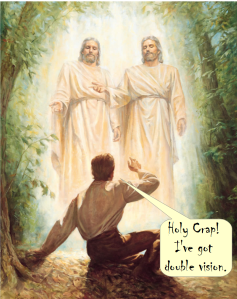
First off, Joseph Smith saw the resurrected Jesus in person! Not only Jesus but God the Father too. And they spoke to him! He relates the story himself, so unlike the gospels, this is no second hand reportage:

I saw two Personages, whose brightness and glory defy all description, standing above me in the air. One of them spake unto me, calling me by name and said, pointing to the other—This is My Beloved Son. Hear Him!

Following this, young Joseph was instructed to translate the Book of Mormon from some golden plates. We don’t have to take his word for it that these plates existed because Joseph had witnesses:

Eleven official witnesses and several unofficial witnesses testified to the existence of the golden plates and, in some cases, to dramatic supernatural confirmation of their truth. Meticulous research on these witnesses has confirmed their good character and the veracity of their accounts.

Impressive, don’t you think? We have no such affidavits for the gospel writers – we don’t even know who they were!

Also like the Bible, the Book of Mormon had multiple authors (Joseph Smith was only translating, remember):

Furthermore, in recent years, rigorous statistical analysis strongly indicates that neither Joseph Smith nor any of his known associates composed the English text of the Book of Mormon. In fact, research suggests that the book was written by numerous distinct authors.

And yet, the Book of Mormon tells a story even more consistent than the Bible’s!

Better still,

the Holy Ghost affirms the authenticity of the Book of Mormon, just as he does the Bible: the conclusion of the matter is that much modern evidence supports the more powerful witness of the Holy Ghost that the Book of Mormon is true. Joseph Smith, who translated it, had to be what he said he was, a prophet of God.

Finally, the growth of the Church of The Latter Day Saints demonstrates its truth and saving power. Its early expansion was greater than that of the first-century church.

Amazing, don’t you think, Don?

* * * * *

I expect like me, you reject all this so-called evidence and regard Mormonism as so much bunk. But on what basis? What causes you to dismiss the teaching of the Latter Day Saints while embracing the equally incredible, magic-infused stories of the Bible? As the Mormon church says (sounding not unlike yourself when talking about the Bible):

Persons who choose to dismiss the Book of Mormon must find their own ideas for explaining it and the mounting evidence for its authenticity.

When you arrive at the criteria you apply in rejecting Mormonism, you’ll have arrived at the reasons I and many others reject your beliefs.

Where’s The Harm?

So what does it matter if people believe in make-believe? It does no harm and might even do some good, right? I mean, if they want to believe in ghosts or horoscopes and that helps them make sense of life, then why not?

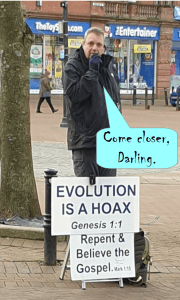
But with Christianity and other theistic religions it’s a different story. While they might provide their adherents with some coherence to their lives, they also equip them with a distorted and unhealthy view of other people. This is what compels local street preacher, Dale McAlpine, to pick up his megaphone and stand yelling at passers-bye in my local town centre. I took the picture above of him yesterday, when he invited me, like an evangelical Hannibal Lecter, to come closer. I declined.

Dale’s theme this time was, predictably, that evolution is a Satanic hoax, everyone is a wicked sinner and God requires a blood sacrifice for them to be saved. He no doubt had a swipe at LGBT folk too; he usually does. Dennis and I didn’t stop to listen to him but, along with everyone else, were lambasted with his ignorant BS as we passed. Such nasty stuff needs to be opposed and in the absence of my own megaphone, this is my way of doing it.

Those who believe planets millions of miles away control their lives don’t, as a rule, set themselves up on a soap box in the centre of town and threaten people with hell. Ultimately, though, there is no substantial difference between the baseless wishful thinking of astrology and Christianity. Today’s version of the faith owes its existence to Paul’s ‘revelation’ of an imaginary celestial being that sacrificed itself to restore our standing with an imaginary God. This makes as much sense as believing that the planets ‘in conjunction’ shape our destinies.

Would I, if it were in my power, ban the likes of Dale from spouting his ignorant, ugly version of Christianity? Probably not, as I’m a liberal at heart and cancel culture concerns me. I would, however, be pleased if he came to senses and of his own volition stopped spouting publicly his brand of theo-babble. I’d rather he spent his time tending to the sick, homeless, naked and imprisoned as his Saviour tells him to. I fear though that that kind of Christianity is too hard for the likes of Dale.

The Trouble With Atheists: A Christian Sets Us Straight

My friend Bruce Gerencser was good enough to repost my previous post on his blog. It prompted a comment from someone calling himself James Thompson, who Bruce says used a fake email address and quite possibly a false name. (These Christians; so fearless and honest in all their doings!) Here’s what ‘James’ had to say:

It’s because that’s what you live to do argue the truth. You’re not “atheists”. Antitheists yes. Agnosticism yes. A true atheist would not give a rip about the discussion on this blasphemous blog.

And atheists don’t go out seeking to remove Mickey Mouse from everything.

Or Buddha or Mohammed.

But they do Jesus Christ because Satan knows he is the only one who can bring salvation

I did respond to James on Bruce’s blog but wanted to address his garbled points, such as they are, more fully here. They’re typical of the low level thinking Christians and others use to defend their beliefs.

It’s because that’s what you live to do argue the truth.

Amazingly James has an uncanny insight into the minds of atheists; we live only to argue the truth, by which he means, presumably, critiquing his pet deity and magical saviour. Most of the time, most atheists barely give these two mythical beings a second thought; neither do I when I’m not blogging. I live for entirely different things.

You’re not “atheists”. Antitheists yes. Agnosticism yes.

But wait! People who don’t believe in his God aren’t, according to the omniscient James, atheists; they’re anti-theists. Okay, I concede; I am opposed to the notion that there’s a loving God somewhere out there who is interested in us and has made it possible for us to know him by, according to James and other deluded souls, making his only son a blood sacrifice. I dispute this silly idea, which has no evidence to support it, and is, as Jesus is made to say in Matthew 11.25, irrational and illogical. So yes, I’m an anti-theist. I’m also anti-theist because of what believers in the one true God (in his various guises) do terrible things to each other and to non-believers. And when they’re not doing that, they’re parading their ignorance, propagating their book of myths and spells, denying evolution, dumbing down children’s education, suppressing LGBT+ people and threatening everyone who doesn’t subscribe to their superstition with eternal damnation. I mean, what’s not to like?

 A true atheist would not give a rip about the discussion on this blasphemous blog.

And then James returns to his mind reading act. How does he know what a ‘true atheist’ might think of Bruce’s blog? There are plenty of atheists who comment there; whether they are ‘true’ atheists apparently only James knows.

And atheists don’t go out seeking to remove Mickey Mouse from everything.

It is true atheists (which we’re not, according to James) don’t seek to remove Mickey Mouse from everything, whatever this means. But then Mickey Mouse doesn’t start wars, condemn everyone as wicked sinners or try to control their sex lives. Disneyworld would quickly go out of business if he did. (That Donald Duck is a different kettle of fish however.)

Or Buddha or Mohammed.

James then scrapes the bottom of the cliché barrel: ‘You wouldn’t dare criticise the revered characters of other religions’. Yes, we would. As I said in my post, which evidently James didn’t read, there is no supernatural. All gods, ghosts, spirits, angels, demons, heaven and hells, from whichever religion or superstition they emanate, are figments of the imagination.

But they do Jesus Christ because Satan knows he is the only one who can bring salvation

These two as well. The Christ and his evil doppelganger, Satan, are human inventions. As fantasy figures they are open to as much ridicule and ‘removal’ as any other imaginary being. Perhaps more, given the damage they’ve caused and continue to cause.

James has been sold salvation snake-oil and thinks that because he’s been duped, everyone else should be too. Or at the very least should respect his delusion. Ain’t gonna happen, Jimmy boy. You need to grow up a little. And maybe also learn some grammar.