We owe it all to Jesus

MarySo the UK is a Christian country. Prime minister Dave Cameron has decreed it. In his hallowed Christmas message he proclaims that Britain derives all of its values from Christianity:

As a Christian country, we must remember what (Jesus’) birth represents: peace, mercy, goodwill and, above all, hope. I believe that we should also reflect on the fact that it is because of these important religious roots and Christian values that Britain has been such a successful home to people of all faiths and none.

‘Peace, mercy, goodwill, hope and tolerance’. Doesn’t it warm your heart? This country of ours has these wonderful sentiments at its core and all of them derive from the baby Jesus. I’m not sure about where our other values – capitalism, colonialism, democracy, free-thought and expression – originate but no doubt Dave will tell us they too spring from our ‘religious roots’.

What about the values he mentions though? Do they originate with Jesus as Dave claims?

Peace we covered last time: Christianity have not brought peace into the world, ever. Dave seems to have forgotten that Britain is currently at war; the so-called ‘war on terror’ Is he now suggesting that as a ‘Christian country’ we should turn the other cheek and propose peace, because that’s what Jesus would want? I doubt it, somehow.

Mercy? Here’s the kind of mercy Jesus proposed: ‘But those enemies of mine who did not want me to be king over them – bring them here and kill them in front of me’ (Luke 19:27). Nice.

Goodwill? Jesus always extended goodwill to others. Like here: ‘It is not right to take the children’s bread and toss it to the dogs (non-Jews)’. And here: ‘Do not give dogs what is holy, and do not throw your pearls before pigs (non-Jews again), lest they trample them underfoot and turn to attack you’ (Matthew 15.26 & Matthew 7.6).

Hope? The Bible does speak about hope – hope that this will all soon be over and God will consign non-believers to hell, set up his kingdom on earth and put Jesus in charge (Matthew 19:28 & 24.51). Is this what Cameron means by hope?

Tolerance? Paul on tolerance: ‘do you not know that wrongdoers will not inherit the kingdom of God? Do not be deceived: Neither the sexually immoral nor idolaters nor adulterers nor men who have sex with men’ (1 Corinthians 6:9). It’s difficult to see how modern notions of equality and acceptance can derive from bigotry like this.

No, Britain does not get its values from Christianity or the Bible or baby Jesus. It has worked them out for itself, principally through social progress and the reforms of modern times.

The UK is not a Christian country in any other sense either. Christians are required to turn the other cheek (Matt. 5.38–42), give all they have to the poor (Luke 14.33) and buy into a convoluted salvation scam plan (2 Timothy 1.9 etc). Can a country do these things? It would be unthinkable for it to give away its wealth, accede to other countries’ demands and respond non-aggressively to attack. Individual Christians don’t or won’t do these things and it would be nothing short of suicidal for a country to attempt to; yet this is what Jesus insists is involved in following him. It’s impossible for individuals to live this way, let alone entire nations.

Cameron can’t even claim that the majority of the population subscribes to the great salvation plan either. A recent government poll showed that only 49% of the population admits to being Christian and in any case, the plan is designed for individuals, not countries. So let’s hope (hah!) the Prime Minister will stop fawning over Christians, fatuously pretending that the UK is a Christian country when it isn’t. Let’s hope too he understands that our values, whatever they are, do not derive from an ancient, expired superstition. The UK is not a Christian country in any sense. Let us rejoice in that fact.

Peace Off

angels

Glory to God in the highest, and on earth peace, good will toward men. Luke 2.14 as rendered by the King James Bible.

Whatever happened to that peace? There hasn’t been peace on earth ever since the angels were made to herald Christ’s birth with these words. Some of that absence of peace – the conflicts and wars – has been the result of religion, including that of Jesus himself. Then again, he did contradict the angels when he said he hadn’t come to bring peace but a sword and for once, he was right (Matthew 10.34). So what can the angels have meant? More to the point, what can those who created these words to put in the mouths of non-existent beings have been thinking? Is their declaration a promise? A prophecy? Something to look good on Christmas cards?

Other translations of Luke 2.14 avoid the whole peace on earth shtick by watering down the statement: ‘Glory to God in the highest heaven, and on earth peace to those on whom his favour rests’ reads the NIV. Now only those whom God ‘favours’ are granted peace, which presumably means only Christians, and it’s now a vague sense of well-being (complacency? smugness?) that isn’t of much use to the world at large. Certainly other New Testament writers, the creators of John’s gospel and the letter to the Ephesians for example, interpret ‘peace’ in this very limited way.

And yet, in Isaiah, in verses applied to Jesus (especially at this time of year; they were read out in the carol service I attended last night) we find him descibed like this:

For to us a child is born, to us a son is given, and the government will be on his shoulders. And he will be called Wonderful Counselor, Mighty God, Everlasting Father, Prince of Peace. (Isaiah 9.6)

Apart from the fact this is a specifically Jewish prophecy that has nothing to do with Jesus – which is why most of the titles don’t really apply to him (nobody has ever called him ‘Wonderful Counselor’ or ‘Everlasting Father’) – there again is the idea that he’s somehow connected with capital-letter Peace. He’s a Prince of it, no less.

But wait – there’s more:

Of the increase of his government and peace there will be no end. He will reign on David’s throne and over his kingdom, establishing and upholding it with justice and righteousness from that time on and forever. The zeal of the Lord Almighty will accomplish this. (9.7)

Of course; it’s all end time stuff! We should’ve guessed. Long term peace on the Earth, predicted by the angels and, ostensibly, by Isaiah is going to be in the future, after Jesus returns to establish God’s Kingdom on earth.

Have you noticed how it’s always in the future? Everything Christianity offers is going to happen later: heaven, eternal life, the second coming, the rapture, resurrection, God’s Kingdom, the lion lying down with the lamb, the end of war, everlasting peace. Not in Jesus’ own time as he thought; not in Paul’s, not in the gospel writers’, not any time since, but always just around the corner, any time now, soon. Never in the here and now. Peace on Earth, like all those other promises, is always just out of reach, like the pot of gold at the end of the rainbow – the closer you think you might be to it, the further it moves away.

A friend added one of those clever posters to Facebook recently. It said, amongst other things, that it wasn’t okay to ‘shame’ religion. I couldn’t disagree more. Scams must be debunked and the sham of religion’s empty promises held up to the light of reality. None of the things that the Bible says will happen is going to; not now, nor in an ever-elusive future.

A happy and peaceful Christmas to both my readers.

What is the point?

Stairway

There isn’t any point. At least, not ‘out there’ somewhere, waiting to be discovered. The point, purpose and meaning of life is what we make of it. We make our own purpose.

The Christians among us claim to have real purpose. Not like we sad non-believers whose purpose is to do with raising and supporting our family, being creative, doing things for others or whatever. No, Christians get their real purpose from God, or so they say. Perhaps some of them would be good enough to share it with us; is it rushing from one church meeting to another? Singing badly written hymns badly? Cosying up to one another? Telling others about the great salvation plan?

Apparently not, though they do seem to spend a lot of time doing these things. According to CARM the purpose of life ‘is to praise God, worship Him… proclaim His greatness, and… accomplish His will.’ Got Questions, on the other hand, says it’s to ‘1) glorify God and enjoy fellowship with Him, 2) have good relationships with others, 3) work, and 4) have dominion over the earth,’ while Open Bible claims it’s ‘to love and serve God in order to help bring about God’s glorious plan for creation.’

That’s it? The purpose faith supplies is this woolliness? It’s about doing stuff we already do (‘work’, ‘have good relationships with others’) and fawning over a needy, insecure deity? God help us if this is all it amounts to. Those who claim to know the secrets of eternal life and the mind of God himself should surely be able to come up with something better than the rest of us.

As I’ve written before, this isn’t what Jesus told his followers life was for. No, he said it was to work to bring about God’s kingdom on Earth (Matthew 6.33; 13.44, Luke 9.62 etc). Try as you might you’ll struggle to find a Christian site that says this is the point. That’s because Christians long ago – almost two thousand years ago – stopped believing that God’s kingdom was due to arrive here and switched their expectation to one of an after-life in heaven. But that’s not what the Bible promises, and it’s certainly not what Jesus said.

So maybe, Christians, you’re missing the point of your faith and your purpose in life; it’s to bring about the Kingdom of God on Earth (Matthew 6.10) – in the first century (Mark 9.1). No wonder you’re now so rudderless, so lacking in direction and real purpose. You missed the boat, which sank without you two millennia ago.

Now you have to construct your own meaning, just like the rest of us. Except ours is better, lacking as it does the faux Biblical language and all those fairy tale elements.


You’re not as saved as you think

God2So now you’re a Christian. You’ve listened to the street preacher or that Christian at work and you’ve accepted Christ. You’re saved and going to Heaven when you die.

Or are you? You’re not going to Heaven that’s for sure, because Heaven isn’t on offer – as we saw here, the Bible doesn’t promise an eternal life in Heaven. But are you even saved? Has ‘the most important decision of your life’ really made you one of God’s own?

If you think you’ve chosen God, you’re wrong. You don’t choose God, he chooses you (or not, as the case may be). And if he hasn’t chosen you, then any decision of yours is of no consequence. You can shout all you like about how you’re now saved, born again and a follower of Jesus but if God says you’re not, then you’re not.

How do we know this? Because the Word of God™ says so:

Blessed be the God and Father of our Lord Jesus Christ, who has blessed us in Christ with every spiritual blessing in the heavenly places, just as he chose us in Christ before the foundation of the world to be holy and blameless before him in love. He destined us for adoption as his children through Jesus Christ, according to the good pleasure of his will… (Ephesians 1. 3-5)

In other words, you’re only saved if God decided you were going to be right back at the beginning of time. And if he didn’t, well, you can talk the talk and even walk the walk, but it will all be for nothing.

Jesus too is quite clear that it isn’t up to you whether or not you’re one of God’s chosen few. Here he is the middle of one of his tiresome parables about the Kingdom of God, where the King has told his slaves:

“Go… into the main streets, and invite everyone you find to the wedding banquet.” His slaves went out into the streets and gathered all whom they found, both good and bad; so the wedding hall was filled with guests. But when the king came in to see the guests, he noticed a man there who was not wearing a wedding robe, and he said to him, “Friend, how did you get in here without a wedding robe?” And he was speechless. Then the king said to the attendants, “Bind him hand and foot, and throw him into the outer darkness, where there will be weeping and gnashing of teeth.” For many are called, but few are chosen. (Matthew 22.9-14)

So, how do you know if you’re one of the special few hand-picked by God himself and not just one of those poor suckers who’s been invited along only to be thrown out? You don’t. Your capricious God won’t tell you till after you’ve died and you meet him face to face. There’s every possibility you’ll find out then that you’re not saved, because only a few of those called actually are. And then where will you be? Hell, that’s where. You’ll be no better off, according to the Bible anyway, than those who’ve not been duped by all of this nonsense.

So, you can believe all you like that God loves you. You can make all the right noises, study your Bible, pray, imagine you hear God’s voice in your head, go to church, sing the right songs and defend God’s standards, but there’s still a very good chance you’re not saved.

Jesus again:

Not everyone who says to me, “Lord, Lord”, will enter the kingdom of heaven, but only one who does the will of my Father in heaven. On that day many will say to me, “Lord, Lord, did we not prophesy in your name, and cast out demons in your name, and do many deeds of power in your name?” Then I will declare to them, “I never knew you; go away from me, you evildoers.” (Matthew 7.21-23)

But don’t worry, you were never ‘saved’ in the first place, nor lost, nor in need of Jesus; none of this mad fairy tale is real. Your only mistake – and it was a big one – was to think it was.

Rejecting Jesus – The Book

RJCoverIt’s a miracle! Rejecting Jesus is now in book form! And on Kindle too.

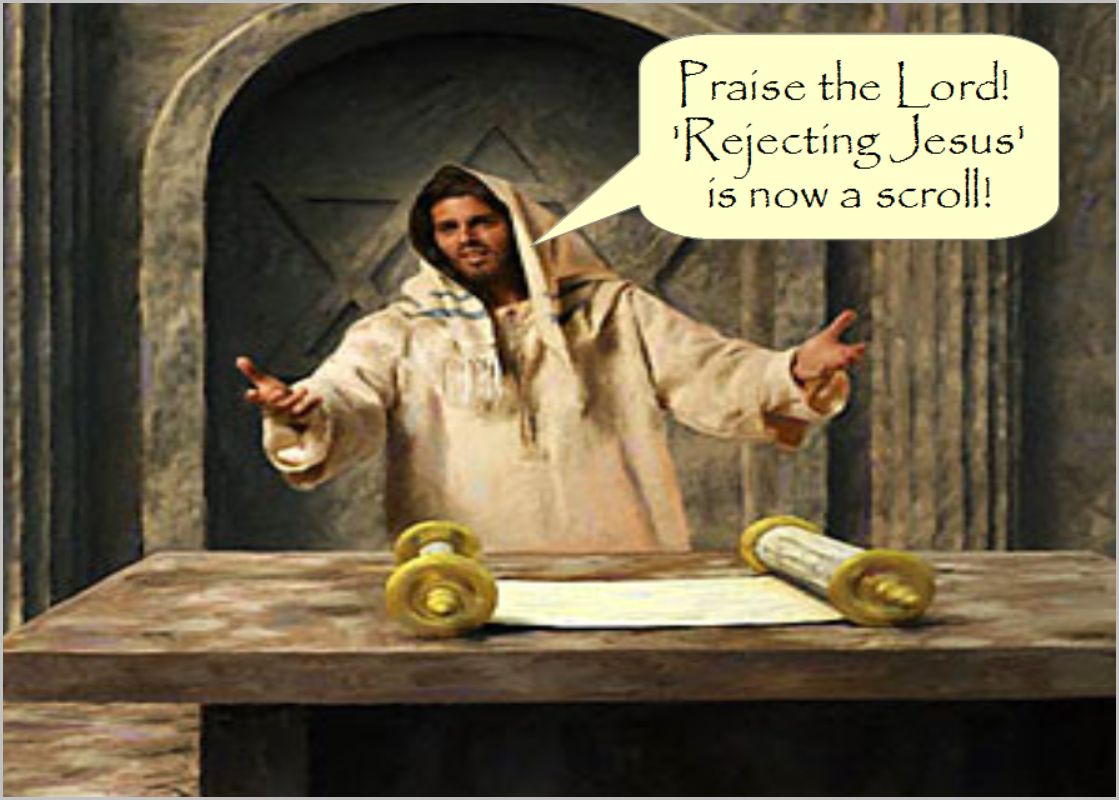
ScrollWell, not quite – sorry JC.

But you can now read Rejecting Jesus posts in the format the Son of God would surely have preferred if books had existed then the way they do now. The pictures are all present and correct too, in glorious B&W, for all first-century messiahs to enjoy.

Available here and here and also all over the world. Go, buy it, make disciples of all nations.


Christians’ Favourite Delusions 35: Jesus Christ is the same yesterday, today and forever.

LaughAccording to God’s Magic Book (in Hebrews 13.8), Jesus is ‘the same yesterday, today and forever’. Let’s see how that works out in reality:

Yesterday he said the way to ‘inherit eternal life’ was to follow the law and sell everything you had (Mark 17.17-22).
Today, according to his spin doctors, he says you’ve got to believe a magic formula – the one about him dying – if you want to live forever.

Yesterday he despised wealth and possessions (Luke 6.24-25).
Today he thinks they’re just fine.

Yesterday he said this world would end while his disciples were still alive (Matthew 16:27-28).
Today he says these are the end times:

… we’re now living in Romans 1. How do you know when the wrath of God is released? How do you know when the wrath of God is unleashed against a society? First, Romans 1:24, there is a sexual revolution. We’ve had that—in the 60s, the last century. Then there will be a homosexual revolution led by lesbians. The women are mentioned first in Romans 1:26. And then there will be the reprobate mind. And that’s when the thinking is really the product of the sexual, homosexual revolutions, and the thinking is so corrupt we can’t find our way back. That’s where we are. (John MacArthur, We Will Not Bow; all subsequent references to MacArthur are from this same poisoned well)

Yesterday Jesus’ Good News was about the coming Kingdom (Luke 4.43).
Today it’s about eternal damnation:

And the most compassionate thing you can do for those (LGBT) people is, in love, to warn them of eternal damnation—to warn them of eternal judgement. That’s compassionate. That’s compassionate. Preach the gospel; proclaim the gospel; proclaim grace and forgiveness such as we read in Isaiah and 1 Corinthians. But preach judgement. (MacArthur again)

Yesterday Jesus invited people to join God’s Kingdom on Earth (Matthew 6.10; 13.43 etc).
Today he’s made to invite everyone to Heaven.

Yesterday his Good News was only for his own people: ‘I was sent only to the lost sheep of the house of Israel’ (Matthew 15:24).
Today he says anybody can go to Heaven so long as they believe the magic formula. Oh, and aren’t gay.

Yesterday his own people were the Jews (Luke 2.22-32; Matthew 4.23 etc).
Today he’s really only interested in America (to listen to MacArthur and others).

Yesterday he was recruiting slaves for his Kingdom (Matthew 20.27).
Today he wants to be your buddy.

Yesterday he’d nothing good to say about marriage (Luke 20.34-35).
Today he’s all for it (unless it’s same-sex marriage).

Yesterday he had nothing good to say about the family (Luke 14.26).
Today he’s all for it (unless the parents are gay).

Yesterday he had nothing to say about abortion, homosexuality or people changing sex.
Today it’s all he’s interested in (MacArthur and just about every other Christian preacher).

Yesterday he was an itinerant Jewish preacher and failed messiah.
Today he’s a Starman waiting in the sky to zap unbelievers to hell (yup, MacArthur again, quoting 2 Thessalonians 1.7-8).

Like a ventriloquist’s dummy, Jesus just says whatever his self-appointed spokespersons want him to say. Pliable and malleable, he can be made to match the needs of anyone who recruits him to their spiritual, moral or social crusade. He is all things to all people and what he’s like today is nothing like what he was yesterday. Which doesn’t say much about ‘forever’.

When it’s Gone, it’s Gone

JudgementAs you’ll see in comments to previous posts, Christians like to encourage gambling. Recycling Pascal’s wager, they say things like ‘if I am wrong then I have based my life on a false premise and have ceased to exist. I won’t even have the opportunity to express regrets. However, if you are wrong, having rejected Christ, you, sadly, will have quite a while to weep, wail and gnash your teeth.’

The old faith-as-insurance-policy argument. Rather like the Chance card in Monopoly that lets you avoid jail, it offers you the chance to escape hell, where all this gnashing is supposed to occur, by the simple expedient of holding a particular set of beliefs in your head.

Surely this hedging of bets doesn’t impress God, the supposed creator of the universe, Father of mankind and judge of all the Earth. He won’t really be taken in, will he, on that great and dreadful Judgement Day when we admit, ‘actually, I only believed in you so you wouldn’t send me to hell’? Maybe he will, being a God without discernment or insight. It’s certainly all that evangelical Christianity has to offer – just ask my preacher friends – a Get Out Of Hell Free card. Which is a long way from what Jesus taught about the coming Kingdom and how to be part of it; not, in his case, by believing the right things but by doing them (Matthew 25.31-36).

What if I am wrong, though, as Christians think? Then I could be in trouble. But so might they; they could find they’ve gambled on entirely the wrong God (curse you Pascal for not thinking of that!) and find themselves up before Allah or Vishnu once they’ve miraculously survived death. ‘Wrong God, mate,’ Allah will have to tell them: الله خطأ، تتزاوج . What then?

And given that they think eternal life awaits them, why are so many Christians fearful of leaving this life? Could it be because they’re not convinced that the gamble is going to pay off? They know intuitively that this life is the only life they’ll be getting – and that when it’s gone it’s gone, as it says in Poundland. That will be why they mourn their brothers and sisters in Christ who ‘pass away’; “sorry to hear about your loss,” they say, when according to their magic betting slip it’s no loss at all but an immortal gain.

So I’m confident I’m not wrong. The odds are in my favour; the evidence is on my side. Consider, if you will, Christians:

  • Every single human who has ever lived has died, or will die, and has ceased to be in their entirety;
  • No human has ever lived again after death (not even Jesus who wasn’t, according to you, properly human anyway and so doesn’t qualify.)
  • No human has ever lived forever;
  • There’s nothing on the other side – no judgement, no Heaven, no Hell, no eternal life – because there is no ‘other side’.

If any of you would like to demonstrate that these assertions are wrong, please do. All I ask is that you bear in mind that insisting they’ll happen at some point in the future because the Bible says so, is not evidence; it’s wishful thinking. Which is pretty much where we came in.

All is vanity.

All is Vanity

DaleThe idea that human beings can live forever is a very old one, being part of a number of ancient religions. The Egyptians, for example, believed there was an afterlife and that where you spent it was determined by a post-mortem judgement. Christianity would later embrace similar notions of judgement and everlasting life.

The idea is, however, largely absent from Judaism. Ecclesiastes in the Christian Old Testament (‘Kohelet’ in Judaism) has this to say about death and its aftermath:

I said in my heart with regard to human beings that God is testing them to show that they are but animals. For the fate of humans and the fate of animals is the same; as one dies, so dies the other. They all have the same breath, and humans have no advantage over the animals; for all is vanity. All go to one place; all are from the dust, and all turn to dust again (Ecclesiastes 3.18-20).

This seems to me to be an entirely realistic, if somewhat pessimistic, view of life and death. (And humans as animals! Today’s believers still have trouble accepting this, even when their holy book spells it out for them.) Later writing – the book of Daniel, for example – begins to toy with the idea of eternal life, but it isn’t until we get to Jesus’ time that the idea really takes off.

As the writer of Ecclesiastes knew, and as I suggest here, there is no evidence we survive death. Death would hardly be death if we did. The dessicated bodies of those Egyptians, mummified so their ‘owners’ could reclaim and re-use them on the other side, are still with us. There’s no evidence either that a special part of us – a soul or spirit – makes the transition. In any case, this is a predominantly pagan idea and is not what the New Testament offers. Both Jesus and Paul are firm believers in bodily resurrection here on the Earth.

The desire to live beyond the brief few years that our physical bodies last is understandable. It’s hard to imagine that one day every single one of us will no longer exist, that our consciousness, personalities, thoughts, memories, emotions – everything that makes us who we are – will simply no longer be. That’s why, I suppose, people in the past rebelled against that inevitability and fantasised about a continued existence once this one came to an end. Eventually religions came to offer such compensatory life-after-death, provided of course suckers people believed the right things.

Such is Christianity.

When you think about it, what a truly absurd notion it is; that believing in a magic formula will defeat death and enable you to be resurrected on the Earth to live in God’s new Kingdom here, or (when that didn’t quite pan out) taken up to Heaven to live there. All you have to do is believe the right things and God will do this for you. Death will be defeated by the simple expedient of your belief. We’re so used to the idea after 2,000 years of Christianity that the absurdity ceases to register – but absurd it surely is.

to be continued


Jesus: The Dark Side

SacrificeDo not think that I have come to bring peace to the earth; I have not come to bring peace, but a sword (Matthew 10.34).

Well, isn’t that a comfort. Jesus, who said ‘blessed are the peacemakers’ and for whom Christians like to claim the title ‘Prince of Peace’, declares himself to be anything but.

Of course, it’s possible these words were put into Jesus’ mouth once belief in him had indeed started splitting families and communities; between those who subscribed to his cult and those who saw it for what it was. Maybe though he really did advocate armed rebellion – against the Roman and Jewish authorities – rather more than later believers care to admit. Even as they’ve come down to us, the gospels retain references to taking up arms in the cause of God’s Kingdom. For example:

  • Jesus didn’t see the transition from the existing system to the Kingdom as a peaceful one:

Matthew 11.12: From the days of John the Baptist until now the kingdom of heaven has been coming violently and the violent take it by force.

Matthew 3.10: Even now the axe is lying at the root of the trees; every tree therefore that does not bear good fruit is cut down and thrown into the fire.

  • He instructed the disciples to arm themselves:

Luke 22. 36-38: He said to them… ‘the one who has no sword must sell his cloak and buy one. For I tell you, this scripture must be fulfilled in me, “And he was counted among the lawless”; and indeed what is written about me is being fulfilled.’ They said, ‘Lord, look, here are two swords.’ He replied, ‘It is enough.’

  • And evidently they did:

Luke 22.48-49: Jesus said to him, ‘Judas, is it with a kiss that you are betraying the Son of Man?’ When those who were around him saw what was coming, they asked, ‘Lord, should we strike with the sword?’ Then one of them struck the slave of the high priest and cut off his right ear. (Jesus promptly heals the slave and then says, sanctimoniously, that ‘those who live by the sword will die by it’, as if swords weren’t his idea in the first place!)

  • More than this, when, as he clearly believed he would be, Jesus is appointed King in God’s new Kingdom, he hints he will be happy to see all of his opponents put to death:

Luke 19.27: “But as for these enemies of mine who did not want me to be king over them—bring them here and slaughter them in my presence.”

  • Jesus was executed by the Romans as a revolutionary. Crucifixion made an example of those who actively opposed Roman rule. The charge against Jesus was that he was an intended usurper of power; two fellow ‘rebels’ are executed with him:*

Mark 15.26-27: The inscription of the charge against him read, ‘The King of the Jews.’ And with him they crucified two rebels, one on his right and one on his left.

So much for ‘love your enemies’ and ‘turn the other cheek’. So much for the Jesus who does nothing but preach love and forgiveness. So much too for Paul’s mystical Christ. There is a very dark side to Jesus that expresses itself in vengefulness and megalomania. That anyone so disturbed could be considered an emissary from God, let alone God the Son, beggars belief.


* Since writing this post I’ve read Marcus J. Borg’s Jesus: Uncovering the Life, Teachings, and Relevance of a Religious Revolutionary. Borg makes precisely the same point about the charges against Jesus (though he sees him as a non-violent revolutionary). He explains that the Greek word used to describe the two killed with him – rendered as ‘rebels’ above – ‘is the term more commonly used for those engaged in armed resistance against Rome – “terrorists” or “freedom fighters”, depending on one’s point of view (p265).

Jesus v. Paul Round 2: And the winner is…

Make-overI’m re-reading Barrie Wilson’s excellent How Jesus Became Christian. Wilson makes the case that Paul’s Christianity was, and is, an entirely different religion from that of the historical Jesus. He shows how Paul’s ‘Christification’ changed the original mission of Jesus – to alert his fellow Jews to the imminence of God’s kingdom on Earth – ‘from one focused on the teachings of Jesus to one about the Christ’ (p242).

How right he is. This very the dichotomy troubled me in my own church-going days when evangelical Christianity, as it still does, consistently excluded the demanding, extreme and human Jesus of the synoptic gospels to focus instead on this illusory supernatural being. They preach sermons about him, sing hymns to him and intone creeds that skip glibly over everything Jesus said and did when he was alive. The Christ was, I came to see over time, an invention of Paul’s, the product of his strange hallucination sketchily recounted in Galatians 1.11-12 and 1 Corinthians 9.1 & 15.45. The Jesus he talks about is a sort of cosmic super-hero, a god-man of the type found in pagan religions in the first century. He has little or nothing to do with Jesus the Jew preacher and would-be Messiah, preserved – just about – in the three synoptic gospels.

So, the differences between Jesus and the Christ are profound. Here are a few of them, that I’ve drawn up, demonstrating that Christianity as we know it – essentially Paul’s ‘Christified’ version with inconvenient bits removed – bears little relation to the ‘good news’ of Jesus:

Jesus’ good news: God’s Kingdom on Earth imminent (Mark 9.1 etc)
Paul’s good news: Salvation through a dying/rising god-man (Romans 3.19-26; 4.24; 5.1-2; 5.10 etc)

Jesus presents as: Jewish Messiah claimant: ‘Son of Man’; Self-appointed judge and king in near future (Matthew 16.28; 13.41; Luke 22.30 etc)
Paul presents: Mystical saviour: The Christ, who saves those who ‘share’ in his death and resurrection; Christ as judge and ruler of mankind in near future (Romans 3.25; 6.1-11; 13.11-12; 1 Corinthians 15.20-28; Philippians 3.20)

Jesus’ qualifications: Teacher, preacher and healer; ideas rooted in Jewish prophecy; full of his own importance (Matthew 5.17; 7.12; 9.35; 25.40)
Paul’s qualifications: Builds entire religion on single hallucination; borrows heavily from pagan cults; full of his own importance (1 Corinthians 15.8; Galatians 1.15-16)

Jesus’ position: Adherent of Jewish Law; emphasises its importance (Mark 6.2; Matthew 5.19)
Paul’s position: Disregards Jewish Law; implies it is ‘dung’ (Romans 3.28; Galatians 5.6; Philippians 3.7-9)

Jesus insists on: Obedience to Jewish Law (Matthew 5.17-20)
Paul insists on: Faith in Christ and his resurrection (Romans 1.16-17; 3.22)

Jesus’ salvation requirement: Be righteous/perfect (Matthew 5.48; 13.43)
Paul’s salvation requirement: Faith (Romans 5.1; Galatians 2:15-16)

Jesus expects: Right behaviours and attitudes (Matthew 5.38-48)
Paul expects: Right belief (Romans 10.10-13)

Jesus’ teaching: Measure for measure morality (Matthew 6.38; 7.2; Luke 6.37); Forgive in order to be forgiven (Matthew 6.14); Show mercy in order to be shown it (Matthew 5.7); Give in order to receive (Matthew 6.38); Treat others as you wish to be treated (Matthew 7.12)
Paul’s teaching: Profess right belief (Romans 10.9)

Jesus’ commands: Love God (Matthew 22.37); Love your neighbour (Matthew 22.39); Love your enemy (Matthew 5.44)
Paul’s commands: Embrace Christ (Romans 8.35-38; Galatians 3.27); Be filled with the Holy Spirit (Romans 5.5; Galatians 5.16-18); Avoid those with different teaching (Romans 16.17; Galatians 6.6-9)

Jesus’ extremism: Give up everything you have (Mark 10.21; Luke 14.33); Give to all who ask (Matthew 5.42); Turn the other cheek (Matthew 5.39); cut off own hands, remove eyes (Mark 9.43-47); Consider castration (Matthew 19.12)
Paul’s extremism: No interest in anything Jesus taught when was alive; intolerance of Jesus’ original followers (Galatians 2.11-21)

Jesus’ guarantees: Resurrection/eternal life through demonstration of one’s personal righteousness once the Kingdom comes (Matthew 25.31-36)
Paul’s guarantees: Resurrection/eternal life for those with right belief and faith when Christ returns soon to judge mankind (1 Corinthians 15.20-28; 51-52)

Jesus’ outcomes: No Kingdom on Earth; no appearance of the Son of Man or a returned Jesus; disappearance of the movement that subscribed to Jesus’ ‘good news’
Paul’s outcomes: No appearance of the Christ; no rapture; no resurrection; no cosmic judgement

Jesus’ result: Failure
Paul’s result: Becomes mainstream Christianity; Paul wins!

As Wilson makes clear, the two are, despite some small overlap, very different belief systems. The Christ Christians worship is not the same as the Jesus they ignore. Nonetheless, they continue to pretend they are one and the same, unable to see that the join is, and always has been, a gaping hole.

 
Notes:
i) Biblical references are by no means exhaustive; there are many others that support each point and difference.

ii) Details of Wilson’s book are:
Wilson, B. (2008) How Jesus Became Christian: The Early Christians and the Transformation of a Jewish Teacher into the Son of God. Weidenfeld & Nicolson, London.