Where was God?

GodGod

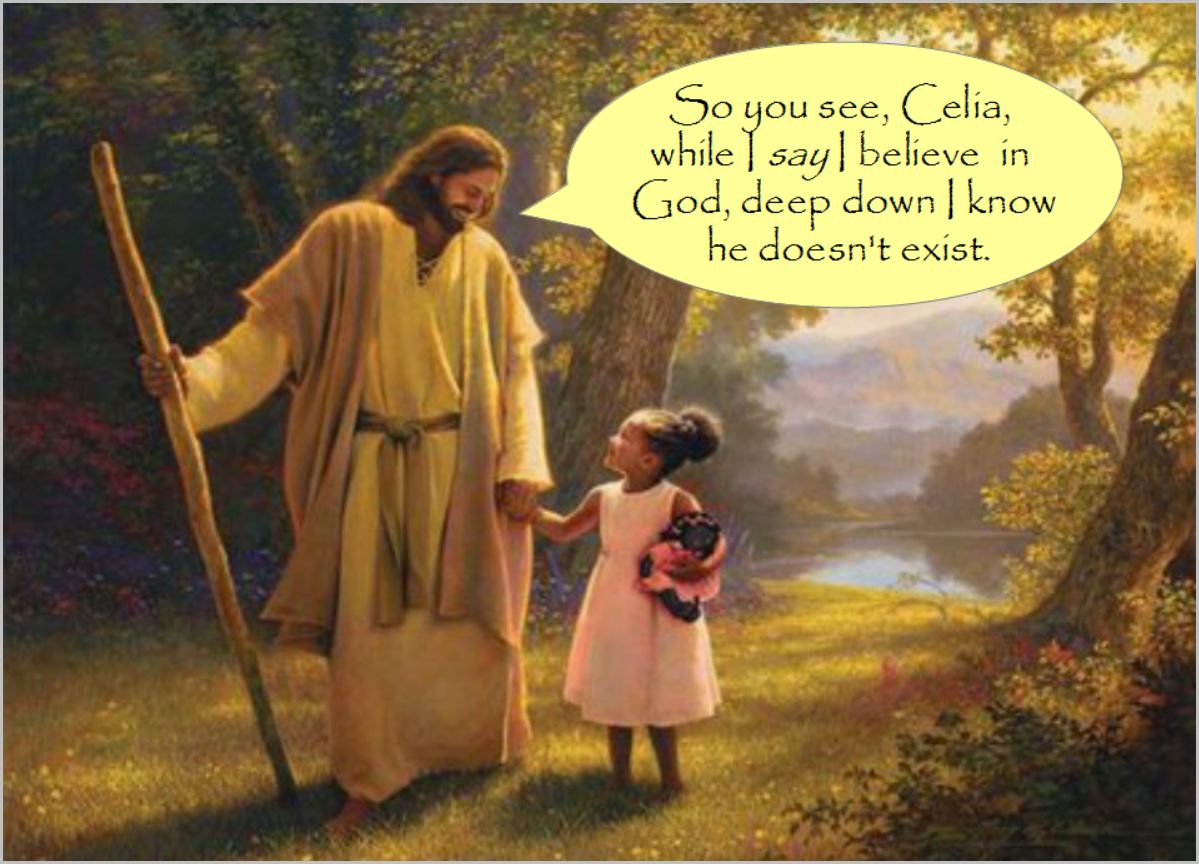
While they were communing with God, gunman Dylann Roof sat among them for forty-five minutes. Then he opened fire and killed nine of them. That’s forty-five minutes during which time God could have warned the Christians who believed he was listening to them that something terrible was about to happen. But he didn’t. The communication was all one way. They talked to him but he didn’t talk to them. He didn’t even listen. Why not? Because either he doesn’t care what happens to his people, despite what Jesus promised, or he isn’t there.

After the massacre, Christians across America resorted to pleading with this negligent God to comfort the bereaved and to help police find the killer. We can be sure God didn’t do any such thing because if he cared at all, he wouldn’t have let the massacre happen in the first place. 

Presidential hopeful Mike Huckabee declared that if only some of those at the prayer meeting had been ‘pistol-packing’ themselves, they could have taken out Roof before he did too much damage. And he’s right – absurd as it sounds, one of them could have done. So why didn’t the God who never forsakes his people prompt one of them to take a gun to church? Perhaps because, unreasonably, he thinks it’s better to turn the other cheek. Either way, mark God down for another fail.

Fellow crank, the ‘reverend’ E. W. Jackson, blamed the shootings on liberals, gays and Obama. So, God – pissed with those who don’t support ‘Christian values’ –  allowed a gunman to mow down nine of his own. Makes sense.   

Debbie Dills, meanwhile, spotted the killer’s car on the freeway and informed the police. She later claimed this was God’s doing; the very God incapable of warning his loved ones they were about to be murdered. This God, who allowed his people to be massacred, directed Debbie Mills, who cannot see that she was just happened to be in the right place at the right time, to notice the killer’s vehicle and report his whereabouts.

Let’s get real: a God who can’t prevent the murder of nine of his children but then behaves like a third-rate Jessica Fletcher is no God at all. He is an impotent creation, a being of trivial pursuits, who fails to materialise when he’s really needed; a mythical figure who keeps his super-powers to himself, except in the most insignificant and coincidental of occurrences; a figment of believers’ imaginations.

Show us he’s not, Christians, why don’t you. Show us how he loves you, never forsakes you and protects even the hairs on your heads. Where is he? Where’s the evidence he exists, outside your inconsistent, fallacious scriptures and your own wishful thinking? Where in this real world? The people of Charleston really need to know.
Idiotic Stuff Jesus Said 12: My words will never pass away

AndersonThe premise of my first ‘Jesus’ book* is that while Christians profess to believe in Jesus, they choose to ignore most of what he taught while he was alive. While they claim a vapid super-hero Christ as personal saviour, they replace what the human Jesus had to say with words of their own choosing. In reality, they have about as much time for Jesus’ ‘eternal words’ as the average non-believer or atheist. You don’t have to look very far to see how much his words have already ‘passed away’:

Jesus said, ‘Don’t judge so that you won’t be judged’ (Matthew 7.1). Our representative Christian says, ‘LGBT people are filthy and wrong.’

Jesus said ‘Love your enemies, pray for those who persecute you’ (Matthew 5.44). Our representative Christian says, ‘I’m gonna pray a transgender person dies and goes to Hell.’

Jesus said, ‘Love your neighbour as yourself’ (Mark 12.31). The Christian says, ‘The way to show love is to tell other people they’re going to Hell.’

Jesus said, ‘sell all you have and give to the poor’ (Mark 10.21). The Christian is concerned about where to buy jewellery: ‘…somewhere other than Tiffany’s, because Tiffany’s is gay friendly.’

Jesus said, ‘Forgive those who sin against you so you can be forgiven yourself’ (Matthew 6.14). Our believer rants, ‘LGBT people should be executed.’

Jesus said, ‘Don’t commit adultery and don’t get divorced’ (Matthew 5.27-28 and 19.9). Significant numbers of Christians , including our own Stephen Green, say, ‘that doesn’t apply to me.’

See what I mean? Christians regard the words of their saviour, not as having everlasting value, but as if they’re nothing more than worthless bits of fluff. Even if God were real, every word of the Bible true, every aspect of the Great Salvation Plan genuine, it wouldn’t change the fact that believers treat as optional almost everything Jesus commanded and live as if he never had.


* Why Christians Don’t Do What Jesus Tells Them To …And What They Believe Instead is available from Amazon worldwide (UK here, US here) but not, alas, from Tiffany’s.

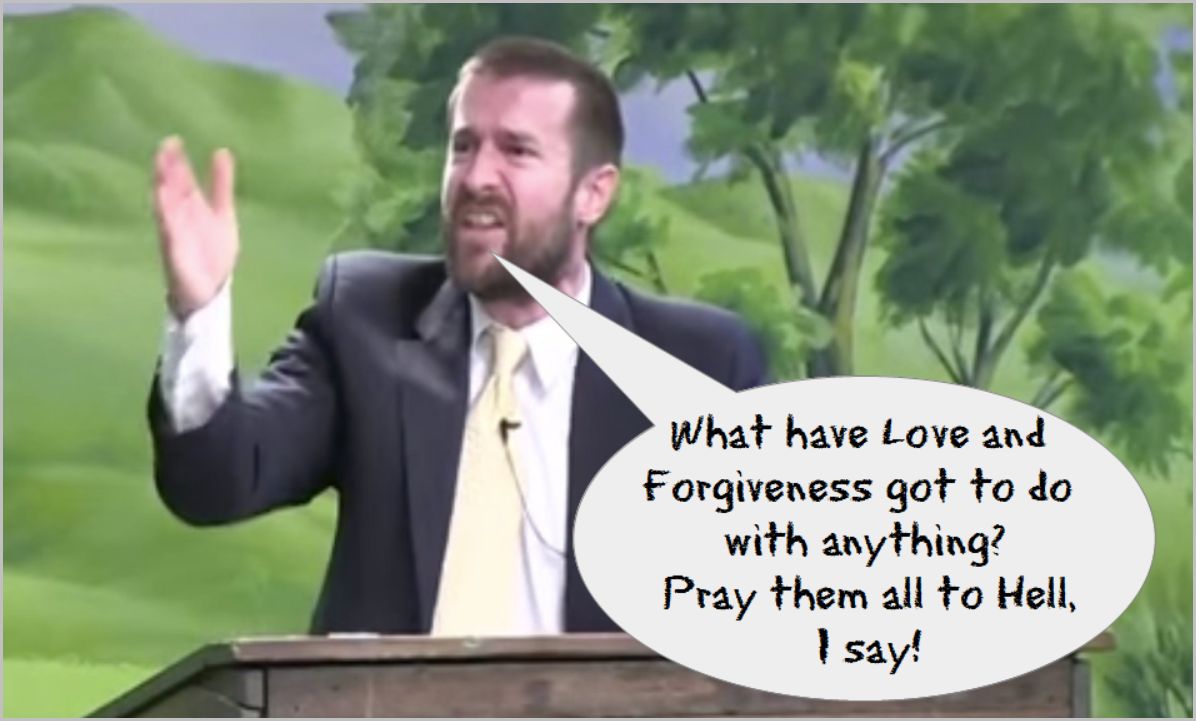
The picture shows the deplorable Pastor Steven Anderson (linked above). He knows better than Jesus ever did.


Idiotic Stuff Jesus Said 11: Build Your Lives on the Things I Say

WhoDoJesus demanded you base your life on his teaching. It’s the only way, he said, that you’re going to find meaning, as well as the principles you’ll need when the going gets tough:

Everyone then who hears these words of mine and acts on them will be like a wise man who built his house on rock. The rain fell, the floods came, and the winds blew and beat on that house, but it did not fall, because it had been founded on rock (Matthew 7.24-25).

And what exactly were those words of his? Here’s what he taught:

  • The Son of Man was coming to the Earth to establish God’s Kingdom within the lifetime of his original followers (Matthew 16:27-28; Matthew 24:27, 30-31, 34; Luke 21:27-28, 33-34);
  • His own people needed to be more ‘righteous’ in order to be part of this Kingdom (Matthew 5.20; Matthew 6.33; Matthew 13.49 etc);
  • Being righteous entailed some extreme behaviour; loving your enemies, giving away all you had, turning the other cheek, forgiving repeatedly, being perfect (Matthew 5.44; Matthew 5.42; Luke 6.29; Luke 6.37; Matthew 5.48; Matthew 19.21);
  • It was crucial to obey Jewish law, even if some of it could be reinterpreted (Matthew 5.17-18; Matthew 12.1-7);
  • Once the Kingdom arrived Jesus himself would be King of the world, aided and abetted by his pals (Matthew 19.28; Luke 22.30);
  • His followers would do even greater miracles than he did himself. Given he controlled the weather, healed the sick and raised the dead, that’s going some (John 14:12).

Anybody know anyone who believes all of this or lives this way? Anyone who operates on these exacting principles? I don’t know of anyone and never have. I didn’t even when I was Christian myself. Jesus demands are impossible. No-one can live according to them. ‘Of course not,’ say Christians. ‘You need supernatural help to live like this.’ So why don’t they, when they have God’s spirit living within them (John 14.16-17)? Why don’t we see Christians who perform spectacular miracles, who constantly go the extra mile, who give away everything they have, who are, as Jesus tells them they should be, perfect?

We don’t because no-one can live as Jesus insisted they should. Nor do we see Christians who believe his prophecies either, particularly the one about the Son of Man bringing God’s Kingdom to Earth two thousand years ago. Christians pretend he didn’t really say it, or if he did, that he meant something else entirely. They’ve changed his very words – the ones they should be building their lives on – to claim Jesus himself will be returning any time now (the synoptic gospels are confused about whether Jesus is this Son of Man, or someone else). When he does, they say, true believers will be going with him to Heaven. Never mind that Jesus teaches nothing of the kind and there’s absolutely no foundation for these beliefs in his words. As such, they’re the faith built on sand he tells them is worthless:

And everyone who hears these words of mine and does not act on them will be like a foolish man who built his house on sand. The rain fell, and the floods came, and the winds blew and beat against that house, and it fell—and great was its fall! (Matthew 7.26-27).

So, if Christians don’t do what Jesus tells them and don’t believe his promises or prophecies, then in what way can it be said they take his words as the foundation of their lives? Don’t they, rather, base them on Paul’s teaching, about a supernatural Christ who bears little resemblance to the zealous Jewish preacher they pretend is their ‘Lord’? Teaching that has nothing to do with that of the man who demands his pronouncements be the very basis of life? Paul doesn’t quote any of Jesus’ teaching.  The foundation Jesus speaks of is of no interest to him; so, naturally, this is whom Christians follow – not Jesus, but Paul and his mythical Christ.

Christians have no time for Jesus’ words – and who can blame them? All he offers is impossible morality, false promises and failed prophecies. Far better to go with what Paul offers, because that’s about what’s in it for them. But even Paul didn’t believe anyone was going to Heaven, so they ignore that bit in his teaching too.

Christians’ Favourite Delusions 33: Atheists know in their hearts that God exists

DenyTwo tried cliches trotted out by evangelising (i.e. aggressive) Christians are that ‘atheism is a religion‘ and that in their ‘heart of hearts atheists know there really is a god’. Ken Ham of Answers In Genesis is fond of both assertions, as are other equally desperate promoters of unsupportable beliefs. We’ll come to the first in a later post, but here’s how Ham expresses the second:

They (atheists) know in their hearts that God exists, but they are actively suppressing this belief in unrighteousness (Romans 1:18). They fight so hard against a God that they claim doesn’t even exist because they know that He really does! We need to pray that, instead of fighting against God, these lost individuals will repent and put their faith and trust in Christ and in what He did for them.

Romans 1.18 that he cites says: For the wrath of God is revealed from heaven against all ungodliness and wickedness of those who by their wickedness suppress the truth.

Assuming Paul is saying here what Ham claims he is (it’s doubtful from this verse alone) both he and his hero are demonstrably wrong – as they are about so much. The evidence suggests that while young children look for meaning and assume agency, they do not necessarily attribute these to a god until they are taught to do so by others. The god they then come to acknowledge is the one already prevalent in their social environment. In a predominantly Christian context, they will come to be acquainted with – and may go on to develop a full-blown belief in – the interpretation of the Christian God common within their particular culture.

It is the same for conversion generally. You are more likely to be a Mormon in Salt Lake City, a Roman Catholic in East Timor. If raised in a Jewish environment, it’s more likely you’ll subscribe to YHWH; in an Islamic one, an interpretation of Allah; Buddha – not strictly speaking a god – in a Buddhist one. Statistically, those who adopt a religion and a belief in a god, almost always opt for that which is prevalent in the society into which they are born. This is not god ‘writing a knowledge of himself’ in their hearts, it is a cultural, human phenomenon.

Ham and others see this as evidence for their belief that we all have some sort of ‘god-shaped hole‘ in our psyche that we can just as easily fill with false gods as with the real one (theirs). But this is a shift in the argument; it’s not now that God makes himself known to everyone but that we all find a need for a god. This is not the same thing, nor is it true. Certainly humans have a history of creating gods to explain the strange, magnificent and sometimes hostile universe in which we find ourselves; but this does not mean these many gods exist, as Ham would be the first to admit (c’mon, there’s only one real God – his.) It means only that the human brain seeks pattern and meaning, and has often drawn the wrong conclusions in its quest for them. The gods – and God – are part of these wrong conclusions.

And what of Ham’s assertion that atheists deny their awareness of God because of ‘unrighteousness’ – because, he implies, we just want to live a life of rampant ‘sin’? Well, I admit, I like a bit of a sin as much as the next man, but that’s not why I’m an atheist. I’m an atheist because, like most others, I find no evidence for gods or God either in my ‘heart’, nor in the way the world works nor in collections of iron age stories. Morality doesn’t come into making this assessment. In any case, those who buy into a god don’t have a monopoly on ‘righteousness’, as their weak morals, judgemental attitudes and destructive behaviour regularly demonstrate. More than this, and as Ham admits, Christians are only concerned about others because the Bible says they should be: ‘The reason I care about poverty,’ he says, ‘is because God’s Word instructs me to care, and all humans are made in the image of God as God’s Word tells me.’ This is not righteousness, nor a morality that comes from any real concern for fellow human beings.

Finally, atheists don’t, as Ham claims, ‘fight so hard against’ a non-existent God that we secretly believe in. We oppose Christians and other purveyors of supernatural nonsense when they try to impose their irrational beliefs on others, when they condemn fellow human beings, seek to control them and try to limit their rights in the name of God and the cause of ‘righteousness’.

So, no, don’t condescend, Christians, to tell us we all know that there’s a God that we wilfully ignore. You’re wrong, and I’ll show you even more reasons why you are, next time.

Jesus v. Paul Round 2: And the winner is…

Make-overI’m re-reading Barrie Wilson’s excellent How Jesus Became Christian. Wilson makes the case that Paul’s Christianity was, and is, an entirely different religion from that of the historical Jesus. He shows how Paul’s ‘Christification’ changed the original mission of Jesus – to alert his fellow Jews to the imminence of God’s kingdom on Earth – ‘from one focused on the teachings of Jesus to one about the Christ’ (p242).

How right he is. This very the dichotomy troubled me in my own church-going days when evangelical Christianity, as it still does, consistently excluded the demanding, extreme and human Jesus of the synoptic gospels to focus instead on this illusory supernatural being. They preach sermons about him, sing hymns to him and intone creeds that skip glibly over everything Jesus said and did when he was alive. The Christ was, I came to see over time, an invention of Paul’s, the product of his strange hallucination sketchily recounted in Galatians 1.11-12 and 1 Corinthians 9.1 & 15.45. The Jesus he talks about is a sort of cosmic super-hero, a god-man of the type found in pagan religions in the first century. He has little or nothing to do with Jesus the Jew preacher and would-be Messiah, preserved – just about – in the three synoptic gospels.

So, the differences between Jesus and the Christ are profound. Here are a few of them, that I’ve drawn up, demonstrating that Christianity as we know it – essentially Paul’s ‘Christified’ version with inconvenient bits removed – bears little relation to the ‘good news’ of Jesus:

Jesus’ good news: God’s Kingdom on Earth imminent (Mark 9.1 etc)
Paul’s good news: Salvation through a dying/rising god-man (Romans 3.19-26; 4.24; 5.1-2; 5.10 etc)

Jesus presents as: Jewish Messiah claimant: ‘Son of Man’; Self-appointed judge and king in near future (Matthew 16.28; 13.41; Luke 22.30 etc)
Paul presents: Mystical saviour: The Christ, who saves those who ‘share’ in his death and resurrection; Christ as judge and ruler of mankind in near future (Romans 3.25; 6.1-11; 13.11-12; 1 Corinthians 15.20-28; Philippians 3.20)

Jesus’ qualifications: Teacher, preacher and healer; ideas rooted in Jewish prophecy; full of his own importance (Matthew 5.17; 7.12; 9.35; 25.40)
Paul’s qualifications: Builds entire religion on single hallucination; borrows heavily from pagan cults; full of his own importance (1 Corinthians 15.8; Galatians 1.15-16)

Jesus’ position: Adherent of Jewish Law; emphasises its importance (Mark 6.2; Matthew 5.19)
Paul’s position: Disregards Jewish Law; implies it is ‘dung’ (Romans 3.28; Galatians 5.6; Philippians 3.7-9)

Jesus insists on: Obedience to Jewish Law (Matthew 5.17-20)
Paul insists on: Faith in Christ and his resurrection (Romans 1.16-17; 3.22)

Jesus’ salvation requirement: Be righteous/perfect (Matthew 5.48; 13.43)
Paul’s salvation requirement: Faith (Romans 5.1; Galatians 2:15-16)

Jesus expects: Right behaviours and attitudes (Matthew 5.38-48)
Paul expects: Right belief (Romans 10.10-13)

Jesus’ teaching: Measure for measure morality (Matthew 6.38; 7.2; Luke 6.37); Forgive in order to be forgiven (Matthew 6.14); Show mercy in order to be shown it (Matthew 5.7); Give in order to receive (Matthew 6.38); Treat others as you wish to be treated (Matthew 7.12)
Paul’s teaching: Profess right belief (Romans 10.9)

Jesus’ commands: Love God (Matthew 22.37); Love your neighbour (Matthew 22.39); Love your enemy (Matthew 5.44)
Paul’s commands: Embrace Christ (Romans 8.35-38; Galatians 3.27); Be filled with the Holy Spirit (Romans 5.5; Galatians 5.16-18); Avoid those with different teaching (Romans 16.17; Galatians 6.6-9)

Jesus’ extremism: Give up everything you have (Mark 10.21; Luke 14.33); Give to all who ask (Matthew 5.42); Turn the other cheek (Matthew 5.39); cut off own hands, remove eyes (Mark 9.43-47); Consider castration (Matthew 19.12)
Paul’s extremism: No interest in anything Jesus taught when was alive; intolerance of Jesus’ original followers (Galatians 2.11-21)

Jesus’ guarantees: Resurrection/eternal life through demonstration of one’s personal righteousness once the Kingdom comes (Matthew 25.31-36)
Paul’s guarantees: Resurrection/eternal life for those with right belief and faith when Christ returns soon to judge mankind (1 Corinthians 15.20-28; 51-52)

Jesus’ outcomes: No Kingdom on Earth; no appearance of the Son of Man or a returned Jesus; disappearance of the movement that subscribed to Jesus’ ‘good news’
Paul’s outcomes: No appearance of the Christ; no rapture; no resurrection; no cosmic judgement

Jesus’ result: Failure
Paul’s result: Becomes mainstream Christianity; Paul wins!

As Wilson makes clear, the two are, despite some small overlap, very different belief systems. The Christ Christians worship is not the same as the Jesus they ignore. Nonetheless, they continue to pretend they are one and the same, unable to see that the join is, and always has been, a gaping hole.

 
Notes:
i) Biblical references are by no means exhaustive; there are many others that support each point and difference.

ii) Details of Wilson’s book are:
Wilson, B. (2008) How Jesus Became Christian: The Early Christians and the Transformation of a Jewish Teacher into the Son of God. Weidenfeld & Nicolson, London.

Money, Money, Money

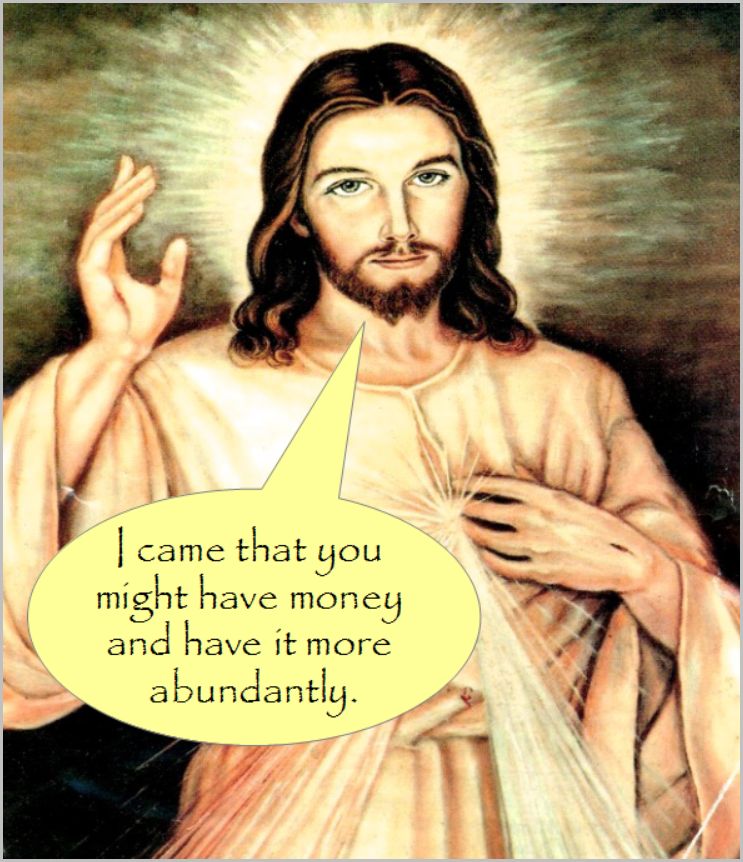
MoneyAfter the Kingdom-that-never-comes, what does Jesus talk about more than anything else? Love? Forgiveness? Marriage? Sin? No. While he does mention all of these, more of his teaching is to do with money and wealth. When he isn’t speaking about money specifically he’s using it as the background to a parable. Eleven of his thirty-nine parables involve it.

He had a thing about money. He resented the wealthy to such an extent he said it was unlikely they’d find a place in his new world order – the famous ‘camel through the eye of a needle’ saying of Matthew 19.24.

Come the revolution, he implied, the rich would have their wealth stripped from them (Luke 6.24-25).

He consigned the wealthy to Hell, not because they weren’t ‘saved’, but because they were rich and ignored the poor (Luke 6.19-25).

He seemed to think being poor was a virtue and that those who were, were especially favoured by God (Luke 6.20).

He preached against what he saw as the dangers of wealth and on more than one occasion (Matt 19.21 & Luke 12.33) and advised those with money and possessions that if they wanted God’s approval they’d have to give them away to the poor.

“No one can serve two masters,” he’s recorded as saying in Matthew 6.24. “Either he will hate the one and love the other, or he will be devoted to the one and despise the other. You cannot serve both God and Money.”

Jesus was no capitalist.

So what do Christians make of Jesus’ evident contempt for money? They certainly don’t give it all away as he said they should. Nor do they see it as an impediment to their salvation, even though Jesus was clear it is (Matt 13.22). As far as today’s Christian are concerned you can serve God and mammon, which is good news – just not Jesus’.

Most Christians in the modern west are incredibly wealthy in comparison with the rich of the first century whom Jesus castigated. Take a look too at the incomes of well known pastors and evangelists – Billy Graham is estimated to be worth $25 million, for example; Creflo Dollar $27 million (but he can still beg his flock for $60 million more to buy a new jet) and Benny Hinn $40 million (who did the same a few years ago). You can see why it’s imperative rich Christians get round Jesus’ injunctions about the evils of wealth somehow.

What is a Christian to do? What they always do when they don’t like what Jesus has to say: ignore him, or try to explain away what he actually said. So, enter the usual excuses: he was only speaking metaphorically/shouldn’t be taken literally/’really meant’ something else. And what did Jesus ‘really mean’ when he denigrated money? That it’s the love of money that’s the problem – doesn’t 1 Timothy say so? Indeed it does, but 1 Timothy was written a hundred years after Jesus. Already his message about wealth was being diluted; Jesus doesn’t make any nice distinction between possessing wealth and loving it. According to Jesus, having money is to love it (Matthew 6.21).

In that case, say those who really can’t countenance surrendering their wealth, money and/or the love of it is really only a problem when it comes between the believer and God. But to believe this necessitates overlooking Jesus’ repeated point that it always comes between the individual and God. Money, according to the radical, demanding Jesus of the synoptic gospels cannot be trifled with; it will always turn those who have it away from God, as well as from those who don’t have any (Matthew 6.21).

And that’s the problem, isn’t it. Jesus is – or was – just too radical and too demanding for those who profess belief in him. He can’t possibly mean that they should surrender their wealth and possessions for the sake of their spiritual well-being. And so they do exactly what he said they’d do: they put their money before God.

Never mind. They can always campaign against others’ so-called sin or whinge about the supposed loss of religious liberty, about which Jesus says nothing. Just so long as they don’t have to do what he says with their wealth because in an area where they have all the religious freedom in the world, they definitely don’t want to exercise it.


Christian Homeopathy

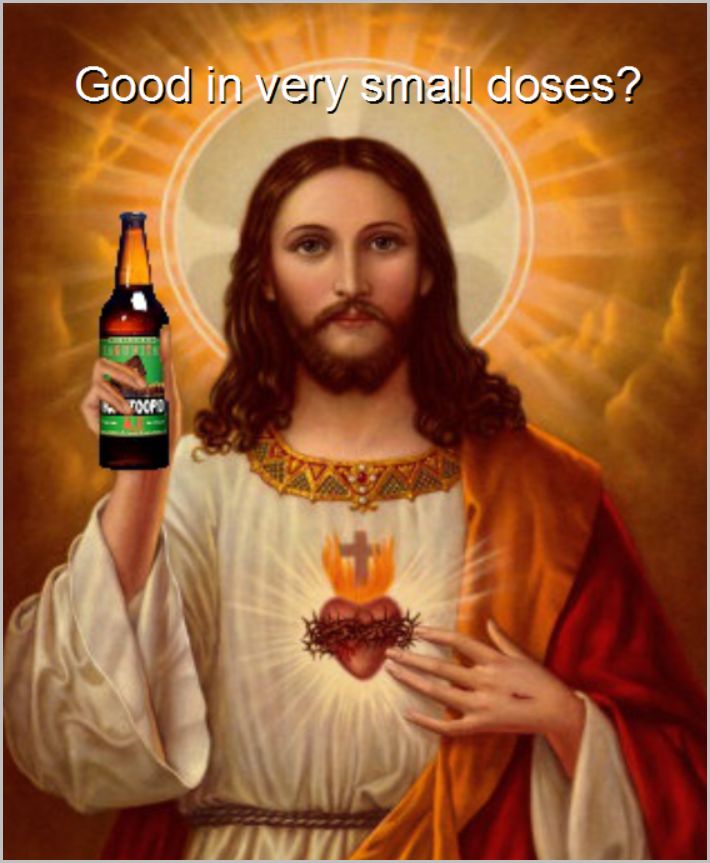
Drink2Homeopathy works on the ‘principle’ that in order to cure yourself of an illness or complaint you take natural remedies in a radically diluted form. Like, say, a couple of molecules of arsenic per reservoir of water. And it really works. It says so on the Internet so it must be true.

Biblical morality is a form of homeopathy. At least that’s how most Christians practise it: in miniscule amounts and only to their own taste.

Others remain strongly opposed to homeopathic marriage.

There Is No God. And Here’s Why

adamSometimes I wonder why I continue writing this blog. There seems to be little that can shake believers from their delusions; what I write here doesn’t appear to be it. When they do respond it’s to tell me that I’m in for a shock when, after my death, I stand in front of the the throne of God and have to give an account of myself. I’ll not be smiling then, they tell me. They’re right, I won’t be. Not because of any ‘judgement’, but because dead people don’t smile. Not of their own volition anyway.

Christians can’t seem to see the ludicrousness of their post-mortem proposals. Religion, all religion, is wrong about most things at most levels; it denies death, which does exist, and replaces it with fantasies about supernatural beings, eternal life and judgements, none of which does. Christianity offers false promises, failed prophecies and an impossible morality, which Christians themselves can’t even manage. By and large they don’t even try to (see previous posts on all of this) yet they stick uncritically, unthinkingly, blindly to the fantasy elements of their ‘faith’ because they’re frightened of their own extinction and want to live forever. Christianity deceitfully promises them that they will – the ultimate false promise.

So let’s cut to the chase. There is no God. This is an indisputable fact, though believers will dispute it anyway. Even now, any Christians who are reading this will be muttering something about the fool saying in his heart there is no God; another tired, cliched response, which I’ve already considered here. But there is no God, not because of any foolishness on my part but because of the evidence. Or rather the absence of it. There is no evidence there is anything other than the physical universe or that life came about as the result of anything other than physical processes (it is not the case that scientists do not know how life emerged from non-life; they do and it did) or that humans evolved by any means other than blind, mindless natural selection. God is not required to explain any of this; not necessary to explain anything at all to do with life, the universe and ‘why there is something rather than nothing’. That being the case, we can know for certainty that he wasn’t in any way involved.

Let’s take a more down-to-Earth parallel to illustrate the point: we do not need to resort to stories of the tooth fairy to explain dentistry. I’m guessing that even Christians would agree with this; the tooth fairy has no part in matters of dental hygiene, orthodontist training or even the payment sometimes made by indulgent parents when their child’s tooth falls out. Trying to force the tooth fairy into any of these scenarios is not only entirely unnecessary, it’s erroneous and unhelpful. Dentistry is far better explained without reference to a mythical sprite. The tooth fairy not being needed, we can safely conclude that she doesn’t actually exist; she is a figment invented for children intended to take the away the pain of tooth loss, nothing more.

So it is with God in explanations into which he too is shoe-horned. He’s not needed, he’s superfluous to requirements. That being so, we can similarly conclude that he isn’t real either. A being that isn’t needed to explain anything is one that doesn’t exist.

This is not, note, a rejection of a figure who, even now, is sitting up in the sky somewhere feeling sad or angry because we’re ‘shaking our fist’ at him. If that’s what you’re seeing, you’re still believing in God, even if it is one you might be in the process of rejecting. It’s worse than that, Jim (or better): there is no super-being in the sky, or anywhere else. The universe is devoid of gods and of God; it always has been and always will be. There are none to be found because there are none there; not your pet god, nor those of other faiths, ancient or modern. None. There is only the physical universe itself and for the brief time we are here in it, we are lucky to be here in it. Which is more than any god has ever managed.

What Jesus should have said…

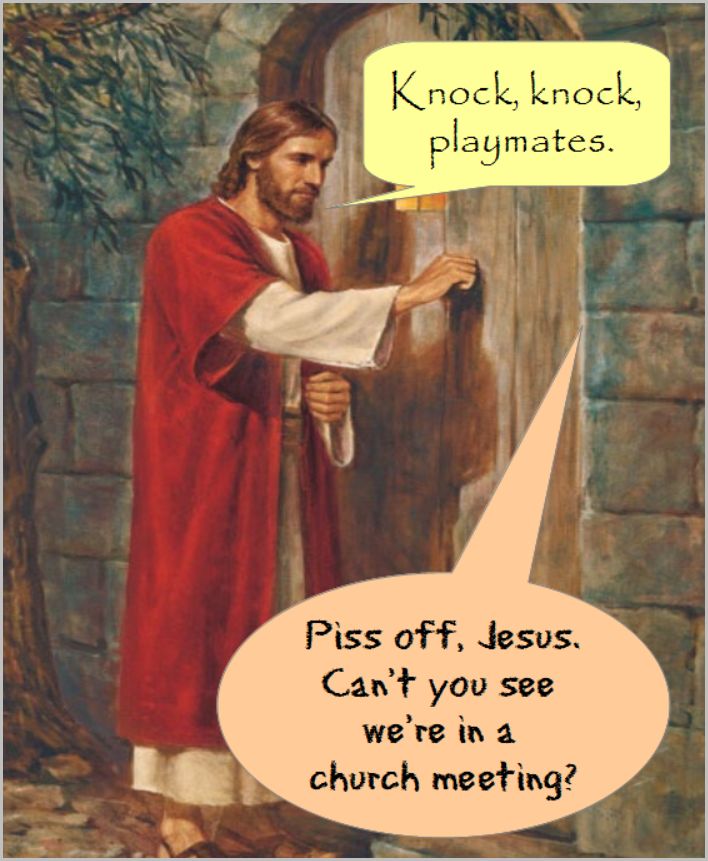
KnockLists are the thing, aren’t they. It’s time we had some on this here blog thingy.

List 1. 10 things Christians pretend Jesus didn’t say:

1. Treat others as you like to be treated (Matthew 7.12)

2. Forgive so that you’ll be forgiven (Matthew 6.14)

3. Don’t judge unless you want to be judged (Matthew 7.1)

4. Sell all you have and give it to the poor (Mark 10.21)

5. Turn the other cheek (Luke 6.29)

6. Go the extra mile (Matthew 5.41)

7. Give to all who ask and lend without expecting anything back (Luke 6.30 & 35)

8. Love your neighbour as much as yourself (Matthew 22.39)

9. Love your enemies (Luke 6.27)

10. Don’t worry about the future (Matthew 6.34)

If Christians followed these injunctions, what a very different world it would be. Instead, what do we get..?

List 2. 10 things Christians think Jesus should have said, but didn’t (with a few examples):

1. Show love for others by telling them what sinners they are (1, 2)

2. Stand on principle as much as you can (1, 2, 3).

3. Take easy offence (1, 2)

4. See persecution everywhere (1, 2, 3, 4)

5. Sue those who upset you (1, 2)

6. Demonise those who don’t share your world view (1, 2, 3, 4)

7. Hate homosexuals and oppose same-sex marriage (1, 2, 3)

8. Set yourself up as defender of God’s standards (1, 2)

9. Argue endlessly about points of doctrine (1, 2)

10. Obsess about the future and the state of the world (1, 2, 3)

This is the Christianity we’ve got. Well done, o righteous ones, for perverting Jesus’ radical (and yes, ridiculously impossible) message into this unsavoury concoction of mean-spirited self-centredness. It’s what he wouldn’t have wanted.


Why_Christians_Don't_Cover_for_KindleMy book Why Christians Don’t do What Jesus Tells Them To …And What They Believe Instead looks at how Christians ignore most of what Jesus says in favour of a Christianity of their own making. You can find it here in the UK, here in the US and on Kindle. Go on. You know you want it.


Idiotic Stuff Jesus Said 10: How to Entertain

Last supper 2Here’s something you don’t see every day.

When you give a luncheon or a dinner, do not invite your friends or your brothers or your relatives or rich neighbours, in case they may invite you in return, and you would be repaid. But when you give a banquet, invite the poor, the crippled, the lame, and the blind. And you will be blessed, because they cannot repay you, for you will be repaid at the resurrection of the righteous.
Luke 14.12-14

In fact, you don’t see it at all, because Christians feel free to flout this command of their Lord’s. I mean, he couldn’t speak any more plainly than he does here, could he? And yet, Christians, you don’t invite the poor, the dispossessed and the disabled to your luncheons and dinner parties. Like the rest of us – that’s the unsaved and sinners in Christian-speak – you only invite your friends, family and fellow-believers. If you’re well-placed, maybe as an official of the established church or as an obscenely wealthy evangelist, you invite those who are similarly rich and famous. As far as you’re concerned Jesus and his ridiculous ideas can just f**k off.

What? You object? You don’t say this, Christians? It would be blasphemous? But of course you say it, when you spiritualise his point, explain it away (‘what he really means is…’), claim the context excuses you or just plain ignore him.

Please don’t misunderstand me; I don’t blame you. Jesus’ expectations are totally unreasonable – idiotic even. But I’m not a Christian; I don’t pretend to follow him and don’t have to do as he says. You, on the other hand claim him as your saviour, your God, and profess to live your life in obedience to him. Except you don’t, do you; you wilfully disregard the clear, direct instructions, like this one, that he gives you.

You much prefer setting your own agenda, whether that’s ‘defending God’s standards’ (your God is incapable of defending his own standards?), bashing the gay or making sure you yourself are ‘blessed’. But these are not part of Jesus’ agenda; his good news (mad as it is), is much more concerned with elevating the lowest of the low, including inviting them into your homes and feeding and entertaining them.

So how about it Christians? How about it all you outspoken men of God – Stephen Green, Steven Anderson, Scott Lively, Matt Barber, Franklin Graham – and all you other Christians; isn’t it time you got down off your soap-box of whatever it is you’re opposing this week and made a start doing what your saviour commands you to do?

Well, isn’t it?