The Return of the Annual Christmas Quiz!

Back, due to popular demand! The annual Christmas quiz, last seen in 2014. Ten questions on Biblical trivia. Answers at the bottom of the page.

Good luck. You’ll need it.

1. Where did Mary and Joseph live prior to Jesus’ birth?

a) Bethlehem

b) Nazareth

c) Galilee

2. How did Mary conceive?

a) By the power of the Holy Spirit

b) She didn’t. It’s a story.

c) How’d you think?

3. What was the relationship between John the Baptist and Jesus?

a) They were second cousins

b) They didn’t know each other and didn’t meet until they were adults

c) Jesus originally belonged to John’s baptism cult

4, When was Jesus born?

a) When Herod I was alive

b) After Herod had died and Quirinius was governor of Syria

c) Perhaps he wasn’t

5. How did Mary end up giving birth in Bethlehem?

a) There’s no evidence she gave birth in Bethlehem

b) She and Joseph had to go there because of the Roman census

c) She lived there anyway

6. The Lord tells Mary to call her child

a) Jesus

b) Immanuel

c) Yeshua

7. Where did the family go following the birth?

a) They went home to their house in Bethlehem

b) Egypt

c) Nazareth

8. Who preserved the songs of Zechariah, Mary and Simeon (Luke 1 & 2)?

a) They were preserved orally word-for-word for 50 years

b) They were recorded in Q

c) They were created in their entirety by Luke, based loosely on Jewish scriptures

9. Where is the prophecy, quoted by Matthew (2:23), that Jesus would be called a Nazarene?

a) Micah

b) Isaiah

c) Nowhere: there is no such prophecy in Jewish scriptures or anywhere else

10. Which is the most unbelievable part of the nativity stories of Matthew and Luke?

a) a host of singing angels hovering in the sky

b) the wand’rin’ star

c) a virgin giving birth

d) Herod’s re-enactment of a story from Exodus

e) All the angelic visitations, dreams and visions that are needed to make the stories function

Answers:

1. Where did Mary and Joseph live prior to Jesus’ birth? All of the answers here are correct, so the Holy Bible say. According to Matthew, Mary & Joseph lived in Bethlehem. According to Luke they lived in Nazareth. According to Mark, it was known that Jesus hailed from Nazareth though he doesn’t say Jesus was born there. John refers to Jesus being from Galilee and acknowledges he comes from Nazareth (1:46).

Matthew and Luke insist Jesus was from Bethlehem to make him ‘fulfil’ the prophecy that the Messiah would come from there. Mark and John apparently don’t care.

2. How did Mary conceive? Matthew and Luke have the Holy Spirit do the deed. Matthew says merely that Mary ‘conceived by the Holy Spirit’, while Luke really goes to town with a ridiculous story involving an angel and Mary being orgasmic about the coming of the Lord. Mark hasn’t heard of either account, because neither had been invented, and fails to invent his own. John is only interested in Jesus as The Logos prior to his time on Earth. Actually, Jesus could only have been conceived by the only method we know that works: boy and girl hoochie-coochie.

3. What was the relationship between John the Baptist and Jesus? All are correct. Luke says Jesus and John were second cousins (1:36) and their mothers were close (1:56). The Gospel of John (1:31) says that John the Baptist didn’t know Jesus personally. Some scholars think Jesus was originally a member of John’s baptism cult.

4, When was Jesus born? a) and b) are both correct according to the gospels. Matthew places Jesus’ birth in Herod I’s reign, which ended when he died in 4BCE. Luke meanwhile dates it to Quirinius’ governorship of Syria, which was in 6 and 7CE. No wonder there are those who think Jesus may never have existed, so encrusted with myth and make-believe is he.

5. How did Mary end up giving birth in Bethlehem? The census is a contrivance to shift the birth to Bethlehem. There wasn’t a census of the kind described when Quirinius was governor of Syria, nor in 4BCE. Quirinius’ census was of property and would not have entailed the (mass) movement of people. Matthew seems to think M&J lived in Bethlehem all along. No-one else thinks so.

As the Bethlehem connection derives only from prophecy (Micah 5:2), it is likely Matthew and Luke located the birth there to show the ‘fulfilment’ of that prophecy. In other words, they invented it, as they do other ‘fulfilments’. It looks like a) is the only viable answer.

6. The Lord tells Mary to call her child… According to Matthew. Mary is meant to call the baby Immanuel, which, as the text helpfully informs us, means ‘God with us’. This is to make the story comply with Isaiah 7:14 which claims the Messiah will be called Immanuel. But Mary doesn’t call her baby Immanuel. She calls him Yeshua, meaning ‘God Saves’, which is not the same thing. How Matthew thinks this is a fulfilment of the Immanuel prophecy is anyone’s guess. When the gospels came to be written, Yeshua was rendered in Greek as Iesus and eventually in English as Jesus. Neither he nor his mother would have recognised this rendering.

7. Where did the family go following the birth? Again, all are correct according to the gospels. The family went on living in Bethlehem according to Matthew (2:7-11) but fled to Egypt according to Luke. Mark doesn’t appear to know either the Bethlehem or Egypt stories and refers only to Jesus coming from Nazareth.

8. Who preserved the songs of Zechariah, Mary and Simeon (Luke 1 & 2)? c) is correct. No oral tradition could possibly preserve the three carefully structured poems verbatim for 50 years. The hypothetical Q is conjectured to be a collection of Jesus’ sayings so the songs don’t come from there either. Luke or his community made them up.

9. Where is the prophecy, quoted by Matthew (2:23) that Jesus would be called a Nazarene? There is no such ‘prophecy’ anywhere in Jewish scripture nor in any extant writing: c) is correct once again.

10. Which is the most unbelievable part of the nativity stories of Matthew and Luke? That’s right. All of them are completely unbelievable.

How did you do? If you’re confused, don’t be. It’s the gospel writers who were. They made up stories about Jesus so that he complied with parts of Jewish scripture that seemed to them to be speaking of the Messiah. (John’s stories are a little different; they and Jesus’ tedious monologues were created to make him seem more like a Greek demi-god.)

Perhaps though I’m taking it all too literally, ‘like a fundamentalist’ as my self-appointed chief critic likes to say. I should perhaps accept it’s all just a metaphor, as he advises. Of course, when I do, he objects to that too; ‘A metaphor for what?’ he asks, forgetting he’s the one who believes the stories are ‘intended’ to be deeply meaningfully symbolic.

The muddled accounts arose as each gospel writers attempted to make an origin story for their hero based on scraps from Jewish scripture, Paul’s teaching and the emerging beliefs of their particular brand of the cult. They’d have got away with it too if some clever-dicks hadn’t decided, many decades later, to put their efforts side by side so their differences were laid bare for all to see: all the contradictions, inconsistencies, fallacies, anomalies and incompatible flights of fancy. Thank god the church kept their writings hidden away from most folks by preserving them in a language they couldn’t read.

That same critic will no doubt tell me I’m wrong again. ‘Everything happened as Matthew and Luke relate. There are no contradictions between them and the other two, Mark and John, had different priorities anyway.’ (See comments to this post here). He’ll tie himself in knots rather than admit the nativity stories are myth, as is everything that follows.

Have a happy Christmas, ya’ll. See you on the other side.
 

Jesus the No-Hoper

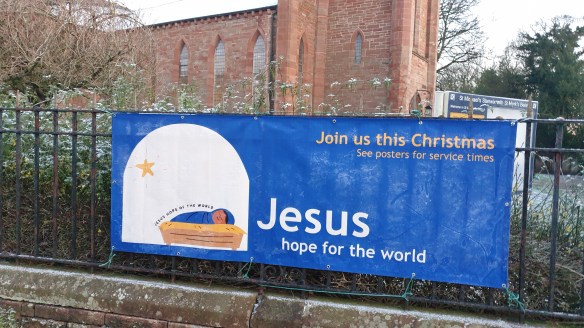
Jesus – Hope for the World declares the banner outside the church near where I live. I can’t help but wonder about the naivety of the people who came up with the slogan and what it means. What are the possibilities?

‘Peace on Earth, goodwill to all men’ (and maybe women)? If so, the world isn’t showing much of either, certainly none that can be attributed to Jesus and his fractured, fractious and frequently intolerant church.

How about inner peace then, even though that’s a long way from ‘hope for the world.‘ How many Christians exemplify this particular fruit of Spirit? Is this, in the end, all that Jesus offers: the hope of a nice fuzzy feeling inside? Of course, peace of mind can be spirit-generate, though personally I prefer wine. 

Hope of reconciliation with God then. Only if you believe in God in the first place, not to mention ‘sin‘, human sacrifice and magic. If this is the kind of hope Jesus represents, then really, what good is it? 

Possibly the hope of which the banner speaks is the hope the earliest Christians had, of Jesus coming back real soon to slaughter his enemies and set up the Kingdom with, naturally, themselves at the top of the pile? Hasn’t Jesus had two thousand years to deliver this hoped for outcome?  An idea well past its sell-by date, the Kingdom of God on Earth isn’t ever going to materialise, however much ‘hope’ people have.

Maybe, then, it’s a hope of eternal life. The gospel writers have Jesus make such a preposterous offer (e.g. John 10:27-28). If this is what Christians are hoping for they are sadly deluded, and, as Paul puts it, the most pitiable of all people (1 Cor 15:19). No human being outside of myth and comic books has ever lived forever. None ever will.

Hope of heaven? See above. Besides, the Bible really doesn’t offer a place in heaven to anyone. That’s a much later development. It’s a waste of this one and only life to live in the vain hope of something better after death. 

Maybe the hope referred to is hope in hope itself. How futile would that be? Hope is no substitute for food for the hungry, shelter for the destitute, treatment for the sick. 

When I go to the carol service at the church next weekend, I’m confident it will be made clear just what sort of hope Jesus offers the world. If not, I’ll be sure to ask. I’ll let you know.

No True Christian


Why is it, I wonder, that every Christian I encounter thinks they are True Christians, while most others are not?

A recent survey in the States revealed that belief in God is in decline. Ken Ham of Answers In Genesis decided this is because:

We live in a day when the religion of secularism (naturalism)—with its belief that there is no God, morality is relative, my happiness is all that matters, and we’re simply the products of evolution—is taught as fact in public schools and through the media.

I suggested on Ken’s Facebook page that the reason more people are rejecting the idea of God might have a lot to do with Christians themselves; that Christians’ own public performance was a complete turn-off for many people. I meant by this the way evangelicals in particular:

  • align themselves with Christian Nationalism;
  • actively campaign to restrict LGBT+ rights (and in some cases to have gay people executed);
  • are obsessed with abortion;
  • disregard almost totally Jesus’ actual commands and instead –
  • waste their time online maligning atheists and other minority groups;
  • are downright unpleasant to those who don’t share their views.

Silly me! I was told by a real Christian called Tim Bodnar that Christians who behave like this are not real Christians (despite believing they are):

If we are to know fellow believers by their fruit (or as you say, “public performance”) – we then know that their fruits show them to not be the Christians they claim to be.  That’s why our relationship with Jesus Christ is a personal one.

When I pointed out to Tim that this was nothing more than the No True Scotsman fallacy, he told me – passively aggressively but oh so lovingly – that ‘it isn’t difficult to grasp’ what’s going on; Christians who aren’t real Christians are the same as people who impersonate police officers. In any case, he said, Jesus had it covered.

Maybe it’s a good thing Christians refuse to look to themselves to learn why others are increasingly rejecting their God and their beliefs. After all, if they were to make their worn-out old fantasies more attractive, more people might fall prey to them. ‘True’ Christians are to be applauded for discouraging, albeit unwittingly, belief in their non-existent God.

A Christian’s Circular Reasoning

Don asks:

Why is it not possible for people to see immaterial things? We see with the mind as much or more than with then eyes. If the mind can conceive of immaterial things we can see them. Often skeptics declare that what Paul saw was a hallucination. If so, he saw something that was not material. We all dream. When we do we see things that are not material. If there are immaterial beings such as spirits, why would it not be possible to see them?

Why is it not possible for people to see immaterial things? Because ‘immaterial things’ by their very nature cannot be seen. Moreover, in the sense you’re talking about – supernatural beings and places – there is no evidence they have independent existence outside the human imagination.

We see with the mind as much or more than with then eyes. The mind processes what the eyes see. Sometimes it produces, imagines, ‘sights’ for itself, as in hallucinations or dreams, but this doesn’t mean these sights are real. Indeed, they are not.

If the mind can conceive of immaterial things we can see them. You mean like ghosts, spirits from the Greek underworld and Norse gods? Of course you don’t,  though your argument applies equally to these. You mean only Christian immaterial things: heaven and hell, angels and demons and the risen Christ. This is merely special pleading.

Your assertion is patently untrue. It begs the question, ‘if the mind can conceive of ’immaterial things’ does this mean these things are real?’ To which the answer must always be ‘no’.

what Paul saw was a hallucination. If so, he saw something that was not material. Yes and yes. Paul hallucinated on more than one occasion, seeing figures and places that were not real. His seeing them did not make them real.

We all dream. When we do, we see things that are not material. A statement of the bleedin’ obvious, but yes, we all dream. Does this make what we see in those dreams real? Again, no.

If there are immaterial beings such as spirits…There aren’t. As you keep stating while failing to recognise it, they are merely figments of the imagination.

why would it not be possible to see them? Because as figments of the imagination, they don’t exist. Here’s where your ‘reasoning’ is entirely circular: the human mind can conceive of immaterial beings and places and these things can be ‘seen’ ((in dreams and hallucinations); because they can be seen they must be real. Therefore, we know they’re real because they can be seen. Can you not ‘see’ the absurdity of your position, Don?  

My 3+ year old granddaughter can distinguish between reality and figments of the imagination, fantasy and dreams. It is really is time you could too.

Jesus Quiz

Sort these statements of Jesus’ into the following categories: a) metaphor, b) hyperbole, c) literal:

Be perfect as your father in Heaven is perfect

Judge not that ye be not judged

Remove the log from your own eye before attending to your neighbour’s

Slay my enemies in front of me

If your hand causes you to stumble, cut it off.

Turn the other cheek

Give to all who ask

Very truly I tell you, the one who believes has eternal life

Whatever you ask for in prayer believe that you have receive it and it will be yours

If you have faith enough you can move mountains

Love your enemies

There are also eunuchs who made themselves eunuchs for the sake of the kingdom of heaven.

After three days I will rise again

Some who are standing here will not see death before they see the Son of Man coming in his Kingdom

I am the Resurrection

Do works even greater than mine

Answers? Damned if I know (and no doubt damned if I don’t.) I do, however, know a man who thinks he knows. He says as a rule of thumb, if you don’t like the sound of something Jesus says, it’s definitely not literal. But if it fuels your fantasy then of course it is.

Thanks, Don.

If It Walks Like A Duck…

Psychology Today has this to say about cults:

Destructive individuals and cults use deception and undue influence to make people dependent and obedient. A group should not be considered a cult merely because of its unorthodox beliefs. It is typically authoritarian, headed by a person or group of people with near complete control of followers. Cult influence is designed to disrupt a person’s authentic identity and replace it with a new identity.

Let’s break this down a little:

Destructive individuals: But those enemies of mine who did not want me to be king over them – bring them here and kill them in front of me (Luke 19.27).

Do not suppose that I have come to bring peace to the earth. I did not come to bring peace, but a sword (Matthew 10:34).

He said to them, ‘But now, the one who has a purse must take it, and likewise a bag. And the one who has no sword must sell his cloak and buy one. For I tell you, this scripture must be fulfilled in me, “And he was counted among the lawless”; and indeed what is written about me is being fulfilled.’ They said, ‘Lord, look, here are two swords.’ He replied, ‘It is enough’ (Luke 22: 36-38). [This is evidently a fictitious episode created around a supposed prophecy (Isaiah 53:12).]

Use deception: The time has come. The kingdom of God has come near. Repent and believe the good news! (Mark 1:14-15). Therefore I tell you, whatever you ask in prayer, believe that you have received it, and it will be yours (Mark 11.24).

Undue influence: Any one of you who does not renounce all that he has cannot be my disciple (Luke 14.33). No one who puts his hand to the plough and looks back is fit for the kingdom of God. (Luke 9.62).

To make people dependent: If anyone comes to me and does not hate his own father and mother and wife and children and brothers and sisters, yes, and even his own life, he cannot be my disciple (Luke 14.26).

…and obedient: If you love me, keep my commands (John 14:15). Whoever serves me must follow me; and where I am, my servant also will be. My Father will honour the one who serves me (John 12.26).

Typically authoritarian… with near complete control: You are my friends if you do what I command you (John 15.14).

Not everyone who says to me, ‘Lord, Lord,’ will enter the kingdom of heaven, but the one who does the will of my Father who is in heaven. On that day many will say to me, ‘Lord, Lord, did we not prophesy in your name, and cast out demons in your name, and do many mighty works in your name?’ And then will I declare to them, ‘I never knew you; depart from me, you workers of lawlessness’ (Matthew 7.21)

Disrupts a person’s true identity: If anyone wants to come after me, let him deny himself, and take up his cross, and follow me. For whoever wants to save his life will lose it. But whoever loses his life for my sake will find it. (Luke 9.23). 

And replaces it with a new identity: Truly I tell you, unless you change and become like little children, you will never enter the kingdom of heaven (Matthew 18.13).

(John said,)He must become greater; I must become less’ (John 3.30).

It is not the healthy who need a doctor, but the sick. I have not come to call the righteous, but sinners to repentance (Luke 5: 31-32).

Whether Jesus said these things or they were put into his mouth by his early followers, it is still the case that if it looks like a cult, talks like a cult and behaves like a cult… it’s a cult.

As it was in the beginning, now and ever shall be.

A Christian Writes

A Christian commenter writes –

…there is only one issue of primary importantance. That is is Jesus the Son of Man and the Son of God and my/your Savior. If so, every other issue pales.

Neil, you and many other atheists seem to think Christianity is broken up into a multitude of pieces that do not agree and do not get along because of disagreements on doctrine and practice. That is actually untrue. When it gets right down to it, only the one issue is important. And that means there are billions of Christians in fellowship. That is the church.

If you missed that in your time as a Christian, I wonder if you really were or whether you were merely religious. Now, among the religious there are significant differences and divisions. Religious Roman Catholics disagree with religious Baptists, and Pentecostals with Greek Orthodox and so on. But that is religion. Christians in all those denominations agree and can have wonderful fellowship when it is about Jesus.

And I respond –

This is nothing more than the No True Scotsman fallacy: ‘those who don’t practise Christianity in the way I (or my sect/church) approves of are not true Christians; they’re merely ‘religious’.’ Having thus discounted those who ‘disprove’ the rule, the rule now gives every impression of working. Brilliant!

You assert that ‘only one issue is important… is Jesus… my/your Savior?’ No, he’s not. He’s nobody’s. Just because Paul and those who came after him decided he was doesn’t mean he is. He’s long gone. Dead. Even so, he doesn’t claim in the synoptic gospels that he came to be anyone’s personal Savior. For synoptic Jesus the only thing of ‘importantance’ was working towards the Kingdom of God on Earth. ‘Seek ye first the Kingdom of Heaven, and his righteousness, and all these other things shall be added unto you.’ For some in the early church, the ‘only issue of importance’ was obeying Jesus’ commands, including, presumably, seeking first the Kingdom on Earth (1 John 2:3-6).

The evidence shows, however, that Christians have never managed to do this (not even after discounting those they disagree with). Just look at Paul’s first letter to the Corinthians. The church has been an unholy mess since the very beginning. It continues to be to this day: take a look at Christian Research Network, which denounces fellow Jesus-lovers on a daily basis.

You delude yourself if you think the ‘true’ church, then as now, is in complete harmony, enjoying blissful love-ins with Jesus while everything else, differences in doctrine and practice included, conveniently fade away. But then, you’ve already bought into one of the most perfidious delusions ever foisted on human beings so I don’t suppose another one matters all that much.


How We Got The New Testament

Recycled pictures, new post.

Once upon a time, there was, possibly, a bloke called Yeshua Bar Yosef. Maybe there was, maybe there wasn’t, but either way, a couple of other blokes, one called Simon (or maybe Cephas or maybe Peter), came to believe that Yeshua had returned from the dead and had appeared to them, alive. This was probably all in their heads and what they saw was at most a blinding light, if they saw anything at all. This was certainly the case for a different bloke, Saul (or maybe Paul) who came along later. He wrote about his experiences and admitted they were all in his mind.

This Simon-Peter-Cephas and maybe one or two others convinced themselves that Yeshua was God’s special emissary and would save them from something, somehow or other. They told other people this and, being gullible, some of these other people believed that Simon-Peter-Cephas and his mates really had seen Yeshua alive again. They started to believe Yeshua would save them too. Saul-Paul, meanwhile, wrote letters to the people he’d persuaded to believe in his version of events – it was a bit different from what Simon-Peter-Cephas and co believed – and, writing in Greek, rendered Yeshua as Iesous (‘Jesus’ came much later when the ‘J’ was invented in the 16th century.) Paul thought Iesous was a celestial being he called ‘the Christ’. He taught that this Christ would soon be coming down to the Earth to set up God’s Kingdom here. Even though they were obviously a bit rubbish, Saul-Paul’s letters were copied multiple times by hand, which is when errors began to creep in. In some places, the letters were deliberately altered.

Other people wanted to get in on the act, so they wrote letters too, pretending they were Saul-Paul. Sometimes these letters said the exact opposite of what the real Saul-Paul wrote. His weren’t the only letters to be forged either. Fifty or more years after the entire scam had got underway, someone pretending to be Simon-Peter-Cephas sent letters as if they were from the man himself. Needless to say there were cultists daft enough to believe it. There were others who wrote letters too, people like James and John. James didn’t see eye-to-eye with Saul-Paul and contradicted many of the things he said.

About 40 years after Simon-Peter-Cephas thought he’d seen the dead-but-alive Yeshua-Iesous-Jesus, somebody in a different country decided to write a back story for the character. He didn’t know much about Yeshua-Iesous-Jesus, what he’d said and done and whatnot, but that didn’t deter him. He borrowed bits from Saul-Paul’s letters and Greek myths and set about it. He scoured the Jewish scriptures for anything that sounded like it might be a prediction of Yeshua-Iesous-Jesus and his supposed escape from death. He made up episodes for him based on these completely unrelated scraps of scripture. He forgot to sign his work, however, and it wasn’t until years later that someone else decided this author’s name should be ‘Mark’.

A couple of other anonymous dudes liked what ‘Mark’ had done when inventing his Yeshua-Iesous-Jesus story but thought they could make a better job of it themselves. The first of these, who would later be called Matthew, lifted most of Mark’s effort (which is how we know ‘Matthew’ wasn’t an eye-witness; an eye-witness wouldn’t plagiarise most of the story from someone who wasn’t) and then went overboard with the prediction/prophecy thing that Mark had started. He found even more spurious bits of scripture and made up a whole lot of new stories about Yeshua-Iesous-Jesus from them. Later still, ‘Luke’ wrote his version of the story, using Mark and Matthew’s accounts and inventing a few new episodes himself. This same person went on to write a fabricated history of the Yeshua-Iesous-Jesus cult, making up stories and speeches for caricatures of Simon-Peter-Cephas and Saul-Paul.

The fourth person to try his hands at writing a script for Yeshua-Iesous-Jesus decided to completely reimagine the character. Strictly speaking, this ‘gospel’ was produced not by a single person but by a collective of cult members. Their Jesus was nothing like the one in the other three gospels. He was more a super-hero, whose special power was boasting about himself. This is the Jesus that, 70 years on, the cult wanted to believe in. Eventually, the name John would be attached to this fantasy, though this isn’t the same John who wrote letters nor the one who created the hallucinatory nightmare that would become the final book of the Bible.

These various letters and stories circulated round the Roman Empire wherever members of the new cult met. Eventually, someone hit upon the idea of collecting them together as one volume. The first we hear of this is when a guy called  Marcion produced his own collection, round about AD140. Stupidly, he didn’t include the right ‘books’ and it wasn’t until AD367 that the collection we now know as the New Testament was first mentioned. This was ratified later that century by a group of men who had elevated themselves to positions of authority in the Church, as the cult was now calling itself. Despite claiming they had been guided by the Holy Spirit, these learned men endorsed the inclusion of several forgeries. Neither did they see fit to arrange the books in the order they’d been written, giving the impression that the accounts of Yeshua-Iesous-Jesus’ life existed before Simon-Peter-Cephas and Saul-Paul’s innervisions that had sparked the whole thing in the first place.

Jump forward a few hundred years and the New Testament, as it was now known, had come to be regarded, by some, as the infallible, inerrant and authoritative Word of God, which clearly it is not. These epithets stuck, however, and are still held to be accurate descriptors of the New Testament by people who have stopped thinking for themselves.

So there we have it: how we got the New Testament –

  • It wasn’t written by eye-witnesses.
  • Its accounts of Jesus’ life are largely fictional.
  • It owes much to fanatics who were prone to visions.
  • It is given to wild speculation, offered without a scrap of evidence.
  • It contradicts itself.
  • It includes many fakes and forgeries.
  • It was banged together by men who didn’t really know what they were doing.

And after that, everyone lived delusionally ever after. The End.

Assertions

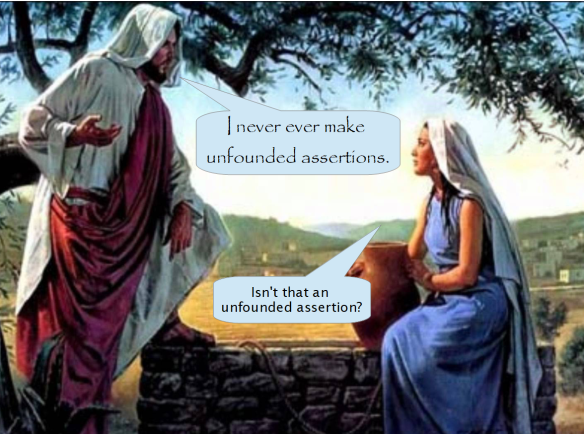
Don likes to take me to task for what he says are assertions in my arguments. I do make assertions, as do we all, because not all points in an argument need to be demonstrated every time they’re used. Indeed, not all assertions can be.

There are assertions that we all accept are likely to be true: the sun will ‘rise’ tomorrow; the Earth is a sphere; evidence is better than no evidence and so on. There are those who dispute these assertions but the onus is then on them to provide the evidence or argument that their counter-assertion is true. Yes, there may come a day when the sun doesn’t rise but it is statistically improbable; the Earth is demonstrably not flat; faith is not an reliable substitute for evidence. There is abundant evidence and sound argument why these things are not the case. But – and this is my point – this evidence does not have to be trotted out every time an argument relies on such probabilities; they can be asserted.

I write, and indeed live my life, on the basis of the fact (‘assertion’) that the supernatural does not exist. Over the last ten years, I’ve posted several arguments why this is the case. I frequently provide a link to these arguments when asserting that, outside of the human imagination, gods, spirits, angels, devils, demons, powers, principalities, ghosts, avatars, heaven and hell do not exist. These arguments form the backbone of any subsequent assertion that the supernatural is not real.

Nonetheless, the onus to ‘prove’ that this is the case does not rest with me. First, because it is impossible to prove a negative. Consider, for example, the Christians challenge to prove their God doesn’t exist. While there is plenty of circumstantial evidence that this is the case, there is no absolute ‘proof’ of God’s non-existence (as I’ve argued before, it all comes down to probability, or, in God’s case, improbability.) Absence of evidence is invariably evidence of absence.

The onus instead lies with the one making the incredible claim. Those who take it as fact that the supernatural and God are real need to demonstrate to the rest of us that this is the case. They have, in my long experience, failed to do this. The best they can do are the various arguments (the ontological, Kalam cosmological, teleological, fine-tuning and the argument from design) that suggest the possibility of the supernatural but fall far short of convincing evidence that the supernatural is real, and further still that the Christian God exists. They depend in the end on the feelings they have in their heads and the Bible (or some other holy book.) This is wholly inadequate

Consequently, I’ll continue to operate from and make my assertion that the supernatural does not exist until such time as Don or any other of his co-religionists demonstrate the probability that it does.

From my assertion, backed up, remember, by earlier arguments, a number of other facts follow:

With no supernatural, there are no gods; YHWH in all his incarnations is a God, therefore YHWH does not exist.

Much follows from this:

If YHWH does not exist, Jesus cannot have been either his avatar, Son or incarnation;

Jesus cannot have been raised from the dead by a being who doesn’t exist;

Stories that he did so must therefore be merely that: stories;

The celestial, eternal Jesus who sits at the right hand of God in heaven is not real;

Any experience people have of this being is entirely within their own imaginations;

The Bible is based on such imagined encounters with these imagined characters;

There is no after-life or judgment;

The Christian faith, including my own, cannot be explained in terms of the supernatural;

Only explanations that are rooted in naturalism, as in science, have any validity.

There are more implications that can be drawn from the premise that there is no supernatural, including the fact that the world makes much more sense (if it makes any sense at all) without drawing gods and demons into it.

Consequently, I shall continue to make my assertions, like those above, supported as always by previous argument. Any religious believer who wants to challenge them is welcome to do so, but must do more than point out the obvious, that they are assertions. They must provide the evidence for the supernatural, and all that follows from it, independent of the goings on in their heads and without reference to holy books written by those with similar subjective feelings.

Responding to a Christian

I responded to comments by our resident cultist, Don Camp, who replied with the following (and more: see comments). I want to pick up (in blue) on some of the points he makes:

I originally asked Don: why is it that whenever anyone asks you to provide evidence for your beliefs, or to confirm what those beliefs actually are, you invariably side-step the issue.

Don: That seems to be the procedure (your procedure, Don?) here and on most atheist blogs, I might add. I really think that I have answered that question clearly enough to be understood (you’ve responded to some questions but have provided evidence for very little of what you’ve claimed. Bible quotes are not evidence.) If not, there is my blog post. But I would ask the same and have of all of you. What do you believe to be true about life and reality? And why or what evidence do you have to support that belief?

Don, there’s ten years’ worth of blog posts on Rejectingjesus, many of which are about what I believe and the evidence I have for those beliefs. I’m not going to reiterate all of them here for your benefit. If you’re interested you could read the posts here, here, here, here and here. I suspect you’re not though; this is just another tactic to deflect the question away from yourself. Don’t you think it reasonable when you launch your sermonettes on other people’s blogs that they ask you to supply evidence for the beliefs you’re promoting? 

Don: I usually get what, I believe, Ark said when I asked about his evidence for Materialism: Everything we know has natural causes, so to presume that the whole universe has a natural cause reasonably follows. (My paraphrase) That is honest and clear. But that is the very same kind of evidence I’ve provided for my worldview. You, Neil, have not provided even that much. Usually I get something like: Atheism, is about what we don’t believe, and we don’t believe there is evidence for God. The trouble is that is negative that conveniently sidesteps the question.

So you do get answers to your questions (so what you moaning about?) I concur with Ark. However, you do not provide the same sort of evidence. You generally rely on the argument from incredulity: I can’t see how something so amazing as the universe could have come into existence on its own, therefore God must’ve done it.’ This is not evidence. You then make the further unfounded claim that this God must be your God who magically created everything via the agency of his Son. Whatever this means, it is not evidence. (Before you say you don’t do this, just check out your further comment below.)

Neil: How about answering my question: do you subscribe to Paul’s first century view that ‘the world’ is governed by wicked powers and principalities that hover around us causing all sorts of mayhem…

Don: No and Yes. No, I don’t think that people are governed by those powers, but they are influenced by them. Yes, I believe there are powers that influence people. And I believe that people can so give themselves to that influence that I would say they are governed by them. (my emphasis). So no prevarication here then! Now how about answering mine. Do you believe that reality is purely material? See above and the posts I directed you to. There is no evidence for the supernatural.

Neil:  Could only a blood sacrifice, in God’s eyes ameliorate (the effects of these demons)?

Don: No. Those powers do not cause sin. We do. (And that I believe is really Paul’s view.) Right. So you know what was really Paul’s view, which, it turns out, is not the one expressed in Ephesians 2:1-3 & 6.11-13. (Addendum: it’s widely acknowledged that Paul didn’t actually write Ephesians. It’s a later forgery based on Colossians.)

Don: No. I believe that only forgiveness can ameliorate sin. The sacrifice of the Lord Jesus is the act of forgiveness made visible. Does your believing make it so? Where does the bible actually say this?

Neil: where is your evidence that this (Paul’s worldview) is reality?

Don: I am not sure what “this” means. There are too many possible referents. If you replace that with a specific, I’ll answer.

It’s clear and specific, Don. We were discussing Paul’s worldview. I asked if you believed it and if so, what evidence you had that ‘this’, Paul’s demon-infested world, was real. You’re side stepping again. 

Me: Or how about answering Ark’s question about whether you believe Jesus was the creator of the universe and what evidence there is for such a belief?

Don: I don’t recall that question exactly (!) But the answer is I believe that God created the universe through the agency of his Son and the earth within it. (And I think that is the crux of our differences). You’re not kidding. 

Don: Evidence “succinctly” is, to use a metaphor, his fingerprints are all over it. Is a metaphor evidence? I don’t think so. It’s a literary device. In any case, every other religion that claims a creator God says the same thing. 

HOW DO YOU THINK THE UNIVERSE CAME TO BE, AND WHAT EVIDENCE IS THERE FOR SUCH A BELIEF? AND HOW DO YOU ACCOUNT FOR THE DYSFUNCTION OF HUMANITY THAT CAUSES ALL THE CHAOS AND DESTRUCTION MORALLY AND SOCIALLY? AND FINALLY, WHAT IS THE REMEDY?

My God. You’re gone all caps lock. In answer to your very important questions, see my response above. To summarise:

It is largely irrelevant what I THINK about the origin of the universe. It’s possible, however, that the universe has always existed in some form. You claim this for your God when there’s no evidence he exists; assuming those same qualities for something that does is a more realistic prospect. It is indeed what a number of scientists think. (I expect you’ll know better).

The ‘dysfunction of humanity.’ Is it dysfunctional? Many of us are kind and decent. Humanity is what it is, and it is what it is because we’re evolved primates.

The remedy for what, Don; for what we are? It’s quite likely there isn’t one. Jesus certainly isn’t it. History teaches us that Christianity has only provided some of us with an excuse to behave even more reprehensibly (Putin claims to be a Christian albeit a Catholic; he says one of the reasons he’s invaded Ukraine is to impose traditional Christian values on the country.)  If anything is going to improve us, it’s education; it has civilised us to a significant extent but still has a lot to overcome. 

That’s it. Now go and read those old posts before writing your next sermonette.