The Stuff Christians Say… (part three)

DoorToDoorAtheists are aggressive/militant/unreasonable: The Christians might’ve got us on this one. After all, it is incredibly irritating when we atheists start preaching in the town centre or invade others’ events to tell them what to believe or dish out loony pamphlets or turn up at people’s doors when they’re just about to have their tea. And what about all those meeting places we have, on just about every corner of the city, with smart-arse posters about Adam and Steve on the board outside? And let’s not forget our readiness to blow up ourselves and others in the name of our great cause. Now that’s ‘militant’! Yes, we atheists really do have too much freedom to push our views on others. No wonder we’re so insufferable. (Note to self: check you’ve got this right.)

It takes more faith to be an atheist than a Christian: It takes no faith to recognise there are no supernatural beings. It takes no more faith not to believe in God – or to acknowledge that there is no God to believe in – than it does not to believe in Santa Claus, Poseidon or Ra. Christians themselves require no great abundance of faith to dismiss these characters. Is it so difficult to understand that atheists disregard the Christian pantheon of fantasy figures in exactly the same way? Or are believers practising their dishonesty-for-Jesus again? There is no faith involved in being an atheist. On the other hand, believing in an omnipotent but suspiciously inactive God, a super-hero Saviour, a magic Spirit, angels, cherubim, seraphim, demons, Satan, resurrected saints, Heaven, Hell and all manner of powers and principalities – this requires faith in delusional quantities. No atheist could possibly compete. Nor would they want to.

Do No Harm

sermon2

If religions took ‘do no harm’ to heart (as the Hippocratic Oath does) and their adherents were made to comply with it, what a better place this world would be. There’d be –

No more religiously-motivated suicide bombers and terrorist atrocities;

No more murder in the name of the Lord (whichever);

No more children molested by priests and pastors;

No churches attempting to cover up their crimes;

No more child deaths as a result of ‘faith-healing’;

No religiously-sanctioned denigration and abuse of women;

No more ritualistic mutilation of children’s and young women’s genitals;

No more religious scams and shams;

No more religiously-inspired vitriol directed at gay and transgender people;

No more barbaric executions of ‘minorities’, like gay men, women and those of other faiths.

Of course, even without these, the world would still not be perfect. Awful things would still happen. But the principle of doing no harm would eliminate much of the trauma inflicted on people by the proponents of irrational superstition.

On paper at least, the Abrahamic religions have expectations that are more demanding than simply doing no harm:

Love your neighbour as yourself (Leviticus 19:18; Judaism);

Love your enemies; treat others as you would like to be treated’ (Matthew 7.12 and 5.44; Christianity);

…compete with each other in doing good (Surat al-Ma’ida, 48; Islam).

However, these are just too damned hard for so many religionists. They disregard them and opt instead for the spiteful paranoia of the same holy books. Perhaps the simpler injunction of ‘do no harm’ would be easier for them. But until the preachers of judgement and hatred find it in themselves to promote such a principle, we will all continue to suffer the destructive effects of the ‘great’ faiths.

So, how long until the next terrorist attack? The next church child-abuse cover-up? The next rape scandal? The next persecution of gay people?

      Not long at all.

           Praise the Lord (whichever)!


The stuff Christians say… (part one)

Jesus-Facepalm

On the day Christians remember the time Jesus allegedly spent being dead and buried (that’s one day, if you’re counting; what happened to the three he promised?) by going shopping or watching sport, let’s take a look at some of the nonsense they spout about atheists:

Atheism/humanism is of Satan: Given there’s no evidence for any supernatural beings, there can be no devil, Satan, Lucifer – or whatever other name Christians come up with for this fantasy figure. (Bizarrely, it’s Jesus who’s called Lucifer in Revelation 5.5) The devil is a creation of the human mind, intended to explain the nasty stuff in life and to let a supposedly good God off the hook. It follows that an imaginary being can’t make human beings be anything. The devil therefore does not make people atheists nor direct them in their ways.

Humanists/atheists set themselves up as God: Every manifestation of the god(s), including those that happen to be popular at present, is of human origin. Like all the others, the Christian God is a product of the human imagination that is made manifest only through human behaviour. So who is it who sets themselves up as God? Those who recognise that this creation of the human mind has no external reality, or those who claim an intimacy with the ‘Supreme Being’, believe his Holy Spirit lives within them and delude themselves into thinking they speak for him? No prizes.

Humanists/atheists worship man as God: Atheists don’t do this either. We are well aware of humans’ fallibility, inconsistency and capacity to bugger things up. However, we’re all we’ve got. There’s no God going to come and save us or solve our problems. We have to do it ourselves (or, as the case may be, not). Nor do atheists regard other people as wicked sinners who have no good in them – a particularly unhealthy viewpoint favoured by the religious – but this hardly constitutes ‘worship’.

Atheists hate God: Only to the same extent we ‘hate’ Santa Claus, Poseidon and Ra. You can’t hate (or rebel) against something that doesn’t exist. We do get very tired though of Christians foisting their views on us, insisting we should believe what they believe. And we get angry when they disparage others and attempt to curtail their freedom because they alone know what Jesus would want. But being angry about Christians’ unreasonableness is not the same as hating something that doesn’t exist.

To be continued

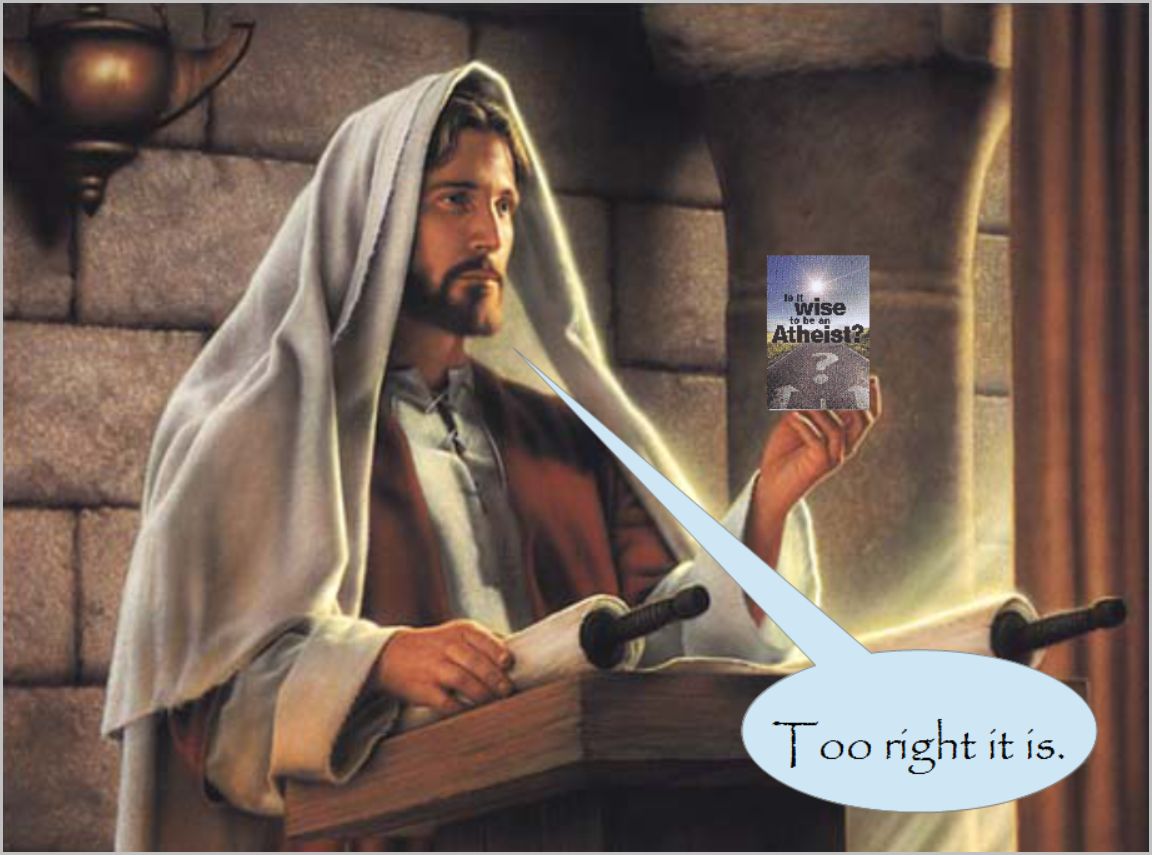
Is It Wise To Be An Atheist?

Tract

Christians say the funniest things… like ‘atheists can’t possibly know that there’s no God.’

This is the argument expressed in a tract,  Is It Wise To Be An Atheist?, that I was given on the street the other day:

A person cannot really be sure there is no God (unless) they have existed for all time and have identified that God isn’t there; they have been everywhere and have seen that God isn’t anywhere and they know everything and therefore know for certain that God is non-existent.

Safe to say, these are not the same impossible criteria Christians apply when determining whether deities other than their own exist. Even Christians know that Allah, Zeus, unicorns and the tooth fairy don’t really exist. But without being immortal, omnipresent and omniscient, they cannot know for sure. By their own criteria, all mythical/supernatural beings have as much chance of existing as their God. Yet Christians do claim, with reasonable certainty, that other Gods and imaginary entities are not real. This is because determining the authenticity of entities is not about absolute certainty but probability and, yes, reasonable certainty.

For reasons I explore on this blog – here, here and here, for example – the likelihood that a god of some sort exists is low. That that god should then turn out to be the one worshipped by Christians today reduces the possibility still further, on the basis that the more conditions one adds to a proposition, the more improbable it becomes.

To put it another way, the probability that there is no god is already high; that there is no God as conceived by Christians is higher still. Therefore it is reasonable to conclude he does not. This is reasonable certainty; the same reasonable certainty Christians apply when dismissing all other gods.

Better luck next time, Christians.

Arguing for God

God3It’s a funny thing, but there aren’t hundreds of sites on the internet arguing for Barrack Obama’s existence. Nor the Eiffel Tower’s. Nor Australia’s. Nor the moon’s, nor the universe’s.

Why not? Because we have an abundance of empirical evidence that all of these things are real. People have experienced them first hand, can observe them and interact directly with them. There is no need to ‘prove’ or argue for their existence.

There are, however, hundreds of sites – plus books and broadcasts – that argue for the existence of God. This is telling. It is, whether those offering such arguments realise it or not, a blatant admission that there is no empirical evidence for him. If there were, there would be no need for argument and ‘proofs’; no need for apologists to resort to persuasion that is ultimately self-refuting to ‘demonstrate’ his existence. No need for apologists. Their problem is, of course, no-one has ever met God nor observed or interacted directly with him. Not in the same way people have met President Obama, seen him on the television, heard him speak or interacted with him in person. No-one has done anything of the kind with God, not even those who claim they have and feel compelled to tell us all about it. Every encounter with the Almighty has taken place in the mind of the individual experiencing it, just as St Paul admitted. God himself has never made an appearance.

So, yes, it’s very telling, this having to argue for God. If there was clear evidence of him there wouldn’t be any need to devise arguments for his existence; he’s not, or shouldn’t be, a philosophical proposition. An omnipotent, omniscient, omnipresent, creative being would, by dint of his immanence (presence in this world), be somewhat obvious and there would be incontrovertible evidence of his existence. Christians and other god-botherers say there is such proof, citing Nature, Goldilocks universes, Holy Books and personal experience. But these are far from incontrovertible, being much better explained by other means, none of which involve God. His very superfluousness demands that, through the application of Occam’s razor, he be discarded; not, as apologists would have it, rebranded as ‘transcendent’, a sleight of hand allowing them to proffer unreality as the ultimate reality.

The desperation to convince others there’s a God with an existence outside the human imagination is, then, more than adequate demonstration that there isn’t. Christians and others who want us to believe their God is real, protest much too much and in so doing, demonstrate precisely the opposite.

Our Father

FatherJosh, our social worker, would always tell us that our father didn’t mean it. He didn’t mean to threaten and intimidate us. He didn’t want to have us cringing in fear of him whenever he came near. Josh said our father loved us really, in his own way. I think we knew that ‘in his own way’ really meant ‘not in the way anyone else would recognise as love’. But, Josh said, whatever it might look like, father really did love us. It was just, Josh said, that he was naturally short-tempered and really couldn’t tolerate what he judged to be our terrible behaviour, even though none of us was really what you’d call badly behaved. No more than most children, anyway. Just by being there, it seemed we irritated father to such an extent that he’d punish us severely, the punishments out of all proportion with our supposed misdemeanours. Dolores once spent the night in the coal shed because she forgot to ask father’s permission for something trivial. No-one could remember what the next morning when she was allowed back in, crying, shivering and covered in black dust. But father said she deserved it for being such a wicked child. He said we all did.

We’d appeal to Josh, of course, but he’d just say we should ask father’s forgiveness for our wickedness, but as we explained to Josh, it seemed to us that father was the wicked one. We couldn’t see what we’d done that we needed to ask forgiveness for. Josh said that this sort of attitude wasn’t going to get us anywhere except into more trouble. Didn’t we know father loved us very much? All the same, he said, he’d have a word with father on our behalf. ‘He’ll listen to me,’ he said, but it didn’t seem like he did. Father’s demands would become all the more exacting as he told us he expected more of us only for our own good. Then he’d punish us when we couldn’t do what he asked — when we weren’t what he asked, which seemed terribly unfair when we couldn’t be anything more than he’d made us in the first place. Maybe if he’d been around more and had shown us more love than he did, we might not have turned out to be such a disappointment to him.

As you might expect, we eventually lost all faith in Josh. He really wasn’t much use. He promised to fix things with father, but it always seemed like he was on father’s side rather than ours, and his threats still hung over us. We would never be good enough for him, even with Josh’s ineffectual interventions. So when we grew up we all left home. I don’t think any of us has any contact with father now. I’m fairly sure he’s dead, in fact. He has no more control over us anyway; we don’t live in fear of his threats and punishments. We’re finally free of him, thank God.

God’s Ache

 TBNI was going through my nightly ritual of channel-hopping before going to bed the other night when I lighted on a station called ‘TBN’. ‘TBN’, for the uninitiated, stands for ‘Trinity Broadcasting Network’. It is managed and operated by a posse known only as the Father, Son and Holy Spirit. No-one else is involved. These three have decided the best way to get the word out to the masses is to do it on the TV, which, I suppose, beats the old-tech approach. I mean, who reads books these days?

The Father, Son and Holy Spirit Collective was evidently having a night off and had delegated the job of running the station to an ordinary mortal (whose name I was sure I’d remember but have already forgotten). This chap was telling everyone – I say ‘everyone’ though he was standing in an empty attic – just how much God loves us and yearns to heal us. That was his word, ‘yearns’, which means to desire strongly or to ache to do something.

And I found myself wondering why he doesn’t – heal us, that is. I’ve already shared my thoughts on the Godhead’s abdication of any hands-on demonstration of his love, but if this bloke was right and God really does want to heal us – then why doesn’t he just get on with it? He could post a big miraculous sign in the sky saying ‘Hi. It’s me, God. I’m doing all this, the healing you’re seeing all over the world,’ so everyone would know it was him and not aliens or some super-advanced scientists who’d travelled back from the future. Or – even better idea – he could have it broadcast on his very own TV station. If he’s not available to do it himself, what with all his preparations for the miracle-to-end-all-miracles, he could get one of those Holy Joes who’ve got a direct line to him to announce it for him. Franklin Graham maybe, or Jan Crouch, who could have her hair roughed up specially:

Starting tomorrow at 12.00 the Lord God Almighty will be curing every illness, healing every psychological and physical ailment and eradicating all illness, just like he said he would way back when (in Isaiah 35.5 and Matthew 11.5 if you’re interested). Okay, he’s a little behind schedule but he’s been busy and, well, better late than never.

Something like that.

If the Lord doesn’t care for either of these splendid options then surely he can come up with a better alternative; according to his human mouthpieces, he sends storms and earthquakes when he’s unhappy, so he could easily conjure up something nice for a change. He’s a creative sort, after all. Not to mention omnipotent.

Now I know there are a couple of theological flies in the ointment that would make all of this difficult for him. The first is Kryptonite. Or human sin… one or the other. But he could obliterate this at the same time, couldn’t he; make us all perfect first then the Kryptonite couldn’t harm him while he’s busy fixing us. I know, you’re going to tell me this would be an infringement of our free-will. But there’s nothing Biblical about free-will. God’s never been keen on it, preferring instead to choose his buddies up front, and in any case, he’s going to eliminate it completely once they’re all taken up into Heaven. So it really wouldn’t hurt him to make some sort of decision about it now. With free-will gone he could just get down to the business of making us all better, not forgetting to take credit for his work in one of the mysterious ways I’ve suggested.

‘What’s in it for God?’ I hear you ask. Well, my tele-evangelist failed to say, but I can think of at least three benefits: 1. He’d get over his ache. Instead of just yearning to do something about disease he’d have actually done something and this would make him feel a whole lot better about himself. 2. He wouldn’t have to worry about Kryptonite any more. 3. He’d have lots of new friends that he wouldn’t then have to consign to Hell.

To be honest, I can’t see why God hasn’t done something like this already. His first idea, to bully a load of ancient tribesmen into submission, didn’t work so well and Plan B just ended in tears. Let’s face it, it wasn’t the greatest of ideas. This though is a far better option. So if you’re listening God, it’s yours, gratis.

                        God?

                                      God?

All in the mind

Disaster

A new minister at the church near where I live has announced his plans to bring ‘God’s love’ to people in the parish. This sounds laudable enough, I suppose – it’s better than delivering God’s condemnation and judgement as many holy rollers are prone to do – but it begs the question why God doesn’t deliver his own love in person. Why is it he feels he can only channel his love through flawed and fallible human beings? Why doesn’t he engage intimately with his creation and let his love be known and felt directly? Why doesn’t he show his love by eradicating cancer, say, or preventing natural disasters, or exterminating the mosquitoes that cause the deaths of up to 2.7 million people every year? Why, in anything that would count as a tangible expression of God’s love for the world, as declared in John 3.16, is there a singular lack of evidence for both his love and his very presence?

‘Ah, but wait!’ say any Christians reading this. ‘God’s love is made manifest through his people, just as the new minister suggests.’ But this is my point; if I only ever expressed my affection for my loved ones through intermediaries – or even strangers, as this minister is to me – or only through a succession of Valentine’s cards, what sort of impression of my love would they have? They would, I think, be unconvinced of it, because love is not just a distant expression of feeling; it’s what we do for others. Love is action.

‘Ah, but wait again!’ say the Christians. ‘What about the second part of John 3.16 that tells us that God showed his love for the world by sending Jesus to die for us?’ You’ll pardon me, won’t you, if I find that a paltry and pathetic expression of love? If I had somehow expressed my love for others millennia ago, no-one at this distance would be impressed by a largely symbolic ‘gift’ proffered only after its original intended recipients declined it (Matthew 22. 8-10).

God didn’t really do this, of course; he didn’t send Jesus, didn’t instruct Paul to extend to all and sundry the offer of salvation that Jesus made only to Jews, didn’t transmit any sort of time-travelling compassion to reach us in the present; doesn’t express his love through other flawed human beings today. How do we know this? Because there is no God to show us love nor to judge or condemn us. Any judgement, condemnation or love is expressed by other human beings, frequently in the name of one god or another but humanly derived even when drawn from a holy book. Gods don’t write books; they’re human creations too.

Everything to do with God, from his very existence and all of his supposed attributes – his aversion to sin, his revelations about himself, his miraculous and mysterious ways, his answers to prayer, his non-answers to prayer, his supposed offer of eternal life, his holy books and his hatred and love – derive from human hopes and fears and our need for explanation. We know this because God’s love and all his other supposed characteristics are made manifest through human agency and in no other way; they have no existence outside the human imagination. So the new minister’s love can’t really be from God. At best, it will be a level of interest and concern for a limited number of people, because that is all that is humanly possible. Even so, it’s more than a God with no direct dealings with his creation can manage. Every expression of who he is, how he thinks and how he behaves is a projection of how human beings think and behave. That is why he is so maddeningly inconsistent across cultures and even within them, depending on which cult (and they’re all cults), denomination or church claims to be representing him. The Christian God is, like all the others, a human creation and all manifestations of him – including his much vaunted love and the relationship believers claim to have with him – are entirely human too.

2015: How was it for you?

2ndComingI promised this time last year to revisit my predictions for the year that lay ahead. So how did I do in my prophecies for 2015?:

The first was that there would be no Second Coming in 2015. Well, how wrong could I be! As we all know Jesus returned on September 13th, just as John Hagee hinted he would be. It’s been so great, hasn’t it, living in Hell / God’s Kingdom on Earth (delete as appropriate) since that time. Fantastic. I’m so pleased to have been wrong about this one.

On the other hand, maybe what I said last year still stands: Jesus won’t be back this year. Just like he wasn’t back in 2014, 2013, 2012… 1985… 1914… 1868… 1497… 1000… 446… 35. Just think of all those years – count ’em, nearly two thousand – when he’s failed to return so far. Actually, he promised he’d be back while his followers and those listening to him were still alive, around AD30 or thereabouts. Safe to say he’s not coming back at all, just like dead people don’t. Not in 2015, not ever.

Of course it still stands. As ever Christianity fails to deliver. That hasn’t stopped True Believers™ from telling us that he’ll be back very, very soon. Which was prediction number 2: Christians will go on believing that Jesus is going to return any day now. I gave up collecting examples well before the end of the year – there were just too many – but here’s a few of them: here, here, here, here, here, here and here. Will the gullible Born Again ever come to their senses and stop listening to idiots like these? (Nope).

Prediction 3. There’ll be no natural disasters or human calamities as a result of gay marriage. There have been lots of disasters and calamities during the year, but here’s the thing – natural disasters have natural causes, not supernatural ones, and similarly, human calamities have human causes. Not one of the events this year (or any other) was the direct result of gay marriage. This hasn’t stopped the religious from claiming – as I predicted they would in prophecy number 4 – that disasters and calamities are God’s punishment for gay marriage; here, here , here, here, here, here and here, for example.

Prediction 5: More than one prominent Christian will call for the execution of gay people. Yup. Here are those loving men of God doing just that (and here, here and here too). Jesus would be so proud.

Prediction 6: Christians in the west will claim they’re being persecuted when they’re being expected to treat others fairly and equally, and not to discriminate against them. Yes, I know Christians are persecuted in some parts of the world, but the moaners I’m talking about are only focused on their own self-serving, self-inflicted ‘marytrdom’. Again, there are just too many of these to link to them all, but here are a few (and here, here and here).

Prediction 7. Christians will respond to criticism with clichés like ‘they wouldn’t dare say that about Muslims’… ‘Christians are the last group who are fair game’… ‘It’s time for Christians to speak out’… ‘Stand up for God’s standards…’ etc. Yes, predictable in more ways than one

Prediction 8: Christians will continue to dismiss and disparage anyone who doesn’t share their views, especially atheists. Look out for ‘atheists have no morality’,’the fool hath said in his heart there’s no God’ and ‘atheists want to oppress Christians’ occurring with tedious regularity. And they didn’t disappoint: here, here, here and here.

Prediction 9: There will be more revelations about the abuse of children by church ministers. Of course there were. Christians may be new creatures in Christ but that doesn’t stop some of them behaving in the same old despicable ways, God love ’em.

Ditto number 10: Church hierarchies will attempt to cover up the abuse of children by their ministers. And here they are at it. The body of Christ certainly seems to have an unhealthy interest in the bodies of others. Still, they always ever so modestly cover up afterwards.

Prediction 11. There will be the usual manufactured ‘war on Christmas’. Ho-hum. And you can guess who did the manufacturing.

And finally I offered number 12: these predictions have far more chance of coming to pass than any of the so-called prophecies of Bible. And do you know, they did. That’s because none of the Bible’s predictions have ever come to pass – not those purportedly about Jesus himself, nor of the second coming, nor the judgement of sheep and goats, nor God’s Kingdom on Earth – and (here’s another prediction) they never will.

So, another year of empty promises, failed prophecies and superstitious fantasy in the wonderful, wacky world of religion. May you all be safe from the effects of faith and fundies in the one that lies ahead.

Sin Nevermore

Second

Remember the old hit Spirit in the Sky? It had the line, ‘never been a sinner, I never sin, ‘cos I got a friend in Jesus’. It doesn’t seem likely, does it? I don’t mean that Norman Greenbaum, who wrote the song, never sinned (he was Jewish, not a Christian) but that friends of Jesus are entirely sin-free. The idea that Christians never sin would be preposterous.

But actually, it’s true; Christians never sin. How do we know? Because the Bible tells us so. 1 John 3.6 says,

No one who abides in Christ sins; no one who sins has either seen him or known him.

And just in case we miss the point, the writer of the letter (almost certainly not the same John who wrote the gospel, nor the John who came up with the trippy Revelation) repeats it in verse 9:

Those who have been born of God do not sin, because God’s seed abides in them; they cannot sin, because they have been born of God.

Christians love to say that awkward bits of scripture like these have been taken out of context, so please feel free to read them in context – you’ll find they say exactly the same thing. What John is claiming – without a glimmer of irony – is that anyone who really knows God/Christ ‘cannot sin’.

So next time you see Christians shooting people at family planning clinics, committing adultery, lying or even just judging others, remember they’re not really sinning. Yes, they may be behaving immorally, uncharitably or despicably but they are most definitely not sinning. That would be impossible because they’re incapable of it.

However, Christians are all too aware that they sin (that’s their choice of word, by the way; I’d prefer to say they sometimes – often – behave as badly as those of us who are not ‘saved’.) So where does this leave us or, more importantly, them? How do they square their capacity for sin with what the Bible says here? Does their behaviour demonstrate that God’s Word has it wrong? Or are they not really Christians, not really people who ‘abide in Christ’, not really born of God?

What a dilemma. Either the Word of God™ is wrong here, like it is in so many other places, or Christians are not as saved as they like to think they are. Perhaps it’s both.

Definitely it’s both.