Call yourself a Christian?

jc-prays

So you think you might be a Christian? Try this handy-dandy checklist to see if you’re a true follower of Jesus or just someone who’s paying lip-service. You’ll need to score big if you’re ever going to get into his exclusive club!

1) Have you relinquished all worldly goods as Jesus tells you to in Matt 19.21 & Luke 12.33?

If not, better get to it. It’s pretty important to him – he mentions it at least a dozen times in the gospels.

2) Have you forsaken your loved ones, taken to hating them even, the better to serve him and his Kingdom?

No? Than what are you thinking of? Not Luke 14. 26 & 33 that’s for sure.

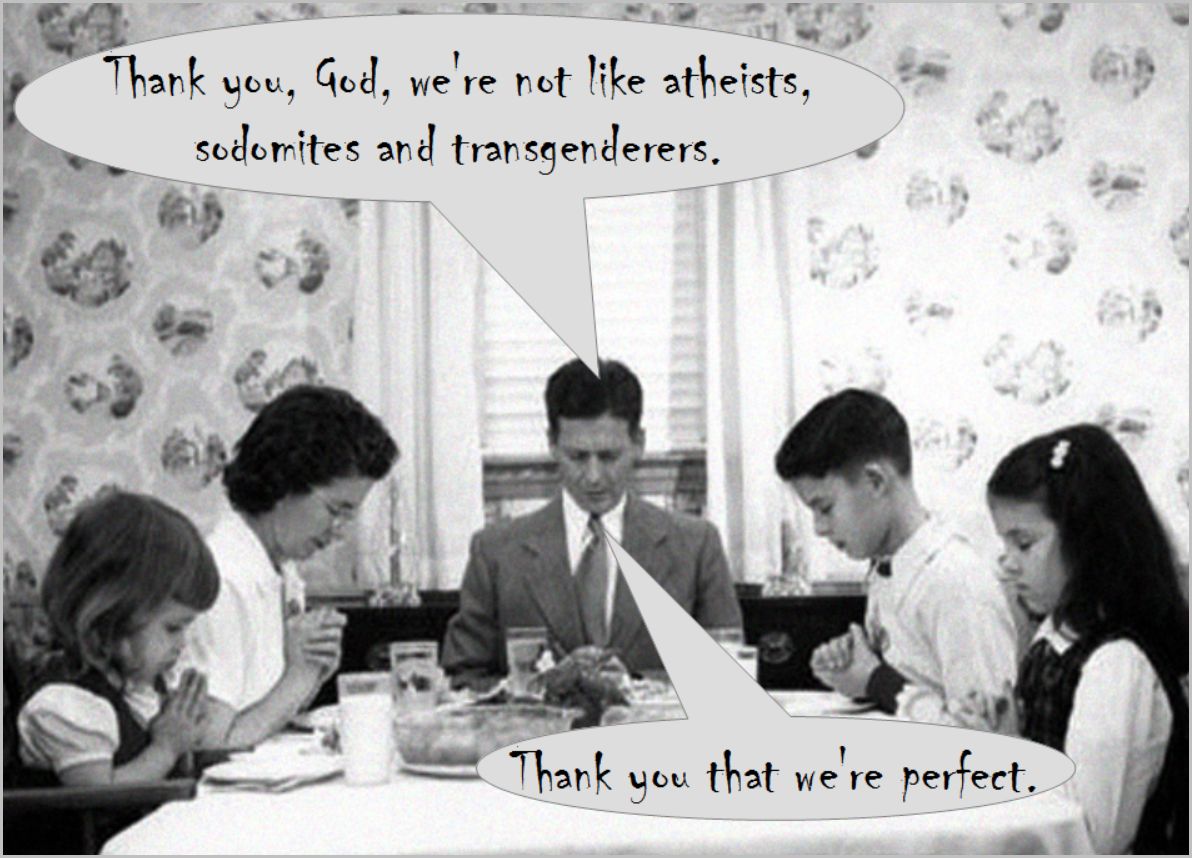
3) Do you constantly go the extra mile, turn the other cheek, give to all who ask, love your enemies and forgive others repeatedly (Matthew 7.12; Luke 6.27 & 29; Matthew 6.14; Matthew 5.38 etc)? In short, are you perfect as he says you should be?

Some work to do here then, to come up to the expected standard?

4) Do you sacrificially serve others – the sick, the imprisoned, the homeless, the hungry, the naked (Matthew 25.34-46)?

Better get round to it as the only way to avoid Jesus’ blacklist.

5) Do you work tirelessly and exclusively to bring about God’s Kingdom on Earth (albeit in the first century) like Jesus commands in Matthew 6.33?

Why not? Get with the programme!

6) Have you stayed single, never marrying, and certainly never getting divorced?

You haven’t? Shame on you, because you can’t into the Kingdom with a spouse and definitely not with one you’ve discarded along the way (Luke 20.34-35).

7) Have you given up judging others?

If not, you can expect to be on the receiving end of a hell of a lot of judgement in return (Matthew 7.1-2).

8) When you throw a party do you invite the poor, the crippled, the lame and the blind instead of your friends (Luke 14.12-14)?

I think we know the answer to this one.

9) Are you tireless in denigrating, campaigning against and ranting about same-sex relationships and marriage?

Well, good for you though this has nothing to do with being a follower of Jesus (see 7 above).

10) Do you believe in a magical incantation that is going to preserve the essential ‘you’ in Heaven forever?

Jesus didn’t.

So how did you do? Are you someone Jesus would say, ‘Well done you good and faithful servant’ to (Matthew 25.21), or would he insist he never knew you (Matthew 7.23)? –

0-2: Pathetic, especially if the two in question are 9 & 10.

3-7: You’re neither hot nor cold. Expect to be spewed out of his mouth (Revelation 3.16).

8-10: You’re getting there, but then, you didn’t really answer truthfully, did you? Your yes didn’t mean yes (Matthew 5.37).

Never mind, you can always get back to singing songs, waving your arms about and condemning others because they have a speck in their eye (Luke 6.42). Everybody knows that’s what being a Christian is really all about.

The Gospel of Hatred

nasty

You might have seen the disturbing BBC documentary America’s Hate Preachers this week, featuring hunky Steven Anderson, pastor of Faithful Word Baptist Church’ in Tempe, Arizona, and chunky street preacher Ruben Israel (above). If not, it’s available here for the next few months (and also, I understand, on YouTube, but of course I couldn’t possibly endorse that.)

Both Men of God™ claim they’re preaching the gospel, which is strange when all they have to offer is bile, hatred and self-aggrandisment. Anderson actually says at the end of the programme that he does what he does – mainly reviling gay people – because he wants to ‘do something big with (his) life.’ Maybe that’s what the gospel is – bile and hatred mixed with self-promotion. There’s nothing of the good news attributed to Jesus or Paul’s ‘love-is-all’ message in the vitriol spewed forth by these two sorry individuals and their various acolytes.

The gospel they preach and the Jesus they convey is spiteful, judgemental and unforgiving. Who knows, maybe that’s what he was. But if you claim to believe in Jesus, all you self-righteous souls, all you grandstanding screwballs, then fine, so long as you do as he tells you: sell all you have and give to the poor; hate your father and mother; remain unmarried; tend to the sick, the needy and the imprisoned; give to anyone who asks; turn the other cheek, go the extra mile and be perfect. Do you do these things? Are you faithful to these words? If not, then you don’t really believe in him either.

People like Anderson and Israel take what little good there is in the Bible and poison it all the more with their own prejudices, their own putrification, their own sour self-hatred. This is the fruit we see in them and in others like them, which would also be fine if they kept it to themselves. But they can’t. They are compelled to try to infect the rest of us with their nasty perversion of a gospel.


The stuff Christians say… God Gave Us Free-will

freewill

Did he really? He doesn’t mention it in his ineffable, infallible, inerrant Word and you’d think he would when it’s so important. It’s a favourite cliché of Christians whenever they’re challenged about why God has let the world get in such a mess, why he allows children to die, why there are hurricanes and earthquakes, that kind of thing. These are all, they like to tell us, the result of humans using the ‘free-will’ God gave them to make the wrong choices – which are anything that’s not God himself. When that happens, he deserts us, abandoning any idea of a duty of care. But that’s not his fault – oh, no – it’s ours for using the free-will he gave us… freely.

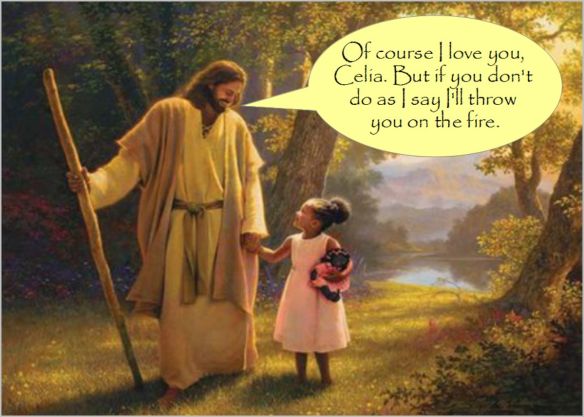
So even though we have free-will, we’re in big trouble if we use it any other than the way God thinks we should. Of all the options available to us, only one is any good; there are so many penalties for choosing anything other than him. It’s as if he says to us, ‘obey me or I’ll abandon you, make everything shit and ultimately torture you’. And you’d be right to ask how this is in any way ‘free’ will. Imagine a human father saying, ‘Now, kids, choose to do as I say or else I’ll throw you on the fire.’ Would children presented with a choice of this kind really be ‘free’ to make their decision?

Still, apparently we are, and wouldn’t you know it, we choose the wrong things. This might have something to do with there being far more ‘wrong’ things than ‘right’ ones, but that’s how God has set things up and who are we to point out the inconsistency of his mysterious way?

More than this, God has handicapped us by making us ‘slaves of sin’ and ‘servants to corruption’ (John 8.34 & 2 Peter 2.19) which naturally disposes us to use our free-will in such a way that almost always leads to the wrong decisions. How about that? Not only does he say ‘obey me or I’ll abandon you, make everything shit and ultimately torture you’, God has given us up to our base desires and so impaired our ability to make the ‘right’ choices.

Ultimately, the idea of ‘free-will’ is a Gordian knot created by Christians, who, finding themselves unable to explain why a loving God would allow everything to be far from perfect, added it to their already shaky theology. But free-will isn’t scriptural; as we’ve seen, the Bible teaches that God does the choosing not us. Nor does it stand up to  scrutiny in the real world. Science tells us that free-will doesn’t exist, it’s an illusion. Our subconscious mind makes our decisions before informing our conscious mind of what these are. This means our decision-making is neither free – our subconscious mind is shaped and constrained by environment, genes and upbringing – nor the product of our conscious mind, our ‘will’.

Still, this is of little interest to Christians who cling tenaciously and blindly to the notion of ‘free-will’. They’ve made the right decision by opting for God and in so doing have surrendered the free-will they otherwise insist is crucial in explaining the state of the world. They’re not going to need it in heaven, I don’t suppose, sitting around praising God all day long. Given though that they’ve made the right decision, why is it the world continues to be such a muddle? Why is life for believers not noticeably better than for the rest of us? Why are they as subject to life’s tragedies and calamities – cancer, disease, death – just the same as the rest of us? Shouldn’t their free-will decision nullify the disasterous effects of rejecting God so that we can see some overall improvement in the state of the world, or at the very least in the lives of God’s Chosen themselves? Why doesn’t it? What good is ‘free-will’ which, even when exercised in the ‘right’ way, appears to make no difference at all?

God wants you to beg

beggar2 What do God and the Queen have in common?

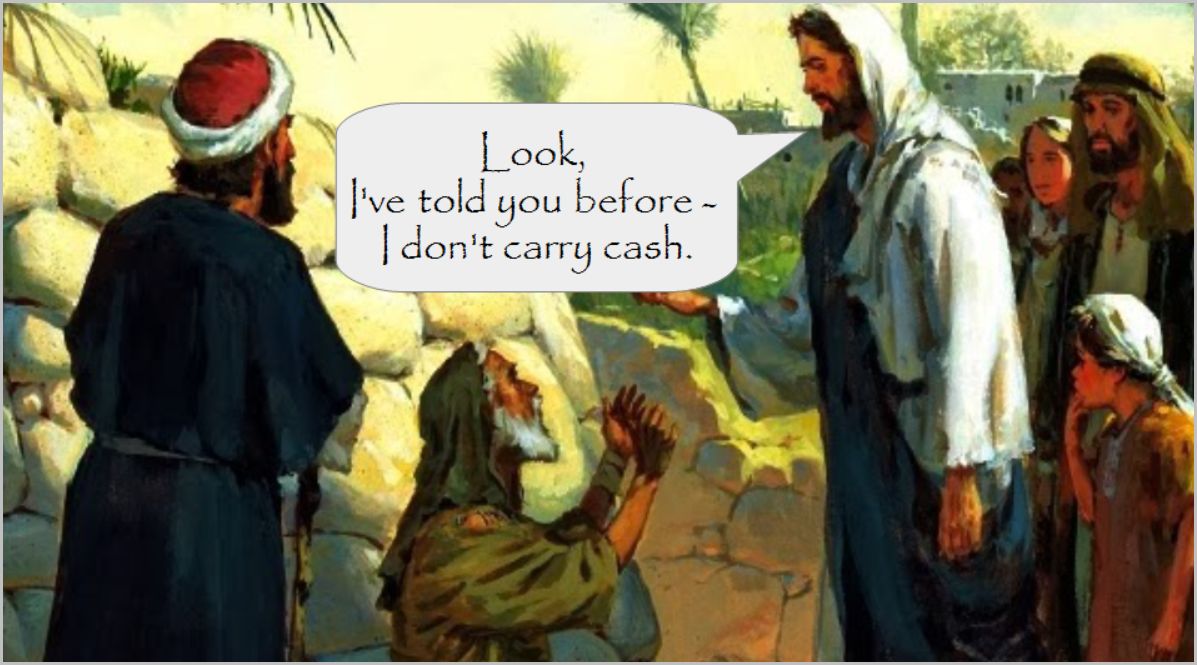
Neither of them do money. Famously, Queen Elizabeth II never carries cash. It’s not like she’s ever going to find herself out of milk so that she has to dash to shop for some. Even if she did, she wouldn’t be expected to pay for it. So she doesn’t need to bother with money.

Same with God. He’s less likely to run out of milk, it’s true, but he does lots of important work in the world and a bit like the Queen, who is funded in large part by the British tax payer, he expects everyone else to cough up what’s needed.

Though he’s a God of abundance who supplies whatever is asked of him, he just can’t bring himself to do money. We know this because those humans who work for him here on earth constantly have to beg other people for it. When they’re busy getting his Word™ out to those who don’t have a Bible of their own, the Lord refuses to pay a penny. Likewise, he declines to assist the brave souls who work tirelessly protecting one-man-one-woman marriage, which, as they tell us, was all his idea in the first place. Nor does he support building Noah’s Arks theme parks ($18 million in tax perks helped with that one), church maintenance (tithes anyone?), helping the persecuted or feeding the hungry. He’ll do all he can to help, naturally, just so long as he doesn’t have to put his hands in his pockets and get them grubby handling cash.

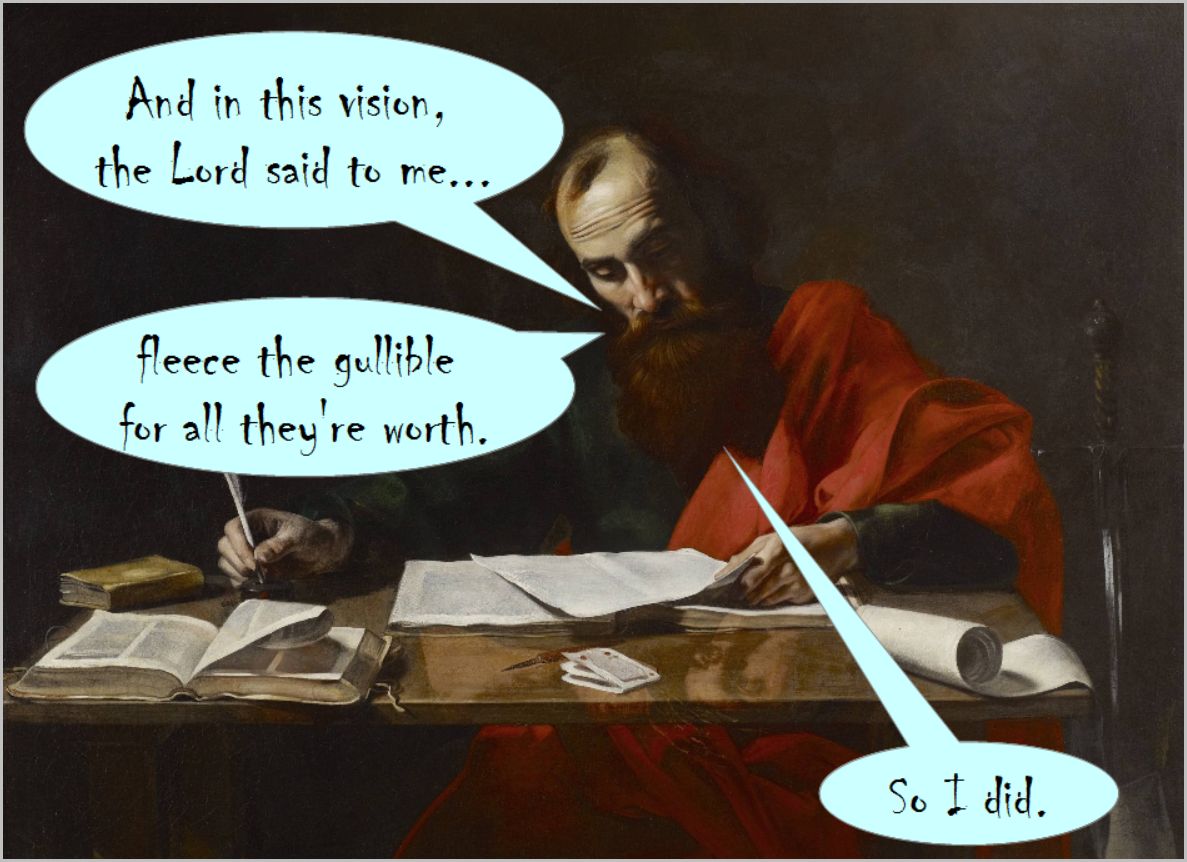
No, what all these noble causes need they have to raise themselves, which is why every single Christian enterprise begs for money, not from God who they know won’t help, but from fellow human beings. ‘Search your heart,’ they tell the gullible, ‘and ask the Lord what he would have you give us.’ Could this the same God of whom Paul says, “He is able to make every blessing of yours overflow for you, so that in every situation you will always have all you need for any good work” (2 Corinthians 9.8)? It surely could. And this being so, why, when he specifically directs his people to create projects that will make his Kingdom a reality, does the money not come pouring in to the point where it ‘overflows’? God being God could make it happen supernaturally or, if that’s a little too ostentatious, by more mundane means. But he doesn’t, hence all the begging.

Like his love, God’s provision is met only through other human beings, be it money, food, love or, most importantly of all, spreading the Word™. You have to wonder, when he finds himself incapable of supporting even his own causes – and they are his own causes because those who operate them on his behalf tell us so – whether he has the remotest interest in any of them.

Which might just be because it’s all a delusion.

The Lord really wants you to support the efforts of this site. Send cash only in a plain brown envelope and he will surely bless you.


Let’s Talk About Sex

Green&Daley

Oh, go on let’s…

The average person has sex about 2,500 times in their lives and produces an average of 2 children. In other words, a mere 0.08% of the sex they have leads to procreation. This means that the remaining 99.92% is entirely recreational. People have sex together because it feels good or helps them be close to someone they love or because they enjoy it, or all three, plus a multitude of other reasons. Even if we were to increase tenfold the number of occasions when sex is intended to produce babies but doesn’t, that still leaves 99.2% of the time when sex is just sex.

So why is it, holy readers of this unholy blog, do you insist that sex is only for procreation (like you do here, here and here)? If that’s all it’s for, shouldn’t you produce more offspring every time you and your partner have sex? Yet you don’t. Even those extremists among you who have 8 or 12 children still have sex a hell of lot of times when it doesn’t result in another kid and isn’t meant to. Most of you use contraception to actively prevent procreation and have all the fun sex you want, whenever you want, without risking another pregnancy. Surely your God can’t possibly approve when he made sex exclusively for reproduction.

Catholics – you don’t get off the hook either; you have lot of sex that doesn’t lead to babies too (or you’d be clocking up kids by the dozen by now). How’d you manage that, I wonder? Same way everybody else does, I’d guess. And what about all the jerking off to porn that macho Christian men enjoy? That for procreative purposes too?

So, why is it you keep telling the rest of us that sex is only for procreation? Let me tell you – because it’s part of your anti-gay agenda. ‘Filthy gays,’ you’re saying, ‘having all that sex that can’t possibly lead to procreation, sex that’s just for fun, that might be with more partners than I’ll ever manage’ (though multiple partners and sex outside those ‘one man/one woman’ marriages you care so much about are pretty common among Christians – but you don’t want that mentioned either). While it may come as a surprise, most gay people are not infertile; they are quite capable of ‘procreating’; given the problems of overpopulation, shouldn’t you be grateful many don’t? Or maybe, like spiteful nutjob Stephen Green in his recent rant about Tom Daley, you like to make the bleedin’ obvious point that gay men need ‘a girl’ in order to reproduce… just like straight men do.

‘But,’ you say, ‘gay sex is between two men – maybe more – or two women (maybe more) and that’s so downright distasteful and disgusting. The Bible says so and I believe it.’ Of course, you’d believe it even if the Bible didn’t say so. So what if it does? Do you honestly think the rest of us care what a bunch of ancient tribesmen and other sex-obsessed fanatics thought?

For men and women who are gay, sex with each other is far from disgusting or distasteful. It’s every bit as exciting, loving and fulfilling as all the fun sex you have. Unless of course, yours isn’t.

Your ranting about recreational sex, gay or otherwise, is just so much hypocrisy. You like it yourself, or else you wouldn’t do it (and you do do it) yet you don’t want the rest of us doing it with the consenting adults we find attractive. Until you’re prepared to give up sex so Jesus will let you in his Magic Kingdom (like he says you should in Matthew 19.10-15 and Luke 20.34-35) then do us all a favour and shut the fuck up about all the great sex the rest of us are having.


Imagine… no religion

Jimenez2People say, like, you know, “Aren’t you sad that 50 superstitious nut-jobs died?” Here’s the problem with that. It’s like the equivalent of asking me, you know, what if you asked me, “Hey, are you sad that 50 Christians were killed today?” Um, no, I think that’s great! I think that helps society! You know, I think the world is a little safer tonight!…

The tragedy is that more of them didn’t die… because these people are predators! They are abusers! They take advantage of people! And look, as Rationalists, we need to take the stand that it is not our job to sit there and say, “Oh, this is a tragedy” or “Oh, this is something we mourn.” Look, everything tells us these are deluded, wicked people. These are evil people.

… People sometimes will say, “You guys are advocating violence!” We’re not advocating violence! We’re not saying we should go do this! But we’re just saying this: If we lived in a rational nation with a rational government, then the government should be taking them… I wish the government would round them all up, put them up against a firing wall, put a firing squad in front of them, and blow their brains out. If we lived under a truly secular government that loved rationality and loved children, and wanted to protect them, that’s what we’d do.

Hate speech? Certainly. But not mine. The original, which you can find here, is about the Orlando shootings a few weeks ago, and is directed at gay people. I’ve simply replaced gentle ‘Pastor’ Jimenez’s use of ‘sodomite’ and ‘paedophile’, which he disingenuously uses interchangeably, with ‘Christians’ and ‘religious nut-jobs’, and his use of ‘God’ and ‘righteous’ with ‘superstition’ and ‘rational’. Jimenez, emissary of a religion of love (Matthew 5.44 etc), would like to see his government exterminate LGBT people.

But, you know, maybe there’s also a case to be made for eliminating the superstitious and irrational from among us. Those of us who have adopted a rational basis for our lives would be happy to see the end of religion and superstition, the removal from the Earth of the religious and the superstitious (I use the terms interchangeably). After all, what do believers in mumbo-jumbo add to the world that is any way positive? What can those who are unable to engage with reality without the crutch of make-believe possibly have to give? On top of their general uselessness, they’re also dangerous and predatory.

Maybe there is a case to be made. But I’m not making it. Any philosophy, ideology or religion that preaches the extermination of other people is wrong, debased, corrupt (you’d think, wouldn’t you, that we’d have learnt that by now.) If you subscribe to such a view – be it from a Christian, Islamic or Jewish perspective – you are wrong. No-one, whatever magic books may say about them, merits death simply because those magic books say so (ratified, of course, by the dim-witted prejudices of those who subscribe to them). Rationality and a secular perspective, on the other hand, eschew hatred and are philosophically opposed to harming those who might not agree with them. Yes, even the religious.

In this way it is vastly superior to religion – your religion, whatever that happens to be.

It was all just a dream…

Stone2Perry Stone, self-styled prophet, evangelist and teacher is of the view that God provides dreams and visions to his followers. He does this, apparently, when he can’t think of a better way of communicating them. Perry recommends that those on the receiving end of God’s special messages should immediately wake up and quickly write down what their dream was about. If they don’t, they’ll forget it! Who knew we can’t always recall dreams once we wake up? Who knows how to wake up as soon as a dream is over? Perry has big drawings made of his own God-delivered dreams. Here’s one. See if you can guess what it was about:

Stone1

Yes, it was a warning about 9/11. The Lord gave it to Perry, in a dream, long before the 2001 attack.

You can’t see it? You think five tornadoes and the monolith from 2001: A Space Odyssey look nothing like 9/11? Shame on you! You need to take this more seriously. You’re thinking, aren’t you, that Perry’s dream, if he had it at all, was down to the cheese he’d eaten before going to bed. That and a deranged mind.

But you’d be wrong; Perry knows for certain his dream was from God and that his interpretation is right on the mark. And who are we to doubt it? Curious, though, that even though the Lord had warned him about the attack in advance, Perry neglected to tell anyone about it. I wonder why that was? God must have wondered too – why he’d entrusted such an important message to a dimwit who did nothing with it. (Then again, if the Lord is capable of inducing dreams why didn’t he speak directly to the terrorists to prevent them from doing what they did?)

Still, good ol’ Perry’s made up for lost time since and is now more than happy to tell the rubes everyone about his dreams. And so what if it makes him a few million dollars? Frenetic Perry has a significant following on TBN and on his own web-site, which is where you can buy his dream-world DVDs for as little as $45 a set.

Nut-jobs’ dreams and visions have been at the centre of religious belief since forever. Dreams are significant, or so it’d have us believe, in the Old Testament where there are at least two dozen ‘important’ ones, together with advice about their interpretation (Job 33.15-18, for example). They’re quite a presence in the Qur’an too.

In fact, dreams and their waking equivalent, visions, are ultimately what religion is made of. They’re certainly what Christianity is made of; Joseph, the Magi, Pilate’s wife, Peter and Paul all have deeply meaningful dreams while Peter, Paul, John and others have visions which, they persuade themselves, can only be the monolith from 2001 Jesus returned from the dead, and other fantastic nonsense. The authors of the New Testament attached such importance to converts’ dreamy/visionary experiences that they had them written back into the Jesus narrative itself. That way it sounded like Jesus knew when he was alive that later fanatics would think they could sense his presence (especially when they whipped themselves up together) and could experience him in dreams and visions. Still today there are those who convince themselves they have a ‘relationship’ with him and can see him in their dreams, near-death experiences and other hallucinations. Just ask Perry Stone. It’s all real!

Well, as real as things entirely in the mind can be.

Same as it ever was…

Paul2

(Edited for clarity 2nd Aug)

Sweet and sour, nasty and nice

or, whatever happened to Luke 18.11-14?

prayer2Why is it when people are emotionally blackmailed into becoming followers of Jesus, does their conversion make them sweet and sour, nasty and nice at the same time? The sweet and nice parts are what their new experience does for them. They get a new start of sorts, are introduced to like-minded friends in the church and become compelled to share their new joy with everyone else, whether they want to hear it or not, about how much they’ve changed because of Jesus. It’s nice for them. Deluded too, but if it makes them happy then why not?

This is why not. What they don’t tell you, not at first anyway, is how sour and nasty they have also become; how they must now defend God’s standards, because, as everyone knows, the omnipotent God of all creation is incapable of defending them himself. Being born again and morphing into ‘a new creation’ involves, without exception, becoming judgemental of others, condemnatory, inflammatory, bigoted and spiteful.

You think not? Then you haven’t heard what these same Christians think about abortion and women who have them. Homosexuality and those who are gay. Transgenderism and those born in the wrong body. Science and those who value evidence. Atheism and those of us who see through believers’ sad delusion.

Christians don’t, as some of them profess, hate the sin but love the sinner. They despise those who have philosophies different from them, those who live differently from them, those who are different from them.

A recent BBC poll asked if the world wouldn’t be more peaceful without religion. Here’s the results as of 14th July 2016:

Poll

I don’t know how many people this represents nor where they’re from – the site doesn’t say – but it would seem that most of us would think we would be better off without religion. It’s long past time we were able to be; religion has nothing to offer. It’s time we stopped giving it special treatment because some of it is sweet and nice. Its sour, nasty aspects are just as much a part of it, inseparable from whatever positives its adherents say it has. I’ll be looking soon at how we might push back against religion’s pervasive and poisonous influence in society.

Effective Preachin’ (Part Two)

Sheep

Reverend M. T. Vessal of the Church of The Raised Up here again, with the second part of my guide to Effective Preachin’. In case you missed it, repent! (The first part’s here.)

Now we’re really gonna get going, praise the Lord! The tools you’re gonna need for your talk proper are:

Lots of anecdotes (make up ’em up if you don’t know any true ones), specially ones about life- and-death situations. Stories about encounters with people on planes always go down well, as there’s always the chance the plane will too, and accounts of foolish follk who hear the gospel and ignore it, only to die in a terrible accident soon after.

Cod-psychology. That’s the stuff about God-shaped holes, how only Christ can forgive sin and meet all our needs, even though he doesn’t and never said he would. You can add something in here slagging off atheists and anyone else you disagree with.

Conviction. This is crucial. Sound as if you mean whatever it is you’re spouting. Sound as if you really know what the Bible says. Make it sound like it’s relevant and meaningful, even though it isn’t.

Modulation, otherwise known as shouting and dropping your voice. Shout when the argument is weak (and they’re all weak – you’re making this stuff up, remember)) and drop your voice almost to a whisper so that people know you’re being really, really sincere.

Drama. Pace up and down, like ‘Bishop’ T. D. Jakes, and mop your brow a lot. Wave your arms about, like Joseph Prince and show you really mean it. Maybe you could use props, like Beth Moore does, though you run the risk then of diverting the attention away from yourself. Better is to demonstrate what a cool guy you are, even if you’re not a guy, by sitting on the edge of the altar steps or, if you’re in a really cool church like Steve Furtrick’s, the Stage. This shows the congregation/audience just how cool you are.

Whipped up emotion. This is optional but if you lay it on thick about what Jesus has done for the spiritually inferior, how their sin caused those nails to be driven in, then you’re on to a winner. Aim for some arm waving from ’em, babbling in jibberish speaking in tongues and maybe even some crying. Don’t forget to tell ’em that whatever they’re feeling is the Outpouring of the Holy Spirit. Definitely nothing to do with your manipulating their already fragile emotions. No sir. This here frenzy is divinely inspired.

Finally, get to the challenge bit of your sermon/talk/self-promotion. This can involve an appeal for money. Correction: this will involve an appeal for money. The God who supplies everything doesn’t supply money so you’ll need to lay a guilt trip on your fans/congregation to provide you with the cash to maintain your lavish lifestyle continue the Lord’s work. But it’s not only about money; remember to pressurise/inspire the congregation/audience/fans to go out and harrass their neighbours so maybe they and their wallets will come to church next week. As the Lord Jesus himself said, ‘the harvest is plentiful but the labourers are few’!

Above all, though, let everyone leave feeling that they’ve had a good time. Like kettles, they should have had a real great Outpouring and feel well and truly Blessed. Leave ’em feeling ready for more, same time, same place next Sunday.


Less religion, not more

Welby

A bloke in a pointy hat and posh frock thinks there should be more religion on television and radio. Justin Welby, Archbishop of Canterbury, says that religion merits as much air time as politics, sport and drama.

The Archbish makes it sound like there’s nothing at all on TV and radio already about religion. In fact, in the last few months in the UK we’ve had a full schedule of Easter programmes; Simon Reeves’ The Ganges on BBC2 (looking at India’s religious heritage); Channel 4’s Unreported World and Dispatches, which regularly consider religious issues; Clare Balding’s trite Good Morning Sunday on Radio 2; the weekly broadcast of church services and daily Thought For the Day on Radio 4; the weekly dollop of worship on Songs of Praise on BBC1 and the 24-hour Christian ‘ministry’ of Trinity Broadcast Network and other God channels for those who just can’t get enough mumbo-jumbo.

Maybe that’s not as much as sport, but then there’s hardly anything on TV that has as much coverage as sport. (Bad news too for those of us with little interest in watching others running, jumping and hitting things; there’s even more to come in the shape of Wimbledon, Euro 2106 and the Olympics.)

Do we really want religion to have the same level of coverage? Are people really as interested in belief systems as they are in sport? Or music? Or art? Or comic book franchises? Even if there are, why is it up to television – the Archbish singles out the BBC as the broadcaster he thinks should indulge his fantasies – to provide it? Isn’t it, rather, up to churches, mosques, temples and other centres of superstition to promote their own particular brand of nonsense?

Make no mistake about it, this is what Justers is proposing; the promotion of religion – ‘religious literacy’ he calls it. He is not, we can be fairly sure, looking for programmes that are critical of religion (unless it’s other people’s). He wants, he says, to see more programmes that give us a better understanding of religious belief. What he means by this are proselytising programmes that create greater empathy for those who subscribe to delusion.

He isn’t advocating, for example, documentaries that explore the irrationality of faith, or ones that show the slap-dash, deceptive ways in which holy books came to be compiled or ones that demonstrate how most adherents to faith fail to live out its exacting demands. Nor is he suggesting programmes that focus on the appalling misery religion brings to some, or shows that give a sympathetic hearing to cults, sects and extremists. I would have no objection to programmes like these (except those that are sympathetic to extremists) because the ugly underbelly of religion deserves to be exposed, like Channel 4’s The Untold History of Islam of a few years ago, taken off air after its presenter was threatened with violence by those who didn’t like its critical perspective.

But these are not the kind of programmes the Archbishop is proposing. The religious literacy he wants us to have is of the cuddly side of faith, the supposed deep spirituality of the obsessive and what he regards as the positive contribution religion makes to the world; a one-sided picture already more than adequately covered by the nation’s broadcasters.

Thankfully, despite the recent political interference in the BBC, the Corporation is still required to present balanced and impartial views of its subject matter. If the Archbishop, who sits in the House of Lords and so is not without influence, is successful in forcing the BBC and other broadcasters to increase their coverage of his obsession, then we should also be able to look forward to programmes that are critical of religion too.

No broadcaster is obliged to promote religion nor to proselytise on its adherents’ behalf. Shame on the Archbishop, with his smiles and pointy hats, for suggesting they are.