Measure for measure

Blog383b

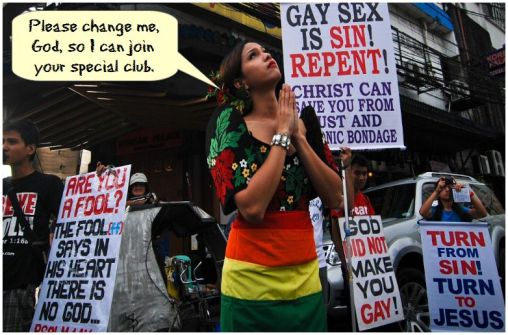
I get so tired of being told how I should live my life. Christians do this quite often, either directly or indirectly. Most don’t know me but they think they have a God-given right to tell me, purely out of love of course, that I’m a sinner who lives life in such a way that it’s going to cost me my eternal existence. God has, apparently, given me over to the wickedness of my own depraved mind (Romans 1.26-29) and they just can’t stop telling me. Being judged relentlessly, and condemned, by a couple of Christian ‘friends’ a few years back was what started me writing and blogging about Christianity in the first place.

When the self-righteous tell me how I should be living my life I usually point them to Matthew 7.1-2 where Jesus is fairly clear about where he stands on the judgement issue:

Do not judge, or you too will be judged. For in the same way you judge others, you will be judged, and with the measure you use, it will be measured to you.

His followers today, however, as they’ve always done, have all sorts of reasons why Jesus didn’t really mean what he said. He never does when they don’t like what he’s saying. Doesn’t he elsewhere, they point out, judge people for their sins? Yes, he does, which only goes to show how inconsistent he was – or at least how inconsistent those who were inventing his stories were. It’s an own goal, but what do his modern day followers care if it gets them off the hook?

So instead, I try 1 Corinthians 5.12 where Paul says,

What business is it of mine to judge those outside the church? Are you not to judge those inside?

Now, I’m quoting out of context. Paul is, in any case, speaking rhetorically/metaphorically/symbolically/out of his arse. (Actually they don’t suggest the last of these even though it’s the closest to the truth.) Christians demand the right to judge. From prominent Christians like Franklin Graham and Pat Robertson to common or garden evangelicals, they are commissioned to tell you the good news of Jesus, an integral part of which is to judge you for the louse they think you are. Conveniently, they ignore the fact that Jesus is emphatic that they themselves can expect to be judged in exactly the same way they judge others. Should you object to their sanctimonious condemnation, or worse still, if they have to face the consequences of judging those outside the church, they claim they’re being persecuted, denied their freedom of speech and are having their religious ‘rights’ trampled on.

I grow increasingly intolerant of their intolerance, which I’d say is the sort of measure-for-measure Jesus says can be expected. As far as I’m concerned, they can all take their ‘good news’ and shove it where the son don’t shine.

You too can be free

Blog381

One of the most liberating aspects of jettisoning Christianity was the realisation that nothing I did had cosmic significance. Nothing anybody does has cosmic significance. Yet to hear the cult’s leaders and spokesman talk, now as then, everything matters.

First and foremost, what you believe determines whether you lived forever in Heaven or not. Can you credit that: what you believe. So better get that doctrine sorted out! Right thought makes all the difference. You only have to read a few Christian blogs to realise how important this still is. Believe something only minimally unorthodox and your eternal life is in jeopardy. Not only that, but what you think in the privacy of your own head about issues like abortion, homosexuality, politics and society is subject to the Lord’s scrutiny. Better get it right – ‘Right’ being the operative term. It means recognising that Trump is God’s Chosen One because the Almighty is really only interested in the USA. He has much less time for other nations, except maybe Israel, so better get your thinking straight on that score, buddy.

God is, or so his self-appointed mouthpieces like to tell you, obsessively interested in how you, as an individual, spend your time, the language you used and whether you’re a faithful steward of the money he supplies (that’s the money you work hard for yourself). He lays it on your heart about how you should spend your time, the only valuable way being in the service of his Kingdom-that-never-comes. You’re made to feel that if your marriage isn’t close to perfection then you’re not really working at it (though god knows the biblical view of marriage is nothing like the one promoted by today’s Christian leaders). You’re made to feel you must share the gospel with everyone else you have relationships with: children, friends, colleagues, acquaintances, complete strangers. Don’t they too deserve to have a chance at eternal life? You don’t want them denied it because you failed to speak up, do you? Well, do you?

And then there’s the guilt when you can’t do all of this. You’re not sure you believe all the right stuff. You think you do but then you’re told about some point of doctrine you hadn’t considered and it is, apparently, really essential you do. So you consult the Holy Spirit who you think lives in your heart and you wonder why he hasn’t spoken up before now. Maybe you have liberal views about abortion. And really, you can’t find it in yourself to condemn all those ‘sodomites’ you’re told about; what difference does it make if you do or don’t? And your marriage is less then perfect. In fact, it’s a little bit messy, like human relationships tend to be, and sometimes you want just to relax, maybe laze a little bit. Not everything you do has to contribute to the Kingdom, after all.

But the guilt won’t let you. What kind of Christian are you, anyway? And as for witnessing at every opportunity, you wonder why you feel like a dog that’s compelled to pee at every lamp-post. Can’t friends just be friends? Can’t you just appreciate others for who they are, not as sinners who need saving? Apparently not.

What a wonderful release it is then, when you finally realise that none of this crap matters. Nothing you do, say or think makes the slightest bit of difference to whether you or others live forever (Spoiler: you won’t, they won’t.) How you act may help others feel a bit better about themselves or provide you with a sense of fulfilment but that’s the extent of it. Outside your immediate context, you’re insignificant, and there’s great significance to that. The pressure is off; God is not watching you to see whether you’re a good and faithful servant. Your time, money and thoughts are yours and yours alone. It’s entirely up to you how you use them, free from the tyranny of religion.


Hope v. Miserable Christians

Blog380c

I am without hope.

Well, I’m not actually, but I am according to many of the Christians who engage me in futile dialogue about how lost I am, how much in need of repentance I am and how not believing in Jesus leaves me entirely adrift in life. ‘Hope of what?’ I invariably ask, and they tell me of being resurrected after I die, of avoiding the judgement of God in the post-mortem state and of spending eternity thereafter with the Lord.

And I have to agree, I am without hope of these things. In return I tell them that evidence shows us that people do not live forever, that because no-one survives death there can be no judgement after it and that no-one therefore gets to spend eternity with the Lord (never mind the fact there’s no Lord to spend it with.) No-one in the entire history of humankind, I tell them, has ever done such things. They say then that they feel sorry for me, because the bible promises they will happen and that only as a Christian (repent! repent!) can I have hope that I will enjoy them for myself.

Just in case you were wondering, all this Christian ‘hope’ in impossible events might sound like it’s indistinguishable from wishful thinking, but it’s not! Here’s how the Desiring God website puts it:

When you read the word “hope” in the Bible (like in 1 Peter 1.13* ‘set your hope fully on the grace that will be brought to you at the revelation of Jesus Christ’), hope is not wishful thinking. It’s not “I don’t know if it’s going to happen, but I hope it happens.” That’s absolutely not what is meant by Christian hope.

Christian hope is when God has promised that something is going to happen and you put your trust in that promise. Christian hope is a confidence that something will come to pass because God has promised it will come to pass.

*written by someone who wasn’t Peter, but we’ll overlook that.

So, you see, Christian ‘hope’ is fixing one’s own wishful thinking onto the wishful thinking of people who lived two thousand years ago, people who believed with certainty that Jesus would be coming to the Earth through the clouds to rescue them at any moment. Having hope today is trusting in this mistaken belief; wishing and hoping that these guys were right, when clearly they were wrong. The hope of today’s wishful thinkers is that the wishful thinking of the past will eventually happen. But these first century wishful thinkers were making it all up; wishing and hoping and praying that Jesus would be back soon, that the resurrection process that they thought he’d begun would continue with them and that they’d inherit the Earth and live forever. As Word of God for Today puts it:

Paul spoke* of the “…hope of eternal life, which God, who does not lie, promised before the beginning of time… (Titus 1:2). Only in Christianity is there such a promise of glorious life beyond the grave. The hope of eternal life is very important, and even if we Christians have hope only in this life we are of all people most miserable (1 Cor. 15:19).

*Not Paul, but we’ll overlook that too.

I sometimes ask Christians to point me to one person, one ordinary mortal who has ever achieved immortality – not someone from a story or (biblical) myth; not Jesus who wasn’t, according to them, an ordinary man, but an incarnate deity – who has survived death and gone on to live with God forever. They can’t, of course. None of the bible’s scenarios for the end of the age, the return of Jesus, the resurrection of believers and the rest has ever come to pass. Nor will it.

Despite their denials, hope that all these fantasies will come true is wishful thinking, just like the Rastafarians hope that Haile Selassie will return from the dead to rescue the descendants of slaves from Jamaica, or my fantasy that one day I’ll win the lottery when I don’t even buy a ticket. It’s wishing, as countless people from different cultures and religious background have throughout history, that life doesn’t end when we die.

Christian hope is futile wishful thinking in an impossible dream. I for one am glad to be without it.

The Chosen One

Blog377

Donald Trump is chosen by God. His powerful friends in The Family have decided. Other influential Christians, like the odious Franklin Graham, have endorsed it. Trump himself made reference to it in a speech recently. He claims this was a joke, but we know what’s said about words spoken in jest; the Donald believes what his Christian chums have told him.

Evidently Trump cannot have been chosen by God when there is no God to do the choosing. Nor does Trump’s behaviour indicate that he’s God’s man. He is ignorant, self-obsessed, spiteful, vindictive, boorish, narcissistic and cruel. Not only is he ignorant generally, he is ignorant about the bible, has no idea about what being a Christian entails and is unable to answer any questions about his supposed faith.

Why then do Christians of all stripes claim he is specifically chosen by God to be president? How do they know? Allowing for a moment that there is a God, the notion that he chooses his agents here on Earth is fraught with insurmountable problems. That he predetermines who will serve him or even who is saved is an insoluble paradox that I’ve written about before, here and here.

No, Christians who say Trump is God’s Chosen are convinced of this only because he supports and implements their agenda; he is anti-abortion, anti-gay and anti-immigrant. He favours guns, white people, Israel, the wealthy and evangelicals. This is why Christians like him, why The Family says he is chosen by God, because these are their priorities and therefore, they conclude, they must be God’s priorities too.

Blog377a

For any Christians reading, particularly in the U.S., the process goes something like this:

1. You decide what is important to you.

2. You find support for your priorities in the bible (because support for just about anything can be found somewhere in the bible. Alternatively, you can just say what you believe is in the bible. Nobody’s checking.);

3. You disregard any apparent contradiction in the words attributed to Jesus;

4. You tell yourself that because God supports your agenda somewhere in the bible, this must therefore be his agenda also;

5. You exercise cognitive dissonance, a.k.a. dishonesty, to enable you to conclude that any influential agent who is prepared to support your priorities must therefore be chosen by God.

Naturally your agent need not demonstrate any other traits that might reasonably be expected of a God-follower (humility, love, hospitality, treating others like they themselves like to be treated and so on.) These things are unimportant so long as the agent is carrying out your agenda.

6. You tell others only of point 5, thus furnishing the entire process with a high-sheen spiritual gloss;

7. You accuse anyone who doesn’t support your agenda and your Chosen One of betraying God.

A good deal of self-deception and deceiving of others is required to pull this off, but Christians are more than up to the job. That’s why Trump is in the White House and why his Christian fixers are never far from his side.

Jesus, plus nothing

Blog376

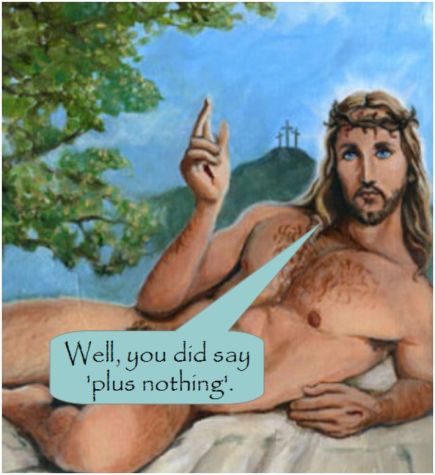
‘Jesus, plus nothing’ is the motto – the slogan – of ‘The Family’, a secretive, clandestine Christian group that for 60+ years has influenced, and been part of, the government of the USA. Yes, poor persecuted Christians, who find their rights eroded on a daily basis (or so they like to tell us) actually exercise a disproportionate amount of control over those in power. Controlled for many years by ‘the most influential Christian you’ve never heard of’, Doug Coe, this group disregards any notion of separation of church and state. The new Netflix series, The Family, based on Jeff Sharlet’s books The Family and C Street, documents their activities, which include affecting policy both at home and abroad, and taking the gospel of ‘Jesus, plus nothing’ to the mighty and powerful across the globe, often on the taxpayer’s dime.

But what does ‘Jesus, plus nothing’ really mean? There’s no doubt it’s intended to convey a stark honesty: this version of Christianity, it says, is without all the clutter that has accrued since Jesus walked the Earth, including all of Paul’s complicated theology. The Family’s holy book is not the bible in its entirety but a slim volume simply entitled Jesus that contains only the four gospels and Acts. The Jesus story, pure and simple.

Except there really isn’t anything simple about the Jesus story. It isn’t even a single story. Nor is there one, single Jesus. (As you’ll see at the links, I’ve written about both of these problems before.) The Jesus that The Family promotes is one of its own making. Of course, every version of Jesus is a construct, loosely based, at best, on bits and pieces from the bible, but manufactured entirely by what different groups and individuals would like him to be. It’s probable that the gospels themselves are constructs built on Old Testament ‘prophecies’ and references, and that the Jesuses they portray are no more than literary creations. Even so, the Jesuses held dear by modern believers, and The Family in particular, bear little resemblance to the constructs of Mark, Matthew, Luke and John on which he is supposedly based.

He is, as one of The Family’s Christian critics points out, a talisman, a magic word that opens doors for speaking ‘truth’ to dictators and tyrants. A Jesus synonymous with power; the power to control nations’ policies, direction and morality. A Jesus who chooses his men (always men) to wield this power; a Jesus who chooses ‘weak vessels’ to do his bidding; a Jesus who, The Family is convinced, chose Donald Trump to be president. And when Jesus chooses you – or when his agents on Earth do – then you are chosen indeed. They make sure of it.

To be continued.

Whatever happened to the Golden Rule?

Blog375a

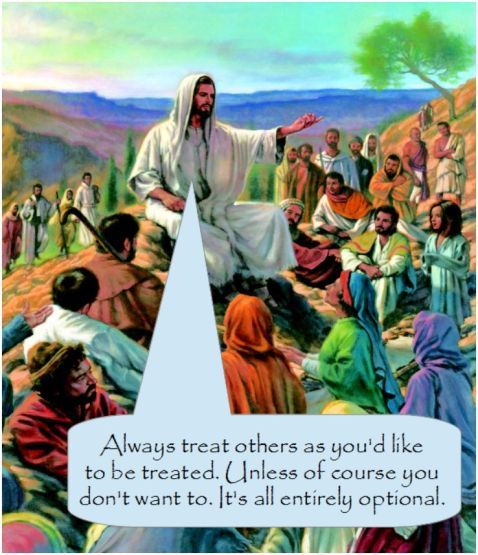
So in everything, do to others what you would have them do to you, for this sums up the Law and the Prophets. (Matthew 7.12: New International Version)

In everything, treat others as you would want them to treat you, for this fulfils the law and the prophets. (Matthew 7.12: NET Bible)

I went to see a performance at the Edinburgh Fringe on Saturday. Actor David Benson presented a one-man show about the Cato Street Plot, which was an 1820 plan to assassinate the British Prime Minister and government (or possibly not. It was probably a set-up.)

During the show, Benson riffed on some of Jesus’ sayings, including the one above, about how we should treat one another in a country that claims to be Christian (as Britain did in 1820). ‘Do unto others’ has become known as The Golden Rule and like most rules it is largely ignored, even (or especially) by many who profess to be disciples of the man said to have formulated it. The principle is of course much older than the gospels.

When I returned home I caught up with some of my favourite blogs and read about:

A military organisation that promotes the separation of church and state in the U.S. on the receiving end of Christian hate mail.

A preacher who thinks the comedian Sarah Silverman should have her teeth smashed before dying prematurely and being sent to Hell.

The same preacher promising that the Jews, who he says are not God’s Chosen People, will be made to bow down before male Christians, who are.

A different pastor who recited Bible verses while allegedly assaulting an under-aged girl.

The cover-up of the sexual abuse of minors by the Jehovah’s Witness cult.

A Baptist Preacher charged with sexual assault.

Thousands of hateful messages, many from Christians, sent to Montreal Pride organisers.

They just don’t get it, do they? Being a Christian means doing what Jesus says (doesn’t it?) and he says that in everything we should to treat others as we ourselves like to be treated. Note how all encompassing that is: in everything, meaning ‘in every circumstance, with no exception’.

My guess is that the majority of Christians like to be treated fairly, with kindness and respect. I know they do because they whine endlessly when they think they’re not being. Yet so many of them won’t extend the same fairness, kindness and respect – in every circumstance – to other people.

I recently saw a slogan that said ‘Why be racist, sexist, homophobic or transphobic when you could just be quiet’; too many Christians can’t even manage that. They feel compelled to hurl vitriolic insults and threats in defence of the most powerful being ever imagined (and he is imagined). Others think that people more vulnerable than themselves, children included, exist only for their own sexual gratification. These Christians have no interest in ‘In everything, treat others as you like to be treated’. It just doesn’t apply to them.

Strike up another failure for their Lord and Saviour, Jesus Christ.

Crawling from the Wreckage

Blog372

I’m occasionally accused of criticising only evangelical Christianity. It’s an easy target, I’m told, and I should spend some time investigating the more sophisticated and respectable version of Faith: intellectual, liberal Christianity. In fact I already have, and have written about it before. This ‘respectable’ version of the Faith is every bit as dishonest and intellectually lazy as its more excitable counterpart.

It has always seemed to me that evangelicalism and fundamentalism do at least take the most indefensible parts of the bible seriously. They may ignore them when it comes to applying them (loving enemies and giving to all who ask, for example) but at least they accept them, if only metaphorically, as part of ‘God’s inerrant and infallible Word’. Intellectual Christians on the other hand sidestep what they find uncomfortable, selecting only that which fits with what they think the Faith should be:

A Loving Father? Then we’ll disregard the parts where God is clearly anything but.

A wise and compassionate Jesus? We’ll pretend the bits where he’s cruel, ignorant and just plain wrong aren’t really there (or are later additions to the gospels; the mistaken beliefs of the early church.)

Church as inclusive community? We’ll have some of that and ignore all the unhelpful nonsense about most of humankind being destined for eternal torture. (That, after all, is just Paul, or whoever, getting carried away.)

I know they do this, because when my own faith was in its death throes, I did too.

Back in the early ’90s. I’d given up on evangelicalism but desperately wanted to salvage something of the Faith that had once meant so much to me (even as it completely messed up my life.) I wanted a God of Love, so persuaded myself there was one – disregarding what I knew of the hateful, unsavoury aspects of the God of the bible. I also really wanted Jesus to have some meaning; if not as personal saviour then as one who exemplified a purposeful and compassionate life. To do this I had to overlook Paul’s theology of a vengeful God, hell bent on punishing everyone.

In the end, however, I had to be honest with myself and accept that the nice God I was trying to believe in was no more real than the nasty one. What I wanted had no bearing on the nature of God, nor on whether he existed. Similarly with the nice Jesus, who could be unpleasant and unreasonably demanding as well. I was being entirely selective, as most Christians are, about how I constructed my own personal Jesus.

Hanging on to fragments of faith was futile. I could no longer sustain the cognitive dissonance required to embrace the parts of Christianity that made me feel good, inspired me or made me kinder, while ignoring the downright nasty bits. If I was experiencing the good things (and I was) I had to accept they were coming from somewhere other than Christianity; if I was to go on experiencing them I had to acknowledge that and cultivate them by other means.

It seemed at first that this would be difficult outside of a church but in fact there are numerous groups committed to helping and inspiring others, without the superfluous and irrelevant presence of religion. It simply isn’t necessary to hang on to selected scraps from a discredited belief system; life lies, in abundance, elsewhere.

This is why I have no more respect for intellectualised, liberal Christianity than I have for evangelicalism. There is nothing intellectual about the cognitive dissonance needed to be an ‘intellectual’ Christian. It is, in the end, a largely content free version of Faith, the spiritual equivalent of a homeopathic remedy. I mean, really: why bother?

Why Christians Don’t Do What Jesus Tells Them To …And What They Believe Instead*

Blog370

A few days ago, notorious God-botherer and TV evangelist, Pat Robertson, said on his TV Show that churches should revise Jesus’ stern teaching about divorce to better fit modern sensibilities. As today’s Christians divorce at about the same rate as non-believers, old Pat thinks it a mite inconvenient that they should feel guilty about it. He reminded his viewers that Jesus gave the church authority over all things and that it should therefore amend Jesus’ teaching. That’s amend as in ‘ignore completely’.

Which is fine, I guess, if you take the same approach to everything else Jesus said. That way, Christians would be safe to ‘amend’ his commands about feeding the hungry, visiting the imprisoned, healing the sick, turning the other cheek, welcoming the stranger, going the extra mile, forsaking possessions, relinquishing wealth, giving to everyone who asks, not judging, putting themselves last and others first, loving their neighbour and enemies alike… and so on.

But wait – they do that already, don’t they? Most Christians don’t practise these things. They don’t see these commands as applicable to them. They work hard, and unconvincingly, at interpreting his words as metaphorical – ‘he didn’t really mean give everything away because where would that leave us?’ – or claim they’re being taken out of context, or insisting they have a spiritual meaning…

Which is to say, nothing Jesus said is to be taken literally, even though the most straight forward reading of his pronouncements is that this is how he meant them. It’s how his early followers, the people who preserved or created his words in the gospels, understood them. Why record them otherwise?

But Jesus’ moralising is inconvenient, impractical, exacting, extreme; ridiculous, in fact, and Christians know this. Still his commands must be dealt with somehow. So the Righteous™ work round them – like Robertson and the teaching about divorce – or they ignore them completely and replace his priorities with ones of their own: worshipping him; defending his reputation; striving for power; complaining about secular society; promoting aggression; acquiring wealth; trying to control others’ behaviour; interfering in others’ sex lives; suppressing LGBT people; arguing that religious rights trump those of minorities; opposing abortion.

None of these figured on Jesus’ agenda. Some are in direct opposition to what he’s made to say in the gospels.

When we see Christians doing the things Jesus tells them they should be doing, maybe then we’ll listen to what they have to say. When they demonstrate credibility rather than hypocrisy, maybe they’ll have earned the right to be heard. But as there’s not much chance of that happening any time soon, it’s way past time we ignored them, and their superstition, in much the same way they ignore their Lord and Saviour™.


*See my book of the same name: https://www.amazon.com/gp/product/147016373X/ref=dbs_a_def_rwt_hsch_vapi_taft_p1_i0 (US) & https://www.amazon.co.uk/gp/product/147016373X/ref=dbs_a_def_rwt_hsch_vapi_taft_p1_i0 (UK)


Why it’s never a good idea to throw stones from inside your glass house

Blog369

I added the comment below to Bruce Gerencser’s blog yesterday. Bruce had been writing about one reason people don’t like Evangelical Christians, that being their attitude towards LGBT folk. It’s a good post and well worth your time (though not, of course, till you’ve finished here.) This is what I wrote:

It never ceases to amaze me that people who claim to possess the key to salvation, know the secret of eternal life, have a relationship with the creator of the universe and think their sins are all forgiven, have nothing better to do than spend their time slagging off LGBT folk.

A quick, admittedly non-scientific, survey of Christian blog and web-sites suggests that at least a third are attacks on those fortunate enough to be gay.

Maybe all that other stuff just isn’t as marvellous as they like to think it is.

Genuinely, I cannot understand how, when they think they’re tapped into the First Cause/the Power of the Universe/God, the Father Almighty, that the best evangelicals can do is to make repeated snipes at gay people. I had a look this morning at the Christian Research Network site to find three articles had recently been posted doing precisely that: one called ‘Which should be illegal: Christianity or Sodomy?’, about how religious rights are soon to be negated by gay rights (they won’t be, specially not in America); one criticising popular preacher Beth Moore for supporting a small number of gay-affirming pastors and another attacking clergy who might be gay but who remain celibate.  Obviously these matters are of great concern to the Lord of Hosts, the Judge of Mankind, who is, nonetheless, demonstrably impotent when it comes to doing anything about them. Or maybe, given his non-existence, they matter only to his small-minded sycophants here on Earth.

Bruce writes in another post that he doesn’t comment on Christian web-sites because ultimately it makes no difference; evangelicals don’t listen and don’t want to know what others think. They regard even the mildest criticism as the persecution the Bible promises they will face, particularly in these ‘last days’ (that we’ve been enjoying now for two millennia.) Bruce is right, of course. All the same, when I’ve time, I can’t help but comment on their anti-gay rhetoric, their judgement and condemnation of a relatively powerless minority. They can take it how they like; their casting of the first stone just can’t go unopposed.

I think it’s always pertinent to ask Christians why they’re not living according to Jesus’ commands – by not judging others, giving to all who ask, loving their enemies, and the rest, because as sure as eggs is eggs, the majority don’t. As if this matters to today’s evangelicals. Being a Christian is really about being part of a glee club that first and foremost benefits its members, no one else. Sometimes the party bubble needs a little puncturing. Of course, believers don’t like it; they tell you Jesus was only speaking ‘metaphorically’, which he always is when he says things they don’t like. They become aggressive and unpleasant because, presumably, that’s what he would want. Nonetheless, they sometimes need to see that when they condemn others, they can expect to be judged in return. That’s just how it works. Jesus says so.

Oh, and Dolly Parton too:

If you live in a glass house, don’t throw stones,
Don’t shatter my image till you look at your own,
Look at your reflection in your house of glass,
Don’t open my closet if your own’s full of trash,
Stay out of my closet if your own’s full of trash.

Amen to that, Dolly.


Christian charity?

Blog367

Over at the distastefully named Cripplegate, Jordan Standridge has been considering what Christians should do when a homeless person asks for money. Jordan wants some means of weeding out the fakes (fair enough, though he doesn’t really have any clear strategy for doing this) and also attaches conditions to his giving – the recipient of his largesse has to listen to him ‘sharing the gospel’. Jordan reports that none of those he treats to a free meal object to him doing this – probably because they fear going hungry if they don’t listen to him droning on about Jesus.

Most of the comments following Jordan’s post betray the Christian eagerness not to have to follow the command of Jesus’ to give unstintingly. I felt moved to add one of my own:

It’s good that you’re considering ways you can help the poor and homeless, but Jesus says to ‘give to everyone who asks’ (Luke 6.30). ‘Everyone’ is a pretty inclusive! There’s no mention of ‘weeding out the fakes’; just give to all. Seems to me you’re hedging around this command.

This met with variety of responses, shown below in italics, followed by my replies:

Mike: By that logic, if a homeless person asks you for your home, are you then to sign it over to them? If they simply ask for your car, are you then going to hand them your keys? Of course not. That’s not what Luke 6 has in mind. Otherwise YOU would be left on the street naked and homeless simply because someone ASKED you for everything you owned…

You’re right, Mike – it’s completely absurd and unreasonable. But it’s Jesus’ absurdity and unreasonableness, not mine. If you want to say he’s wrong – as you do when you say ‘that’s not what Luke 6 has in mind’ (you know what it ‘has in mind’, I take it?) – then your dispute is with him, not me.

Jane: I believe your atheism qualifies you as the one having the dispute with Him.

Well, Jane, you’re the one who claims to obey him as Lord and Savior and yet here you are trying to figure out ways not to. It brings to mind another of his sayings from Luke 6: ‘Why do you call me “Lord, lord,” and not do what I tell you?’ Why indeed.

Craig: The passage in Luke 6 is not instructions for the body of Christ. In the gospels Jesus has come to Israel as their Messiah to bring in the kingdom that was promised to them. Jesus is telling them how it will be if they accept Him as Messiah.

It’s not, Craig? How’d you know?

What you’re really saying is ‘we Christians don’t much care for this commandment, so we’ve decided it doesn’t apply to us.’

However, if we were to go along with your argument, that Jesus is not addressing the ‘body of Christ’ here, then it follows neither can he be addressing it anywhere else in the gospels. You can’t simply delete the bits you don’t like.

4CommenceFiring4: “Give to everyone who asks” doesn’t specify what to give, or how much. The other commands–like going the second mile or giving them your cloak when they ask for your shirt–has to do with attitude, not mathematical formulas.

The Jews asked Jesus for a “sign” that He was the Christ. Did violate His own standards by not providing a sign? If you think He did, then it would be fruitless to get into the subject any further.

Really? It’s to do with attitude not action? Who says so? I thought the Bible was the literal word of God, meaning Jesus’ commands here should be taken at face value. Thanks for enlightening me; I’m relieved to learn there’s enough wriggle room not to have to do what Jesus says.

Oh, and according to John’s gospel, Jesus provided numerous ‘signs’ for ‘the Jews’ (which he was himself, of course.)

4CommenceFiring4: “The Bible is the literal Word of God” is the claim of someone–believer or otherwise–who hasn’t thought much about what that even means. There are theological debates by serious people about that, so don’t think for one minute that because “literal” means different things to different people means it doesn’t mean anything and we can go merrily on our way thinking we have nothing to which we owe our attention.

A devotion to strict literalism would lead to ridiculous conclusions, as you well know, so if you intend to use that as a defense for why the Bible isn’t to be taken seriously, try again. Smarter people than either of us have devoted their lives to debunking it, and it’s still standing long after they faded away. So don’t waste your time with that empty pursuit.

The bottom line is, are you ready for what comes next? And are you sure? It’s a bet you can’t afford to get wrong. Examine that, and everything else is secondary.

Great stuff. The ingenuity and effort that goes into avoiding doing what Jesus clearly commands is truly impressive.

Am I ready for what comes next? Sure. Oblivion never hurt anyone.

*****

Meanwhile, the homeless go on being homeless and Christians continue to demonstrate that the people who get the most out of their ‘discipleship’ is primarily they themselves.