Jesus’ dates with destiny

Blog338Cross

I hope you’ll allow me a little speculation…

Here are the few days leading up to Jesus supposed resurrection as related by the synoptic gospels:

Nisan 15: Wednesday sunset to Thursday sunset. The Day of Preparation when thousands of Paschal lambs are slaughtered ready for the following day’s (i.e. Thursday evening’s) Passover. Jesus instructs his disciples on the arrangements he has made for the feast.

Nisan 16: a. Thursday evening: Jesus celebrates Passover.

b. Thursday evening and night: Jesus is arrested and tried.

c. Friday 9.00: Jesus is put to the cross

d. Friday 15.00: Jesus dies.

Nisan 17: a. Friday ‘evening’: The start of the Sabbath: Jesus is buried by Joseph of Arimathea.

b. Friday evening to Saturday sunset: Jesus body lies in the sealed tomb.

Nisan 18: Saturday sunset to ‘early’ Sunday: The body remains in the tomb overnight(?) but by early next morning is missing.

John’s timeline, however, is markedly different. He says that Jesus is arrested on the Day of Preparation for Passover – that’s Nisan 15 according to the synoptics, which started at sunset on Wednesday (John 13.1; 19.14.) In John, therefore, Jesus does not eat a Passover meal with his disciples. He shares an ordinary supper with them on the Wednesday evening, when he washes their feet. Judas slips out to inform on him just as he does in the synoptic gospels, a day later (Mark 14.16-17; Matthew 26.19-20; Luke 22.33-45.) John significantly alters the timing of events though he retains Judas leaving, though from a different meal. In the fourth gospel, Jesus is arrested on the Wednesday evening, the start of Nisan 15. John mentions in 18.28 that the temple officials involved in the arrest have yet to eat their Passover meal; it still awaits on Thursday evening.

In John, Jesus is tried during the night of Nisan 15, or the early hours of Thursday. Eventually, at around noon on the Thursday he is nailed to the cross and dies rapidly (John 19.14, 31, 42). By the time everyone else is eating the Passover meal later that day – a meal Jesus is present for in the synoptic gospels – John’s Jesus is well and truly dead. He is placed in Joseph of Arimathea’s tomb at some point Thursday evening, either the end of Nisan 15 or the start of Nisan 16. He remains there during Friday and Saturday (the Sabbath) but by Sunday morning his body, according to the story, is missing.

It has been argued – given we don’t know the year Jesus was crucified – that John has his Passover falling on the Saturday, the Sabbath (John 19.31), as happened on occasion, and that therefore John’s ‘Day of Passover Preparation’ was not the Thursday – as it is in the synoptics – but the Friday. According to this line of reasoning, Jesus’ arrest in John was also on Thursday evening, at the start of Nisan 16 and his crucifixion was on Friday, as in the synoptic gospels. But the Day of Passover Preparation cannot be freely moved around to accommodate both versions of events; either it was on the Thursday (Nisan 15) as the synoptics record, or it was on the Friday (Nisan 16) as those who seek to locate John’s crucifixion on Friday argue. Either John is wrong about when the Day of Passover Preparation fell or his Jesus was crucified a day earlier than in the synoptics on their Day of Preparation, Nisan 15.

There is further circumstantial evidence for John’s crucifixion being on the Thursday. While the synoptics have the chief priests, scribes and elders witnessing the crucifixion for themselves, John doesn’t mention their presence. In his Thursday scenario, they are too busy preparing for that evening’s Passover, overseeing the ritual slaughter of thousand of animals, to attend the crucifixion. Similarly, the various activities after Jesus dies – the buying of linen and spices, the removal of the body from the cross, the preparation for burial, sundry visits to Pilate and the posting of guards (though John does not report the latter.) – do not entail any infringement of the Sabbath regulations.

Moreover, John has Jesus in the tomb for three days and nights, more or less; the supposed resurrection does indeed occur ‘after three days’ as Jesus is made to predict numerous times (19 in total.)

Nisan 16: Jesus is buried at the start of Nisan 16 (our Thursday evening),

Nisan 17: Jesus remains in the tomb throughout Nisan 17; 6pm Friday to 6pm Saturday.

Nisan 18: 6pm Saturday to the early hours of our Sunday. He remains in the tomb until some indeterminate point, either before dawn (according to John) or just after (the synoptics.)

As well as a resurrection ‘on the third day’, John’s version of events provides an added bonus. By having his crucifixion on the Day of Passover Preparation, John  is able to draw an analogy between the slaughter of the sacrificial lambs and his ‘Lamb of God’ who, in his death, replaces them as an atonement offering.

I don’t know; maybe I’ve got this all wrong. There’s a problem, I concede, with John 19.30 which implies Jesus is on the cross on Friday (though by John 19.42, when Jesus is buried, it looks like the narrative has reverted to the day before the Sabbath; Friday day time.)

The effort to harmonise the two different timelines, that of the synoptics and that of John, involves having two different Days of Passover Preparation (Thursday and Friday) and indeed, two Passovers (Friday and Saturday). Does this seem likely to you? Two lots of lambs to be slaughtered and two celebrations on two consecutive days – I mean, these people weren’t made of money! Isn’t it far more likely there was one Day of Preparation and one Passover? If so, who is right about when they fell? John or the synoptic writers? They both can’t be. Whether apologists like it or not, isn’t it more likely that the fourth gospel has Jesus crucified on the same Day of Preparation that the synoptics mention (the Thursday), while in the synoptics – all based, let’s remember, on Mark’s account – he dies on the Friday after the Passover meal as they relate? It makes more sense of the conflicting timelines than attempting to mash them both together when they won’t. One or other, John or the synoptics, got it wrong about the day Jesus died; perhaps both did.

One thing’s for sure, what follows is pure unadulterated myth.

What if… the resurrection really happened?

Smith

The Christian faith rests entirely on the resurrection of Jesus. As Paul says in 1 Corinthians 15.17 & 19:

…If Christ has not been raised, your faith is futile; you are still in your sins. Then those also who have fallen asleep in Christ are lost. If only for this life we have hope in Christ, we are of all people most to be pitied.

Of course neither Jesus nor Paul’s invention, the Christ, were raised from the dead; those encounters with him, described in the gospels are, like Paul’s, visions and sensations of his presence (later ‘the Holy Spirit’) embroidered in the 40 or more years between when they occurred and when they were recorded.

Let’s though, suppose that Jesus really did rise from the dead and work backwards from there. What difference did it make? More specifically, what does the bible say were the results and consequences of Jesus being raised?

The Coming of the Kingdom

According to the New Testament (Matthew 25.34; Romans 15.12; Revelation 20.4-6), the resurrection was a clear sign that Yahweh’s Kingdom was finally arriving on Earth.

Was God’s wonderful reign established here on Earth back in the first century? Were all wrongs righted, the social order inverted, and war and suffering abolished (Mark 10.31; Matt 5.2-11; Rev 21.4)? New Testament writers believed that following the resurrection, all of this would be happening –

in reality, none of it happened; not then and not since.

The Resurrection of the Dead

Did Jesus’ resurrection result in even more people rising from the dead? Paul said it would; he said Jesus was the ‘first fruits’, meaning the first of many, with others following him in being raised from the dead (1 Corinthians 15.20-21). Has any ordinary person – anybody at all – ever returned from the dead, long after they passed away? Not one; never mind the hundreds or thousands Paul and other early cultists had in mind. No Pope, no shining example of Christian piety, no activist or worker in the Lord’s vineyard has ever been resurrected during Christianity’s entire history. The dead have always remained stubbornly dead.

So no, this didn’t happen either.

After-life in Heaven

Did the resurrection result in people going to heaven after they died? This seems to be the view held by many Christians today. Unfortunately, it is not what the New Testament offers. Its writers believed that the Kingdom of Heaven would be coming to Earth in their very near future, not that ordinary mortals would invade God’s home post-mortem. Granted there are traces of this view emerging in the later books of the New Testament (given the failure of earlier predictions about the Kingdom coming to the Earth), but it is not what the founders of Christianity believed and hoped for.

In any case, who has ever died, again from the billions who have lived, and gone to heaven? No-one. Predictably, Christians now say that this transition won’t happen until the final judgement, scheduled for some unspecified time in the future (looks like God is as limited by time as we are.) That’s Christianity for you: always winter but never Christmas, everything in an ever-distant future.

No-one has gone to heaven as a result of the resurrection and no-one ever will.

New Creatures

Did the resurrection result in those who believed becoming ‘new creatures’? Paul said it would (2 Corinthians 5.17). He also said members of the new cult would be loving, forgiving and non-judgemental (1 Cor 5.12 & 13.14). There’s no evidence, from his letters, that they were, nor is there evidence from the long and often cruel history of the church. Christians today don’t always radiate loving-kindness either. Those who are caring and gentle before they become Christians remain so; those who are self-gratifying, vindictive or exploitative find a new context in which to be so. As I’ve said before, religion is like excess alcohol; it exaggerates the essential characteristics of a person, for good or for bad.

What it doesn’t do is make shiny ‘new creatures’.

So, what conclusions can we draw from this? Perhaps that nothing went to plan in post-resurrection Christianity. The promised results all failed to materialise. If the effects of the resurrection were and are not what they should have been, what does this say about their supposed cause?

If a storm is forecast and yet, when the time comes, there is no rain, wind or damage, wouldn’t we say that there was no storm?

If a woman said she was pregnant but during the ensuing nine months there was no physical evidence of pregnancy and ultimately no baby, wouldn’t we say she wasn’t pregnant at all?

If God’s Kingdom on Earth, brand new creatures, the resurrection of ordinary believers, the final judgement and eternal life in heaven failed to materialise, wouldn’t we say there can have been no resurrection? The supposed causal event of all these non-effects really can’t have happened. Jesus died and like all dead people stayed dead. The visions, dreams and imaginings of his early followers gave rise to a cult in his name, one that, ultimately failed on all levels to deliver what it promised.

There was no resurrection.


What A Dream I Had

Resurrection3

Last night.

I dreamt I was troubled and anxious about something or other, even though I’m not aware of being this way in reality.

In the dream, a couple of people drop by to console me. One of those people is my dad. He asks what’s wrong, listens and offers advice. He’s concerned and wise, positive and supportive. I have no doubt this is my father; he looks and sounds like him, but he’s an idealised version of him. I’m dimly aware in the dream that he’s behaving differently from the way he would in life – we rarely had heart-to-heart talks – but I’m so grateful for the help he’s offering, and it’s good to feel close to him.

In reality, my father died over ten years ago. I’m not sure I was aware of this in the dream or perhaps I just ignored it. I certainly ignored the way he was acting slightly out of character; I just was glad to see him again. I woke this morning feeling invigorated by the time spent with him (or the illusion of time spent with him) and with other friends who appeared in the dream to offer support.

I don’t for minute believe that the father I experienced in my dream was really my dad, returned from wherever he’s been these last ten years to offer words of comfort. My real dad has been nowhere for the past decade. He ceased to be in 2007. The version of him in my dream was a construct of my own mind, made from memories, wishful thinking and – okay, I admit it – a glass or two of wine. He was an image of how I’d like my dad to have been, perhaps – not that I give that much conscious thought. Nevertheless, this version of him is evidently buried somewhere in my head, waiting to be resurrected when the dream circumstances are right.

This is what it must surely have been like for those few individuals who, in visions and dreams, experienced Jesus after his death. In their grief and turmoil, the need to embrace the dream version of their friend must have been overwhelming. They would have persuaded themselves it really was him, communicating with them from beyond the grave. The fact one or two others had a similar experience can only have reinforced the compulsion to believe: ‘You saw him too? Then it must really have been him.’

It wasn’t, of course. What those who witnessed the risen lord experienced was, as Paul suggests in Galatians 1.16, a creation of their own minds, constructed from religious fervour, wishful thinking and a powerful need to believe.

From this, all else followed.

The Resurrection Explained

Light2

The earliest reference to Jesus being raised from the dead appears in Paul’s first letter to the Corinthians: 

Christ died for our sins, just as the Scriptures said. He was buried, and he was raised from the dead on the third day, just as the Scriptures said. He was seen by Peter and then by the Twelve. After that, he was seen by more than 500 of his followers (Corinthians 15.3-6).

Scholars are generally agreed that Paul is quoting from a very early creed, created within a few years of Jesus’ death. Ftbond, a commenter on Escaping Christian Fundamentalism, asks that if this creed was in existence

within a year or two or three after Jesus crucifixion (and, obviously, claimed resurrection), then one must ask: What was so important, so astounding, so amazing, so desirable, so attractive, so encaptivating (sic) and charismatic about that person that anyone would think him to be a “candidate” for resurrection in the first place?

It seems to me all of these questions and attendant adjectives are irrelevant and that ftbond is looking at the resurrection claims the wrong way round.

First, the creed doesn’t refer to ‘resurrection’. ‘He was raised’ is the term favoured by these earliest of Christians, one that doesn’t suggest they could only have had a reanimated corpse in mind.

There is no justification for supposing that ‘he was raised’ meant the same, either in Paul’s mind or that of the creed writers, as ‘bodily resurrection’. To assume they’re the same is to impose all the later accretions of the latter term onto the much simpler earlier one. We know Paul’s ‘risen Christ’ was a ‘revelation’ in his own head (let’s call it an hallucination) and nowhere does he suggest that Jesus was brought back to life in his old body. Paul talks only of Jesus being raised as ‘a life giving spirit’, not a ‘corrupt’ body of flesh at all (1 Corinthians 15.46).

Hallucinations of a ‘raised’ Jesus, then, long preceded the idea that he had returned in the same physical body that two days earlier had died on the cross. The notion that he was alive again resulted from the ‘visions’ – quite possibly dreams – that two or three of his early followers had. They took these visions to mean that Jesus had returned spiritually from beyond the grave.

Others came to believe in the risen Jesus, not because they personally experienced a vision or dream about him (though Paul insists there were some who did), but because of the reports of others experiencing them. Still more became believers as a result of reports of reports (of reports.) These experiences were then incorporated into creeds like the one quoted by Paul, and ultimately into the gospels when they were written 40-100 years later. By that time the original hallucinations were being worked up into real encounters with a Jesus physically resurrected in the flesh.

No-one needed to find Jesus ‘captivating’, ‘astounding’ and all those other adjectives ftbond applies to him; most converts, like Paul, would never even have met him. It is all a matter of interpretation; either a few early believers convinced themselves they’d experienced their late charismatic companion alive again, or, if he didn’t actually exist (and he is so mythic this is a possibility), they concocted a back story for their mystical experiences. The result was the creation of stories about Jesus, largely cobbled together from the ‘Scriptures’ (as Paul all but admits.)

This seems to me to be the most likely explanation of the ‘resurrection’. There is so much special pleading in the gospel accounts, so much that is clearly invented and designed to fulfil prophecy, so many inconsistencies and anomalies, that the entire enterprise smacks of imaginative invention, designed to lend credence to a few people’s innervisions.

Man imagines he sees Jesus

Congregation

Just last Friday, a pastor saw the Risen Lord.

I wonder: how different is Pastor Stovell Weems’ sighting from those of the disciples and Paul? Would you say it was just as real? Less real? Completely inauthentic? How do we decide?

For me, his encounter is every bit as real as those experienced by the disciples. I defy anyone to demonstrate otherwise.

Of course, accounts of visions, hallucinations and dreams, however old or however new, are not evidence that the resurrection really happened. Paul happily admits that his experiences were in his head (Galatians 1.16). It is entirely reasonable to conclude that Pastor Weems’ encounter with an apparition-like Risen Lord is exactly the same as Paul’s, and identical to that experienced by Mary, Peter and John in the gospels. Like theirs it’s vague – “I could sense his personality”, “I didn’t see his face” – and dream-like.

There is a difference though: the nutty pastor recounts his hallucination first-hand. The disciples’ encounters were reported third, fourth, fifth… hand, decades down the line.


In which the witnesses try to get their story straight

Tomb2

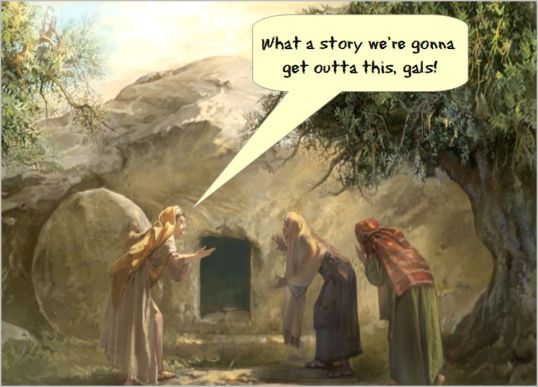
Mary: Well, the other Mary and me (Matthew 28.1) were first to go down to the cave where somebody said they’d put the body overnight.

Salome: I was there too, don’t forget (Mark 16.1).

Mary: Were you? I don’t remember that.

Salome: Bloody was, I’m telling you. So were a bunch of others (Luke 24.10).

Mary: Anyway, we get there and the entrance stone has been rolled away (Mark 16.4).

Peter: Wait a minute… I thought you said that happened after you got there. I thought you said there was an earthquake nobody else could feel and an angel came and rolled away the stone in front of your very eyes (Matt 28.2).

Mary: Did I? Oh yes, that’s right. That’s what happened. And the guards fainted out of sheer fright (Matt 28.4)

Thomas: They did? You didn’t mention any guards the first time you told this story (Mark 16.4).

Mary: Didn’t I? I must’ve forgotten. Oh well. And there was this strange young man sitting inside the tomb (Mark 16.5).

Salome: There were two young men and they were standing outside (Luke 24.4).

Mary: Really? I saw only one and he was definitely inside.

Peter: It wasn’t a young man, it was an angel (Mark 28.5).

Mary: Angel? Oh yes, I suppose you’re right. It must have been an angel. And he said the Master wasn’t there, that he’d risen or something (Matt 28.7).

John: That’s funny, I don’t remember anyone being there at this point. I certainly don’t remember anybody speaking to us (John 20.4-5).

Mary: That’s strange, because the young man in the tomb definitely spoke to me.

Salome: And the two men outside the tomb spoke to me.

Peter: And the angel… don’t forget the angel.

Thomas: So what happened then?

Mary: We were so frightened, we just ran away.

Thomas: You ran away? And then what?

Mary: Nothing. We said nothing to anybody (Mark 16.8).

Thomas: You said nothing to anybody. Then how did Peter find out? ‘Cos the next thing he was running hell for leather to the garden to see this empty cave for himself.

Peter: Oh, she must’ve told me. Yes, that was it, she said something to me and some of the others (Luke 24.10).

Mary: Erm, yes, that’s right. I told Peter and he went to see the empty tomb.

Peter. Ran all the way on my own, I did (Luke 24.12).

John: No, you didn’t. I went with you. In fact I overtook you and got there first (John 20.3-6).

Peter: Did you? I don’t remember that. Are you sure you haven’t just added yourself in here?

John: So anyway, we ran to the tomb…

Peter: And we see that the body has gone. I’m telling you, we couldn’t work out what had happened (John 20.9).

John: Though the most logical explanation seemed to be that he’d risen from the dead. I mean nothing else made sense (John 20.8).

Mary: It’s a shame you didn’t see the young man/men/angel. They’d have spelt it out for you like they did for us.

John: Don’t worry, we’ll bring them into the story later and we’ll have two angels for good measure. (John 20.12).

Mary: So while I was waiting there alone…

Thomas: Wait, you were there alone? I thought you said you ran away with the other women (Mark 16.8)?

Mary: Erm, yes, that’s right, I did. I must’ve gone back later just to hang about (John 20.11) and suddenly I see this, like, apparition. At first, I thought it was the gardener…

Thomas: You mean you didn’t know who it was?

Mary: No, I didn’t, which I agree was a bit odd, but then I realised it must be him, the Master, I mean. Who else could it have been?

Thomas: Well, if it was anyone at all, I’d have thought it more likely it was the gardener than a body back from the dead.

Mary: I suppose, but it just felt like the Master to me. I so wanted to see him again.

Thomas: Did he have holes in his hands and a wound in his side (John 20.27)? Surely that would’ve told you it was him.

Mary: Erm, I can’t recall now. But anyway, it was him.

Thomas: How’d you know?

Mary: ‘Cos he spoke to me. He said, ‘Keep your hands off me, woman, because I’ve not yet, erm… ascended’ (John 20.17, 20).

Thomas: What did that mean? If he was back like you said then how come you couldn’t touch him?

Mary: Well, I don’t know, you’d have to ask him.

Thomas: And how we gonna do that, him being dead and all?

Mary: He’s not dead, I tell you, and you’re all just jealous ‘cos I did better than all of you. I saw him in person and he talked to me!

Peter: All of you, just stop a minute and listen. Can you hear it?

Thomas: No.

Peter: Can you feel it?

Mary: Yes, I can. I can sense his presence (Luke 24.36-37).

John: He’s here with us. He’s back. Hallelujah!

Mary: It’s as if he’s standing right in front of us, talking to us.

John: Yes, that’s exactly what it’s like. He’s here with us. I can feel him. He’s back from the dead, I’m sure of it (John 20.19).

Peter: Let’s tell people we’ve seen him. They’re bound to believe us. I mean, we don’t live in a superstitious first-century backwater for nothing.

Thomas: Jesus Christ! Next you’ll be trying to convince everyone that this cockamamy story is true.

Those resurrection experiences explained

Emmaus

Isn’t it amazing how modern Christians see Jesus in clouds (the picture in the previous post was taken from a site that genuinely believes it was Jesus in the sky – there were lots of others examples there too), on toast, in their own whipped-up emotions, through voices in their heads and as a result of inner-visions but deny that the original resurrection appearances were just the sort of thing? No, Jesus really appeared then, they say, resurrected in his damaged body – he showed Thomas the holes in his side, didn’t he?

Given people’s propensity for seeing things that are not really there – figures in clouds, the sense of a supernatural presence (‘Mother Mary comes to me’) – isn’t it more likely the original ‘manifestations’ of the risen Lord were precisely this; the same sort of ‘sightings’ that people claim to experience today? Maybe not on toast admittedly, but in their heads, in the euphoria of shared worship, in their need for comfort? I’ve done it myself, when I was a Christian. I sensed Jesus’ presence in carefully stage-managed worship, in intense prayer, in what I took to be his response to those prayers. Of course, these were nothing more than my interpreting my own emotions as something from outside myself; an intense and reassuring self-delusion.

Is there evidence of this sort of process in the accounts of the risen Christ? Sure there is – Paul’s encounter is a vision in his head (Galatians 1.16; 1 Corinthians 9.1 & 15:8), while the gospels have Jesus say that whenever two or three of his followers are gathered together, there he will be amongst them (Matthew 18.20). He cannot have meant that, long after he’d left the Earth, he’d be physically present. Rather, this is a later explanation of the intense emotion early believers felt and decided could only be Jesus’ mystical presence – his so-called holy spirit (which isn’t called ‘The Comforter’ for nothing.) They were doing what I did and what millions of Christians still do today – interpreting the feelings they shared in these worshipful contexts as visits from the risen Lord. Later, the gospel writers made Jesus ‘predict’ just such experiences and then firmed them up, so that the accounts of warm feelings and visions became, retroactively, encounters with a physically manifested person.

That’s how it happens today – a vaguely human-like shape in the clouds or on toast and warm feelings become an experience of Jesus. We readily see human form where there is none (we are psychologically primed to seek out human faces) and attribute external agency to phenomena that don’t have any. No reason to suppose it was any different back in the first century.

The oldest trick in the book

Cloud

Hemant Mehta draws our attention to a new book by ‘Christian Prophet’, Mark Robert Pryce called Princess Diana Speaks from Heaven: A Divine Revelation. In it, Pryce claims, the late Princess of Wales communicates with him from beyond the grave. Hemant notes how

(Diana) spends a lot of time convincing readers it’s totally her. Which is exactly what the real Diana would do, of course.

Sound familiar?

Here’s an earlier version:

After his suffering, (Jesus) presented himself to (the disciples) and gave many convincing proofs that he was alive (Acts 1.3).

I’ve always wondered why Jesus would need to do this. Wouldn’t his old friends just, well… recognise him? How exactly do you prove you’re alive? Wouldn’t it be self-evident when you were breathing, moving and talking right there in front of people? Unless, of course, you weren’t really there, but were some sort of apparition or shared delusion. Then, those who felt they were experiencing you would need to convince themselves that you were really there. Just as charlatan Prophet Mark Robert Pryce has ‘Diana’ do in his book.

Plus ça change.


The original ‘good news’ had nothing to with any mystical salvation plan (part two)

Disciples2

Last time, I provided evidence that Jesus’ original ‘good news’ had nothing to do with any mystical salvation plan constructed around his supposed resurrection. My six references demonstrated that, even after his death, the disciples adhered to Jesus’ original message: God’s Kingdom was coming soon and they were going to rule over it. Here are six more reasons we can be sure this was the case:

7. Our earliest sources, Q and the gospel of Mark, do not give much credence to the resurrection as an actual event: Q records no sayings of the risen Jesus and Mark has no resurrection appearances; it ends with the women who discover the empty tomb deciding not to tell the disciples about it. In Mark’s gospel, then, the disciples are not even aware the tomb is empty, let alone that Jesus has returned from the dead. We can conclude from this that the community that produced Mark’s gospel, the supposed resurrection was not significant in and of itself.

8. Paul tells us that the disciples’ gospel was not the same as his, despite the fact he too believed the Kingdom wasn’t far off (1 Thessalonians 4:17). The disciples, he says in 2 Corinthians 11.4-5 and Galatians 1.6; 2.11-21, were preaching ‘a different gospel’. Different from his, certainly, but the same as the ‘good news’ Jesus proclaimed: Jewish people should prepare for the imminent arrival of God’s Kingdom on Earth (Mathew 9.35; 15.24), when, as Jesus himself had promised them, the disciples would judge the restored tribes of Israel and rule over them. It is, as we have seen, out of the question that they would jettison this aspect of the ‘good news’, given to them by Jesus himself.

9. Because the disciples – and Jesus’ brother James – saw the new Kingdom as intended for Jews only, as Jesus had before them (Matthew 10.23), they insisted that any Gentile converts must be circumcised; must become Jewish (Galatians 2.7). Paul, of course, objected to this requirement and throws tantrums about it in his letters (Galatians 5.1-12; Philippians 3.3). But like Jesus, the disciples saw no place for Gentiles, the unrighteous, in the new age; those who didn’t convert would, of necessity, be dispatched to eternal punishment (Matthew 25.31-46).

10. As far as the disciples were concerned, therefore, it was entirely for their own good that converted Gentiles be circumcised (Galatians 6.12-13) as this was their only guarantee of a place in the new Kingdom. What this tells us is that a salvation formula, such as that dreamt up by Paul, had no part in the disciples’ ‘good news’.

11. Wherever they appear – in Paul’s writing, the gospels, Acts – the disciples are portrayed as being at odds with an incantational, faith-based Christianity. The Bible attests, even with Paul’s new religion superimposed, that they held to a different gospel, a different sense of what Jesus’ life meant and a different notion of their place in the coming Kingdom. And wouldn’t they be the ones to know? They knew Jesus, spent time with him, listened to his teaching, bought into his misguided mission and had sufficient understanding of it to spread his ‘good news’ to fellow Jews, both while he was still alive and afterwards (Matthew 10.23; Luke 9.1-2).

12. The New Testament is testimony to the failure of everything Jesus and the disciples stood for; their ‘news’ that God was soon to turn the Earth over to the meek and that they would then rule the only people who mattered, the twelve tribes of Israel, with everyone else thrown into outer darkness (Luke 13:28). Jesus himself, of course, would return at some point to be top dog, God’s representative on Earth – his anointed one. None of this happened.

If only it had been allowed to rest there, we might not know today of Jesus and his mad ideas. Instead, Paul stepped in, reinterpreted the whole ridiculous enterprise and bequeathed the world a set of different but equally absurd beliefs. And the rest is history: religious wars, pogroms, inquisitions, suppression, superstition, clerical child abuse, Pat Roberston. Is this the Kingdom that Jesus and his closest associates foresaw? Decidedly not. But it is their legacy.

The original ‘good news’ had nothing to do with any mystical Salvation Plan™


Pentecost

As I discussed last time, there are indications throughout the New Testament that Jesus’ original ‘good news’ had nothing to do with a mystical salvation plan. There are clues too that the disciples clung to this original message – they’d heard it from Jesus himself, after all – even as other interpretations began to supersede it.

Let’s take a look at the evidence:

  1. Jesus tells his chosen twelve, which includes Judas, that they will rule with him in the age to come (Matt 19.28). As Bart Ehrman points out1, the fact that Jesus evidently had no foreknowledge of Judas’ later betrayal means this promise undoubtedly goes back to Jesus – it is unlikely later believers would have made it up. Though their names vary between gospels, Jesus hand-picked twelve men to rule with him.

  2. He appoints twelve disciples quite specifically and later tells them privately that this is so they can judge and each rule one of the twelve tribes of Israel once God’s Kingdom arrives (Luke 22.30).

  3. When Judas kills himself, the remaining eleven disciples think it vital to appoint a replacement twelfth (Matthias, in Acts 1.21-26). The number remains significant to them. How would they be able to rule the twelve tribes of Israel if there were only eleven of them? There had to be twelve for this very purpose. Even after Jesus’ death and supposed resurrection, the disciples are still preparing for the end of the age he prophesied and for their positions of power in God’s Kingdom.

  4. By the time the synoptic gospels were written, Jesus secret teaching that the Twelve would rule alongside him in the new kingdom had become common knowledge (hence its inclusion in the gospels). Given that he told them in private they’d be judges and rulers, it can only have been the disciples who later broadcast this information. And why would they do this? Because it was an integral part of their good news. Furthermore, all three synoptic gospels include a range of episodes in which the twelve are castigated for their presumption (eg: Mark 10.37-41; Matthew 20.22-24; Luke 22.24-30). These have all the hallmarks of stories created later, when a different ‘good news’ was emerging, specifically to mock the disciples’ belief.

  5. In much the same way, the disciples are consistently depicted as having no real understanding of Jesus’ mission (Mark 9.30-32; 10.35-45). And they don’t, in that they have no understanding of the later reinterpretation of Jesus’ significance. How could they? By the time the gospels came to be written, the mystical-Christ version of Christianity had started to take hold. Paul’s salvation plan and the supposed resurrection were beginning to assume greater importance than Jesus’ original message. How could the disciples, 40 years earlier, have known that this was going to happen? How could Jesus? They have to be portrayed as being largely ignorant of later developments – developments which, in any case, they opposed when they did encounter them (Acts 9.26; Galatians 1.6; 2.11-14; 3.1-3).

  6. In fact, Jesus teaching – all of it – was predicated on his belief that the Kingdom of God was ‘at hand’, imminent, about to happen real soon (Mark 1.15; 9.1; 13.30; Matthew 10.23; 16.28; 24.34), and that when it did, he and his chums would be there ruling it. It is unthinkable his inner circle would abandon this teaching, even after he died, in favour of something else. Any visions they had of him returned from the dead would only have reinforced their commitment to his ‘good news’; resurrection, after all, was a sure sign of the Kingdom’s arrival (Daniel 12.2-3).

To be continued…

1 Ehrman, Bart D., The Lost Gospel of Judas, p146