

Written By God

According to researchers, recent analysis of the Bible strongly suggests that it was written by God. I kid you not. The headline above, from Britain’s Daily Mail, proves it.

The researchers in question were ‘a computer scientist at Carnegie Mellon University and a Lutheran pastor in Germany’. Their findings were announced by The Mail in its Science section, conclusive proof that God himself, the mythical creation of an ancient nomadic tribe, personally wrote the Bible! He didn’t inspire it or guide the pens of the men who put it together. Oh no, he actually wrote it.

How can we know this? Because there are way too many coincidences, too much foreshadowing of later events in stories written hundreds of years earlier, and too many fulfilled prophecies for it not to be.

This analysis is of course seriously flawed. Operating within the parameters that the far from objective ‘researchers’ set for it, the project told them exactly what they wanted to hear. Yes, there are some themes and ideas that run throughout the Bible but this is because its various authors were all concerned with the gods, one in particular. This is all they wanted to write about and all that subsequent editors were interested in too.

The Bible is noticeably short on recipes and sports reports because such things were of no interest to the priests and zealots who wrote it. We might have had a more engaging and less divisive book if these men and their later editors had been more interested in sport and cooking, but they weren’t and the Bible reflects this fact. But there’s nothing supernatural about this. The authors were, like many other ancients, concerned with meaning of life stuff and the God myths that seemed to them to explain it. The god the nomadic tribes of the middle east thought explained it best was YHWH. Far from being a consistent presence in the books of what is now the Old Testament, YHWH changes depending on who’s shaping the myths he plays a part in. This is not, incidentally, what theologians are pleased to call progressive revelation.

It’s a reflection of multiple authors writing over long periods of time in various contexts about the same thing. Nonetheless, the way humans relate to YHWH changes from book to book, as do his morals, demands and expectations. If YHWH authored the Bible, the one character he hasn’t got a grip on is himself.

Our computer specialist and German pastor also dredge up the discredited fantasy that Jesus fulfils all the prophecies of the Old Testament. Of course he does; that’s the way he’s written. His story – actually ‘stories’, plural – are rewrites of older myths, particularly those about Moses. Did Moses foreshadow Jesus, foretelling all he’d do hundreds of years before he was even born? Of course not. Did Jesus then knowingly mirror the acts of Moses during his life to prove he was God’s chosen one? Again, of course not; only a fool is taken in by this ruse. There have, alas, been plenty of them, including the present ‘researchers’.

The obvious explanation is the one that makes most sense; the Jesus stories are modelled on earlier myths and snippets from the Jewish scriptures without any of them needing to be remotely historical. The article mentions, for example, the description of the Passover lamb in Exodus 12 and gasps that, yes, centuries later, Jesus is referred to as the ‘Lamb of God’ (John 1:29). It doesn’t seem to enter the researchers’ credulous little heads that the later authors knew Exodus and decided to apply its imagery to Jesus. This is how the trick was done. There was no holy dictation making the connection. They simply applied earlier scriptures to Jesus and write his story around them. We can see this in another example from the report: Matthew used a mistranslation of Isaiah 7:14 as a template for his virgin-conception myth.

Claiming, as the researchers do, that the construction of later stories was God making sure no-one missed the point of the earlier ones is painfully niave.

Jane Austen’s Pride and Prejudice foreshadows Helen Fielding’s Bridget Jones’s Diary. The details of the two works are, after all, remarkably similar. The only plausible explanation for these similarities is that Jane Austen’s hand must have been guided by a spiritual force to record events almost two centuries before they would occur for real in Helen Fielding’s definitive version of the story. This at least is what these present researchers would conclude if they ran an analysis of the two Mr Darcy books in the same way they have the Bible.
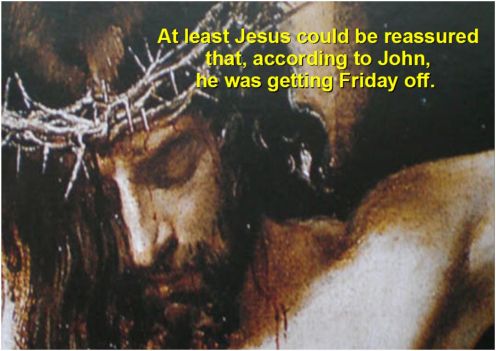
Jesus’ dates with destiny

Blog338Cross

I hope you’ll allow me a little speculation…

Here are the few days leading up to Jesus supposed resurrection as related by the synoptic gospels:

Nisan 15: Wednesday sunset to Thursday sunset. The Day of Preparation when thousands of Paschal lambs are slaughtered ready for the following day’s (i.e. Thursday evening’s) Passover. Jesus instructs his disciples on the arrangements he has made for the feast.

Nisan 16: a. Thursday evening: Jesus celebrates Passover.

b. Thursday evening and night: Jesus is arrested and tried.

c. Friday 9.00: Jesus is put to the cross

d. Friday 15.00: Jesus dies.

Nisan 17: a. Friday ‘evening’: The start of the Sabbath: Jesus is buried by Joseph of Arimathea.

b. Friday evening to Saturday sunset: Jesus body lies in the sealed tomb.

Nisan 18: Saturday sunset to ‘early’ Sunday: The body remains in the tomb overnight(?) but by early next morning is missing.

John’s timeline, however, is markedly different. He says that Jesus is arrested on the Day of Preparation for Passover – that’s Nisan 15 according to the synoptics, which started at sunset on Wednesday (John 13.1; 19.14.) In John, therefore, Jesus does not eat a Passover meal with his disciples. He shares an ordinary supper with them on the Wednesday evening, when he washes their feet. Judas slips out to inform on him just as he does in the synoptic gospels, a day later (Mark 14.16-17; Matthew 26.19-20; Luke 22.33-45.) John significantly alters the timing of events though he retains Judas leaving, though from a different meal. In the fourth gospel, Jesus is arrested on the Wednesday evening, the start of Nisan 15. John mentions in 18.28 that the temple officials involved in the arrest have yet to eat their Passover meal; it still awaits on Thursday evening.

In John, Jesus is tried during the night of Nisan 15, or the early hours of Thursday. Eventually, at around noon on the Thursday he is nailed to the cross and dies rapidly (John 19.14, 31, 42). By the time everyone else is eating the Passover meal later that day – a meal Jesus is present for in the synoptic gospels – John’s Jesus is well and truly dead. He is placed in Joseph of Arimathea’s tomb at some point Thursday evening, either the end of Nisan 15 or the start of Nisan 16. He remains there during Friday and Saturday (the Sabbath) but by Sunday morning his body, according to the story, is missing.

It has been argued – given we don’t know the year Jesus was crucified – that John has his Passover falling on the Saturday, the Sabbath (John 19.31), as happened on occasion, and that therefore John’s ‘Day of Passover Preparation’ was not the Thursday – as it is in the synoptics – but the Friday. According to this line of reasoning, Jesus’ arrest in John was also on Thursday evening, at the start of Nisan 16 and his crucifixion was on Friday, as in the synoptic gospels. But the Day of Passover Preparation cannot be freely moved around to accommodate both versions of events; either it was on the Thursday (Nisan 15) as the synoptics record, or it was on the Friday (Nisan 16) as those who seek to locate John’s crucifixion on Friday argue. Either John is wrong about when the Day of Passover Preparation fell or his Jesus was crucified a day earlier than in the synoptics on their Day of Preparation, Nisan 15.

There is further circumstantial evidence for John’s crucifixion being on the Thursday. While the synoptics have the chief priests, scribes and elders witnessing the crucifixion for themselves, John doesn’t mention their presence. In his Thursday scenario, they are too busy preparing for that evening’s Passover, overseeing the ritual slaughter of thousand of animals, to attend the crucifixion. Similarly, the various activities after Jesus dies – the buying of linen and spices, the removal of the body from the cross, the preparation for burial, sundry visits to Pilate and the posting of guards (though John does not report the latter.) – do not entail any infringement of the Sabbath regulations.

Moreover, John has Jesus in the tomb for three days and nights, more or less; the supposed resurrection does indeed occur ‘after three days’ as Jesus is made to predict numerous times (19 in total.)

Nisan 16: Jesus is buried at the start of Nisan 16 (our Thursday evening),

Nisan 17: Jesus remains in the tomb throughout Nisan 17; 6pm Friday to 6pm Saturday.

Nisan 18: 6pm Saturday to the early hours of our Sunday. He remains in the tomb until some indeterminate point, either before dawn (according to John) or just after (the synoptics.)

As well as a resurrection ‘on the third day’, John’s version of events provides an added bonus. By having his crucifixion on the Day of Passover Preparation, John  is able to draw an analogy between the slaughter of the sacrificial lambs and his ‘Lamb of God’ who, in his death, replaces them as an atonement offering.

I don’t know; maybe I’ve got this all wrong. There’s a problem, I concede, with John 19.30 which implies Jesus is on the cross on Friday (though by John 19.42, when Jesus is buried, it looks like the narrative has reverted to the day before the Sabbath; Friday day time.)

The effort to harmonise the two different timelines, that of the synoptics and that of John, involves having two different Days of Passover Preparation (Thursday and Friday) and indeed, two Passovers (Friday and Saturday). Does this seem likely to you? Two lots of lambs to be slaughtered and two celebrations on two consecutive days – I mean, these people weren’t made of money! Isn’t it far more likely there was one Day of Preparation and one Passover? If so, who is right about when they fell? John or the synoptic writers? They both can’t be. Whether apologists like it or not, isn’t it more likely that the fourth gospel has Jesus crucified on the same Day of Preparation that the synoptics mention (the Thursday), while in the synoptics – all based, let’s remember, on Mark’s account – he dies on the Friday after the Passover meal as they relate? It makes more sense of the conflicting timelines than attempting to mash them both together when they won’t. One or other, John or the synoptics, got it wrong about the day Jesus died; perhaps both did.

One thing’s for sure, what follows is pure unadulterated myth.