Angels & Demons

angel

Last time, Benjamin Corey was feeling rather pleased with himself that he’s able to take a more considered, adult approach to the Bible. He doesn’t interpret it like those dim-witted fundamentalists. Instead, he consults ‘scholars’ to tell him what the Bible’s really about. And in case we’re in doubt, that is never (ever) anything to do with myths or fairy tales.

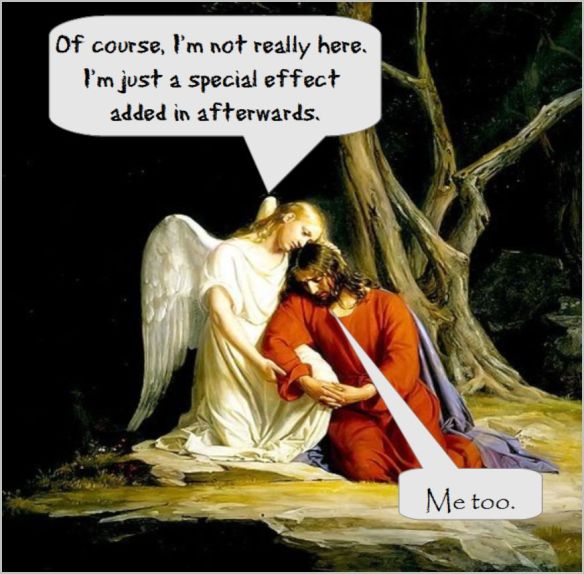
Which makes me wonder: what do mature, clever Christians like Benjamin make of the Bible’s supernatural fantasies and its cast of invisible beings?

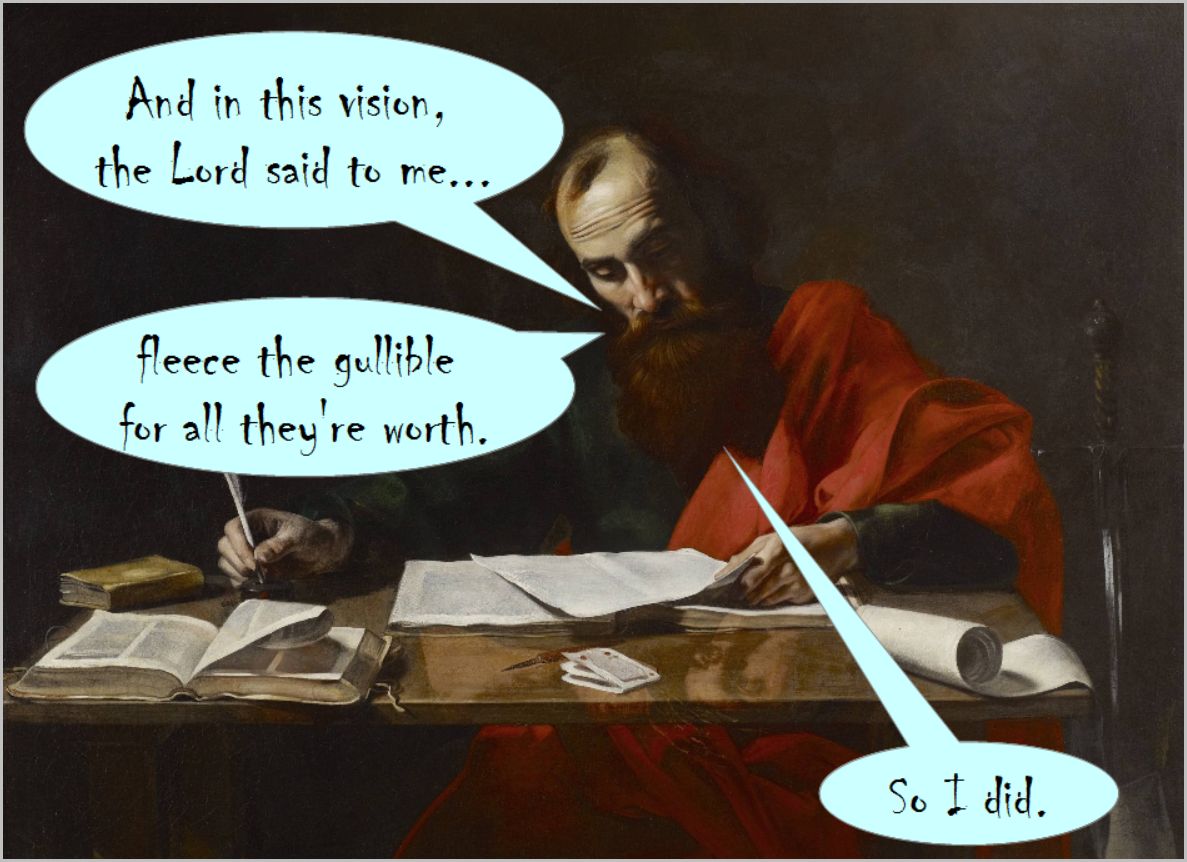
Do they, for example, dismiss the demons that are all over the New Testament? Jesus, you see, believed in demons; he thought some illnesses were caused by them and had a repertoire of incantations for exorcising them from their victims. There are cranks today who believe the same sort of thing, but that’s a bit too much of a fundie approach for the kind of serious-minded Christian I’m talking about here. They probably don’t care that the Bible says in Ephesians 6.12 (written by fake-Paul) that demons are all around us, engaged in invisible spiritual warfare in equally invisible heavenly realms.

I can’t help but think that if only a demon would make itself visible and show us what it looks like, we would know that fake-Paul and Jesus were right and not just religious fanatics inculcated with the unscientific notions of their primitive cultures. But no, no demons have ever shown themselves in person (as opposed to ‘in a person’) except, of course, in third-rate horror films.

So how about angels? Maybe we could see an angel – an undeniable, indisputable, bona fide angel. According to the Bible, they were often seen back when people didn’t know any better. Mary, shepherds watching their flocks, the disciples, Mary Magdalene, Paul and even Jesus himself encountered angels in the flesh. So why don’t we see them now? Why don’t they make themselves known, outside of people’s imaginations? According to fundies they do, but alas, there’s no evidence this is true, which is convenient to say the least.

Still, I’m sure you can be a Christian without believing in angels and demons, even if the Bible is sure they’re real. You don’t have to believe everything it says (right, Dr Corey?)

So what about the rest of the Bible’s fantasies, its invisible creatures and make-believe places? Next time we’ll take a look at the evidence for them and ask, are they really just the low-fi special effects of a book well past its sell-by date?


God’s Election

church4

As we saw in the previous post, the Bible tells us that God chose his ‘Elect’* before the creation of the world (Ephesians 1.4-6). Which begs the questions –

1: On what basis did God select the favoured few untold aeons before they were born? Did he decide by looking at their dress sense, as Jesus’ parable in Matthew 22.1-14 suggests? I guess it must be, given the Bible is the ‘literal’ word of God.

Or did God assess ahead of time just how righteous his Chosen would turn out to be? In Matthew 25.31-46 Jesus says righteousness is the yard stick (though naturally Christians don’t believe him because Paul says something different).

Or did God decide in advance – Paul says he ‘foreknew’ – who would repent and turn to Jesus, free-will be damned? Maybe, but then Jesus suggests that not everyone who does even this will make it into God’s Kingdom (Matthew 22.1-14).

What a bummer! Looks like God’s decision is/was purely arbitrary. You make it, or not, on the whim of a capricious monster.

2: What’s the point of evangelism? If God chose who was going to have eternal life/enter the Kingdom/live in Heaven before the creation of the world, then there can be absolutely no need for anyone to tell anyone else about Jesus, sin and salvation. Why? Because it makes no difference; God’s Chosen will remain his Chosen, as they were long before they were born, and he’ll be sure to rescue them once they die. Those who haven’t been pre-selected will stay lost and will go to Hell whether or not they’ve heard or responded to the gospel.

‘But how will the unsaved Chosen hear the message if we don’t tell them?’ ask our zealous evangelical friends, still not getting the point. Jesus, lads! The Chosen don’t need to hear the gospel: God – has – already – chosen – them. They will go to Heaven, live in the Kingdom or whatever, regardless of your efforts. You and your evangelism are superfluous.

3: How can you be sure, if you’re a Christian, that you’re of the ‘Elect’ and so destined for Eternal Life? Yes, you’ve chosen Jesus – but has he chosen you? How can you know? Your own sense of righteousness, your faith, self-sacrifice and adherence to sound doctrine (whatever that is) are no guide to whether or not you’ve made the grade. Only God knows that, and he’s not telling.

Not yet, anyway, so you’d best make sure you’re buried in your very best clothes, just in case.

* Jesus is made to call the chosen few ‘the Elect’ in Matt 24.22, 24 & 31; Mark 13.20, 22 & 27 and Luke 18.7.

Smash! Kill! Destroy!

handsofgod

So how has the great God of Reason done so far?

We’re still not out of Genesis and he’s –

Trashed his entire creation just because a couple who didn’t know how touchy he is managed to upset him;

Destroyed two towns and almost everyone in them because he found the locals offensive;

Drowned everyone in existence (except for an old piss-head and his family) because – you guessed it – they offended him;

Engineered a spot of child-abuse;

Decided the best way for people to show him they’re his bestest buddies is to have them disfigure their genitals.

Now, honestly, Christians, how can you say any of this is rational or logical, reasonable or considered? Your God’s response to everything is Smash! Kill! Mutilate! Destroy! – never as a last resort, always as his first reaction. He’s the Hulk, Godzilla and ISIS all rolled into one. Not once does he apply reason or logic. Smash! Kill! Mutilate! Destroy! And not only in Genesis but throughout the Old Testament:

His chums want the land occupied by other tribes? Smash! Kill! Destroy!

They don’t show him enough love? Smash! Kill! Destroy!

They break one or other of his mostly petty rules? Smash! Kill! Destroy!

They offend him in some remarkably trivial way (collecting sticks, teasing a bald bloke, doing sex wrong)? Smash! Kill! Destroy!

Over and over again.

Until, at last, he has another big idea! Another Master Plan! The Master Plan to end all Master Plans! (His fourth at least.) And guess what? It’s all Smash! Kill! Destroy! Especially Kill! This is a dude who really can’t think outside the box.

Here’s how it goes: the Lord gives up on his previous Master Plan, which he’d told some selected desert marauders was forever and ever, and decides its time to have another go at sorting out mankind that he helped screw-up in the first place. His idea this time is to come to Earth himself as a sort of clone, which he creates by raping a young woman, just like all the other gods of old. When he grows up this clone/avatar tells everyone how God wants them to behave so they don’t upset the version still in Heaven quite so much. The clone then gets himself murdered at the hands of the very people he’s come to visit – the same ones the Lord promised to take care of forever and ever in his previous Master Plan – which magically allows anyone who repeats a special incantation to join an exclusive club. Everyone else he plans to torture and murder for all eternity, because that’s what he likes doing best. Of course, the version of himself he sends to Earth won’t actually make any of this clear – that’ll be left to someone else to make up afterwards – but, in the best illusion yet, he’ll come back to life before beaming up to Heaven to cosy up to his other self, the one preoccupied with death, destruction and mutilation.

This time it’s foolproof: a well-thought through, logical, rational and reasonable plan.

Except… not really. It’s bullshit. There’s no reasoning here, just a lot of stuff made up as people went along. None of it makes sense. The copy seems to have no idea what’s going on and certainly no inkling that his death has cosmic significance. On top of that, no-one really knows how the magic works – everyone who mentions it has a different idea – and the record of it all is scrappily cobbled together donkeys’ years after it all was supposed to have happened. Still, the main thing is it all involves a lot of killing – the clone first; then the poor sap manipulated into ‘betraying’ him; a couple who don’t want to give away all their belongings; some of the dudes who believe the magic is for real then, after they’ve really pissed off the Romans, lots more of them and finally, once the nutjobs get the upper hand, loads and loads of other people – which must really have pleased the God of Death Reason.

If this is the best he can do, then we’re in trouble deep. If our ability to reason comes from him, as Christians claim, it’s no wonder we can be irrational, illogical, unreasonable and unreasoning. Which of course is why he is, because he’s a reflection of the beings  that created him – us. Human emotions and cognitive capabilities came first and were projected onto the gods we created, including, eventually, the monotheistic monster, Yahweh. It was he primitive tribesmen decided must be responsible for natural disasters and the brevity and brutality of life. Such things had to be punishments, hadn’t they? And if punishments, then there had to be One doing the punishing. One who must be appeased if he was ever to stop. Hence sacrifices, behaving in ways that might please him, killing those who don’t, worship. All futile, like pleading with one’s own reflection in a mirror.

The God created by this kind of thinking only reflected back at his makers the worst of themselves; jealousy, anger, intolerance, belligerence, petulance, vengefulness and violence. Hardly ever Reason. 

And so does he still.


Idiotic Stuff Jesus Said

JC&ManJust what did Jesus say? The Jesus Seminar and other scholars* conclude that only about 18% of the words attributed to him in the gospels are authentically his. They reach this conclusion because so much of what Jesus ‘said’ – 82% of his utterances – is demonstrably derived from elsewhere.

There were four major sources for his words, which I’ll discuss briefly here, providing an example of each. Bear in mind also that whatever the derivation of Jesus’ words, those we have today have been subject to, in their earliest days, an unreliable oral tradition, repeated copying and deliberate and accidental alteration. The earliest surviving ‘words of Jesus’ (a few fragments of the fourth gospel) date to a century after he lived.

1. The early church created a good deal of the Jesus narrative, making him say what was important to them. For example, ‘take, eat, this is my body,’ and ‘take, drink, this is my blood that is shed for you,’ is clearly a post-crucifixion perspective. While it appears in arguably the most Jewish of the gospels (Matthew’s) the idea of drinking blood, even symbolically, would have been, and remains, anathema to Jews, whose scriptures forbid it (Leviticus 17.10 -16). Jesus was an orthodox Jew; it was the Hellenised Paul who transplanted the pagan ritual into nascent Christianity. He relates in 1 Corinthians 11.23-26, written about 15 years before the first gospel, how his wholly imaginary ‘Christ’ told him of this bizarre activity. Once established in the early church, Jesus then had to be made to endorse it and it was written back into the gospels.

2. The gospel writers (or others) invented dialogue for him. His entire conversation with Pilate, for example, is invented not once but four times, the encounter being rendered differently in all four gospels. It is probable that the entire scenario is fiction, given the likelihood the excessively cruel Roman governor would even entertain the idea of questioning a seditious nobody himself. And then there’s the ‘I am’ statements of John’s Jesus that I considered here.

3. The gospel writers altered difficult sayings into something more palatable. For example, in Matthew 15.24 Jesus says he was ‘sent only to the lost sheep of Israel’ (my italics). By the end of the same gospel, as well as in Luke and John, this has become a commandment to ‘make disciples of all nations, baptising them in the name of the Father, the Son and the Holy Spirit’ (Matthew 28.19). So which was it? Was the message exclusively for Jews or was it for all? It suited early churches, filled with non-Jews, that the gospel was for everyone, just as Paul had argued. Jesus’ words to the contrary – even if they were sufficiently widely known to have had to be included in Matthew’s original account – needed to be amended. Who amended them and when we shall never know, but it was certainly after the idea of the Trinity had taken hold.

4. Statements Jesus actually made. The Jesus Seminar regards as authentic sayings such as:

If anyone strikes you on the right cheek, turn the other also (Matthew 5.39)

If anyone wants to sue you and take your coat, give your cloak as well (Matthew 5.40)

Love your enemies (Luke 6.27)

Blessed are you who are poor for yours is the Kingdom of God (Luke 6.20) [changed in Matthew’s gospel to the less radical ‘poor in spirit’!]

If anyone forces you to go one mile, go also the second mile (Matthew 5.41)

As inspiring as these might initially appear, they actually mean very little; they’re either prophecies that didn’t come to pass, impractical moral expectations or pseudo-spiritual homilies. And how much of this advice, these admonitions, do today’s Christians follow? You’d be hard pushed to find many that do. After all, following Jesus doesn’t entail doing what he says.

* I have used Robert W. Funk et al‘s The Five Gospels (HarperOne, 1997), Simon Loveday’s The Bible For Grown-Ups (Iconbooks, 2016) and Mark Allan Powell’s rather less impartial The Jesus Debate (Lion, 1998) for this post

Silence of Mind

ThinkerThe anonymous blogger over on Silence of Mind, (we’ll call him ‘SoM’) is arguing that Christianity is responsible for Western civilisation. He does so even though others have pointed out to him that the essential elements of a civilised society – democracy, the rule of law, moral codes, mathematics, scientific enquiry, medicine, education, art, literature and architecture – were all evident in human societies millennia before Christianity emerged.

SoM goes further, however, insisting that Western culture owes its existence solely to Christianity. He doesn’t demonstrate how this is so; he is content to assert that it is. He is, of course, confusing correlation with causation, failing to recognise that Christianity’s involvement in the development of Western society does not mean it was the cause.

Having reach this insupportable conclusion, SoM makes an even greater leap of faith by declaring that because the Christian faith created civilisation as we know it – we’ll ignore, as he does, the church’s suppression of so much that is integral to a civilised society during the ‘dark ages’ – then Jesus must therefore be God. Here’s how he puts it:

1. Jesus established the Christian religion.

2. Christianity became the religion that spawned Western Civilization.

3. Western Civilization is the only civilization in human history to have developed modern science.

4. Modern science proved the existence of God

5. Since only God can reveal God, Jesus of Nazareth must be God.

So wrong in every respect:

1. Jesus did not establish the Christian religion. Paul did.

2. Christianity did not spawn Western civilisation (see above).

3. Western civilisation is not the only one to have developed science, and where it has emerged has often been in spite of religion, not because of it.

4. Science certainly has not ‘proved’ the existence of God. It has no interest in the so-called ‘supernatural’ nor, indeed, in ‘proving’ anything. It is significant that none of the explanations science has arrived at require the involvement of a god.

5. ‘Since only God can reveal God, Jesus of Nazareth must be God’ is a non-sequitur; it doesn’t follow from anything that has gone before, as flawed as all of the previous assertions are. What SoM is claiming here is that because “1, 2, 3 and 4 are the case (though I have failed to demonstrate they are and in fact they are not), then A must equal B”.

In the end, SoM’s ‘argument’ is the same as saying that because there is a place called Greece, Zeus must really exist. Or because there are tea-shops, we can be certain Bertrand Russell’s teapot is orbiting the sun, forever just out of sight.

As proof of the divinity of Jesus, the argument from the scientific and cultural achievements of the West has to be one of the worst. All arguments (and SoM’s assertions can hardly lay claim to the term) that attempt to demonstrate how an abrasive, inconsistent zealot from a Palestinian backwater was secretly the God of the Universe are equally worthless while God himself remains unproven, as he always must.

This is why believing anything about him and about Jesus’ supposed divinity is called ‘faith’. If it were possible to prove the things held on faith, then faith wouldn’t be necessary. But it is, because believing the impossible and the unprovable can only be managed by by-passing and, yes, silencing the mind’s critical faculties.

It was all just a dream…

Stone2Perry Stone, self-styled prophet, evangelist and teacher is of the view that God provides dreams and visions to his followers. He does this, apparently, when he can’t think of a better way of communicating them. Perry recommends that those on the receiving end of God’s special messages should immediately wake up and quickly write down what their dream was about. If they don’t, they’ll forget it! Who knew we can’t always recall dreams once we wake up? Who knows how to wake up as soon as a dream is over? Perry has big drawings made of his own God-delivered dreams. Here’s one. See if you can guess what it was about:

Stone1

Yes, it was a warning about 9/11. The Lord gave it to Perry, in a dream, long before the 2001 attack.

You can’t see it? You think five tornadoes and the monolith from 2001: A Space Odyssey look nothing like 9/11? Shame on you! You need to take this more seriously. You’re thinking, aren’t you, that Perry’s dream, if he had it at all, was down to the cheese he’d eaten before going to bed. That and a deranged mind.

But you’d be wrong; Perry knows for certain his dream was from God and that his interpretation is right on the mark. And who are we to doubt it? Curious, though, that even though the Lord had warned him about the attack in advance, Perry neglected to tell anyone about it. I wonder why that was? God must have wondered too – why he’d entrusted such an important message to a dimwit who did nothing with it. (Then again, if the Lord is capable of inducing dreams why didn’t he speak directly to the terrorists to prevent them from doing what they did?)

Still, good ol’ Perry’s made up for lost time since and is now more than happy to tell the rubes everyone about his dreams. And so what if it makes him a few million dollars? Frenetic Perry has a significant following on TBN and on his own web-site, which is where you can buy his dream-world DVDs for as little as $45 a set.

Nut-jobs’ dreams and visions have been at the centre of religious belief since forever. Dreams are significant, or so it’d have us believe, in the Old Testament where there are at least two dozen ‘important’ ones, together with advice about their interpretation (Job 33.15-18, for example). They’re quite a presence in the Qur’an too.

In fact, dreams and their waking equivalent, visions, are ultimately what religion is made of. They’re certainly what Christianity is made of; Joseph, the Magi, Pilate’s wife, Peter and Paul all have deeply meaningful dreams while Peter, Paul, John and others have visions which, they persuade themselves, can only be the monolith from 2001 Jesus returned from the dead, and other fantastic nonsense. The authors of the New Testament attached such importance to converts’ dreamy/visionary experiences that they had them written back into the Jesus narrative itself. That way it sounded like Jesus knew when he was alive that later fanatics would think they could sense his presence (especially when they whipped themselves up together) and could experience him in dreams and visions. Still today there are those who convince themselves they have a ‘relationship’ with him and can see him in their dreams, near-death experiences and other hallucinations. Just ask Perry Stone. It’s all real!

Well, as real as things entirely in the mind can be.

Same as it ever was…

Paul2

(Edited for clarity 2nd Aug)

Who wrote the Bible?

According to Christians, Moses wrote the first five books of the Bible; Genesis to Deuteronomy are widely known as ‘the books of Moses’. There is little evidence Moses had anything to do with them and plenty that he didn’t. The narrative, for example, is never once in the first person; it’s all ‘Moses ordered this slaughter, Moses ordered that slaughter’, never ‘I was the bastard who ordered all the genocide.’ Maybe he was embarrassed about it or – much more likely – it was written by someone else..

In fact, the books were compiled from a range of sources, including stories from other cultures. They reached the form in which we know them around 600-400BC, a mere eight hundred to a thousand years after Moses was supposed to have lived. The events and folk-heroes they describe are demonstrably mythical.

Moses2

Christians like to say that King David wrote many of the Psalms. While David’s name is attached to 73 of the 150, there is no reason to conclude he wrote them. It is more likely ‘of David’ serves as a dedication to a revered (and long dead) figure and may, indeed, have been added much later. The Psalms were actually created over an extended period of time – as much as five hundred years – by a wide range of unknown composers.DavidBelievers attribute much of the book of Proverbs to King Solomon, the fruit of David’s loins. Again, this is highly unlikely. The sayings are largely traditional and the attribution ‘is likely more concerned with labeling the material than ascribing authorship.’

Palin

Christians believe four blokes called Matthew, Mark, Luke and John wrote the New Testament’s gospels. They didn’t. The gospels were written anonymously and did not have the traditional names attached until a century or so after their composition. None is by an eye-witness. There is no evidence that the writer of Mark was a disciple of Peter’s, nor that ‘Luke’ was a companion of Paul’s (and even if he was, this wouldn’t make him an expert on the historical Jesus), nor that ‘John’ was a bona fide disciple. The fourth gospel was written between 90 and 110CE when the disciple would have had to be between 80 and 100 years old, or, much more likely given life-expectancy in the first century, dead. There are several hands at work in ‘John’, as the gospel itself concedes (John 21.24).

 Beatles

Christians insist that all of the letters attributed to Paul in the New Testament were written by him. However, despite the fact they say they’re by Paul, Colossians, Ephesians, 2 Thessalonians, 1 & 2 Timothy and Titus are not; they are forgeries. They were composed long after Paul’s death, which occurred some time around 64CE. The earliest of the forgeries, Colossians, is thought to be circa 75CE, while the ‘pastoral’ letters to Timothy and Titus may be as late as 150CE. All of the forgeries contradict the ideas expressed in Paul’s genuine letters.

PaulPeter wrote the letters that carry his name, or so god-botherers claim, but according to the Bible itself, Peter was an illiterate Galilean fisherman (Acts 4.13). The Greek of the letters supposedly by him is accomplished and the theology well developed. Did Peter have time to learn Greek and polish its written form to perfection while busy preaching the gospel to all nations? Even if he did, how did he manage to write a letter (2 Peter) concerned with conditions in the church more than a century after his time with Jesus?

Anderson3

Jesus’ brothers James and Jude, we’re told, wrote the letters carrying their names. Again, they didn’t. The letter of James may have originated in the early Jerusalem church presided over by James the Just, but there’s no evidence this was Jesus’ brother. Jude is plagiarised from 2 Peter – word-for-word in places – which is itself a forgery. Would someone who knew Jesus as intimately as a brother need to steal what he had to say from an illegitimate source? Jude would have had to be well over a hundred years old to pull this one off.

Robertson2When all else fails – and it does – Christians fall back on that most implausible of last resorts, ‘the Holy Spirit’. The very breath of God, they insist, presided over the creation of the Bible from start to finish. If it did, it made a staggeringly bad job of it; misattribution, mistakes and forgeries are the hallmarks of ‘God’s precious Word’.doveAnd on this unstable foundation, this tissue of lies, rests the entire edifice that is Christianity.

(It is difficult to find online sources on the authorship of the Bible. Christians have taken over the Internet with innumerable sites insisting the Bible was written by whoever they say it was. I’ve had to fall back on Wikipedia here (the articles are pretty comprehensive) but if you don’t think it reliable enough, I recommend Bart D. Ehrman’s Forged: Writing in the Name of God – Why The Bible’s Authors Are Not Who We Think They Are.)


Effective Preachin’ (Part One)

church3Reverend M. T. Vessal of the Church of The Raised Up here, with the first of my special guest posts for all you wannabe preachers out there. I’m gonna be telling you on how to preach the Good News of Salvation and win souls for Christ.

Right. First off, remember to use the words ‘Blessings’, ‘Sanctify’ and ‘Outpouring’ in your preamble or opening prayer. ‘Course no-one will know what these mean as you haven’t provided any context and they’re pretty meaningless anyway – apart from ‘Outpourings’ which is something kettles do. But it’ll get the folks worked up to expect something real good. Folks in church go for things like Blessings, Sanctifying and Outpourings, believe me.

Next, repeat the title of your sermon – or, if you’re part of a cool modern church like Steve Furtick’s, your talk, or, if you’re really honest (and let’s face it you wouldn’t be doing this if you were really honest) your spot of self-promotion – three times. This is a useful tip for any point of your sermon/talk/self-promotion; if you can’t remember what you were going to say next, say the last thing you can remember saying three times over, putting the emphasis on a different word each time. So, for example, ‘Twelve ways to receiving the Lord’s blessings’ would be: ‘Twelve ways to receive the Lord’s blessings’, then ‘Twelve ways to receive the Lord’s blessings’, and finally, ‘Twelve ways to receiving the Lord’s blessings‘, though feel free to alter this as suits. Saying it three times like this makes it sound like you’ve just come out with something real deep and profound, when you’ve done nothing of the sort. Plus, people sit up and listen to things said in threes. It’s kinda hypnotic.

I said, ‘it’s kinda hypnotic.’

‘It’s kinda hypnotic.’

See? It works.

Next make a joke. Say something like, ‘if you’ll switch on your Bibles’, just to show how with-it and up-to-date you are, knowing most folks bring their iPads to church these days. That way they can shop on Amazon or send an offensive tweet when your sermon gets really boring (and it will get really boring).

Now quote the verse you’re gonna preach about and let the folks follow along; you won’t need to quote it accurately because they’ll all be using different translations, so accuracy’s not important. Unless, of course, you’re one of those churches that only accepts the Authorised Version, the one with all the errors in it that right-royal homosexual James I… well, authorised. (One of the advantages of the KJV is you can  drop in words like ‘lieth’ and ‘unto’ which sound like you really know what you’re talking about.) So, yes, it’s okay to paraphrase the verse your talk is gonna be tenuously connected to because, let’s face it, it’s not going to have much to do with the verse in any case. It’s going to be more about you than whatever’s in the Bible. The exception is if you’re planning on having a rant about homosexuals, in which case you’ll want to stick pretty closely to Leviticus 20.13 and Romans 1.26.

A word on choosing your Bible verse: make it one of Paul’s or something from John. The other stuff, about loving your neighbour and your enemy and going the extra mile isn’t the kind of thing you want to have to talk about. You’re gonna concentrate on Blessings, Sanctification and Outpourings, remember, things that are exclusively for Christians. If you’re feeling really adventurous though you can try a story from the Old Testament. Maybe one of those blood-baths it has a lot of. You can show how all that bronze-age inter-tribal slaughter was really about how much Jesus loves Christians in the twenty-first century.

Right. You’re all set. Next time, I’ll tell you how to preach so that you can make a name for yourself truly reflect the glory of Jesus.

Did Jesus Exist? (part one)

Cross3

I want to say at the outset that I don’t think it matters whether Jesus existed or not. Even if he lived, it is highly unlikely he said much that is attributed to him or that he performed the miracles ascribed to him. Neither would it be the case that he rose from the dead or became a supernatural godman afterwards. All of these supposed attributes would be, for an individual who actually existed, later accretions. The man underneath them, the so-called historical Jesus, is difficult to detect. It hardly matters to Christians; they’re really only interested in the accretions, the later add-ons, the myth the man became.

Those who think Jesus never existed raise a number of interesting points, chief of which is that what I’ve referred to as accretions, being central to subsequent Christian belief, actually came first. The accounts of Jesus’ life – the gospels – they see as later attempts to provide the myth with a ‘realistic’ back story based in history. Certainly the gospels came after Paul had had his vision and had set about interpreting it to arrive at his convoluted theology about ‘the Christ’. Jesus-belief certainly existed decades before the first gospel account, Mark’s, and was as a result entirely independent from it. In this scenario, therefore, the myth came first and the stories of Jesus were crafted afterwards as supplementary fiction.

For me, however, as problematic as the gospels are, the synoptic accounts – Matthew, Mark and Luke – are largely at odds with Paul’s theology. If they were written to bolster the myth of a supernatural godman, they don’t do it very well. John’s gospel, on the other hand, is much more successful in portraying a mythical being, which is why its implausible ‘Word became flesh’ is not very much like the Jesus of the synoptic gospels.

The synoptics of course have their own agendas and do not represent accurate biographies of Jesus either – there are too many contradictions and anomalies to claim they do – but, to varying degrees, they do not present a Jesus who is the embodiment of Pauline theology. The synoptic Jesus doesn’t, for example, promote a salvation plan involving his own death or say that faith is the means by which one enters the Kingdom of God. These are ideas of Paul’s, as are notions of grace, election, sanctification, redemption, substitutionary atonement, imputation, gifts and fruits of the Spirit and even more mumbo-jumbo besides.

The good news of the synoptics’ Jesus, however, is that God’s Kingdom is coming to Earth soon and to be part of it one must become ‘righteous’ both by serving others and relating to them in a ‘measure for measure’ way: forgiving in order to be forgiven, being compassionate to be shown compassion, giving in order to receive, not judging so as to avoid being judged. This Jesus and his gospel are, moreover, predominantly Jewish; Matthew’s version in particular is virulently anti-Gentile. All of this is totally at odds with the magic formula of salvation-available-to-all of Paul’s make-believe. If this came first, it is difficult to see why the synoptic gospels would not present, as John does, a Jesus who is more compatible with it.

Either the synoptic gospel writers got much wrong in providing the Christ’s supposed back story or they were representing other traditions, ones that were different from and possibly even older than Paul’s interpretation. Belief in Jesus as teacher, prophet and, possibly, Messiah predates Paul (he refers to it himself while Matthew and Luke make use of an earlier sayings gospel known as ‘Q’) and it seems likely that Mark and Matthew in particular reflect these traditions, untainted by Paul’s fantasies. Of course these traditions too could have been invented, just as Paul’s theology is, but if that is the case, then, once again, the gospel writers – Mark and Matthew especially – make a decidedly bad job of it.

Next: what this ‘bad job’ tells us about the existence of Jesus.

Get your free Porsche here*

*Or maybe notRaising

A True Story**

“So,” he says, “you might have an old banger now but when it finally packs in for good, we’ll upgrade it for you, free of charge.”

“You’ll upgrade it?”

“Sure. No problem. You see your old car is… well, I’ll be honest with you, it’s a really rubbish make. It’s a pile of crap to tell you the truth.”

“A pile of crap?” I splutter. “I can’t believe what I’m hearing. If it’s such a pile of crap why’d you sell me it in the first place? Why d’you sell them at all?”

“No need to get upset, mate,” he says. “As I said, when it’s completely clapped out we’ll replace it with a brand new one, free of charge.”

“Free of charge?”

“Yeah, that’s the deal. You wear out a lemon we give you a brand new Porsche.”

“A new Porsche? C’mon man, you’re winding me up. Why would you give me a new Porsche for nothing?”

“Because as I said, that’s the deal. Have a little faith man. It all works out.”

“Okay, I say. Well how about I get the Porsche now. Before this old rust bucket let’s me down completely.”

“Doesn’t work like that mate,” he says. “You get the banger first, the Porsche at the end.”

I tell him this makes no sense at all. “Look… Paul,” I say, reading his name off the dirty old name tag he’s wearing, “if you want people to have a completely free brand-new, top-of-the-range luxury car then you should just give it to them the first time they come in here. Forget the clapped out old banger bit. Just give them the Porsche.”

“Nah, mate. I’ve told you, that’s not the offer.”

“Okay,” I say, making one last effort. “Show me one person who’s benefited from this mad scheme of yours. Show me one person who’s driven away in a Porsche after their old vehicle’s reached the end of the road.”

“Listen, mate,” he says, “it’s like I said. You need to have a little faith.”

One person,” I say.

“Okay,” he mumbles, ”there are stories that the boss’s son did once…”

“The boss’s son? ‘Stories’? Christ, what sort of con are you operating here?”

“You’ve upset me now, you fool” he says, “and I’m not sure you qualify for the deal any more.”

I can only shake my head. “I’m not sure I ever did… mate,” I say.

*   *   *   *   *   *   *   *   *   *   *   *

**Yes, this really is a true story. You can find it in Paul’s first letter to the Corinthians (15.35-50). Here’s how it goes there:

But some one will ask, “How are the dead raised? With what kind of body do they come?” You foolish man! What you sow does not come to life unless it dies.  And what you sow is not the body which is to be, but a bare kernel, perhaps of wheat or of some other grain…

So will it be with the resurrection of the dead. The body that is sown (buried) is perishable, it is raised imperishable; it is sown in dishonour, it is raised in glory; it is sown in weakness, it is raised in power; it is sown a natural body, it is raised a spiritual body…

Flesh and blood cannot inherit the kingdom of God, nor does the perishable inherit the imperishable.

Right…