Are You A Good Person?

Bleach

My old mate Dale McAlpine has been missing from the streets of my home town recently. Perhaps he’s saving himself for Pride when he can ‘coincidentally’ turn up with his fellow street-preachers and try to ruin the celebration. He hasn’t updated his blog for two years either. I’m really quite worried about him. Perhaps he’s realised the error of his ways and has abandoned all that Salvation clap-trap has taken up a more rational approach to life. I do hope so. Or perhaps he’s just given up trying to reach people for Jesus; maybe the folk where I live are so reprobate even the mighty Dale Jesus can’t reach them. I’d like to think so.

Dale, like other joyless evangelists, is fond of asking those he’s haranguing, ‘are you a good person?‘ It’s a loaded question, of course, because no matter how you answer it, the street preacher is able to use it to direct the ‘conversation’ (in which he has a megaphone and you don’t) around to Jesus. If you say ‘yes, I am a pretty good person’, the evangelist will then ask you if you’ve ever told lie or stolen something; if the answer is ‘yes’, he will then pronounce you ‘Not A Good Person’ and point out how, as a result, you are in need of Jesus. Easier to answer ‘No,’ in the first place, ‘I’m not a good person’ and get it over with quickly, leading, as this does, more directly to the saving power of Jesus. He alone, apparently can save you from not being good, stop you stealing the paper clips and save you from sin. Because, as everyone knows, accepting Jesus into your life automatically makes you a good person. (It doesn’t? Okay, but we’ll leave that for another time.)

Of course it might be the case that you really are a mass-murderer, child-molester or fraudster, and this may indeed disqualify you from being ‘a good person.’ But most of us are not; we’re just ordinary folk living ordinary lives with the characteristics, flaws and foibles that result from being raised by other ordinary folks with flaws and foibles of their own. If, on the other hand, you really are a bad person, it’s hardly likely you’re going to tell Dale and his pals about it in the middle of a public street.

However you regard yourself, it’s far better not to answer the likes of Dale at all; what right have they to know whether you regard yourself as a good person or not? What right have they to expect you to declare it publicly? Why should you respond to an agenda set entirely by them? None at all. Just shake the dirt from your Nikes and walk away.

If, however, you do feel inclined to engage with the religiously disturbed, you could try telling them you are neither a good person nor a bad one, because that is what most of us are; complex individuals who really can’t be delineated in such a nonsensically simplistic way. Only the religious seek to define human psychology with the false dichotomies of good and evil, right and wrong, righteous and unrighteous. Responding that you are neither good nor bad, while quite possibly both at the same time, is much too complicated for them. They will judge you a smart arse unworthy of God’s Grace and pretty quickly move on to a fresh victim.

Sweet and sour, nasty and nice

or, whatever happened to Luke 18.11-14?

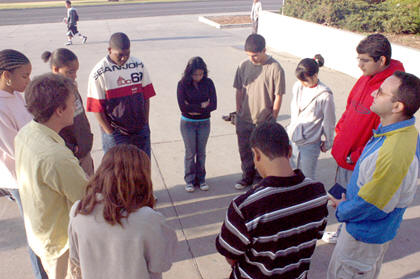
prayer2Why is it when people are emotionally blackmailed into becoming followers of Jesus, does their conversion make them sweet and sour, nasty and nice at the same time? The sweet and nice parts are what their new experience does for them. They get a new start of sorts, are introduced to like-minded friends in the church and become compelled to share their new joy with everyone else, whether they want to hear it or not, about how much they’ve changed because of Jesus. It’s nice for them. Deluded too, but if it makes them happy then why not?

This is why not. What they don’t tell you, not at first anyway, is how sour and nasty they have also become; how they must now defend God’s standards, because, as everyone knows, the omnipotent God of all creation is incapable of defending them himself. Being born again and morphing into ‘a new creation’ involves, without exception, becoming judgemental of others, condemnatory, inflammatory, bigoted and spiteful.

You think not? Then you haven’t heard what these same Christians think about abortion and women who have them. Homosexuality and those who are gay. Transgenderism and those born in the wrong body. Science and those who value evidence. Atheism and those of us who see through believers’ sad delusion.

Christians don’t, as some of them profess, hate the sin but love the sinner. They despise those who have philosophies different from them, those who live differently from them, those who are different from them.

A recent BBC poll asked if the world wouldn’t be more peaceful without religion. Here’s the results as of 14th July 2016:

Poll

I don’t know how many people this represents nor where they’re from – the site doesn’t say – but it would seem that most of us would think we would be better off without religion. It’s long past time we were able to be; religion has nothing to offer. It’s time we stopped giving it special treatment because some of it is sweet and nice. Its sour, nasty aspects are just as much a part of it, inseparable from whatever positives its adherents say it has. I’ll be looking soon at how we might push back against religion’s pervasive and poisonous influence in society.

Effective Preachin’ (Part Two)

Sheep

Reverend M. T. Vessal of the Church of The Raised Up here again, with the second part of my guide to Effective Preachin’. In case you missed it, repent! (The first part’s here.)

Now we’re really gonna get going, praise the Lord! The tools you’re gonna need for your talk proper are:

Lots of anecdotes (make up ’em up if you don’t know any true ones), specially ones about life- and-death situations. Stories about encounters with people on planes always go down well, as there’s always the chance the plane will too, and accounts of foolish follk who hear the gospel and ignore it, only to die in a terrible accident soon after.

Cod-psychology. That’s the stuff about God-shaped holes, how only Christ can forgive sin and meet all our needs, even though he doesn’t and never said he would. You can add something in here slagging off atheists and anyone else you disagree with.

Conviction. This is crucial. Sound as if you mean whatever it is you’re spouting. Sound as if you really know what the Bible says. Make it sound like it’s relevant and meaningful, even though it isn’t.

Modulation, otherwise known as shouting and dropping your voice. Shout when the argument is weak (and they’re all weak – you’re making this stuff up, remember)) and drop your voice almost to a whisper so that people know you’re being really, really sincere.

Drama. Pace up and down, like ‘Bishop’ T. D. Jakes, and mop your brow a lot. Wave your arms about, like Joseph Prince and show you really mean it. Maybe you could use props, like Beth Moore does, though you run the risk then of diverting the attention away from yourself. Better is to demonstrate what a cool guy you are, even if you’re not a guy, by sitting on the edge of the altar steps or, if you’re in a really cool church like Steve Furtrick’s, the Stage. This shows the congregation/audience just how cool you are.

Whipped up emotion. This is optional but if you lay it on thick about what Jesus has done for the spiritually inferior, how their sin caused those nails to be driven in, then you’re on to a winner. Aim for some arm waving from ’em, babbling in jibberish speaking in tongues and maybe even some crying. Don’t forget to tell ’em that whatever they’re feeling is the Outpouring of the Holy Spirit. Definitely nothing to do with your manipulating their already fragile emotions. No sir. This here frenzy is divinely inspired.

Finally, get to the challenge bit of your sermon/talk/self-promotion. This can involve an appeal for money. Correction: this will involve an appeal for money. The God who supplies everything doesn’t supply money so you’ll need to lay a guilt trip on your fans/congregation to provide you with the cash to maintain your lavish lifestyle continue the Lord’s work. But it’s not only about money; remember to pressurise/inspire the congregation/audience/fans to go out and harrass their neighbours so maybe they and their wallets will come to church next week. As the Lord Jesus himself said, ‘the harvest is plentiful but the labourers are few’!

Above all, though, let everyone leave feeling that they’ve had a good time. Like kettles, they should have had a real great Outpouring and feel well and truly Blessed. Leave ’em feeling ready for more, same time, same place next Sunday.


Effective Preachin’ (Part One)

church3Reverend M. T. Vessal of the Church of The Raised Up here, with the first of my special guest posts for all you wannabe preachers out there. I’m gonna be telling you on how to preach the Good News of Salvation and win souls for Christ.

Right. First off, remember to use the words ‘Blessings’, ‘Sanctify’ and ‘Outpouring’ in your preamble or opening prayer. ‘Course no-one will know what these mean as you haven’t provided any context and they’re pretty meaningless anyway – apart from ‘Outpourings’ which is something kettles do. But it’ll get the folks worked up to expect something real good. Folks in church go for things like Blessings, Sanctifying and Outpourings, believe me.

Next, repeat the title of your sermon – or, if you’re part of a cool modern church like Steve Furtick’s, your talk, or, if you’re really honest (and let’s face it you wouldn’t be doing this if you were really honest) your spot of self-promotion – three times. This is a useful tip for any point of your sermon/talk/self-promotion; if you can’t remember what you were going to say next, say the last thing you can remember saying three times over, putting the emphasis on a different word each time. So, for example, ‘Twelve ways to receiving the Lord’s blessings’ would be: ‘Twelve ways to receive the Lord’s blessings’, then ‘Twelve ways to receive the Lord’s blessings’, and finally, ‘Twelve ways to receiving the Lord’s blessings‘, though feel free to alter this as suits. Saying it three times like this makes it sound like you’ve just come out with something real deep and profound, when you’ve done nothing of the sort. Plus, people sit up and listen to things said in threes. It’s kinda hypnotic.

I said, ‘it’s kinda hypnotic.’

‘It’s kinda hypnotic.’

See? It works.

Next make a joke. Say something like, ‘if you’ll switch on your Bibles’, just to show how with-it and up-to-date you are, knowing most folks bring their iPads to church these days. That way they can shop on Amazon or send an offensive tweet when your sermon gets really boring (and it will get really boring).

Now quote the verse you’re gonna preach about and let the folks follow along; you won’t need to quote it accurately because they’ll all be using different translations, so accuracy’s not important. Unless, of course, you’re one of those churches that only accepts the Authorised Version, the one with all the errors in it that right-royal homosexual James I… well, authorised. (One of the advantages of the KJV is you can  drop in words like ‘lieth’ and ‘unto’ which sound like you really know what you’re talking about.) So, yes, it’s okay to paraphrase the verse your talk is gonna be tenuously connected to because, let’s face it, it’s not going to have much to do with the verse in any case. It’s going to be more about you than whatever’s in the Bible. The exception is if you’re planning on having a rant about homosexuals, in which case you’ll want to stick pretty closely to Leviticus 20.13 and Romans 1.26.

A word on choosing your Bible verse: make it one of Paul’s or something from John. The other stuff, about loving your neighbour and your enemy and going the extra mile isn’t the kind of thing you want to have to talk about. You’re gonna concentrate on Blessings, Sanctification and Outpourings, remember, things that are exclusively for Christians. If you’re feeling really adventurous though you can try a story from the Old Testament. Maybe one of those blood-baths it has a lot of. You can show how all that bronze-age inter-tribal slaughter was really about how much Jesus loves Christians in the twenty-first century.

Right. You’re all set. Next time, I’ll tell you how to preach so that you can make a name for yourself truly reflect the glory of Jesus.

Did Jesus Exist? (part two)

WaterIf Matthew, Mark and Luke were creating a Messiah from scratch, or, more probably, recording the invention of believers who went before them, then it is unlikely they would have arrived at the loser preserved in their accounts. The Jesus we find there is nothing like the Messiah anticipated in Jewish scripture nor by Jews at the time.

He is a false prophet, his good news about the imminent arrival of the Son of Man and the Kingdom of God being patently unfulfilled. His ministry is a failure, ending as it does in ignoble execution. This is not the Messiah anyone would create if they were inventing one to satisfy the longings of a thwarted people. In particular, God’s emissary would not lose control of the situation in the way the Jesus of the synoptic gospels does. He would not allow himself to be executed by the occupying forces in the manner the gospels record. (All the surviving sources attest to his death by crucifixion; we can be fairly certain he died in this way.)

A created Messiah, on the other hand, would surely have announced the arrival of the Son of Man/Kingdom of God before leaving the stage of his own volition – ascending to heaven perhaps as some of the gospel writers eventually have him do – to await the unfolding of the events he had proclaimed. Of course, the death of a godman is a recurrent theme in the mythologies of the ancient world, so it is possible that an unpleasant death would be invented for an imaginary Jesus so that he complied with the trope. But, as I’ve already suggested, the central figure of the synoptic gospels is noticeably ungodmanlike. We only see him as such through the distorting prism of Paul’s theology; without this, we can see that the gospels of Mark, Matthew and Luke really don’t portray him like this at all.

It seems much more likely, therefore, that what the synoptic writers are conveying are distorted memories of an individual who actually lived. A man who promised much but whose mission went drastically wrong but which would, his earliest followers believed, be completed by God himself in the near future. This latter part is, as we now know, pure invention, the gospels conveying only an imaginative interpretation of this man. It would seem, nonetheless, to be an interpretation of someone – a charismatic Jewish preacher and failed heir-presumptive – who had actually lived some years before.

As I said at the beginning of this two-part post, I don’t really care whether Jesus existed or not. The end result is the same; millions of people seduced by a significance he did not have, either as a real person or as an imaginary construct. On balance, for the reasons I’ve touched on in these posts, it seems to me Jesus – Yeshua bar Yosef – did once exist. Like we all must, he died and others set about interpreting his life in their various, incompatible ways. These interpetations are all ultimately meaningless; we can be absolutely certain that, whatever the Bible and Christians today tell us, Jesus, whether he lived two thousand years ago or not, does not exist now in any shape or ethereal form.

Did Jesus Exist? (part one)

Cross3

I want to say at the outset that I don’t think it matters whether Jesus existed or not. Even if he lived, it is highly unlikely he said much that is attributed to him or that he performed the miracles ascribed to him. Neither would it be the case that he rose from the dead or became a supernatural godman afterwards. All of these supposed attributes would be, for an individual who actually existed, later accretions. The man underneath them, the so-called historical Jesus, is difficult to detect. It hardly matters to Christians; they’re really only interested in the accretions, the later add-ons, the myth the man became.

Those who think Jesus never existed raise a number of interesting points, chief of which is that what I’ve referred to as accretions, being central to subsequent Christian belief, actually came first. The accounts of Jesus’ life – the gospels – they see as later attempts to provide the myth with a ‘realistic’ back story based in history. Certainly the gospels came after Paul had had his vision and had set about interpreting it to arrive at his convoluted theology about ‘the Christ’. Jesus-belief certainly existed decades before the first gospel account, Mark’s, and was as a result entirely independent from it. In this scenario, therefore, the myth came first and the stories of Jesus were crafted afterwards as supplementary fiction.

For me, however, as problematic as the gospels are, the synoptic accounts – Matthew, Mark and Luke – are largely at odds with Paul’s theology. If they were written to bolster the myth of a supernatural godman, they don’t do it very well. John’s gospel, on the other hand, is much more successful in portraying a mythical being, which is why its implausible ‘Word became flesh’ is not very much like the Jesus of the synoptic gospels.

The synoptics of course have their own agendas and do not represent accurate biographies of Jesus either – there are too many contradictions and anomalies to claim they do – but, to varying degrees, they do not present a Jesus who is the embodiment of Pauline theology. The synoptic Jesus doesn’t, for example, promote a salvation plan involving his own death or say that faith is the means by which one enters the Kingdom of God. These are ideas of Paul’s, as are notions of grace, election, sanctification, redemption, substitutionary atonement, imputation, gifts and fruits of the Spirit and even more mumbo-jumbo besides.

The good news of the synoptics’ Jesus, however, is that God’s Kingdom is coming to Earth soon and to be part of it one must become ‘righteous’ both by serving others and relating to them in a ‘measure for measure’ way: forgiving in order to be forgiven, being compassionate to be shown compassion, giving in order to receive, not judging so as to avoid being judged. This Jesus and his gospel are, moreover, predominantly Jewish; Matthew’s version in particular is virulently anti-Gentile. All of this is totally at odds with the magic formula of salvation-available-to-all of Paul’s make-believe. If this came first, it is difficult to see why the synoptic gospels would not present, as John does, a Jesus who is more compatible with it.

Either the synoptic gospel writers got much wrong in providing the Christ’s supposed back story or they were representing other traditions, ones that were different from and possibly even older than Paul’s interpretation. Belief in Jesus as teacher, prophet and, possibly, Messiah predates Paul (he refers to it himself while Matthew and Luke make use of an earlier sayings gospel known as ‘Q’) and it seems likely that Mark and Matthew in particular reflect these traditions, untainted by Paul’s fantasies. Of course these traditions too could have been invented, just as Paul’s theology is, but if that is the case, then, once again, the gospel writers – Mark and Matthew especially – make a decidedly bad job of it.

Next: what this ‘bad job’ tells us about the existence of Jesus.

Dear Christian

Christians

Dear Christian,

Jesus said treat others as you like to be treated (Matthew 7:12) so why do you treat them with abuse and unpleasantness?

Blog191(2)

Jesus said turn the other cheek (Luke 6:29) so why do you respond with insults?

Blog191(1)Jesus said don’t judge unless you want to be judged (Matthew 7:1) so why do you constantly judge and condemn?

Blog191(5)

Jesus said love your enemies (Luke 6:27) so why doesn’t it happen?

Blog191(11)

Jesus said don’t call anyone a fool (Matthew 5.22) so why do you call them far worse than that?

Blog191(4)

Jesus said don’t pray in public (Matthew 6.5) so why do you pray in public?

Blog191(7)

Jesus said sell all you have and give the money to the poor (Luke 18.22) so why don’t you?

Jesus said you cannot serve God and money (Luke 16.13) so why are some of you so obscenely rich?

CrouchHinn'sJet

Jesus said deny yourself (Matthew 16.24) so why do you indulge and promote yourself above all things?

Blog191(8)OsteenPope Francis waves to the crowd, aboard the popemobile in Mexico City's main square, the Zocalo, Saturday, Feb. 13, 2016. Pope Francis kicks off his first trip to Mexico on Saturday with speeches to the country's political and ecclesial elites. The pontiff's five-day visit will include a very personal prayer at the Virgin of Guadalupe shrine. (AP Photo/Moises Castillo)

Jesus said ‘be perfect’ (Matthew 5.48) so why don’t we see you trying?

Sick

Jesus asked why you call him ‘Lord, Lord’ and yet don’t do what he tells you (Luke 6.46). Evidently he didn’t understand, as you do, just how many of his commands are optional. Thank goodness you know better than he did.

There’s good news and there’s good news…

Bat-Jesus

Mark, Matthew and Luke all tells us that Jesus preached the gospel when he was alive (Mark 1.14-15; Matthew 4.23, 9.35 & 10.5-7; Luke 20.1). So what was this gospel? What was Jesus’ ‘good news’? He had yet to die so it couldn’t possibly have been ‘you can be saved through my death and resurrection’ because this magic formula had yet to be arrived at by those who came later. Nor could it have been ‘accept my substitutionary atonement whereby I take the punishment you deserve in order to restore your relationship with God,’ for much the same reason. Nor could it have been, ‘you must accept me as your personal your saviour if you want to gain everlasting life in Heaven,’ because he didn’t regard himself in this way and he didn’t, according to the synoptic gospels, offer an eternity in Heaven. No, Jesus’ good news could not have been any of these because they are all later developments, mumbo-jumbo invented about him by others, not things he said himself .

Actually we needn’t speculate on what the good news was that Jesus preached because the gospels tell us: God was going to intervene in history very soon, rescuing his people from Gentile rule and setting up his Kingdom, in which he, Jesus, would be judge and king (Matt 24.27-34 & 25.31; Luke 1.33; 21.25-28). People, he said, referring only to Jewish people, should prepare themselves for this coming Kingdom by mending their ways (Matthew 10.5-6).

How soon would all this happen? In the lifetime of his hearers according to Mark 9.1, Matthew 16.28 and Luke 9.27, maybe even within a few weeks or months. When sending out the disciples to spread his good news he promised them, ‘you will not have gone through all the towns of Israel, before the Son of man comes (to usher in the new Kingdom)’ (Matthew 10.23). We can only assume that the disciples are back by now – in fact they return a few verses later – yet the Son of man still hasn’t materialised among the clouds in full view of ‘the tribes’ of the Earth (Matthew 24.30).

As the Bible records, Jesus was wrong in every respect; God did not set up his new Kingdom within the lifetime of those Jesus spoke to; the Son of man did not appear; the Romans were not overthrown; Jesus was not appointed judge and king of the world. The sarcastic inscription on his cross, ‘King of the Jews’, was the closest he came to having his self-aggrandising prophecy realised.

Is this the Jesus that Christians worshipped subsequently and still worship today? It ought to be as he’s the one revealed in the first three gospels. But the Jesus believers carry around in their heads is not this man. The ‘Jesus’ worshipped by Christians is primarily a construct of Paul’s – his ‘Christ’ – and their own collective imaginations. The mythical ‘Christ’ that Paul ‘did not receive from any man’, has replaced and almost obliterated Yeshua and his mistaken beliefs about the coming Kingdom (though Paul held on to the idea that it was indeed imminent; see 1 Thessalonians 4.15-17).

Admittedly ‘the Christ’ has had a far better shelf-life than Yeshua could ever have had on his own; the continual resurrection of the idea in the minds of believers – and only there – has ensured the perpetuation of the myth. When all is said and done, however, the Christ is nothing more than an imaginative recreation of a failed zealot with an altogether different gospel.* Yeshua’s good news of the Kingdom died shortly after he did and like him has stayed dead, its echoes preserved by Mark, Matthew and Luke and ignored by Christians everywhere.

* I’m aware there is a body of thought that gives primacy to the mythical god-man, ‘the Christ’, with the Jesus stories being seen as a later ‘in-fill’ designed to provide him with a plausible back-story. I’m not convined of this for several reasons, which I’ll explore at a later date.

Christianity: always winter but never Christmas

Spot the difference:Shore

Christians are hot on evidence.

There isn’t enough for evolution, they say, even though there’s an abundance.     

None, they claim, that the Earth is billions of years old, but only 6 thousand.

Not enough that climate change is man-made, when there’s considerable evidence it is.

None that there’s a genetic component to homosexuality when science reveals that there is.

But, as far as the resurrection of the body, judgement and eternal life in either Heaven or Hell are concerned, these they believe in, no evidence required.

I recently challenged Christians on Charisma magazine’s blog-site to provide or point me to evidence that any one of the 107 billion people who has ever lived who after they had died had gone on to enjoy either eternal life in Heaven or eternal punishment in Hell. Unfulfilled promises from magic books weren’t admissible, because a promise of something happening is not the same as it actually doing so. Jesus didn’t count either, as there are no eye-witness accounts of his bodily resurrection, only stories written decades after the supposed event. In any case he was half Vulcan or something, not an ordinary mortal.

Alas, my challenge went unanswered. You won’t find it on the Charisma site now because it has been removed by the moderator there. Expecting evidence from Christians for what they believe is patently unreasonable. After all, who needs evidence when you can exercise your licence to believe whatever you’re told?

Of course, there is no evidence of any resurrection nor of anyone who has gone on, post-mortem, to enjoy everlasting life. Have you noticed how everything about Christianity is either invisible – God, the Holy Spirit, Heaven, angels, demons – or lies permanently in the future; the Second Coming, the resurrection of the body, the Kingdom of God, judgement and eternal life? All of them always just that little bit further on. This year, next year, sometime, never. Just not now.

Yet Jesus, Paul, Revelation’s John and most other New Testament luminaries believed God’s Kingdom, the resurrection and judgement were coming within their own lifetimes.* Not one of them entertained the thought that 2000 years down the line none of these miraculous events would have materialised.

Small wonder then, that at the start of the second century, believers began to lose hope in the Second Coming, the Kingdom’s arrival and an earthly resurrection of the dead. Maybe, some of them began to think, eternal life would be not be here on Earth, as Jesus and Paul had promised, but in Heaven with God, which they most definitely hadn’t. This way, everything that hadn’t happened here on Earth would happen instead after death (we can see this transition taking place in the very late gospel of John). All of which was fortunate, because it dispensed with the need for confirmation and evidence; no-one could prove – apart from the fact nobody has ever survived their own extinction – that believers didn’t go to Heaven when they died. Equally, no-one could provide evidence they did.** How neat and convenient.

So if any Christians reading this would like to like to show us some evidence for the resurrection of the dead, post-mortem judgement, Heaven, Hell, God’s Kingdom on Earth – any of it – I’m sure we would all like to see it. Until then, I will go on regarding all of these assurances as empty promises – pie in the sky – that believers cling to desperately, while calling their desperation ‘faith’.

* See Matthew 16.27-28 & 24.27, 30-31, 34; Luke 21.27-28, 33-34; 1 Corinthians 15.51-52; 1 Thessalonians 4.15-17; 1 John 2:17-181; Peter 4.7; Revelation 1.1 & 21.2-4

** Psychics claim to commune with the dead of course, or at least with their spirits; more hokum from the minds of the deluded. Even if it weren’t, this isn’t the kind of resurrection Christians envisage for themselves. They dismiss psychics’ ‘evidence’ of life-after-death as so much demonic deception.

Now make up a story about it

Bible4

So there we have it. The accounts of Jesus’ resurrection all derive from imagined sightings of him post-mortem. Call them hallucinations, visions or revelations, none of them were encounters with a real, revived physical being.

Except that’s not quite it, because it’s worse than that, Jim.

Most of our accounts of the resurrection appearances are fifty years or more too late. Paul’s is the only first hand account we have and even that is sketchy and recounted several years after it happened. For at least three of those years, Paul meditated on his seizure and interpreted it as a revelation from the Lord. Undoubtedly, others had similar experiences; the stories of the resurrected Christ came from somewhere and the resurrection seems to have been central to Christian faith from its earliest days. Paul cites in 1 Corinthians 15:4-8 those he says have encountered the risen Christ:

He appeared to Cephas, then to the twelve. After that He appeared to more than five hundred brethren at one time, most of whom remain until now, but some have fallen asleep; then He appeared to James, then to all the apostles; and last of all, as to one untimely born, He appeared to me also.

Paul implies here that his own experience is the same as that of the others on his list; they too, then, had visions of the risen Christ within their imaginations. Significantly, Paul omits Mary Magdalene, the first to ‘see’ the post-mortem Jesus according to the later gospels, while some of the other encounters Paul claims to know about do not find their way into those accounts. Of those that do, we can be confident the details are wrong. They were most certainly not as they are described in the stories that eventually came to be written.

The earliest copies of Mark’s gospel famously have no resurrection appearances. The women discover the empty tomb, which Matthew and Luke later lift into their gospels, and, bizarrely, decide not to tell the disciples about it. By the time we get to last canonical gospel, written some thirty years down the line, its author embellishes Luke’s attempts to suggest that the risen Jesus has some physicality; he allows his old friends, especially Thomas, to poke around in his wounds and he eats fish. Nonetheless, as in the earlier gospels, the disciples all have trouble recognising him, even on a third occasion, and are afraid to ask him who he is (John 21.12). Did his followers simply experience, as John 14.15-20 and Matthew 18.20 seem to suggest, an intense sense of Jesus’ presence? This would make the reports of actual sightings evidence of later believers’ need for something more substantial than flashing lights and fuzzy feelings. Which is how, over time, surrounding detail came to be added.

In their specifics, the resurrection appearances in the gospels and Acts are stories that accrued around the visions and inner traumas experienced by Jesus’ friends and other zealots. As such they are fiction; the angels at the tomb – probably the empty tomb itself – the encounter on the road to Emmaus, the fish breakfast and the rest. Bart D. Ehrman demonstrates convincingly in Jesus Before The Gospels, that the oral tradition was not capable of transmitting the details of Jesus’ life and ministry accurately over a 40 year period (when Mark’s gospel was written). The same is true, perhaps moreso, of individuals’ idiosyncratic inner experiences. Over 50+ years, after which Matthew and Luke’s gospels were composed, reports of these visions would have been altered innumerable times by those relating them, ever onwards and outwards; details would inevitably have been changed, added, removed and invented in a protracted game of Chinese whispers. In all probability the gospel writers themselves introduced their own embellishments.

So then, from a small number of visions/hallucinations/feelings, via significantly altered accounts of these same subjective experiences, together with others that are pure invention, to the eventual recording of such stories 50 to 80 years later, this is the evolution of the fantasy that is the risen Christ.