
Are You Doing What Jesus Christ Says?

Billboard

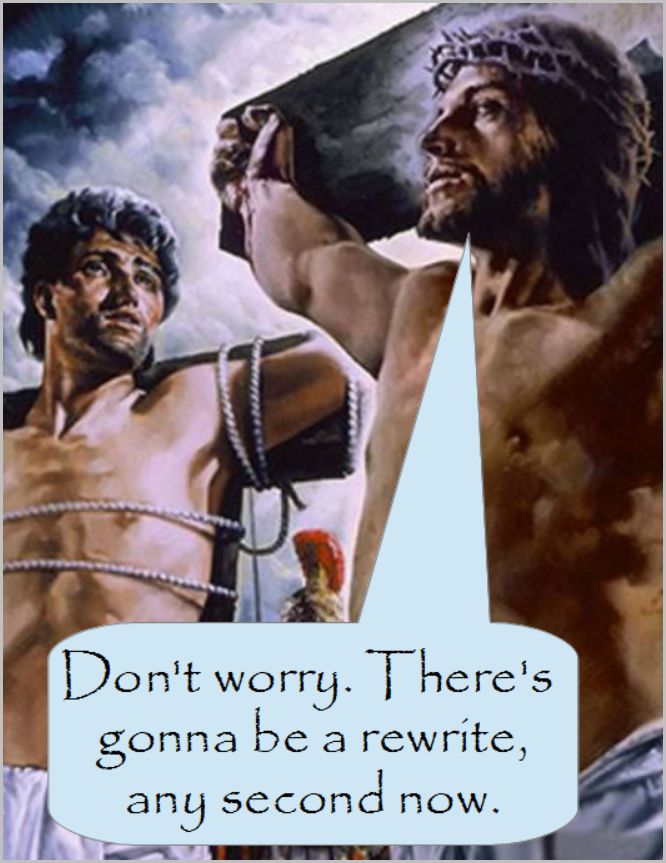
Dale McAlpine, sometime commenter here and fanatical street-preacher in these parts, has posted a tasteful little video on his web-site – that’s the smugly named Repent.com if you’re interested – called Are You Doing What Jesus Christ Says? Take a look at it over on Repent.com or on YouTube; it’s ludicrously melodramatic and wonderfully over the top. You’re sure to enjoy its typos and spelling mistakes too.

What’s remarkable about it apart from these things is that, despite its title, it makes little reference to what Jesus is supposed to have said. Instead, it’s all about how you’ll go to hell if you don’t repent and accept him as your saviour; but Jesus never said this. It says you’re a ‘vile, wretched, hell-deserving son or daughter of Adam’ – Jesus didn’t say this either. It also insists you should let his cross ‘disrupt the very centre and citadel of your life of self’ (whatever that means) and guess what? This wasn’t part of Jesus’ teaching either. In fact, none of these claims were part of his ‘good news’.

Of the things Jesus did say – go the extra mile, sell all you have to give to the poor, turn the other cheek, avoid judging so you won’t be judged, give to all who ask, give away your shirt as well as your coat, feed the hungry, visit the sick, clothe the naked and love your enemies – the video makes no mention. Funny that. Maybe that’s why we don’t see Christians doing them very often.

So, Christians – and Dale too – are you doing what Jesus said or are you, like the video, only interested in pointing out others’ supposed sins and shouting about how they need to join you in your delusional mumbo-jumbo?

Yes. Thought so.

The Stuff Christians Say… (part three)

DoorToDoorAtheists are aggressive/militant/unreasonable: The Christians might’ve got us on this one. After all, it is incredibly irritating when we atheists start preaching in the town centre or invade others’ events to tell them what to believe or dish out loony pamphlets or turn up at people’s doors when they’re just about to have their tea. And what about all those meeting places we have, on just about every corner of the city, with smart-arse posters about Adam and Steve on the board outside? And let’s not forget our readiness to blow up ourselves and others in the name of our great cause. Now that’s ‘militant’! Yes, we atheists really do have too much freedom to push our views on others. No wonder we’re so insufferable. (Note to self: check you’ve got this right.)

It takes more faith to be an atheist than a Christian: It takes no faith to recognise there are no supernatural beings. It takes no more faith not to believe in God – or to acknowledge that there is no God to believe in – than it does not to believe in Santa Claus, Poseidon or Ra. Christians themselves require no great abundance of faith to dismiss these characters. Is it so difficult to understand that atheists disregard the Christian pantheon of fantasy figures in exactly the same way? Or are believers practising their dishonesty-for-Jesus again? There is no faith involved in being an atheist. On the other hand, believing in an omnipotent but suspiciously inactive God, a super-hero Saviour, a magic Spirit, angels, cherubim, seraphim, demons, Satan, resurrected saints, Heaven, Hell and all manner of powers and principalities – this requires faith in delusional quantities. No atheist could possibly compete. Nor would they want to.

Faith: An Exercise In Futility

MountainsWhat is faith?

The anonymous author of the book of Hebrews says it’s ‘the substance of things hoped for, the evidence of things not seen.’ (11.1)

Hoping for ‘things’ like perfection, resurrection, eternal life, heaven (not to mention the ability to move mountains), the likes of which no-one has ever achieved, is nothing but wishful thinking. Despite what the Hebrews author says, wishful thinking isn’t evidence of anything – except a capacity for wishful thinking.

By it’s very nature, then, faith is not evidence, but the very opposite. It is the effort to believe in things for which there is no evidence and the delusional insistence that the imagined is more real than that which is.

The stuff Christians say… (part one)

Jesus-Facepalm

On the day Christians remember the time Jesus allegedly spent being dead and buried (that’s one day, if you’re counting; what happened to the three he promised?) by going shopping or watching sport, let’s take a look at some of the nonsense they spout about atheists:

Atheism/humanism is of Satan: Given there’s no evidence for any supernatural beings, there can be no devil, Satan, Lucifer – or whatever other name Christians come up with for this fantasy figure. (Bizarrely, it’s Jesus who’s called Lucifer in Revelation 5.5) The devil is a creation of the human mind, intended to explain the nasty stuff in life and to let a supposedly good God off the hook. It follows that an imaginary being can’t make human beings be anything. The devil therefore does not make people atheists nor direct them in their ways.

Humanists/atheists set themselves up as God: Every manifestation of the god(s), including those that happen to be popular at present, is of human origin. Like all the others, the Christian God is a product of the human imagination that is made manifest only through human behaviour. So who is it who sets themselves up as God? Those who recognise that this creation of the human mind has no external reality, or those who claim an intimacy with the ‘Supreme Being’, believe his Holy Spirit lives within them and delude themselves into thinking they speak for him? No prizes.

Humanists/atheists worship man as God: Atheists don’t do this either. We are well aware of humans’ fallibility, inconsistency and capacity to bugger things up. However, we’re all we’ve got. There’s no God going to come and save us or solve our problems. We have to do it ourselves (or, as the case may be, not). Nor do atheists regard other people as wicked sinners who have no good in them – a particularly unhealthy viewpoint favoured by the religious – but this hardly constitutes ‘worship’.

Atheists hate God: Only to the same extent we ‘hate’ Santa Claus, Poseidon and Ra. You can’t hate (or rebel) against something that doesn’t exist. We do get very tired though of Christians foisting their views on us, insisting we should believe what they believe. And we get angry when they disparage others and attempt to curtail their freedom because they alone know what Jesus would want. But being angry about Christians’ unreasonableness is not the same as hating something that doesn’t exist.

To be continued

The Embarrassment that is the Old Testament

bible2

When does the Old Testament count and when doesn’t it? When does what it says matter and when doesn’t it?

The answer to both questions is when Christians say so. It counts when something from it can be used to underline how wicked the rest of us are and when they think it’s pointing to the coming of Jesus, many years in its future. It doesn’t, of course, foretell of Jesus as such, despite its predictions of a coming Messiah and/or Son of Man. Jesus doesn’t fit its descriptions of either of these figures. Rather, Jesus’ story is read back into the older texts, their characters and events forced to serve typological and prophetic purposes for which they were never designed. The entire endeavour, which began very early in the development of Christianity, is entirely back to front, with the gospel writers, Paul and other New Testament authors pillaging older Jewish texts and forcing them to fit Jesus retrospectively (and often laughably.)

Regarding ancient Jewish texts as an Old Testament – that is, as representing a previous agreement/covenant between God and his people that has since been superseded – is a political, interpretive manoeuvre of the later religion. (While it’s true Jesus is made to speak of a new covenant, it is debatable how authentic his words are; rewriting the past is not only confined to the New Testament’s treatment of the Old.) This kind of slippery manoeuvring was also endorsed by those who later compiled the Bible as we now know it,* when they relegated the writings that Jesus and all the New Testament writers would have regarded as sacred Scripture to nothing more than a forerunner of the real thing.

Believers want to hang on, naturally, to Genesis, because that’s where it tells them God created everything using nothing but magic and breath from his holy lungs. It relates too how everything went pear-shaped after some mythical people ate some fruit. Noah’s ark is there too, which is a jolly good fantasy, apart from that weird bit at the end where Ken Ham gets an eyeful of his old man’s old man (Genesis 9.20-27). Christians are less keen on those Old Testament stories where God instructs the Israelites to massacre other tribes (1 Samuel 15.2-3; Deuteronomy 2.34 etc) and rape their women (Isaiah 13.15; Zechariah 14.1-2 etc) but nonetheless they’ll defend these unpleasant, barbaric stories just because they’re in the Bible. The Psalms are nicer, what with their words of comfort and paranoia, but best of all are the Old Testament pronouncements that can be used for clobbering sinners. Leviticus 20.13 – ‘If a man lies with a male as with a woman both of them have committed an abomination; they shall be put to death; their blood is upon them’ – is a particular favourite, as is the story of Sodom and Gomorrah for much the same reason. But when it comes to other diktats, Christians are less interested; rules about not eating shellfish or wearing clothes of mixed fabrics, they are quick to point, are entirely negated by the new covenant; they don’t count any more, even though they’re in the same list of largely petty rules as the homophobic one (Leviticus 11.10 & 20.9.)

So how do Christians decide which Old Testament laws are applicable and which are now inessential? There is no shortage of know-alls Christian scholars who make it up as they go along and can tell them. It’s easy you see; the old ‘ceremonial’ rules of the old covenant are now redundant while the moral precepts still stand. Needless to say, the Bible itself suggests no such thing, with Jesus saying precisely the opposite in Matthew 5.17-18 and Luke 16.17; evidently another of his strange ideas that can safely be ignored.

So how do we know which of the Old Testament’s prescriptions are ceremonial and which moral? The same self-appointed experts can tell us this too, though it’s actually easy to work it out for oneself. As a general rule of thumb, verses that condemn other people are still applicable while those that Christians themselves don’t care for are not. So the shellfish and mixed fabrics directives can be disregarded, because obviously they’re ceremonial, while the anti-gay stuff isn’t – obviously. And there’ll be no public stoning of wayward teenagers (Deuteronomy 21.18-21) because that’s obviously ceremonial too – and don’t even think of having sex with the slaves, not even ceremonially. These days, thank God, it’s considered so uncivilised (even if, in Numbers 31.17-18, Yahweh says it’s okay. )

The Old Testament then; an embarrassment Christians are compelled to defend as part of their magic book but which they nevertheless feel free to use selectively, according to taste. Not unlike the New Testament really.

*There are, we should note, several variations of the Bible within Christendom; God can’t seem to decide which books are or are not part of his Holy Word.

All in the mind

Disaster

A new minister at the church near where I live has announced his plans to bring ‘God’s love’ to people in the parish. This sounds laudable enough, I suppose – it’s better than delivering God’s condemnation and judgement as many holy rollers are prone to do – but it begs the question why God doesn’t deliver his own love in person. Why is it he feels he can only channel his love through flawed and fallible human beings? Why doesn’t he engage intimately with his creation and let his love be known and felt directly? Why doesn’t he show his love by eradicating cancer, say, or preventing natural disasters, or exterminating the mosquitoes that cause the deaths of up to 2.7 million people every year? Why, in anything that would count as a tangible expression of God’s love for the world, as declared in John 3.16, is there a singular lack of evidence for both his love and his very presence?

‘Ah, but wait!’ say any Christians reading this. ‘God’s love is made manifest through his people, just as the new minister suggests.’ But this is my point; if I only ever expressed my affection for my loved ones through intermediaries – or even strangers, as this minister is to me – or only through a succession of Valentine’s cards, what sort of impression of my love would they have? They would, I think, be unconvinced of it, because love is not just a distant expression of feeling; it’s what we do for others. Love is action.

‘Ah, but wait again!’ say the Christians. ‘What about the second part of John 3.16 that tells us that God showed his love for the world by sending Jesus to die for us?’ You’ll pardon me, won’t you, if I find that a paltry and pathetic expression of love? If I had somehow expressed my love for others millennia ago, no-one at this distance would be impressed by a largely symbolic ‘gift’ proffered only after its original intended recipients declined it (Matthew 22. 8-10).

God didn’t really do this, of course; he didn’t send Jesus, didn’t instruct Paul to extend to all and sundry the offer of salvation that Jesus made only to Jews, didn’t transmit any sort of time-travelling compassion to reach us in the present; doesn’t express his love through other flawed human beings today. How do we know this? Because there is no God to show us love nor to judge or condemn us. Any judgement, condemnation or love is expressed by other human beings, frequently in the name of one god or another but humanly derived even when drawn from a holy book. Gods don’t write books; they’re human creations too.

Everything to do with God, from his very existence and all of his supposed attributes – his aversion to sin, his revelations about himself, his miraculous and mysterious ways, his answers to prayer, his non-answers to prayer, his supposed offer of eternal life, his holy books and his hatred and love – derive from human hopes and fears and our need for explanation. We know this because God’s love and all his other supposed characteristics are made manifest through human agency and in no other way; they have no existence outside the human imagination. So the new minister’s love can’t really be from God. At best, it will be a level of interest and concern for a limited number of people, because that is all that is humanly possible. Even so, it’s more than a God with no direct dealings with his creation can manage. Every expression of who he is, how he thinks and how he behaves is a projection of how human beings think and behave. That is why he is so maddeningly inconsistent across cultures and even within them, depending on which cult (and they’re all cults), denomination or church claims to be representing him. The Christian God is, like all the others, a human creation and all manifestations of him – including his much vaunted love and the relationship believers claim to have with him – are entirely human too.

Hermeneutics = Sameoldtrics?

Paul&JCHermeneutic consistency is the means by which Christian apologists try to harmonise disparate parts of the Bible. Saddled with the premise that the Bible is the Word of God they need to demonstrate a consistency it doesn’t have because God, as its ultimate creator, could not possibly be the author of confusion (1 Corinthians 14.33). Consequently, they set about ironing out the Bible’s many discrepancies and contradictions to arrive at what they claim is a consistent and uniform Salvation Plan.

Unfortunately, this being an essentially dishonest enterprise, they have to pretend that New Testament authors with conflicting ideas about what it means to be a follower of Jesus are really saying the same thing. As I demonstrate in Jesus v Paul Round 2, there are vast differences between Paul’s good news and that ascribed to Jesus in the synoptic gospels. In the latter, Jesus is made to say that ‘righteousness’ can be cultivated in a measure-for-measure arrangement so that the extent to which a person forgives, gives to others and demonstrates compassion and mercy is mirrored exactly in how much God forgives, gives and shows mercy and compassion to that person in return. Paul on the other hand sees ‘salvation’ as being entirely undeserved. It is, rather, the result of God’s ‘grace’, which is given even though unmerited. According to Paul, showing compassion and mercy and offering forgiveness has no bearing on whether one is saved or not. These – Jesus’ path of righteousness and Paul’s unearned salvation – are two entirely different, and mutually exclusive, ‘ways to God’. Christians choose to remain blind to this fact.

They see no difference between the two ways to redemption because they are taught that Christianity is one grand scheme, woven, as it were, from a single piece of cloth. From this perspective, Jesus and Paul are simply drawing attention to different aspects of what is taken to be a consistent pattern. But this isn’t so; the New Testament is more like an untidy patchwork, a series of explanations by at least a dozen hands of what Jesus was about. Its most prominent voice is Paul’s (and those who pretend to be him); Christians prioritise Paul’s teaching over and above that of the synoptic gospels, which is markedly different, and interpret their ‘good news’ in the light of Paul’s mysticism. What doesn’t fit, they discard.

This has been a problem ever since the start of Christianity; the differences and disputes between Paul and the original disciples is well documented in the New Testament itself. Paul did not regard those who had walked and talked with Jesus as having a grasp of the true gospel (his) and was not reticent about saying what he thought of them. In Galatians 5.12, for example, Paul is so pissed off with the apostles he wishes they would accidentally castrate themselves.

Enter Luke, the original hermeneutic harmoniser. His Acts of the Apostles is designed to reconcile the radically different doctrines. By and large he succeeds, with most believers down the ages, perhaps because they haven’t wanted to, unable see the joins. But Acts doesn’t get Paul’s itinerary right, let alone his theology. The speeches Paul makes in Acts are not about the salvation through grace that concern him in his letters. They make concessions to other teaching – that of repentance and forgiveness (for example in Acts 13.38 and 17.30) while the real Paul makes no such compromise. There are no exhortations to repentance nor the promise of forgiveness in Paul’s own writing; there he mentions repentance only once, in a strikingly different context (Romans 2.4), and forgiveness not at all.

Moreover, Paul is adamant that he did not receive his doctrine from Peter or anyone else (Galatians 1.11-12). Instead he insists he got it direct from the Lord – i.e. through the hallucination he alludes to in Galatians 1.11-12 and 1 Corinthians 9.1 & 15.45 – which explains why it is so radically different from the original believers’. In Acts, however, Luke isn’t very happy with this – he’s trying to harmonise, after all – and has Paul meet Peter and James very soon after his conversion (Acts 9.26-30). Following some initial sheepishness, Luke implies, they all get on famously.

According to Paul, however, he and Peter didn’t meet for the first time until three years after Paul’s conversion (Galatians 1.18) and it was fourteen years later before he talked with a larger group of disciples (Galatians 2.1), when ‘the pillars of the church’ summoned him because of his wayward teaching. Paul records how he ‘rebuked’ Peter shortly after this (Galatians 2.11-13) because he objected to Peter’s interpretation of what was involved in following Jesus. In short, Paul and the apostles could not agree on what constituted belief in Jesus and what part Jewish law played.

Two questions result that Christians need to ask themselves, though invariably they don’t:

1. Where there are discrepancies between Paul’s theology and account of events, and Luke’s – written 15-20 years after Paul’s death – which is more likely to be correct?

2. Who is more likely to have the greater understanding of Jesus’ teaching: Paul who never met him but made it all up in his head, or Peter and the other disciples who spent years with him, listening to what he said?

In answer to the second, Christians down the ages have opted for Paul, the one who made it all up. His Salvation Plan is, after all, easier to buy into than Jesus’ mad idea of giving everything away and loving your enemies. Having chosen their man, it follows that the rest of the New Testament must be forced to comply with Paul’s ideas.

This is hermeneutics in the hands of Christians; an intellectually dishonest sleight of hand designed to bring everything into line with their interpretation of Paul’s idiosyncratic take on a man he never met. As for those who are unimpressed by their contortions, well, it must be that they have a faulty hermeneutic. Praise the Lord!

Consensual text

BiblePastor Chris Linzey has taken me to task for quoting the Magic Book out of context. Interestingy, the latest post on Chris’s blog, written by his father, does just that, so it must be okay for Christians to do it even if no-one else can.

Let’s take a close look at a couple of verses, Matthew 19.4-6, that God’s Chosen like to quote out of context, entirely altering their meaning in the process (but that’s okay, because you know, Christians are doing it):

Have you not read that the one who made them at the beginning “made them male and female”, and said, “For this reason a man shall leave his father and mother and be joined to his wife, and the two shall become one flesh”? So they are no longer two, but one flesh. Therefore what God has joined together, let no one separate.’ (Matthew 19.4-6; Jesus quoting Genesis 2.24 out of context).

As it stands, this passage seems to suggest that Jesus is endorsing marriage between one-man and one-woman (only) but pan out from the isolated section and this not what he’s talking about at all. He’s discussing divorce. Here’s the verse in context:

Some Pharisees came to (Jesus), and to test him they asked, ‘Is it lawful for a man to divorce his wife for any cause?’ He answered, ‘Have you not read that the one who made them at the beginning “made them male and female”, and said, “For this reason a man shall leave his father and mother and be joined to his wife, and the two shall become one flesh”? So they are no longer two, but one flesh. Therefore what God has joined together, let no one separate.’ They said to him, ‘Why then did Moses command us to give a certificate of dismissal and to divorce her?’ He said to them, ‘It was because you were so hard-hearted that Moses allowed you to divorce your wives, but at the beginning it was not so. And I say to you, whoever divorces his wife, except for unchastity, and marries another commits adultery.’ (Matthew 19. 3-9)

What the one-man, one-woman verse can now be seen to be saying is that once a couple are married, they should stay together and not divorce; Jesus isn’t prescribing marriage at all. Add even more context and what we find following the lines about divorce is this:

His disciples said to him, ‘If such is the case of a man with his wife, it is better not to marry.’ But he said to them, ‘Not everyone can accept this teaching, but only those to whom it is given. For there are eunuchs who have been so from birth, and there are eunuchs who have been made eunuchs by others, and there are eunuchs who have made themselves eunuchs for the sake of the kingdom of heaven. Let anyone accept this who can.’ (Matthew 19.10-12)

In other words, Jesus doesn’t recommend marriage in any shape or form, not even between one man and one woman; his view is that it is better not marry at all. He goes further still: it is better to be completely sexless, as if without testicles, for the sake of the Kingdom of God. He acknowledges, bless him, that not everyone will be able to comply with this ‘teaching’ – who’d have thought it?

Zoom out further still and set this part of Matthew’s gospel against Luke 20.34-35 where Jesus really is talking about marriage:

He said to them, ‘Those who belong to this age marry and are given in marriage; but those who are considered worthy of a place in that [Kingdom] age and in the resurrection from the dead neither marry nor are given in marriage.’

This time the message is that only those mired in the ways of the world marry, costing themselves a place in the coming Kingdom. Those in the know, however, avoid it and so guarantee their resurrection and transition to the new age. Whatever else it is (wackadoodle nonsense?) this is not a ringing endorsement of marriage. The verses from Matthew and Luke when taken together show clearly that not only did Jesus fail to endorse one-man, one-woman marriage, but that he disparaged the entire institution. He believed that when the Kingdom came to the Earth, marriage would be done away with altogether and advocated abandoning it in the interim as well. You wouldn’t know this though from the decontextualised use of Matthew 19.4-6.

We might ask here why it is that today’s Christians don’t comply with his directive. Why don’t they shun marriage as their Lord and Saviour says they should? Why do they regard his commands as optional? Why don’t they want to guarantee themselves a place in the coming Kingdom by vetoing marriage? Have they abandoned all hope of God’s Kingdom ever coming to the Earth? Shifty hermeneutics won’t help them here either, because Paul is of a similar opinion (1 Corinthians 7.8-9; 28-29). Evidently this is the kind of teaching Christians are free to discard, perhaps because they see it – unjustifiably – as specific to the first century, like the coming Kingdom itself.    

So, yes, context can be important, given the haphazard and disjointed fashion in which the Almighty chose to express himself. But it doesn’t always produce the result Christians might like. That’s where the sleight of hand known as ‘hermeneutic consistency’ comes in. We’ll try that out next time.


Some material in this post has appeared before; specifically here. I hope I didn’t take it out of context.


A Long Long Time Ago

ShinyJesusHe was a man of great charisma, a provocative individual who challenged the establishment and the norms of his day. Some said, as he implied himself, that he had come to visit the Earth from a higher plane and that perhaps, again as he occasionally hinted (though maybe he was only being contentious) that he was some sort of Messiah. He certainly inspired and gave hope to others who, like himself, found themselves on the fringes of society, who felt unaccepted and down-trodden. Some of what he said and did may have enabled such people to accept who they were or, better still, who they wanted to be.

He refused to accept that he was ‘good’, and certainly he acted as he did because it suited him to do so, not because he felt any need to impress others. Nevertheless, many found him to be humble and kind. His detractors said he was a charlatan and claimed he was demon-possessed; he was all things to all people.

His death came as a shock, what with its suddenness and the manner in which it happened, but nonetheless he seemed to have been prepared for it. In his final messages he suggested he was returning to the higher place from where, perhaps, he’d originally come.

Those who had followed him mourned him and talked of him as an important figure in their lives. They couldn’t, they said, believe he was gone. Some felt that even though he was no longer a physical presence in the world, what he had meant to them would always live on in their hearts, especially when a few of them would gather together to reminisce about him. Others talked of how they hoped and prayed God would raise him from the dead and allow him to live again.

It wouldn’t be long before someone claimed to have seen him back among the living.

So much for David Bowie (there really is a petition asking God to bring him back to life, in spite of his already having been cremated and there being no God.) Within hours of his death being announced, Bowie was elevated to a sort of godhood, his work and sense of alienation imbued with a kind of profound mysticism. The reaction we’ve seen, particularly in the UK, to Bowie’s demise is a common human reaction to the death of a revered one. It happened when John Lennon was killed (a saint he was not) and with Elvis Presley, who, in the years following his death was frequently seen alive in the supermarket or laundromat, and with Diana, Princess of Wales. Elevating larger than life characters to hallowed status when they die is a human trait that helps us mourn them and deal with bereavement.

Is this not what happened when Jesus died? The profound grief, bewilderment, fear and shared memories of those who idolised him, together with their desperate search for meaning in his pointless end, led to his elevation to quasi-godhood and, eventually, to visions of him, if not in the supermarket and laundromat, then back amongst them somehow. If such a thing can happen still, in the technological world of the twenty-first century, how much more could it happen in the superstitious backwaters of first century Palestine.


What Does Atheism Have To Offer? (Part One)

Station-12-ArtistOver the next few posts I’m going to do my best to answer the question, ‘what does atheism have to offer?’ that a commenter on Facebook has put to me – that’d be you, Dave – because, he says, I’m too sneery about Christianity. Some of my response will of necessity be personal in nature, and you can take or leave whatever I say; you won’t go to hell if you disagree (or heaven either.)

1. Atheism offers the truth
Christianity wasn’t delivering; it didn’t ring true for me any more and lacked explanatory power. As a result, a need to know the truth of why we’re here and what life is about preceded my atheism. I set about examining the facts of our existence as we know them, together with all the evidence. I became committed to this pursuit regardless of where it might lead. I didn’t, initially, confine my questioning and subsequent reading only to secular or scientific sources, but continued to explore religious and spiritual explanations of life as well. These quickly paled in comparison with empirical evidence; they were vapid and unsubstantiated, relying as they did on talk about ‘energies’ and entities that no-one had ever seen and for which there was no evidence.

Drawn increasingly to scientific explanations of life – biology, genetics, psychology, astronomy – I became increasingly aware that God wasn’t and isn’t required to explain anything about life, the natural world, the universe or indeed anything. Natural phenomena (and they’re all natural phenomena) have, on the principle of Occam’s razor, natural, not super-natural, explanations. The only reasonable conclusion to be drawn from this was that he wasn’t and isn’t involved in any of them. His very superfluity demonstrates his non-existence; a god who is not evident in any aspect of reality is a god that doesn’t exist. This pursuit of truth therefore led to atheism as something honest and inherently truthful.

2. Atheism offers a real life in the here and now
Living without recourse to the supernatural is refreshing. There is no god (no angels, devils, spirits, ghosts or demons either) watching over us, waiting for an opportunity to punish or bless us; no god whom we are answerable to either in the present or at some future judgement; no god of vengeance who must be obeyed; no god who will vindicate us at the end of time; no god to grant us eternal life; no set of frequently bizarre rules to follow and no empty promises to claim. Atheists take full responsibility for their own lives and behaviour; they construct their own meaning, knowing this life is the only one they’ll get. Atheism alone grants this responsibility and privilege.

3. Atheism offers a humanist perspective and approach to life
This is not the End Times™ as salaciously envisaged by Christians ancient and modern, just as the first century wasn’t – even though Jesus and Paul both thought it was (Matt 16:27-28; 1 Thess 4.15-17 etc.) The atheist accepts that the only help we’re going to get in solving our problems is from ourselves. There is no god waiting in the wings to put things right; no end time scenario when he will come to rescue a chosen people. (This is, incidentally, one of the most pernicious ideas ever to have been devised by humankind, causing more strife and ‘excusing’ more inhumane treatment of others than any other we’ve devised.)

Apart from natural disasters – and we seem to be contributing increasingly to those – the cause of all of our problems is us. Equally, the solutions will have to come from us too. More positively, all of our endeavours, our achievements, our scientific, technological and social progress are ours alone too. We have the potential to do great good, and often do, just as we cause great harm. Free of religious restrictions, the atheist is at liberty to help others out of fellow-feeling, not because a (non-existent) god demands it.

to be continued…