Loose Threads

FamilyPick a thread. Any thread. And start pulling. Gently does it, no need for force. A gentle pull on any of the loose ends of faith and the whole fabric will come apart quickly.

Here, pull on this one marked ‘the infallibility of the Bible‘. See how easily it comes loose as soon as you realise that most of it, Old and New Testament alike, was written long after the events it purports to describe, some of it by imposters and forgers.

Or this one – the salvation thread, much of it stitched into place by an excitable chap prone to hallucinations. Pull it and see how its pattern is nothing like the one proposed by the man it claims to be about.

Pull the magic threads, the ones about Gods, supernatural beings, heaven and hell, eternal life. Watch them disintegrate in your fingers once they’re teased out into the real world.

Take hold of the threads about Resurrections, Second Comings, Raptures and Judgements; so fragile, these break away as soon as they’re touched. The only miracle is that they’ve lasted this long.

Then there’s the promises threads, about how believers are going to do fantastic miracles and heal the sick and raise the dead. Imaginative and colourful, these have never really fitted in.

Then there’s the prayer threads, whose embroidery tells us how prayer works, how God will give us whatever we ask for. Downright embarrassing, these – yank ’em out.

And how about the strands that those who say they love the cloth pick out themselves and throw away? You know the ones; the threads which tell them how to live their lives that they just don’t like the look of and think spoil the overall effect. These have definitely got to go.

What about the threads that weren’t originally there – the ones about ‘defending God’s standards‘ and having a ‘relationship‘ with a dead person? These grubby, greasy threads have been added in to replace the ones those who love the cloth have pulled out for themselves.

Choose any number of other threads – the ones that clash with other bits of the pattern, the ugly brutal ones, the fantastic, the ignorant – and give them a tug. Oh, look. They come away too.

And before you know it, the entire fabric has come apart in your hands. All that’s left is a pile of worthless, brittle threads, good for nothing but throwing in the bin.

The Late Great Planet Earth

burning_earth1The scene yesterday as the Earth finally came to an end.


Today is an illusion. You are not really here. Yesterday, the world ended, destroyed with the fire predicted in 2 Peter 3. The Lord finally had enough and set fire to the Earth and obliterated it.

So how was it for you?

And here we are today, the day after it all ended. Doesn’t it seem remarkably like it was before the terrible events of yesterday?

As ever, God mispoke to his trusted servants who took the time to tell us of our impending doom.

Never mind. Let’s set another date. Oh wait – we already have. Plenty to choose from here. You can’t have too many ends-of-the-world, can you?


Once in a Blood Moon

HageeSomething’s going to happen today. Or maybe tomorrow. Maybe something happens every day. But evangelical pastor John Hagee says that because of last night’s Blood Moon and lunar eclipse, something special’s going to happen real soon. He can’t say whether it’s something good or something bad, but it’s something, okay? Because predictable lunar events are really secret messages from God, telling us he’s pissed  off again and warning us something big is going to happen, whether that’s something good or something bad. Who knows. But you will know when you see it and you’ll be able to say, ‘So this is what John Hagee warned/promised us would happen!’ He really can’t lose; ‘prophecy’ with the details filled in after the event – any event – is prophecy that can’t fail.

Christians, you are being short-changed. Your teachers and leaders, including, in all probability, those you sat listening to in church yesterday (maybe even writing down what they said) are feeding you inanities. The rest of us see it whenever we look at the God channels or stumble upon the pronouncements of the likes of Hagee or Robertson or Meyer. These people have nothing to say of any substance, sense or meaning. This isn’t just someone in an ‘unregenerate’ state saying so – analyse what they tell you for yourself and let your eyes be opened. See through the thin veneer of derisible pop-psychology and lunatic make-believe (pun intended) to the vacuousness at the heart of Christian ‘teaching’. Admittedly, this will entail doing some thinking for yourself rather then just absorbing uncritically the drivel these people send your way – but it will be worth it. Then you’ll finally see: the emperor’s self-appointed spokespersons really don’t have any clothes on.

Meanwhile look out for something happening today. Or tomorrow. Or some other damn time.

I Don’t Believe It

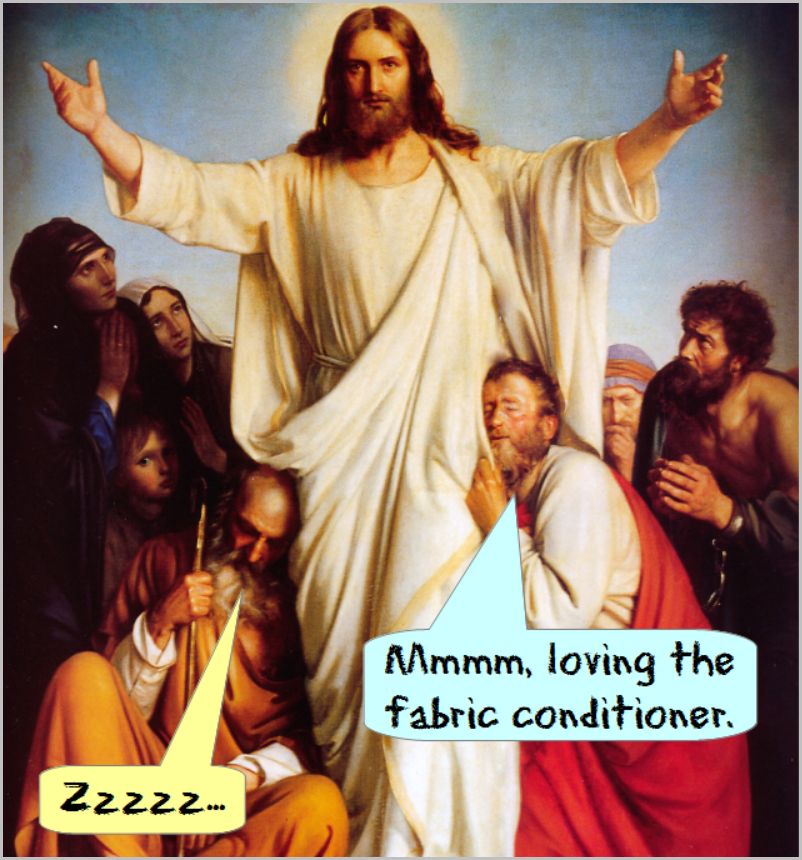
Fabric‘When you think about it’, the taller of the two men said, ‘there is no evidence whatsoever that God, nor indeed any supernatural being.

‘I suppose you’re right’, said the other.

‘With that realisation, my faith began to dissipate. I mean if there’s no God, no angels, demons or Christs, no Holy Spirit, devils, fairies or Santa Claus, then it must mean they’re just figments of the imagination. Take that human element out of the equation and what you’re left with is… well, the natural world and nothing else’.

‘I suppose not’, said the other.

‘From there one realises there is no point in praying – I mean, talking to a being who only exists in your own head. Or reading the Bible; one begins to see it as a very human book, which of course it is’.

‘I suppose so’, said the other.

‘It means too that Jesus can only have been a mortal man – of course he was – and that a good deal of his teaching – if we can believe it really was his and not simply invented by his followers – makes no sense whatever. It was only the eyes of misplaced faith that made it appear so’.

‘I suppose it doesn’t’, said the other.

‘I mean, “pray for whatever you need and God will supply it”. Who has ever believed that sort of thing anyway? No-one. Not really. We all know that doesn’t work; Jesus himself, one suspects. And as for the resurrection, well, if you read those accounts at face value all they saw – Mary Magdalene, Paul and the rest of them – all they saw were visions, not a real person. All in their minds, you see’.

‘I suppose I do’, said the other.

‘No, Christianity is nothing but false promises, failed prophecies – Jesus saying he’d return within his disciples’ lifetime – and impossible morality: “be perfect as your father in heaven is perfect”! Well, I’ve never met anyone who is, Christian or otherwise. Good people are good whether or not they’re Christians and the mean-spirited are mean-spirited whichever side of conversion they’re on.

‘I suppose so’, said the other, before seeing his chance to add, ‘well, that’s £1.80 for your Church Times, Archbishop. Will there be anything else?’

Idiotic Stuff Jesus Said 11: Build Your Lives on the Things I Say

WhoDoJesus demanded you base your life on his teaching. It’s the only way, he said, that you’re going to find meaning, as well as the principles you’ll need when the going gets tough:

Everyone then who hears these words of mine and acts on them will be like a wise man who built his house on rock. The rain fell, the floods came, and the winds blew and beat on that house, but it did not fall, because it had been founded on rock (Matthew 7.24-25).

And what exactly were those words of his? Here’s what he taught:

  • The Son of Man was coming to the Earth to establish God’s Kingdom within the lifetime of his original followers (Matthew 16:27-28; Matthew 24:27, 30-31, 34; Luke 21:27-28, 33-34);
  • His own people needed to be more ‘righteous’ in order to be part of this Kingdom (Matthew 5.20; Matthew 6.33; Matthew 13.49 etc);
  • Being righteous entailed some extreme behaviour; loving your enemies, giving away all you had, turning the other cheek, forgiving repeatedly, being perfect (Matthew 5.44; Matthew 5.42; Luke 6.29; Luke 6.37; Matthew 5.48; Matthew 19.21);
  • It was crucial to obey Jewish law, even if some of it could be reinterpreted (Matthew 5.17-18; Matthew 12.1-7);
  • Once the Kingdom arrived Jesus himself would be King of the world, aided and abetted by his pals (Matthew 19.28; Luke 22.30);
  • His followers would do even greater miracles than he did himself. Given he controlled the weather, healed the sick and raised the dead, that’s going some (John 14:12).

Anybody know anyone who believes all of this or lives this way? Anyone who operates on these exacting principles? I don’t know of anyone and never have. I didn’t even when I was Christian myself. Jesus demands are impossible. No-one can live according to them. ‘Of course not,’ say Christians. ‘You need supernatural help to live like this.’ So why don’t they, when they have God’s spirit living within them (John 14.16-17)? Why don’t we see Christians who perform spectacular miracles, who constantly go the extra mile, who give away everything they have, who are, as Jesus tells them they should be, perfect?

We don’t because no-one can live as Jesus insisted they should. Nor do we see Christians who believe his prophecies either, particularly the one about the Son of Man bringing God’s Kingdom to Earth two thousand years ago. Christians pretend he didn’t really say it, or if he did, that he meant something else entirely. They’ve changed his very words – the ones they should be building their lives on – to claim Jesus himself will be returning any time now (the synoptic gospels are confused about whether Jesus is this Son of Man, or someone else). When he does, they say, true believers will be going with him to Heaven. Never mind that Jesus teaches nothing of the kind and there’s absolutely no foundation for these beliefs in his words. As such, they’re the faith built on sand he tells them is worthless:

And everyone who hears these words of mine and does not act on them will be like a foolish man who built his house on sand. The rain fell, and the floods came, and the winds blew and beat against that house, and it fell—and great was its fall! (Matthew 7.26-27).

So, if Christians don’t do what Jesus tells them and don’t believe his promises or prophecies, then in what way can it be said they take his words as the foundation of their lives? Don’t they, rather, base them on Paul’s teaching, about a supernatural Christ who bears little resemblance to the zealous Jewish preacher they pretend is their ‘Lord’? Teaching that has nothing to do with that of the man who demands his pronouncements be the very basis of life? Paul doesn’t quote any of Jesus’ teaching.  The foundation Jesus speaks of is of no interest to him; so, naturally, this is whom Christians follow – not Jesus, but Paul and his mythical Christ.

Christians have no time for Jesus’ words – and who can blame them? All he offers is impossible morality, false promises and failed prophecies. Far better to go with what Paul offers, because that’s about what’s in it for them. But even Paul didn’t believe anyone was going to Heaven, so they ignore that bit in his teaching too.

Jesus: The Dark Side

SacrificeDo not think that I have come to bring peace to the earth; I have not come to bring peace, but a sword (Matthew 10.34).

Well, isn’t that a comfort. Jesus, who said ‘blessed are the peacemakers’ and for whom Christians like to claim the title ‘Prince of Peace’, declares himself to be anything but.

Of course, it’s possible these words were put into Jesus’ mouth once belief in him had indeed started splitting families and communities; between those who subscribed to his cult and those who saw it for what it was. Maybe though he really did advocate armed rebellion – against the Roman and Jewish authorities – rather more than later believers care to admit. Even as they’ve come down to us, the gospels retain references to taking up arms in the cause of God’s Kingdom. For example:

  • Jesus didn’t see the transition from the existing system to the Kingdom as a peaceful one:

Matthew 11.12: From the days of John the Baptist until now the kingdom of heaven has been coming violently and the violent take it by force.

Matthew 3.10: Even now the axe is lying at the root of the trees; every tree therefore that does not bear good fruit is cut down and thrown into the fire.

  • He instructed the disciples to arm themselves:

Luke 22. 36-38: He said to them… ‘the one who has no sword must sell his cloak and buy one. For I tell you, this scripture must be fulfilled in me, “And he was counted among the lawless”; and indeed what is written about me is being fulfilled.’ They said, ‘Lord, look, here are two swords.’ He replied, ‘It is enough.’

  • And evidently they did:

Luke 22.48-49: Jesus said to him, ‘Judas, is it with a kiss that you are betraying the Son of Man?’ When those who were around him saw what was coming, they asked, ‘Lord, should we strike with the sword?’ Then one of them struck the slave of the high priest and cut off his right ear. (Jesus promptly heals the slave and then says, sanctimoniously, that ‘those who live by the sword will die by it’, as if swords weren’t his idea in the first place!)

  • More than this, when, as he clearly believed he would be, Jesus is appointed King in God’s new Kingdom, he hints he will be happy to see all of his opponents put to death:

Luke 19.27: “But as for these enemies of mine who did not want me to be king over them—bring them here and slaughter them in my presence.”

  • Jesus was executed by the Romans as a revolutionary. Crucifixion made an example of those who actively opposed Roman rule. The charge against Jesus was that he was an intended usurper of power; two fellow ‘rebels’ are executed with him:*

Mark 15.26-27: The inscription of the charge against him read, ‘The King of the Jews.’ And with him they crucified two rebels, one on his right and one on his left.

So much for ‘love your enemies’ and ‘turn the other cheek’. So much for the Jesus who does nothing but preach love and forgiveness. So much too for Paul’s mystical Christ. There is a very dark side to Jesus that expresses itself in vengefulness and megalomania. That anyone so disturbed could be considered an emissary from God, let alone God the Son, beggars belief.


* Since writing this post I’ve read Marcus J. Borg’s Jesus: Uncovering the Life, Teachings, and Relevance of a Religious Revolutionary. Borg makes precisely the same point about the charges against Jesus (though he sees him as a non-violent revolutionary). He explains that the Greek word used to describe the two killed with him – rendered as ‘rebels’ above – ‘is the term more commonly used for those engaged in armed resistance against Rome – “terrorists” or “freedom fighters”, depending on one’s point of view (p265).

The Revolution Has Been Postponed

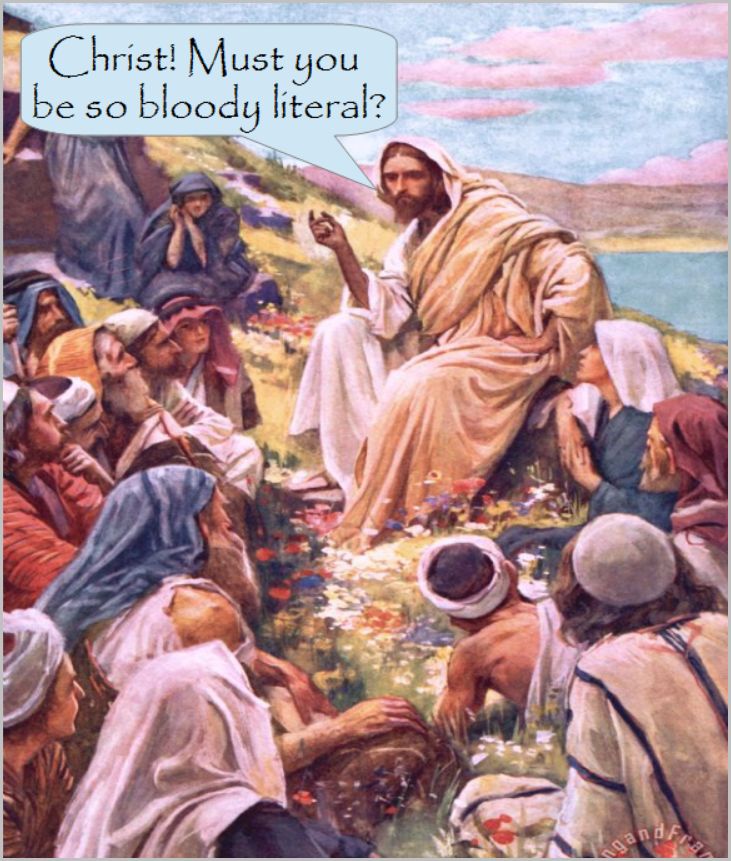
LiteralSo we all sat down on the grass and waited for the great man to speak.

“You’re a winner,” he said eventually, “if you’re ordinary and oppressed, because one day you’re going to rule the Earth!” Everyone gasped. We were all of us just ordinary, plain-speaking folk and things like this didn’t happen to us.

“Yes, really,” he said, “because God is going to establish his kingdom on Earth. And when he does he’ll sweep away the rich and the powerful, and you’ll be in charge. This I promise.”

We couldn’t believe it – proper gobsmacked we were.

“You’re in luck too,” the teacher went on, “if you’re poor, because once God’s kingdom comes, you’ll be rich beyond measure. And as for those of you who are hungry, you’re going to be filled like you’ve never been filled before. God, you see, is going to turn everything upside. Those of you at the bottom of the heap now – and let’s face it, that’s all of you sorry schmucks – are suddenly going to find yourselves at the top. And those who are on top now will be right down at the bottom. This, I promise you, is how it’s going to be.”

I can tell you everyone was beaming. We could already feel the change in the air.
Then Eli, sitting next to me sticks up his hand. “Hey, boss,” he shouts.

“Eli,” I says to him, “don’t be disrespectful. This bloke obviously knows what he’s talking about. He’s a messenger from God.”

“Yo, boss!” shouts Eli again.

“Yes,” the man up front says to him. “What?”

“When’s all this going to happen, then?” asks Eli. “When can we expect this big change?”

“Oh,” the teacher says, “I was thinking… maybe in a couple of thousand years?”

“What?” Eli says. “What good is that to us? From the way you were talking we thought all these wunnerful things were going to happen soon. What’s the point of telling all of us, sitting here in front of you, that we’re gonna be top dog and everything if it’s not us you’re talking about.”

“Good point,” the great man says. “All right then. How about if it’s sooner?”

There’s a lot of murmuring and everybody thinks this a good idea.

“Great,” he says. “Then that’s settled. We’ll make it sooner, so that you guys are still around. How does that sound?”

Everybody says it sounds marvellous.

“Great,” the big man says again. “It’s agreed, then – it’ll be soon. On that, you have my word.”

That was good enough for us and so we all set off home to get ready for the big changes we’d been promised.

“Thousands of years in the future,” Eli scoffs. “What a bloody con. Who does he think he is? God Almighty?”

There Is No God. And Here’s Why

adamSometimes I wonder why I continue writing this blog. There seems to be little that can shake believers from their delusions; what I write here doesn’t appear to be it. When they do respond it’s to tell me that I’m in for a shock when, after my death, I stand in front of the the throne of God and have to give an account of myself. I’ll not be smiling then, they tell me. They’re right, I won’t be. Not because of any ‘judgement’, but because dead people don’t smile. Not of their own volition anyway.

Christians can’t seem to see the ludicrousness of their post-mortem proposals. Religion, all religion, is wrong about most things at most levels; it denies death, which does exist, and replaces it with fantasies about supernatural beings, eternal life and judgements, none of which does. Christianity offers false promises, failed prophecies and an impossible morality, which Christians themselves can’t even manage. By and large they don’t even try to (see previous posts on all of this) yet they stick uncritically, unthinkingly, blindly to the fantasy elements of their ‘faith’ because they’re frightened of their own extinction and want to live forever. Christianity deceitfully promises them that they will – the ultimate false promise.

So let’s cut to the chase. There is no God. This is an indisputable fact, though believers will dispute it anyway. Even now, any Christians who are reading this will be muttering something about the fool saying in his heart there is no God; another tired, cliched response, which I’ve already considered here. But there is no God, not because of any foolishness on my part but because of the evidence. Or rather the absence of it. There is no evidence there is anything other than the physical universe or that life came about as the result of anything other than physical processes (it is not the case that scientists do not know how life emerged from non-life; they do and it did) or that humans evolved by any means other than blind, mindless natural selection. God is not required to explain any of this; not necessary to explain anything at all to do with life, the universe and ‘why there is something rather than nothing’. That being the case, we can know for certainty that he wasn’t in any way involved.

Let’s take a more down-to-Earth parallel to illustrate the point: we do not need to resort to stories of the tooth fairy to explain dentistry. I’m guessing that even Christians would agree with this; the tooth fairy has no part in matters of dental hygiene, orthodontist training or even the payment sometimes made by indulgent parents when their child’s tooth falls out. Trying to force the tooth fairy into any of these scenarios is not only entirely unnecessary, it’s erroneous and unhelpful. Dentistry is far better explained without reference to a mythical sprite. The tooth fairy not being needed, we can safely conclude that she doesn’t actually exist; she is a figment invented for children intended to take the away the pain of tooth loss, nothing more.

So it is with God in explanations into which he too is shoe-horned. He’s not needed, he’s superfluous to requirements. That being so, we can similarly conclude that he isn’t real either. A being that isn’t needed to explain anything is one that doesn’t exist.

This is not, note, a rejection of a figure who, even now, is sitting up in the sky somewhere feeling sad or angry because we’re ‘shaking our fist’ at him. If that’s what you’re seeing, you’re still believing in God, even if it is one you might be in the process of rejecting. It’s worse than that, Jim (or better): there is no super-being in the sky, or anywhere else. The universe is devoid of gods and of God; it always has been and always will be. There are none to be found because there are none there; not your pet god, nor those of other faiths, ancient or modern. None. There is only the physical universe itself and for the brief time we are here in it, we are lucky to be here in it. Which is more than any god has ever managed.

The End Times Are Here! Again.

livelyWhat does the future hold? It’s difficult to say, really, when the future isn’t, as Doris Day once so very wisely expressed it, ours to see. That doesn’t stop Christians from claiming they can though. They know exactly what the future holds, they insist, because the Bible tells them so.

There are at least two problems with this claim, the first being that the Bible’s predictions were written by men with as little ability to see the future as anyone alive today. The second is that their prophecies, like all other predictions, are suitably nebulous. It’s easier to see vague, non-specific claims come true when you can add the details yourself at a later date.

So it is for anti-gay pastor Scott Lively, who, incidentally, wishes to make it known that he’d prefer not to be referred to as anti-gay. This, of course, rests entirely in the anti-gay pastor’s own hands, though you’ll not be able to tell him so as he doesn’t allow comments on his blog. Christian leaders must never be contradicted!

The Reverend Lively, as well as being anti-gay, reckons that abortion, multi-culturalism, international discord and gay marriage are, in all likelihood, paving the way for the Anti-Christ and, ultimately, the end of everything. God is going to get so angry with the good ol’ US of A for all these things that he’s going to bring about the end times prophesied in the Bible.

The Reverend is quick to say he doesn’t know this for certain because God hasn’t actually told him so directly (why not, Scott?) so he’s just making an ‘educated’ guess. He does this by cherry-picking verses from all over the Magic Book – from Daniel to the gospels and Revelation – and shows, or thinks he does, how the USA is really the focus of God’s concerns in these last days. This is an impressive feat when the Bible doesn’t say anything of the sort, not least because its writers were completely unaware of the entire American continent.

From there, anti-gay Scott outlines how the world’s woes, but chiefly gay marriage in the USA, are going to allow the Anti-Christ in. That’s the Anti-Christ of which the Bible doesn’t speak. It doesn’t say, anywhere, that there is one almighty Anti-Christ. There are only four uses of the term in the entire Bible, all in the letters written by a John (not the same John credited with John’s gospel) in the New Testament. Letter-writer John whines about those in the early church who, two thousand years ago, were fomenting dissent; these people, he says, are literally anti Christ. And that’s it; you won’t find the all-powerful Anti-Christ that later fantasists like Scott Lively believe in, either here or anywhere else in ‘God’s Word’.

That’s because Lively and fanatics like him confuse these long dead dissenters with a figure from one of the Bible’s nuttiest books, Revelation. Known as ‘The Beast’, this pantomime villain is actually a caricature of barking-mad Emperor Nero, who began the first wave of persecutions against the early church. But that’s not good enough for nutters believers like Scott. The anti-gay pastor insists that the Beast, whom he mistakenly calls the Anti-Christ, is actually a politician of future times – our times in fact. He – that’s the Beast, not cuddly old Scott – is going, pretty soon, to exploit the mess the world is in, put things right and then take over. In so doing he’ll be usurping Christ’s position as ruler of everything. (You didn’t know Christ was ruler of everything? Just think what a mess the world would be in if he wasn’t.) This, the Reverend warns us – with capital letters to show how significant it all is – will be only the Beginning of Sorrows. Oh, and there’ll be Blood Moons too, just to add a splash of colour.

God is going to be so pissed off with this state of affairs that after a while he’s going to destroy everything, just like Jesus predicted he would be doing around about AD30, and Paul said would happen soon after AD55 and Revelation’s John (no relation to the crank who wrote the anti-Christ letters) claimed was still going to happen soon after AD95. Just as thousands of others have predicted in the 2,000 years since; every one of them wrong.

Statistically, rationally and empirically it isn’t remotely likely that current events in the USA mark the beginning of the end either. The Bible’s writers had absolutely no idea of what the future held, as their disastrous track record shows. Their rambling, vague prophecies didn’t come true when they said they would and they’re not going to now, even with an anti-gay pastor’s US-centric gloss on them. Which isn’t to say the world might not end some day. If it does, however, it certainly won’t be because it is following an expired Biblical timetable, open to a multitude of interpretations.

Better to stick to what you do best, Scott, being anti-gay. Though that’s not exactly going your way at the moment either, is it?

What Christians Believe: Part Two

AscensionHi, Thea Lojan here talking about the creed. Here’s what else it says, following on from last time:

I believe Jesus ascended into heaven and is seated on the right hand of God and will come to judge the living and the dead. As I was saying, Jesus could do amazing things. He could, like, beam up into the sky and out into space – that’s what ‘ascended’ means. Amazing. And he is coming back to judge the Earth, just like he promised. I know he said he’d be back real soon, like while his disciples were still alive, but to God a minute is like a thousand years so a few years can be anything like a million, or something like that. We shouldn’t take it literally when he said he’d be back while his friends were still around, though the Bible is, without a doubt, the literal Word of God.

Anyway, when he returns Jesus is going to send those who don’t believe in him to Hell, where they’ll suffer eternal torment for, like, forever and ever, amen. And he’ll take people who are saved, like me, back to Heaven with him. I can’t actually find the bit in the Bible where he says he’ll be taking me to Heaven, but I have faith so I’m sure he will.

Just a thought, but why doesn’t this creed mention the Bible, and how it’s the ineffable and literal Word of God? You’d think it would, wouldn’t you.

I believe in the Holy Spirit, the holy Catholic Church and the communion of saints. Definitely. The Holy Spirit is like the feeling of God that you get when you’re being blessed. You can’t see it – though it’s actually a ‘him’ because God is a ‘him’ – but it’s there, helping you make decisions, like whether you should buy a new car or install a heated pool in the yard. You definitely get a sense of him then. In my experience, he’s never let me down. He always guides me right.

I’m less sure of the holy Catholic Church because of course we’re not all Catholics and nor should we be when Catholics have got everything so wrong. But the pastor at church says it just means ‘the Body of Christ’ here, the same as ‘the communion of saints’ does, though that makes you wonder why we’ve got it in there twice. The communion of saints means all worshippers everywhere being united and working together. So, yes, I totally believe that because, that’s what we do as Christians; we all love each other. I don’t accept any of those lies that some people put about that there’s, like, 41,000 different kinds of churches. I don’t think God would let that happen, do you?

I believe in the forgiveness of sins. Yes I surely do, for God has forgiven my sins through the redeeming blood of the Lord Jesus Christ, his son. And if they’re really, really sorry I can forgive the sins of others, except of course if they’re, like, homosexuals. It really grosses me out to think about what so-called “gay” people do with each other. It’s unforgivable and even the Lord doesn’t forgive it. But my sins, yes, he forgives those.

The resurrection of the body and the life everlasting. Well, I already covered this. This is another repeat. What this really means is that everyone whose sins are forgiven and have been saved will go to live with God in Heaven after they die. Isn’t that amazing? Just think, whatever happens to your body all the time you’re dead, even if it’s been burnt or has rotted away to nothing, God will repair it and make it good as new. And then you’ll live forever in Heaven, because that’s what it means when it says ‘the life everlasting’. Even if I still can’t find that bit in my Bible.

Well, that’s it. That’s my creed, and what Christians everywhere believe. It was written, in fact, by the apostles, that’s Jesus’ friends, way back when he was still alive or just after. If you were to give your life to the Lord – and you really should if you want live forever in Heaven – then it’s what you’d believe too. Isn’t that, like, really, literally incredible?