The disciples would not have died for a lie (part two)

Rule

As we have seen, the available evidence does not support the idea that Jesus’ original followers subscribed to a miraculous physical resurrection. It suggests instead that their beliefs centred on the promises Jesus had made about returning from heaven as ‘the Son of Man’ to establish God’s Kingdom on Earth, which they would then rule with him.

Elements of this promise survive in the gospels as we have them, even if there are, in all four, obvious concessions to Paul’s Christ figure; the gospels were, after all, written after Paul’s version of Christianity had begun to take hold. Significantly, the promise of the triumphant appearance of the Son of Man ‘within this generation’ is present in Q, the source of many of the sayings common to both Matthew and Luke’s gospels that they didn’t get from Mark. It’s also there in the sources (L and M) peculiar to each of the gospels. Obviously L, M and Q pre-date the gospels that later made use of them. Scholars think Q could have been written as early as 40CE, a few years after Jesus’ death, with some sayings earlier than that. It pre-dates Paul too and reflects a tradition that has nothing to do with him or his convoluted theology.

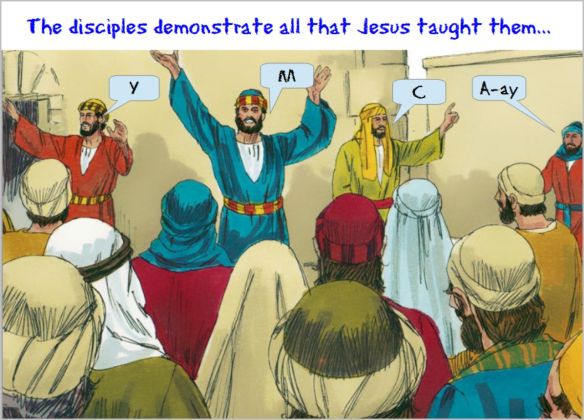
Q, in fact, has no sayings attributed to the resurrected Jesus, nor anything from his trial, the crucifixion or resurrection.1 How can that be? Were they not important to the early believers who compiled it? The answer can only be, no, they weren’t. For the creators of Q what mattered was what Jesus said – his ethical teaching and his promise to return as the Son of Man, within his hearers’ lifetime, to inaugurate the Kingdom of God on Earth in which the disciples would reign alongside him (Matthew 19:28). To be part of this Kingdom, people had to become righteous, not have it gifted to them (Matthew 5.20 & 48). This was the ‘good news’ for Jesus’ earliest followers, the gospel as it is preserved in the Q source.2 The lie that the disciples were to rule the world with Jesus inspired them to spread the news of the coming Kingdom; they demonstrate little interest in a reanimated dead man or a magical salvation formula.

So, did the disciples die for their faith in the Risen Jesus? Highly unlikely. They don’t seem, despite the later stories in which they feature, to attach any importance, at least in Q, to visions of a resurrected god-man.

How did they die, then? The simple answer is that, for most of them, we don’t know. They could have met their end when the original church community in Jerusalem was annihilated by the Romans in 70CE. The Romans didn’t particularly care what a minority group of fanatics believed – they were rebellious Jews who needed to be taught a lesson.

If not slaughtered by Romans in their capture of Jerusalem, then perhaps the disciples died for their seditious belief in the imminent arrival of the Kingdom of God, just as Jesus had before them. The Bible records the deaths of only two of them: Judas, who appears to have committed suicide using two different methods depending on which account you believe (Matthew 27:5-8 or Acts 1:18-19), and James, brother of John, who, according to Acts 12.1-2 was executed by Herod Agrippa 1. By the time Acts was written, however, somewhere between 80-90CE, the beliefs of the original followers had been swallowed up by Paul’s alternate version of the faith; we have no way of knowing how accurate the report of James’ death is. It’s hard to believe it was merely because he thought an old pal had risen from the dead. It is hard to believe this of any of them. For the other disciples there are only traditional accounts of how they died ‘for their faith’ with nothing to corroborate these legends.

It is quite possible Jesus’ original followers died for reasons unconnected with their outlandish beliefs in an imminent supernatural kingdom. They could just as easily have died of natural causes. One thing seems probable – they did not die because they believed in a resurrected Messiah. It’s not that they didn’t believe in a physical resurrection – they did – but they were convinced it would only happen with the arrival of God’s Kingdom on Earth, as prophesied in Daniel 12.1-4.

That it had already happened to their former leader did not figure in their beliefs, their writing or even their thinking.


1 Bart D. Ehrman, Jesus Before the Gospels, p279-280

2 ‘But for Q, Jesus was indeed principally remembered as a teacher of great wisdom and high moral demands, as an apocalyptic prophet anticipating the imminent end of the age, and one whose miraculous activities showed that the day of judgement was soon to come. For the author of Q, Jesus’ teachings provided the goal of the Christian life. Followers of Jesus are those who adhere to his directives for how to live, in anticipation of the coming kingdom of God.’ Bart. D. Ehrman, Jesus Before the Gospels, p280

Updated to include link to Matthew Ferguson’s celsus blog.


Still more of the Bible written sdrawkcab

The first mention of the Last Supper and the ritual established at it is in Paul’s first letter to the Corinthians (11.23-26):

For I received from the Lord that which I also delivered to you, that the Lord Jesus in the night in which he was betrayed took bread; and when he had given thanks, he broke it and said, “This is my body, which is for you; do this in remembrance of me.” In the same way he took the cup also after supper, saying, “This cup is the new covenant in my blood; do this, as often as you drink it, in remembrance of me.” For as often as you eat this bread and drink the cup, you proclaim the Lord’s death until he comes.

As David Madison points out, Paul happily admits he invented this – or, rather, he worked it up from one of his hallucinations. He certainly didn’t hear it from the people who’d known Jesus when he was alive; it’s unlikely they would have subscribed to such barbarity. As Madison shows, the idea of consuming blood, even symbolically, would have been anathema to most Jews (Deuteronomy 12.23 etc); it’s a ritual that originates in pagan worship. It’s there, for example, in Mithraism, which flourished in, among other places, Tarsus, where Paul came from. Evidently, celebrating Christ’s sacrifice by eating his body and drinking his blood took hold in the churches Paul established and by the time the gospels came to be written, its origin story was sent back in time to be part of them. This kind of thing happens in comic books all the time.

It’s quite possible that the stories of the resurrection developed the same way. We know that later followers of Jesus had visions that they interpreted as being of ‘Christ’. We know this because Paul refers to his experience a few times and also implies that other people had visions similar to his own. Were these hallucinations the only ‘sightings’ of the Risen Christ? We have no first-hand, eye-witness accounts of any other sort. Given that bodies don’t ever rise from the grave, especially not after a couple of days, it is more than likely they were all imaginary. It looks suspiciously like later encounters of Christ – all entirely within people’s heads – were written back into the gospel accounts to become the resurrection. Some of these were ‘firmed up’ to seem like encounters with a real person, which led to the invention of the empty-tomb, while others weren’t; a number make little attempt to convey an encounter with a real flesh-and-blood individual.

Bur wait, you say. There were believers in the resurrection before Paul. Surely the original followers of Jesus – the disciples, Mary Magdalene – saw the Risen Jesus. That’s why they believed in him, why they gave their lives to his cause, why they were prepared to die for their faith.

Well, no. We don’t know that this is what the original followers of Jesus thought or experienced. Why don’t we? Because:

  • The original followers left no records (or did they?)
  • Their community was wiped out by the Romans in 70CE.
  • Their brand of the faith, whatever it was, was obliterated by Paul’s Christ cult.
  • They had plenty of other reasons for believing in Jesus.

Seemingly Jesus told them he’d be back soon, bringing God’s Kingdom with him (Matthew 16.27-28 etc). And then, as he promised, the meek would inherit the Earth and his original followers would the rule the planet with him (Matt 19.28). Good enough – though completely daft reasons – why, after his death, these same followers holed-up in Jerusalem to await his re-appearance (through the clouds no less). The unlikely resurrection scenario, if they were even aware of it outside of their difficult meetings with Paul, must have seemed a poor second to the possibility of ruling the world in the here and now alongside their returned Lord and Master.

So, it’s entirely plausible that the resurrection, like Jesus’ prophecy of the temple’s destruction and the body-and-blood ritual of the Last Supper were invented decades after he lived by those in the Christ cult. It has long been known that the experiences of those in the early church, particularly those promoted by Paul, were written back into the gospels when they came to be created years after Jesus’ and the disciples’ deaths. Much of what you read there is fiction, propaganda served up, and believed to this day, as history.


How much of the Bible was written backwards?

We know for a fact the book of Daniel was. The term for creating a prophecy after the event it purportedly predicts is Vaticinium ex eventu (Latin for ‘devious sleight of hand’). The creators of the Book of Daniel in the Old Testament were rather fond of Vaticinium ex eventu. Daniel’s prophecies, supposedly written in the sixth century BCE during the Babylonian exile about events that would occur later – much later – were actually created during the second century BCE. This was, of course, after most of them had occurred, which is how Daniel manages to predict most of them with reasonable accuracy. The remaining prophecy, however, written before the events it purportedly predicts is hopeless, completely way off; it foresees the resurrection of God’s people and the establishment of his Kingdom on Earth in the early part of the first century. As we know, this didn’t happen, though Daniel’s madcap ideas influenced the creators of the Jesus cult who all thought they were living in the end times. Jesus’ term for himself, ‘Son of Man’, is lifted straight from Daniel.

This is how most prophecy in the Bible works; it’s either written after the event, Vaticinium ex eventu style, or, when it’s genuinely written beforehand, doesn’t – surprise, surprise – ever come to pass.

Which bring us to Jesus own predictions of the destruction of the Jewish Temple in Jerusalem. He explains to his disciples in some detail in Mark 13 what to expect. He suggests too that soon after the destruction, the Son of Man will arrive through the clouds to establish God’s Kingdom on Earth, once and for all (well, maybe not all – just for ‘righteous’ Jews). It is no coincidence that Mark’s gospel was written about 70CE, just after the temple was destroyed, which makes it easy for Jesus to outline in some detail what the event would like, describing, as he is, what it was like.

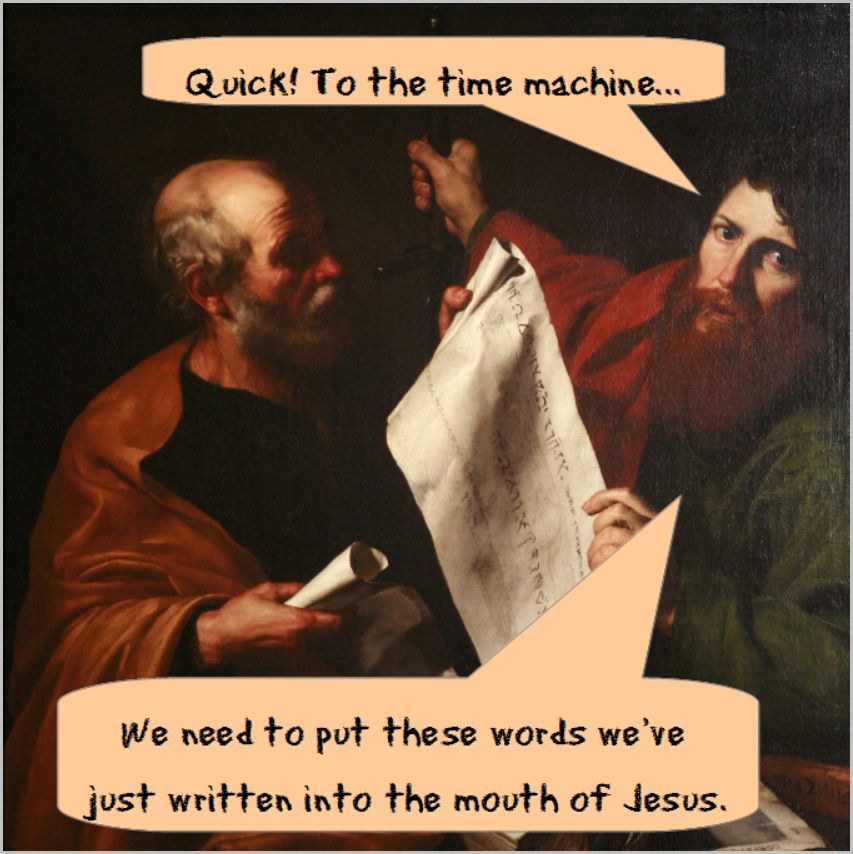
Did I say Jesus? No, not Jesus, but the anonymous author of ‘Mark’s’ gospel who implants his knowledge from 70CE back to 30CE and on to Jesus. He – the gospel writer – also has Jesus refer to the opposition some believers were experiencing in the 70s and to the ‘reader’ of his warning. As David Madison notes in Ten Tough Problems in Christian Thought and Belief , ‘reader’ is an anachronism too; Jesus had no ‘readers’ when he was alive. The whole prophecy is later fabrication. Its author is typically less successful – completely unsuccessful in fact – in his prediction that soon after the events he describes, the Son of Man would return to put everything right (Mark 13.26-27). So, as we might expect, there is a reasonable degree of accuracy from the bit of the ‘prophecy’ written after the event, but none at all when it genuinely looks to the future.

But it’s not just prophecy this affects. It looks very much that key episodes in the Jesus story were invented (long) after his death, assuming he existed in the first place, and were added into the gospel stories many more years later. John’s gospel is almost entirely like this. The Jesus of the fourth gospel bears no relation to that in the synoptic gospels; in John he has morphed into the Christ of late first-century Christian belief, spouting fantastical gibberish about himself, like ‘I am the Way, the Truth and the Life’ and ‘I and the Father are One’. The Christ of faith is superimposed on the itinerant Jewish peasant executed for sedition.

It happens in the synoptic gospels too. In Matthew 28.19, the post-mortem Jesus commands his followers to ‘Go therefore and make disciples of all the nations, baptising them in the name of the Father and the Son and the Holy Spirit,’ undoubtedly quoting a later liturgical formula; the notion of the Trinity explicitly referenced here was unknown in Jesus’ own time and indeed in Paul’s. Similarly, the disputes with the scribes and Pharisees represent the writing back into the gospels of later Christians’ difficulties with the religious hierarchy.1 Jesus’ Sermon on the Mount meanwhile is demonstrably a later creation, not translated from Aramaic but written in Greek.2 Other absolutely crucial aspects of the Jesus story – it is easy to see how a case can be made for his not having existed at all – are also retrospective additions. We will come to them next time.

__________________________________________________________________

1 ‘Perhaps the best way to explain Matthew’s extensive criticism of the Jewish authorities is to say that his own community continued to experience opposition from non-Christian Jews, especially influential scribes and rabbis of the local synagogue(s), who accused them of abandoning Moses and the Law, of becoming apostate from the Jewish religion through their ill-advised faith in Jesus.’ Bart D. Ehrman, chapter 6, The New Testament: A Historical Introduction to the Early Christian Writings.
2 Richard Carrier, On the Historicity Of Jesus, pp 465-466, cited in Madison, p300


It’s Only Make Believe

godsatan

All you have to do to become a Christian/be saved from sin/gain eternal life is to accept Jesus as your Lord and Saviour.

Except, it isn’t.

You’ve also to put your faith in the Bible, acknowledging it’s God’s word in some form or other. It would be impossible to be a Christian without it; you’re required  to read it, let the Holy Spirit or one of God’s chosen instruments here on Earth interpret it for you and you’ve to live by it.

And this, in turn, entails believing in the menagerie of supernatural creatures and invisible realms the Bible assumes exist. Angels and demons we considered last time, and then there’s –

The Risen Christ who sits at the hand of the Father. He sits? He’s like a real body, but at the same time not a real body? A spiritual body, then, who metaphorically ‘sits’ next to –

God the Father, whom no human has ever seen (confirmed by John 1.18 but contradicted by Genesis 32.20) who abides in –

Heaven, a place no-one has ever seen. No, really, no-one. Not even those people who have hallucinated about being there. Hallucinations, dreams, visions, even so-called out of body experiences, are not evidence Heaven exists. They’re evidence that people sometimes hallucinate, dream and have visions and out of body experiences. The same is true of ‘sightings’ of God himself and of –

The Holy Spirit. That’s the part of God Christians dupe themselves into thinking has moved in inside them to guide them through their Christian life. That’s the same Holy Spirit who’s guided God’s Chosen to create 34,000 different distinct interpretations of the Truth. Even now, the Spirit is leading church after church down the road of apostasy, according to those he also leads to condemn them. Confused yet? It all makes sense if you recognise that it’s all imaginary, created by human beings who didn’t and don’t know any better. Like –

Satan is. He’s the character who evolves during the course of Bible until he’s a cross between Lex Luthor and the Joker; God’s arch-enemy. He only ‘exists’ to get God off the hook. All the bad in the word can’t be God’s fault now, can it? Somebody’s got to carry the can and it sure isn’t YHWH. So Satan, the devil, gets to be the embodiment of evil. Which isn’t to say evil doesn’t exist because it does, but it’s not caused by this third-rate Dick Dastardly. Nor is –

The Anti-Christ. This is the guy Christians believe will appear at the end of the age, some time around AD 100 according to Revelation 14.9-10. Never mind his creator there calls him something else entirely (‘the Beast’ as it happens); unless he’s finally arrived in the shape of Donald J. Trump, he’s no more real than –

Those who’ve died (‘the saints’ according to Catholics) and have been given new, magic bodies in Heaven or –

Those who’ve died and have gone to Hell to be tortured forever. That’s because –

Hell doesn’t exist either.

Nor do seraphim (Isaiah 6.2), cherubim (Hebrews 9.5), dragons (Psalm 148.7), satyrs (Isaiah 13.21) or unicorns (Numbers 23.22 etc) .

How do we know these beings, places and states don’t exist? Well, they’re all invisible, intangible, undetectable, unverifiable, supernatural (literally, ‘outside nature’), and, ultimately, unconvincing. They’re rejects from far more interesting mythologies that abounded in the ancient world. Today’s mythologies – of Middle Earth, Game of Thrones and the innumerable virtual worlds of computer games – are far more plausible (and even then, not very).

The supernatural doesn’t exist; everything we know is part of a physical universe. There is no evidence anything exists outside, alongside or in addition to that universe. (Though if you think there is evidence for the supernatural – and I mean evidence, not ‘feelings’, personal experiences or ancient texts – then please make it known in the comments).

There is an abundance of evidence, however, that –

Human beings are rather good at inventing stories and mythologies;

Their psychology inclines them to inner imaginings;

They are largely irrational and with a tendency to attribute agency to inanimate objects, phenomena and the chimera of their own imagining;

They have a fear of death and their own personal extinction.

How could religion, with all of its make-believe, not fail to materialise under such conditions? And how can anyone in this day and age take it seriously, knowing what we do now?

I know I can’t.

God’s Wrath (and those who direct it)

typhoon-phillipines

The idea that natural disasters and death are punishments from God – for whatever we humans have done to offend him – is still with us. As I suggested here, such a notion has been around from the beginnings of religious belief. It, together with its counterpart – that we need to appease the god(s) who so afflict us – is responsible for the genesis of all religion. There are those today whose thinking is wilfully stranded in the ancient world-views of ‘sacred’ texts that embody this dual notion of punishment that’s somehow merited and the need to appease the deity dishing out the punishment.

Here it is expressed recently by bear of little brain, Sam Rohrer, who has it directly from the Lord that he, the Almighty, has turned his back on America because it does not force immigrants to believe in him. America, he says has

changed the historic biblical rules (regarding immigration) … this is a reason why God must discipline our country.

Looney tune Pat Robertson, with his direct hotline to the Almighty, insists that it’s abortion that’s going to bring down God’s wrath:

One day, a righteous, holy God is going to demand an accounting for every drop of blood that has been spilled of innocent, unborn babies. And we just keep it in mind, when it happens it’s going to be awful.

Andrew Bieszad, on the other hand, knows that Hurricane Matthew which struck Florida back in August was God punishing the State for its tolerance of ‘evil sodomites’ (you don’t get much more tolerant than that.):

Stop sinning, especially with sodomy, as it is one of the four sins in the Bible which cry out to God for vengeance, which we are seeing now.

And these are just a few examples. There are many more. According to his whack-job servants, God can punish us, entirely indiscriminately, by unleashing earthquakes, tsunamis and floods; he can turn his back on us so that we wallow in our own filth; he can show his distaste for our ‘sin’ by raining down death and destruction upon us.

Naturally there’s plenty of this kind of thinking in the Old Testament, where God is credited with drowning his entire creation when a few ancient tribesmen misbehave (Genesis 6); he’s made to destroy Sodom and Gomorrah after every male turns inexplicably violent-gay (Genesis 19) and he’s said to wipe out whole swathes of his chosen people because they don’t pay him enough attention (Exodus 32.28).

None of these things happened, of course. They’re stories, myths or legends that incorporate the primitive thinking of the pre-scientific people who devised them, people who could only explain violent events in terms of divine punishment. It is this same thinking that is perpetuated today by those whose development is similarly arrested: through exposure to these same stories, an unwillingness to think rationally, an unhealthy preoccupation with God-nonsense and an overweening sense of self-righteousness (‘don’t blame us; it’s those others that attract God’s wrath.’)

There is no correlation between the disasters that befall humankind and God. Not one of the self-appointed prophets who say there is offer a single scrap of evidence that they are inflicted by a deity. Not one of their cause-and-effect assertions has ever been tested, can ever be tested. And – the clincher – there is no God anyway. All of which renders appeasement unnecessary and is good enough reason not to believe a word from these misguided charlatans.

How It Works: God

Let’s see. If there’s a God – and how could there not be? – he’d have to be perfect. And powerful and really, really good. Not like all those pagan Gods who are just a bit too much like us. No, the most bestest God of all would have to be big and powerful, and good and perfect. I mean, why bother otherwise?

Oh, oh… first problem. If he’s good and perfect, how to explain us and the fact life can be pretty crap and not good or perfect at all? That can’t be his fault, can it? He’s perfect, so he couldn’t possibly make something that isn’t. Soooo… only logical conclusion – the crap must be our fault. Something we do, or maybe something we are. Yes, that’s what it must be (plus we get to bump up our part.)

And shit happens. Tsunamis, earthquakes, the crops fail, the rains don’t come. Life can be tough and seem pointless. It’s all depressing, then we die. It can feel like we’re being punished. Wait! Maybe we are being punished! For things we’ve done, or for what we are. That would fit wouldn’t it? A good and perfect God would surely want to punish us, with death and destruction and stuff. So that’s what these things must be!

Let’s get all this written down, that this is how things are. This good and perfect God finds us offensive and that’s why life is so shit. Except, except… surely God’s a reasonable bloke at heart and can be appeased? We could wheedle our way back into his good books and then life wouldn’t be quite so bad. Not sure how, though. Maybe sending him presents would do the trick, though how to get them to him when we can’t see him or anything…

I know! Let’s eviscerate some animals and then burn them and that way, he’ll be able to smell our efforts up where he lives, in the sky. That’s bound to work. And to be doubly sure, let’s mutilate our genitals and keep our women subjugated – because he can’t fail to like that.

Or maybe not. Maybe life will still be shit and we’ll still be shit. Maybe we need something more… imaginative. So let’s pretend that this God of ours puts together a rescue package. And what this means is he zaps us with some magic that obliterates the bits of us he can’t stand, which is pretty much all of it. And – here’s the good bit – we get to keep some of the eviscerating and sacrifice stuff.

Let’s get that written down too. And, and… maybe we can have it that this God is really going to rescue us and make everything not shit any more. He’s going to shake things up down here… no, no, wait – better than that, we’re going to go and live with him in the sky once we die, which gets rid of how shit death really is, and we’ll all live happily ever after, those of us he’s zapped anyway. Everyone else he can torture and burn forever! Yes that’s it! That’s how it’s got to be. God can still be good and perfect, even though he murders just about everyone, and some of us will get to be good and perfect too, and all the crap will just disappear, as if by magic.

That’s it. That’s how it really is. I can see it all now.

Oops. Gotta go. Time for my medication.

straitjacket

Prophets At A Loss

prophets

God’s prophets; holy men who are God’s confidantes, his mouthpiece on Earth. They know how he thinks, what his plans are, what pleases him, what annoys him, what he intends doing in the future. They’re the first to know all of these things because they’re so much in touch with him, he speaks to them personally.

That’s how Jim Bakker knows God plans to punish those counties in the States that voted for Hillary Clinton. God simply can’t stand her, you see, and is going to vent his anger at those who thought she’d make a better president than his anointed one, the Donald.

It’s how Cindy Jacobs knew in 2015 that Civil War and Christian persecution were coming to America, how Michelle Bachmann knew Obama would start World War III, how William Tapley (‘the Third Eagle of the Apocalypse’, don’t you know) sees the signs of the End Times™ everywhere, and how John McTernan can tell us that natural disasters are the result of America’s lack of support for Israel.

These men and women (who evidently don’t know they’re supposed to keep quiet [1 Timothy 2:12] ), are also proficient, or so they’d have us believe, at interpreting the signs of the times. They know when events are actually God meting out punishment (usually) or trampling over someone’s much vaunted free-will to ensure his purposes are met. Hence, their conviction that natural disasters are divine tantrums, caused by a growing acceptance of LGBT people, or abortion, or some other damn thing they don’t care for much. And they know for sure that Trump’s election was because God wanted him to be the next president, because the Almighty told them so himself.

There are others, however, who think these fellow-Christians have got it all wrong. God has no need of prophets today (Luke 16.16). He used them only in more primitive times when people were more credulous and superstitious – Bible times, in fact. The only way of knowing what God is up to these days, these prophecy-denying Christians say, is to read and interpret his Holy Word.™

If only it wasn’t filled with the same sort ramblings as those of the current crop of fantasists, the only difference between today’s and yesterday’s prophets being that the earlier nutjobs were lucky enough to have their words preserved – by those with a need to believe and the self-interested – in the supposedly ‘ineffable’ Bible. Their prophecies are no more accurate and have no more bearing on reality than the messages of Bakker, Jacobs, Tapley, McTernan and the like claim to receive from God today. They’re of the same lunatic level, offering the same sort of vacuous bullshit.

How do we know? Because of the Bible’s prophecies written before the events they purport to predict, none has come to pass. This includes Jesus’ prophecy that the Son of Man would soon appear in the sky with the heavenly host to usher in God’s Kingdom on Earth (Matt 16.27-28; Matt 24:27-31. Including his and Paul’s predictions of an imminent judgement (Matthew 7.22 & 25:36-40; 1 Corinthians 4.5); Paul’s promise of a rapture (1 Corinthians 15.51-52; 1 Thessalonians 4.15-17); John’s prophecy of the armies of heaven defeating the Whore of Babylon (the Romans) and Jesus being put in charge instead (Revelation 17.8-14 & 20.11-15). These prophets were certain these events were going to happen soon, within, as the text spells out, the lifetimes of their listeners and readers. They didn’t and they’re not going to happen now either, two thousand years after their sell-by date. They’re not going to happen at all.

They are fantasies, every one of them. As are the messages supplied by the self-appointed prophets of our day. Fraudulent twaddle from charlatans with a pathological need to have their delusions taken seriously; these men and women of God can no more divine the future than you or I. True, once in a while events in the real world might bear some coincidental resemblance to one of their predictions, but that is all it is – coincidence. As the Brexit vote and the election of Donald Trump have reminded us, we can’t ever see the future with any degree of certainty. Soothsayers, fortune-tellers and Prophets of God who tell us we can – tell us they can – are liars and deceivers. And we know, don’t we, what the Bible says should be done about them (Deuteronomy 13.5).

Picture: Artist’s impression of JC, archetypal false prophet (as if there’s any other sort); Jim Bakker, crook and adulterer; Cindy Jacobs (loose screw not shown) and William Tapley, Looney Tune of the Apocalypse.

God’s Chosen Ones

chosen The God of the Bible is not the God of Reason that Answers in Genesis, William Lane Craig, Tim Keller, Silence of Mind and others tell us he is. None of the evidence, some of which we’ve reviewed, supports the supposition. That’s because the God of Reason, like all gods, is a construct of the human mind. In much the same way as Yahweh was a reflection of irrationality, this God is a reflection of our rationality. He could not – and did not – exist before the Enlightenment, before Rationalism itself and the new understanding of mathematics, science and philosophy.

As appealing as his apologists try to make him, the God of Reason is demonstrably not the God of the Bible, who is defined by impulsive, destructive passions. No, he’s not the tempestuous Yahweh, nor is he the daddy-god Jesus imagined (who is just Yahweh with a few rough edges knocked off), nor the God of blood-sacrifice and atonement beloved of Paul. He is, like all those inventions, a fabrication of our own making. For Christians who are drawn to him, he is a false god. But then, aren’t they all?

Whichever version of the Christian God Christians choose to worship, however, they’ve got it wrong. They don’t choose to believe in him or to follow Jesus or whatever. Not at all; he chooses them (or not as the case may be.) Now known as Calvinism, the idea that God earmarked a select few to be his best mates right back at the dawn of time – while disregarding others who might want to be but aren’t on the guest list – is right there in the Bible. Paul first:

For those God foreknew he also predestined to be conformed to the image of his Son, that he might be the firstborn among many brothers and sisters. And those he predestined, he also called; those he called, he also justified; those he justified, he also glorified (Romans 8:29-30; see also 1 Thessalonians 1.4)

The idea is picked up by one of Paul’s imitators in the forged letter to the Ephesians:

For he chose us in him before the creation of the world to be holy and blameless in his sight. In love he predestined us to be adopted as his sons through Jesus Christ, in accordance with his pleasure and will—to the praise of his glorious grace, which he has freely given us in the One he loves. (Ephesians 1.4-6)

The same sort of time-loop paradox also finds its way into the gospels. In Matthew 22.1-14, Jesus tells a parable involving a man who has been asked to a Royal Banquet (i.e. the Kingdom of God) only for the King (Jesus) to take offence at the way he’s dressed. For this heinous crime he is bound hand and foot and unceremoniously thrown out. Jesus concludes his cheery tale with the aphorism, ‘Many are called but few are chosen.’

So much for ‘free will’, a notion that’s alien to the Bible in any case. If I were a Christian, which thank God I’m not, I’d really want some answers to the questions this bizarre idea throws up. We’ll take a look at what these are next time.

Picture shows Tim Keller, John Sentamu (Archbishop of York), ‘Pastor’ Rick Warren and ‘Pastor’ Steve Furtick. Chosen by God, every one. And some kids he couldn’t care less about.


Smash! Kill! Destroy!

handsofgod

So how has the great God of Reason done so far?

We’re still not out of Genesis and he’s –

Trashed his entire creation just because a couple who didn’t know how touchy he is managed to upset him;

Destroyed two towns and almost everyone in them because he found the locals offensive;

Drowned everyone in existence (except for an old piss-head and his family) because – you guessed it – they offended him;

Engineered a spot of child-abuse;

Decided the best way for people to show him they’re his bestest buddies is to have them disfigure their genitals.

Now, honestly, Christians, how can you say any of this is rational or logical, reasonable or considered? Your God’s response to everything is Smash! Kill! Mutilate! Destroy! – never as a last resort, always as his first reaction. He’s the Hulk, Godzilla and ISIS all rolled into one. Not once does he apply reason or logic. Smash! Kill! Mutilate! Destroy! And not only in Genesis but throughout the Old Testament:

His chums want the land occupied by other tribes? Smash! Kill! Destroy!

They don’t show him enough love? Smash! Kill! Destroy!

They break one or other of his mostly petty rules? Smash! Kill! Destroy!

They offend him in some remarkably trivial way (collecting sticks, teasing a bald bloke, doing sex wrong)? Smash! Kill! Destroy!

Over and over again.

Until, at last, he has another big idea! Another Master Plan! The Master Plan to end all Master Plans! (His fourth at least.) And guess what? It’s all Smash! Kill! Destroy! Especially Kill! This is a dude who really can’t think outside the box.

Here’s how it goes: the Lord gives up on his previous Master Plan, which he’d told some selected desert marauders was forever and ever, and decides its time to have another go at sorting out mankind that he helped screw-up in the first place. His idea this time is to come to Earth himself as a sort of clone, which he creates by raping a young woman, just like all the other gods of old. When he grows up this clone/avatar tells everyone how God wants them to behave so they don’t upset the version still in Heaven quite so much. The clone then gets himself murdered at the hands of the very people he’s come to visit – the same ones the Lord promised to take care of forever and ever in his previous Master Plan – which magically allows anyone who repeats a special incantation to join an exclusive club. Everyone else he plans to torture and murder for all eternity, because that’s what he likes doing best. Of course, the version of himself he sends to Earth won’t actually make any of this clear – that’ll be left to someone else to make up afterwards – but, in the best illusion yet, he’ll come back to life before beaming up to Heaven to cosy up to his other self, the one preoccupied with death, destruction and mutilation.

This time it’s foolproof: a well-thought through, logical, rational and reasonable plan.

Except… not really. It’s bullshit. There’s no reasoning here, just a lot of stuff made up as people went along. None of it makes sense. The copy seems to have no idea what’s going on and certainly no inkling that his death has cosmic significance. On top of that, no-one really knows how the magic works – everyone who mentions it has a different idea – and the record of it all is scrappily cobbled together donkeys’ years after it all was supposed to have happened. Still, the main thing is it all involves a lot of killing – the clone first; then the poor sap manipulated into ‘betraying’ him; a couple who don’t want to give away all their belongings; some of the dudes who believe the magic is for real then, after they’ve really pissed off the Romans, lots more of them and finally, once the nutjobs get the upper hand, loads and loads of other people – which must really have pleased the God of Death Reason.

If this is the best he can do, then we’re in trouble deep. If our ability to reason comes from him, as Christians claim, it’s no wonder we can be irrational, illogical, unreasonable and unreasoning. Which of course is why he is, because he’s a reflection of the beings  that created him – us. Human emotions and cognitive capabilities came first and were projected onto the gods we created, including, eventually, the monotheistic monster, Yahweh. It was he primitive tribesmen decided must be responsible for natural disasters and the brevity and brutality of life. Such things had to be punishments, hadn’t they? And if punishments, then there had to be One doing the punishing. One who must be appeased if he was ever to stop. Hence sacrifices, behaving in ways that might please him, killing those who don’t, worship. All futile, like pleading with one’s own reflection in a mirror.

The God created by this kind of thinking only reflected back at his makers the worst of themselves; jealousy, anger, intolerance, belligerence, petulance, vengefulness and violence. Hardly ever Reason. 

And so does he still.


Idiotic Stuff Jesus Said

JC&ManJust what did Jesus say? The Jesus Seminar and other scholars* conclude that only about 18% of the words attributed to him in the gospels are authentically his. They reach this conclusion because so much of what Jesus ‘said’ – 82% of his utterances – is demonstrably derived from elsewhere.

There were four major sources for his words, which I’ll discuss briefly here, providing an example of each. Bear in mind also that whatever the derivation of Jesus’ words, those we have today have been subject to, in their earliest days, an unreliable oral tradition, repeated copying and deliberate and accidental alteration. The earliest surviving ‘words of Jesus’ (a few fragments of the fourth gospel) date to a century after he lived.

1. The early church created a good deal of the Jesus narrative, making him say what was important to them. For example, ‘take, eat, this is my body,’ and ‘take, drink, this is my blood that is shed for you,’ is clearly a post-crucifixion perspective. While it appears in arguably the most Jewish of the gospels (Matthew’s) the idea of drinking blood, even symbolically, would have been, and remains, anathema to Jews, whose scriptures forbid it (Leviticus 17.10 -16). Jesus was an orthodox Jew; it was the Hellenised Paul who transplanted the pagan ritual into nascent Christianity. He relates in 1 Corinthians 11.23-26, written about 15 years before the first gospel, how his wholly imaginary ‘Christ’ told him of this bizarre activity. Once established in the early church, Jesus then had to be made to endorse it and it was written back into the gospels.

2. The gospel writers (or others) invented dialogue for him. His entire conversation with Pilate, for example, is invented not once but four times, the encounter being rendered differently in all four gospels. It is probable that the entire scenario is fiction, given the likelihood the excessively cruel Roman governor would even entertain the idea of questioning a seditious nobody himself. And then there’s the ‘I am’ statements of John’s Jesus that I considered here.

3. The gospel writers altered difficult sayings into something more palatable. For example, in Matthew 15.24 Jesus says he was ‘sent only to the lost sheep of Israel’ (my italics). By the end of the same gospel, as well as in Luke and John, this has become a commandment to ‘make disciples of all nations, baptising them in the name of the Father, the Son and the Holy Spirit’ (Matthew 28.19). So which was it? Was the message exclusively for Jews or was it for all? It suited early churches, filled with non-Jews, that the gospel was for everyone, just as Paul had argued. Jesus’ words to the contrary – even if they were sufficiently widely known to have had to be included in Matthew’s original account – needed to be amended. Who amended them and when we shall never know, but it was certainly after the idea of the Trinity had taken hold.

4. Statements Jesus actually made. The Jesus Seminar regards as authentic sayings such as:

If anyone strikes you on the right cheek, turn the other also (Matthew 5.39)

If anyone wants to sue you and take your coat, give your cloak as well (Matthew 5.40)

Love your enemies (Luke 6.27)

Blessed are you who are poor for yours is the Kingdom of God (Luke 6.20) [changed in Matthew’s gospel to the less radical ‘poor in spirit’!]

If anyone forces you to go one mile, go also the second mile (Matthew 5.41)

As inspiring as these might initially appear, they actually mean very little; they’re either prophecies that didn’t come to pass, impractical moral expectations or pseudo-spiritual homilies. And how much of this advice, these admonitions, do today’s Christians follow? You’d be hard pushed to find many that do. After all, following Jesus doesn’t entail doing what he says.

* I have used Robert W. Funk et al‘s The Five Gospels (HarperOne, 1997), Simon Loveday’s The Bible For Grown-Ups (Iconbooks, 2016) and Mark Allan Powell’s rather less impartial The Jesus Debate (Lion, 1998) for this post