What have reason and logic to do with faith?

Blog355

Last time I considered the Christian claim that reason and logic can only derive from God, and that non-believers’ use of them is nothing more than a illicit hijacking of powers supplied by the God they deny. Why is it important to modern day Christians to attribute reason to their God? After all, the bible only ever speaks disparagingly of reason. It is, it says, the path to self-delusion; Proverbs 3.5 warns ‘trust not in your own understanding,’ while faith, according to Paul far surpasses the limitations of reason and rationality. More than this, as I discuss here, the God of the bible is far from reasonable and logical himself. His response to every issue is the death penalty, mass murder and blood sacrifice.

According to Christians, human reasoning makes no sense if it is ‘merely’ the product of evolution. A random and undirected process cannot produce a reliable rationality on its own. Naturally, they are never entirely clear why this is the case; evolution has, after all, led to other distinctly human characteristics on which we regularly depend, imperfect though they may be: language, memory, social bonding and creativity among them.

However, having singled out reason and dismissed evolution as its cause, Christians then jump to the conclusion that the human capacity to think must come from God. According to Tim Keller, rationality is a ‘clue’, planted in every human being, to God’s existence.* It has evidently never occured to Keller that, by the same token, the human capacity for unbounded irrationality is likewise a ‘clue’ to the non-existence of any rational deity.

Human reasoning – and there’s no other kind – is, like every other evolved characteristic, flawed. It is only as secure as the premise from which it proceeds. Get that wrong, by adopting a premise with an insufficiency of evidence (such as ‘God is a God of Reason’) and human cognition will only ever abandon us in the blind alley of faith.

*The Reason For God, p141

Why logic, reason and truth have nothing to do with any god

Blog354

I’ve recently encountered again the ‘argument’ (it’s actually no more than an assertion) that without God logic and reason would not exist.

Here’s how ‘Liam’ puts it in a comment on Escaping Christian Fundamentalism:

If anything, the illogical nature of a godless universe is a massive pointer to a God, without Whom there is no reason or truth or logic…

To a degree this is right; if God made the universe and everything in it, including reason and truth and logic then, yes, they would owe their existence to him.

But it all hinges on that word ‘if’.

Equally, if God doesn’t exist, it follows he could not have created the universe and everything in it – including logic, rationality and truth.

One cannot take these things and say they are evidence that God exists and also that they only exist because God made them. Not unless you’re happy with a tautology – a feedback loop where each assumption is its own conclusion. Demonstrate, on the other hand, that God exists independently from the human imagination and then maybe you might be able to make the case that he created logic and reason. As it is, pointing to human attributes like logic and reason doesn’t ‘prove’ that God exists; it demonstrates only that these attributes are characteristics of the human mind. Logic, truth, reason (and mathematics), like God himself, have no independent existence outside of human cognition. They are ways of explaining life and the universe; they are not life and the universe themselves.

If, as seems probable, God doesn’t exist, then evidently, logic, truth and reason did not originate with him. Indeed, they took billions of years of slow evolution to develop. We know of no other way for intelligence to arise; and only intelligence produces logic, reason and truths. No God required


Anglican minister almost gets it right Shock

blog352

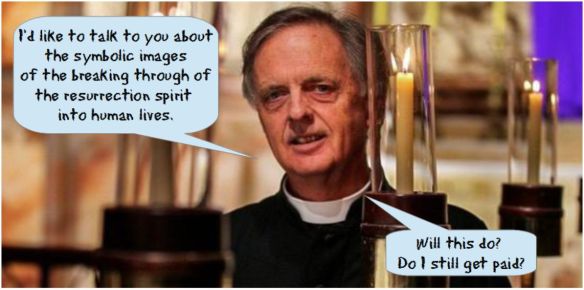
There was controversy last week over the appointment of Dr John Shepherd as the Archbishop of Canterbury’s new ambassador to the Vatican. The controversy wasn’t about the fact one branch of Made-up Beliefs was mingling its Sacred Truths™ with the Sacred Truths™ of another (which was upsetting enough for some of the faithful) but that Dr Shepherd has previously declared Jesus did not rise physically from the grave. In his 2008 Easter sermon, he said:

The resurrection of Jesus ought not to be seen in physical terms, but as a new spiritual reality. It is important for Christians to be set free from the idea that the resurrection was an extraordinary physical event which restored to life Jesus’ original earthly body.

Well, heaven forbid Christians should be compelled to accept reality! Needless to say, many of them didn’t like being made to do so. Undaunted, however, Shepherd went on to explain how the belief in Jesus’ resurrection came about:

…Jesus’ early followers felt His presence after His death as strongly as if it were a physical presence and incorporated this sense of a resurrection experience into their gospel accounts.

Yes, absolutely! This is precisely what happened. I’ve written about it here. This guy’s good. Until we get to his conclusion, anyway:

But (the gospels) are not historical records as we would expect history to be written today; they are symbolic images of the breaking through of the resurrection spirit into human lives.

He’s right about he nature of the gospels, of course. They’re not historical, nor are they eye-witness accounts or even second-hand reports of eye-witness accounts; they’re propaganda, written ‘so that you may believe’ as the fourth gospel  puts it.

But what’s this ‘symbolic images of the breaking through of the resurrection spirit into human lives’, Shepherd talks about? Having a good grasp of how the stories of Jesus’ ‘resurrection’ came about, he wants, for some reason, to continue promote the underlying fantasy – it’s his livelihood, after all – so he has to dress it up as something relevant to people today. He goes for ‘images of the breaking through of the resurrection spirit into human lives’, whatever that means. Breaking through from where? And what’s a ‘resurrection spirit’ when it’s at home?

Why bother though with the Jesus stuff at all? Plenty of people have life-changing experiences without having to hitch them to an ancient cult. My advice to Dr Shepherd would be to dump the ‘breaking through of the resurrection spirit’ hokum and he’ll be pretty much there. Then he can work on getting a real job.

Get your false Messiahs here…

blog351b

There was this guy who said he was the Son of God and the Messiah of his people. God appeared to him in a vision that enveloped him and changed him completely. Afterwards he discovered he had a knowledge of scripture that he previously hadn’t possessed and a invigorated sense of mission: God had appointed him to redeem his people. He changed his name and began to teach his people with power and a knowledge that all of them testified they had never experienced before. He brought them close to God and showed them how the world was coming to an end and how God would soon establish his Kingdom on Earth. He prophesied too, however, that he himself would die at the hands of the authorities, but that his followers should have no fear, because God would not forsake them: they would be part of the coming Kingdom.

And so it came to pass. At the age of 33, the Messiah died at the hands of the state.

And the name of this guy? Jesus, maybe? Well, it could be, but it wasn’t. Saul/Paul perhaps? Again, possibly… but no.

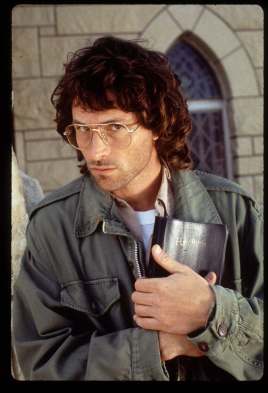
This guy’s name was David Koresh (real name Vernon Howell), leader of a Christian sect called the Branch Davidians. You may remember him from such massacres as the 1993 siege at Waco, where his church was based. He made all the claims above, just like Jesus and, to a lesser extent, Paul before him. None of his followers, it’s true, claimed to see him after his death, but some of those who survived the siege believe still that he will be resurrected and will return to lead them personally into the Kingdom of God.

I was watching a programme about him recently, a Storyville documentary originally broadcast in the States last year, which showed how easily we create our Messiahs and Saviours. The recipe, it turns out, is easy:

Take one charismatic individual who thinks he’s speaking for God;

Mix in an obsession with scripture;

Add some absurd self-promotion, and

Bake for a few years in the over-heated adulation of some desperate sycophants.

So – Jesus, Paul, Koresh. What’s the difference?

blog 351

*Actually, the quote in the picture up top is not Jesus at all; its Koresh, from an interview with the FBI (see first link above.) John 14.6 says ‘No-one comes to the Father except by me,’ which is much the same.

God’s deficient policy documents

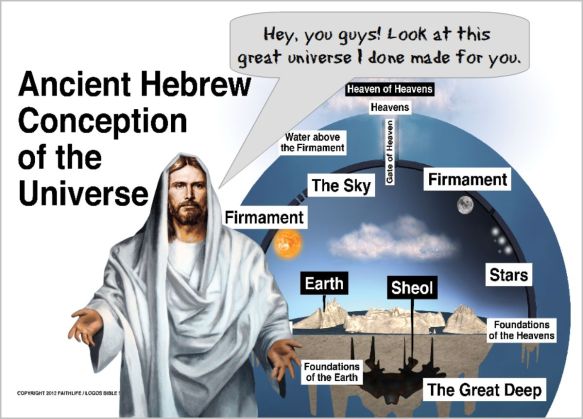
Universe

If you have read even a small percentage of my posts then you know I focus a great deal on defining and presenting the Gospel of our Lord Jesus Christ. I also focus on the Word of God as our source of God’s Truth, which is absolute. We also have defined faith and what God has done to save His people from their sins, which is the purpose of Jesus’ incarnation, perfect life, crucifixion, and resurrection.                 

Mike Ratcliff on Possessing the Treasure


Is your job description at work expressed as a story or myth?

       Are the aims and objectives of your company based on the hallucinations of the owners?

                   Is the health and safety policy made up of spells and incantations devised by someone with no real connection to the company?

Can you imagine if the kind of documentation that determines your work conditions was composed of myths, stories of dreams and visions, historically unreliable accounts and largely incomprehensible, magical terms and conditions? Not only this, but you’re required to root around within this documentation to discover what it is you’re meant to be doing and when you have, you need to find someone who can explain it properly to you.

This, according to Christians, is how God chose to tell his creation what he expected of it. The omniscient, all powerful creator of the universe, whose thoughts are so much greater than ours, was unable to put together a clear, systematic and concise set of directions about how he wants us to live and what we should believe if we’re to avoid an eternity of torture.

These messages are so important, apparently, that he thought they’d be best conveyed in folklore and myth – much of it plagiarised from other cultures – fantastic stories written decades after the events they relate, and muddled, contradictory theology.

Why on Earth would he do this? Why would he not speak directly and clearly to fallible, sinful humans? Provide us, perhaps, with a list that sets out straightforwardly and unequivocally what we need to do if we’re to be ‘saved’. (It’s not as if he’s averse to supplying lists; the Ten Commandments are a list, as are the rules in Leviticus about beating slaves and what should and shouldn’t be eaten.) Why not communicate with us so that we know it’s him and not, say, some pre-scientific tribesmen or a bunch of superstitious zealots? Why not speak to us in ways that are not identical with the way we ourselves invent stories about imaginary beings and far-fetched events?

Why provide us with a ragbag of myths, legends and fables crammed with confused and inconsistent ideas, all of them created by those same fallible, sinful human beings, and stitched together, eventually, by a committee with a vested interest in the success of such a book?

It’s a mystery. Unless of course there’s no God behind the bible. Maybe that’s why we have much better policy documents at work.

Why Jesus can’t possibly have known he’d ‘rise from the dead’.

Blog340JC&Peter

I said at the start of this series of posts about the date of Jesus’ crucifixion that the gospel writers perhaps felt unable to exclude Jesus’ predictions about rising from the grave after three days because these were too well-known. On reflection, it seems more likely that Jesus didn’t make any such prophecies. It is more probable that the gospel writers introduced them into their stories about him decades later.

I’ve written before about how the Resurrection appearances were nothing more than visions and dreams. Paul’s experience of the risen Jesus most certainly was – he says so himself – and Mary’s encounter with angels, telling her Jesus was no longer in his tomb, is described as ‘a vision’ in Luke 24.23. The subsequent accounts of Jesus’ post-mortem appearances also bear all the hallmarks of hallucinations; he disappears at will; passes through closed doors; isn’t always recognisable, drifts up into the sky and so on.

These mystical experiences, those that really happened anyway (it’s safe to say some – the Emmaus story, for example – are complete inventions: see Alter, pp536-8) quickly became a conviction among Jesus’ early followers that he had somehow risen from the grave. By the time of Luke’s and John’s gospel, 50 to 70 years later, this idea had evolved into a full-blown bodily resurrection.

The question is, did Jesus know that this was what was going to happen? Could he have had foreknowledge that he would be seen again after his death? Could he, during his life, have predicted he would rise bodily from the grave?

Christians will tell you that as God or God’s Son, Jesus was omniscient and therefore of course he knew these things in advance. There are, however, several good reasons why we can be sure he didn’t:

  • According to Paul, it was the resurrection that elevated Jesus to his god-like status, not his divinity that enabled the resurrection. Christians who argue that Jesus rose from the dead because he was divine have it back to front. Paul says clearly that Jesus ‘was appointed the Son of God in power by his resurrection from the dead‘ (Romans 1.4; my italics). Without the resurrection, Jesus was, Paul argues, of no great significance (1 Corinthians 12.15-19). However, the only ‘evidence’ for the resurrection is the contradictory, incompatible accounts offered by only three of the gospel writers and by Paul himself. So implausible is this evidence that we can safely conclude, with Michael J. Alter, that there was no such event. How, then, could Jesus possibly ‘know’ he’d rise from the dead when in fact he didn’t?
  • While he suffered from the delusion that he was going to rule God’s imminent Kingdom, it is unlikely Jesus thought he would have to die and be resurrected in order to do so. There was nothing in the Jewish scriptures to suggest either the Son of Man (a figure from Daniel with whom Jesus appears to have claimed some affinity) or the Messiah would be put to death only to rise again. This wasn’t what these characters were about and it wouldn’t have been how Jesus thought.
  • The Kingdom of God did not come about in the way Jesus believed. His death therefore did not bring about the apocalypse, judgement and rule of God he predicted and anticipated. In fact, his death took his cult off in a completely different direction, thanks mainly to Paul’s intervention. Jesus, and to a significant degree, the synoptic writers appear to have little awareness of this seismic shift. The Jesus they portray has little cognisance of events following his demise. Any suggestion he foresaw the creation of the Church is anachronistic, written back retrospectively into the accounts of his life. This was not what his ‘good news’ was about.

  • From their reactions preserved in the gospels, Jesus’ execution evidently came as a shock to both himself and his followers. None of them appear to have been expecting anything like a resurrection. Immediately following his death and burial, not a single one of his followers recalled his supposed predictions of his resurrection, nor did they express the sure and certain hope he would be returning. Even the discovery of the empty tomb (if it happened at all) failed to elicit such an expectation, nor any recollection of his words. The gospels say all those who witnessed the empty tomb were ‘frightened’, ‘astonished’ or ‘amazed’ that the body was missing, but not that they believed he must have risen from the dead. All those who witnessed the empty tomb behaved as if they’d never heard Jesus’ predictions that he’d be returning – probably because they hadn’t

  • It wasn’t until the ‘visions’ started that some of them began to consider the possibility that Jesus had ‘risen’. Not all were convinced, however. Matthew 28.16 notes how a number ‘doubted’ that the apparition they were seeing was Jesus. Significantly, at no point do any of those who think they’re seeing the risen Jesus say, ‘I remember him predicting this would happen.’ On every occasion, either angels or the risen Jesus himself has to explain it to them. (Of course, it’s the gospel writers doing the explaining for those hearing these stories decades later.)

All of this points to the fact that, while he was alive, Jesus didn’t make any predictions about rising from the grave on the third day, after three days, or after three days and nights; these prophecies, incompatible with each other and with the synoptic timeline, were created later, probably much later, after belief in the resurrection had become a central plank – the central plank – of the new cult. They were subsequently written back into the gospels, and placed on Jesus’ lips on the basis to show that of course he knew he’d rise again and knowing would have spoken about it.

The circle was thus complete; his early followers created the myth of Jesus’ return while later ones invented the ‘prophecies’ to bolster the belief that Jesus must have known he would. He said so, didn’t he?

How many angels can dance on the head of a pin?

Blog337Crap

Back when I was a teacher, in a distant, previous life, there were kids who couldn’t grasp the concept that multiplying a number by zero always results in zero. No matter how often I told them, ‘it doesn’t matter how much nothing you have, it’s still nothing,’ some of them just couldn’t see it.

Those who did understand regarded it as almost magical – they were young children – and would challenge each other with the likes of, ‘What’s 47 trillion, 56 billion, 95 million, 34 thousand, 8 hundred and 22 multiplied by zero?… Zero!’

I imagine these smart kids now say things like, ‘What’s Superstition multiplied by New Testament scholarship, theology and the intellectualised analysis of doctrine?… Superstition!’

It is immaterial how rigorous the scrutiny of the non-existent is, the non-existent will only ever be non-existent.

No matter how much nothing you have, it’s still nothing.

God is revealed in Jesus… or not


Blog335CompositeOn his blog-site, humbly named after himself, Roger E. Olson trots out the tired old cliche that there’s no such thing as atheism. Atheists, Rog tells us, know in their hearts that God exists, they just choose to ignore him. As a result, Rog has little time for atheism. (I discovered Roger’s wonderfully smug site through Bruce Gerenscer’s excellent one.)

Rog says that if we want to see what this heart-implanted God looks like, then we shouldn’t look to the Old Testament and the tribal warlord we find there – goodness me, no; we can safely discard him! That God just doesn’t match up to our twenty-first century sensibilities. No, if we want to see God then what we must do is look at Jesus, for in Jesus we see what God is really like.

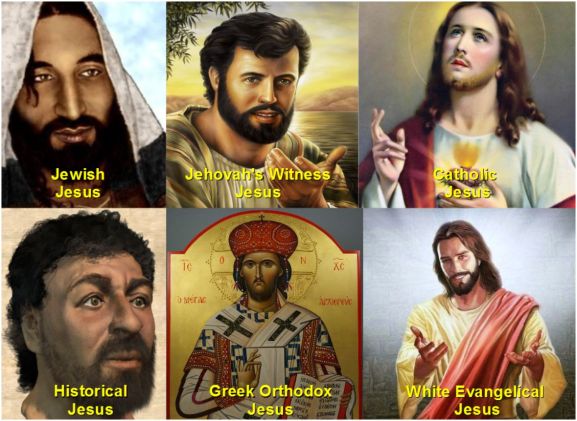
Oops! We’re right back at the problem I’ve been discussing these last few posts: just which Jesus are we talking about? There are so many. There’s the Jesus of the synoptic gospels (though he’s neither consistent nor pleasant), who is nothing like the self-obsessed Jesus of John’s gospel. Paul’s Christ is different again; he’s a complete invention, much like the Jesus of Hebrews who has morphed into a Jewish High Priest. The Jesus of Revelation meanwhile is an Evil Mutant straight out of the Marvel Universe, what with swords coming out of his mouth and all. So which Jesus has Rog got in mind? I think we should be told.

There are so many discrepancies in the various interpretations of Jesus in the New Testament, that it’s hard to see a clear, consistent picture of anything, let alone God, in such a shifting kaleidoscope of images. I’ve recommend that Rog should take atheism a little more seriously; the often incompatible Jesuses of the bible don’t reveal ‘the true nature of God’ anywhere as clearly as he claims. I’d go further: none of them show – can possibly show – what the non-existent is ‘really’ like. What they reveal instead are ideas about a God and a saviour made entirely in the image of the men who tasked themselves with creating them.

So it begins…

Jesus Lazes

A true story:

They didn’t see it coming. No-one did. It couldn’t have been predicted. He came into their lives unexpectedly one summer evening and none of them would ever be the same again.

He met Maddy first, then Andrew and soon after that the rest of the group. He was quiet, diffident even, but from the start his personality shone, his smile captivating them all. Some fell in love with him immediately, others later but either way, there was no escape. His zest for life was infectious, his gentle, thoughtful ways drew in all who encountered him. He didn’t demand change or presume to tell them how they should live, but his unaffected presence changed them all and added immeasurably to each of their lives.

And so the cult of Salvatore began, in the way that all cults begin, with a charismatic personality. When that individual seeks to manipulate and control others, particularly if he or she has Messianic aspirations, then before long an agenda emerges: unquestioning obedience; the belief that only this leader has the Truth; the demand that acolytes abandon family, friends and society for the cause; the proselytising to increase followers; the expectation that others acknowledge the leader’s power and glory; the rejection of those who fail to do so. This is how it was with Jesus, Muhammed, the Buddha, Joseph Smith, Mary Eddy Baker and so many others

The Salvatore cult won’t come to this; the man himself is neither controlling nor manipulative, though there are those who would do anything for him. Myself included.

Hearing Voices

Blog331Moses

I’ve been having a little exchange with the super-spiritual Don Camp over on Debunking Christianity. Don is convinced that the Holy Spirit speaks to him directly. He argues that all true Christians™ can hear the Spirit inside their heads, and seems to think this direct contact is as important as, possibly more important than, what it says in God’s Holy Word®.

There are, of course, many Christians who disagree with him, who think hearing voices in your head is flirting with demonic deception and apostasy (Yes, we’re in pot and kettle territory, but isn’t this what internecine squabbling is all about?) Don says he knows it’s the Spirit who talks to him, however, because what it has to say is in keeping with ‘the tenor’ of the New Testament. Here’s how the discussion went, with my contribution in italics:

Don’s opening salvo: Actually, if you ask people who do have God speak or if you look through the Bible and read the experiences of those to whom God spoke, it is rarely that the Spirit speaks what we want to hear. Do you think Paul want to hear that Jesus was lord? Do you think Abraham wanted to hear God tell him to sacrifice his son? Do you think Moses wanted to hear God tell him to return to Egypt? Do you think Jeremiah wanted to hear God’s message of destruction for Jerusalem? Or Jonah that he was to go to Nineveh? Or Isaiah that he musty preach, but no one would listen?

That in fact is one of the tests. If the “voice” tells you what you want to hear, be careful.

Me: Just reading over on Friendly Atheist of the guy who said the Lord told him to behead his partner because she didn’t repent. It doesn’t say whether he ‘wanted’ to hear this or not, but he went ahead anyway. Luckily for him (though not his partner) there were some bible verses that confirmed what the Lord had told him direct.

This the kind of thing you’re talking about, Don?

Don (below): Nope (a good solid argument! John Loftus threatened at this point to ban Don from Debunking Christianity as he’s had enough of his proselytising and lack of argument. Consequently, after another question from me, Don answered more fully.)

Me: Why not? Why is the voice in your head the real deal while this other nutjob’s isn’t? How can you possibly distinguish? He had bible verses to support what he thought the Lord was telling him, just like you do.

You see, Don, there is no way to distinguish between the two because, like yours, the Lord whispering in this guy’s cerebral cortex is exactly the same as the one whispering in yours. They’re both the product of brains suffering from a surfeit of religiosity.

Don:How can you possibly distinguish?’

Pretty much everyone can identify self-talk. No Christian mistakes the Spirit speaking with self-talk.

‘He had bible verses to support what he thought the Lord was telling him, just like you do.’

It is not simply a matter of finding a verse somewhere and yanking it out of context so that it can mean whatever you wish. That is superstitious and dishonest to the Bible. The question is whether what you feel the Spirit saying to you is is in conformity to the general tenor and tone of Scripture and in particular with the general tenor and tone of the New Testament. I say that because the general tone and tenor is incomplete until we come to the New Testament.

In the case you refer to, I cannot find anything in the New Testament that would allow beheading anyone for any reason. Rather I find a lot that tells us to love our enemy and to love the sinner, repentance or not.

Find me one place where Jesus said anything that would allow one of his followers to take another person’s life. What he said was love others, love the sinner, treat with kindness those who disrespect and even purposefully misuse you.

Find me one place where Paul said anything that would allow a Christian apart from acting under the authority of the state to take another’s life.

Both he and Jesus allow that an unrepentant person who claims to be a follower of Jesus might be excluded from the fellowship of Christians. But nowhere is there any warrant for beheading anyone anywhere.

The person who finds such warrant is misreading and misusing the Scripture

Me: ‘Pretty much everyone can identify self-talk. No Christian mistakes the Spirit speaking with self-talk.’ Though not, apparently, the guy who decapitated his partner. How about the preacher (Steven Anderson) who says the Spirit tells him LGBT people should be executed? Or those who say this self-same Spirit tells them to welcome gay people? Why does the same ‘Spirit of Truth’ provide such contradictory messages?

I feel the Spirit telling me right now, Don, that the voices in your head are nothing more than self-generated delusions.

As for New Testament verses (why you suddenly excluding the blood-soaked Old Testament?) that advocate violence, how about Matthew 10.34-36 where Jesus says he came to bring not peace but a sword? Or Matt 3.10-12 where he says that those who bear bad fruit will be ‘cut down’ and burned ‘with unquenchable fire.’? Or Matt 5.25-30 where he advocates cutting off hands and gouging out eyes when they ‘offend’? There are many more such verses attributed to Jesus; violence is easily justified with the words of your ‘peace-loving’ fraud, Don.

As for Paul, how about Romans 1.31-32 or 1 Thessalonians 1.10? Do you ever read this damnable book for yourself, Don, or do you just rely on hearing voices in your head telling you what you want to hear?

Don:How about the preacher (Steven Anderson) who says the Spirit tells him LGBT people should be executed?’

He is wrong. And everyone I know

‘how about Matthew 10.34-36 where Jesus says he came to bring not peace but a sword?’

The sword would be that which would be directed against them – as it was of Jesus.

‘Or Matt 3.10-12 where he says that those who bear bad fruit will be ‘cut down’ and burned ‘with unquenchable fire.’?’

It is not Christians who will do this. This is God’s final judgment. The King who has that authority will judge.

‘Or Matt 5.25-30 where he advocates cutting off hands and gouging out eyes when they ‘offend’?’

This is a metaphor. It is neither your hands or eye that offends. Evil comes from the heart (the inner person).

As for Paul, how about Romans 1.31-32′

It is not Christians who will judge the sins listed here. This is God’s judgment.

‘or 1 Thessalonians 1.10?’

This also is God’s judgment.

I said, if you recall, that Christians are never called to behead anyone anywhere, that they are to love their enemies and to do good to them rather than harm. There will be no “voice in the head” from God that tells a Christian to do harm – except as the agent of a government, which does have the God-given right to enforce justice.

Christians are called to follow Jesus. And he picked up no stone or sword to do violence to anyone.

But I did not say that God would not judge evil. That is his right and prerogative. He will certainly do so.

Me: All neatly side-stepped with the usual ‘he didn’t really mean what he clearly says.’ (Your response to the sword quote is particularly ludicrous: Jesus has just told the disciples to bring their swords to the garden in anticipation of his arrest; Peter actually uses his!)

I guess this kind of self-deception – you’re fooling no-one else – is why you can suggest Steven Anderson ‘and everyone I know’ is wrong. Only you are right, Don; the voice in your head says so.

Don:You can suggest Steven Anderson ‘and everyone I know’ is wrong. Only you are right, Don’;

Sorry. The failure to complete the sentence was a fault of not proof reading. It should read “everyone I know” agrees. (I knew this really.)

So let me say this carefully. I personally know of no Christian who condones Anderson’s act of beheading his partner. We all find it totally out of step with the words and character of Jesus. In a word, Anderson is a nut job on the order of a terrorist or atheist who walked into a Texas church and shot 20 plus people. They are all carried along by some passion that the rest of us would find far over the edge.

Me: Well, as you say it carefully that you and your buddies know personally that these other guys are wrong, I guess I’m convinced.

Unfortunately, the other fruitloops I’ve mentioned are as convinced as you are that the Lord (of Murder and Genocide) is really speaking to them. You see how subjective it all is, Don?

Btw, Steven Anderson isn’t the Christian who decapitated his partner; Anderson is your brother in the Lord – a preacher no less – who says the Holy Spirit has told him that gay people deserve death (because the bible says so.)

Don: ‘the other fruitloops I’ve mentioned are as convinced as you are that the Lord (of Murder and Genocide) is really speaking to them. You see how subjective it all is, Don?’

Self-talk, whether positive or negative, is subjective. No one else hears your internal talking to yourself. BTW there is nothing wrong with self-talk. We all do it.

Schizophrenia delusions (see https://www.aristada.com/wh… are also subjective. In this case almost everyone who is not schizophrenic can identify the unreality of the messages and hallucinations of a schizophrenic.

My own experience with schizophrenics is that they rarely if ever act in positive ways. They are fearful and troubled and riven people. Far more often their delusions cause them to act in anti-social and even violent ways. I would say that the person who beheaded his partner seems schizophrenic. I wonder if many of the mass shooters are not schizophrenic. We certainly know that some have been.

Schizophrenics can mix religious talk into their delusions. But we should not imagine that these are meaningful any more than the delusions they see.

Neither self-talk nor schizophrenic delusions describe the kind of God-speaking believers experience. They are different in kind not merely in degree.

‘Anderson . . . says the Holy Spirit has told him that gay people deserve death (because the bible says so.)’

The Bible says that we all deserve death. I deserve death. You deserve death. Romans 6:23 “The wages of sin is death, but the gift of God is eternal life through Christ Jesus our Lord.”

But that fact is not a mandate for any follower of Jesus to kill another person.

I do not know what Anderson did with his word from the Lord. If he organized a lynch mob, he is violating the word and tenor of the New Testament. If he argued that gay people should be denied their civil rights or in any way treated as enemies of Christians (yes, this what Anderson advocates, as well as the state execution of gay people), he is violating the word and tenor of the New Testament. If I remember right, Jesus was a friend of sinners not their executioner. And I do not know of any instance in which Jesus made a distinction between me as a heterosexual sinner and any homosexual sinner. We are all the same.

Jesus message to every sinner – and that was everyone he met – was repent and and seek the kingdom of God.

Me: This is the last time I’m going to respond to this nonsense. I have a godless life to be getting on with.

So, let me see if I’ve got this right: anyone who hears a different voice from yours, or receives a message from the Lord that’s at odds with your highly selective, rose-colored perspective of the bible, is schizophrenic.

You sure you’re not in two minds about this, Don?

Which all just goes to show how pointless it is arguing with someone in whom the Delusion is very strong.

I want to return to Jesus’ advocacy of violence and self-harm soon. These parts of his  inspirational teaching are so overlooked, don’t you think?