Bible Truths

Blog387

If ever there was evidence that Christianity is an entirely human affair it’s the way believers constantly disagree with each another. If the bible really was, in some way, ‘the Word of God’ (they don’t all agree even with what this might mean) then surely it would offer greater clarity on what being a Christian entails. Given what’s at stake – heaven or hell, a life of fullness or one spent mired in sin, helping the poor and hungry or self-indulgence – you’d think God would be just a little more precise about what his expectations are.

Instead, what do we get? A rag bag collection of myths, pseudo-history, folklore, poetry, fantasy, yet more pseudo-history, letters, forgeries and invective. Muddled and inconsistent about what the Supreme Being requires of his creation, it ranges from a forever agreement that says following a set of arbitrary laws is what he wants, along with a spot of male genital-mutilation (Genesis 17.1-16), to a new scheme that involves magical incantation (Romans 10.19), to yet another that says helping those in need is what he requires (Matthew 25.31-40).

I’ve been involved at different times in my life with writing policy documents for a range of organisations. Despite creating what I’d estimate to be around 50 of these documents, it never occurred to me to cobble together myth, stories, letters and fake news in even one of them. They needed to be precise, detailing how the organisation worked, what its take was on various areas of operation and, most importantly spelling out for people as clearly as possible what was expected of them. This precision was important; the documents had to be water-tight and open to as little interpretation as possible. They couldn’t allow for the possibility of one part of the organisation acting in one way in a given area while another acted completely differently in that same area.

If I, a fallible human, could manage this more often than not, why couldn’t God?

Why could he not declare definitively how old the Earth is so as to leave no room for dispute?

Why could he not set out his requirements for pleasing him as one single, unequivocal list? (he’s not averse to bullet points – see his ten commandments, of which he manages to present two largely incompatible versions, both of them fairly useless.)

Why could he not ‘inspire’ scribes contemporaneous with the figures in the Old Testament to record what happened as they happened and not centuries later?

Why could he not ‘inspire’ eye-witnesses of Jesus ‘ministry’ to write about it at the time, instead of waiting decades before giving the job to strangers who’d never met him?

Why could he not say decisively what happens to people when they die?

Why could he not present one definitive way of how to get in his good books instead of offering a range of confused alternatives, about which he is prone to change his mind?

And so on and so forth…

If the managing director of an organisation produced policy documents as shoddy and shambolic as God’s they wouldn’t last five minutes. Nor would the organisation.

But of course God didn’t write, inspire or otherwise cause the bible to be written. It’s human through and through, culturally-bound (to a range of ancient cultures) and not intended by its myriad authors to be a single volume. This fact doesn’t trouble most Christians; they read it selectively, if they read it at all, and believe what they are told about it. Others, who are aware of the bible’s shortcomings, have a variety of ways of negotiating around them. All of these entail great dollops of cognitive dissonance. We’ll look at some of them next time.

God’s Very Good Creation

Blog385

I’m recovering from a viral condition that’s affecting people in these parts. It’s set me thinking about how many diseases and conditions humans are susceptible to. An online search suggests the figure is unquantifiable. There are, for example, over 5,000 viruses known to affect human health, including the 200 that cause various versions of the so-called common cold. Of these 5000, we understand only a few hundred. There are also some 6,000 diseases caused by single-gene defects, and even more by other genetic disorders. In case that’s not enough, there are also hundreds of infectious diseases caused by bacteria, fungi and parasites. While some of these cause only minor discomfort, it remains the case that almost every one of us will die, or has already died, from one or other of these diseases, conditions or illnesses.

How does Christianity account for all of these horrors? Here’s the cerebrally challenged Ken Ham to explain:

We need to start with the fact that God created everything perfect, and this perfect creation was then marred by sin. This is the only way the gospel makes sense. You need the foundation of the history in Genesis in order to fully understand the gospel!

Yup, God made everything perfect and a pair of mythical humans messed it up by ‘sinning’. Everything that’s bad about the world is the result of Adam and Eve’s one-off disobedience. That single act opened the floodgates not only to all of the illnesses to which we and the animal kingdom are prone, but also to natural disasters and the brutality we inflict on one another.

But don’t worry, God has a cunning plan! Ken wants us to teach our children about it:

Teach them about God’s original “very good” creation. Instruct them that mankind’s sin broke God’s creation and brought death and suffering into it. Teach them that we needed someone to pay the penalty for our sin, and that’s why Jesus stepped into history… and now offers the free gift of eternal life to all who will put their faith and trust in him.

You see, as Ken likes to say, only this explanation makes sense of our susceptibility to disease and illness. Only this explanation makes sense of the gospel too; the good news that Jesus sacrificial death will put everything right.

                   Eventually.

                            No rush.

                                   Whenever…

It also demonstrates what a complete and utter bastard the biblical God is, that he condemns his ‘very good’ creation to a disease ridden, disaster stricken existence, simply because he himself made the first humans as fallible as he did.

But no. Neither this explanation nor its concomitant ‘gospel’ makes any sense, whichever perspective you look at them from. The development of innumerable diseases, and the viruses, bacteria, parasites and genetic conditions that cause them, are clear evidence of evolution; of an unsupervised arms-race in which the best-adapted invader or host survives to reproduce/replicate. Having then had the chance to transmit their DNA/chemical data, their purpose is served. They die. They stay dead.

The men who created Genesis 1 & 2 did not know about evolution, microbes or viruses. They did, however, see the deficiencies of the world in which they lived, the struggle for existence, illness and death, and found these impossible to square with the benign creator God they imagined existed. And so were formed the Genesis myths of a perfect creation spoilt by the only agent whom these men believed capable of causing such havoc; they themselves. There is no denying their accounts have been remarkably influential, and also completely wrong.

No gospel is needed to put right a fallen creation. It isn’t fallen, it is what we should expect if life evolved; if each species, organism and virus that exists today has spent millions of years constantly adapting in order to survive. Jesus’ supposed sacrifice has no bearing on any of this; it is superfluous, unnecessary and entirely irrelevant. The salvation myth is a virus in its own right, existing, like the meme it is, merely to perpetuate itself.

Jesus can’t save you from the common cold, let alone death.

The Voice in my Head is my Only Friend

Blog372b

I hear it clearly, the voice in my head. It speaks to me all the time; telling me I am marked out for greatness. I am the Chosen One. I shall make this country and these people great again too. It all falls to me.

The voice speaks sure and true; it does not mislead me. It is of the Lord. Others tell me they have a voice within, but they are misled; the hear merely their own thoughts. I know this, for once, long before, I listened to that same voice, the endless annoying sound of the self, undermining, planting only doubt, questioning my true destiny. It was Satan’s voice, whispering sweet and low. But his is not the voice I hear now. It is God who speaks clearly to me now, strengthening me, reassuring me, directing my path. His voice sounds for me and me alone. It is my constant companion and there is no need of any other. I listen only to him.

He directs me to gather around me those I need to realise my mission. There are others who do not share my vision; the vision he gives me. It matters not; they matter not. Those who do not do my bidding fall by the wayside. Others take their place, true believers in the work I am doing. God himself tells me so, God alone guides me.

For I am the Chosen One; this he has made clear. I am his Son, his appointed Savior for this dissolute age. All else will pass away but what I do will never pass away. For I am the Way, the Truth and the Life.


The Chosen One

Blog377

Donald Trump is chosen by God. His powerful friends in The Family have decided. Other influential Christians, like the odious Franklin Graham, have endorsed it. Trump himself made reference to it in a speech recently. He claims this was a joke, but we know what’s said about words spoken in jest; the Donald believes what his Christian chums have told him.

Evidently Trump cannot have been chosen by God when there is no God to do the choosing. Nor does Trump’s behaviour indicate that he’s God’s man. He is ignorant, self-obsessed, spiteful, vindictive, boorish, narcissistic and cruel. Not only is he ignorant generally, he is ignorant about the bible, has no idea about what being a Christian entails and is unable to answer any questions about his supposed faith.

Why then do Christians of all stripes claim he is specifically chosen by God to be president? How do they know? Allowing for a moment that there is a God, the notion that he chooses his agents here on Earth is fraught with insurmountable problems. That he predetermines who will serve him or even who is saved is an insoluble paradox that I’ve written about before, here and here.

No, Christians who say Trump is God’s Chosen are convinced of this only because he supports and implements their agenda; he is anti-abortion, anti-gay and anti-immigrant. He favours guns, white people, Israel, the wealthy and evangelicals. This is why Christians like him, why The Family says he is chosen by God, because these are their priorities and therefore, they conclude, they must be God’s priorities too.

Blog377a

For any Christians reading, particularly in the U.S., the process goes something like this:

1. You decide what is important to you.

2. You find support for your priorities in the bible (because support for just about anything can be found somewhere in the bible. Alternatively, you can just say what you believe is in the bible. Nobody’s checking.);

3. You disregard any apparent contradiction in the words attributed to Jesus;

4. You tell yourself that because God supports your agenda somewhere in the bible, this must therefore be his agenda also;

5. You exercise cognitive dissonance, a.k.a. dishonesty, to enable you to conclude that any influential agent who is prepared to support your priorities must therefore be chosen by God.

Naturally your agent need not demonstrate any other traits that might reasonably be expected of a God-follower (humility, love, hospitality, treating others like they themselves like to be treated and so on.) These things are unimportant so long as the agent is carrying out your agenda.

6. You tell others only of point 5, thus furnishing the entire process with a high-sheen spiritual gloss;

7. You accuse anyone who doesn’t support your agenda and your Chosen One of betraying God.

A good deal of self-deception and deceiving of others is required to pull this off, but Christians are more than up to the job. That’s why Trump is in the White House and why his Christian fixers are never far from his side.

Jesus, plus nothing

Blog376

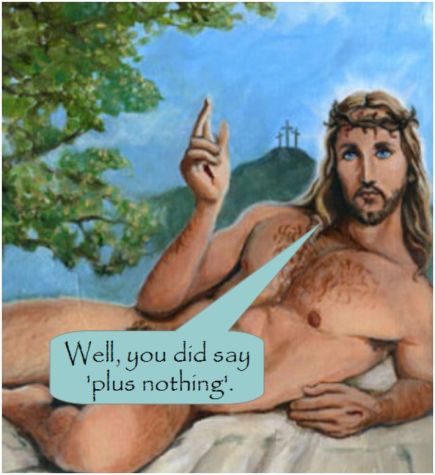
‘Jesus, plus nothing’ is the motto – the slogan – of ‘The Family’, a secretive, clandestine Christian group that for 60+ years has influenced, and been part of, the government of the USA. Yes, poor persecuted Christians, who find their rights eroded on a daily basis (or so they like to tell us) actually exercise a disproportionate amount of control over those in power. Controlled for many years by ‘the most influential Christian you’ve never heard of’, Doug Coe, this group disregards any notion of separation of church and state. The new Netflix series, The Family, based on Jeff Sharlet’s books The Family and C Street, documents their activities, which include affecting policy both at home and abroad, and taking the gospel of ‘Jesus, plus nothing’ to the mighty and powerful across the globe, often on the taxpayer’s dime.

But what does ‘Jesus, plus nothing’ really mean? There’s no doubt it’s intended to convey a stark honesty: this version of Christianity, it says, is without all the clutter that has accrued since Jesus walked the Earth, including all of Paul’s complicated theology. The Family’s holy book is not the bible in its entirety but a slim volume simply entitled Jesus that contains only the four gospels and Acts. The Jesus story, pure and simple.

Except there really isn’t anything simple about the Jesus story. It isn’t even a single story. Nor is there one, single Jesus. (As you’ll see at the links, I’ve written about both of these problems before.) The Jesus that The Family promotes is one of its own making. Of course, every version of Jesus is a construct, loosely based, at best, on bits and pieces from the bible, but manufactured entirely by what different groups and individuals would like him to be. It’s probable that the gospels themselves are constructs built on Old Testament ‘prophecies’ and references, and that the Jesuses they portray are no more than literary creations. Even so, the Jesuses held dear by modern believers, and The Family in particular, bear little resemblance to the constructs of Mark, Matthew, Luke and John on which he is supposedly based.

He is, as one of The Family’s Christian critics points out, a talisman, a magic word that opens doors for speaking ‘truth’ to dictators and tyrants. A Jesus synonymous with power; the power to control nations’ policies, direction and morality. A Jesus who chooses his men (always men) to wield this power; a Jesus who chooses ‘weak vessels’ to do his bidding; a Jesus who, The Family is convinced, chose Donald Trump to be president. And when Jesus chooses you – or when his agents on Earth do – then you are chosen indeed. They make sure of it.

To be continued.

Whatever happened to the Golden Rule?

Blog375a

So in everything, do to others what you would have them do to you, for this sums up the Law and the Prophets. (Matthew 7.12: New International Version)

In everything, treat others as you would want them to treat you, for this fulfils the law and the prophets. (Matthew 7.12: NET Bible)

I went to see a performance at the Edinburgh Fringe on Saturday. Actor David Benson presented a one-man show about the Cato Street Plot, which was an 1820 plan to assassinate the British Prime Minister and government (or possibly not. It was probably a set-up.)

During the show, Benson riffed on some of Jesus’ sayings, including the one above, about how we should treat one another in a country that claims to be Christian (as Britain did in 1820). ‘Do unto others’ has become known as The Golden Rule and like most rules it is largely ignored, even (or especially) by many who profess to be disciples of the man said to have formulated it. The principle is of course much older than the gospels.

When I returned home I caught up with some of my favourite blogs and read about:

A military organisation that promotes the separation of church and state in the U.S. on the receiving end of Christian hate mail.

A preacher who thinks the comedian Sarah Silverman should have her teeth smashed before dying prematurely and being sent to Hell.

The same preacher promising that the Jews, who he says are not God’s Chosen People, will be made to bow down before male Christians, who are.

A different pastor who recited Bible verses while allegedly assaulting an under-aged girl.

The cover-up of the sexual abuse of minors by the Jehovah’s Witness cult.

A Baptist Preacher charged with sexual assault.

Thousands of hateful messages, many from Christians, sent to Montreal Pride organisers.

They just don’t get it, do they? Being a Christian means doing what Jesus says (doesn’t it?) and he says that in everything we should to treat others as we ourselves like to be treated. Note how all encompassing that is: in everything, meaning ‘in every circumstance, with no exception’.

My guess is that the majority of Christians like to be treated fairly, with kindness and respect. I know they do because they whine endlessly when they think they’re not being. Yet so many of them won’t extend the same fairness, kindness and respect – in every circumstance – to other people.

I recently saw a slogan that said ‘Why be racist, sexist, homophobic or transphobic when you could just be quiet’; too many Christians can’t even manage that. They feel compelled to hurl vitriolic insults and threats in defence of the most powerful being ever imagined (and he is imagined). Others think that people more vulnerable than themselves, children included, exist only for their own sexual gratification. These Christians have no interest in ‘In everything, treat others as you like to be treated’. It just doesn’t apply to them.

Strike up another failure for their Lord and Saviour, Jesus Christ.

Crawling from the Wreckage

Blog372

I’m occasionally accused of criticising only evangelical Christianity. It’s an easy target, I’m told, and I should spend some time investigating the more sophisticated and respectable version of Faith: intellectual, liberal Christianity. In fact I already have, and have written about it before. This ‘respectable’ version of the Faith is every bit as dishonest and intellectually lazy as its more excitable counterpart.

It has always seemed to me that evangelicalism and fundamentalism do at least take the most indefensible parts of the bible seriously. They may ignore them when it comes to applying them (loving enemies and giving to all who ask, for example) but at least they accept them, if only metaphorically, as part of ‘God’s inerrant and infallible Word’. Intellectual Christians on the other hand sidestep what they find uncomfortable, selecting only that which fits with what they think the Faith should be:

A Loving Father? Then we’ll disregard the parts where God is clearly anything but.

A wise and compassionate Jesus? We’ll pretend the bits where he’s cruel, ignorant and just plain wrong aren’t really there (or are later additions to the gospels; the mistaken beliefs of the early church.)

Church as inclusive community? We’ll have some of that and ignore all the unhelpful nonsense about most of humankind being destined for eternal torture. (That, after all, is just Paul, or whoever, getting carried away.)

I know they do this, because when my own faith was in its death throes, I did too.

Back in the early ’90s. I’d given up on evangelicalism but desperately wanted to salvage something of the Faith that had once meant so much to me (even as it completely messed up my life.) I wanted a God of Love, so persuaded myself there was one – disregarding what I knew of the hateful, unsavoury aspects of the God of the bible. I also really wanted Jesus to have some meaning; if not as personal saviour then as one who exemplified a purposeful and compassionate life. To do this I had to overlook Paul’s theology of a vengeful God, hell bent on punishing everyone.

In the end, however, I had to be honest with myself and accept that the nice God I was trying to believe in was no more real than the nasty one. What I wanted had no bearing on the nature of God, nor on whether he existed. Similarly with the nice Jesus, who could be unpleasant and unreasonably demanding as well. I was being entirely selective, as most Christians are, about how I constructed my own personal Jesus.

Hanging on to fragments of faith was futile. I could no longer sustain the cognitive dissonance required to embrace the parts of Christianity that made me feel good, inspired me or made me kinder, while ignoring the downright nasty bits. If I was experiencing the good things (and I was) I had to accept they were coming from somewhere other than Christianity; if I was to go on experiencing them I had to acknowledge that and cultivate them by other means.

It seemed at first that this would be difficult outside of a church but in fact there are numerous groups committed to helping and inspiring others, without the superfluous and irrelevant presence of religion. It simply isn’t necessary to hang on to selected scraps from a discredited belief system; life lies, in abundance, elsewhere.

This is why I have no more respect for intellectualised, liberal Christianity than I have for evangelicalism. There is nothing intellectual about the cognitive dissonance needed to be an ‘intellectual’ Christian. It is, in the end, a largely content free version of Faith, the spiritual equivalent of a homeopathic remedy. I mean, really: why bother?

Hasa Diga Eebowai*

Blog378

I went to see The Book of Mormon at the weekend. It’s offensive, blasphemous (if there is such a thing) and very funny. I recommend it. I’d say that, by and large, it represents the Mormon faith pretty accurately, mocking the Latter Day Saints’ belief that Jesus visited America about a year after his resurrection. Beaming into the proto-U.S.A, he converted the Nephite civilisation and turned them white, while the Lamanites, who were ‘so wicked’, God eventually curses ‘with (a) dark and benighted and loathsome condition’ (he made them black.) Sadly, all the archaeological evidence for these two civilisations has since been lost.

Three centuries later one of their number, a fictional character guy called Mormon, wrote down their adventures with Jesus on some gold plates that happened to be lying round. After Mormon died, his son Moroni buried these plates for safe keeping, as you would. 1500 years later still, Jesus prompted a chancer called Joseph Smith to dig them up again and, with the help of the returning Moroni and some magic stones, Smith translated them from the original Gibberish into stilted English. The plates and stones were never seen again, but every true Mormon knows that he/she will be resurrected after they die, provided, of course, they are wearing their special underwear. According to some, they’ll then be given their very own planet to rule.

Ludicrous, right? How could anyone invent such twaddle, let alone believe it and allow it to determine their lives? Yet, they do. But is it any more far-fetched than the fantasy on which it’s based? A guy called Yeshua goes round spouting platitudes and proclaims himself king of the New Age that’s coming soon. He gets killed and after 36 hours comes back to life, walks through walls and takes off into the sky. Not long after, a crank who never met him, decides this Yeshua must really have had super powers, and that all anyone has to in order to live forever is believe in a magic spell he, Paul, just made up! More than this, he’s convinced Yeshua will visit the Earth soon, when he’ll condemn most of its inhabitants to an eternity of hellish torture. Unbelievable! Literally unbelievable, and yet millions do believe it.

Joseph Smith’s hokum deserves all the mockery The Book of Mormon and others heap on it, but the original story is every bit as preposterous. Why can’t mainstream Christians see it?


*The phrase ‘Hasa Diga Eebowai’ appears in The Book of Mormon. It definitely doesn’t mean ‘no worries’.

All in the Mind

Blog 368 (2)

Christians dispute that those who saw the Risen Jesus after his death were merely experiencing hallucinations or ‘visions’ in their own heads. Despite the fact that the only first-hand eye-witness report we have of a resurrection sighting is of precisely this nature – Paul’s, in Galatians 1.16 where he says that the Risen Christ was revealed ‘in’ him – Evangelicals in particular insist that Jesus rose physically from the dead and was seen by numerous ‘witnesses’.

And yet, in the two thousand years since he supposedly ascended into Heaven, no-one has seen Jesus in his resurrected, physical body. This doesn’t stop believers today claiming that they experience him in ‘real’ ways. As the old song goes, they walk with him and talk with along life’s narrow way. Or they think they do.

Back when I was a Christian I used to hear Jesus speaking to me. He’d create a thought in my head, telling me to act in a certain way, to speak to some lost soul about him, for example. At the time I was convinced these promptings were really ‘the Lord’. How could they not be? I had his Spirit living inside me, a sure-fire way of experiencing the living Jesus. His presence felt very real, as it does still for millions of Christians. What greater proof of the resurrection could there be?

In fact, Jesus’ ‘voice’ was no more than the vague recollections of Bible verses I half remembered. The sense of his presence I felt was a trick of my own mind, conditioned by hours of sermons, Bible reading and the mutual reinforcement provided by fellow-believers.

I never actually visualised Jesus, though many claim to. They see him in burnt toast or cloud formations; they dream about him or think he has visited them in the night, standing at the foot of the bed. Some have near-death experiences when (they imagine) they travel to Heaven and are welcomed by his outstretched arms. Others ‘know’ he has rescued them from calamity, or purposely sent them a sign (by leaving a Bible unscathed after a storm destroyed a house, as happened this week in Indiana.) Still others, a mite more credibly perhaps, have a sense of Jesus being present in a wishy-washy mystical way. He seems especially real when they’re caught up in the ecstasy of worship or a mighty and wondrous healing is being staged taking place. What a blessing! After all, didn’t Jesus promise in Matthew 18.20 that ‘when two or three are gathered in my name there I am in the midst of them’? (Probably not, but Christians believe he did and that’s what matters.)

My point is this: if this is how Jesus ‘manifests’ himself today – in whispered messages, inner-visions, emotions, dreams, blessings and ‘signs’ – and if these are enough to keep today’s believers convinced he lives again, then isn’t it likely that this was exactly how his earliest followers experienced him after his death? Not as a real, physical body but in these same ‘spiritual’ ways, conjured up by minds deep in the thrall of religion? If illusions of their own imaginations are enough to persuade the susceptible of the Risen Lord’s presence today, then surely they were more than enough to convince a handful of superstitious zealots in the first century.

I mean, just look at Paul.

The Gods of Christianity

Blog366

Christians who argue that only their God is real and that life is futile without him, are like the person who jumps up and down on thin ice insisting the ground beneath him is solid.

The various forms of Yahweh belief have rarely been monotheistic. While Isaiah declares there is only one God, the Jewish scriptures also refer to ‘him’ as ‘Elohim’ and ‘Adonai’, plurals meaning ‘deities’ and ‘my lords’ respectively. Other gods abound, with Psalm 82.1 relating how Yahweh presides over an assembly of other deities. From the beginning – certainly the beginning of the bible – a belief in other supernatural agents has been a requirement; Satan and angels are both present in Genesis and throughout the Old Testament. There are also the cherubim and seraphim of Genesis 3.24 and Isaiah 6:1-8 who do Yahweh’s dirty work for him. All of these beings are supernatural entities of immense power; gods in everything but name.

And this is before we get to the New Testament where several new superhuman characters are introduced. Most notable, of course, is the Christ, the invention of cultist Paul. This eternal being is capable of rescuing human beings from the wrath of God and has the power to resurrect them after death. He is, in Paul’s eyes, on an equal footing with Yahweh himself, a god in his own right (Philippians 2.6-11). While the Christ himself has resided in heaven for the past two thousand years (or for eternity, give or take thirty years), his spirit haunts the Earth to this day, possessing members of the Christ cult. The three of them together – the Christ, the Spirit and Yahweh (re-imagined as ‘The Father’) – are the chief gods of Christianity. The church has spent almost two millennia trying to explain how there is only one god who is simultaneously three distinct deities. The Vatican declares the Trinity to be the greatest mystery of all, though of course it is only a mystery in the same way something that makes no sense whatever can be considered a mystery.

According to the gospels, Jesus himself believed in yet another collection of supernatural agents; demons who caused all manner of illness and mischief, opposing Jesus wherever he went. According to the writer of Ephesians (6.12), these ‘wicked spirits’ and ‘principalities’ rival God in terms of power, and are, together with their overlord, Satan, the real rulers of this world

For Catholics, this pantheon of three-in-one gods, angels, devils and demons is supplemented by another layer of super-beings. These are humans who have attained the status of divine immortality, and who are prayed to and worshipped by acolytes on Earth. Mary, the supposed ‘mother of God’ is the most significant, followed by ‘saints’ who have been translated to Heaven and now have free access to the chief gods, ‘interceding’ with them on behalf of ordinary mortals. While no doubt Catholics would dispute that these figures are themselves gods, it’s difficult to see how they are not: they’re immortal, eternal, possessed of great power and in direct communication with the Big Three. They are the equivalent of the Titans’ offspring in Greek mythology.

There is nothing monotheistic about Christianity (nor Judaism) despite the protestations of those who claim to follow the one true God. Christianity has, like most of its predecessors, a pantheon of gods. This not surprising when history repeatedly demonstrates the extent to which humans are inclined towards ensemble theistic imaginings.

So, beware those who tells us they know what the one true God wants, what he approves of and what he condemns: that ice is exceedingly thin and already cracked. It has been from the very beginning.