God is revealed in Jesus… or not


Blog335CompositeOn his blog-site, humbly named after himself, Roger E. Olson trots out the tired old cliche that there’s no such thing as atheism. Atheists, Rog tells us, know in their hearts that God exists, they just choose to ignore him. As a result, Rog has little time for atheism. (I discovered Roger’s wonderfully smug site through Bruce Gerenscer’s excellent one.)

Rog says that if we want to see what this heart-implanted God looks like, then we shouldn’t look to the Old Testament and the tribal warlord we find there – goodness me, no; we can safely discard him! That God just doesn’t match up to our twenty-first century sensibilities. No, if we want to see God then what we must do is look at Jesus, for in Jesus we see what God is really like.

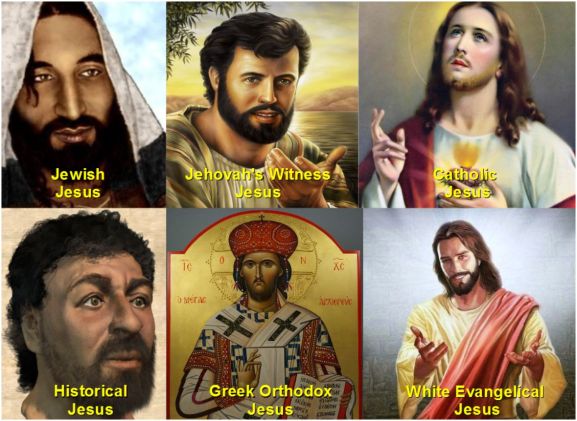
Oops! We’re right back at the problem I’ve been discussing these last few posts: just which Jesus are we talking about? There are so many. There’s the Jesus of the synoptic gospels (though he’s neither consistent nor pleasant), who is nothing like the self-obsessed Jesus of John’s gospel. Paul’s Christ is different again; he’s a complete invention, much like the Jesus of Hebrews who has morphed into a Jewish High Priest. The Jesus of Revelation meanwhile is an Evil Mutant straight out of the Marvel Universe, what with swords coming out of his mouth and all. So which Jesus has Rog got in mind? I think we should be told.

There are so many discrepancies in the various interpretations of Jesus in the New Testament, that it’s hard to see a clear, consistent picture of anything, let alone God, in such a shifting kaleidoscope of images. I’ve recommend that Rog should take atheism a little more seriously; the often incompatible Jesuses of the bible don’t reveal ‘the true nature of God’ anywhere as clearly as he claims. I’d go further: none of them show – can possibly show – what the non-existent is ‘really’ like. What they reveal instead are ideas about a God and a saviour made entirely in the image of the men who tasked themselves with creating them.

So it begins…

Jesus Lazes

A true story:

They didn’t see it coming. No-one did. It couldn’t have been predicted. He came into their lives unexpectedly one summer evening and none of them would ever be the same again.

He met Maddy first, then Andrew and soon after that the rest of the group. He was quiet, diffident even, but from the start his personality shone, his smile captivating them all. Some fell in love with him immediately, others later but either way, there was no escape. His zest for life was infectious, his gentle, thoughtful ways drew in all who encountered him. He didn’t demand change or presume to tell them how they should live, but his unaffected presence changed them all and added immeasurably to each of their lives.

And so the cult of Salvatore began, in the way that all cults begin, with a charismatic personality. When that individual seeks to manipulate and control others, particularly if he or she has Messianic aspirations, then before long an agenda emerges: unquestioning obedience; the belief that only this leader has the Truth; the demand that acolytes abandon family, friends and society for the cause; the proselytising to increase followers; the expectation that others acknowledge the leader’s power and glory; the rejection of those who fail to do so. This is how it was with Jesus, Muhammed, the Buddha, Joseph Smith, Mary Eddy Baker and so many others

The Salvatore cult won’t come to this; the man himself is neither controlling nor manipulative, though there are those who would do anything for him. Myself included.

Hearing Voices

Blog331Moses

I’ve been having a little exchange with the super-spiritual Don Camp over on Debunking Christianity. Don is convinced that the Holy Spirit speaks to him directly. He argues that all true Christians™ can hear the Spirit inside their heads, and seems to think this direct contact is as important as, possibly more important than, what it says in God’s Holy Word®.

There are, of course, many Christians who disagree with him, who think hearing voices in your head is flirting with demonic deception and apostasy (Yes, we’re in pot and kettle territory, but isn’t this what internecine squabbling is all about?) Don says he knows it’s the Spirit who talks to him, however, because what it has to say is in keeping with ‘the tenor’ of the New Testament. Here’s how the discussion went, with my contribution in italics:

Don’s opening salvo: Actually, if you ask people who do have God speak or if you look through the Bible and read the experiences of those to whom God spoke, it is rarely that the Spirit speaks what we want to hear. Do you think Paul want to hear that Jesus was lord? Do you think Abraham wanted to hear God tell him to sacrifice his son? Do you think Moses wanted to hear God tell him to return to Egypt? Do you think Jeremiah wanted to hear God’s message of destruction for Jerusalem? Or Jonah that he was to go to Nineveh? Or Isaiah that he musty preach, but no one would listen?

That in fact is one of the tests. If the “voice” tells you what you want to hear, be careful.

Me: Just reading over on Friendly Atheist of the guy who said the Lord told him to behead his partner because she didn’t repent. It doesn’t say whether he ‘wanted’ to hear this or not, but he went ahead anyway. Luckily for him (though not his partner) there were some bible verses that confirmed what the Lord had told him direct.

This the kind of thing you’re talking about, Don?

Don (below): Nope (a good solid argument! John Loftus threatened at this point to ban Don from Debunking Christianity as he’s had enough of his proselytising and lack of argument. Consequently, after another question from me, Don answered more fully.)

Me: Why not? Why is the voice in your head the real deal while this other nutjob’s isn’t? How can you possibly distinguish? He had bible verses to support what he thought the Lord was telling him, just like you do.

You see, Don, there is no way to distinguish between the two because, like yours, the Lord whispering in this guy’s cerebral cortex is exactly the same as the one whispering in yours. They’re both the product of brains suffering from a surfeit of religiosity.

Don:How can you possibly distinguish?’

Pretty much everyone can identify self-talk. No Christian mistakes the Spirit speaking with self-talk.

‘He had bible verses to support what he thought the Lord was telling him, just like you do.’

It is not simply a matter of finding a verse somewhere and yanking it out of context so that it can mean whatever you wish. That is superstitious and dishonest to the Bible. The question is whether what you feel the Spirit saying to you is is in conformity to the general tenor and tone of Scripture and in particular with the general tenor and tone of the New Testament. I say that because the general tone and tenor is incomplete until we come to the New Testament.

In the case you refer to, I cannot find anything in the New Testament that would allow beheading anyone for any reason. Rather I find a lot that tells us to love our enemy and to love the sinner, repentance or not.

Find me one place where Jesus said anything that would allow one of his followers to take another person’s life. What he said was love others, love the sinner, treat with kindness those who disrespect and even purposefully misuse you.

Find me one place where Paul said anything that would allow a Christian apart from acting under the authority of the state to take another’s life.

Both he and Jesus allow that an unrepentant person who claims to be a follower of Jesus might be excluded from the fellowship of Christians. But nowhere is there any warrant for beheading anyone anywhere.

The person who finds such warrant is misreading and misusing the Scripture

Me: ‘Pretty much everyone can identify self-talk. No Christian mistakes the Spirit speaking with self-talk.’ Though not, apparently, the guy who decapitated his partner. How about the preacher (Steven Anderson) who says the Spirit tells him LGBT people should be executed? Or those who say this self-same Spirit tells them to welcome gay people? Why does the same ‘Spirit of Truth’ provide such contradictory messages?

I feel the Spirit telling me right now, Don, that the voices in your head are nothing more than self-generated delusions.

As for New Testament verses (why you suddenly excluding the blood-soaked Old Testament?) that advocate violence, how about Matthew 10.34-36 where Jesus says he came to bring not peace but a sword? Or Matt 3.10-12 where he says that those who bear bad fruit will be ‘cut down’ and burned ‘with unquenchable fire.’? Or Matt 5.25-30 where he advocates cutting off hands and gouging out eyes when they ‘offend’? There are many more such verses attributed to Jesus; violence is easily justified with the words of your ‘peace-loving’ fraud, Don.

As for Paul, how about Romans 1.31-32 or 1 Thessalonians 1.10? Do you ever read this damnable book for yourself, Don, or do you just rely on hearing voices in your head telling you what you want to hear?

Don:How about the preacher (Steven Anderson) who says the Spirit tells him LGBT people should be executed?’

He is wrong. And everyone I know

‘how about Matthew 10.34-36 where Jesus says he came to bring not peace but a sword?’

The sword would be that which would be directed against them – as it was of Jesus.

‘Or Matt 3.10-12 where he says that those who bear bad fruit will be ‘cut down’ and burned ‘with unquenchable fire.’?’

It is not Christians who will do this. This is God’s final judgment. The King who has that authority will judge.

‘Or Matt 5.25-30 where he advocates cutting off hands and gouging out eyes when they ‘offend’?’

This is a metaphor. It is neither your hands or eye that offends. Evil comes from the heart (the inner person).

As for Paul, how about Romans 1.31-32′

It is not Christians who will judge the sins listed here. This is God’s judgment.

‘or 1 Thessalonians 1.10?’

This also is God’s judgment.

I said, if you recall, that Christians are never called to behead anyone anywhere, that they are to love their enemies and to do good to them rather than harm. There will be no “voice in the head” from God that tells a Christian to do harm – except as the agent of a government, which does have the God-given right to enforce justice.

Christians are called to follow Jesus. And he picked up no stone or sword to do violence to anyone.

But I did not say that God would not judge evil. That is his right and prerogative. He will certainly do so.

Me: All neatly side-stepped with the usual ‘he didn’t really mean what he clearly says.’ (Your response to the sword quote is particularly ludicrous: Jesus has just told the disciples to bring their swords to the garden in anticipation of his arrest; Peter actually uses his!)

I guess this kind of self-deception – you’re fooling no-one else – is why you can suggest Steven Anderson ‘and everyone I know’ is wrong. Only you are right, Don; the voice in your head says so.

Don:You can suggest Steven Anderson ‘and everyone I know’ is wrong. Only you are right, Don’;

Sorry. The failure to complete the sentence was a fault of not proof reading. It should read “everyone I know” agrees. (I knew this really.)

So let me say this carefully. I personally know of no Christian who condones Anderson’s act of beheading his partner. We all find it totally out of step with the words and character of Jesus. In a word, Anderson is a nut job on the order of a terrorist or atheist who walked into a Texas church and shot 20 plus people. They are all carried along by some passion that the rest of us would find far over the edge.

Me: Well, as you say it carefully that you and your buddies know personally that these other guys are wrong, I guess I’m convinced.

Unfortunately, the other fruitloops I’ve mentioned are as convinced as you are that the Lord (of Murder and Genocide) is really speaking to them. You see how subjective it all is, Don?

Btw, Steven Anderson isn’t the Christian who decapitated his partner; Anderson is your brother in the Lord – a preacher no less – who says the Holy Spirit has told him that gay people deserve death (because the bible says so.)

Don: ‘the other fruitloops I’ve mentioned are as convinced as you are that the Lord (of Murder and Genocide) is really speaking to them. You see how subjective it all is, Don?’

Self-talk, whether positive or negative, is subjective. No one else hears your internal talking to yourself. BTW there is nothing wrong with self-talk. We all do it.

Schizophrenia delusions (see https://www.aristada.com/wh… are also subjective. In this case almost everyone who is not schizophrenic can identify the unreality of the messages and hallucinations of a schizophrenic.

My own experience with schizophrenics is that they rarely if ever act in positive ways. They are fearful and troubled and riven people. Far more often their delusions cause them to act in anti-social and even violent ways. I would say that the person who beheaded his partner seems schizophrenic. I wonder if many of the mass shooters are not schizophrenic. We certainly know that some have been.

Schizophrenics can mix religious talk into their delusions. But we should not imagine that these are meaningful any more than the delusions they see.

Neither self-talk nor schizophrenic delusions describe the kind of God-speaking believers experience. They are different in kind not merely in degree.

‘Anderson . . . says the Holy Spirit has told him that gay people deserve death (because the bible says so.)’

The Bible says that we all deserve death. I deserve death. You deserve death. Romans 6:23 “The wages of sin is death, but the gift of God is eternal life through Christ Jesus our Lord.”

But that fact is not a mandate for any follower of Jesus to kill another person.

I do not know what Anderson did with his word from the Lord. If he organized a lynch mob, he is violating the word and tenor of the New Testament. If he argued that gay people should be denied their civil rights or in any way treated as enemies of Christians (yes, this what Anderson advocates, as well as the state execution of gay people), he is violating the word and tenor of the New Testament. If I remember right, Jesus was a friend of sinners not their executioner. And I do not know of any instance in which Jesus made a distinction between me as a heterosexual sinner and any homosexual sinner. We are all the same.

Jesus message to every sinner – and that was everyone he met – was repent and and seek the kingdom of God.

Me: This is the last time I’m going to respond to this nonsense. I have a godless life to be getting on with.

So, let me see if I’ve got this right: anyone who hears a different voice from yours, or receives a message from the Lord that’s at odds with your highly selective, rose-colored perspective of the bible, is schizophrenic.

You sure you’re not in two minds about this, Don?

Which all just goes to show how pointless it is arguing with someone in whom the Delusion is very strong.

I want to return to Jesus’ advocacy of violence and self-harm soon. These parts of his  inspirational teaching are so overlooked, don’t you think?


Abandon Reason all ye who enter the Faith

Descartes

The question of whether religious believers are less intelligent than non-believers surfaces every now and again. The atheist blogs I read are usually courteous enough to say that of course believers are not less intelligent, and there are no studies that I can find that have considered the matter.

Evidently there have been intelligent Christians; C. S. Lewis comes to mind, Francis Collins of the Human Genome project and William Lane Craig are evidently intelligent men. (I can’t think of any obviously intelligent women who subscribe to religion; I suspect intelligent women are intelligent enough to avoid superstition altogether.) It seems to me though that what those who profess religious belief are prepared to do, is sublimate whatever intelligence they have and sacrifice intellect in the service of faith. They suppress their critical faculties, usually through a form of cognitive dissonance, and press rationality into the servitude of beliefs that have been arrived at irrationally. I might be wrong of course, but this what the evidence suggests to me.

A recent commenter on this blog by name of tides99, does seem to support to this hypothesis. tides99 originally wrote to say how his chosen superstition, Catholicism, is the one true way (aren’t they all) and that while I’m right to criticise Protestantism, I really should investigate Catholicism for myself. When I declined his very generous offer, tides99 responded – you’ll find his comments in ‘the author’ section above – with a number of points about the limits of human reason. It is these I take apart respond to here.

tides99: I have a PhD in philosophy, so I certainly would not believe in anything that goes against reason or requires one to repress or contradict one’s critical faculties.
For one who professes a PhD in philosophy, tides99, there is some very sloppy reasoning here and throughout your argument. Already in this first sentence we see the contradiction between belief and reason; they are not the same and can’t ever be; belief doesn’t require reason. That is why it is often called ‘faith’.

Criticsl (sic) reason is only one way of encountering and assessing reality… You’re right, tides99, but not for the reason you think. Critical reasoning is one way of assessing reality, but is insufficient on its own. It needs the support of evidence. Evidence is supplied by science and the methods used in scientific enquiry that seek to eliminate, as far as possible, human bias and presupposed conclusions.

and there are aspects of reality that reason cannot adjudicate because it cannot access them. If there are aspects of reality that reason cannot ‘adjudicate’ (whatever that means) and that science cannot access, then how do you know these supernatural aspects exist? You feel them? Your church says they do? You’d like them to? Maybe so, but none of these mean that these mysterious ‘aspects’ really do exist. You’re sneaking supernaturalism in through the back door here, tides.

Rationalism is itself based Upon faith, of faith… Oh dear, this old chestnut.

in the ultimate intelligibility of the universe, and its perfect transparency to human reason. Is rationality really based on these things? Scientists concede there may be aspects of the universe which, while we might observe them or extrapolate mathematically, we might never properly understand or be able to explain. This doesn’t, to my knowledge, prevent the exercise of rationality.

This of course cannot be proven, yet you believe it anyway. Scientists and free-thinkers rarely go in for ‘proof’. Your use of the word makes me suspicious of your claims about your credentials. Things can be proven mathematically, it’s true, as can matters in a court of law (beyond reasonable doubt) but by and large science is more interested in theories, working models and demonstration. So, no-one is looking to ‘prove’ that the universe is ultimately intelligible and no-one ‘believes’ it is perfectly transparent to human reason. This is a strawman argument, tides.

It’s quite superstitious to have such faith, but yet have nothing really to ground it on. Whatever reason and rationality are based on, it is not faith in the universe’s intelligibility or transparency. The use of reason and the application of the scientific method are nothing like ‘faith’. Both are tools, and they are the best we have.

The truth is that the reason why reason exists is because the universe is ordered… Beware any statement that starts ‘the truth is’! Reasoning is a manifestation of the human brain. It is not something that has discreet, independent existence. It has not been floating around for aeons, out there somewhere, waiting for advanced apes finally to discover it and make it their own. The only reason reason exists is because the human brain evolved to the extent it became capable of reasoning. All the same, the brain did not leave behind its capacity for irrationality, unreasonableness and disorderly impulse. Might we not then claim, this being an equally viable proposition, that because these are human traits of even longer standing than our capacity for reason, that the universe must therefore also be irrational, unreasonable and disordered? Of course not, because the universe’s characteristics are not a reflection of the human brain’s abilities, and vice versa. The inclination to project human behaviour onto an impersonal, indifferent environment – to anthropomorphise the universe – exemplifies our irrationality, not rationality.

But, just a minute, we have another contradiction here, tides99. You have already speculated that there are aspects of reality beyond our grasp – and yet here you are telling us that, along with the rest of the universe, these supernatural aspects are ordered. How do you know this? How do you know anything about parts of reality which reason cannot ‘adjudicate’ and science cannot access?

and the reason why it’s ordered is, of course, because there is an orderer, namely God. And there we have it. It’s God. Of course it is. Far from demonstrating that the universe is ordered, you now conjecture that the order you claim for it has an orderer behind it. Yes, it’s another leap of faith, reason be damned. Anthropomorphising the universe leads inevitably to deities and, ultimately, the Christian god, who is merely ourselves writ large.

Speaking for myself, anyway, I can say this much. When I was an undergrad I came across the saying that learning a little philosophy leads you away from God, but learning a lot of philosophy leads you back. As a young man who had learned a little philosophy, I scoffed. But in later years and at least in my own case, I would come to see that it’s true.

It’s no good blaming a surfeit of philosophy, tides99. If what you say were true, all philosophers with PhDs would have reached conclusions similar to your own. The majority haven’t.

To summarise your argument, you claim – without evidence – that there are supernatural aspects to the universe/reality which reason and science can’t detect. You assert that nevertheless the universe as a whole is ordered and it follows therefore that there must be an orderer. This orderer, you then go on to assume, is the very God you’ve chosen, for entirely irrational reasons, to worship.

Science and reason tell us that every one of these assertions is wrong. You are projecting your beliefs onto the universe as you perceive it, tides99. Project away, by all means, but remember, these beliefs and your version of reality are only in your head. The real universe as science, and, I’d venture to say, reason demonstrate, is busy doing something else entirely.

Young men’s visions, old men’s dreams

Stephen4

In Acts 2.17, Luke (mis)quotes a prophecy from Joel 2.28:

In the last days, God says, I will pour out my Spirit on all people. Your sons and daughters will prophesy, your young men will see visions, your old men will dream dreams.

I was always taught that the Acts version was a prophecy in its own right, predicting what would happen in the very last days before Jesus returned, some time in the future (his future, though maybe not ours.) But it isn’t. Luke, or whoever wrote Acts, is claiming the fulfilment of the prophecy in his own time. He’s not saying,’ this is what will happen at some point in the next few millennia.’ He’s declaring – or he’s making Peter declare – ‘this is what’s happening right now.’ Luke, like all members of the cult in its early days, believed the last days had arrived; God was about to impose his Kingdom on the Earth, in a display of power and glory (Luke 21.27).

The dreams and visions of which Luke speaks were, he believed, happening then, as he was writing. To prove it, he relates numerous dreams and visions in Acts; Stephen’s vision of God and Jesus; Paul’s ‘sighting’ of the risen Christ on the road to Damascus and Peter’s encounter with, erm… a table-cloth to name only a few. Elsewhere, Paul himself refers obliquely the innervision that led to his conversion (Galatians 1.16) and recounts his ‘visit’ to ‘the third heaven’ (2 Corinthians 12.2); he’s kind of embarrassed about this one though – as well he might be – and relates it in the third person.

Luke knows that the new cult is built on dreams and visions. He believes such hallucinations are genuine revelations from God himself. Moreover, Luke tells his readers explicitly and directly in Acts 2.17 that such visions and dreams were how the cult’s founders experienced the risen Jesus. How do we know this is what he means? Because he puts the quotation about young men having visions and old men dreaming dreams into the mouth of Peter. That’s the disciple Peter whom the gospels tell us was one of the first to experience the risen lord. Luke has Peter reveal the nature of that experience. ‘This is how it was for me,’ he confesses. ‘I had a god-given vision, just as the scriptures promise.’

Luke is proud of the fact that the new faith is based on young men’s visions and old men’s dreams. Proud enough to include it in Acts 2.17 and proud enough to make Peter of all people declare it. Christianity owes its existence to these hallucinations and delusions, nothing more.


What A Dream I Had

Resurrection3

Last night.

I dreamt I was troubled and anxious about something or other, even though I’m not aware of being this way in reality.

In the dream, a couple of people drop by to console me. One of those people is my dad. He asks what’s wrong, listens and offers advice. He’s concerned and wise, positive and supportive. I have no doubt this is my father; he looks and sounds like him, but he’s an idealised version of him. I’m dimly aware in the dream that he’s behaving differently from the way he would in life – we rarely had heart-to-heart talks – but I’m so grateful for the help he’s offering, and it’s good to feel close to him.

In reality, my father died over ten years ago. I’m not sure I was aware of this in the dream or perhaps I just ignored it. I certainly ignored the way he was acting slightly out of character; I just was glad to see him again. I woke this morning feeling invigorated by the time spent with him (or the illusion of time spent with him) and with other friends who appeared in the dream to offer support.

I don’t for minute believe that the father I experienced in my dream was really my dad, returned from wherever he’s been these last ten years to offer words of comfort. My real dad has been nowhere for the past decade. He ceased to be in 2007. The version of him in my dream was a construct of my own mind, made from memories, wishful thinking and – okay, I admit it – a glass or two of wine. He was an image of how I’d like my dad to have been, perhaps – not that I give that much conscious thought. Nevertheless, this version of him is evidently buried somewhere in my head, waiting to be resurrected when the dream circumstances are right.

This is what it must surely have been like for those few individuals who, in visions and dreams, experienced Jesus after his death. In their grief and turmoil, the need to embrace the dream version of their friend must have been overwhelming. They would have persuaded themselves it really was him, communicating with them from beyond the grave. The fact one or two others had a similar experience can only have reinforced the compulsion to believe: ‘You saw him too? Then it must really have been him.’

It wasn’t, of course. What those who witnessed the risen lord experienced was, as Paul suggests in Galatians 1.16, a creation of their own minds, constructed from religious fervour, wishful thinking and a powerful need to believe.

From this, all else followed.

The Resurrection Explained

Light2

The earliest reference to Jesus being raised from the dead appears in Paul’s first letter to the Corinthians: 

Christ died for our sins, just as the Scriptures said. He was buried, and he was raised from the dead on the third day, just as the Scriptures said. He was seen by Peter and then by the Twelve. After that, he was seen by more than 500 of his followers (Corinthians 15.3-6).

Scholars are generally agreed that Paul is quoting from a very early creed, created within a few years of Jesus’ death. Ftbond, a commenter on Escaping Christian Fundamentalism, asks that if this creed was in existence

within a year or two or three after Jesus crucifixion (and, obviously, claimed resurrection), then one must ask: What was so important, so astounding, so amazing, so desirable, so attractive, so encaptivating (sic) and charismatic about that person that anyone would think him to be a “candidate” for resurrection in the first place?

It seems to me all of these questions and attendant adjectives are irrelevant and that ftbond is looking at the resurrection claims the wrong way round.

First, the creed doesn’t refer to ‘resurrection’. ‘He was raised’ is the term favoured by these earliest of Christians, one that doesn’t suggest they could only have had a reanimated corpse in mind.

There is no justification for supposing that ‘he was raised’ meant the same, either in Paul’s mind or that of the creed writers, as ‘bodily resurrection’. To assume they’re the same is to impose all the later accretions of the latter term onto the much simpler earlier one. We know Paul’s ‘risen Christ’ was a ‘revelation’ in his own head (let’s call it an hallucination) and nowhere does he suggest that Jesus was brought back to life in his old body. Paul talks only of Jesus being raised as ‘a life giving spirit’, not a ‘corrupt’ body of flesh at all (1 Corinthians 15.46).

Hallucinations of a ‘raised’ Jesus, then, long preceded the idea that he had returned in the same physical body that two days earlier had died on the cross. The notion that he was alive again resulted from the ‘visions’ – quite possibly dreams – that two or three of his early followers had. They took these visions to mean that Jesus had returned spiritually from beyond the grave.

Others came to believe in the risen Jesus, not because they personally experienced a vision or dream about him (though Paul insists there were some who did), but because of the reports of others experiencing them. Still more became believers as a result of reports of reports (of reports.) These experiences were then incorporated into creeds like the one quoted by Paul, and ultimately into the gospels when they were written 40-100 years later. By that time the original hallucinations were being worked up into real encounters with a Jesus physically resurrected in the flesh.

No-one needed to find Jesus ‘captivating’, ‘astounding’ and all those other adjectives ftbond applies to him; most converts, like Paul, would never even have met him. It is all a matter of interpretation; either a few early believers convinced themselves they’d experienced their late charismatic companion alive again, or, if he didn’t actually exist (and he is so mythic this is a possibility), they concocted a back story for their mystical experiences. The result was the creation of stories about Jesus, largely cobbled together from the ‘Scriptures’ (as Paul all but admits.)

This seems to me to be the most likely explanation of the ‘resurrection’. There is so much special pleading in the gospel accounts, so much that is clearly invented and designed to fulfil prophecy, so many inconsistencies and anomalies, that the entire enterprise smacks of imaginative invention, designed to lend credence to a few people’s innervisions.

It all comes down to feelings and subjective experience

Faith4

Argue with Christians (Hi there, Jim! Hi there, Don!) about the veracity of their faith and they will tell you it’s true for two reasons: the Bible and their own personal experience. ‘Christianity is true and Jesus is real because the Bible says so – and, whatsmore, I feel it.’

Or, as William Craig Lane likes to put it, the inner witness of the Holy Spirit testifies to the truth of Christianity. It’s a beautifully circular argument: ‘Christianity and its holy book are true; I know this because the Holy Spirit who lives in me tells me so; I know the Holy Spirit lives in me because the Bible says he does; therefore, I know Christianity and the Bible are true because the Holy Spirit tells me so’.

But equally, Mormons claim that they ‘know’ a completely different set of improbable beliefs are true because they experience a ‘burning in the bosom’ that tells them so. Roman Catholics say their faith is true because they experience Christ through the Eucharist, while Muslims know theirs is true because they have a real sense of Allah’s presence.

All of these spiritual convictions are not, as a liberal theologian like Karen Armstrong might claim, evidence that there is Something-Out-There that loves and communicates with us, but more obviously that human beings’ brains are adept at creating whatever ‘inner witness’ is required to support the beliefs and convictions they have arrived at. William Lane Craig concedes this when he acknowledges that

Anyone (or, at least any sort of theist) can claim to have a self-authenticating witness of God to the truth of his religion. But the reason you argue with them is because they really don’t: either they’ve just had some emotional experience or else they’ve misinterpreted their religious experience.

In other words, any experience of ‘self-authenticating witness’ enjoyed by believers in faiths outside Craig’s own brand of Christianity is at best mistaken, at worst fake. But then, how can anyone know, Craig included, that his own conviction isn’t just as much an emotional flush or mere subjective experience? Why is his conviction any more real than that of other kinds of believers? Ultimately, Craig can only say, “because it is”:

a person (possessed by the Holy Spirit) does not need supplementary arguments or evidence in order to know and to know with confidence that he is in fact experiencing the Spirit of God.

In other words, the true believer knows his experience of the Holy Spirit is real because his experience of the Holy Spirit tells him it is. And round the argument goes, though no amount of assertion makes a subjective experience an event in objective reality.

It is impossible for Craig, or any other Christian, to demonstrate that an entity he imagines inhabits his brain, no matter how convincing its presence may seem, has any existence anywhere other than in his brain. What the person who says ‘I believe’ is really saying is that they have no evidence at all for what they are claiming. If they had, they wouldn’t need to believe it; they would know it. They would, whatsmore, be able to point to independent, external evidence for it.

The Bible makes a virtue out of not knowing, of believing when there is no evidence.  It calls the resulting cognitive dissonance, ‘faith’.

Adapted from my book, Why Chrisitans Don’t Do What Jesus Tells Them To …And What They Believe Instead.

The Sect Hiding in Plain Sight

Condemning-Pharisees

With thanks to David Eves.

Back at the start of Christianity, the cult was divided into numerous factions; not unlike its modern counterpart. Acts’ claim that all the new converts – the church – got on famously, sharing all they had and generally taking part in one big love-in is spin, a lie concocted by its author, ‘Luke’. Its not the only lie he invents; later in Acts he tries to present the new faith’s ambassadors, Paul and the original apostles, as being largely in agreement about what the Christian message was about. We know from Paul’s own writing that this wasn’t so.

Likewise the united church. We know that there was part of the cult that had a very different theology and soteriology (doctrine of salvation) from Paul. They didn’t subscribe to his incantational magic about a dying god-man who would save them if they claimed his death for themselves. Instead, this group believed that the way to find favour with God was to be ‘righteous’, by doing good works and generally expending oneself on others. Its members promoted, and probably practised, a yin and yang measure-for-measure philosophy: God would show forgiveness, mercy and compassion, they said, only to the same extent that a believer demonstrated them him or herself. Because they believed Jesus had commanded it and God favoured it, they denounced wealth and advocated a self-deprecating way of life. They were predominantly Jewish. They believed Jewish Law was still valid and should still be followed by cult members. They were, however, hostile towards those who, unable to see any value in the new cult, remained within Judaism. The sect invented anachronistic stories about Jesus sparring with the Jewish leaders of their time, half a century or more after Jesus died.

Though it is unlikely any of members of this sect had ever encountered Jesus in person, they believed he was going to return to the Earth while they were still alive in order to judge humankind. Naturally he would vindicate them while condemning all others, particularly the rich and powerful. He would do this because they were the ones who were doing as he commanded – helping the sick, the hungry and the homeless – which would ensure the returning Lord would look on them favourably. None of them had seen the resurrected Jesus but nevertheless they valued the stories they heard about those who supposedly had, and they promoted these stories themselves.

How do we know this? Because this particular sect left behind a record of their beliefs. They imbued them with authority by putting them into the mouth of a preacher who had lived more than fifty years earlier. Who knows, maybe he did say such things. The sect either believed that Jesus had actually contradicted Paul’s notion that the Jewish Law was no longer valid or they felt it necessary to to make Jesus say so themselves. Likewise, they rejected the magical mysticism preached by Paul that was beginning to take hold in those early days. The group’s beliefs were radically different and their writing specifically designed to counteract ideas they opposed with a passion.

Where will you find this group’s writings? In the bible, at the very start of the New Testament in the book called ‘The Gospel According to St Matthew’; this book is their writing, give or take the odd bit of tampering from later on. Matthew’s gospel details the sect’s beliefs about Jesus, their measure-for-measure morality, their recipe for righteousness and their beliefs about salvation and the coming judgement.* So different are these from Paul’s ideas that the gospel can only have been created to counteract his doctrines. The community that produced Matthew had no truck either with Paul’s theology or his soteriology.

Read Matthew for yourself and see how much it is at odds with Paul. The discrepancy is there for all to see, yet Christians have always convinced themselves, if they’ve thought about it at all, that not only is Matthew’s gospel compatible with the mumbo-jumbo that follows it, but that its ‘good news’ and Paul’s are identical. Nothing could be further from the truth.


* I’m happy to provide chapter and verse from Matthew’s gospel to support all I say about it.

Man imagines he sees Jesus

Congregation

Just last Friday, a pastor saw the Risen Lord.

I wonder: how different is Pastor Stovell Weems’ sighting from those of the disciples and Paul? Would you say it was just as real? Less real? Completely inauthentic? How do we decide?

For me, his encounter is every bit as real as those experienced by the disciples. I defy anyone to demonstrate otherwise.

Of course, accounts of visions, hallucinations and dreams, however old or however new, are not evidence that the resurrection really happened. Paul happily admits that his experiences were in his head (Galatians 1.16). It is entirely reasonable to conclude that Pastor Weems’ encounter with an apparition-like Risen Lord is exactly the same as Paul’s, and identical to that experienced by Mary, Peter and John in the gospels. Like theirs it’s vague – “I could sense his personality”, “I didn’t see his face” – and dream-like.

There is a difference though: the nutty pastor recounts his hallucination first-hand. The disciples’ encounters were reported third, fourth, fifth… hand, decades down the line.