The Inflationary Vacuum

Not a simulation, not created by a God: so how did the universe come to be? Can something arise naturally from nothing, after all? Many scientists think so, but not because a god overturned the idea that something cannot come from nothing. They also answer the related question of why there is something rather than nothing.

I’m not going to reiterate their explanation here, as you can read a summary for yourself (I’ve linked to a simple one for the sceptical among us and of course the diagram above makes it all clear.) Suffice to say, the theory demonstrates that ‘something’ came about when quantum particles popped into existence from nothing. We know they are capable of doing this, making them the Uncaused Cause. These particles led to ‘a chunk of inflationary vacuum’, from which, everything else arose..  

And no, Don, unless he’s ‘a chunk of inflationary vacuum’, this is not your God. Nor did he conjure up the chunk .Before it appeared at the quantum level there was, according to this scientific theory, nothing: no God, nothing.

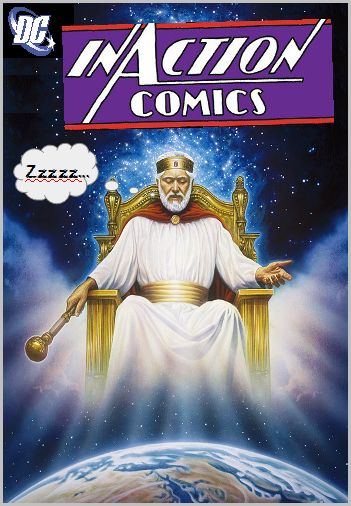
The God

So the universe isn’t a simulation created by a Mind in its mom’s basement. Shame. I thought Don was onto something there.

Let’s consider then another option. The universe, reality and we ourselves were made by a super-being, a God no less. How would that work?

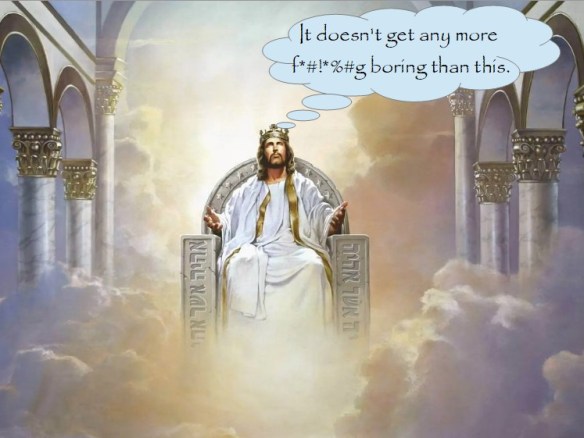
The God looked round. There was nothing, only himself. He did not know for sure that he was a he because he had no Y chromosome or a penis. He hadn’t invented either yet and as an eternal being he had no need of such things. Heavens above, he didn’t even drink or eat so didn’t need dual purpose genitals, not even for urination. He did plan however to create, eventually, when billions of years had past, a sentient being who would have a Y chromosome and a penis. He intended calling this being A Man. This Man would be inherently male so it seemed only right that he, God, should identify as male too.

Damn, he’d digressed again. Where was he? He realised for the billion billionth time (though it was hard to count when time didn’t yet exist and even if it did he’d be outside it) he was nowhere amidst nothing and hadn’t created anything yet. It was time, bearing in mind no time existed, to create the universe, a reality outside of himself.

He looked round again. He was, he had to admit, a bit stuck. There was nothing around with which to create anything; no quarks, no gravity, elements or even Lego; none of the fundamental forces of the universe. There were no fundamental forces because there was no universe. He was going to have to create these things before he could even think about creating a universe. But how? He looked around for something with which to make the quantum realm and gravity and elements and all the other stuff from; but there was nothing. Even as God he was constrained by the principle that something cannot come from nothing. This was a truth universally acknowledged even if there wasn’t yet a universe.

What to do? Could he make a universe from himself, from his own essence as it were? But if he did, would that not diminish him in some way, make him less of a God? A God with a universe-shaped hole in his middle? He didn’t much like the idea of that. It really wouldn’t work.

Could he, he wondered, zap things into existence with just a word? But wouldn’t that be the same as making something from nothing? As such it couldn’t be done. In the far, far future those who believed in him would insist that something could not come from nothing in their arguments with those who doubted his existence. He couldn’t flout the rule and make his acolytes look foolish.

He decided he would have to abandon the whole project. He’d had such plans too, of making his Man and then destroying his descendants in a flood and every other way imaginable until he could send his other Big Idea down to rescue them with special magic. ‘Shit,’ God thought, though that didn’t exist either: ‘I’ll just have to get used to being here all alone with my Big Ideas, surrounded by all this nothing instead of something.’

God’s conundrum demonstrates that it is logically impossible that a God created the universe. Apparently, something cannot be made from nothing, even by a god.

The Mind

Let’s run with the idea* that this reality might be nothing more than a simulation, created by a Mind vastly superior to our own.

*From an idea by Don Camp.

The Mind set up its simulation to run without any external interference. The Mind is outside the simulation and has no interest in engaging with it. Doing so would negate the purpose of the simulation, which is to see how it evolves naturally and unaided.

It is not clear at this point how long the simulation has been running; part of its programming exists to create the impression of a considerable passage of time. Time, memory and even distance are all simulated.

Unfortunately for the simulated individuals within it, the simulation also incorporates penalties – bugs, viruses, perils, conflict and ultimate deletion – to stimulate their collective evolution. These are in fact the drivers of the simulation.

Through them, the simulation has produced the semblance of sentient life. These apparent sentients are largely unaware, like the characters in their simulated dreams, that they are not real. Some of them however are vaguely aware – a glitch in the program, no doubt – that they are the product of a simulation. They create their own simulated constructs of what they think the initiator of the simulation must, in their simulated imaginations, be like. They give these constructs names: Ra, Osiris, Zeus, YHWH, Allah. Jesus and many others. They mistake these simulations for the Mind itself with some concluding they will, once the simulation ends for them, join the Mind in actual reality.

The Mind notes this development with disinterest. It is mildly amusing, nothing more. It turns to more important matters – feeding the cat, taking out the trash – and leaves the ssimulation to run in the corner of the basement.

Now, don’t you think Don, that this is a much more likely scenario than that of super-beings outside of time and space? I’m so glad you suggested it.

Next, what if the universe really was created by a super-being? How would that work? From another brilliant idea of Don’s!

Everything, Everywhere, All At Once

Sadly, we’ve failed to locate Jesus, the celestial super-being who is everything, everywhere, all at once yet nowhere at all. We’ve been presented with some possibilities, specifically that he exists in another dimension, which may or may not exist, from where he whispers directly into the brains of those who, over in this reality, call upon him. He even appears occasionally in visions, when the two dimensions ‘intersect’, which, as everyone knows, they’re capable of doing.

Unfortunately, all of this is undetectable by science but there’s no reason for concern because there is more to reality than that which science can observe. Equally regrettably, there’s no way of verifying this claim either; this is because science is deficient, limited as it is to investigating only ‘dirt and rocks’.

* * * *

It is far more likely that science can’t detect heaven and the eternal Jesus in precisely for the same reason it can’t detect Narnia, Valhalla and all the other fantasy worlds created over the millennia by human minds. Applying Occam’s razor, the imagination accounts for all these other ‘realities’ and the immortals that inhabit them.

No further explanation necessary.


Suffer, Little Children

I recently wrote the post below for The Life and Times of Bruce Gerencser and thought that if you missed it, you might like to read it here. 

I was reading Gary Marston’s latest post on Escaping Christian Fundamentalism God Is So Good! He Allowed Ten Thousand Children to Starve to Death Today.

Gary has his very own Christian troll (All atheist/agnostic bloggers have them) called Swordmanjr, who leapt to God’s defence, the mighty Creator Of All Things needing fallible, flawed human beings to do this for him. Swordmanjr accused Gary of scapegoating God who, apparently, is not really responsible for suffering, nor indeed anything horrible.

I guess God could be being scapegoated if it wasn’t for the fact, his Son, God Incarnate according to some, tells us he cares for human beings much more than he cares for sparrows (which is, admittedly, not much at all), that he is concerned to the extent that he numbers each and every hair on individuals’ heads (Matthew 10:29-30). This must be before he allows so many of them to die of starvation and in natural disasters.

The evidence is that God does not care. He doesn’t care if you’re a child born into poverty who then dies a slow, miserable, painful death through malnutrition. He doesn’t care if you’re caught up in a natural disaster like the recent earthquake in Turkey (which, according to some Christian nutjob, was God’s response to Sam Smith’s performance at the Grammies) in which your entire community and you yourself are wiped out. He doesn’t care if you die of a nasty virus, which ultimately he’s responsible for, as millions including Christians did during the pandemic. He doesn’t care that you die, when, or how horribly. He – just – doesn’t – care, period.

Jesus, as he was about so much, was plain wrong about his Father’s caring. The real world does not and will not match up with this early Christian fantasy.

Believers who leap to God’s defence invariably do it by launching vitriolic ad hominem attacks on non-theists who dare to criticise his shoddy performance. In doing so, they demonstrate yet another of Christianity’s disconnects; it’s promise that it makes new creatures of people, filled with love and compassion (2 Corinthians 5:17).

By their fruits shall ye know them,’ proclaims Jesus in Matthew 7:15-20. If the Christians who lurk around atheist blogs are anything to go by, those fruits are often pretty rotten: vitriol, spite, hatred… ‘evil’ Jesus calls it. These Christians frequently end their comments with a threat: one day the atheist will stand before God’s judgement throne and then they’ll be sorry: hell awaits!

God is not there in this kind of behaviour. He’s not there when humans suffer and die, frequently horribly. He’s not there in the Bible verses that promise he is there in such circumstances. God is not there.


It’s life, Don, but not as we know it

Don wrote:

Here’s the deal. Present evidence, not validations, for the natural fine-tuning of the fundamental forces and for the natural origin of those forces and I’ll use that as a model for my evidence for the existence of God.

I assume a non-answer is because there is no answer.

While I’m under no obligation to respond to Don’s challenge ( a fact he seems unable to comprehend) he continues to badger me to do so.  So here is my response.

Like many of your comments, Don, I really don’t know what point you’re making here. Your challenging me, I think, to provide evidence that the fine-tuning of the universe arose by natural means. I declined to engage with this evasive irrelevancy but as it is preventing you from answering our questions about the evidence for God, I’ll reiterate points I’ve previously made here and here. God forbid you should search for these for yourself, or indeed that you should remember the one from last year, which you commented on.

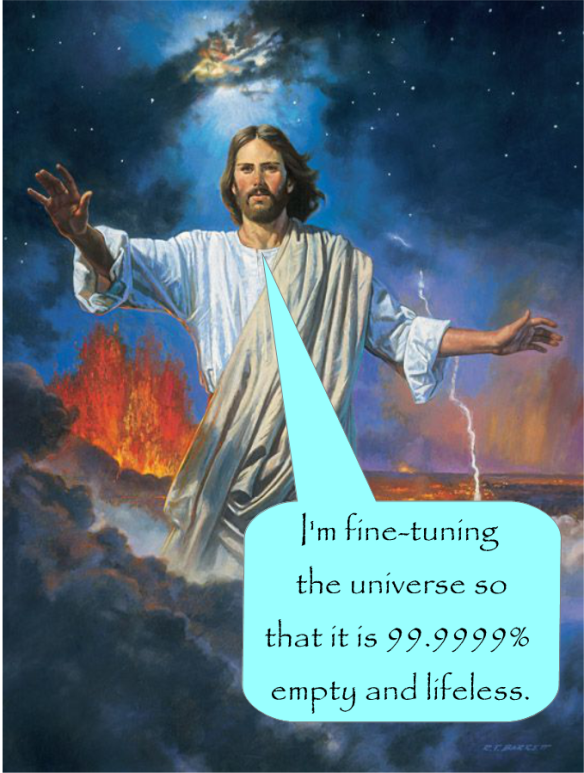
You  presuppose the universe is fine-tuned for life. The evidence demonstrates quite conclusively that it is not.  With 99.9999% of it inanimate, it is evident that what the universe is ‘fine-tuned’ for is inanimacy.

Statistically, however, given there are billions of planets, the likelihood that at least one will have conditions capable of giving rise to life is good. Indeed, the sheer enormity of numbers makes it highly probable. This is not ‘fine-tuning’, which implies conditions were created in order for life to arise.  They weren’t. Conditions happened to be conducive for life’s emergence, though only after 3.7 billion years of inanimacy. That is all.

You come at this from the assumption that life is the most incredible thing the universe could possibly produce. We don’t know this. If the universe were conscious it might think stars or worm-holes much more impressive. Life is but one of the phenomena the universe has produced. We think it’s the most amazing achievement because we are it. This doesn’t mean it is. Indeed that same conscious universe might regard life as a bothersome infestation of one of its more insignificant planets.

No God is required to explain the phenomenon of life and therefore, applying Occam’s razor, we can safely conclude that no God had a hand in its creation or development here on Earth. Certainly not your small, man-made tribal deity, YHWH.

So, as you promised, let’s see you apply these same principles to demonstrate your God’s existence and/or that of a supernatural plane. You can make use of empirical evidence, probability theory and logic but you mustn’t appeal to myth, the Bible or ‘spiritual experiences’ that originate inside people’s heads. Have at it.

Show Me Heaven

On the radio this Sunday, a couple of presenters were discussing a woman’s Near Death Experience. Lynda Cramer claimed that in 2021 she had been clinically dead for 14 minutes when she visited Heaven for five years. You can see her raving about it on YouTube, while the Amazon synopsis of her book, Five Years In Heaven (of course there’s a book; four in fact) reads:

In May 2001, Dr Lynda Cramer died. This is the story of her Near Death Experience, outlining the five years that she spent in Heaven. Starting when she found herself “floating” in the living room for over 45 minutes, she then went on a journey where she entered Heaven, she then processed her Life Review prior to meeting her great-great-great-great grandmother who explained what Life Lessons, Life Contracts and Reincarnation are all about. Backed up by Medical Records as well as diagrams she drew, this is her personal account for anyone intrigued by what happens in the afterlife…

So, is this real? Did Lynda Cramer visit Heaven while she was dead for 14 minutes? She’s a doctor, after all, so superficially at least, she has credible credentials. Until you see that her PhD was obtained researching Near Death Experiences  themselves. Vested interest or what?.

But, let’s not be cynical; she has diagrams too, for God’s sake. What more proof could we ask for? We know too, because our resident Christian tells us, that dreams and visions like this are most definitely from God. Lynda’s experience ticks all the boxes, no matter what we sceptics might think.

Except, no. Lynda was not dead for 14 minutes. We have only her word for it that she was declared clinically dead, while she describes her experience as a Near Death Experience. The clue is in the name. If she was near death, she was not dead; her brain was still alive, if only just. Her mind was still active, creating, if this happened at all, a reassuring experience for itself as it came close to shutting down. There is well documented evidence that this is what the brain is capable of doing when it is close to death (but not actually dead).

Significantly, the scenario her mind created was informed by cultural, quasi-Christian images of Heaven, just as believers’ dreams of God are informed by the same images and characters that occupy their waking minds. My own dreams, for example, are populated by people I know and places I’m familiar with (though sometimes only vaguely; my subconscious fills in the details often in bizarrely imaginative ways.)

Nonetheless, Lynda’s life-changing 5 years visit to Heaven (during which she seems to have done nothing except admire mountains and buildings while blue balls, hijacked from science-fiction, danced around her) is just as real, just as divine, just as valid as the God-given dreams and visions Christians claim they sometimes have. Naturally, we sceptics can’t possibly appreciate these until we’ve experienced them for ourselves.

Lynda’s experience was a subjective, emotional experience while she was unconscious. But such ‘spiritual’ inner experiences are ‘real’ according to at least some Christians, and we can’t argue with that which we have not experienced  for ourselves.

Right, Don?


Redemption Songs

I was listening to some Bob Marley the other day and was struck by a line in his song ‘Get Up Stand Up’: ‘Almighty God is a living man’. He was not of course referring to Jesus but to Haile Selassie, the Emperor of Ethiopia who was still alive when ‘Get Up Stand Up’ was recorded in 1973. Rastafarians like Marley believed the Emperor would redeem African-descended Jamaicans and restore them to Africa from where their ancestors had been taken.

Rastafarians saw and still see themselves as modern day Israelites, like those in the Bible stories of Egyptian slavery and Babylonian captivity. Their perspective is reflected in songs like ‘Exodus’, by Marley, ‘The Israelites’ (Desmond Dekker) and ‘Rivers Of Babylon’ (The Melodians). Selassie himself denied being divine (‘why do you call me good, when only God is good?’) but that didn’t stop those who believed in him from making a saviour god of him. When, inevitably, he died (in 1975), some Rastas left the movement while others reinterpreted his role:

Some Rastas believed that Selassie did not really die and that claims to the contrary were Western misinformation… Another perspective within Rastafari acknowledged that Haile Selassie’s body had perished, but claimed that his inner essence survived as a spiritual force. A third response within the Rastafari community was that Selassie’s death was inconsequential as he had only been a “personification” of Jah rather than Jah himself.

It all sounds rather familiar doesn’t it? The saviour didn’t really die/his inner essence survived/his death was inconsequential. Where have we heard all that before?

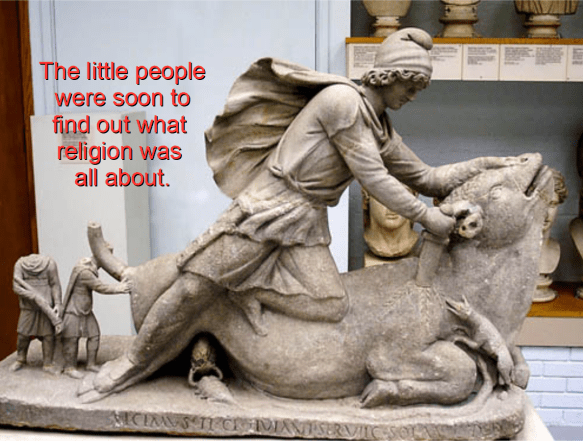
This put me in mind of a cult that for a long time rivalled that of Christianity. Indeed, in the early days of Jesus belief, it boasted more members, all of them men. Unlike Christianity and Rastafari, this cult believed in a saviour whom adherents knew had never existed as a human on Earth. Mithras was a celestial being whose salvific work, which involved the symbolic slaughter of a bull, was carried out in the heavenly realm:

Mithras is the guide of souls which he leads from the earthly life into which they had fallen back up to the light from which they issued… It was not only from the religions and the wisdom of Orientals and Egyptians, even less from Christianity, that the notion that life on earth was merely a transition to a higher life was derived by the Romans. Their own anguish and the awareness of senescence made it plain enough that earthly existence was all hardship and bitterness. Mithras-worship became one, and perhaps the most significant, of the religions of redemption in declining paganism. (Jacob Burckhkart)

Eventually, in the fourth century, Christians suppressed Mithraism to the extent that its adherents, along with its ritualistic texts, were wiped from history. Only its deserted, underground temples remained.

What both examples tell us – and there are hundreds more – is that people have always been willing and eager to make gods of revered figures, both real and imagined. They are ready to believe them capable of impossible feats and to trust in them for whatever form of redemption they feel in need of. There can be no doubt Jesus belief sprang from this same sort of wishful thinking; Jesus being cast as a divine figure with the power to lead believers into the light and/or the promised land of eternal life. It hardly matters whether he existed or not. Like Mithras, an imaginary/imagined figure could just as easily fulfil the role as a real person, like Selassie, who had others’ unrealistic expectations thrust upon him.


Christians’ Favourite Delusions 36: The Universe Is Fine-Tuned For Life.

  1. The return of an old favourite(?)! Christians’ Favourite Delusions. The other 35 posts in this series start here

The vast universe, almost infinite in size, was created, according to Christians, with the sole purpose of bringing us humans and the other creatures who share this planet with us into existence. This fine-tuning argument is used to ‘prove’ that the God of the Bible really exists.

According to Ken Ham, we’re the only life forms in the universe, while other Christians speculate that there may be other intelligent creatures out there somewhere. If there are, then, so says the late Larry Norman, ‘(Jesus) has been there once already and has died to save their souls.’*

The fine-tuning argument proposes that the universe exists so that this minute, insignificant blue dot we live on, and possibly a few other tiny specks, could produce life of some sort. But what of the rest of the universe: the other 99.9999% that doesn’t have life, because it is entirely hostile to it; the vast bulk of the universe that is made up of nebulae, gas clouds, lethal radiation, black holes, anti-matter and lifeless planets?

Taken as a whole, the universe is cold and dead; not finely-tuned for anything, let alone life. But don’t take my word for it. Here’s Richard Carrier debunking the whole fine-tuning argument:

‘[T]he only way we could exist without a God is by an extremely improbable chemical accident, and the only way an extremely improbable chemical accident is likely to occur is in a universe that’s vastly old and vastly large; so atheism predicts a vastly old and large universe; theism does not …

Likewise, if chance produced this universe, we should expect it to be only barely conducive to life, indeed almost entirely lethal to it (as in fact it is), since there are vastly more ways to get those universes by chance selection, than to get a universe perfectly suited to life throughout. … Design predicts exactly the opposite.’

And here, several more scientists, philosophers and other interested parties do the same thing:

https://www.skeptic.com/reading_room/non-fine-tuned-universe/

https://www.google.com/amp/s/www.technologyreview.com/2011/01/18/260556/evidence-emerges-that-laws-of-physics-are-not-fine-tuned-for-life/amp/

https://whyevolutionistrue.com/2015/12/31/sean-carroll-debunks-the-fine-tuning-argument-for-god/

https://m.youtube.com/watch?v=Z9O5wXsgqrc

https://www.goodreads.com/quotes/tag/fine-tuning-argument-debunked

https://www.answers-in-reason.com/religion/christianity/fine-tuning-debunked-holy-koolaid/

Life is remarkable, it is true (but then we would think that, wouldn’t we, when we are it) but it is no more remarkable than any other of the phenomena the universe has produced in its 13.7 billion years of its current existence. No God has been required for any of it. No fine-tuning = no fine-tuner

*In his 1972 song ‘UFO’.

Assertions

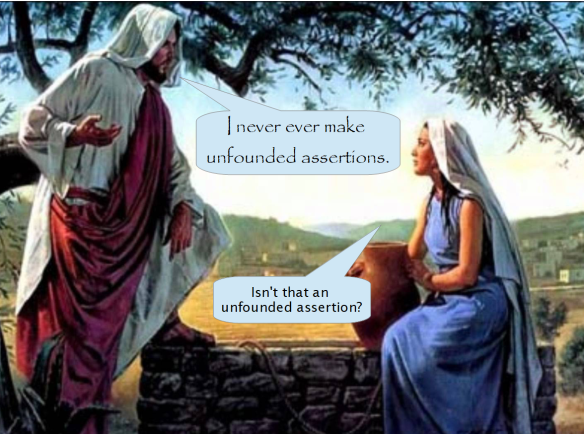
Don likes to take me to task for what he says are assertions in my arguments. I do make assertions, as do we all, because not all points in an argument need to be demonstrated every time they’re used. Indeed, not all assertions can be.

There are assertions that we all accept are likely to be true: the sun will ‘rise’ tomorrow; the Earth is a sphere; evidence is better than no evidence and so on. There are those who dispute these assertions but the onus is then on them to provide the evidence or argument that their counter-assertion is true. Yes, there may come a day when the sun doesn’t rise but it is statistically improbable; the Earth is demonstrably not flat; faith is not an reliable substitute for evidence. There is abundant evidence and sound argument why these things are not the case. But – and this is my point – this evidence does not have to be trotted out every time an argument relies on such probabilities; they can be asserted.

I write, and indeed live my life, on the basis of the fact (‘assertion’) that the supernatural does not exist. Over the last ten years, I’ve posted several arguments why this is the case. I frequently provide a link to these arguments when asserting that, outside of the human imagination, gods, spirits, angels, devils, demons, powers, principalities, ghosts, avatars, heaven and hell do not exist. These arguments form the backbone of any subsequent assertion that the supernatural is not real.

Nonetheless, the onus to ‘prove’ that this is the case does not rest with me. First, because it is impossible to prove a negative. Consider, for example, the Christians challenge to prove their God doesn’t exist. While there is plenty of circumstantial evidence that this is the case, there is no absolute ‘proof’ of God’s non-existence (as I’ve argued before, it all comes down to probability, or, in God’s case, improbability.) Absence of evidence is invariably evidence of absence.

The onus instead lies with the one making the incredible claim. Those who take it as fact that the supernatural and God are real need to demonstrate to the rest of us that this is the case. They have, in my long experience, failed to do this. The best they can do are the various arguments (the ontological, Kalam cosmological, teleological, fine-tuning and the argument from design) that suggest the possibility of the supernatural but fall far short of convincing evidence that the supernatural is real, and further still that the Christian God exists. They depend in the end on the feelings they have in their heads and the Bible (or some other holy book.) This is wholly inadequate

Consequently, I’ll continue to operate from and make my assertion that the supernatural does not exist until such time as Don or any other of his co-religionists demonstrate the probability that it does.

From my assertion, backed up, remember, by earlier arguments, a number of other facts follow:

With no supernatural, there are no gods; YHWH in all his incarnations is a God, therefore YHWH does not exist.

Much follows from this:

If YHWH does not exist, Jesus cannot have been either his avatar, Son or incarnation;

Jesus cannot have been raised from the dead by a being who doesn’t exist;

Stories that he did so must therefore be merely that: stories;

The celestial, eternal Jesus who sits at the right hand of God in heaven is not real;

Any experience people have of this being is entirely within their own imaginations;

The Bible is based on such imagined encounters with these imagined characters;

There is no after-life or judgment;

The Christian faith, including my own, cannot be explained in terms of the supernatural;

Only explanations that are rooted in naturalism, as in science, have any validity.

There are more implications that can be drawn from the premise that there is no supernatural, including the fact that the world makes much more sense (if it makes any sense at all) without drawing gods and demons into it.

Consequently, I shall continue to make my assertions, like those above, supported as always by previous argument. Any religious believer who wants to challenge them is welcome to do so, but must do more than point out the obvious, that they are assertions. They must provide the evidence for the supernatural, and all that follows from it, independent of the goings on in their heads and without reference to holy books written by those with similar subjective feelings.