Making Prophecy Work

Recycled image and still no second coming

Never one to belabour a point, Don Camp has responded to my posts and comments about prophecy over on his own blog, Biblical Musing. This is a modified version of my response to that post.

What you seem to be saying, Don, is ‘leave a selected prophecy long enough and eventually it’ll appear to come true’. Perhaps, but then, if you take any selection of predictions from any source and you’ll find this to be the case. Why? Because:

1) You’ll have cherry-picked from the start so only those ‘prophecies’ that are vague enough or appear to have been fulfilled already will make up the bulk of your selection.

2) The vagueness of many that are chosen will make it relatively easy to scout around and alight on circumstances that seem to demonstrate some sort of fulfilment. You may even invent some that do, like the synoptic gospel writers do.

3) Some prophecies will indeed come true, but at no greater rate than chance allows. A prophecy you cite may say a particular city state will fall and return to the wilderness from which it was built. To claim that when, centuries later, it does so is not a fulfilment of this prophecy; it is a happy coincidence (for you and your so-called prophet, not so much for the denizens of the city state.) Just look at the number of ancient cities to which this has happened, without there being a preceding ‘prophecy’. It just happens.

4) You’ll ignore your own failure rate, or explain it away: i) discounting those prophecies that have never come to pass, even after millennia; ii) insisting ‘they could still occur! With God a day is like a thousand years!’; iii) reinterpreting them: ‘they’re metaphorical’ etc.

5) You invoke the get-out clause; the god says ‘if you don’t do ‘x’ then I’ll make ‘y’ happen.’ “Well, praise the god, everyone did ‘x’ and the calamity was averted! It’s a miracle!” This then counts, somehow or other, as a win for the ‘prophecy’.

These are your strategies, Don. You use them in combination to demonstrate the ‘fulfilment’ of biblical prophecy. You work really hard at nullifying your own cognitive dissonance, desperately attempting to demonstrate the truth of ancient fantasies. You conclude your post by saying Jesus will return as King soon. No, he won’t. You need to apply every one of your strategies to believe this is ever going to happen.

The ‘F’ Word

Don Camp is defending Christians in the comments. They’re in the process of becoming ‘more like Jesus’, he says.

What does this even mean, Don? How can you know what Jesus was like when there are so many disparate versions of him in the Bible (as has been pointed out to you)? Does becoming more tempestuous, impatient, impossibly demanding and Jewish count? These are some of the traits his propagandists show him as having.

You then tell Jim not to measure Christians ‘by his (own) experience’. What other measure is there? Christians aggressively promote their beliefs on the internet, have infected politics and, at a lower level, are encountered as judgmental evangelicals and sanctimonious street preachers; these are the Christians of our experience and like it or not, the fragrance ain’ that sweet. As Jesus is supposed to have said, ‘by their fruits shall you know them’. We sure do.

Bottom line, Don: you Christians have had two thousand years now to make the world a better place by being ‘more like Jesus’. On balance, you’ve failed. Not surprising when Jesus himself failed even more. Where is he, Don? Following his ‘return’, the Righteous should have been living in peace and harmony for the past two millennia, tediously worshipping him and his Father in God’s Kingdom on Earth. They haven’t been, even though Jesus, Paul and several other NT writers said they would be ‘soon’, relative to their own lifetimes. 

Argue it how like, Don (and you will), Christianity merits one big ‘F‘.

Battle Of The Magic Books

Don Camp replies (in blue) to my previous post. My responses are in black.

There are multiple reason for rejecting Mormonism. The primary reason is similar to discerning between a fake $20 bill and the real thing. The fake just doesn’t feel like the real thing. Of course, that test requires that one knows what a $20 bill feels like. Anyone who does not know is easily fooled.

In fact, if you don’t know what the real thing is like, it is impossible to identify a fake. You might notice an ink smudge and a difference in paper, but who is to say one is fake and the other is not?

This presupposes that your version of Christianity is ‘the real thing’. For a Jew, Judaism is the real thing and Christianity the Johnny-come-lately fake. All you’re saying here is that you ‘feel’ your version of Christianity is the real thing and you ‘feel’ Mormonism isn’t. This isn’t persuasive. I know, for reasons other than intuition, that Christianity isn’t the real thing. To use your analogy, it is the twenty dollar bill received in change when in the UK a twenty pound note is the ‘real thing’.

But since you have a knowledge of literature, Neil, why not apply those standards? Nice concession there, Don. The Bible is indeed literature and as such deserves to have the same standards applied to it as any other work of fiction.

Is the Bible and the narrative in the Bible coherent?? No. Its central character is ridiculously inconsistent. Described as an unchanging God, he changes from book to book and most noticeably between the Old and New Testaments. As someone commented on Debunking Christianity recently, it’s as if he ate a Snickers bar between the two. (He does get hungry again towards the end of the NT, when he reverts to being an omnipotent Putin.)

As the protagonist undergoes his major rewrite, the plot also suddenly deviates, becoming a completely different story. It starts by being about this poorly conceived character’s ‘everlasting covenant’ with his chosen people, but then two thirds of the way through, this everlasting covenant is scrapped and replaced with a new, largely incoherent deal involving a human sacrifice that the unchanging God has previously said he finds abhorrent.

Does it stick together and develop a single theme across the whole? No, it doesn’t ‘stick together’, not unless you ignore the gaping inconsistencies in character and plotting, and its overall implausibility.

Do you know what the theme of the Bible is, Neil? Yes, thank you, Don. Condescending of you to ask. Any apparent consistency is because the writers of the second part of the story had access to the first part. They plundered it for their own purposes, drastically altering it so that it suited their new theme. That is why much of the Jesus story appears to be foreshadowed in the Old Testament. The Jesus story – and it is a story – is built on events and episodes they found there.

Remember that the Mormons tell us that the Book of Mormon is an extension of the Bible and that the people of the Americas were related to the Jews and held to the basic truths of the Jews. (Remember also the Mormons believe that Jesus appeared to these people in the New World shortly after his resurrection.) So if you put the Torah and the Book of Mormon together, is the narrative coherent? Does it develop a single theme? The Old testament and the New Testament are a coherent whole, but I do not think the Old Testament and the Book of Mormon are. As you can tell, I dispute that the Old and New Testament are a coherent whole. The Old Testament and the Book of Mormon aren’t either. That lack of coherency becomes even more obvious when we compare God in the Old Testament with God in the Book of Mormon. The person of Jesus is also inconsistent in the Book of Mormon with the Bible.

But they’re inconsistent within the Bible too, Don. Compare John’s Jesus with Mark’s. Compare Paul’s beatific Christ with Revelation’s grotesquely super-powered warlord.

Of course, the standard explanation by Latter Day Saints is that the Bible has not been adequately translated, though I know of no place where they can demonstrate that claim. There are significant translation problems with the Bible, which mainstream scholars consider at length. Mormon desperation to resolve these conflicts is the same as that demonstrated by Christian theologians.

Finally, there is a matter of provenance. We know in very good detail where the Bible came from.

We do? We know who Matthew, Mark, Luke and John actually were? No, we don’t nor do we know where they wrote or what their sources were. We don’t have the autographs (originals) of any of the New Testament documents but we do know some of them are forgeries and others have been tampered with.

There are many copies, especially for the New Testament, and there are many commentaries of both the OT and NT from very early in the their history. Proving what? Only that they were copied, frequently inaccurately. The copies are all much later than the probable time of composition. The commentaries are similarly far removed from them; there are commentaries on the Book of Mormon much closer to its composition.

What is the provenance of the Book of Mormon? It apparently appeared magically out of nowhere pretty recently. No mention in any other literature of its existence. It did appear magically! Oh ye of little faith! God sent an angel, like he does numerous times in the Bible, and told Joseph Smith to translate the golden tablets. The NT books were similarly created, with God breathing his word into cult followers as they wrote. God, angels, Holy Spirit, magic – all of a muchness, don’t you think?

No copy is available to examine. Nor of the original copies of anything in the Bible.

That is not to speak of the total lack of any archaeological evidence for the Mormon claims of Jews in the Americas. Mormons dispute this, of course. There are similar problems with some locations mentioned in the Bible. More fatally, most of what the Bible promises has proven false. For example: Jesus’ imminent return, his guarantee of miracles, believers becoming new creations. (Paul spends much of his time ticking off these ‘new creations’ who remain resolutely unreformed.)

So, I would say the Book of Mormon fails on all levels.

I would too. As does the Bible for the reasons I’ve outlined, and despite your special pleading. You don’t apply the same rigour in your consideration of the Bible that you do to Latter Day Saint fiction. Why is this, Don?

Dear Evangelical: Why Aren’t You A Mormon?

Dear Don,

Why are you not a Mormon? I mean, you appeal to the evidence of consistency across the 66 books of the bible, claim that the gospel writers remained true to an oral tradition (despite John’s gospel being markedly different from the other three) and insist there is no difference between the original apostles’ gospel and Paul’s (when Paul is adamant there is.) In fact, there is even better evidence that Mormonism is true.

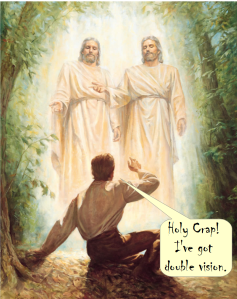
First off, Joseph Smith saw the resurrected Jesus in person! Not only Jesus but God the Father too. And they spoke to him! He relates the story himself, so unlike the gospels, this is no second hand reportage:

I saw two Personages, whose brightness and glory defy all description, standing above me in the air. One of them spake unto me, calling me by name and said, pointing to the other—This is My Beloved Son. Hear Him!

Following this, young Joseph was instructed to translate the Book of Mormon from some golden plates. We don’t have to take his word for it that these plates existed because Joseph had witnesses:

Eleven official witnesses and several unofficial witnesses testified to the existence of the golden plates and, in some cases, to dramatic supernatural confirmation of their truth. Meticulous research on these witnesses has confirmed their good character and the veracity of their accounts.

Impressive, don’t you think? We have no such affidavits for the gospel writers – we don’t even know who they were!

Also like the Bible, the Book of Mormon had multiple authors (Joseph Smith was only translating, remember):

Furthermore, in recent years, rigorous statistical analysis strongly indicates that neither Joseph Smith nor any of his known associates composed the English text of the Book of Mormon. In fact, research suggests that the book was written by numerous distinct authors.

And yet, the Book of Mormon tells a story even more consistent than the Bible’s!

Better still,

the Holy Ghost affirms the authenticity of the Book of Mormon, just as he does the Bible: the conclusion of the matter is that much modern evidence supports the more powerful witness of the Holy Ghost that the Book of Mormon is true. Joseph Smith, who translated it, had to be what he said he was, a prophet of God.

Finally, the growth of the Church of The Latter Day Saints demonstrates its truth and saving power. Its early expansion was greater than that of the first-century church.

Amazing, don’t you think, Don?

* * * * *

I expect like me, you reject all this so-called evidence and regard Mormonism as so much bunk. But on what basis? What causes you to dismiss the teaching of the Latter Day Saints while embracing the equally incredible, magic-infused stories of the Bible? As the Mormon church says (sounding not unlike yourself when talking about the Bible):

Persons who choose to dismiss the Book of Mormon must find their own ideas for explaining it and the mounting evidence for its authenticity.

When you arrive at the criteria you apply in rejecting Mormonism, you’ll have arrived at the reasons I and many others reject your beliefs.

Slippin’ and Slidin’

Recycled picture, new post

I’ve written before about how impossible it is to argue with Christians. It’s either that they have superior knowledge because an invisible ghost possesses them and is guiding them towards truths that non-believers can’t possibly perceive. Or it’s that the supernatural just cannot be understood in an evidential, naturalistic way. Science and empiricism – what we can detect with our own eyes, with specialist equipment that serves as an extension of those eyes or that can be mathematically demonstrated – just cannot detect, perceive or understand the supernatural. Gary Matson is currently experiencing this on Escaping Christian Fundamentalism, where a Catholic Christian (an oxymoron to many other religionists) is arguing that the things he believes in – hell specifically and his God generally – are just too sophisticated for the ignorant layman to understand. We’ve met this before too, from pseudo-intellectual Christians who think their faith, which its supposed founder said was best understood by becoming like a child, requires a degree or three in theology or philosophy.

It’s all a sleight of hand, and rather like wrestling with a jelly-fish. The assertion that the believer in the supernatural makes, that his or her particular brand of woo lies outside the purview of science, is mere flannel. ‘You can’t prove this because you haven’t the tools to’, applies to any form of magical belief – in heaven and hell, in an afterlife, in ghosts, and angels, gods who speak to mortals, mystical saints, flying horses, reptilian overlords, UFO abductions… you name it – does not stand up to scrutiny. If supernatural entities and states are outside the natural universe (and they are, by definition) then they will never be detected by science, observation and empirical measurement; but not because our means of detection is inadequate, but because they don’t exist. It isn’t that they are out there somewhere, detectable only with the right frame of mind or with the help of a spirit that itself has no physical presence; they are nowhere; they are not real. It is not the inadequacy of our means of detection that is at fault; it is that the invisible, non-physical and intangible have no substance outside the human imagination. As I’ve said before, remove human imagination from the equation and the supernatural goes with it. If humans were to become extinct tomorrow, so too would all the magical beings and places that humans have ever conjured up. They have no  existence independent of the human imagination.

Arguing that this isn’t so is to assume your conclusion in your premise: ‘Of course supernatural things exist, you just can’t see them. But I can prove them with my argument/philosophy/faith’. This, however, is a demonstration of irrationality, not of the supernatural. In any case, the fact the supernatural has to be argued for at all is evidence that it doesn’t exist. Nothing real has to be argued for, it can be detected, shown, demonstrated and measured by the senses, by instruments, by mathematical proofs. That gods and ghosts can’t be, but have to be argued for, tells us they are not real – not that they are beyond the scope of our capabilities.

What Christian Music Tells Us About God

ThankYouBasedGod.tumblr.com

Have your ever noticed how the unchanging God’s musical tastes… well, change?

In the time of David, or so we’re told in Psalm 150, he liked nothing better than the sound of lutes and harps. When monasteries were all the rage, he was pacified by the monotonous chanting (‘plainsong’) of those very same psalms. He went all highbrow a few centuries later with the likes of Bach and Handel, but found out later still that he preferred bad poetry set to rousing tunes, such as How Great Thou Art and Amazing Grace (the latter by slave trader John Newton.) Not to show partiality, he’s also been known to be turned on by some good ol’ gospel music. Last night on TBN, a TV network of spectacular mindlessness, he was brought to orgasm by a third-rate hip-hop track that, like a primitive enchantment spell, repeated Jesus’s name ad infinitum. Which reminded me of a Christian rock group of that name that performed back in my youth, when God was into sub-standard glam rock. It is amazing, isn’t it, that God’s musical tastes keep pace with our own.

On the other hand, maybe it’s that we delude ourselves into thinking our changing musical preferences, be it for lutes and harps, glam rock or hip-hop (ten years past its sell-by-date), are what please the Lord. He is not a God of changing tastes but one who is a reflection of whichever culture projects its idiosyncrasies, musical or otherwise, onto their conception of him. He truly is made in our image.

All Along The Watchtower II

I’ve had a reply from my friendly neighbourhood Jehovah’s Witness, Jim and Sandra. Well, from Jim. Sandra seems to have left him to it. Naturally, politeness compelled me to reply to Jim’s reply.  

Jim first:

Hello Neil 

We wanted to say thanks very much for your email. We appreciate hearing what you had to say. We hope that you and your family are well, and continuing to stay safe. We want you to know that we fully respect your beliefs so thank you for sharing them with us. But please consider what we have to say in response with an open mind. 

Firstly, you may be familiar with the ‘Cambrian Explosion’ which marked the time when most of the major groups of animals first appear in the fossil record. The reason they call this an ‘Explosion’ is because of how short the period of time with which almost all animal life suddenly appears. As you mentioned with Occam’s Razor, we have found that the Bible provides one explanation as to how life got here, whereas science points to an accumulation of many different theories that even scientists themselves don’t agree on… such as Sir Isaac Newton and William of Ockham as well as many other scientists who do believe in an intelligent designer – God.

You also raised excellent points about God’s existence too, you mentioned that according to our reasoning things that are complex must have a creator. While we completely agree God is definitely complex, the Bible answers that question by saying that “From eternity [God has] existed” and “From everlasting to everlasting, you are God”. So we can see here that while God is the creator, he is not a creation. So as hard it is for us as humans to comprehend (as everything we know has a designer) God wasn’t created as he has always existed. 

You also mentioned that if God created everything, this would mean that he also created viruses etc. However if we think of Benjamin Franklin, for example, he created electricity… but we would not say he was the cause of people dying due to the electric chair would we? The Bible does clearly state that God “created all things, and because of [his] will they came into existence and were created”. So while we would not dispute God did create everything, things we experience today are present as a byproduct of a situation God never intended to happen.  However this then raises the questions… What was God’s initial purpose for humans? And why does God allow suffering and diseases?

If you would like the answers to those questions, just let us know in your reply and we would be happy to discuss that with you too.  In the mean time, we found this video that we thought you would find really interesting. You can watch it for free and by all means please let us know your thoughts on it.  https://www.jw.org/en/library/videos/viewpoints-origin-of-life/irene-hof-laurenceau-orthopedic-surgeon/

Kind regards, 

Jim

And my reply. I wanted to turn the discussion round to that JW weakness – one of many – their preoccupation with Jesus’ return (or lack of it):

Hi Jim,

Thank you for your response. I hope too you are both well. I have to say I was unconvinced by your assertion that Ben Franklin created electricity – he certainly didn’t. Electricity is a natural phenomenon that humans have been interested in for thousands of years. Consequently, your analogy between Franklin and God doesn’t stand up. If God created viruses, germs and parasites (as he must’ve done if he created ‘everything’) only to let them run amok amongst the rest of his creation, then he is responsible for the outcome. You say this is not what he intended but as an omniscient being he must have known what was going to happen, just as he must’ve known in advance that Adam and Eve would ‘sin’. Yet he still went ahead and created viruses and the like, knowing the havoc they would cause. How could a loving God do that?

I have to tell you, I’m not going to be persuaded of God’s existence by the argument from design, nor by the argument – though it’s really no more than an assertion – from incredulity. It’s the one in the video clip you sent that says essentially, ‘this natural phenomenon is just so amazing I can’t understand how it came about. Therefore it must have been God.’ Similarly, for you to quote the bible’s claim that God has always existed isn’t convincing either; that some ancient tribesman and their scribes thought so does not constitute proof. 

What might convince me? Possibly if the things Jesus said he was going to do had actually happened. Take, as one example, his promise that God’s Kingdom would be established on the Earth while those he was speaking to were still alive (Matthew 16:27-28, Matthew 24:27, 30-31, 34 and Luke 21:27-28, 33-34 amongst other places.) If this had happened, I’d be able to look around and see God’s plan for humankind in action and say to myself, ‘how mighty fine it is to live in the wonderful kingdom God has blessed us with these past 2000 years. He truly is real.’ But of course he didn’t, and Jehovah’s Witnesses and other branches of Christianity have been making excuses for him ever since. 

I keep a blog you might like to read. A while back I did some posts on the non-arrival of the Son of Man, the final judgement and God’s Kingdom on Earth. While you might find them irreverent, you can see them here: https://rejectingjesus.com/2018/01/28/jesus-demonstrates-that-god-doesnt-exist/ https://rejectingjesus.com/2017/06/23/making-excuses-for-jesus-4/

I do hope you’ll read them. Feel free to explore other of my posts too.

Neil  

All Along The Watchtower

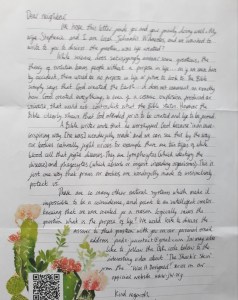
One post in and already a diversion from my planned ’12 Rules’ series. This is because I was fortunate enough to receive a letter in the post recently from my ‘neighbours’, Jim and Sandra. You can see it above. I’ve no idea who Jim and Sandra are – I’ve changed their names here to protect the guilty – but they tell me they’re Jehovah’s Witnesses. They want to convince me of their God, first by pointing out that we are, everyone of us, created by him. They then proceed to demonstrate their God’s existence with rather weak versions of the weak ‘argument from design’, with a spot of the so-called ‘argument from incredulity’ thrown in. Having ‘proved’ God, they conclude with a lovely non-sequitur, that God = purpose.

As they had gone to a lot of trouble to do this, I felt Jim and Sandra deserved a reply, specially as they were kind enough to include their email address. So here it is.  

Hi Jim and Sandra,

I was interested to get your letter recently. I notice you ask the question, ‘was life created?’ Of course it was! You’ll get no argument from me there. Nature and the processes of natural selection and evolution created life as we know it today. You of course want to draw God into these processes, but actually he’s not needed to explain them. 

Your ‘argument from design’ doesn’t work at all, because if God created all the wonderful, intricate things you talk about, he also created viruses, including covid-19, cancer and parasites. You can’t say he created everything and then discount all the nasty things as the product of natural processes or man’s sin or whatever. Either everything was made by God or everything is the result of natural processes – you don’t get to pick and choose. 

You say that only (your) God could make all the complexities of life, as complexity necessitates a creator. But that creator must, by definition, be more complex than his creation – yet you don’t think he had a creator, do you. But he must have done – because according to you, complexity has to have a creator. This principle doesn’t grind to a halt with God just because you or your church or holy book says it does. 

The intricacies and complexity of life that we see are the result of organisms, including ourselves and all other life & non-life, like viruses, adapting to their environments over billions of years. That’s it – no need to add another layer of complication, like a god, to this explanation (you may have heard of Occam’s razor, which is what I’m applying here). If something complex has existed for eons it is far more likely that it is something we know for sure exists – nature – rather than something we don’t. 

Life has in fact many purposes; one doesn’t need a God who doesn’t exist to discover them. I’d be happy to share some of these with you, though I imagine you are already quite set in your beliefs. That’s a shame.

Best wishes,

Neil 

Prophets At A Loss (again)

What a joy it is to witness the prophets of the Lord who a few weeks ago assured the world that Jesus had told them Donald Trump was going to win the US presidential election. Look at them floundering now to explain away their foolishness:

Pat Robertson on 20th October: ‘Without question, Trump is going to win the election.’

After the election: ‘Here is my take on the election. In my opinion I think Trump won it. That may shock you… There are cases being filed in many courts but I don’t give them much chance of winning.’

Paula White on 5th November: I hear a sound of victory. I hear a sound of abundance of rain. I hear a sound of victory. The Lord says it is done. The Lord says it is done. The Lord says it is done.

After the election: ‘God’s decision has been made… the church must enforce some things in the realm of the Earth. We must take authority over every demonic spirit, every high thing.’

Kat Kerr on 24th October: ‘Trump will win. He will be president of the United States. He will sit in that office for four more years and God will have his way in this country.’

After the election: ‘One of the things [God] had me say was that Trump would win by a landslide… But many times, as we know in the Word or even just from experience ourselves — especially as a prophet — that doesn’t ever mean what man thinks that means.’

Jeremiah Johnson on 30th September: ‘I had a dream… God showed me… President Trump will be re-elected.’

After the election: ‘There has been a chorus of mature and tested prophets in America with a proven track record that have predicted Donald J. Trump would be re-elected President of the United States. I am one of them… Either a lying spirit has filled the mouths of numerous trusted prophetic voices in America or Donald J. Trump really has won the Presidency and we are witnessing a diabolical and evil plan unfold to steal the Election. I believe with all my heart that the latter is true.’

Denise Goulet on 19th October, speaking to Trump in person: ‘The Lord showed me today that you are going to get a second wind…another in-filling of the Holy Spirit…because the Holy Spirit makes you able to finish, to take this to the end, Mr President.’

After the election: f*** all.

It’s demons! An evil plan! I meant something else! I still think I’m right! I hope everyone forgets what I said.

Friendly Atheist Hermant Mehta has a whole lot more. These people are either frauds or self-deluded idiots. It’s stating the obvious to say that God and Jesus do not communicate directly with them. They haven’t been singled out to receive divine messages. Yet that is what they believe, or claim to anyway. They know no more about the future or God’s intentions than a typical house fly does. Yet the gullible, those caught in the same pretence that is Christianity, believe them. Yes, there are smart arse discerning Christians out there who say they never fall for these charlatans. Yet they do.

In Jesus Eclipsed, David Chumney cites Eugene Boring who, he says, ‘catalogs dozens of sayings ascribed to Jesus in the Gospels that very likely originated with later Christian prophets’ (my emphasis). Yet the writers of the gospels pass off these ‘spiritual insights’ as though they were Jesus’ own. Those who first read the gospels believed they were. Christian’s today assume the same. They’re not. They’re the words of religious zealots making things up as they went along. Some, most perhaps, no doubt believed what they were channelling the words of the Lord. Others wouldn’t have been quite so sincere.

There is no such thing as a prophet. God doesn’t make his intentions known through cranks and fraudsters. There’s no God and no Eternal Jesus to do such a thing, as today’s holy con-artists so ably demonstrated with their predictions of a Trump victory.


In which Paul takes a trip to the third heaven

Blog408

In the New Testament, there are:

8 or more supernatural ‘visions’;

18 or so ‘appearances’ of angels;

about 6 significant dreams, through which God talks to people;

a dozen apparitions of dead people and

at least 3 significant ‘revelations’, in which individuals sense God in their heads (Paul, Jesus and John of Patmos).

The man who is largely responsible for Christianity as we know it, Paul, alludes only briefly to his magical conversion to the faith, describing it as ‘in’ his head in Galatians 1.16. It’s up to the writer of Acts to elaborate and embroider this non-event. Paul does, however, give rather more detail about another hallucination he has, in 2 Corinthians 12.1-4. To avoid boasting, he says boastfully, he refers to himself in the third person:

I must go on boasting. Although there is nothing to gain, I will go on to visions and revelations from the Lord. I know a man in Christ who fourteen years ago was caught up to the third heaven. Whether it was in the body or out of it I do not know, but God knows. And I know that this man—whether in the body or out of it I do not know, but God knows— was caught up to Paradise. The things he heard were too sacred for words, things that man is not permitted to tell.

This is evidently a psychotic episode; seeing things that are not there, experiencing events that are not happening. Paul himself admits he doesn’t know whether it was a real experience, nor does he know if he was in his body or not (definitely in it, just out of his mind.) He heard, he says, things he can’t possibly repeat, which makes you wonder why he bothers mentioning the whole bizarre episode in the first place: ‘I had this fantastic experience, unlike anything I’ve experienced before – but I can’t tell you a thing about it.’ It sounds like a dream he’s having trouble remembering or, like, man, a really freaky hallucinogenic trip.

From psychotic episodes like this – his conversion is another one – Paul spins his entire theology. Yes, the faith of Christians everywhere is founded on the hallucinations of a first century nutcase visionary.

I don’t know about you, but I’ve better things to do with my life than base it on the dreams and visions of a psychotic who lived 2000 years ago.