Some Pig: Why God’s laws are not written on our hearts

Morals

According to Christians, everyone of us knows the right way to behave because God has written his laws in our ‘hearts’. We don’t always bother to consult what he’s written there, however, because we prefer to do our own thing, which is when our consciences start to bother us about our wicked ways. Here’s how Paul put in Romans 2.15:

Gentiles show that the work of the law is written on their hearts, while their conscience also bears witness, and their conflicting thoughts accuse or even excuse them.

There’s no evidence that this is how it works, of course; Paul never cared much for evidence nor even for making sense. We know that, provided we are not born with psychopathic tendencies, we learn values, morals and how to relate to others from care-givers in our early lives. They teach us to share (or not) and how we should treat other people, and while it’s true we do seem to be born with a sense of empathy – watch a young child respond to the distress of another – this needs to be cultivated and nurtured. A knowledge of the 613, frequently absurd stipulations of the Old Covenant (which is what Paul is referring to) is demonstrably not genetic; we do not have an innate or instinctive understanding of God’s requirements. Psychologists point to the fact that it is only when she is three that a child learns that stealing is wrong; she is not born knowing it.

All of which is a far cry from ‘God’s law being written in (our) hearts’. Even if Paul meant we have a sort of general, non-specific understanding of how we ought to behave – though this is not what he actually says – there is no evidence this has been planted in us by a supernatural being. Certainly not one that thinks slavery is okay and whose prohibition against killing doesn’t extend to tribes beyond one’s own.

The Christian approach to morality puts me in mind of Charlotte’s Web. In that great children’s book, Charlotte the spider adds messages to the webs she spins to help save her friend, Wilbur the pig, from slaughter. When the gullible humans in the story see ‘Some Pig’, ‘Radiant’, ‘Amazing’ and ‘Humble’ written in the webs, they inexplicably give the credit, not to Charlotte, but to Wilbur. No-one, either in the book itself nor in reviews, comments on the fact that it is not Wilbur who has these qualities, despite what the messages say, but the creature who made them (an anomaly I’m sure E. B. White was aware of when he wrote the book.)

If I might interpret Charlotte’s Web allegorically, we humans are Charlotte, while Wilbur, on whom everyone seems focused, is God. It is we who have developed moral codes throughout our existence, the latest versions of which our children learn from us, and attempt to follow (or not). Meanwhile, the likes of Paul and contemporary Christians refuse to give us one iota of credit. Instead, they insist, the credit goes to their god; a being nowhere near as pleasant as Wilbur, though he’s every bit as fictional – another of our creations, just like those moral codes we invented.


“When (a worldview) doesn’t include God, there is no basis for morality.” Roy Moore, 2008

Ravi3

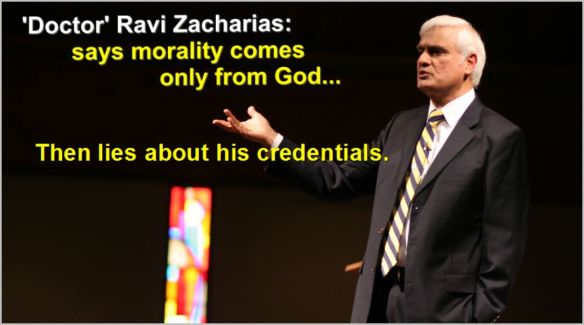
I planned to dissect Ravi Zacharias’ morality argument even before recent revelations that he lied about his credentials. I’m sure that, despite his fraudulent claims, he’s still a good Christian™, perfectly entitled to tell the rest of us what terrible sinners we are. If you’ve ever seen his grandiose sermonising, you’ll know he likes to pretend that Faith is something deeply intellectual, despite Paul’s contention in 1 Corinthians 1. 26-27 that it isn’t. Zacharias’ pseudo-intellectual Christianity is, like many of his qualifications, fake.

In common with other Christians desperate to prove their God, he relies too on circular reasoning. He tells us that our morality derives from God (you listening TC Howitt?) and then uses this to argue that, because of we have morality, God must exist. His unproven conclusion is his premise, with nothing in between to justify either.

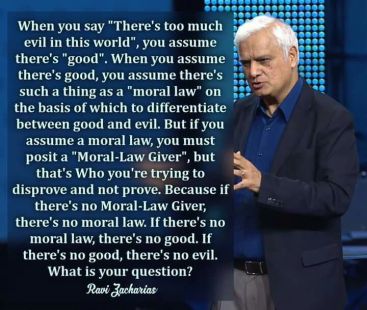
Here’s his ‘argument’ in full:

Ravi3

Let’s take a closer look:

‘When you say “There’s too much evil in the world”, you assume there’s “good”. Who says this? How much evil is ‘too much’? Do people other than Christians see the world in terms of good and evil? Does acknowledging evil mean one also assumes there is good? How is this ‘good’ defined? So many unanswered questions in this first muddled statement.

‘When you assume there’s good, you assume there’s such a thing as a “moral law” on the basis of which to differentiate between good and evil.’ The only one making assumptions here is Ravi himself. The considerate treatment of others, which is how we might reasonably define morality, is easily recognisable when it occurs. This presumably, given he fails to define any of his terms, is what Ravi means by ‘good’ (and conversely, inconsiderate or malicious treatment of others is his ‘evil’). There’s no reason to suppose, however, that the demonstration of good is a component of an objective ‘moral law’ that exists somehow independent of human interaction. Morality and any resulting goodness (or ‘evil’), is human interaction.

‘But if you assume a moral law you must posit a “Moral-Law Giver.” Well, of course we’re not assuming a moral law, not in the magical way Ravi is assuming we’re assuming. And how about that imperative: ‘You must posit a “Moral-Law Giver”‘! Must we? Morality is socially determined by human beings themselves; we see this is in the different moralities that have emerged in cultures with shared heritage; we see it in the changing attitudes over the last fifty years to the treatment of women and gay people. Morality is fluid; it evolves. The ‘Moral-Law Giver’ then, if we must have such a term, is we ourselves.

‘But that’s Who you’re trying to disprove and not prove.’ Erm no. Ravi’s being disingenuous here. ‘We’ were not trying to disprove a Moral-Law Giver at all; he was trying to prove it (him? – note the capital sneakily added to ‘Who’). Let’s though, for the sake of argument say Ravi is right; let’s say there is a Moral-Law Giver out there somewhere. Why has he, over the expanse of human existence, issued such varying and often conflicting moral codes? Compare, for example, today’s moral standards with the harsh, brutal morality of the ancient Israelites, which demanded the death penalty for almost any infringement of the law. Compare that with the morality Christians today claim they derive from New Testament. Then compare Jesus’ impossible demands with how Christians actually behave. By and large, they’re happy to ignore him and, with the exception of one or two areas they get hot under the collar about (abortion, same-sex relationships), they go along with the consensus of the culture in which they live.

‘Because if there’s no Moral-Law Giver, there is no moral law.’ There is a ‘moral-law giver’: it is us. That is why moral laws vary according to culture and through time. Zacharias wants us to conclude that this capitalised ‘Moral-Law Giver’ is his God, yet he has neither demonstrated that a deity (any deity) decrees moral codes from on high, nor has he ‘proved’ (his word) that this cosmic law giver is his god, the barbaric and inconsistent YHWH. Rather, he ‘assumes’ this to be the case and hopes that his audience, failing to notice his assumptions, presuppositions and sleight of hand, will too. Given that most of them are Christian sheep  (Jesus’ term, not mine) they will no doubt do just that.

‘If there’s no moral law, then there’s no good. If there’s no good, there’s no evil.’ This is where the argument, such as it is, turns back on itself. Zacharias thinks he’s being very clever (he always thinks he’s being clever) but all he’s doing is declaring his premise over again.

Of course there are moral standards; humans have devised them throughout their existence. The ‘Golden Rule’ promoted by Jesus, for example, is first recorded thousands of years before him. We determine for ourselves what is good and therefore what is ‘evil’; these defintions are not delivered to us ready made from a “Moral-Law Giver” in the sky.

(While Zacharias doesn’t use the argument, there are those who like to say, on the basis of Romans 2.15, that God has written his (ever-changing) rules in our hearts, a fallacy I’ll address in the next post.)

‘What is your question?’ clever Ravi finally asks. We didn’t have a question. Here’s one for him anyway: how has he got away with such fraudulent drivel for so long?


Can you be good without God?

Good

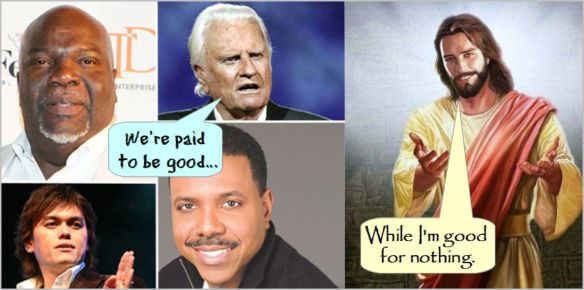
You can’t be good without God, you can only be good with him – or so Christians like to tell us.

What is the evidence for this? What ‘goodness’ do we see in and from Christians (and other believers in God) that demonstrates they are directed in their morality by a supernatural being who, they say, dwells within them? ‘By their fruits ye shall know them,’ declares their leader in Matthew 7.16 – so what ‘fruits’ do we see?

How about Christians abusing the vulnerable? Sexual abuse of minors has long been widespread in the Catholic church and more and more cases are coming to light in Protestant ones too. Bruce Gerencser keeps a log of those accused and convicted of such crimes, adding names and cases from the States on almost a daily basis. Is this the ‘goodness’ Christians like to say comes from knowing God?

Or how about those believers whose ‘goodness’ manifests itself in cruelty, dishonesty or extreme right-wing views? (Never mind goodness, from these examples it would seem God doesn’t even provide his followers with common sense.)

Then there’s the likes of former judge Roy Moore, anti-LGBT politician who, when he’s not trying to erect monuments to the ten commandments, is excusing his history of grooming and abusing 14 year old girls? What part of this behaviour is ‘good’?

How about preachers like Franklin Graham, Stephen Green here in the UK and the self-righteous know-alls of Teens4Truth, all of whom persistently bear false witness? Perhaps demonising others with the intention of stirring up hatred and paranoia is somehow ‘good’ inside the Christian bubble.

‘Ah, but wait!’ say those Christians who insist we can only be good with God. ‘These people are not true Christians; if they were they wouldn’t be doing these things. Their behaviour tells us they’re not really Christians at all.’ And yet, they all profess faith in Jesus and are convinced his spirit lives in them; however they behave, and whether or not other believers accept it, they are Christians by virtue of this profession alone (Romans 10.9). Christian apologists can’t get out of the double-bind they’ve got themselves into by saying those who do wrong can’t be considered Christians and only those who are seen to be ‘good’ are true believers. They can’t reasonably demonstrate the goodness of God’s Chosen by discounting those who don’t manifest the characteristic they’re attempting to demonstrate, while pointing only to those who remain.

‘Well,’ Christians say, ‘non-believers and atheists are capable of behaving immorally too!’ which is true. But wasn’t their original argument that Christians are so much better (more good) than non-believers because of the indwelling Holy Spirit and their resulting spiritual discernment (or whatever)? Pointing out that some non-believers are capable of behaving as deplorably as some Christians is hardly a demonstration of the supernatural goodness that allegedly infuses Christ’s followers.

It has always seemed to me that religion is like alcohol. A little too much of either accentuates an individual’s true nature. If he or she is already a decent, kind person, drink and god-bothering tend to highlight these characteristics. If, on the other hand, a person is self-centred, greedy and unreasonable then that’s what we get more of. God has nothing to do with it; if it’s your nature, you can be good with or without him. As Bertrand Russell put it:

Cruel men believe in a cruel god and use their belief to excuse their cruelty. Only kindly men believe in a kindly god and they would be kindly in any case.

It is a pernicious lie that subscribing to a superstition imbues a person with ‘goodness’. It should be disputed at every turn.


To clanging cymbals everywhere

Massacre

If you’ve ever engaged one of God’s gentle people™ in discussion about one of their pet topics – the infallibility of scripture, evidence for the resurrection, the ‘abomination’ that is homosexuality or some other damn thing – you’ll know that, sooner or later, they turn nasty. They resort to name-calling and personal attacks; they tell you the reason you’re arguing against them is because you just want to wallow in your own sin – and, boy, are you going to suffer when it comes to judgement day.

Fellow-blogger, Bruce Gerencser has recently experienced this kind of thing from some twerp self-appointed ‘preacher of God’s word’ called T.C. Howitt, over on the Reasonable Doubt blog. I’ve been subjected to it innumerable times too. Eventually, you retreat; not because you’ve lost the argument or don’t have anything reasonable left to say but because there is only so much battering you can take. Then, as Bruce says, the bible thumper declares victory; the foe is vanquished – God’s word prevails! Even supposing this to be true, it is a Pyrrhic victory; the defence of doctrine is at the expense of others’ well-being and is achieved only by hurting them, usually intentionally so.

We shouldn’t be surprised by this of course; it has been the church’s way since the very beginning, from Paul’s tantrum about other evangelists he wished would accidentally castrate themselves (Galatians 5.12) to the massacre of native Americans by those passing on Jesus’ good news in the 16th century, right through to present day ‘hate’ preachers like Steven Anderson and Franklin Graham. Christianity is, and always has been, a nasty, bullying religion that cares only about its own preservation, never other people.

Those who proselytise on its behalf might care to read one of Paul’s better bits of self-promotion (1 Corinthians 13.1-2) which, if it is part of God’s infallible Word™, applies to those Christians today who have nothing better to do than hang around social media:

If I speak in the tongues of men or of angels, but do not have love, I am only a resounding gong or a clanging cymbal. If I have the gift of prophecy and can fathom all mysteries and all knowledge, and if I have a faith that can move mountains, but do not have love, I am nothing.

We might add that if the only way you can win your argument is by demolishing your opponent psychologically, you demonstrate that you are without love, making you in the eyes of ‘men’ and your own God, worth precisely nothing.

The oldest trick in the book

Cloud

Hemant Mehta draws our attention to a new book by ‘Christian Prophet’, Mark Robert Pryce called Princess Diana Speaks from Heaven: A Divine Revelation. In it, Pryce claims, the late Princess of Wales communicates with him from beyond the grave. Hemant notes how

(Diana) spends a lot of time convincing readers it’s totally her. Which is exactly what the real Diana would do, of course.

Sound familiar?

Here’s an earlier version:

After his suffering, (Jesus) presented himself to (the disciples) and gave many convincing proofs that he was alive (Acts 1.3).

I’ve always wondered why Jesus would need to do this. Wouldn’t his old friends just, well… recognise him? How exactly do you prove you’re alive? Wouldn’t it be self-evident when you were breathing, moving and talking right there in front of people? Unless, of course, you weren’t really there, but were some sort of apparition or shared delusion. Then, those who felt they were experiencing you would need to convince themselves that you were really there. Just as charlatan Prophet Mark Robert Pryce has ‘Diana’ do in his book.

Plus ça change.


God approves of slavery

slavery

Over on his blog site, Biblical Musing, Don Camp is trying to justify why God appears to condone slavery. It’s not the first time Don has tried to defend the indefensible; he’s recently been arguing much the same thing on Debunking Christianity.

The fact the Old Testament appears to endorse the keeping of other human beings as slaves is a problem for Christians. It’s a problem compounded by the fact that Jesus in Luke 12.47-48 and the imposter-Paul, in Ephesians 6.5, both support the practice. How can it be that God approves, or at least raises no objection to it? Wouldn’t an omniscient, all-loving God have outlawed slavery, as he outlaws so much else, in one of his innumerable laws and commandments?

Instead, he provides instructions about how to keep and look after slaves; what to do, for example, when you flog one to within an inch of his life so that he later dies (Exodus 21.20-21) or when you deliberately blind your slave – she’s your property after all – or rape her (Exodus 21.26; Numbers 31.17-18).

Don’s answer is that, despite God involving himself in the minutiae of slave treatment, he knew it would be a waste of time telling his people slavery was wrong. Why? Because he took the trouble to tell them lying and stealing were wrong and yet they ignored him. So, hey, why should he bother telling them about slavery? They’d just ignore that too.

But the point is – disregarding the fact that not everyone steals and lies – ‘God’ did issue laws prohibiting stealing and lying (and eating shellfish, and wearing garments of mixed fabric). It seems it was important to him to tell his pet-tribe that these were wrong, even though he must have known many of their number, and many more subsequently, would ignore him.

What can we conclude from this? Only this: that God didn’t feel the same way about slavery as he did about lying and stealing, which is why he didn’t bother making even the same token effort to prohibit slavery.

Or, and much more likely: the tribes who wrote the laws didn’t think slavery was wrong. In fact, they thought it quite useful to have slaves. Given this utility, they were unlikely to have devised laws preventing their ownership. The enslaved themselves no doubt thought differently, but then they didn’t get to write the rules.

We don’t find a commandment prohibiting slavery in the bible because those who wrote it liked having slaves. For this reason too, we find all those inhumane instructions about keeping slaves and what should happen if you maim or kill them.

Of course God didn’t write these laws. People did. And they wrote them according to their understanding of what was moral, fair and legitimate within their own primitive milieu. Thus it was that slavery got a free pass.

Gilead – just a stone’s throw away

Stone3

Ken Ham’s Answers In Genesis thinks it’s okay to stone people. Specifically, your wayward kids. The bible says so and AiG’s Elizabeth Mitchell is eager to defend whatever the bible says, on account of it being ‘God’s Word’. She does warn us that we need to read Deuteronomy 21:18–21, where you’ll find this particular bit of parenting advice, in context, because although the bible is the fallible, eternal, literal word of the Creator of the Universe it needs interpreting, and has to be understood in terms of the time it was written.

The context is of course that Deuteronomy and all of the Old Testament was written by primitive, superstitious bronze-age tribesmen who had the same mentality the Taliban and Isis have today. But this isn’t good enough for ‘Doctor’ Mitchell. No, her context is altogether different; she tells us in an article recently posted on the Answers In Genesis Facebook page that Deuteronomy 21 isn’t talking about children. No, it’s referring to uppity teenagers, which makes it okay. And not just teenagers, but really, really troublesome ones, which makes it doubly okay. These really, really troublesome teenagers are the scourge of society and can be stoned with impunity. The bible says so.

And yet, they’re not. Christians don’t stone awkward family members, thankfully. Perhaps, despite articles like Mitchell’s and others’, Christians don’t really believe the brutality promoted in and by the bible. Mitchell offers no explanation for this inconsistency of belief. Instead, her article peters out with some incoherent rambling about Jesus; the same Jesus who declared his undying support for these brutal, Old Testament laws (Matthew 5.17-19).

I suggested in the comments on Facebook that it doesn’t matter how much one takes context into account, the command of Deuteronomy, that rebellious youths be stoned to death, is utterly indefensible. It is cruel, barbaric and belongs in the past when, presumably, unfortunate young people were actually killed in this way by their families and tribal elders. I suggested morals and standards have evolved for the better since the days when people considered that murder was the best way to deal with youthful bad behaviour.

And for that I was metaphorically stoned myself. How dare you challenge God and his Word! How ridiculous to suggest we have better moral standards today when clearly we are in an immoral abyss worse than any before! Last Days! God’s standards are inviolate and if he says the best way to deal with miscreants is to stone them to death then it is!

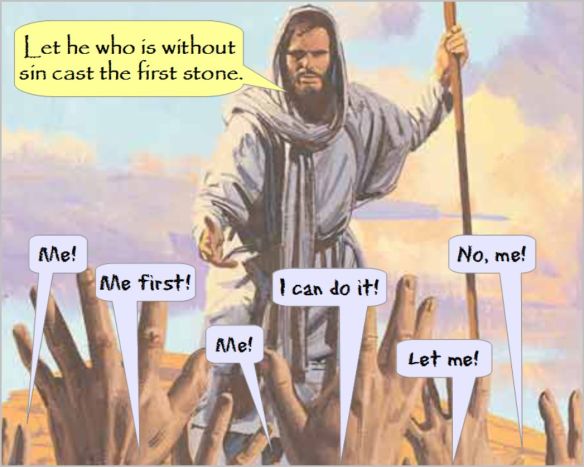
The Gilead regime envisaged by Margaret Atwood in The Handmaid’s Tale, where Old Testament sanctions are stringently applied in contemporary society, is closer than we think. People like those who hang around on Answers In Genesis’ Facebook pages, like flies around a corpse, would be more than happy to see the death penalty for those who infringe God’s barbaric laws. They’d be only too willing to throw the first stone, not only at difficult teenagers, but at all the others ‘God’s Word’ says merit the death penalty: couples who have sex when the woman is on her period (Leviticus 18.19); women who are not virgins on their wedding nights (Deuteronomy 22.13-14; 20-21); gay people (Leviticus 20.13); those who work on the Sabbath (Exodus 35.2; Numbers 15.32-36); blasphemers (Leviticus 24.16) and worshippers of other gods (Deuteronomy 13.6-9).

I am not an advocate of censorship but some form of censure is necessary for those who, either in speech or writing, advocate that others be put to death. Calling for the execution of those with whom you disagree or who have different moral codes cannot – must not – be tolerated in a civilised society. Pronouncements like those of Elizabeth Mitchell, her supporters and other religious crackpots who defend the indefensible, should be flagged up as hate speech, carrying a warning that the views expressed are themselves immoral, insupportable and, ultimately, illegal in civilised society. Ideally, their poisonous rhetoric should not be provided with an online platform. This wouldn’t, before anyone suggests otherwise, violate their right to free speech; they would still be free to express their unpalatable views in their churches, Creation Museums and own homes. Excluding them from Twitter, Facebook and YouTube, however, would deprive them of their wider audience – they’re only showing off, after all – and confine their hateful rhetoric to where it can do least harm.

These people are not merely ‘causing offence’ – offence is not the issue. They are inciting violence against others, influencing fellow believers to adopt their repellent views as their own. The standards of bronze-age tribes are not ours today; those who think they are abuse free speech and forfeit their right to be heard publicly.


How the bible gets almost everything wrong: volume 2

bible-questions

The bible’s moral inconsistencies:

As we saw here and here, the bible’s morality is confused and frequently contradictory. Jesus himself adds to the confusion with pronouncements like:

You have heard it said (in Exodus 21.24), ‘Eye for eye, and tooth for tooth.’ But I tell you, do not resist an evil person. If anyone slaps you on the right cheek, turn to them the other cheek also. (Matthew 5:38-39)

and

You have heard it said, ‘You shall not commit adultery.’ But I tell you that anyone who looks at a woman lustfully has already committed adultery with her in his heart (Matthew 5.27-28).

God’s ‘standards’ change depending on who thinks they’re channelling him:

In Joel 3.8 he advocates slavery but in Exodus 21.16 he forbids it.

In Matthew 6.1 Jesus insists good deeds should be done secretly forgetting he’s already said, in Matthew 5.1, that they should be done openly to impress others.

In Matthew 7.1-3 Jesus says judging others is to be avoided while in 1 Corinthians 6.2-4, Paul gives it the go-ahead; judging others is fine.

In Matthew 19.10-12 Jesus disparages marriage but the writer of Hebrews approves of it (13.4)

God allows divorce in Deuteronomy 21.10-14 but in Matthew 5.32 Jesus doesn’t.

And on and on. Like everyone else’s, Christians’ morality is socially determined. Unlike everyone else’s, their morality reflects the bible’s own confusion and inconsistencies. To accommodate its contradictions, Christians cherry-pick from it to bolster their pre-existing prejudices and biases. The rest of us are then measured – judged – against the resulting pick’n’mix morality and, boy, are we found lacking. ‘Biblical morality’ is nothing if not projectile.


The bible’s weak understanding of psychology:

Many of those who wrote the bible had a particularly bleak view of human beings. To these men we are totally depraved and our every thought is ‘continually evil’ (Genesis 6.5) Our ‘hearts’ are supremely deceitful and desperately sick (Jeremiah 17.9) and we’re under the control of the devil (Ephesians 2.1-3). We are incapable of doing good (Romans 3.10-13) and as Jesus himself puts it:

That which proceeds from a person, defiles that person. For from within, out of the heart, proceed the evil thoughts, fornications, thefts, murders, adulteries, deeds of coveting and wickedness, as well as deceit, sensuality, envy, slander, pride and foolishness. All these evil things proceed from within and defile a person. (Mark 7.20-23).

I don’t recognise this as a description of myself and I’m sure you don’t of yourself. Of course human beings are capable of terrible acts (I’m writing this not long after a fanatical Muslim murdered 22 young, innocent people in a terrorist bombing in Manchester, here in the UK) and, on a more mundane level, we can behave in thoughtless or vindictive ways, entirely out of self-interest.

But we’re also capable of great kindness, compassion and concern. We are a complex mixture of these traits, the good and the bad. The biblical view that we are only ever hateful, devoid of any good, is jaundiced and unnecessarily negative. If parents were to spend their time telling a child he or she is only ever bad, wicked and evil, they would rapidly deprive the child of their self-worth, self-confidence and ability to relate in positive, loving ways to others. The description would become self-fulfilling. This is what the God of the bible does to his children.

Neither are we awash with sin. Sin is a religious idea, used to describe how humans fall short of the glory of God. It need not concern us here. There is no God to fall short of; sin therefore is a concept without any traction in the real world.


The bible’s fantasy perspective of the world:

Did you know this world is controlled by the devil and his demons? That powers and principalities of the air are at war with God and the powers of holiness all around us? In fact, the devil is always looking for ways to discredit the bible and is constantly trying to weaken Christians’ faith. He smuggles false doctrine into the church in order to mislead believers, and uses the hoax that is evolution to prevent unbelievers from accepting Christ as their saviour. He gives women ideas above their station, which God says is to be submissive, and has unleashed a wave of homosexual behaviour and gender confusion to blind people to God’s goodness and to kindle his wrath.

Did you know, though, that this fallen world and the ‘heavens’ above it are soon to be destroyed and replaced by a new earth and new heavens, where Jesus will reign over the select few God decides to raise from the dead? Despite Satan thinking he’s in control, it’s actually God who is. God only allows the devil to think he’s top-dog while he, God, is secretly pulling the strings.

If you do know these things, and if you believe them, then you have a ‘biblical worldview’. Or, to put it another way, you’ve bought into third-rate hokum that bears no relation to the world – the universe, even – as it is.


Sin

Sin

During the recent election in the UK, the leader of the Liberal Democrat party, Tim Farron, was asked if he thought gay sex was a sin. Farron is a born-again Christian and instead of answering the question, he hedged round it. Predictably, this meant that journalists returned to it, with the politician dodging it each time.

In all probability, Farron does regard gay sex as a sin. The bible teaches that all behaviour that offends God is sin, causing a rift between mortals and the deity. This, biblically speaking, is what defines sin. Tim Farron would have been better being honest, saying that his faith leads him to believe that sex between people of the same sex is sinful but that personally he is a supporter of equal rights for all. His voting record indicates this to be the case; he has consistently voted in favour of LGBT rights while, presumably, maintaining his faith. Perhaps if he had answered in this way, he might not have felt the need resign as Lib-Dem leader on the grounds that his role as party leader conflicted with his personal beliefs. Predictably, evangelical groups have claimed he was hounded out of office because of his beliefs, but it seems far more likely he was, as he said himself, finding it difficult to reconcile his faith-induced worldview with his public duty. It must be difficult defaming your colleagues when you’re supposed to be demonstrating Christ’s love.

Whatever the reason, those who believe that human behaviour is sinful are wrong. Nothing humans do is a sin. Nothing we do, gay sex included, offends God because there is no God to offend. Sin is an entirely religious concept that has outlived its usefulness, if it ever really had any. Which is not to say human behaviour cannot be immoral. It can, but immoral behaviour and sin are not the same thing. As a rule of thumb, morality is determined by the extent to which our behaviour adversely affects others. Deliberately harming them physically, materially or emotionally is (likely to be) immoral behaviour. Murder, theft and abuse are immoral – but they are not ‘sin’.

Morality is not always clear cut, however; arguably it would not be wrong to murder a terrorist or suicide bomber before he can embark on a killing spree. Aborting collections of cells in a woman’s uterus, if that is what she wants, is also not an immoral act. Similarly, victimless behaviours such as sex – both hetero and homosexual – between free, consenting adults is neither wrong nor immoral. Nor is masturbation, gender fluidity or transgenderism. And as for the betes noir of the church of my youth (and who knows, they may still be) – listening to rock music, having the odd drink and dancing – they’re not either.

On the other hand, some of the activities indulged in by religious people are immoral: attempting to impose their beliefs on others; misrepresenting and denigrating those different from themselves; pressurising gay people to deny their sexuality; advocating the death penalty for homosexuality; covering up fellow-believers’ criminal activity; teaching children that creation myths are true; dismissing science; persuading people that prayer works; convincing others they are sinners.

We all behave immorally, thoughtlessly and carelessly, from time to time. But we are not, as a consequence, destined for hell, nor are we in need of a saviour to magically wash away any wrong-doing; if that really worked, we would see no immoral Christians. No, when we have behaved immorally we need to make reparation to those we have harmed, not ‘repent’ by begging forgiveness of some irascible god. What we should never do, whatever the Righteous ones tell us, is regard ourselves as sinners. We are not: it is impossible to offend a deity that doesn’t exist.


Suffer the Little Children

Jesus said to them, “Let the little children come to me, and do not hinder them, for the kingdom of God belongs to such as these.” Mark 10.14

…the very hairs of your head are numbered. Fear not: you are of more value than many sparrows. Luke 12.7

Jesus+kid

Recently, I attended the funeral of a little boy who died of the cancer he’d suffered from the time he was nine months old. His young parents are friends of mine. They showed their son such incredible love during his illness, ensuring he received the best medical care possible.

But where was God through it all? The God that Christians say has a special affinity for children, who loves them and cares for them? The God who looks after ‘the little people‘?

That God was nowhere. He showed no interest in this particular ‘little person.’ No concern and no compassion for him or his parents. Of course, that’s because he doesn’t exist, though this didn’t stop Christians telling the family how marvellous and caring and loving he is.

Really? If I had any vestige of faith left, what has happened to this innocent during his short life would have cured me of it entirely. And make no mistake, he was innocent, not a sinner (as if that would let God off the hook.) A deity who allows a baby to have cancer and to die after fourteen months of prolonged, invasive treatment would be a callous, worthless bastard. But we knew that already.

Had there been a God who cared, this little boy would’ve been two today, Easter Sunday.