The Gospels and Other Fiction, part 3

The final part of my critical look at Christians’ defence of scripture as truth.

‘The logia of the Lord in all three of the synoptics stand out from the narration of the author by style and grammar.’

The same way Elizabeth Bennet’s/Jay Gatsby’s/Hermione Granger’s dialogue stands out from the narration and the speech of other characters in Pride and Prejudice/The Great Gatsby/Harry Potter. A skilled author can make all of their characters speak in different and distinctive styles, with their own particular grammar and syntax. This doesn’t mean those characters are real. Nor does the fact that some of the ‘logia of the Lord’ was carried over from Mark into Matthew and Luke mean the two later authors were at pains to preserve the real words of Jesus. They were, as scholars, including the evangelicals Dr Strauss and Dr Wallace suggest, copying, plagiarising, editing, amending and inventing his script.

There are also the omissions to take into account: words recorded by Mark that Matthew and Luke didn’t see fit to copy into their gospels. Were they not convinced these were genuine sayings of Jesus? Did they just not like them? On what basis did they jettison these ‘logia of the Lord’?

If only there were a fourth gospel that didn’t lift its logia from Mark, one whose Jesus speaks in a very different style, with different content, vocabulary, syntax and grammar from the synoptics, but which is itself internally consistent. We would know then his script could be made up.

Miracles of miracles, we do have such a gospel, one in which Jesus is completely different from the version in the synoptics. Where does this character’s logia come from? A different oral tradition, one totally separate from and uninfluenced by that used by Mark but which existed in parallel to it? Highly unlikely. An eyewitness? One who heard Jesus speak an entirely different set of words from whoever supposedly heard those eventually used by Mark? Of course not. The fourth gospel’s logia was invented by a much later author and his collaborators, with no direct experience of Jesus (if he existed). He and they do a pretty good job of writing his fake lines.

And if they can do it, why not Mark forty years earlier?

‘There are, in the synoptic gospels, fewer variations in the logia than in the surrounding shared narrative.’

This doesn’t mean there aren’t any. There are. For example:

Whoever is not against us is for us’ (Mark 9.40) v. ‘Whoever is not with me is against me.’ (Luke 11.23). 

‘And these are the ones sown on the good soil: they hear the word and accept it and bear fruit, thirty and sixty and a hundredfold.’ (Mark 4:20) v. ‘But as for that in the good soil, these are the ones who, when they hear the word, hold it fast in an honest and good heart, and bear fruit with patient endurance.’ (Luke 8:15) [Luke makes a terrible job transferring this parable from Mark to his own gospel. His is full of errors and discrepancies, generally attributed to ‘author fatigue’. He was just so tired of cribbing from Mark and Matthew.]

The time has come,’ he said. ‘The kingdom of God has come near. Repent and believe the good news!’ (Mark 1:15) v. ‘The kingdom of God is not coming in ways that can be observed, nor will they say, ‘Look, here it is!’ or ‘There!’ for behold, the kingdom of God is in the midst of you of you.’ (Luke 17.21)

It looks like isolating the logia and claiming because they are similar across the gospels they must be the actual words of Jesus. Matthew and Luke copying from Mark (and each other?) while John invents his own unique dialogue, makes for a far better explanation of both the similarities and the differences.

The Gospels and Other Fiction, part 2

The gospels were written as history. Their writers did not make things up.’

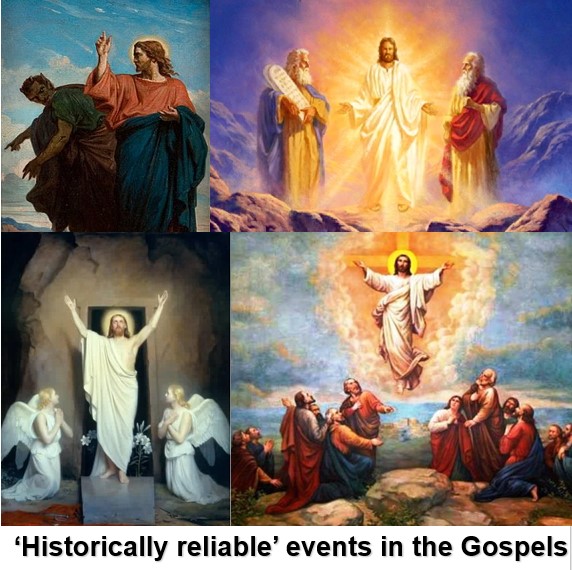
History, as koseighty has reminded us, is not littered with angels, devils, demons, spirits, apparitions, miracles, voices from the sky and resurrected corpses. Real history was being written at the same time as the gospels, by Josephus and Suetonius for example, who do not include the supernatural but do reference their sources, something the gospels never manage.

And of course the gospel writers did make things up. They invented numerous stories for Jesus to make it appear he is fulfilling prophecy (even when that ‘prophecy’ wasn’t prophecy to begin with.) This included making up ‘history’; Herod’s Massacre of the Innocents (a rewrite of a fiction about the infant Moses), the crucifixion eclipse, the rending of the temple curtain and more. These are all symbolic events. They didn’t really happen. Jesus’ own resurrection can safely be added to the list. It’s ironic that those who defend the gospel authors against the charge they made stuff up are the same who invent stories themselves: Mark and Luke knew each other? Mark proof-read Luke’s first draft? There were people who would fact check the gospels and point out any errors? But the original Christians wouldn’t do such a thing. Except they did.

There are no Inconsistencies, contradictions and inaccuracies in and between the gospels, but if there are, these are irrelevant. It’s the bigger picture that counts.’

Jesus is different in all four gospels. Despite Matthew and Luke’s plagiarising of Mark, they alter him to reflect the Jesus they believe in. John’s Jesus is so far removed from Mark’s that he’s a different character altogether. The inconsistencies do matter: did Jesus perform signs and wonders or not? Was he crucified on Thursday or Friday? Was it Peter, John or Mary who was first to see him resurrected? Did he hang around for one day or for 40? These conflicting details tell us that the creators of the Jesus story were more than happy to alter it when it suited their purposes. This is not how history is written. It is how propaganda is created. The ‘bigger picture’ is, in any case, made up of these smaller details. They work collectively and cumulatively to create the bigger picture. If we can’t rely on their being accurate how can we be sure the bigger picture is? When the gospel writers are unreliable in the smaller details, how can we be certain they’ve got the bigger picture right, given they’re all copying it from the same source, Mark, and giving it their own spin?

There is corroborating evidence of the gospels’ accounts’.

There is? Where? Just because there is some evidence that Nazareth existed doesn’t mean Jesus performed miracles, any more than Dunsinane castle’s existence proves Macbeth murdered King Duncan (he didn’t). Just because Pilate was a real historical figure doesn’t mean he crucified Jesus, any more than the existence of King’s Cross Station means Harry Potter catches his train there. And these, surely, are merely the small details. There is no corroboration at all for the bigger picture. Mention of the followers of Chrestus in Suetonius confirms at best that there were Christians in Rome at the time of Claudius, but no-one is disputing that. At worst, for the apologist, this curious reference has nothing whatever to do with Jesus. Later references to incidents from his story, by the much vaunted Church Fathers, are derived from the gospels and are therefore dependent on them. As such, they don’t constitute independent corroboration.

Everything Jesus prophesies or predicts in the gospels will come to pass, then sceptics will see that everything in the Jesus story is true.’

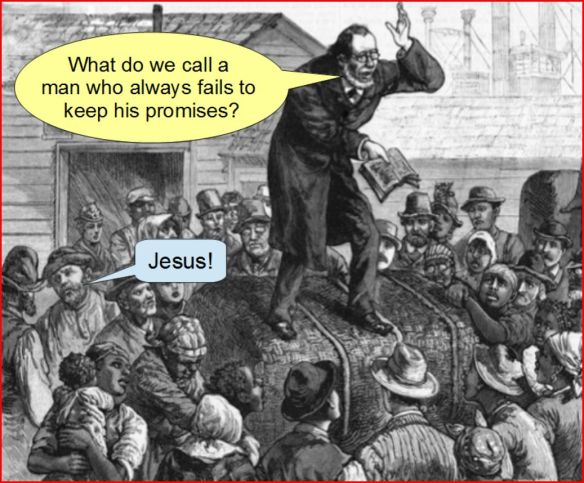
This one is from a commenter on Don’s blog. (I only went there by accident, honest.) The problem with this one is that everything Jesus is made to promise should already have come true, two thousand years ago. The Son of Man should have appeared in the sky with the heavenly host to usher in God’s Kingdom on Earth, while sending most of mankind to the fiery pit or outer darkness or some other damn place. Both he and Paul claimed that this would happen within their and their followers’ lifetimes. The trouble with Christianity is it is always winter and never Christmas. Its fulfilment God’s – God’s Kingdom on Earth, life after death, the final judgement – is always going to be at some indeterminate time in the future, a time and fulfilment that never quite arrives. It never will; part of ‘the big picture’ we can be confident we will never see.

More to come (unlike Jesus). 

The Power of Figments

Since his death, no-one has seen the itinerant preacher now known as Jesus. Some dispute he existed in the first place and certainly the character depicted in the gospels is a fictional creation. Assuming, however, that there was a real individual on whom this character was based, no-one has seen him in the flesh for 2000 years.

This includes all or most of those who wrote about him in the early years of the cult and whose writing now forms the New Testament. They either learnt about Jesus by word of mouth, as most converts throughout history have done, or they had a vision within their own heads of – what exactly? Those who write of such visions are either vague about what they claim they saw (Paul in Galatians 1: 15-16), are evidently making it up (John of Patmos in Revelation) or their visions are related by third parties many years down the line (Peter and Mary in the gospels, Stephen in Acts.)

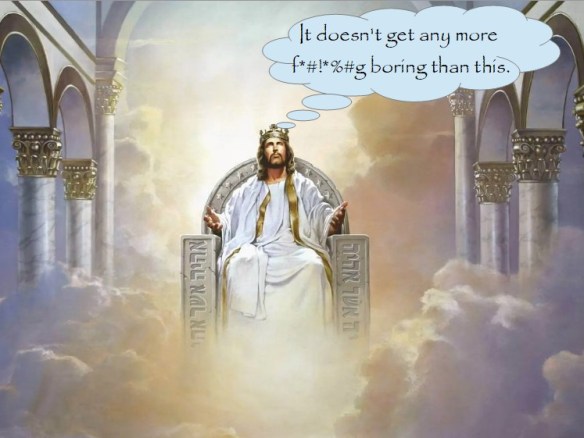
Either way, the character believers claim to have seen or have heard about is a fantasy figure, not the rabbi who may or may not have existed. It’s this fantasy who lives in heaven snuggled up to his equally fictitious father, monitoring people’s behaviour, listening into their thoughts while simultaneously observing ‘the destruction the world is bringing on itself’ and doing not a thing to help.

All this from the heaven no Christian can locate: in another unspecified, invisible, undetectable dimension is the best they can offer. Nonetheless, if only more people would turn to him, Super-Jesus would help us solve the problems we face.

Because theocracies have always been so effective. They’ve led to a more just, fairer world as wise compassionate religionists have listened to their heavenly leaders – God, Allah, Jesus, Muhammed – and have applied the principles of their holy books to the running of their societies. Only obstinate sinners have had anything to fear from the arrangement: the degenerate, like those who have sex outside marriage and want access to contraceptives; gay people (especially); women who don’t know their place; women who seek abortions; the powerless; other, ‘inferior’ races; those of other religions, non-believers and atheists. None of these would have a place in Jesus’s new perfect world either, just as they don’t in societies controlled by Muhammed’s holy ones. Jesus’ agents will be happy to exterminate them, just as he instructs.

Magic Jesus as a figment of his followers’ imaginations can be made to say whatever they want, just as he was when he was being created by Paul and the gospel writers. He is a perpetual work in process, constantly changing to conform to what those who claim to know him want him to be. It’s easy to achieve this with a non-existent being from a non-existent place.

Everything, Everywhere, All At Once

Sadly, we’ve failed to locate Jesus, the celestial super-being who is everything, everywhere, all at once yet nowhere at all. We’ve been presented with some possibilities, specifically that he exists in another dimension, which may or may not exist, from where he whispers directly into the brains of those who, over in this reality, call upon him. He even appears occasionally in visions, when the two dimensions ‘intersect’, which, as everyone knows, they’re capable of doing.

Unfortunately, all of this is undetectable by science but there’s no reason for concern because there is more to reality than that which science can observe. Equally regrettably, there’s no way of verifying this claim either; this is because science is deficient, limited as it is to investigating only ‘dirt and rocks’.

* * * *

It is far more likely that science can’t detect heaven and the eternal Jesus in precisely for the same reason it can’t detect Narnia, Valhalla and all the other fantasy worlds created over the millennia by human minds. Applying Occam’s razor, the imagination accounts for all these other ‘realities’ and the immortals that inhabit them.

No further explanation necessary.


Real Christianity v Catholicism

I visited a Catholic cathedral in Santa Cruz, Tenerife, while on my latest adventure. Not, I hasten to add, as a worshipper but as a tourist. One of the Canary Islands, Tenerife is a Spanish territory with a long association with Catholicism. Its name means Holy Cross, reflecting its history and the pervasiveness of the church. The cathedral’s altar can be seen in the picture above, highly ornate and completely over the top, with a statue of Mary, the Holy Mother, as its centrepiece. .Her son, you’ll note, plays only a bit part in the picture above her.

Real Christians™ of course don’t regard Catholics as true Christians. They point to their reliance on the Pope, when Jesus himself says his followers should call no-one Father apart from God; the army of dead saints that intercedes in heaven when all people really need is Jesus; the need to confess sins to a priest and the worship of Mary as the immaculately conceived ‘Mother of God’, who works miracles on their behalf.

People – Catholics – who believe these things can never be part of the club. ‘Their ideas are as ridiculous as they are unbiblical. No-one in their right mind,’ Real Christians™ say, ‘should believe such fanciful stuff. Stick resolutely to what we know to be true: the resurrection of a dead man; the Virgin birth and the promise of eternal life. These things are biblical and as such we can know and trust them. Not rubbish about saints in… erm, heaven living forever, having to ask for our sins to be forgiven and thinking Mary was conceived free from the scourge of sin.’

It seems to me that it’s only a short hop from believing one lot of far-fetched rubbish to believing still more. Maybe the Catholic stuff isn’t strictly biblical (though at a stretch it could be said to have been drawn from the make-believe found there) but then there’s nothing particularly special, plausible or reasonable about that which has found its way into God’s Word. Just because something is in there doesn’t make it true. Those who invented Jesus’ Virgin birth, his resurrection and the promise of everlasting life were making it all up, just as those who, further down the line, created the phantasmagoria that is Catholicism.

Santa Cruz is nice though.


Eggs, Bunnies and Dead Bodies

88

Easter rolls round again. The spring festival, which in English is named after a pagan fertility Goddess (hence the eggs and bunnies), was usurped by the church in the second century as a celebration of a dead man rising.

Sometime in the first century, a few desperate men had visions of a Yeshua – his name meaning ‘to deliver’ – shortly after his death (if indeed he existed). The visions, which were entirely in their heads, were so vivid, it seemed to these men that Yeshua was alive again. They began looking for his (re)appearance in the sky when they thought he would establish God’s Kingdom on Earth. It was a preposterous idea, but in preparation for his appearance, the men encouraged others to adhere to Jewish law so that they would find a place in the New Age.

A short while after, a different fanatic had his own vision. Saoul, who transitioned into Paûlos, thought he heard Yeshua speaking to him. Yeshua told him the conditions that needed to be met in order to secure a place in the new order: all anyone had to do was believe and they would live forever. This was all entirely within Paûlos’ head of course but nevertheless enough people took notice of his preposterous idea and decided to worship Yeshua.

Later still, the Romans destroyed Jerusalem, which was the centre for those who’d come up with the original version of the preposterous idea. Almost all of them were eliminated. Not because of their preposterous idea but because the Romans were indiscriminate in slaughtering those they regarded as rebellious Jews. Their elimination cleared the way for Paûlos’ preposterous idea to flourish unopposed.

Around this time, a literate acolyte of Paûlos’ idea, who later became known as Mark, set about creating a back story for Yeshua. He based it on Paûlos’ teaching and on stories from Jewish scripture that he thought predicated Yeshua, though in fact they didn’t.

Two other cultists liked this idea but didn’t think Mark had done a very good job of it. They set about rewriting his story, adding even more preposterous elements. Finally, about 60 or 70 years after the whole thing had begun, a fourth chap, later called John, reimagined the Yeshua story. His version bore little relationship to Mark’s tale but this didn’t really matter as all the versions of Yeshua’s life story were made up. In any case, no-one would notice the discrepancies provided the four stories were never collected together.

And so Christianity was born, created from visions and false hopes, reinventions and fanciful fictions. The preposterous idea in its different forms appealed to people, now as then, because of its false promise of eternal life and as the means of avoiding an imagined God’s wrath.

This is the idea the church is celebrating, preposterously, this weekend.

As for me, my days of fertility are long gone, but I might, nevertheless, indulge in a little bit of chocolate egg.

Jesus: Practically Perfect In Every Way?

Was Jesus a gracious, gentle and humble as Christians like to claim or was he intolerant, self-important and frequently wrong? What do the gospels say?

He’s intolerant and self-important when:

He insists people should love him more than their own families (Matthew 10:37).

He says he’s not a peacemaker but intends creating strife (Luke 12:51).

He claims anyone who doesn’t follow him deserves to be burnt (John 15:6).

He wants the world to be destroyed by fire (Luke 12:49).

He commands people not to call others ‘fools’ (Matthew 5.22) but tells those he doesn’t care for that they’re ‘swine’, ‘dogs’, ‘snakes and vipers’, ‘whitewashed tombs’, and, yes, ‘fools’ (Matthew 7:6; 15:26; 23:33; 23:27; 23:17 & Luke 11:40).

He deliberately speaks in riddles so that people won’t understand him and won’t find forgiveness (Mark 4:12).

He tells his followers to love their enemies but says he’d have his own killed (Luke 19:27 & Matthew 13:41-42).

He endorses slavery and the cruel treatment of slaves (Luke 12:47-48).

He says people would be better off if they cut off their hands, plucked out their eyes and castrated themselves (Mark 9:43-48 & Matthew 19:12).

He endorses the Jewish law that demands the death penalty for those who disrespect their mother and father (Matthew 15:4-7).

He disrespects his mother (Matthew 12:48-49).

He tells people not to get angry but loses his own temper (Matthew 5:22 &Mark 3:5).

He callously kills a herd of pigs and, in a fit of pique, destroys a fig tree (Matthew 8:32 & Matthew 21:19).

He takes a whip to people (John 2:15).

He tells his mates he’ll soon be king of the world and promises them that they’ll rule alongside him (Matthew 19:28).

Are these the marks of a tolerant, compassionate man? Or the characteristics of an unpleasant, delusional megalomaniac?

As for frequently wrong: first, the false promises –

I will do whatever you ask in my name, so that the Father may be glorified in the Son (John 14:13).

Very truly, I tell you, if you ask anything of the Father in my name, he will give it to you (John 16:23).

These signs will accompany those who believe: …they will lay their hands on the sick, and they will recover’ (Mark 16:17).

Therefore do not worry, saying, “What will we eat?” or “What will we drink?” or “What will we wear?” But strive first for the Kingdom of God and his righteousness, and all these things will be given to you as well (Matthew 6:25-7.1).

and then there’s the failed prophecies –

For the Son of Man is going to come in his Father’s glory with his angels… I tell you the truth, some who are standing here will not taste death before they see the Son of Man coming in his Kingdom (Matthew 16:27-28). Just in case we don’t get this the first time, he tells us again in Matthew 24:27, 30-31, 34 and in Luke 21:27-28, 33-34.

Did he return with the angelic host and establish God’s kingdom on Earth before his disciples died? He did not.

Christian zealots unable to accept the evidence of the gospels themselves will no doubt have a hundred and one clichéd, implausible excuses for Jesus’ many failures: ‘he was speaking metaphorically’; ‘you lack the spiritual insight to see what he really meant’; ‘you’re quoting him out of context’, blah blah, blah.

All I ask is that they please, please don’t inflict these excuses on us here when we’ve heard them all so many times before.

Sowing seeds

The early church had multiple problems, many of which Paul and other New Testament writers refer to. Any reasonable person would have taken these problems as a sign that the faith they were pushing really didn’t work; didn’t produce new creations powered by a holy spirit. Some, including a number of the very earliest followers (Matthew 28.17), were leaving the church, disappointed and disillusioned. How were leading figures in the cult to explain this? Having supposedly encountered the supernatural Jesus these people were now having doubts that he was real and were turning their backs on him. This shouldn’t have been happening!

The writer of 1 John accounts for the departure of those who had come to their senses by suggesting they were never really true believers:

They went out from us, but they were not of us; for if they had been of us, they would have continued with us. But they went out, that it might become plain that they all are not of us. (1 John 2:19)

It’s significant that the writer of this letter doesn’t allude to Jesus’ parable about the sower of the seeds from Matthew 13. Not one of the letter writers in the New Testament who address the problem of defections does so. This can only be because none of them knew of it when they were writing decades after it was supposedly told. The reason they don’t mention it is because it had yet to be written.

The parable of the sower is Matthew’s attempt to have Jesus address the problem of those who fell away from the cult. Matthew’s explanation is it’s because the good news – the imminent arrival of God’s kingdom on Earth – only takes root in the spiritually astute. Others, who might initially accept the gospel, are like stony ground on which birds gobble up the seed. They are those who allow the cares of this world – metaphorical weeds – to choke the message before it can flourish.

It’s a very colourful explanation designed to reassure those persisting in the faith that they are the favoured, while those who have defected have fallen prey to the shallow soil, birds and weeds. It’s neat and it gives reassurance and encouragement to remaining cultists.

Jesus could not possibly have known what was to become of his ‘church’ and the (non)arrival of God’s Kingdom – his good news – following his death. The parable was created for him, or more specifically, as Matthew makes abundantly clear in 13:11-12, for devotees of the early cult decades later. What it emphatically is not, is a story originally delivered by Jesus.

Show Me Heaven

On the radio this Sunday, a couple of presenters were discussing a woman’s Near Death Experience. Lynda Cramer claimed that in 2021 she had been clinically dead for 14 minutes when she visited Heaven for five years. You can see her raving about it on YouTube, while the Amazon synopsis of her book, Five Years In Heaven (of course there’s a book; four in fact) reads:

In May 2001, Dr Lynda Cramer died. This is the story of her Near Death Experience, outlining the five years that she spent in Heaven. Starting when she found herself “floating” in the living room for over 45 minutes, she then went on a journey where she entered Heaven, she then processed her Life Review prior to meeting her great-great-great-great grandmother who explained what Life Lessons, Life Contracts and Reincarnation are all about. Backed up by Medical Records as well as diagrams she drew, this is her personal account for anyone intrigued by what happens in the afterlife…

So, is this real? Did Lynda Cramer visit Heaven while she was dead for 14 minutes? She’s a doctor, after all, so superficially at least, she has credible credentials. Until you see that her PhD was obtained researching Near Death Experiences  themselves. Vested interest or what?.

But, let’s not be cynical; she has diagrams too, for God’s sake. What more proof could we ask for? We know too, because our resident Christian tells us, that dreams and visions like this are most definitely from God. Lynda’s experience ticks all the boxes, no matter what we sceptics might think.

Except, no. Lynda was not dead for 14 minutes. We have only her word for it that she was declared clinically dead, while she describes her experience as a Near Death Experience. The clue is in the name. If she was near death, she was not dead; her brain was still alive, if only just. Her mind was still active, creating, if this happened at all, a reassuring experience for itself as it came close to shutting down. There is well documented evidence that this is what the brain is capable of doing when it is close to death (but not actually dead).

Significantly, the scenario her mind created was informed by cultural, quasi-Christian images of Heaven, just as believers’ dreams of God are informed by the same images and characters that occupy their waking minds. My own dreams, for example, are populated by people I know and places I’m familiar with (though sometimes only vaguely; my subconscious fills in the details often in bizarrely imaginative ways.)

Nonetheless, Lynda’s life-changing 5 years visit to Heaven (during which she seems to have done nothing except admire mountains and buildings while blue balls, hijacked from science-fiction, danced around her) is just as real, just as divine, just as valid as the God-given dreams and visions Christians claim they sometimes have. Naturally, we sceptics can’t possibly appreciate these until we’ve experienced them for ourselves.

Lynda’s experience was a subjective, emotional experience while she was unconscious. But such ‘spiritual’ inner experiences are ‘real’ according to at least some Christians, and we can’t argue with that which we have not experienced  for ourselves.

Right, Don?


Jesus: not worth the paper he’s printed on?

There is broad consensus amongst respected scholars that the Jesus of the gospels didn’t exist. This is hardly surprising. Gospel Jesus, as I hope I’ve demonstrated over the past few weeks, is constructed from fragments of Jewish scripture and Paul’s (and others’) visions and dreams. There is also good evidence, which I’ve not discussed, that some Jesus stories are recreations of legends and tales of other god-men (turning water into wine and the Road to Emmaus story*, for example).

All of which raises the question suggested by David Fitzgerald in Nailed, that if there was a real Jesus who was so incredible that he gave rise to an entire religion, why was almost everything about him invented? Why could his story not have been told as it was? Why didn’t his inspiring, dynamic personality speak for itself? Personally, I don’t care whether Jesus existed or not, but if the supposedly remarkable Jesus of history did once exist, he has been totally obscured by the stories, legends and myth that were constructed around him not long after he died. The celestial Jesus that today’s Christians claim to know personally, who they say inhabits their hearts while simultaneously living in heaven, is emphatically not the man who lived, but a myth. A different myth, even, than that of the New Testament. A non-existent star-man, waiting in the sky.

Jesus belongs with all those other heroes who may or may not have existed prior to their being turned into myth and legend: Abraham, Moses, Buddha, Confucius, Saint Nicholas, Robin Hood, Paul Bunyan. There is very little evidence, apart from stories and legends, that any of these figures actually existed. More, it’s entirely conceivable that Jesus belongs to a still different group of super-beings: those who were created as mythic characters, including but not confined to, Osiris (and the entire Egyptian panoply), Apollo (and all the Greek gods), Romulus, Circe, Attis, the angel Gabriel, Mithras, Aladdin, the angel Moroni, Superman, Harry Potter…

There is meagre evidence there was an historical Jesus who, even if he did exist, is now buried beneath layers of make-believe. The Jesus who has come down to us through the gospels and the rest of the New Testament is fictional. From his fairy-tale origin to his fantasy ascension and beyond, he’s completely imaginary.

I’m conscious I’ve written other posts making this same point. I find that, whatever starting point I take, invariably I end up here. Whether it’s ‘prophecy’, prayer, promises, miracles, the second coming, any aspect of the faith, none has any substance. They’re ineffectual, empty and have no bearing on reality. The character who supposedly embodies and promotes them becomes, as a result, similarly void. Either Jesus was transformed into a fantasy figure soon after he lived or he was imagined, by the likes of Paul, as a magical being to begin with. Whichever it was, from the earliest days of Christianity, there was no way for people to hear of or know about a man who actually walked the Earth.

*See Carrier, On the Historicity of Jesus: Why We Might Have Reason to Doubt, pp 480-81