Less religion, not more

Welby

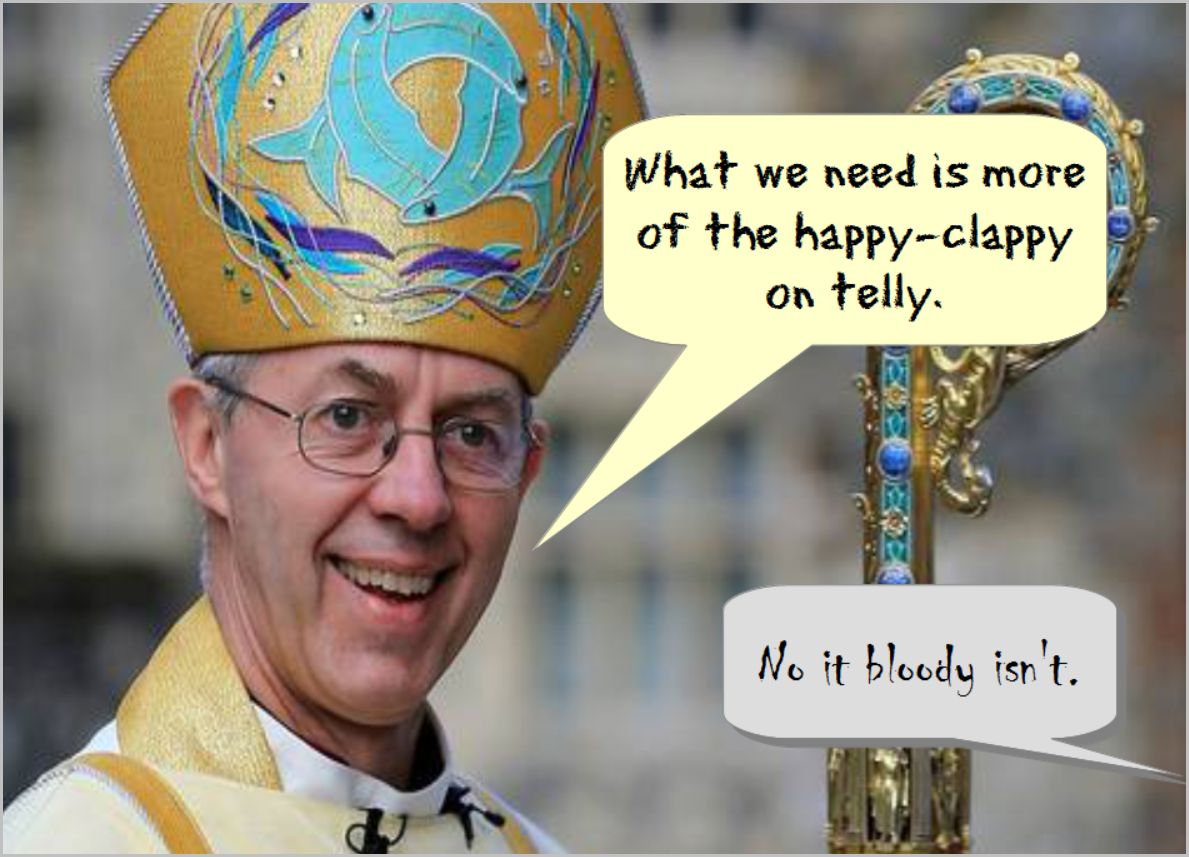
A bloke in a pointy hat and posh frock thinks there should be more religion on television and radio. Justin Welby, Archbishop of Canterbury, says that religion merits as much air time as politics, sport and drama.

The Archbish makes it sound like there’s nothing at all on TV and radio already about religion. In fact, in the last few months in the UK we’ve had a full schedule of Easter programmes; Simon Reeves’ The Ganges on BBC2 (looking at India’s religious heritage); Channel 4’s Unreported World and Dispatches, which regularly consider religious issues; Clare Balding’s trite Good Morning Sunday on Radio 2; the weekly broadcast of church services and daily Thought For the Day on Radio 4; the weekly dollop of worship on Songs of Praise on BBC1 and the 24-hour Christian ‘ministry’ of Trinity Broadcast Network and other God channels for those who just can’t get enough mumbo-jumbo.

Maybe that’s not as much as sport, but then there’s hardly anything on TV that has as much coverage as sport. (Bad news too for those of us with little interest in watching others running, jumping and hitting things; there’s even more to come in the shape of Wimbledon, Euro 2106 and the Olympics.)

Do we really want religion to have the same level of coverage? Are people really as interested in belief systems as they are in sport? Or music? Or art? Or comic book franchises? Even if there are, why is it up to television – the Archbish singles out the BBC as the broadcaster he thinks should indulge his fantasies – to provide it? Isn’t it, rather, up to churches, mosques, temples and other centres of superstition to promote their own particular brand of nonsense?

Make no mistake about it, this is what Justers is proposing; the promotion of religion – ‘religious literacy’ he calls it. He is not, we can be fairly sure, looking for programmes that are critical of religion (unless it’s other people’s). He wants, he says, to see more programmes that give us a better understanding of religious belief. What he means by this are proselytising programmes that create greater empathy for those who subscribe to delusion.

He isn’t advocating, for example, documentaries that explore the irrationality of faith, or ones that show the slap-dash, deceptive ways in which holy books came to be compiled or ones that demonstrate how most adherents to faith fail to live out its exacting demands. Nor is he suggesting programmes that focus on the appalling misery religion brings to some, or shows that give a sympathetic hearing to cults, sects and extremists. I would have no objection to programmes like these (except those that are sympathetic to extremists) because the ugly underbelly of religion deserves to be exposed, like Channel 4’s The Untold History of Islam of a few years ago, taken off air after its presenter was threatened with violence by those who didn’t like its critical perspective.

But these are not the kind of programmes the Archbishop is proposing. The religious literacy he wants us to have is of the cuddly side of faith, the supposed deep spirituality of the obsessive and what he regards as the positive contribution religion makes to the world; a one-sided picture already more than adequately covered by the nation’s broadcasters.

Thankfully, despite the recent political interference in the BBC, the Corporation is still required to present balanced and impartial views of its subject matter. If the Archbishop, who sits in the House of Lords and so is not without influence, is successful in forcing the BBC and other broadcasters to increase their coverage of his obsession, then we should also be able to look forward to programmes that are critical of religion too.

No broadcaster is obliged to promote religion nor to proselytise on its adherents’ behalf. Shame on the Archbishop, with his smiles and pointy hats, for suggesting they are.
Believing is Seeing

Fish

Have you noticed how the risen Jesus seems only to have appeared to those who were already primed to see him? Of course, the accounts of the resurrection are inconsistent, unreliable and constructed long after the supposed event, but just for now, let’s take them at face value. Jesus appears first, according to Matthew, Luke and John, to his female followers – maybe one on her own (in John), maybe two (Matthew), maybe several (Luke) – but to women who would be mourning him and would be longing to see him again. And lo and behold, they do! He’s not quite substantial and not quite recognisable – every bit the hallucination, in fact – but he appears.

Next he is said to have shown himself to the disciples – maybe one (Luke), maybe two (Luke again), maybe several (Matthew) – men who have been thrown into complete disarray by Jesus’ death but who believed in him and his mission to inaugurate the Kingdom of God, and were looking forward to ruling it with him. So naturally they see him in their midst. Never mind he walks through walls and disappears at will, just like an apparition – he appears! As Acts 1.3 puts it, ‘he presented himself alive to them after his suffering by many proofs’.

Wait – ‘by many proofs’? What does that mean? That he had to prove he’d come back to life? Could they not see that for themselves? Couldn’t they recognise the man with whom they’d spent the last three years? Or if they could, weren’t they convinced he’d returned from the dead so that he felt he had to prove it? How? How did he prove it? With a death certificate? By letting them poke his holes? And this took forty days? Isn’t it more likely they were subject to group hysteria and some sort of hallucination (they’d had hallucinations before – see Matthew 17:1-9) and they then had to convince each other that what they’d experienced was really Jesus? No wonder it took forty days to concoct a ‘plausible’ story, to arrive at ‘the many proofs’ that Acts speaks of. Whichever it was, Jesus’ gullible old pals convinced themselves they’d seen him.

During these same forty days – though in his gospel Luke implies it’s a much shorter time (24.40-53) – Jesus fits in a guest appearance at a rock concert in front of 500 believers – believers, note. Not people who were converted as a result of this miraculous appearance, but people who were already part of the Jesus cult when they experienced this vision. Or so Paul tells us in 1 Corinthians 15.3-8. He wasn’t actually there, but he heard about it from a friend of a friend of a friend so it must be true.

And finally he appeared also to Paul himself (1 Corinthians 15.5). Not as a physical body but as a beam of light in Paul’s head. I’m not getting into how this was, as Paul himself admits, no more than an inner vision (he too is prone to hallucinations – see also Acts 16:9-10 and 2 Corinthians 12.1-7) because you can read about that here. Rather, I’m going to argue that Paul, arch-enemy to this point of all things to do with the Jesus cult, is just as primed for a sighting of the Lord as all those other people who think they saw him… next time.

to be continued.

Are You Doing What Jesus Christ Says?

Billboard

Dale McAlpine, sometime commenter here and fanatical street-preacher in these parts, has posted a tasteful little video on his web-site – that’s the smugly named Repent.com if you’re interested – called Are You Doing What Jesus Christ Says? Take a look at it over on Repent.com or on YouTube; it’s ludicrously melodramatic and wonderfully over the top. You’re sure to enjoy its typos and spelling mistakes too.

What’s remarkable about it apart from these things is that, despite its title, it makes little reference to what Jesus is supposed to have said. Instead, it’s all about how you’ll go to hell if you don’t repent and accept him as your saviour; but Jesus never said this. It says you’re a ‘vile, wretched, hell-deserving son or daughter of Adam’ – Jesus didn’t say this either. It also insists you should let his cross ‘disrupt the very centre and citadel of your life of self’ (whatever that means) and guess what? This wasn’t part of Jesus’ teaching either. In fact, none of these claims were part of his ‘good news’.

Of the things Jesus did say – go the extra mile, sell all you have to give to the poor, turn the other cheek, avoid judging so you won’t be judged, give to all who ask, give away your shirt as well as your coat, feed the hungry, visit the sick, clothe the naked and love your enemies – the video makes no mention. Funny that. Maybe that’s why we don’t see Christians doing them very often.

So, Christians – and Dale too – are you doing what Jesus said or are you, like the video, only interested in pointing out others’ supposed sins and shouting about how they need to join you in your delusional mumbo-jumbo?

Yes. Thought so.

The stuff Christians say… (part one)

Jesus-Facepalm

On the day Christians remember the time Jesus allegedly spent being dead and buried (that’s one day, if you’re counting; what happened to the three he promised?) by going shopping or watching sport, let’s take a look at some of the nonsense they spout about atheists:

Atheism/humanism is of Satan: Given there’s no evidence for any supernatural beings, there can be no devil, Satan, Lucifer – or whatever other name Christians come up with for this fantasy figure. (Bizarrely, it’s Jesus who’s called Lucifer in Revelation 5.5) The devil is a creation of the human mind, intended to explain the nasty stuff in life and to let a supposedly good God off the hook. It follows that an imaginary being can’t make human beings be anything. The devil therefore does not make people atheists nor direct them in their ways.

Humanists/atheists set themselves up as God: Every manifestation of the god(s), including those that happen to be popular at present, is of human origin. Like all the others, the Christian God is a product of the human imagination that is made manifest only through human behaviour. So who is it who sets themselves up as God? Those who recognise that this creation of the human mind has no external reality, or those who claim an intimacy with the ‘Supreme Being’, believe his Holy Spirit lives within them and delude themselves into thinking they speak for him? No prizes.

Humanists/atheists worship man as God: Atheists don’t do this either. We are well aware of humans’ fallibility, inconsistency and capacity to bugger things up. However, we’re all we’ve got. There’s no God going to come and save us or solve our problems. We have to do it ourselves (or, as the case may be, not). Nor do atheists regard other people as wicked sinners who have no good in them – a particularly unhealthy viewpoint favoured by the religious – but this hardly constitutes ‘worship’.

Atheists hate God: Only to the same extent we ‘hate’ Santa Claus, Poseidon and Ra. You can’t hate (or rebel) against something that doesn’t exist. We do get very tired though of Christians foisting their views on us, insisting we should believe what they believe. And we get angry when they disparage others and attempt to curtail their freedom because they alone know what Jesus would want. But being angry about Christians’ unreasonableness is not the same as hating something that doesn’t exist.

To be continued

Round in Circles

JC2

Being a religious believer means you can’t be a free thinker. Your conclusions are already determined for you – in the Bible or Qu’ran or some other holy book – and you are compelled, if you’re fundamentalist in your beliefs, to reach and affirm these conclusions. More than this, you are compelled to begin with them, which is why Ken Ham can say that where you start determines where you end up (though this only applies to those who think magic books have all the answers). So if you believe, because the Bible appears to say so, that the universe and all that is in it was created in six days about 6,000 year ago, then that is the premise from which you begin. You are then highly selective in the evidence you’ll consider, forcing it to support your predetermined conclusion. Christian argument is always this circular and heavily dependent on confirmation bias.

It can’t be anything else:

William Lane Craig ‘knows’ that the Holy Spirit is real because he feels it inwardly; the Bible tells him this kind of feeling is attributable to the Holy Spirit, so consequently the Holy Spirit must be real.

Pastor Mike Ratcliff understands that the Bible says everyone is a sinner; Mike’s confirmation bias means he sees sin and apostasy everywhere; therefore the Bible is right when it says everyone is a sinner.

Pastor Steven Anderson condones slavery. God approves of it in the Bible therefore slavery cannot be morally repugnant, and attempts to eradicate it are misguided. How does he know this? Because the Bible says slavery is okay.

Christians generally argue that God is good (because the Bible says he is) but have to disregard the horrors of his creation and the cruelties of life to reach the conclusion that, yes, God is good.

There really is no arguing with such arrested development, such intellectual dishonesty. Christian are not open to wherever reason and the evidence might take them; the end is always assumed at the beginning. Maybe that’s why comments are rarely allowed on Christian web-sites. You can’t argue with the Truth™ – another premise masquerading as a conclusion.

The Embarrassment that is the Old Testament

bible2

When does the Old Testament count and when doesn’t it? When does what it says matter and when doesn’t it?

The answer to both questions is when Christians say so. It counts when something from it can be used to underline how wicked the rest of us are and when they think it’s pointing to the coming of Jesus, many years in its future. It doesn’t, of course, foretell of Jesus as such, despite its predictions of a coming Messiah and/or Son of Man. Jesus doesn’t fit its descriptions of either of these figures. Rather, Jesus’ story is read back into the older texts, their characters and events forced to serve typological and prophetic purposes for which they were never designed. The entire endeavour, which began very early in the development of Christianity, is entirely back to front, with the gospel writers, Paul and other New Testament authors pillaging older Jewish texts and forcing them to fit Jesus retrospectively (and often laughably.)

Regarding ancient Jewish texts as an Old Testament – that is, as representing a previous agreement/covenant between God and his people that has since been superseded – is a political, interpretive manoeuvre of the later religion. (While it’s true Jesus is made to speak of a new covenant, it is debatable how authentic his words are; rewriting the past is not only confined to the New Testament’s treatment of the Old.) This kind of slippery manoeuvring was also endorsed by those who later compiled the Bible as we now know it,* when they relegated the writings that Jesus and all the New Testament writers would have regarded as sacred Scripture to nothing more than a forerunner of the real thing.

Believers want to hang on, naturally, to Genesis, because that’s where it tells them God created everything using nothing but magic and breath from his holy lungs. It relates too how everything went pear-shaped after some mythical people ate some fruit. Noah’s ark is there too, which is a jolly good fantasy, apart from that weird bit at the end where Ken Ham gets an eyeful of his old man’s old man (Genesis 9.20-27). Christians are less keen on those Old Testament stories where God instructs the Israelites to massacre other tribes (1 Samuel 15.2-3; Deuteronomy 2.34 etc) and rape their women (Isaiah 13.15; Zechariah 14.1-2 etc) but nonetheless they’ll defend these unpleasant, barbaric stories just because they’re in the Bible. The Psalms are nicer, what with their words of comfort and paranoia, but best of all are the Old Testament pronouncements that can be used for clobbering sinners. Leviticus 20.13 – ‘If a man lies with a male as with a woman both of them have committed an abomination; they shall be put to death; their blood is upon them’ – is a particular favourite, as is the story of Sodom and Gomorrah for much the same reason. But when it comes to other diktats, Christians are less interested; rules about not eating shellfish or wearing clothes of mixed fabrics, they are quick to point, are entirely negated by the new covenant; they don’t count any more, even though they’re in the same list of largely petty rules as the homophobic one (Leviticus 11.10 & 20.9.)

So how do Christians decide which Old Testament laws are applicable and which are now inessential? There is no shortage of know-alls Christian scholars who make it up as they go along and can tell them. It’s easy you see; the old ‘ceremonial’ rules of the old covenant are now redundant while the moral precepts still stand. Needless to say, the Bible itself suggests no such thing, with Jesus saying precisely the opposite in Matthew 5.17-18 and Luke 16.17; evidently another of his strange ideas that can safely be ignored.

So how do we know which of the Old Testament’s prescriptions are ceremonial and which moral? The same self-appointed experts can tell us this too, though it’s actually easy to work it out for oneself. As a general rule of thumb, verses that condemn other people are still applicable while those that Christians themselves don’t care for are not. So the shellfish and mixed fabrics directives can be disregarded, because obviously they’re ceremonial, while the anti-gay stuff isn’t – obviously. And there’ll be no public stoning of wayward teenagers (Deuteronomy 21.18-21) because that’s obviously ceremonial too – and don’t even think of having sex with the slaves, not even ceremonially. These days, thank God, it’s considered so uncivilised (even if, in Numbers 31.17-18, Yahweh says it’s okay. )

The Old Testament then; an embarrassment Christians are compelled to defend as part of their magic book but which they nevertheless feel free to use selectively, according to taste. Not unlike the New Testament really.

*There are, we should note, several variations of the Bible within Christendom; God can’t seem to decide which books are or are not part of his Holy Word.

What Does Atheism Have To Offer? (Part One)

Station-12-ArtistOver the next few posts I’m going to do my best to answer the question, ‘what does atheism have to offer?’ that a commenter on Facebook has put to me – that’d be you, Dave – because, he says, I’m too sneery about Christianity. Some of my response will of necessity be personal in nature, and you can take or leave whatever I say; you won’t go to hell if you disagree (or heaven either.)

1. Atheism offers the truth
Christianity wasn’t delivering; it didn’t ring true for me any more and lacked explanatory power. As a result, a need to know the truth of why we’re here and what life is about preceded my atheism. I set about examining the facts of our existence as we know them, together with all the evidence. I became committed to this pursuit regardless of where it might lead. I didn’t, initially, confine my questioning and subsequent reading only to secular or scientific sources, but continued to explore religious and spiritual explanations of life as well. These quickly paled in comparison with empirical evidence; they were vapid and unsubstantiated, relying as they did on talk about ‘energies’ and entities that no-one had ever seen and for which there was no evidence.

Drawn increasingly to scientific explanations of life – biology, genetics, psychology, astronomy – I became increasingly aware that God wasn’t and isn’t required to explain anything about life, the natural world, the universe or indeed anything. Natural phenomena (and they’re all natural phenomena) have, on the principle of Occam’s razor, natural, not super-natural, explanations. The only reasonable conclusion to be drawn from this was that he wasn’t and isn’t involved in any of them. His very superfluity demonstrates his non-existence; a god who is not evident in any aspect of reality is a god that doesn’t exist. This pursuit of truth therefore led to atheism as something honest and inherently truthful.

2. Atheism offers a real life in the here and now
Living without recourse to the supernatural is refreshing. There is no god (no angels, devils, spirits, ghosts or demons either) watching over us, waiting for an opportunity to punish or bless us; no god whom we are answerable to either in the present or at some future judgement; no god of vengeance who must be obeyed; no god who will vindicate us at the end of time; no god to grant us eternal life; no set of frequently bizarre rules to follow and no empty promises to claim. Atheists take full responsibility for their own lives and behaviour; they construct their own meaning, knowing this life is the only one they’ll get. Atheism alone grants this responsibility and privilege.

3. Atheism offers a humanist perspective and approach to life
This is not the End Times™ as salaciously envisaged by Christians ancient and modern, just as the first century wasn’t – even though Jesus and Paul both thought it was (Matt 16:27-28; 1 Thess 4.15-17 etc.) The atheist accepts that the only help we’re going to get in solving our problems is from ourselves. There is no god waiting in the wings to put things right; no end time scenario when he will come to rescue a chosen people. (This is, incidentally, one of the most pernicious ideas ever to have been devised by humankind, causing more strife and ‘excusing’ more inhumane treatment of others than any other we’ve devised.)

Apart from natural disasters – and we seem to be contributing increasingly to those – the cause of all of our problems is us. Equally, the solutions will have to come from us too. More positively, all of our endeavours, our achievements, our scientific, technological and social progress are ours alone too. We have the potential to do great good, and often do, just as we cause great harm. Free of religious restrictions, the atheist is at liberty to help others out of fellow-feeling, not because a (non-existent) god demands it.

to be continued…

2015: How was it for you?

2ndComingI promised this time last year to revisit my predictions for the year that lay ahead. So how did I do in my prophecies for 2015?:

The first was that there would be no Second Coming in 2015. Well, how wrong could I be! As we all know Jesus returned on September 13th, just as John Hagee hinted he would be. It’s been so great, hasn’t it, living in Hell / God’s Kingdom on Earth (delete as appropriate) since that time. Fantastic. I’m so pleased to have been wrong about this one.

On the other hand, maybe what I said last year still stands: Jesus won’t be back this year. Just like he wasn’t back in 2014, 2013, 2012… 1985… 1914… 1868… 1497… 1000… 446… 35. Just think of all those years – count ’em, nearly two thousand – when he’s failed to return so far. Actually, he promised he’d be back while his followers and those listening to him were still alive, around AD30 or thereabouts. Safe to say he’s not coming back at all, just like dead people don’t. Not in 2015, not ever.

Of course it still stands. As ever Christianity fails to deliver. That hasn’t stopped True Believers™ from telling us that he’ll be back very, very soon. Which was prediction number 2: Christians will go on believing that Jesus is going to return any day now. I gave up collecting examples well before the end of the year – there were just too many – but here’s a few of them: here, here, here, here, here, here and here. Will the gullible Born Again ever come to their senses and stop listening to idiots like these? (Nope).

Prediction 3. There’ll be no natural disasters or human calamities as a result of gay marriage. There have been lots of disasters and calamities during the year, but here’s the thing – natural disasters have natural causes, not supernatural ones, and similarly, human calamities have human causes. Not one of the events this year (or any other) was the direct result of gay marriage. This hasn’t stopped the religious from claiming – as I predicted they would in prophecy number 4 – that disasters and calamities are God’s punishment for gay marriage; here, here , here, here, here, here and here, for example.

Prediction 5: More than one prominent Christian will call for the execution of gay people. Yup. Here are those loving men of God doing just that (and here, here and here too). Jesus would be so proud.

Prediction 6: Christians in the west will claim they’re being persecuted when they’re being expected to treat others fairly and equally, and not to discriminate against them. Yes, I know Christians are persecuted in some parts of the world, but the moaners I’m talking about are only focused on their own self-serving, self-inflicted ‘marytrdom’. Again, there are just too many of these to link to them all, but here are a few (and here, here and here).

Prediction 7. Christians will respond to criticism with clichés like ‘they wouldn’t dare say that about Muslims’… ‘Christians are the last group who are fair game’… ‘It’s time for Christians to speak out’… ‘Stand up for God’s standards…’ etc. Yes, predictable in more ways than one

Prediction 8: Christians will continue to dismiss and disparage anyone who doesn’t share their views, especially atheists. Look out for ‘atheists have no morality’,’the fool hath said in his heart there’s no God’ and ‘atheists want to oppress Christians’ occurring with tedious regularity. And they didn’t disappoint: here, here, here and here.

Prediction 9: There will be more revelations about the abuse of children by church ministers. Of course there were. Christians may be new creatures in Christ but that doesn’t stop some of them behaving in the same old despicable ways, God love ’em.

Ditto number 10: Church hierarchies will attempt to cover up the abuse of children by their ministers. And here they are at it. The body of Christ certainly seems to have an unhealthy interest in the bodies of others. Still, they always ever so modestly cover up afterwards.

Prediction 11. There will be the usual manufactured ‘war on Christmas’. Ho-hum. And you can guess who did the manufacturing.

And finally I offered number 12: these predictions have far more chance of coming to pass than any of the so-called prophecies of Bible. And do you know, they did. That’s because none of the Bible’s predictions have ever come to pass – not those purportedly about Jesus himself, nor of the second coming, nor the judgement of sheep and goats, nor God’s Kingdom on Earth – and (here’s another prediction) they never will.

So, another year of empty promises, failed prophecies and superstitious fantasy in the wonderful, wacky world of religion. May you all be safe from the effects of faith and fundies in the one that lies ahead.

Sin Nevermore

Second

Remember the old hit Spirit in the Sky? It had the line, ‘never been a sinner, I never sin, ‘cos I got a friend in Jesus’. It doesn’t seem likely, does it? I don’t mean that Norman Greenbaum, who wrote the song, never sinned (he was Jewish, not a Christian) but that friends of Jesus are entirely sin-free. The idea that Christians never sin would be preposterous.

But actually, it’s true; Christians never sin. How do we know? Because the Bible tells us so. 1 John 3.6 says,

No one who abides in Christ sins; no one who sins has either seen him or known him.

And just in case we miss the point, the writer of the letter (almost certainly not the same John who wrote the gospel, nor the John who came up with the trippy Revelation) repeats it in verse 9:

Those who have been born of God do not sin, because God’s seed abides in them; they cannot sin, because they have been born of God.

Christians love to say that awkward bits of scripture like these have been taken out of context, so please feel free to read them in context – you’ll find they say exactly the same thing. What John is claiming – without a glimmer of irony – is that anyone who really knows God/Christ ‘cannot sin’.

So next time you see Christians shooting people at family planning clinics, committing adultery, lying or even just judging others, remember they’re not really sinning. Yes, they may be behaving immorally, uncharitably or despicably but they are most definitely not sinning. That would be impossible because they’re incapable of it.

However, Christians are all too aware that they sin (that’s their choice of word, by the way; I’d prefer to say they sometimes – often – behave as badly as those of us who are not ‘saved’.) So where does this leave us or, more importantly, them? How do they square their capacity for sin with what the Bible says here? Does their behaviour demonstrate that God’s Word has it wrong? Or are they not really Christians, not really people who ‘abide in Christ’, not really born of God?

What a dilemma. Either the Word of God™ is wrong here, like it is in so many other places, or Christians are not as saved as they like to think they are. Perhaps it’s both.

Definitely it’s both.


Human Sacrifice

Swanson

Mesoamerican cultures would ritually kill other human beings to appease their gods. Thousands were sacrificed either willingly or under compulsion.

Thank goodness we have progressed beyond this. We no longer allow superstition to dictate that others should be deprived of their lives to curb gods’ anger and bless us instead.

Unless we’re Christians like pastor Kevin Swanson, pastor Phillip Kayser, Ted Shoebat (loony name, loony guy!) and pastor Rob Gallaty, who call for the execution of LGBT people. It’s gay people, they say, who are bringing down’s God’s wrath on the world because of their wicked ways. Judgement, destruction and death shall surely befall us – or America, anyway, as that’s the only place God has any interest in – because of the gay peril. Unless homosexuals repent, they must be put to death. Only then is God likely to back off.

And just in case you think I might be misrepresenting them, here are those loving, gentle Christian folk to tell you all about it in their own words:

Swanson:

Homosexuals are worthy of death… It’s not so much an issue of the death penalty. It’s an issue of God’s judgement that’s hanging upon this nation today.

This, Swanson says, is ‘the gospel of Jesus Christ’ of which he is not ashamed.

Kayser:

And if we love our country and we don’t want to see God’s intense wrath falling upon it, we cannot ignore the abominations found in the radical LGBTQ movement. It is not just the sinfulness of homosexuality that is known, but also the justice of the death penalty for homosexuality.

In fairness, Kayser also wants the death penalty for breaking the Sabbath, blasphemy and cursing God publicly, publicly sacrificing to other gods and apostasy. He’s nothing if not fair-minded.

Shoebat:

The sodomite, the atheist, the fanatic feminist, the Muslim — all such must be deemed as criminals and enemies to civilization, for they war against the Faith, promote death and hate life…
They should be told to leave their wicked ways under coercion, and if that does not work, then death and strong suppression is the only solution.

Gallaty:

God said that the sins of the people had infected the very land in which they live. So what happens to people who engage in this activity, this sexual immoral activity? Go to Leviticus 20, God gives us the punishment for engaging in these sins… ‘If a man sleeps with a man as with a woman, they have both committed a detestable thing. They must be put to death. And their blood is on their own hands.’

These enlightened men, and others, advocate a return to primitive, barbaric practices like that of the Aztec and Mayan cultures that sacrificed humans to imaginary gods. They have much in common with ISIS and the Taliban too, who are also motivated by religion to murder others. Perhaps we haven’t made as much progress as we like to think.

With or without religion, you would have good people doing good things and evil people doing evil things. But for good people to do evil things, that takes religion.

Steven Weinberg