The Chosen One

Blog377

Donald Trump is chosen by God. His powerful friends in The Family have decided. Other influential Christians, like the odious Franklin Graham, have endorsed it. Trump himself made reference to it in a speech recently. He claims this was a joke, but we know what’s said about words spoken in jest; the Donald believes what his Christian chums have told him.

Evidently Trump cannot have been chosen by God when there is no God to do the choosing. Nor does Trump’s behaviour indicate that he’s God’s man. He is ignorant, self-obsessed, spiteful, vindictive, boorish, narcissistic and cruel. Not only is he ignorant generally, he is ignorant about the bible, has no idea about what being a Christian entails and is unable to answer any questions about his supposed faith.

Why then do Christians of all stripes claim he is specifically chosen by God to be president? How do they know? Allowing for a moment that there is a God, the notion that he chooses his agents here on Earth is fraught with insurmountable problems. That he predetermines who will serve him or even who is saved is an insoluble paradox that I’ve written about before, here and here.

No, Christians who say Trump is God’s Chosen are convinced of this only because he supports and implements their agenda; he is anti-abortion, anti-gay and anti-immigrant. He favours guns, white people, Israel, the wealthy and evangelicals. This is why Christians like him, why The Family says he is chosen by God, because these are their priorities and therefore, they conclude, they must be God’s priorities too.

Blog377a

For any Christians reading, particularly in the U.S., the process goes something like this:

1. You decide what is important to you.

2. You find support for your priorities in the bible (because support for just about anything can be found somewhere in the bible. Alternatively, you can just say what you believe is in the bible. Nobody’s checking.);

3. You disregard any apparent contradiction in the words attributed to Jesus;

4. You tell yourself that because God supports your agenda somewhere in the bible, this must therefore be his agenda also;

5. You exercise cognitive dissonance, a.k.a. dishonesty, to enable you to conclude that any influential agent who is prepared to support your priorities must therefore be chosen by God.

Naturally your agent need not demonstrate any other traits that might reasonably be expected of a God-follower (humility, love, hospitality, treating others like they themselves like to be treated and so on.) These things are unimportant so long as the agent is carrying out your agenda.

6. You tell others only of point 5, thus furnishing the entire process with a high-sheen spiritual gloss;

7. You accuse anyone who doesn’t support your agenda and your Chosen One of betraying God.

A good deal of self-deception and deceiving of others is required to pull this off, but Christians are more than up to the job. That’s why Trump is in the White House and why his Christian fixers are never far from his side.

Between Jesus and Paul

Blog371a

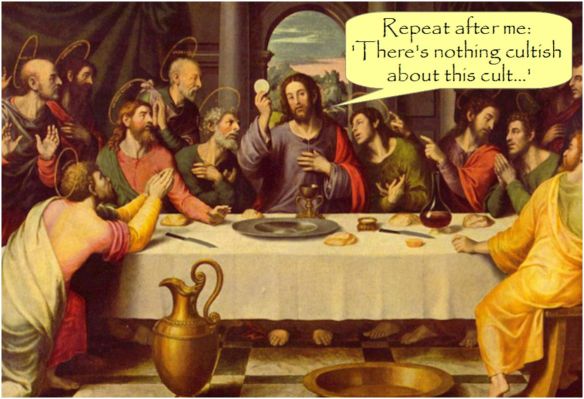
When I joined the group – which I’m not going to call a cult; other people call it a cult, but it’s not. There’s nothing cultish about it – when I joined the group, the leaders told me I had to ignore whatever my family said about it. They instructed us all that the best way to really commit ourselves was to turn our backs on our families. Of course they were right – hadn’t the Teacher himself said so? – families belonged to our old lives. They didn’t understand the Teacher’s message or how important his mission was and how much he loved us. So I turned my back on mine. They weren’t worth a thing next to Him.

Then they said I should give everything away. Sell it all and hand it over to the poorest in the group because possessions only hold us back. Get rid of them, they told us the Teacher had said, and don’t even hang onto the money you got for your stuff. Give that away too. Because, you see, nothing material matters. We’re in the last days. God is going to use the Teacher to do amazing things, to change the world so that those of us at the bottom of the pile rise up to the top, and those on top now – the rich, the powerful and the cruel – well, they’re going to get their comeuppance. Nothing else matters. How could it, really? God’s New Kingdom is going to arrive any day now.

So I spend all my time going out into the streets, proclaiming this great news to the lost. Most of them don’t want to know, of course. They say there have been a thousand would-be messiahs who’ve declared that the world is about to end soon and it never does, and things go on just the same.

This time, though, it’s different. The Teacher is different. He said, the leaders who knew him say, that we should act as if the Kingdom has already arrived. So we try not to judge the foolish ignoramuses who ignore his words of warning, and we make ourselves servants, always doing more than people demand of us, turning away meekly when they spit at us or strike us in the face. We give to anyone who asks – not that I have much to give these days (only what the group graciously provides for me) – and we visit the sick and those in prison. We feed the hungry and give our clothes to the poor, specially our impoverished brothers and sisters in the Lord. Truth to tell, I’m one of those myself now – one of the poor – but I have untold riches stored up in Heaven.

So I have no regrets. I’m doing what the Teacher commanded. I follow his blessed instructions, which his followers passed on to our revered leaders. And it won’t be forever, will it. Just a short while now and we will have our reward. The Teacher will return and he will usher in God’s magnificent Kingdom on Earth and there’ll be no more crying and no more serving; the Lord will lift us up to great heights and we will inherit the Earth.

Didn’t the Teacher say so?

Wouldn’t this be what it was like for some of those early followers of Yeshua Bar Yosef? Those who came immediately after the disciples, but who heard ‘the good news’ only second or third hand? Followers of the Way, known in some circles as ‘The Poor’, whom Paul persecuted? Believers who were around in those few years prior to Paul getting his hands (and unhinged mind) on the message and altering it beyond all recognition? Those ‘Christians’ (the name wouldn’t have existed back then) must’ve believed something and it couldn’t have been Paul’s mystical salvation plan, which didn’t yet exist. From the evidence that survives in the synoptic gospels and from Paul’s disputes with the disciples, I surmise that, for someone who took Jesus’ message seriously in those very early days, it must have been something like the experiences of the hypothetical follower above. As misguided and futile as all of this was, it is, nevertheless, a far cry from the bloated, self-serving travesty that is Christianity today.

Why Christians Don’t Do What Jesus Tells Them To …And What They Believe Instead*

Blog370

A few days ago, notorious God-botherer and TV evangelist, Pat Robertson, said on his TV Show that churches should revise Jesus’ stern teaching about divorce to better fit modern sensibilities. As today’s Christians divorce at about the same rate as non-believers, old Pat thinks it a mite inconvenient that they should feel guilty about it. He reminded his viewers that Jesus gave the church authority over all things and that it should therefore amend Jesus’ teaching. That’s amend as in ‘ignore completely’.

Which is fine, I guess, if you take the same approach to everything else Jesus said. That way, Christians would be safe to ‘amend’ his commands about feeding the hungry, visiting the imprisoned, healing the sick, turning the other cheek, welcoming the stranger, going the extra mile, forsaking possessions, relinquishing wealth, giving to everyone who asks, not judging, putting themselves last and others first, loving their neighbour and enemies alike… and so on.

But wait – they do that already, don’t they? Most Christians don’t practise these things. They don’t see these commands as applicable to them. They work hard, and unconvincingly, at interpreting his words as metaphorical – ‘he didn’t really mean give everything away because where would that leave us?’ – or claim they’re being taken out of context, or insisting they have a spiritual meaning…

Which is to say, nothing Jesus said is to be taken literally, even though the most straight forward reading of his pronouncements is that this is how he meant them. It’s how his early followers, the people who preserved or created his words in the gospels, understood them. Why record them otherwise?

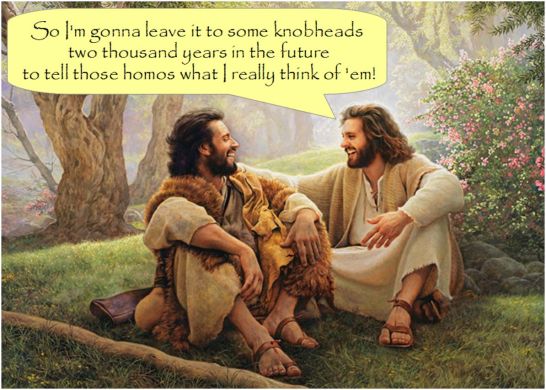
But Jesus’ moralising is inconvenient, impractical, exacting, extreme; ridiculous, in fact, and Christians know this. Still his commands must be dealt with somehow. So the Righteous™ work round them – like Robertson and the teaching about divorce – or they ignore them completely and replace his priorities with ones of their own: worshipping him; defending his reputation; striving for power; complaining about secular society; promoting aggression; acquiring wealth; trying to control others’ behaviour; interfering in others’ sex lives; suppressing LGBT people; arguing that religious rights trump those of minorities; opposing abortion.

None of these figured on Jesus’ agenda. Some are in direct opposition to what he’s made to say in the gospels.

When we see Christians doing the things Jesus tells them they should be doing, maybe then we’ll listen to what they have to say. When they demonstrate credibility rather than hypocrisy, maybe they’ll have earned the right to be heard. But as there’s not much chance of that happening any time soon, it’s way past time we ignored them, and their superstition, in much the same way they ignore their Lord and Saviour™.


*See my book of the same name: https://www.amazon.com/gp/product/147016373X/ref=dbs_a_def_rwt_hsch_vapi_taft_p1_i0 (US) & https://www.amazon.co.uk/gp/product/147016373X/ref=dbs_a_def_rwt_hsch_vapi_taft_p1_i0 (UK)


Why it’s never a good idea to throw stones from inside your glass house

Blog369

I added the comment below to Bruce Gerencser’s blog yesterday. Bruce had been writing about one reason people don’t like Evangelical Christians, that being their attitude towards LGBT folk. It’s a good post and well worth your time (though not, of course, till you’ve finished here.) This is what I wrote:

It never ceases to amaze me that people who claim to possess the key to salvation, know the secret of eternal life, have a relationship with the creator of the universe and think their sins are all forgiven, have nothing better to do than spend their time slagging off LGBT folk.

A quick, admittedly non-scientific, survey of Christian blog and web-sites suggests that at least a third are attacks on those fortunate enough to be gay.

Maybe all that other stuff just isn’t as marvellous as they like to think it is.

Genuinely, I cannot understand how, when they think they’re tapped into the First Cause/the Power of the Universe/God, the Father Almighty, that the best evangelicals can do is to make repeated snipes at gay people. I had a look this morning at the Christian Research Network site to find three articles had recently been posted doing precisely that: one called ‘Which should be illegal: Christianity or Sodomy?’, about how religious rights are soon to be negated by gay rights (they won’t be, specially not in America); one criticising popular preacher Beth Moore for supporting a small number of gay-affirming pastors and another attacking clergy who might be gay but who remain celibate.  Obviously these matters are of great concern to the Lord of Hosts, the Judge of Mankind, who is, nonetheless, demonstrably impotent when it comes to doing anything about them. Or maybe, given his non-existence, they matter only to his small-minded sycophants here on Earth.

Bruce writes in another post that he doesn’t comment on Christian web-sites because ultimately it makes no difference; evangelicals don’t listen and don’t want to know what others think. They regard even the mildest criticism as the persecution the Bible promises they will face, particularly in these ‘last days’ (that we’ve been enjoying now for two millennia.) Bruce is right, of course. All the same, when I’ve time, I can’t help but comment on their anti-gay rhetoric, their judgement and condemnation of a relatively powerless minority. They can take it how they like; their casting of the first stone just can’t go unopposed.

I think it’s always pertinent to ask Christians why they’re not living according to Jesus’ commands – by not judging others, giving to all who ask, loving their enemies, and the rest, because as sure as eggs is eggs, the majority don’t. As if this matters to today’s evangelicals. Being a Christian is really about being part of a glee club that first and foremost benefits its members, no one else. Sometimes the party bubble needs a little puncturing. Of course, believers don’t like it; they tell you Jesus was only speaking ‘metaphorically’, which he always is when he says things they don’t like. They become aggressive and unpleasant because, presumably, that’s what he would want. Nonetheless, they sometimes need to see that when they condemn others, they can expect to be judged in return. That’s just how it works. Jesus says so.

Oh, and Dolly Parton too:

If you live in a glass house, don’t throw stones,
Don’t shatter my image till you look at your own,
Look at your reflection in your house of glass,
Don’t open my closet if your own’s full of trash,
Stay out of my closet if your own’s full of trash.

Amen to that, Dolly.


All in the Mind

Blog 368 (2)

Christians dispute that those who saw the Risen Jesus after his death were merely experiencing hallucinations or ‘visions’ in their own heads. Despite the fact that the only first-hand eye-witness report we have of a resurrection sighting is of precisely this nature – Paul’s, in Galatians 1.16 where he says that the Risen Christ was revealed ‘in’ him – Evangelicals in particular insist that Jesus rose physically from the dead and was seen by numerous ‘witnesses’.

And yet, in the two thousand years since he supposedly ascended into Heaven, no-one has seen Jesus in his resurrected, physical body. This doesn’t stop believers today claiming that they experience him in ‘real’ ways. As the old song goes, they walk with him and talk with along life’s narrow way. Or they think they do.

Back when I was a Christian I used to hear Jesus speaking to me. He’d create a thought in my head, telling me to act in a certain way, to speak to some lost soul about him, for example. At the time I was convinced these promptings were really ‘the Lord’. How could they not be? I had his Spirit living inside me, a sure-fire way of experiencing the living Jesus. His presence felt very real, as it does still for millions of Christians. What greater proof of the resurrection could there be?

In fact, Jesus’ ‘voice’ was no more than the vague recollections of Bible verses I half remembered. The sense of his presence I felt was a trick of my own mind, conditioned by hours of sermons, Bible reading and the mutual reinforcement provided by fellow-believers.

I never actually visualised Jesus, though many claim to. They see him in burnt toast or cloud formations; they dream about him or think he has visited them in the night, standing at the foot of the bed. Some have near-death experiences when (they imagine) they travel to Heaven and are welcomed by his outstretched arms. Others ‘know’ he has rescued them from calamity, or purposely sent them a sign (by leaving a Bible unscathed after a storm destroyed a house, as happened this week in Indiana.) Still others, a mite more credibly perhaps, have a sense of Jesus being present in a wishy-washy mystical way. He seems especially real when they’re caught up in the ecstasy of worship or a mighty and wondrous healing is being staged taking place. What a blessing! After all, didn’t Jesus promise in Matthew 18.20 that ‘when two or three are gathered in my name there I am in the midst of them’? (Probably not, but Christians believe he did and that’s what matters.)

My point is this: if this is how Jesus ‘manifests’ himself today – in whispered messages, inner-visions, emotions, dreams, blessings and ‘signs’ – and if these are enough to keep today’s believers convinced he lives again, then isn’t it likely that this was exactly how his earliest followers experienced him after his death? Not as a real, physical body but in these same ‘spiritual’ ways, conjured up by minds deep in the thrall of religion? If illusions of their own imaginations are enough to persuade the susceptible of the Risen Lord’s presence today, then surely they were more than enough to convince a handful of superstitious zealots in the first century.

I mean, just look at Paul.

Christian charity?

Blog367

Over at the distastefully named Cripplegate, Jordan Standridge has been considering what Christians should do when a homeless person asks for money. Jordan wants some means of weeding out the fakes (fair enough, though he doesn’t really have any clear strategy for doing this) and also attaches conditions to his giving – the recipient of his largesse has to listen to him ‘sharing the gospel’. Jordan reports that none of those he treats to a free meal object to him doing this – probably because they fear going hungry if they don’t listen to him droning on about Jesus.

Most of the comments following Jordan’s post betray the Christian eagerness not to have to follow the command of Jesus’ to give unstintingly. I felt moved to add one of my own:

It’s good that you’re considering ways you can help the poor and homeless, but Jesus says to ‘give to everyone who asks’ (Luke 6.30). ‘Everyone’ is a pretty inclusive! There’s no mention of ‘weeding out the fakes’; just give to all. Seems to me you’re hedging around this command.

This met with variety of responses, shown below in italics, followed by my replies:

Mike: By that logic, if a homeless person asks you for your home, are you then to sign it over to them? If they simply ask for your car, are you then going to hand them your keys? Of course not. That’s not what Luke 6 has in mind. Otherwise YOU would be left on the street naked and homeless simply because someone ASKED you for everything you owned…

You’re right, Mike – it’s completely absurd and unreasonable. But it’s Jesus’ absurdity and unreasonableness, not mine. If you want to say he’s wrong – as you do when you say ‘that’s not what Luke 6 has in mind’ (you know what it ‘has in mind’, I take it?) – then your dispute is with him, not me.

Jane: I believe your atheism qualifies you as the one having the dispute with Him.

Well, Jane, you’re the one who claims to obey him as Lord and Savior and yet here you are trying to figure out ways not to. It brings to mind another of his sayings from Luke 6: ‘Why do you call me “Lord, lord,” and not do what I tell you?’ Why indeed.

Craig: The passage in Luke 6 is not instructions for the body of Christ. In the gospels Jesus has come to Israel as their Messiah to bring in the kingdom that was promised to them. Jesus is telling them how it will be if they accept Him as Messiah.

It’s not, Craig? How’d you know?

What you’re really saying is ‘we Christians don’t much care for this commandment, so we’ve decided it doesn’t apply to us.’

However, if we were to go along with your argument, that Jesus is not addressing the ‘body of Christ’ here, then it follows neither can he be addressing it anywhere else in the gospels. You can’t simply delete the bits you don’t like.

4CommenceFiring4: “Give to everyone who asks” doesn’t specify what to give, or how much. The other commands–like going the second mile or giving them your cloak when they ask for your shirt–has to do with attitude, not mathematical formulas.

The Jews asked Jesus for a “sign” that He was the Christ. Did violate His own standards by not providing a sign? If you think He did, then it would be fruitless to get into the subject any further.

Really? It’s to do with attitude not action? Who says so? I thought the Bible was the literal word of God, meaning Jesus’ commands here should be taken at face value. Thanks for enlightening me; I’m relieved to learn there’s enough wriggle room not to have to do what Jesus says.

Oh, and according to John’s gospel, Jesus provided numerous ‘signs’ for ‘the Jews’ (which he was himself, of course.)

4CommenceFiring4: “The Bible is the literal Word of God” is the claim of someone–believer or otherwise–who hasn’t thought much about what that even means. There are theological debates by serious people about that, so don’t think for one minute that because “literal” means different things to different people means it doesn’t mean anything and we can go merrily on our way thinking we have nothing to which we owe our attention.

A devotion to strict literalism would lead to ridiculous conclusions, as you well know, so if you intend to use that as a defense for why the Bible isn’t to be taken seriously, try again. Smarter people than either of us have devoted their lives to debunking it, and it’s still standing long after they faded away. So don’t waste your time with that empty pursuit.

The bottom line is, are you ready for what comes next? And are you sure? It’s a bet you can’t afford to get wrong. Examine that, and everything else is secondary.

Great stuff. The ingenuity and effort that goes into avoiding doing what Jesus clearly commands is truly impressive.

Am I ready for what comes next? Sure. Oblivion never hurt anyone.

*****

Meanwhile, the homeless go on being homeless and Christians continue to demonstrate that the people who get the most out of their ‘discipleship’ is primarily they themselves.

Jesus, Simon and me

Blog357a

It took me long time to accept who I was. Most of my life, in fact. When I was in my late teens, I had a relationship with a young man the same age as myself. This was illegal at the time as the age of homosexual consent in the UK was 21, remaining so until the late 1990s when it became 18. (In 2004 it was finally made the same as heterosexual consent: 16.) We didn’t care. We had a lovely time and I for one was very happy. I think Sam was too. We lost touch eventually as life took us down different paths.

Not long after, I fell in among Christians. A friend – let’s call him Simon – thought it would be a good idea if we started going to the YMCA. This was long before the organisation became synonymous with the Village People and hangin’ out with all the boys. The YMCA I encountered was markedly evangelical. Once we’d visited a few times we were ‘invited’ to one of their young people’s meetings. I can’t remember what snappy title these meetings went by, but essentially they were a mixture of worship, bible reading and ‘teaching’. Sometimes there’d be a guest speaker who would tell us all about their relationship with Jesus, which, in case we had any doubts, was just marvellous. Before long I was giving my life to Jesus too, though in the long run it turned out to be only a temporary loan.

Occasionally, one of these guest speakers would talk about relationships, those with other human beings, and sex. From them I learnt that sex was almost always wrong: sex before marriage, sex outside marriage, sex with yourself – all of them were sinful. Even imagining sex and fancying someone (which qualified as lust) were wrong too. Who knew? But the most sinful, wicked and sordid sex of all was sex with someone of the same sex.

It didn’t seem it to me. The encounters I’d had with Sam were far from sordid and not at all evil. On the contrary, they were a lot of fun! But these people, these Christians, seemed to know what they were talking about. And hadn’t I given my life to Jesus? He detested homosexuality, or God did anyway, so Jesus must’ve felt the same way (actually this was all in the present tense, Jesus being alive and monitoring us from Heaven and all; Jesus detests homosexuality, they’d tell us.) Sometimes they’d read verses from the bible that proved it.

And so I started to suppress my feelings. They’d kinda got me in trouble anyway, when my body betrayed me in the showers after gym at school. Other boys would torment me about it. I wasn’t actually ‘out’, as we’d say today, and terms like ‘queer’ and ‘poof’ (the British equivalent of ‘fag’) were bandied around as general insults – they didn’t necessarily mean anyone actually thought you were gay. Nonetheless, they came a little too close to comfort. All things considered, a retreat to the back of the closet (not that I knew this terminology then either) seemed the best option. It was what Jesus wanted, or so I thought. I started to deny myself for him, as he insists his followers do, and began a life of self-deception.

Which would’ve been fine, except it’s impossible to live a lie in isolation. Others invariably become involved.

Enter Jane…

An open letter to loving Christians everywhere

Blog357

An open letter to loving Christians* who, in my lifetime, have told me that –

I’m perverted, diseased, sick, sickening, immoral, deviant, degraded, dissolute, toxic, satanic, dangerous, unhinged, unnecessary, intolerant, hateful, harmful, worthless and weird;

I want to destroy Christianity, society, the family, marriage and lives;

I’m indistinguishable from a paedophile or someone who practises bestiality, a sinner, an animal, a ‘sodomite’, a predator, an abomination and a ‘fag’ deserving only of death;

 I’m in rebellion against God and need to be cured;

I’m responsible for hurricanes, tsunamis and other extreme weather conditions and am capable of bringing God’s wrath and judgement to the Earth;

I’m conclusive proof that these are the Last Days.


I’m none of these things.


* Pat Robertson, Steven Anderson, Franklin Graham, Linda Harvey, Tony Perkins, Stephen Green, Scott Lively, Albert Mohler, John Piper, Ken Ham, Westboro Baptist church, Focus on the Family… aah, f**k it, you know who they are.

How to spot a Christian

blog353cross2

What is being a Christian actually about? Do you qualify as a Christian if, like Paul seems to suggest, you believe a particular set of propositions; ‘right belief’ that ensures you’re saved and will go to heaven after you die? Do you have to sing songs about how marvellous Jesus is and how much you love him? Do you show you’re a Christian by defending God’s ‘standards’, which you know about from a very selective reading of the bible? Does being a Christian entail arguing vociferously that Jesus is God, that he rose from the dead and that the bible is God’s inspired word? Is it insisting, with all the loving aggression you can muster, that non-believers are bound for hell, that homosexuals are disgustingly evil and that these, like every other period in the past two millennia, are the end times?

This is what a modern Christian looks like. He or she does these kinds of things, and a whole lot more, that Jesus, as he’s portrayed in the synoptic gospels, wouldn’t recognise. His idea of a Christian (not that he’d know the term) is a very different animal. Here’s what Jesus expects of one of his followers –

They:

cut themselves off from their family – hate them, in fact – just to follow him (Luke 14.26);

deny everything about themselves (Matthew 16.24-27);

forsake home, job, wealth, status, credibility and comfort to help bring about God’s Kingdom on Earth (Mark 10.29-31 etc);

slave tirelessly in the service of others (Mark 10.43-44; Matthew 23.11 etc);

sell their possessions so that they can give the proceeds to the poor (Matthew 19.21; Luke 14.33);

turn the other cheek, repeatedly go the extra mile and give away the shirt and coat off their back – if they’ve still got them after giving everything away – (Matthew 5.38-40);

welcome the stranger, feed the hungry, clothe the naked and visit those in prison (Matthew 25.35-40);

forgive again and again and again (Matthew 18.21-22);

don’t judge others in case they’re judged in return (Matthew 7.1-3);

love their enemies (Matthew 5.44);

regard persecution and injustices done to them as blessings (Matthew 5.11);

do miracles even more impressive than Jesus’s own (Mark 16.17-18; John 14.12);

heal the sick, raise the dead and cast out demons (Matthew 10.7-8);

are granted whatever they ask for in prayer (Mark 11.24; Matthew 21.22);

don’t subscribe to a magic salvation-formula (found nowhere in the synoptic gospels).

Yes, Jesus was completely insane, demanding all this, and more, of those foolish enough to align themselves with him. But demand he did.

I’m sure there are Christians today who do everything he expected… somewhere, possibly… but I don’t know any. They’re all too busy enjoying their affluent, middle-class lives, singing songs at PraiseFests, judging others and squabbling about doctrine from behind their keyboards. It makes you wonder why they call Jesus their Lord when they don’t do a thing he tells them (Matthew 7.21).

Anglican minister almost gets it right Shock

blog352

There was controversy last week over the appointment of Dr John Shepherd as the Archbishop of Canterbury’s new ambassador to the Vatican. The controversy wasn’t about the fact one branch of Made-up Beliefs was mingling its Sacred Truths™ with the Sacred Truths™ of another (which was upsetting enough for some of the faithful) but that Dr Shepherd has previously declared Jesus did not rise physically from the grave. In his 2008 Easter sermon, he said:

The resurrection of Jesus ought not to be seen in physical terms, but as a new spiritual reality. It is important for Christians to be set free from the idea that the resurrection was an extraordinary physical event which restored to life Jesus’ original earthly body.

Well, heaven forbid Christians should be compelled to accept reality! Needless to say, many of them didn’t like being made to do so. Undaunted, however, Shepherd went on to explain how the belief in Jesus’ resurrection came about:

…Jesus’ early followers felt His presence after His death as strongly as if it were a physical presence and incorporated this sense of a resurrection experience into their gospel accounts.

Yes, absolutely! This is precisely what happened. I’ve written about it here. This guy’s good. Until we get to his conclusion, anyway:

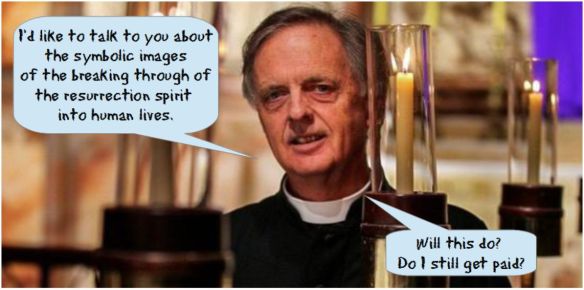
But (the gospels) are not historical records as we would expect history to be written today; they are symbolic images of the breaking through of the resurrection spirit into human lives.

He’s right about he nature of the gospels, of course. They’re not historical, nor are they eye-witness accounts or even second-hand reports of eye-witness accounts; they’re propaganda, written ‘so that you may believe’ as the fourth gospel  puts it.

But what’s this ‘symbolic images of the breaking through of the resurrection spirit into human lives’, Shepherd talks about? Having a good grasp of how the stories of Jesus’ ‘resurrection’ came about, he wants, for some reason, to continue promote the underlying fantasy – it’s his livelihood, after all – so he has to dress it up as something relevant to people today. He goes for ‘images of the breaking through of the resurrection spirit into human lives’, whatever that means. Breaking through from where? And what’s a ‘resurrection spirit’ when it’s at home?

Why bother though with the Jesus stuff at all? Plenty of people have life-changing experiences without having to hitch them to an ancient cult. My advice to Dr Shepherd would be to dump the ‘breaking through of the resurrection spirit’ hokum and he’ll be pretty much there. Then he can work on getting a real job.