What has God ever done for us?

Noah

Back in my Christian days, I used to sing a hymn with a line that went ‘give and give and give again what God has given thee’. It was a fine if largely ignored sentiment – like those of similar nature demanded by Jesus – but I was reminded of it recently on hearing for the umpteenth time of just how much God has given us.

Join me in taking a look around to see.

Everything around me here in the room is… well, not to put too fine a point on it, man-made, that is devised, created, crafted and manufactured by human beings. No supernatural intervention appears to be have been required in the creation of the technology you and I are currently using, nor in the creature comforts that surround me: the chair I’m sitting on, the cushions, the clothes that are keeping me warm this cold winter’s day, the glasses I’m wearing that enable me to see properly (and have done since I was a young child), the carpet that keeps my feet from bare boards, the boards themselves, the house that they’re part of. No god was involved in the making of these things and the many more conveniences that make life in the Western world as comfortable as it is. You name it, humans made it.

It’s true that many of these items utilise natural resources – wood, cotton and so on – but the cultivation of these is again the result of human effort. There’s a clue too in the name of such materials – ‘natural’. Nature produces them, which as Darwin made plain 150 years ago, does not require any god pulling any strings behind the scenes.

The same applies to our bodies; they are the product of natural processes. I was created by my parents who in turn were created by theirs and so back to a time before any of us were human; no god was steering the direction of evolution, nor, despite what Ken Ham thinks were we created as we are today in six days. And when our bodies let us down, as they inevitably do? Even the most ardent among us do not depend on god’s willingness to heal us – he is, as in so many other respects, notoriously unreliable – we go instead to the physician and the surgeon, to medicine and technologies; in short we turn to other human beings and the creations of human beings; we turn to science. The vast majority of Christians do this too, which says much about their faith in an Almighty who can work wonders (but doesn’t). When the chips are down they don’t, as Ham puts it, reject the ‘foolish ways of man’, but turn to the skills and provision of their fellow men and women. They help far more than – infinitely more than – any imaginary god.

So it is with ideologies, philosophies and religions; they too are human inventions, everyone of them. In the West we enjoy the benefits of living in capitalist democracies with their attendant conveniences and freedoms. No god-on-high handed down such systems. Jesus was rabidly opposed to riches and wealth and there was nothing democratic about his intention to be king of the world.

Everything we have, from our ideologies and morality to science and technologies we  created ourselves; no god was involved. The messes we’ve made too; these are our responsibility, from the damage we’ve inflicted on the environment and the climate to the wars we seem endlessly to engage in and the often often appallling way we treat each other. We are culpable. No god is going to come down from heaven to right these wrongs. No god ever has; we have to sort things out ourselves. That has always been the case and always will be.

If it’s not, then those who of you who promote a god need to show him to the rest of us. Show us your god – not through the actions of human beings because those are just that, the actions of human beings. Show us something your god made that is not better explained as a product of nature or of human beings themselves. Provide evidence of your Christ, his angels and his heaven that is more than the delusion shard by you and your co-religionists; show us that they are beings with an existence independent of the human mind.

You can’t, you say, because that’s not the way of spirituality, not the way of a transcendent god.

How very convenient.


“When (a worldview) doesn’t include God, there is no basis for morality.” Roy Moore, 2008

Ravi3

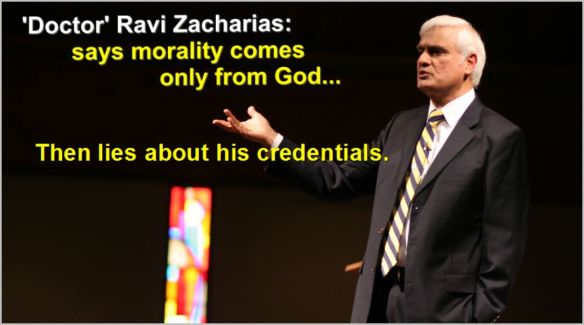
I planned to dissect Ravi Zacharias’ morality argument even before recent revelations that he lied about his credentials. I’m sure that, despite his fraudulent claims, he’s still a good Christian™, perfectly entitled to tell the rest of us what terrible sinners we are. If you’ve ever seen his grandiose sermonising, you’ll know he likes to pretend that Faith is something deeply intellectual, despite Paul’s contention in 1 Corinthians 1. 26-27 that it isn’t. Zacharias’ pseudo-intellectual Christianity is, like many of his qualifications, fake.

In common with other Christians desperate to prove their God, he relies too on circular reasoning. He tells us that our morality derives from God (you listening TC Howitt?) and then uses this to argue that, because of we have morality, God must exist. His unproven conclusion is his premise, with nothing in between to justify either.

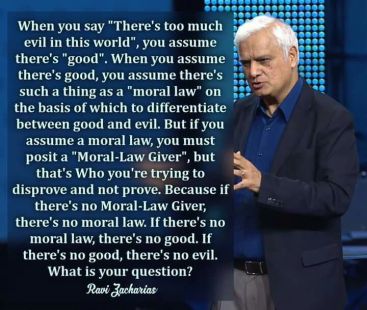
Here’s his ‘argument’ in full:

Ravi3

Let’s take a closer look:

‘When you say “There’s too much evil in the world”, you assume there’s “good”. Who says this? How much evil is ‘too much’? Do people other than Christians see the world in terms of good and evil? Does acknowledging evil mean one also assumes there is good? How is this ‘good’ defined? So many unanswered questions in this first muddled statement.

‘When you assume there’s good, you assume there’s such a thing as a “moral law” on the basis of which to differentiate between good and evil.’ The only one making assumptions here is Ravi himself. The considerate treatment of others, which is how we might reasonably define morality, is easily recognisable when it occurs. This presumably, given he fails to define any of his terms, is what Ravi means by ‘good’ (and conversely, inconsiderate or malicious treatment of others is his ‘evil’). There’s no reason to suppose, however, that the demonstration of good is a component of an objective ‘moral law’ that exists somehow independent of human interaction. Morality and any resulting goodness (or ‘evil’), is human interaction.

‘But if you assume a moral law you must posit a “Moral-Law Giver.” Well, of course we’re not assuming a moral law, not in the magical way Ravi is assuming we’re assuming. And how about that imperative: ‘You must posit a “Moral-Law Giver”‘! Must we? Morality is socially determined by human beings themselves; we see this is in the different moralities that have emerged in cultures with shared heritage; we see it in the changing attitudes over the last fifty years to the treatment of women and gay people. Morality is fluid; it evolves. The ‘Moral-Law Giver’ then, if we must have such a term, is we ourselves.

‘But that’s Who you’re trying to disprove and not prove.’ Erm no. Ravi’s being disingenuous here. ‘We’ were not trying to disprove a Moral-Law Giver at all; he was trying to prove it (him? – note the capital sneakily added to ‘Who’). Let’s though, for the sake of argument say Ravi is right; let’s say there is a Moral-Law Giver out there somewhere. Why has he, over the expanse of human existence, issued such varying and often conflicting moral codes? Compare, for example, today’s moral standards with the harsh, brutal morality of the ancient Israelites, which demanded the death penalty for almost any infringement of the law. Compare that with the morality Christians today claim they derive from New Testament. Then compare Jesus’ impossible demands with how Christians actually behave. By and large, they’re happy to ignore him and, with the exception of one or two areas they get hot under the collar about (abortion, same-sex relationships), they go along with the consensus of the culture in which they live.

‘Because if there’s no Moral-Law Giver, there is no moral law.’ There is a ‘moral-law giver’: it is us. That is why moral laws vary according to culture and through time. Zacharias wants us to conclude that this capitalised ‘Moral-Law Giver’ is his God, yet he has neither demonstrated that a deity (any deity) decrees moral codes from on high, nor has he ‘proved’ (his word) that this cosmic law giver is his god, the barbaric and inconsistent YHWH. Rather, he ‘assumes’ this to be the case and hopes that his audience, failing to notice his assumptions, presuppositions and sleight of hand, will too. Given that most of them are Christian sheep  (Jesus’ term, not mine) they will no doubt do just that.

‘If there’s no moral law, then there’s no good. If there’s no good, there’s no evil.’ This is where the argument, such as it is, turns back on itself. Zacharias thinks he’s being very clever (he always thinks he’s being clever) but all he’s doing is declaring his premise over again.

Of course there are moral standards; humans have devised them throughout their existence. The ‘Golden Rule’ promoted by Jesus, for example, is first recorded thousands of years before him. We determine for ourselves what is good and therefore what is ‘evil’; these defintions are not delivered to us ready made from a “Moral-Law Giver” in the sky.

(While Zacharias doesn’t use the argument, there are those who like to say, on the basis of Romans 2.15, that God has written his (ever-changing) rules in our hearts, a fallacy I’ll address in the next post.)

‘What is your question?’ clever Ravi finally asks. We didn’t have a question. Here’s one for him anyway: how has he got away with such fraudulent drivel for so long?


Can you be good without God?

Good

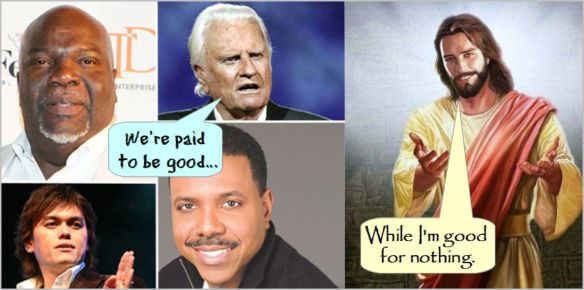
You can’t be good without God, you can only be good with him – or so Christians like to tell us.

What is the evidence for this? What ‘goodness’ do we see in and from Christians (and other believers in God) that demonstrates they are directed in their morality by a supernatural being who, they say, dwells within them? ‘By their fruits ye shall know them,’ declares their leader in Matthew 7.16 – so what ‘fruits’ do we see?

How about Christians abusing the vulnerable? Sexual abuse of minors has long been widespread in the Catholic church and more and more cases are coming to light in Protestant ones too. Bruce Gerencser keeps a log of those accused and convicted of such crimes, adding names and cases from the States on almost a daily basis. Is this the ‘goodness’ Christians like to say comes from knowing God?

Or how about those believers whose ‘goodness’ manifests itself in cruelty, dishonesty or extreme right-wing views? (Never mind goodness, from these examples it would seem God doesn’t even provide his followers with common sense.)

Then there’s the likes of former judge Roy Moore, anti-LGBT politician who, when he’s not trying to erect monuments to the ten commandments, is excusing his history of grooming and abusing 14 year old girls? What part of this behaviour is ‘good’?

How about preachers like Franklin Graham, Stephen Green here in the UK and the self-righteous know-alls of Teens4Truth, all of whom persistently bear false witness? Perhaps demonising others with the intention of stirring up hatred and paranoia is somehow ‘good’ inside the Christian bubble.

‘Ah, but wait!’ say those Christians who insist we can only be good with God. ‘These people are not true Christians; if they were they wouldn’t be doing these things. Their behaviour tells us they’re not really Christians at all.’ And yet, they all profess faith in Jesus and are convinced his spirit lives in them; however they behave, and whether or not other believers accept it, they are Christians by virtue of this profession alone (Romans 10.9). Christian apologists can’t get out of the double-bind they’ve got themselves into by saying those who do wrong can’t be considered Christians and only those who are seen to be ‘good’ are true believers. They can’t reasonably demonstrate the goodness of God’s Chosen by discounting those who don’t manifest the characteristic they’re attempting to demonstrate, while pointing only to those who remain.

‘Well,’ Christians say, ‘non-believers and atheists are capable of behaving immorally too!’ which is true. But wasn’t their original argument that Christians are so much better (more good) than non-believers because of the indwelling Holy Spirit and their resulting spiritual discernment (or whatever)? Pointing out that some non-believers are capable of behaving as deplorably as some Christians is hardly a demonstration of the supernatural goodness that allegedly infuses Christ’s followers.

It has always seemed to me that religion is like alcohol. A little too much of either accentuates an individual’s true nature. If he or she is already a decent, kind person, drink and god-bothering tend to highlight these characteristics. If, on the other hand, a person is self-centred, greedy and unreasonable then that’s what we get more of. God has nothing to do with it; if it’s your nature, you can be good with or without him. As Bertrand Russell put it:

Cruel men believe in a cruel god and use their belief to excuse their cruelty. Only kindly men believe in a kindly god and they would be kindly in any case.

It is a pernicious lie that subscribing to a superstition imbues a person with ‘goodness’. It should be disputed at every turn.


The Moral Maze

Stoning

Where does morality come from? Ken Ham and others like to tell us it comes from the bible and the Christian ‘worldview’ they say they find there. Those non-believers who profess or practise morality in any meaningful way ‘steal’ it, they say, from this Christian worldview. They argue that without supernatural beings to dictate, with wild inconsistency, how we should behave, we simply wouldn’t know how to. That we do, by and large, means we can only have ‘stolen’ our morality from Christianity.

Unsurprisingly, the evidence suggests otherwise; versions of morality exist in all cultures – the secular, the pagan, the alternatively religious. Some of these are similar to those traditionally and often mistakenly associated with Christianity, some are not – which tells us they are socially determined. We decide ourselves, collectively, what is and isn’t morally acceptable. We don’t ‘steal’, or even need to, from the Christian ‘worldview’. Some of our morality might coincide with that espoused somewhere in the bible, but that doesn’t mean its taken from it. It means we value some of the same principles that ancient cultures valued – ‘do not steal’, is fairly ubiquitous, for example – because they too lived communally and needed rules like this one, as we do, to facilitate social cohesion. Of course, the collective understanding of a principle does not necessarily mean that everyone adheres to it, just as in those ancient cultures. Nonetheless we can all understand morality insofar as our culture defines and experiences it.

But let’s take a closer look at that ‘biblical worldview’ morality, that evangelicals think is the be-all-and-end-all, shall we?

T.C. Howitt, curator of the Oil for Light blog and commenter here, argues that ‘God’s moral law’, as demonstrated in the bible, is the only true (‘transcendent’ and absolute) morality. I’ve asked T.C. if he’s talking about the ‘morality’ that promotes the keeping and beating of slaves; the stoning of couples who have sex when the woman is menstruating; the execution of men who sleep with men, uppity teenagers and those who worship other gods, and which forbids work on the Sabbath (Friday evening to Saturday afternoon, that is).

It turns out it’s not (and yet it is) because, this, you see, is Old Testament morality and Jesus did away with all that. But nonetheless it’s still transcendent and absolute because it’s God’s Eternal Law. (I hope you’re following this so far.) However, in practical terms, what moralising believers seem to mean by biblical morality, is that which can be found in the New Testament. As I’ve pointed out to T.C., this is not the same thing as biblical morality.

So what does New Testament morality look like? Presumably it’s the morality promoted by Jesus, such as go the extra mile; sell all you have and give to the poor; turn the other cheek; give to everyone who asks; hand over your shirt when your jacket is demanded of you; don’t judge; love your neighbour as yourself; love your enemies; treat others as you like to be treated yourself, etc, etc.

If this isn’t what’s meant by New Testament morality then I don’t know what is. But forgive me – I don’t know many Christians who practise it, not even with an indwelling Holy Spirit and God’s personal support. That’s because it is an impossible morality. Consequently, Christians, like the rest of us, derive their moral standards from the culture around them, at the same time reserving the right to harangue the rest of us over our lack of ‘biblical morality’.

Doesn’t the bible have something to say about this? Oh my, yes it does. It goes something like this: attend to the log in your own eye, because it’s blinding you, and leave others to attend to the speck in theirs.

Now that’s what I call biblical morality.


On being free

chains

Commenter Rebecca responded at length recently to my post ‘Why God Could Not Possibly Have Created The Universe (pts 4 & 5)’. There was so much in her response, that I thought it best to reply to her in a full length post rather than with a brief comment:

Hi Rebecca,

I won’t be able to respond to all of your points as there are so many, but will attempt a few.

I’m glad you find your faith beneficial. You’ve obviously thought about the whole incarnation/sacrifice/reconciliation issue, but I wonder whether you’ve ever asked yourself what it is you need saving from and reconciled with? What is it that means you personally need to avail yourself of the sacrifice Jesus supposedly made (however you interpret that)? I guess evangelicals, of which you seem to say you are not one, would claim it’s because of sin; the alienation from God that our very existence seems to cause.

Is that really the case though? Isn’t it rather that ancient superstitious peoples needed some explanation for why life was so difficult, short and brutish? They reasoned that surely it couldn’t be the fault of the creator God, so his tendency to treat them badly must be entirely their fault. Consequently, they had to do something to appease this god, to make him smile upon them again as they felt he must once have done. They thought the way to do this was, variously, through sacrifice and/or righteous living, by murdering those they felt offended him the most, and through praise and supplication.

There is no getting away from the fact, however, that the primary way they sought to reconcile themselves with their deity was through blood sacrifice. The New Testament’s interpretation of the death of Jesus is expressed in just such terms:

In Him we have redemption through His blood, the forgiveness of our sins, according to the riches of His grace (Ephesians 1.7).

This is not just an evangelical perspective; it is the major theme of much of the New Testament.

I’d like to ask you, Rebecca: are you really so steeped in sin that you need to avail yourself of a bloody human sacrifice in order to be reconciled with God? I have to say it seems extremely unlikely.

I didn’t leave faith behind because of how repugnant this idea is, however. I experienced an epiphany while walking one day, after many years of thinking about such things, and realised with conviction that there was no god: no god to appease, be reconciled with or commune with. He simply didn’t and doesn’t exist (see here for why I think this is the case). Of course, there being no god means there’s no son of god either.

I then started living my life on the basis of the fact there is no god, and I have to tell you it became a whole lot better. I didn’t have the constant feeling I had to come up to some impossible standard; I didn’t feel guilt for the most trivial of ‘sins’; I no longer worried that not getting my beliefs quite right would result in the loss of my eternal life; I stopped worrying about eternal life because it was obvious there was no such thing; I stopped thinking hell and heaven were real; I started living in the here and now; I stopped thinking I had to respond to others’ needs by telling them about Jesus (and started relating to them as people); I no longer had to subjugate whatever intellect I have to force myself to believe things that were clearly nonsense; the self-loathing I felt about my sexuality began to slip away. I could be me, and what a massive relief that was. I think I became a better person as a result. I certainly became a happier one.

You say the bible contains many deep truths – perhaps – but it also includes much that is cruel, spiteful, damaging and just plain wrong. I lost interest in sifting the wheat from the chaff because there was just too much chaff (a free biblical analogy for you there.)

The secrets of life, whatever they may be, Rebecca, are not in the bible, nor in any convoluted explanation of what Jesus stood for (he was just another failed apocalyptic preacher). They do not lie in Christianity or in any religion. Life is more than any of these ultimately dead things.

Thank you for writing. It can only be a good thing that you’re thinking about these issues. You will I’m sure find your way out into the light. I hope what I post here can help you with that.

The evidence for Christ

Christ

The evidence for Christ is not historical — it’s spiritual — and that evidence is indeed abundant for those who believe.

So says T. C Howitt, commenter on the Rational Doubt blog. And what is the ‘abundant evidence’, of which he speaks, for the existence of this spiritual being? It is, he says, ‘spiritual’. That’s quite a tautology: ‘the evidence for my fantasy is my fantasy’.

T.C. goes on to say that only those who truly believe can know that their experiences of the spiritual are real; the rest of us, he decrees, are blind. In other words, evidence that his fantasy is real is that other people have experienced versions of the same fantasy – some of them thousands of years ago. The ‘evidence’ for Christ (as opposed to Jesus) is therefore one’s own feelings plus the strange psychotic experiences Paul relates that he feels sure must be this supernatural being.

Science removes human subjectivity, as far as is possible, from its demonstration of how things are. All that Christians (and other believers in the supernatural) need do is similarly demonstrate that the spiritual realm, with its attendant beings, has an existence independent of human emotions, feelings and imagination. They could show us that, like gravity, electricity and quantum mechanics, Christ and angels, seventh heavens, demons and all manner of spiritual beings, have an existence separate from the internal, subjective experiences of human beings.

They’ve had two thousand years to do just this and still they haven’t. Why not? Because it can’t be done: Christ and his angels, God and his heaven are mythologies and, like all others, are constructs of the human mind.


Say Hul-loa to the Loa loa, another of God’s amazing creatures

AiGlogo

Answers from the Depths of Ignorance

by Hen Skam on October 22nd 2017

What a great God is our Creator God! Like it tells us in his Word™, he made everything in only six literal days, 6,000 years ago. Then, after planting fake fossils in pre-aged rocks, he found he had a little time on his hands so set about making deadly viruses, pathogens and parasites.

Now, these amazing examples of God’s handiwork didn’t evolve! That would be ridiculous. No, they were made by God just as they are now. So let’s take a look at one special ickle-bitty critter called the ‘Loa loa‘.

You see, this little creature, carefully crafted by our wonderful creator, has an intriguing life-cycle which involves it living for some of the time in the human eye. Once it has burrowed its way in, it quietly eats the eye from the inside, and unless treated with medicine (derived from man’s fallible word, so obviously not recommended) it can render its host blind. It may also lead to early death, but as the Loa loa is found only in Africa, we needn’t worry too much about this. Instead, let’s acknowledge what a blessing it must be to serve one of the Lord’s creations in such a way!

How foolish it is of our atheist friends to think that such an amazing creature could have evolved! There are many more animals like the Loa loa, each and every one of them is the handiwork of the one true Creator God. What an amazing, loving God he is!


This item was written with the assistance of AiG’s pseudo-scientists.

Thanks for stopping by and thanks for paying

(for us to continue with this ministry of superstition and stupidity.)

How the bible gets almost everything wrong: volume 3

Paul4

So there we have it. The bible is historically, scientifically, medically, morally, and psychologically inaccurate. It is a muddle of contradiction and confusion, written by pre-scientific, bronze-age tribesmen and religious zealots who made guesses about how the world worked. In almost every respect they got it wrong.

So what does this mean for the central premise of the book, its claim that the Creator of the universe, the Father of mankind speaks through it? Why should we suppose that when it gets everything else wrong, it manages to get this right?

We shouldn’t. The bible’s knowledge of God comes from the same source as the rest of its information: the wild imaginings of men who knew no better. The bible itself tell us so, many times. By its own admission, it is a catalogue of dreams, visions and inner ‘revelations’. In the New Testament alone there are at least twenty ‘meaningful’ fantasies of this sort, including the entirety of its final book, the aptly named ‘Revelation of St John’. The bible comes from an era when dreams and other subjective internal experiences were widely regarded to have significance as messages – revelations – from the gods, not the routine and not-so-routine workings of the human mind we now know them to be. Every era, before the scientific, regarded them in this way.

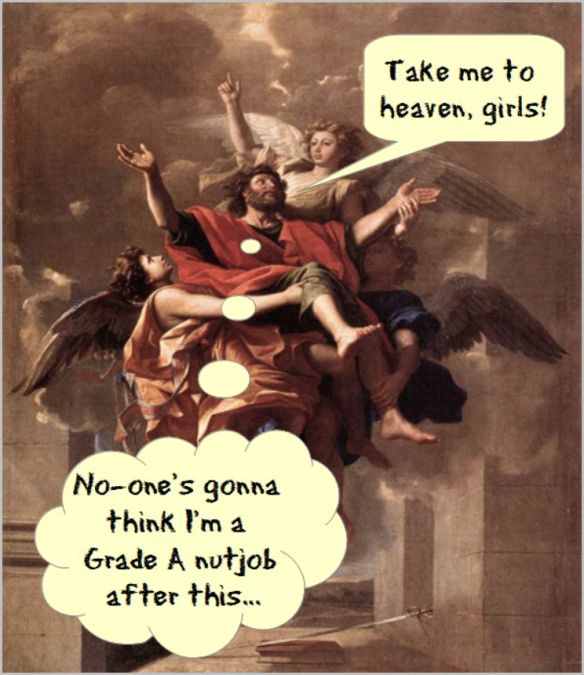
So Paul interpreted his psychotic episodes, depicted as a disembodied voice and bright light in Acts but far more dreamlike and hallucinatory in Paul’s own descriptions, as experiences of the risen Jesus himself (1 Corinthians 9.1 & Galatians 1.11-12) and of heaven (2 Corinthians 12.1-4). From these he built up all of his fanciful ideas of ‘the Christ’, not one of them based on anything demonstrable or real. All of them mere notions in his head, notions that others were all to willing to accept as the words of a god. After all, wasn’t that how the Almighty always communicated with mere mortals?

Still today people surrender to these ‘revelations’; Paul’s theology built on out-of-body experiences, the disciples’ grief-induced visions, John’s hallucinogenic ‘bad trip’. These are the foundation of Christianity as we have it, providing all we know of God, Christ and salvation, and all of them without any basis in reality. Some believers even claim to have the same sort of ‘revelations’ themselves; God speaking to them, Christ bathing them in light, visions of Heaven. All of these, again, entirely within their heads and no more real than the occasional appearances of my long dead grandfather in my own dreams. However much Christians might insist on a rational basis for their beliefs, it is an inescapable fact that the faith has its origins in ancient people’s dreams and hallucinations. Rationalising after the fact doesn’t alter this.

I don’t know about you, but I’m not interested in basing my life on others’ emotionally-induced inner visions, whether those of a Paul, or a Joseph Smith or a contemporary whack-job. I don’t want to learn about the world and life from people whose understanding and knowledge derive from their sub-conscious and hallucinatory fantasy life. Give me science any day, with its attempts to minimise subjective, human biases from its exploration of how things are. Give me its discoveries that have enhanced life, however imperfectly, in the here and now. Above all, give me honest rationality over sub-conscious imaginings and psychoses.

I have no interest in a god, or a saviour, constructed from other people’s dreams, visions or hallucinations, even, or especially, when they’re recorded in that most unreliable of sources, the bible.


Sin

Sin

During the recent election in the UK, the leader of the Liberal Democrat party, Tim Farron, was asked if he thought gay sex was a sin. Farron is a born-again Christian and instead of answering the question, he hedged round it. Predictably, this meant that journalists returned to it, with the politician dodging it each time.

In all probability, Farron does regard gay sex as a sin. The bible teaches that all behaviour that offends God is sin, causing a rift between mortals and the deity. This, biblically speaking, is what defines sin. Tim Farron would have been better being honest, saying that his faith leads him to believe that sex between people of the same sex is sinful but that personally he is a supporter of equal rights for all. His voting record indicates this to be the case; he has consistently voted in favour of LGBT rights while, presumably, maintaining his faith. Perhaps if he had answered in this way, he might not have felt the need resign as Lib-Dem leader on the grounds that his role as party leader conflicted with his personal beliefs. Predictably, evangelical groups have claimed he was hounded out of office because of his beliefs, but it seems far more likely he was, as he said himself, finding it difficult to reconcile his faith-induced worldview with his public duty. It must be difficult defaming your colleagues when you’re supposed to be demonstrating Christ’s love.

Whatever the reason, those who believe that human behaviour is sinful are wrong. Nothing humans do is a sin. Nothing we do, gay sex included, offends God because there is no God to offend. Sin is an entirely religious concept that has outlived its usefulness, if it ever really had any. Which is not to say human behaviour cannot be immoral. It can, but immoral behaviour and sin are not the same thing. As a rule of thumb, morality is determined by the extent to which our behaviour adversely affects others. Deliberately harming them physically, materially or emotionally is (likely to be) immoral behaviour. Murder, theft and abuse are immoral – but they are not ‘sin’.

Morality is not always clear cut, however; arguably it would not be wrong to murder a terrorist or suicide bomber before he can embark on a killing spree. Aborting collections of cells in a woman’s uterus, if that is what she wants, is also not an immoral act. Similarly, victimless behaviours such as sex – both hetero and homosexual – between free, consenting adults is neither wrong nor immoral. Nor is masturbation, gender fluidity or transgenderism. And as for the betes noir of the church of my youth (and who knows, they may still be) – listening to rock music, having the odd drink and dancing – they’re not either.

On the other hand, some of the activities indulged in by religious people are immoral: attempting to impose their beliefs on others; misrepresenting and denigrating those different from themselves; pressurising gay people to deny their sexuality; advocating the death penalty for homosexuality; covering up fellow-believers’ criminal activity; teaching children that creation myths are true; dismissing science; persuading people that prayer works; convincing others they are sinners.

We all behave immorally, thoughtlessly and carelessly, from time to time. But we are not, as a consequence, destined for hell, nor are we in need of a saviour to magically wash away any wrong-doing; if that really worked, we would see no immoral Christians. No, when we have behaved immorally we need to make reparation to those we have harmed, not ‘repent’ by begging forgiveness of some irascible god. What we should never do, whatever the Righteous ones tell us, is regard ourselves as sinners. We are not: it is impossible to offend a deity that doesn’t exist.


Suffer the Little Children

Jesus said to them, “Let the little children come to me, and do not hinder them, for the kingdom of God belongs to such as these.” Mark 10.14

…the very hairs of your head are numbered. Fear not: you are of more value than many sparrows. Luke 12.7

Jesus+kid

Recently, I attended the funeral of a little boy who died of the cancer he’d suffered from the time he was nine months old. His young parents are friends of mine. They showed their son such incredible love during his illness, ensuring he received the best medical care possible.

But where was God through it all? The God that Christians say has a special affinity for children, who loves them and cares for them? The God who looks after ‘the little people‘?

That God was nowhere. He showed no interest in this particular ‘little person.’ No concern and no compassion for him or his parents. Of course, that’s because he doesn’t exist, though this didn’t stop Christians telling the family how marvellous and caring and loving he is.

Really? If I had any vestige of faith left, what has happened to this innocent during his short life would have cured me of it entirely. And make no mistake, he was innocent, not a sinner (as if that would let God off the hook.) A deity who allows a baby to have cancer and to die after fourteen months of prolonged, invasive treatment would be a callous, worthless bastard. But we knew that already.

Had there been a God who cared, this little boy would’ve been two today, Easter Sunday.